




Abstract
The present study was conducted to determine daily intake of cadmium (Cd), copper (Cu), and lead (Pb) and to assess noncarcinogenic human health risk caused by these trace metals in the commonly consumed fish species (Oreochromis niloticus, Rastrineobola argentea, Lates niloticus, and Protopterus aethiopicus) in Nakuru town, Kenya. Trace metal determination in the composite samples of the commonly consumed fish species was done using flame atomic absorption spectrophotometer. Cd, Cu, and Pb content in the muscle tissues of the commonly consumed fish species ranged from 0.11 ± 0.045 to 1.11 ± 0.931 mg kg−1 for Cd, 0.48 ± 0.013 to 3.00 ± 0.009 mg kg−1 for Cu, and 3.42 ± 0.045 to 12.78 ± 0.108 mg kg−1 for Pb. Cu concentrations were within Food and Agriculture Organization (FAO) recommended limits for this trace metal in fish. In contrast, Cd and Pb had values above their respective permissible limits in fish. The assessment of human exposure to trace metals indicated that exposure doses of Cd and Cu were safe for fish consumers. Conversely, target hazard quotient (THQ) values of Pb suggested possible health risks for consumers of the commonly consumed fish species in Nakuru town, Kenya.
Introduction
Fish is an important component of many meals around the world because it has high contents of proteins, essential fats, vitamins, and minerals.1-3 Its growing demand is evident from the vigorous growth in aquaculture and in the fact that the world’s per capita fish consumption has risen from 9.9 kg in the 1960s to 14.4 kg in the 1990s to 19.7 kg in 2013. 4 Nonetheless, increased aquatic pollution caused by industrial discharge, domestic waste, agricultural runoff, mine drainage, and accidental oil spills indicate that fish could be a serious source of human exposure to potentially hazardous substances like trace metals.2,5,6 Trace metals are persistent and nonbiodegradable, and once they enter aquatic ecosystems, they bioaccumulate in aquatic organisms and their concentrations are biomagnified as they move up the aquatic food chain.1,5,7 Trace metals in fish may be transferred and pose serious health problems to fish consumers. Cadmium, for instance, may cause cardiovascular, neurological, and reproductive disorders.7,8 Short-term exposure to high doses of Cd can cause nausea, vomiting, abdominal disturbances, and fatigue. 8 In addition, it has been classified as a probable human carcinogen by the International Agency for Research on Cancer.9-11 Exposure to Pb has been associated with renal, muscular, and cardiovascular problems. It may also cause cognitive and development deficits in children and reproductive disorders in men and women.7,11-15 Unlike Cd and Pb, Cu is an essential element required for various physiological functions in the human body. 16 Even so, Cu levels above the recommended limit may lead to brain, liver, and kidney disorders. 17 Short-term exposure to high doses of Cu can cause diarrhea, stomach pains, vomiting, and death due to liver and kidney failure or due to the depression of the central nervous system. 17
Because of the aforementioned and many other health effects associated with dietary trace metals, there is growing interest in food safety with regard to the accumulation of these substances in food. Studies around the world show that fish and other seafood are a major source of dietary trace metals.18-23 Majority of these studies reveal that human exposure to trace metals from fish and seafood is within the recommended limits. Conversely, other studies indicate that consumers of fish and seafood may be exposed to hazardous levels of these toxicants and adverse health incidents may occur as a result of this exposure.22,24-28 Vegetables and cereals are the other major dietary sources of trace metals. Vegetables and cereals are valued components of many meals around the world. Thus, the presence of trace metals in these food groups is raising concern world over as is made evident by these studies.29-34
In Kenya, various studies have assessed trace metals content in fish,35-39 beef, 40 honey,41,42 and vegetables43-45 to determine whether they exceeded internationally set standards for these substances in food. Nonetheless, exceedance does not always represent human health risk. 46 Thus, in the present study estimated daily intake (EDI) of Cd, Cu, and Pb via consumption of the commonly consumed fish species in Nakuru town, Kenya, were calculated and compared with the provisional tolerable daily intake (PTDI) established by the Joint FAO/WHO Expert Committee on Food Additives (JECFA).47-49 In addition, target hazard quotient (THQ) and hazard index (HI) were computed to assess human health risks posed by Cd, Cu, and Pb in the commonly consumed fish species in Nakuru town, Kenya.
Materials and Methods
Questionnaire survey
A questionnaire-based survey was conducted to establish the commonly consumed fish species in Nakuru town and the consumption rates of these fish species. Questionnaires were administered to 385 randomly selected participants buying fish in 5 retail outlets in Nakuru town. The questionnaire acquired basic information including gender, age, education, and income level of the respondents. It was used to acquire information on fish preferences of consumers. It was also used to determine the frequency and ingestion rates of the commonly consumed fish species in Nakuru town.
The cross-sectional survey established that Oreochromis niloticus (Nile tilapia), Rastrineobola argentea (Silver cyprinid), Lates niloticus (Nile perch), and Protopterus aethiopicus (African marbled lungfish) were the commonly consumed fish species in Nakuru town, Kenya. Moreover, the findings revealed that in a day consumers of these fish varieties consumed on average 0.027, 0.012, 0.035, and 0.023 kg of O niloticus (Nile tilapia), R argentea (Silver cyprinid), L niloticus (Nile perch), and P aethiopicus (African marbled lungfish), respectively.
Sample collection and preparation
Four commonly consumed fish varieties (O niloticus, R argentea, L niloticus and P aethiopicus) in Nakuru town were selected based on the data obtained by the cross-sectional survey. Ten pieces of O niloticus, 10 pieces of L niloticus, and 10 pieces of P aethiopicus, and 10 samples of R argentea each weighing 100 g were purchased from the first market (market 1). Ten pieces of O niloticus and 10 samples of R argentea each weighing 100 g were purchased from the second market (market 2). Ten pieces of O niloticus and 10 samples of R argentea each weighing 100 g were purchased from the third market (market 3). Ten pieces of O niloticus and 10 pieces of L niloticus were purchased from the fourth market (market 4). Ten samples of R argentea each weighing 100 g were purchased from the fifth market (market 5). In total, 70 fresh samples of O niloticus, L niloticus, and P aethiopicus and 40 sun-dried samples of R argentea each weighing 100 g were purchased in August 2016 from the 5 major fish retail outlets in Nakuru town, Kenya (–0.2833°, 36.06667°). The samples were put in sterile polyethylene bags and transported to the laboratory using a cool box at <5°C. After reaching the laboratory, the fish were washed using double distilled water. The samples were carefully dissected to remove muscle tissues from the dorsal part of the fish which were washed using doubled distilled water. The muscle tissues of the same fish species from the same retail market were combined into composite samples of 10 individuals. For the small species (R argentea), 10 samples of this fish species each weighing 100 g from the same retail market were pooled into composite samples. Because of their small size, the entire individual fish were included in the preparation of the composite sample. The composite samples of the commonly consumed fish species were then kept frozen at –20°C until trace metal analysis.
Trace metals analysis
The composite fish samples were thawed at room temperature, oven dried for 72 hours at 105°C until constant dry weight. They were pulverized in a dry pestle-mortar then stored in sterile containers placed in desiccators awaiting trace metal analysis.
The powdered composite samples were thoroughly mixed to attain optimum homogeneity. They were then digested using Food and Agriculture Organization (FAO) procedures.50,51 Briefly, 1 g of homogenized composite sample was weighed into a digestion vessel. Ten milliliters digestion mixture consisting of 65% nitric acid (HNO3) and 30% peroxide hydrogen (H2O2) was prepared and added to the digestion vessels, kept overnight to allow various reactions to occur. The digestion vessels were heated on a hot plate to 130°C until the solutions turned clear and the volume reduced to between 2 and 3 mL. They were allowed to cool, filtered then diluted with double distilled water to 50 mL in volumetric flasks.
Analyses of Cd, Cu, and Pb were performed using flame atomic absorption spectrophotometer (Thermo Jarrell Ash). The detection limits of Cd, Cu, and Pb were 0.0015, 0.003, and 0.01 mg/L, respectively. To ensure reliability of the results, double distilled water was used throughout the study. Glass vessels were precleaned thoroughly using detergent, soaked overnight in 20% nitric acid (HNO3) then rinsed using double distilled water. The experimental reagents and standards used during the study were of analytical grade obtained from Sigma Aldrich. The accuracy of the instrument was ensured by running samples in triplicates. In addition, a reagent blank and a standard were run after every 3 samples to check instrumental drift. The AAS instrument was calibrated with a series of standard solutions prepared in the concentration range of 0 to 15 mg L−1. A calibration curve of absorbance versus concentration was obtained and used to quantify Cd, Cu, and Pb content in the commonly consumed fish species. Trace metal concentration was expressed in milligram per kilogram dry weight.
Human health risk assessment
The risk to human health as a result of consuming the commonly consumed fish varieties sold in Nakuru town, Kenya, was evaluated by calculating EDI and THQ of trace metals. In addition, literature indicates that exposure to 2 or more trace metals from the same source may result to additive effects. 52 Thus, THQs of Cd, Cu, and Pb were summed to generate hazard indices (HI) that represent overall health risk posed by the 3 trace metals in the commonly consumed fish species.

Geographic locations of the main fish retail markets in Nakuru town (Kenya).
EDI was calculated using equation (1).22,53

where EF is exposure frequency (365 days year−1); ED is the frequency duration (70 years, equivalent to the average human lifespan); FIR is the ingestion rate of fish in kilograms person−1 day−1; C is the concentration of Cd, Cu, or Pb in the commonly consumed fish species in mg kg−1; BW is the average body weight which is equivalent to 60.7 kg for an average African adult 37 ; and TA is the average exposure time for noncarcinogens (365 days year−1 × ED). Computed EDI values were compared with PTDI values of Cd (0.001 mg kg−1 day−1), Cu (0.5 mg kg−1 day−1), and Pb (0.00357 mg kg−1 day−1)47-49 to determine whether the daily recommended values were exceeded or not.
Target hazard quotient a ratio between exposure to a potentially hazardous element and its reference dose 5 was determined using equation (2). 22 Computed THQ values less than 1 indicate that the exposed population is unlikely to experience adverse effects associated with trace metals. On the other hand, computed THQ values greater than 1 suggest possible health risks for the exposed consumers.5,54

where RfDo is the oral reference dose of trace metals in mg kg−1 day−1 based on the safe upper level of element’s oral intake for an adult. The oral RfD for Cd, Cu, and Pb is 0.001, 0.04, and 0.004 mg kg−1 day−1, respectively. 55
THQs of Cd, Cu, and Pb were summed to generate a hazard index using equation (3). 56 Assuming additive effects, HI is a measure of the potential risk of adverse health effects from more than 1 element.5,54 HI greater than 1 suggests likelihood of adverse effects on human health and the necessity for further action.5,54

Statistical analysis
SPSS version 22 was used for statistical data analysis. Results are presented as arithmetic mean and standard deviation (mean ± SD). One-way analysis of variance (ANOVA) was used to assess differences among mean concentrations of Cd, Cu, and Pb in fish. It was used to examine variation in trace metal content among the commonly consumed fish species. It was also used to examine trace metal content in fish based on the markets where the fish were purchased. All statistical test were regarded significant when P < .05.
Results and Discussion
Trace metal concentrations in the commonly consumed fish species
The mean concentrations of Cd, Cu, and Pb in the commonly consumed fish species, ie, O niloticus, R argentea, L niloticus and P aethiopicus purchased from the 5 main retail markets in Nakuru town, Kenya, are presented in Table 1. Metal distribution in the commonly consumed fish species followed the sequence Pb > Cu >Cd, Pb having significantly higher (P < .05) concentrations than Cu and Cd. The results indicated that Cd, Cu, and Pb content in fish did not vary significantly (P > .05) among the commonly consumed fish varieties (O niloticus, R argentea, L niloticus, and P aethiopicus). The results also indicated that trace metal content in the commonly consumed fish species did not vary significantly (P > .05) based on the markets where the fish were purchased.
Trace metal concentration (mg kg−1 dry weight) in O niloticus, R argentea, L niloticus, & P aethiopicus sold in 5 retail markets in Nakuru town, Kenya.

The mean concentrations of Cd in the commonly consumed fish species ranged from 0.11 ± 0.045 to 1.11 ± 0.931 mg kg−1. Similar Cd concentrations in the range of 0.05 ± 0.02 to 0.95 ± 0.09 mg kg−1 were reported by Oyoo-Okoth et al 36 in O niloticus, R Argentea, and L niloticus from the coastal zone of Lake Victoria, Kenya. Cd concentrations in the present study also compared fairly well with 1.12 ± 1.13 and 1.66 ± 2.48 mg kg−1 in cultured fish from Machakos and Kiambu counties, Kenya, 39 and 1.06 ± 0.004 to 1.73 ± 0.002 mg kg−1 in Cyprinus carpio from Lake Naivasha, Kenya. 38 They were 2-fold higher than those reported by Oyoo-Okoth et al 35 in R argentea from Lake Victoria. According to FAO,19,57 permissible limit of Cd in fish is 0.5 mg kg−1. Some concentrations were above this proposed limit but generally they did not significantly (P < .05) surpass it.
Cu content in O niloticus, R argentea, L niloticus, and P aethiopicus ranged from 0.48 ± 0.013 to 3.00 ± 0.009 mg kg−1. Cu concentrations in O niloticus, R Argentea, and L niloticus in literature was reported in the range of 2.1 ± 1.1 to 18.8 ± 1.1 mg kg−1 from the coastal zone of Lake Victoria, Kenya, 36 and in the range of 5.38 ± 1.27 to 6.20 ± 1.54 mg kg−1 in R argentea from Lake Victoria, Kenya. 35 Similar Cu concentrations to those in the present study were reported by Mutia et al 38 in C carpio from Lake Naivasha, Kenya, but Otachi et al 37 reported lower Cu concentration in the muscle tissues of Oreochromis leucostictus from the same lake. Permissible limit of Cu in fish according to FAO is 30 mg kg−1.19,57 The amount of Cu measured in all the samples of the commonly consumed fish species were below this permissible limit suggesting no appreciable health risk to consumers.
Pb concentrations in O niloticus, R argentea, L niloticus, and P aethiopicus varied between 3.42 ± 0.045 to 12.78 ± 0.108 mg kg−1. Lower concentrations of Pb were reported in the range of 0.18 ± 0.03 to 0.57 ± 0.02 mg kg−1 in R argentea from Lake Victoria 35 and 0.024 ± 0.03 mg kg−1 in the muscle tissues of O leucostictus from Lake Naivasha, Kenya. 37 Pb concentrations similar to those observed in the present study were reported in farmed fish from Machakos and Kiambu counties, Kenya. 39 FAO has set 0.5 mg kg−1 as the permissible limit of Pb in fish.19,57 The lowest measured Pb content in fish in the present study is above this limit. Pb is not required for physiological functions in the human body; thus, short-term exposure to high doses of this trace metal may cause gastrointestinal disorders. Chronic exposure may cause cognitive and learning deficits in children. It may also cause renal, muscular, cardiovascular, and reproductive disorders.7,11-15
Human health risk assessment
To assess human health risk associated with Cd, Cu, and Pb in the commonly consumed fish species, EDI, THQ, and HI were computed. Human health risks were calculated with the assumption that an adult weighing 60.7 kg 37 consumes 0.027, 0.012, 0.035, and 0.023 kg day−1 of O niloticus, R argentea, L niloticus, and P aethiopicus, respectively. The EDI of Cd, Cu, and Pb through consumption of O niloticus, R argentea, L niloticus, and P aethiopicus from Nakuru town, Kenya, is presented in Table 2. The results show that the trends of the computed EDI values decreased in the following order Pb > Cu >Cd and ranged from 0.00086 to 0.00438, 0.00021 to 0.00099, and 0.00002 to 0.0003 mg kg−1 day−1, respectively.
Estimated daily intake of Cd, Cu, and Pb by consuming the commonly consumed fish species in Nakuru town, Kenya.

The highest EDI value of Cd (0.0003 mg kg−1 day−1) was much lower than the PTDI, whose values is 0.001 mg kg−1 day−1 of body weight48,49 corresponding to 0.0607 mg kg−1 for an adult weighing 60.7 kg. Daily Cd intake through consumption of the commonly consumed fish varieties was lower than or similar to the daily intake reported for adult consumers from other developing countries—Ghana: 0.000092 mg kg−1 day−1,58 Nigeria: 0.000063 mg kg−1 day−1,54 Ethiopia: 0.000029 mg kg−1 day−1,59 D. R. Congo: 0.00012 to 0.00094 mg kg−1 day−1,60 Egypt: 0.000048 to 0.00022 mg kg−1 day−1,61 Iran: 0.00012 mg kg−1 day−1,62 and Bangladesh: 0.00027 to 0.00246 mg kg−1 day−1. 63 Daily Cd intake was higher than that reported for adults in Yaoundé, Cameroon, 0.000017 mg kg−1 day−1,64 and roughly 26 times higher than that reported for adults from Dares salaam, Tanzania. 65
With respect to Cu, the highest daily intake (0.00099 mg kg−1 day−1) corresponded to consumers of O niloticus from Market 1. Compared with the current provisional maximum tolerable daily intake (PMTDI) whose value is 30.35 mg kg−1 day−1 for an adult weighing 60.7 kg, 47 the highest Cu intake was tens of thousands fold lower than its permissible daily limit. This implies that Cu in the commonly consumed fish species does not pose any threat to consumers. Lower or similar Cu EDI values are reported in literature in the range of 0.00000066 to 0.00093 mg kg−1 day−1.54,58,63-65 Higher daily intake of Cu through fish consumption is reported for consumers in Egypt, 0.0124 – 0.0250 mg kg−1 day−1, and Congo, 0.12586 – 0.0211428 mg kg−1 day−1.60,61,63
As for Pb, the greatest daily intake (0. 00438 mg kg−1) was also observed in consumers of O niloticus from market 1. The PTDI of Pb according FAO/WHO 48 is 0.00357 mg kg−1 day−1, corresponding to 0.2168 mg kg−1 day−1 for an adult weighing 60.7 kg. All the EDI values of Pb were below this permissible limit. Nonetheless, they were significantly higher than those of Cd and Cu suggesting that Pb may pose serious health risk to consumers due to the likelihood of bio-accumulation over a period of time. The EDI of Pb compared very well with Pb intake of adult fish consumers elsewhere in developing countries.54,61,63 Lower EDI values in the range of 0.0000053 to 0.0008 mg kg−1 day−1 were reported for adult consumers from Cameroon, Congo, Ethiopia, Ghana, and Tanzania.58-60,64,65
Target hazard quotient and hazard index
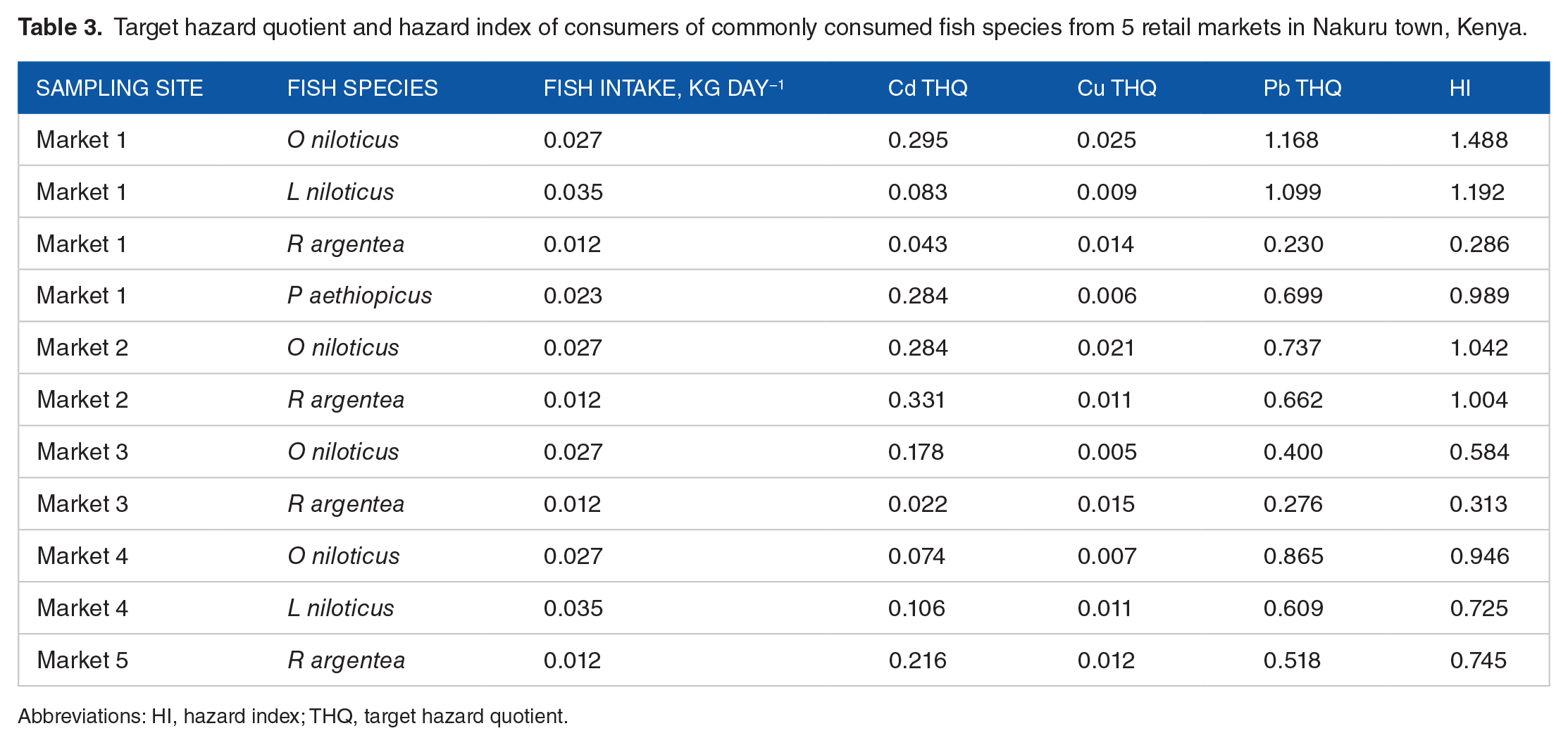
Noncarcinogenic THQs and hazard index of the 3 trace metals through consumption of the commonly consumed fish species sold in Nakuru Town, Kenya, are presented in Table 3. The trend of THQ values for consumers of the commonly consumed fish species decreased in the order of Pb > Cd > Cu. The THQ values of Cd, Cu, and Pb varied from 0.022 to 0.331, 0.005 to 0.025, and 0.230 to 1.168, respectively. Target hazard quotient is a ratio between potential exposure to a given trace metal and its oral reference dose. It is used to assess potential health risk associated with long-term exposure to dietary trace metals.5,54 If the computed ratio is greater than 1, the exposed population is likely to develop adverse health effects.55,56,66 According to the New York State Department of Health (NYSDOH), if the computed THQ value is greater than 1 but less than 5, the risk is low; if it is greater than 5 but less than 10, the risk is moderate; however, if the THQ value is greater than 10, the risk is high. 67 Computed THQ values of Cd and Cu were all below 1, suggesting that health effects associated with Cd and Cu are unlikely to occur. In contrast, THQ values of Pb for consumers of O niloticus and L niloticus bought from market 1 were above 1, indicating a likelihood—albeit low—of adverse health effects occurring.
Target hazard quotient and hazard index of consumers of commonly consumed fish species from 5 retail markets in Nakuru town, Kenya.
Abbreviations: HI, hazard index; THQ, target hazard quotient.
Hazard index is the numerical sum of the computed THQ values.5,54 Like THQ, HI values should not exceed 1 otherwise they would present significant health risks to consumers.5,54 HI values of Cd, Cu, and Pb in this study ranged from 0.286 to 1.488. THQ values of Pb were significantly higher than those of Cd and Cu and contributed between 66% and 92% to the HI values. Consumers of O niloticus and L niloticus from market 1 and O niloticus and R argentea from market 2 had HI values greater than 1, suggesting significant health risks for these consumers posed by the possible additive effects of Cd, Cu, and Pb.
Conclusion
Estimated daily intake, THQ, and hazard index were used to assess consumers’ exposure to Cd, Cu, and Pb via consumption of the commonly consumed fish species (O niloticus, R argentea, L niloticus, and P aethiopicus) in Nakuru town, Kenya. Daily intake of Cd, Cu, and Pb through consumption of the commonly consumed fish species were within FAO/WHO recommended limits. THQ values of Cd and Cu suggest no health risk to consumers of the 4 commonly consumed fish species. In contrast, THQ values of Pb indicate that long-term exposure to Pb content similar to those reported in the present study may pose serious health risk to fish consumers in Nakuru town, Kenya. There is therefore a need for similar studies to be carried out regularly to monitor trends of trace metals in fish and educate consumers on safe quantities of fish to consume. Similar studies done in the future should also determine the sources of fish and trace metal contamination in aquatic ecosystems. Only then strict monitoring and mitigation measures can be implemented to reduce trace metals contents in fish and by that reduce the associated human health risks.
Footnotes
Funding:
The author(s) disclosed receipt of the following financial support for the research, authorship, and/or publication of this article: This work was supported by the National Commission for Science, Technology and Innovation (grant number NACOSTI/RCD/ST&I/7TH CALL/MSc/270).
Declaration of conflicting interest:
The author(s) declared no potential conflicts of interest with respect to the research, authorship, and/or publication of this article.
Author Contributions
FE, WNM, and MM conceived, designed and planned this research. WNM and MM supervised the project. FE and TW carried out the experiments. FE, WNM, MM, and TW contributed to the analysis and the interpretation of the results. FE took the lead in writing the manuscript with significant and critical contributions from WNM, MM, and TM.
