



Abstract
This research intricately explores the dynamics surrounding the coexistence of humans and roosting bats in urban areas, meticulously examining both the advantageous and detrimental aspects of their living arrangement. The study conducted a comprehensive survey with 286 residents in Iwo and Ogbomoso, where Eidolon helvum bats are known to roost, generating a robust dataset for thorough analysis. Rigorous statistical assessments, including the KMO and Bartlett’s tests, confirmed the data’s reliability at a significance level of P < .05. The respondent demographic revealed a predominance of 65% male participants, with an overwhelming 85% claiming familiarity with bats in their respective domains. Utilizing factor analysis, the study identified 8 salient variables from the initial 26, shedding light on diverse perceptions regarding bats: (i) Urban roosting (16.729%); (ii) Impact on tree growth (12.607%); (iii) Failed dislodgement attempts (11.504%); (iv) Medicinal value (10.240%); (v) Co-habitation preference (9.963%); (vi) Costly dislodgment consequences (9.963%); (vii) Beautification disruption (5.615%); and (viii) Structure defacement (5.510%). These factors were systematically categorized into 4 distinct themes: (A) Forced cohabitation (26.762%); (B) Environmental degradation by bats (23.732%); (C) Consequences of dislodging bats (21.477%); and (D) Acknowledged benefits of bats (10.240%). Co-habitation with bats becomes a necessity for ecological balance and, importantly, to safeguard the livelihood of roosting bats within their natural ecology, which man has encroached upon through urbanization, making all negatives arising from such existence self-inflicted by man. However, this study underscores the importance of human-bat cohabitation for mutual benefits, emphasizing potential detrimental consequences, including significant costs, associated with displacing bats from their natural ecosystem. These consequences may exacerbate the impacts of climate change, environmental degradation, and ecological imbalance. Further research is recommended to explore the positive aspects of the sustainable roosting bats’ existence in the natural environment.
Introduction
The survival and life sustenance of man is partly dependent on the quality of his environment. 1 Despite this awareness, human environment is being tampered with and modified almost on daily basis because of both natural and anthropogenic activities. Such activities include deforestation, industrial/carbon emission, civil construction, mining among others. Apart from these, the activities of wild mammals have been observed to have immeasurable consequences on the quality of human environment and thus jeopardizing his survival. The role of various animals, domestic and wild on the status of human and natural environment cannot be overruled. Animals feed and live in the environment where they inhabit. Thus, environmental quality is partly dependent on the activities of animals. One of such animals, whose contributions to the environment cannot be overlooked is the bat (Order Chiroptera). Bats are animals with enormous physiological and ecological diversity. According to Kasso and Balakrishnan, 2 Ramírez-Fráncel et al., 3 and Umar et al. 4 bats are of ecological importance in view of their roles as prey and predator animals,5,6 in buttressing this view, revealed that bats have significant value in North America due to their ability to feed on night-flying (nocturnal) insects, the insects that Ducummon 5 found were pests that were detrimental to agriculture and forests in the continent. Based on this, Umar et al., 4 Rocha et al., 6 and Boyles et al. 7 called the attention of the public to the need for a drastic measure to checkmate declining bats population in North America which may have negative consequence on agricultural production, to the tune of $3.7 billion/year. 7 further lamented on the rate at which the population of bats are declining in North America, especially because of the infectious disease called White-Nose syndrome (WNS) and so suggested public education and policy making on the ecological and economic significance of insectivorous bats with the intention of engaging in practical conservation efforts. Additionally, Ramírez-Fráncel et al., 3 Soliman and Emam, 8 Umar et al., 9 and Adeyanju et al. 10 commented bats’ performance and services in an ecosystem such as being biological crop pests control among others.
Bats may be beneficial to humans in urban centers, however, the consequences of its’ presence cannot be overlooked. According to Schell et al., 11 the coexistence of man with wildlife such as bats, though may have many positive effects but its negative impact on man cannot be disregarded. 11 Listed such negative consequences to include transmission of zoonotic diseases, damage of urban structures and property, physical attacks, among others. Bats have also been implicated as a natural host for SARS-CoV-2, a novel corona virus.12,13 This report has aggravated bitterness against bats despite findings identifying man as the main cause of his own public health challenges. 13 In another instance, bat co-existence with man in urban areas could lead to increase bad odor and noise in human-dominated environments.14,15 Apart from their impact on the quality of human environment, bats and other flying animals could cause destruction of home garden crops.16,17
Understanding human-bat interactions within urban environments encompass a multifaceted approach that integrates ecological, behavioral, and societal perspectives.18,19 Ecologically, researchers delve into how urbanization alters natural habitats critical to bats, affecting their roosting sites, foraging areas, and migration routes. This investigation extends to studying shifts in insect populations, changes in vegetation cover, and the availability of water sources in urban areas, all of which play pivotal roles in shaping bat diets and overall survival rates. Furthermore, exploring predator-prey dynamics becomes crucial, considering not only bats’ roles as insect predators but also their susceptibility to urban predators such as cats and birds of prey. 19
Behaviorally, attention turns to how bats adapt to urban landscapes, including modifications in roosting behaviors, navigation strategies amidst artificial lighting and noise pollution, and adjustments in social structures, mating behaviors, and communication patterns due to urban stressors. 20 The health and disease ecology dimension of human-bat interactions investigates potential zoonotic risks, considering the proximity of bat roosts to human dwellings and the accumulation of urban pollutants in bat tissues, which can impact their immune systems and reproductive health. 21 Apart from this, the proposed conservation and management strategies emphasize the importance of green infrastructure designs, urban planning that protects critical bat habitats, and policies aimed at reducing light pollution and mitigating human-bat conflicts.22,23 Public awareness campaigns are also vital in dispelling myths and fostering positive attitudes toward bats, highlighting their ecological significance for pest control and ecosystem balance. 24
Despite various opinions against bats, there is persistent clamor for the need to preserve these mammals for several reasons such as to maintain ecological balance, to avail these animals to perform other valuable roles in human environments such as predatory, pollination, eco-tourism among other. Such an investigation is desirable as it is expected to guide human behavior, attitude, perceptions, and other myths in relating these mammals in urban centers as reported by Adeyanju et al. 10 This research was therefore designed to assess man-bat co-habitation in urban centers and their potential impact on the quality of environment from human point of view. Specific objectives are to: (i) describe the respondents view about the coexistence of man and bats and (ii) evaluate the pros and cons of man-bat existence in Iwo and Ogbomoso.
Method of Study
Study area
The study locations were Iwo and Ogbomoso. Both locations are respectively in Osun and Oyo States in the southwestern part of Nigeria as shown in Figure 1. While Iwo town is the headquarters of Iwo local government area, Ogbomoso is the seat of the headquarters of 2 local government areas namely, Ogbomoso South and Ogbomoso North LGAs. Ogbomoso is on 8.1227° N and 4.2436° E coordinates while Iwo is on 7.6401° N and 4.1770° E coordinates. Iwo covers an area of about 244 km2 while its projected population which was made available by Currey et al. 17 showed 248 400 people in 2022. On the other hand, Ogbomoso has a population of about 602 329 in 2022 as made available by World Population Review 25 with a total coverage land mass of 934.27 km2. Ogbomoso is the home of Ladoke Akintola University of Technology, Baptist Theological Seminary, Bowen University Teaching Hospital, among many other establishments, private and public. In the same vein, Iwo is the seat of Bowen University, (a faith-based institution owned by The Baptist Family in Nigeria), Westland University, among others. The selection of these 2 urban centers could be attributed to the prevalence of roosting bats in the 2 cities. Dominant areas where bats are found roosting in Ogbomoso are Oke-Ado Akintola-Sabo axis and the Baptist Seminary premises. On the other hand, bats could be found in Bowen University compound, which has been popularly tagged as Bowen Bats.
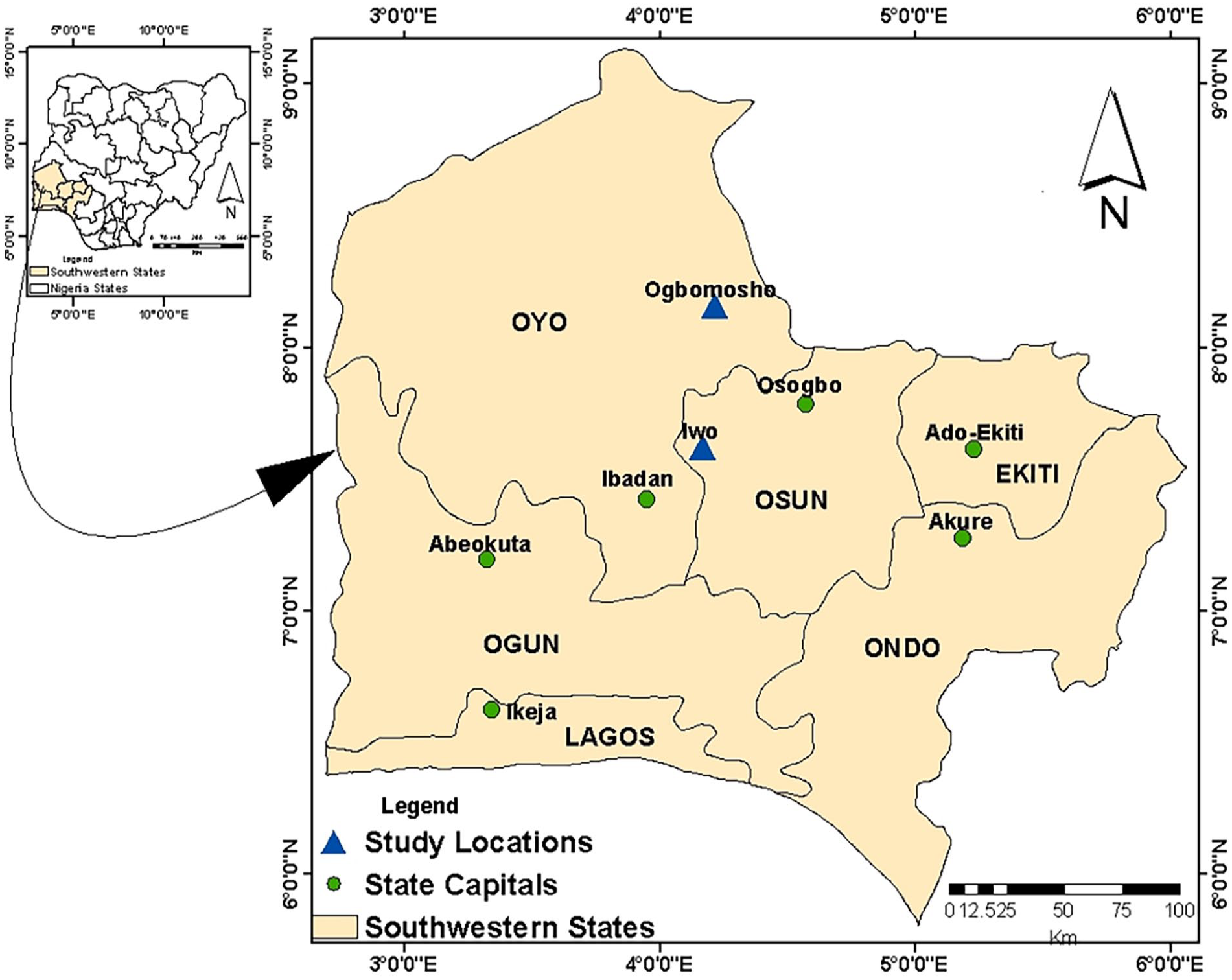
Map showing the study areas in the Southwestern Nigeria (Inset: Map showing the southwestern Nigeria).
The selection of these 2 urban centers could be attributed to the prevalence of roosting bats in the 2 cities. Dominant areas where bats are found roosting in Ogbomoso are Oke-Ado Akintola-Sabo axis and the Baptist Seminary premises. On the other hand, bats can be found in Bowen University compound, which has been popularly tagged as Bowen Bats. Currently, the population of roosting bats in both locations were yet to be documented as at the time of this investigation. Figures 2 and 3 shows roosting bats in Iwo and Ogbomoso respectively.

Roosting bats within the Bowen University premises, Iwo.
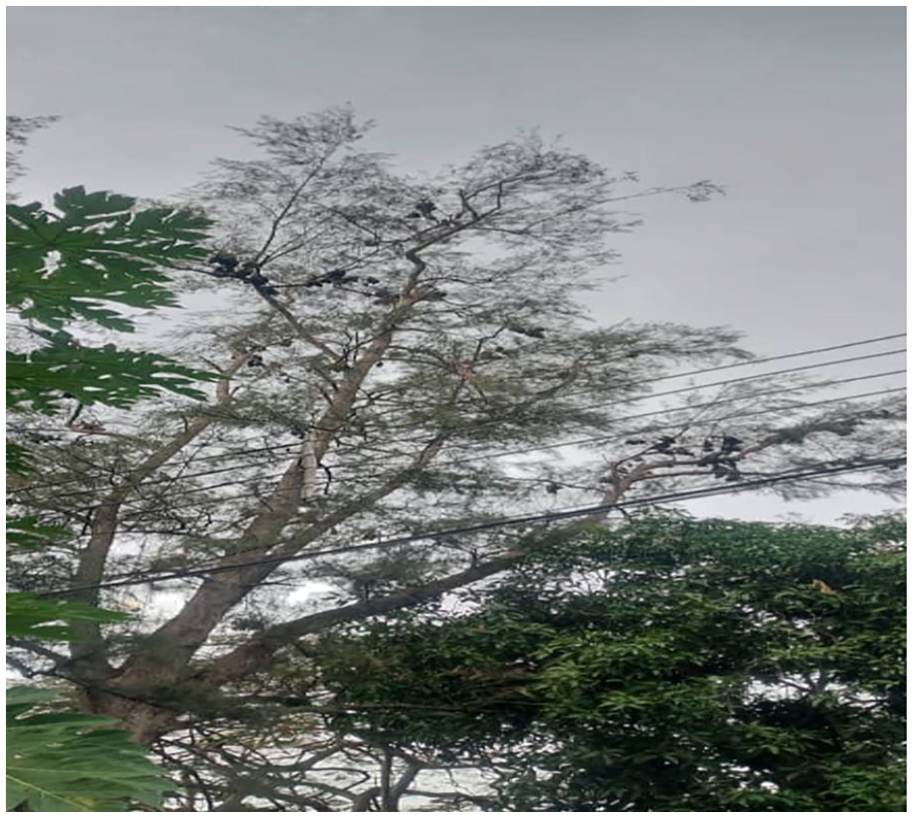
Roosting bats within the Baptist Seminary premises, Ogbomoso.
Data collection
Iwo and Ogbomoso were purposively selected for the investigation because of the presence of roosting bats and also for the ease of accessibility. A questionnaire survey was conducted across 355 selected among the residents inhabiting in the locations. Except where not available or indisposable, males were deliberately selected in view of their potential tendencies for killing to eat or any other efforts to dislodge the animal from their domains. While two hundred and five (205) respondents were randomly selected in Iwo, 350 were selected from Ogbomoso. The disparity was due to the places where bats were found as more sites were identified in Ogbomoso compared to Iwo. Bowen University, Iwo was the only large area where bats were found roosting while in Ogbomoso, 2 large areas were found in Oke-Ado Akintola/Sabo axis and Baptist Seminary community. Due to time constraint, the survey was carried out in Iwo in April, while in Ogbomoso, the survey was held in July, both in the same year (2023). The questionnaire was in 2 sections: Respondents’ biodata and structured questions on bats and the respondent’s coexistence experience. 80.56% of the total questionnaire was retrieved (286 out of 355).
Data analysis
Both descriptive and inferential analysis were used in this study. Descriptive analysis include percentage and tabulation while Factor Analysis (FA) was used to identify the perceptions of the respondents on the roosting bats using Special Product for Service Systems (SPSS). Eigen value was set at 1.000 minimum which implied that any variable with less than the standard set was not identified as strong variables to explain the perceptions of the respondents on the roosting bats. The Kaiser-Meyer-Olkins (KMO) and Bartlett’s tests showed that the data set was factorable at P ⩽ .05.
Results and Discussion
Descriptive analysis
Table 1 shows that male respondents formed 65% of the total respondents while female gender were 32%. The survey had bias for the male gender from the viewpoint that they could have tendency to affect the animal either by killing them for eating or attempt to dislodge them. Of the entire 286 respondents, 85% claimed awareness and knowledge about roosting bats in their respective community. Part of their knowledge about bats included bats been nocturnal animals (active in the night), it hangs itself on the tree with heads upside down and that bats are characterized with high fecundity among other beliefs. Also, 67% of the respondents revealed that they enjoy eating bats while 21% appreciated the existence of bats in their community for their medicinal values- these corroborated findings by other authors.2,26 Thus, roosting bats were considered beneficial to the respondents. On the other hand, the roosting bats posed challenges to the environment, as 61% revealed that bats’ noise and odor from their guano are nuisance to the environment while 18% lamented on the defoliation caused to the hosting trees, thus degrading the well-being of such trees. Another challenge noted by the 13% of the respondents was that the roosting bats deface structures found either under the hosting trees or along their paths by their guanos while 8% stated that the animal caused destruction of the fruits that might be produced by their hosting trees like mango. In another instance, 68% agreed that man should co-exist with the bats in their environs because, in their own view, it will be costly and more threatening to the harmony of the ecosystem to dislodge them since the hosting trees will have to be cut down or the roosting bats sprayed with strong chemicals. However, 27% preferred that the roosting bats should be dislodged because of the havoc they cause to the quality of human environment.
Some basic attributes of the respondents.

The result from the factor analysis (FA) as presented in Table 2 identified eight (8) variables as significant to the explanation on how bats are perceived out of the 28 (26) variables analyzed namely: (i) Bats dwell in urban centers (16.7); (ii) Bats retard the growth of their hosting trees (12.6%); (iii) Attempts to dislodge bats failed (11.5%); (iv) Bats have medicinal value (10.2%); (v) Passion for co-habiting with bats (9.96%); (vi) Consequence of dislodging bats is costly to the environment (9.96%); (vii) Bats distort beautification efforts (5.6%); and (viii) Bats are not threats to human environment (5.5%). All extracted variables offered 82.2% explanation for the perceptions of the residents on roosting bats in their respective domains. The remaining proportion of 17.8% was the variance from other variables which were not identified by FA.
Analysis of human perception about human-bat co-existence in urban environs.

RCM means Rotation Component Matrix extracted from RCM Table.
Extracted from Total Explained Table.
The first variable, bats dwell in urban centers had the highest explanation of the perceptions of the respondents about the roosting bats with Rotated Component Matrix (RCM) of 90.2, Eigen value of 3.680 and offering 16,73% of the total explanation, (82.2%). Roosting bats are mostly and commonly found around human habitation because of urban expansion into the natural habitats of roosting bats. According to Ancillotto et al., 27 roosting bats thrive well in human-dominated environments while in buttressing this view, Santini et al. 28 revealed that bats were found to be tolerant to human disturbances.3,9,29 Also, in support of this observation revealed that bats are fond of roosting in urban buildings and tall trees, not necessarily desired, but as a way of adapting to human encroachment into their natural habitats.
The second factor on the extracted variables was bats retard the growth of their hosting trees. It has the highest value in the second array of the RCM with 88.6. The Eigen value of 2.774 made it the second significant variable explaining 12.607% of the total explanation. The implication of this is that man believes that roosting bats caused retardation to the hosting trees. The respondents also identified that roosting bats defoliate their hosting trees and at times lead to the fall of tree branches caused by their weights and already degraded and weak branches. 30 in a study reported that roosting bats cause damages to their hosting trees through defoliation, thus impairing on the environmental and social functions of the affected trees to the human ecosystem which could be detrimental to the continuous roosting of the bats. Also, Beilke and O'Keefe 31 and Beilke et al. 32 reported something similar and recommended sound management of the affected forests for sustenance.
Attempts to dislodge bats failed was also identified and extracted by FA. This variable was ranked first in the third order of the RCM with 83.2, an Eigen value of 2.531 and the third highest factor as it explained 11.504% out of the 82.200% total explained. The implication of this outcome is the best effective means of dislodging roosting bats from urban areas. This is through cutting down of the hosting vegetation however, cutting the trees may be costly for the ecosystem because it aggravates increasing temperature, susceptibility of structures to the effect of winds and storm, which invariably could lead to increasing consequences of climate change scenario, Diengdoh et al. 33 and Heldt 34 revealed that deforestation has the potential of driving bat virus spillover to humans. Thus, cutting down trees which host roosting bats to dislodge them may be grievous to human comfort and health in urban areas.
Another variable which was found significant and extracted by FA is the medicinal value of the roosting bats. The variable was found prominent among the arrays of the 26 variables analyzed within the fourth order of the RCM with 90.1. It ranked fourth with Eigen value of 2.253 and offered 10.240% of the total explanation. It thus implies that the co-existence of man and bats in urban areas was considered valuable by virtue of its medicinal importance. According to Tackett et al., 35 one of the threatening factors to the population of bats is man’s interest in the medicinal significance of these mammals. Similarly, Umar et al. 9 and Riccucci 29 also noted that the usefulness of bats and its guano in traditional medicine cannot be discounted, most especially in the areas with poor access to Western Biomedical services.
Passion for co-habiting with bats was also recognized and extracted by FA as significant to explain the co-existence of roosting bats with man in urban areas. It was found to be the variable with the highest value in the fifth order of the RCM with 84.7 among the other array of variables. It is the fifth most significant variable with Eigen value of 2.207 and its proportion from the total explanation for the subject matter was 10.033% out of 82.200%. The benefit derivable from the existence of roosting bats in urban environs could contribute to the passion for the existence of bats within human domains. For instance, the edibility of bats, medicinal purposes were mentioned by Riccucci 29 and Jaroli et al. 36 Apart from this, Kasso and Balakrishnan 2 identified the economic significance of bats to man including pest control, pollination of plants, dispersal of seeds, tourism value, guano extraction, among others. Also in support of this findings, bats have become a significant identifiable way of defining urban identity.3,4,6,9 All these and many other benefits could explain why man may need to adjust to her co-existence with bats.
The existence of roosting bats in human habitation areas was also found to be associated with the realization of the consequences of dislodging bats is costly to the environment. This variable was found significant and extracted in the analysis. It was found prominent in the arrays of the factors subjected to the analysis in the sixth order of the RCM with 75.0. It offered 9.963% of the total explanation with the Eigen value of 2.192%. As noted by Heldt, 34 total removal by either pulling down or cutting down the trees seemed to be the considered effective means of displacing roosting bats away from human habitation. This, however, has the potential of compounding the challenges of climate change currently ravaging the global community. 33 Spraying the bats with poisonous chemicals or mass killing of these creatures may constitute jeopardy on man well-being and the harmony of the ecosystem.
The distortion of the beautification efforts by roosting bats especially through their guano was another explanation for the human views about bats in urban area. This variable ranked seventh among the significant variables identified and extracted in the FA. It has Eigen value of 1.235 and explained 5.615% of the total. Bats dungs called guano could constitute a serious challenge to the beautification efforts of man in urban areas. It was observed during the survey that no structures or any property can maintain its beauty status while under the trees hosting roosting bats. The excreta of bats pose serious challenge to the quality of urban environment, 37 especially where roosting bats are found.
The last variable and with least explanation of the man-bats coexistence in urban areas is the view that bats are not threats to the environment. The variable ranked the eighth among the significant ones extracted in the analysis with Eigen value of 1.212 and a proportion of 5.510% of the total explanation. It has 85.7 on the array of variables in eighth order of the RCM. According to Umar et al. 9 and Tuttle, 38 stakeholders should put necessary tools in place to safeguard the existence of bats which is being threatened by the loss habitat and environmental degradation. His viewpoint was from the various benefits which are derived from bats. Even though, bats could be found to be detrimental to human environment, its benefits outweighed the negatives.2,36,39,40
Conclusion and Recommendation
This study conducted a comprehensive survey involving 286 residents in Iwo and Ogbomoso, where Eidolon helvum bats are known to roost, generating a robust dataset for thorough analysis. Rigorous statistical assessments, including the KMO and Bartlett’s tests, verified the data’s reliability at a significance level of P < .05. The respondent demographic revealed a predominance of 65% male participants, with an overwhelming 85% claiming familiarity with bats in their respective domains. Utilizing factor analysis, the study identified 8 salient variables from the initial 26, shedding light on diverse perceptions regarding bats: (i) Urban roosting (16.729%); (ii) Impact on tree growth (12.607%); (iii) Failed dislodgement attempts (11.504%); (iv) Medicinal value (10.240%); (v) Co-habitation preference (9.963%); (vi) Costly dislodgment consequences (9.963%); (vii) Beautification disruption (5.615%); and (viii) Structure defacement (5.510%). These factors were systematically categorized into 4 distinct themes: (A) Forced cohabitation (26.762%); (B) Environmental degradation by bats (23.732%); (C) Consequences of dislodging bats (21.477%); and (D) Acknowledged benefits of bats (10.240%). Despite humans perceived detrimental effects of roosting bats on structures and the natural environment, it is crucial to acknowledge inadvertent human encroachment into the natural habitat of bats through urbanization. As a result, adjusting to the presence of roosting bats in this mammalian habitat is shown to be the most practical choice for humans. This study emphasizes the significance of cohabitation between humans and bats for mutual advantages, while also pointing out the potential harmful outcomes, such as substantial costs, linked with removing bats from their native ecosystem. This research serves as a wake-up call for local communities to reconsider their attitudes toward bats, dispelling misconceptions and highlighting the benefits of mutual cooperation. Additional research is encouraged to delve into the positive aspects of sustainable bat roosting in their natural surroundings.
Footnotes
Author Contributions
Declaration of conflicting interests:
The author(s) declared no potential conflicts of interest with respect to the research, authorship, and/or publication of this article.
Funding:
The author(s) received no financial support for the research, authorship, and/or publication of this article.
Ethical Approval and Consent to Participate
All experiments were performed in accordance with relevant guidelines and regulations. All experimental protocols were approved by Bowen University Research Ethical Committee with the approval number BUREC/COAES/AGR/002. Informed consent was obtained from all subjects that participated in the survey.
Consent for Publication
Not applicable.

Availability of Data and Materials
The datasets during and/or analyzed during the current study available from the corresponding author on reasonable request.