




Abstract
Background:
The adoption of electric vehicles for mobility is seen as a major step towards the conservation of the environment. In India, slow-moving Electric 3-Wheelers (E3Ws) have been adopted for last-mile connectivity. The present study investigated the impact of slow-moving electric 3-wheelers on the environment in terms of emissions and traffic performance in mixed conditions.
Methods:
Field traffic data from a section of road in the city of Lucknow was collected and used for the calibration of the traffic model. A total of 6 scenarios were tested using traffic modelling in the open-source microsimulation software SUMO. Krauss model was used to model mixed traffic and HBEFA 4 was used to calculate the emissions of fuel-driven vehicles. In each scenario, the volume of fuel-driven vehicles was kept constant and the volume of E3Ws was varied. For the last 2 scenarios, E3Ws were replaced with modified Electric 3-wheelers (ME3Ws) and Electric Buses.
Results:
Initial findings showed that the average emission decreased as the number of slowly moving electric vehicles increased, but the average flow and harmonic mean speed decreased by 49.8% and 28.8%, respectively, despite keeping the original composition of fuel-driven vehicles the same in every scenario. Further analysis of scenarios revealed a strong correlation (
Conclusion:
The study shows that the environmental benefits of E3Ws in a limited section of Lucknow road are offset by their low-speed capability. Hypothetical scenarios wherein Modified E3Ws and Electric Buses were introduced reported benefits both in terms of emissions and traffic performance.
Introduction
Pollution is a major contributor to the dangers posed to both human health and the natural state of the environment.
1
About 1.2 million people per year die as a direct result of exposure to environmental pollution.
2
This is exacerbated by the use of automobiles, which are generally accepted as single largest contributor to air pollution
3
and it has necessitated a push to decrease vehicular pollution.
4
Emissions from automobiles have emerged as a major concern in recent years
5
and rising number of automobiles on roads has made the situation grimmer.
6
Also, the evolution of traffic flow, traffic speed and traffic density play important roles in air pollution.
7
Emissions of carbon monoxide (CO), nitrogen oxides (
Introduction of electric vehicles is seen as a major step in reducing air pollution as well as noise pollution. 9 Requia et al 10 in their review concluded that the introduction of electric vehicles resulted in a reduction in emissions, particularly PM and SO2. Authors reported that almost all studies show a reduction in emissions but attribute the reduction to several factors which include the type of electric vehicle. In India, a similar trend has been seen but the type of electric vehicle adopted in India for public transport is not the same as seen in developed economies. The present study aims to study the impact of slow-moving Electric 3-Wheelers (E3Ws) on sections with weaving traffic. The study investigates whether the low-speed capabilities of E3Ws negatively impact traffic performance. In the last decades, it has been observed that the population of E3Ws, also known as e-rickshaws, has increased rapidly. 11 This is due to factors like affordable cost, low maintenance, low operating margin and ease of driving on narrow urban roads. 12 They have medium to low-speed capability and are designed to replace manual pulling rickshaws. The presence of these E3Ws was limited to the sub-urban area only and not on the major city roads 13 but this trend has been changing.
Background
To reduce the pollution due to vehicles, electric vehicles are being introduced in cities.
14
Electric vehicles reduce the emission of greenhouse gases such as carbon dioxide (major), nitrous oxide and methane (minor) in the environment of the city and address the issue of global warming.
15
Twenty-five percent of PM and one-third of India’s PM pollution are caused by the transportation industry with a rise in levels of
Methodology
The objective of this study is to study the impact of slow-moving E3Ws on overall emissions and traffic performance in mixed conditions. In this study, a busy road section of 170 m is considered for investigating the potential impacts of E3Ws. The study aims to present findings from a preliminary investigation of a small section with merging traffic from high-speed National Highways and traffic from local arterial roads in a simulated environment using SUMO. The Traffic Data for the simulation model is collected from an elevated overpass and extraction of traffic volume (vehicles per hour) and speed (kilometre per hour) is done using a semi-automatic Traffic Data Extractor 22 developed by Transportation Systems Engineering, Department of Civil Engineering Indian Institute of Technology, Bombay. For the simulation model, the network is developed by importing an open street map file of the study area and converting it to a .net file using the netconvert Python script. The simulation model parameters are defined and are explained in the section Mixed Traffic Modelling. The methodology for this study is shown in Figure 1. A total of 6 scenarios are developed to understand the impact of the E3Ws on the environment. A similar approach for scenario development has been used by Lertworawanich and Unhasut 23 for CO emission study as well as by Chandra et al (2016) 24 for highway capacity study. For scenario 0, the E3Ws are removed completely from the traffic stream. Scenario 1 represents the actual field conditions with 9.9% E3Ws. For scenario 2 and scenario 3, the percentage of E3Ws is taken as 19.8% and 29.7% respectively. In scenario 2 and scenario 3 the percentage of E3Ws is doubled and tripled respectively to capture the future traffic composition especially due to the exponential growth of slow-moving E3Ws which has a negative impact on traffic speed as platooning by slow-moving E3Ws can lead to substantial speed drops in traffic stream 25 In scenario 4, E3Ws were replaced by Modified Electric Three-Wheelers (ME3Ws) which have powerful motors and have a higher maximum speed comparable to cars. Lastly, for scenario 5 all E3Ws are replaced by electric buses, and their volume is adjusted as per the passenger carrying capacity of the E3Ws. Scenario 4 represents any intervention of policymakers to amend the minimum power requirement of electric vehicles before granting commercial operation licences. Scenario 5 represents the possible electrification of the bus fleet due to their advantages over fossil fuel-powered buses. 26 Mean traffic flow and mean harmonic speed of the traffic stream were considered measures of effectiveness in terms of mobility. The average emission per unit of time was considered a measure of effectiveness in terms of environmental impact. In the next section study area is explained followed by the mixed traffic modelling wherein the traffic model used and vehicle characteristics are explained. It is followed by model calibration and validation. The emission model is discussed in the next section. The penultimate section presents the findings of the study and in the last section conclusions are presented.

Flow chart showing the methodology of the study.
Study Area
Lucknow is the capital city of the state of Uttar Pradesh, which has the largest population among all states in India. 27 It is also one of the fastest-growing cities in India. There are many public transportation modes available in the city, such as the metro, city bus, autorickshaw, electric 3-wheelers, 2-wheelers, etc. 28 The road section taken for this study is a 170 m two-lane road which widens to 4 lanes, with a maximum width of 14.5 m, before meeting an intersection. The road is the connection between the National Highway, connecting the regional capital city Lucknow with the national capital city New Delhi, and the ring road in Lucknow. There is an on-ramp joining an arterial road with the main road. The criteria used to select the section was the weaving of traffic due to an on-ramp, 29 a continuous undisturbed section with 4 possible exit routes which results in mixed traffic and lane-changing manoeuvres. This mixing of fast-moving traffic with slow-moving E3Ws leads to decreased speed for fuel-driven vehicles. Due to the presence of educational institutes, hospitals, commercial outlets and residential areas, there is a substantial presence of slow-moving E3Ws. This creates a situation of merging traffic streams, especially during evening peak hours and is the worst-case scenario for this road. Traffic data was collected at the 4-lane stretch from 17:30 to 18:30 hours on weekdays by installing a camera at a pedestrian overpass. The classwise traffic flow and speed values were extracted using the Traffic Data Extractor (IIT Bombay). The percentage of 2-wheelers was found to be 56.61%, and for cars, it was 25.81%. The percentage of Light Commercial Vehicles (LCV) and buses was 6.6% and 1%, respectively. The percentage of E3Ws stood at 9.9%. The network model was developed by importing the open street map of the study road section. The osm file from the open street map was converted to a network file using the netconvert module of SUMO using the command netconvert-osmfilesmap.som-test.net.xml on the command prompt. The plan of the study area and the corresponding network file are shown in Figure 2.

Aerial view of the study area and modelled network file in SUMO.
Mixed Traffic Modelling
Simulation of Urban MObility (SUMO), developed by German Aerospace is an open-source microscopic traffic simulation software used to model and simulate traffic behaviour in urban areas. It is a widely used tool in transportation research, urban planning and traffic management. It is highly portable and can be used to create detailed models of road networks, simulate the movement of vehicles and pedestrians, and analyse various aspects of traffic flow and congestion. Mixed traffic here refers to a composition of traffic where heterogeneity exists in dimension as well as speed characteristics. Figure 3 shows the lack of lane discipline and the presence of E3Ws in the traffic stream. Munigety and Mathew
30
discussed the suitability of traffic modelling approaches for mixed traffic conditions. For car following, they found that collision avoidance approaches were best suited for mixed traffic conditions. The car-following model considered for the study is the Krauss model as it satisfies the criteria for a collision-free car-following model.
31
The Krauss model was proposed by Stefan Krauss and is a stochastic version of the Gibbs model. It belongs to the category of models which are based on ‘safe distance’. The safe speed

Where

Where


Snap from the traffic recording showing the use of sub lane and presence of E3Ws.
The Maximum Speed (
For the lane change model, SL2015 is used which is an advanced version of LC2013 which in turn is based on MOBIL (Minimizing Overall Braking Induced by Lane Change) proposed by Triber. The equation is given by:

Where
Dimension and vehicle characteristics.
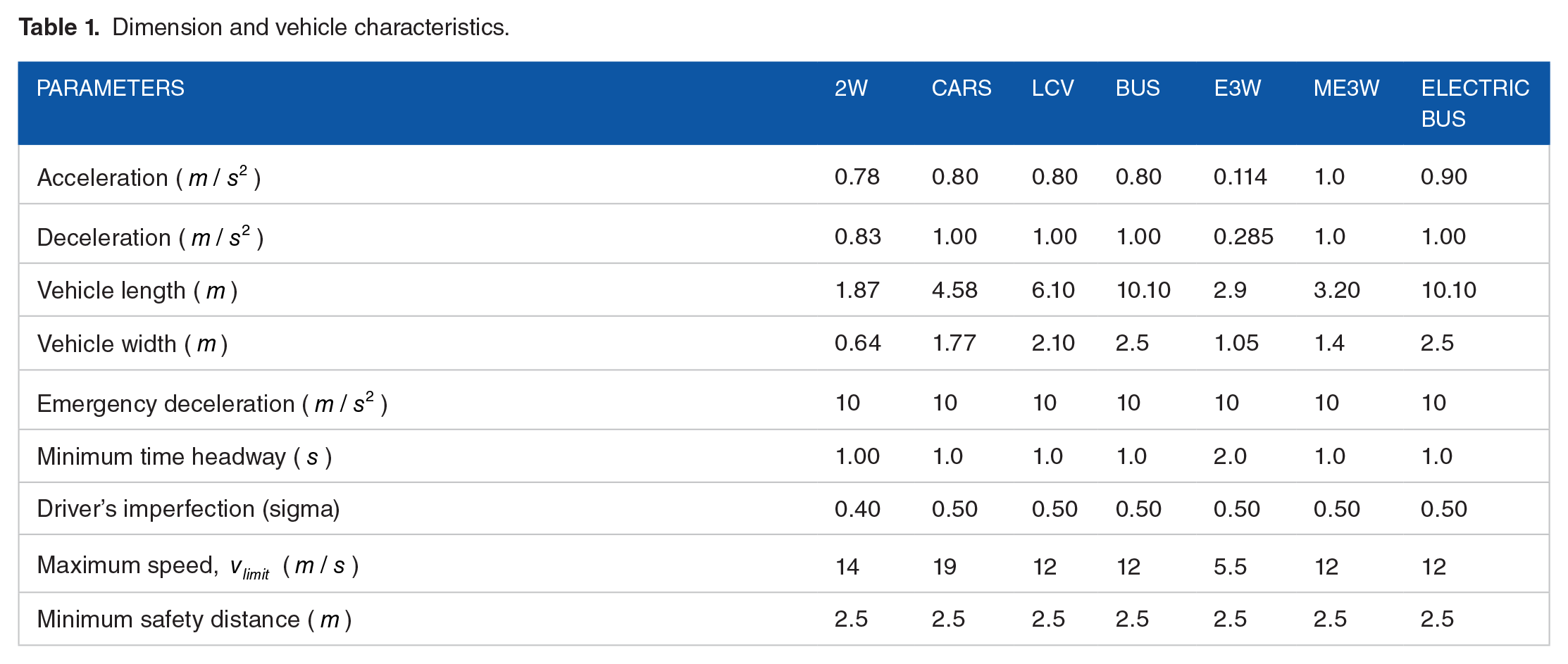
The dimension E3Ws vehicle, characteristics were used as shown in Figure 4. Values were calculated by conducting a pilot survey and random sampling of E3Ws as there is variation in dimension and power. These vehicles are powered by DC motor (brushless) electric motor having power ranging from 0.75 to 0.85 kW. 19 For vehicles other than E3Ws, values were adapted from Amanand Parti. 34

Illustration of electric three wheeler and its attributes.
Model Calibration and Validation
Krauss Model needs to be calibrated to ensure that they represent field-observed traffic conditions closely. For calibration, trial and error methods were adopted since the objective function does not have a closed form. Using an optimization method for such a scenario is difficult. 35 The values of acceleration for vehicles other than E3Ws have been adopted from Mahapatra and Maurya. 36 For speed, normal distribution has been adopted for vehicles. The parameters varied are Tau (headway), driver imperfection Sigma, lateral resolution value, lane change parameter speedGain and the normal distribution factors namely speedDev and speedFactor. The simulated volumes and real volumes for the main freeway are used to calculate GEH statistics.37,38

Descriptive statistics for GEH.

Emission Model
Most exhaust emissions in metropolitan areas come from traditional internal combustion engines.40,41 Several factors affect the exhaust emissions from vehicles which complicates the task of estimating emissions. The size of the scale used to measure the emissions from vehicles 42 is one such factor. When it comes to modelling, the amount of exhaust emissions produced is dependent, among other factors, not only on the type of vehicle but also on the number of vehicles that a specific class of car experiences. 43 The elements that influence these emissions include, but are not limited to, the type of fuel (petrol or diesel) used, the sophistication of the emission control system, and the vehicle’s operation along with environmental settings. 44 It has been observed that E3Ws ply on the major roads of cities and slow down traffic in them. 45 Their slow speed restricts the movement of other fast-moving vehicles. 46 Moreover, due to the low speed, frequent gear shifts are required, which increase the consumption of fuel and result in increased pollution. To reliably predict emissions from vehicular traffic, emission models are employed. Inputs can come in the form of precise information on the vehicle, such as its engine specifications, the conditions of the drive and the qualities of the fuel. 47 Simulations of traffic can be a useful supplement to emission models in some cases. 48 A virtual depiction of real-world traffic scenarios can be created using traffic simulation software. This makes it possible to study the interactions between vehicles as well as the effects those interactions have on the surrounding environment and the well-being of people who use roadways. 49 Simulators can generate a specific set of vehicle traffic data, allowing valuable information to be provided on the amount of vehicle emissions in comparison to, for instance, air quality. This information may then be used to advise decision-makers in the process of reducing air pollution. 50
The models that are used to predict the emissions from vehicles are becoming increasingly complex and comprehensive. 51 There is no question that this is linked to the ever-increasing number of vehicles as well as the wide variety of emissions, modifications and fuel types that are being used. 52 Differentiating between cold start, hot running and other engine thermal states is equally crucial for emission models. In the 1980s and 1990s, researchers worked to build emission models that could estimate emissions from a vehicle’s warmed-up engine for a select few significant emission components using verified test data. 53 Modern emission models are based on data from actual road tests conducted under varying driving situations, predict fuel consumption and allow for the estimation of all known exhaust components, both regulated and unregulated. 54 Early emission models relied on data from only a few dozen automobiles, whereas modern models incorporate information from thousands. 55 The approach has evolved over the years to include other factors in addition to the traditional modelling for driving mode (acceleration, deceleration, idle and cruise). These variables include information from car engines regarding engine load, speed, temperature, air-to-fuel ratio and other parameters. 56
HBEFA4 (Handbook Emission Factors for Road Transport) is the latest version of the emission model used for estimating vehicular emissions. It provides factors for pollutants like

Where co-efficient of
Results and Analysis
For the sake of simplicity Scenario 0, Scenario 1, Scenario 2, Scenario 3 Scenario 4 and Scenario 5 will be referred to as S0, S1, S2, S4, S4 and S5 respectively. After running the simulations it is found that the mean traffic flow falls as the percentage of E3Ws increases on the road. The maximum flow is observed in S0, followed by S5. The minimum value of average traffic flow is observed in S3 (with maximum E3Ws) with a reduction of 49.8%. A similar trend is observed with mean harmonic speed, with a reduction of 28.8% when compared to S0. Mean Harmonic speed is increased by 2.6% for S4 while reduction of HC is maximum for S5 scenario. Figure 5a and b show, respectively, the time series plot of average flow and harmonic mean speed as the percentage of E3Ws increases. For S4 and S5, the median speed is higher than in scenarios with E3Ws.

(a) Time series plot for traffic flow and (b) time series plot for harmonic mean speed.
The box plot in Figure 6 shows the median speed as 21.67 km/h for S3 and 33.46 km/h for S4. It can also be observed that the distribution of speed data points is spread for scenarios where E3Ws are not present. It is worth mentioning that the maximum percentage of E3Ws is taken as 29.7%, but the speed data points concentrate towards the lower value. For analysing the emissions over the section, a heatmap is plotted, where the x-axis represents the space and the y-axis represents the average emission milligrams per second. The emissions near the on-ramp are high in all scenarios but start decreasing after it. It is observed that emissions decrease with increasing E3Ws. A similar trend is observed with other parameters, as shown in Table 3. These results indicate that the emissions were reduced due to the introduction of slow-moving E3Ws, but this observation needed further analysis. Figure 7 shows the heatmap of emissions for cars along the section of the road under consideration. The spatial distribution of emissions shows an initial high density at the beginning of the road due to the presence of 2 lanes and gradual decreases as the lanes increase to 4. In S1, S2 and S3, it can be observed that the intensity of emissions decreased when compared to S0, but the emissions are more spread due to the reduced speed of cars. For S4 and S5, the intensity is low, but the spread is similar to S1, S2 and S3.

Box plot for speed for all scenarios.
Emission for all scenarios.


Heatmap of
Figure 8 shows the spatial spread of

Heatmap of
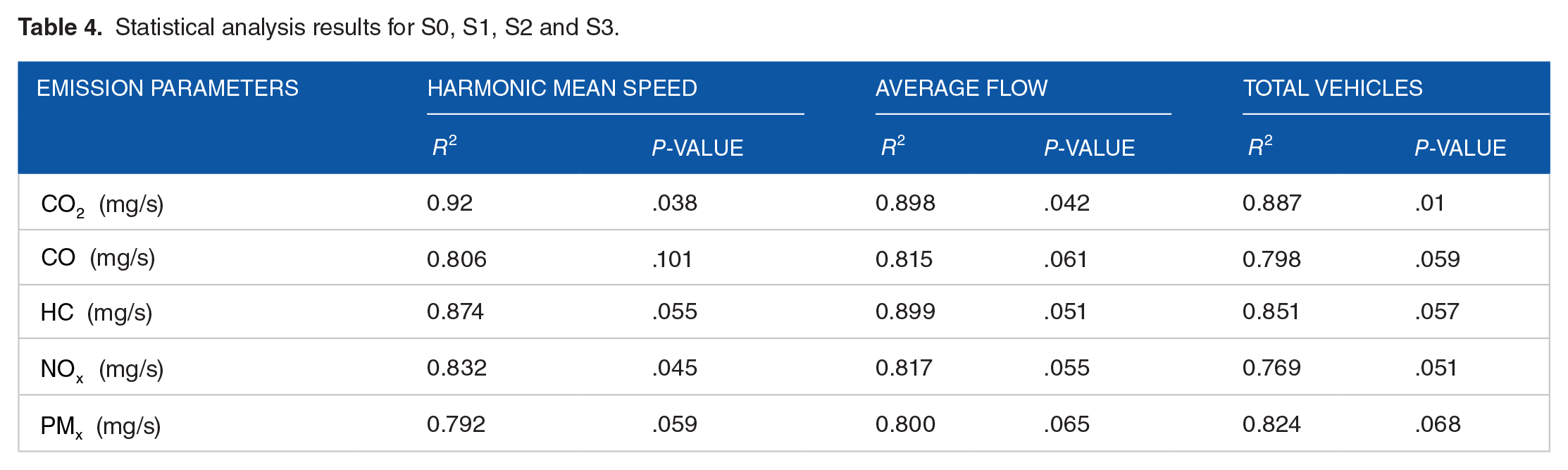
A regression analysis was performed to determine whether the emission reduction is correlated with a decrease in traffic flow caused by an increase in slow-moving E3Ws in traffic. The flow of fuel-driven vehicles is kept constant, and the flow of slow-moving E3Ws is increased progressively from 0% to 29.7% (S0-S3). Table 4 shows the square of the Pearson Correlation Coefficient
Statistical analysis results for S0, S1, S2 and S3.

Correlation between number of vehicles and average
Conclusions
In this paper, we present a study investigating the environmental impact of slow-moving E3Ws widely used in India for last-mile connectivity. A total of 6 scenarios were tested using a calibrated microsimulation model with field data. Scenario 1 represented real field conditions, while the rest of the scenarios were developed with different combinations of E3Ws, ME3Ws and electric buses. This allowed the authors to compare the existing and potential traffic conditions in the test section. The authors examined the scenario with the lowest emission and with the lowest traffic flow as well as harmonic mean speed. The presence of slow-moving E3Ws on the test section of an urban road adversely impacted traffic performance parameters like average flow and harmonic mean speed. The average and emission are reduced with an increasing percentage of slow-moving E3Ws. It is also worth mentioning that the rate of addition of fuel-driven vehicles is kept constant in every scenario. A regression analysis shows that the decrease in emissions is attributed to a decreased number of fuel-driven vehicles on the road section. In the hypothetical S4 scenario where slow-moving E3Ws are replaced by enhanced version ME3Ws, which have acceleration, deceleration, and maximum speed comparable to fuel-driven vehicles, the reduction of emissions is up to 67.1% without compromising the traffic performance parameters, average traffic flow, or harmonic mean speed, which showed a decrease of 8.9% and an increase of 2.6%, respectively, over scenario 0. For hypothetical scenario 5, where all 3-wheelers are replaced by electric buses in the relevant proportion, this results in a 3.4% reduction of average traffic flow and a 4.7% reduction of harmonic mean speed. Maximum reduction in HC and
Footnotes
Acknowledgements
The authors would like to thank the Integral University Lucknow, India for providing manuscript number: IU/R&D/2024-MCN0002465 for the present research. The authors would like to thank Lucknow Police for the permission to collect traffic data on the road section considered for this research.
Declaration of conflicting interests:
The author(s) declared no potential conflicts of interest with respect to the research, authorship, and/or publication of this article.
Funding:
The author(s) received no financial support for the research, authorship, and/or publication of this article.
Author Contributions
Mohd Sadat has collected the data, reviewed the literature, and written the manuscript. Syed Aqeel Ahmad and Mehmet Ali Silgu have supervised the manuscript. Shrish Bajpai and Digvijay Pandey have reviewed and edited the manuscript. The authors do not have any conflicts of interest with other entities or researchers. All authors have read and agreed to publish a version of the manuscript.