




Abstract
Background:
Exposure to air pollution has detrimental effects on the elderly, women, people with pre-existing medical conditions, people living in poverty and children. The aim of the study was to investigate the extent of community awareness and knowledge on the health risks associated with exposure to air pollution. The study was conducted at Annadale residential area locally known as Ladanna surrounded by industrial areas and located in Polokwane Local Municipality under Capricorn District Municipality in Limpopo Province, South Africa.
Methods:
A cross-sectional study design was used for the study, using self-administered questionnaires. The questionnaire was pre-tested on 10 respondents at Emdo Park (Extension 29) in Polokwane from 02 to 06 February 2021 and another fifteen respondents were pre-tested at Lesedi Park. A simple random sampling technique was used to select 376 respondents. Systematic sampling method was applied to select the households. SPSS version 26 was used to analyze data. Data was presented in the form of frequencies and percentages. Spearman rank correlation was used to measure the degree of association between 2 variables. A Chi-square test was used to compare the groups between the categorical variables. Multivariate Logistic Regression Model was used to assess associations of knowledge/awareness outcomes and sociodemographic characteristics with odds ratios (ORs) and 95% confidence intervals (Cls) presented.
Results:
Of 376 respondents, 221 (59%) were males and 154 (41%) females. The majority 113 (70%) of respondents were those between the age group 23 and 47 years and 353 (94%) were aware that if they don’t protect themselves against polluted air, they may get sick, with age and educational status associated with their awareness (P < .05). About 361 (96%) knew what air pollution is and 188 (50%) think the air they breathe in Annadale is moderate. A total number of 278 (74%) said they feel sick/uncomfortable when the quality of air is bad. About 293 (78%) knew that people are exposed to air pollution by breathing contaminated air and 237 (63%) identified sewage smell as the main cause of air pollution. Internet 199 (53%) and television 177 (47%) were identified as the main source of information Those who were not aware of actions implemented to reduce air pollution were 180 (48%). Based on the results of the study, respondents’ level of knowledge in Annadale was poor (71%) and their awareness was good (87%).
Conclusions:
It is crucial that air pollution risk communication strategies be implemented to empower residents and improve the level of knowledge on the dangers of exposure to polluted air.
Introduction
Air pollution happens when different particles and gases emanating from various sources are released in the atmosphere mix. 1 Furthermore, air pollution occurs when gaseous substances (carbon monoxide, ozone, nitrogen dioxide, sulfur dioxide), particulate matter (sulfates, nitrates, ammonia, sodium chloride, black carbon, mineral dust, water) and radioactive materials (radon, radium, thorium, plutonium) are emitted into the atmosphere through natural and anthropogenic sources of air pollution. 2 In urban areas, air pollution is caused by rapid industrialization, population growth and increase of vehicle ownership, sewage purifications plants, waste disposal sites, dusty roads, and the use of solid fuels for cooking. 3 It is estimated that in India there were about 1.1 million preventable fatalities that were reported in 2017 due to exposure to air pollution of which 56% fatalities were due to outdoor PM2.5 and 44% indoor air pollution. 4 Indoor air pollution are pollutants not only generated from indoor sources but are transported indoor through ventilation and openings of the buildings. 5 Outdoor air pollution is the mixture of pollutants emanating from natural and anthropogenic sources such as industrial activities, power generation, domestic heating, cooking, and transportation. 5 Across Europe, transport sector was identified as a main source of air pollution responsible for nitrogen oxides (NOx) emissions accounting for 39% of the total emissions in 2015, which resulted in implementation of different policy measures to address air pollution. 6 Nkosi, Wichmann and Voyi explored the relationship between wheeze and selected sources of air pollution in residential areas at Thembisa and Kempton Park, South Africa, and discovered that, when gas was repeatedly used for reheating homes and when trucks passed close to residential area, children experienced more wheeze. 7
Exposure to air pollution is associated with an increase in hospital visits, worsening of asthma attacks, poor lung function, premature birth, and deaths of children with respiratory infections. 7 In Sub-Saharan Africa, exposure to air pollution is linked to diseases such as asthma, heart disease, hypertension, COPD, and lung cancer, 8 due to the use of biomass fuel for cooking and heating. 9 The other study carried out in Limpopo Province at Greater Tubatse Municipality by Tshehla and Wright investigated possible impact of the concentration of air pollution emitted from anthropogenic sources (vehicles, industries, road dust, open burning, and combustion sources) and natural sources (wildfires and windblown dust). They revealed that particulate matter is linked to childhood pneumonia, respiratory diseases, stroke, cardiovascular and chronic obstructive pulmonary disease (COPD). 10
Most of the developing countries are reported to be exposed to air pollution levels close to or above the recommended World Health Organization (WHO) threshold. 11 The European Union Directive on Air Quality 2008/50/EM recommended the guideline limits to control pollutants that are considered detrimental to human health, infrastructure, and environment. 12 Regardless of air pollution control measures such as air pollution legislation, industries emission standards, environmental impact assessment, environmental audits, control of motor vehicle pollution, air pollution action plans for problem areas, development of environmental standards and promotion of air pollution awareness adopted by government of India, air pollution remain a challenge. 13 In South Africa, the National Environmental Management: Air Quality Act 2004 (No 39 of 2004), South African Air Quality Standards set by the Department of Environmental Affairs and Section 24 of the Constitution 1996 (No. 108 of 1996) place responsibility on government to take responsibility for ensuring that everyone in the country have the right to breathe air that is not harmful to their health and wellbeing.7,14
Despite the efforts made by various governments worldwide, air pollution remains a major environmental problem, with communities lacking knowledge/awareness of the health risk associated with air pollution. Previous studies investigated community knowledge and awareness of the causes and effects of air pollution. The study conducted at 3 Chinese megacities (Shanghai, Wuhan, and Nanchang) assessed the level of knowledge on air pollution discovered that 57.50% of the respondents were unaware of the causes and effects of air pollution. 1 The other study in Tehran, Iran investigated knowledge and attitude of university students on air pollution problem over the period of 2015 to 2016 and discovered weak average cognitive score +2.97, with no significant statistical difference between male and female (P = .32), which show lack of education regarding air pollution. 15 In 2017 the study investigated public awareness on the effects of air pollution in Wuhan, China, which revealed that 65% of the respondents were not aware of measures implemented by government to address air pollution. 16 When public perception of sources of air pollution was surveyed in 7 European countries, most of the population had limited knowledge of the main sources of air pollution. 6 In Peninsular, Malaysia (Southeast Asia), a study explored public awareness and support for environmental protection focusing on air pollution found that female respondents had lower awareness compared to the male counterparts. 2 United Nations International Children & Emergency Fund (UNICEF) indicate that communities should be made aware of the level of air pollution they are exposed to, the effects of air pollution, how to reduce air pollution and how to protect themselves from air pollution. 17
The study sought to add on existing health risk awareness and knowledge about air pollution to allow Annadale community to improve their health conditions by making informed decisions on how to prevent and protect themselves from exposure to air pollutants. The study investigated knowledge and awareness of Annadale community regarding the health risks associated with exposure to air pollution in Polokwane Local Municipality in Limpopo Province, South Africa. This study is different from the study carried out in Wuhan, China by Liu et al 1 that explored the relationship between parents perception toward air quality and the results of air quality monitoring stations located in Wuhan City over a period of 5 years. The findings of our study suggest possible air pollution awareness intervention strategies that can be used to improve community awareness and knowledge regarding air pollution in Annadale.
Methods
Study approach and study design
A cross-sectional study design was used to assess the extent of community awareness and knowledge on air pollution.
Study site and population
The study was conducted at Annadale residential area known as Ladanna surrounded by industrial areas and located Polokwane Local Municipality under Capricorn District Municipality in Limpopo Province, South Africa. Statistics South Africa 2011 report estimated that there is 6386 population consisting of 3244 females (50.80%) and 3142 males (49.20%) in Annadale. 18 Statistics South Africa also estimated that there are around 2277 households in Annadale, with population consisting of Black Africans at 3723 (58.30%), followed by Whites at 2499 (39.13%) and Colored at 116 (1.82%). The most dominating spoken languages in Annadale are Afrikaans (38.24%), followed by Sepedi (28.12%). 18 The target population was community members between the ages of 18 and above 65 years who have been residence of Annadale over the period of 1 year.
Sampling and sample size
A simple random sampling technique was used to obtain a representative sample in the study. A sampling frame consisting of a list of all units in Annadale was developed and used to randomly draw the sample of 376 (n = 376). A systematic sampling meth used to select the households, where every third household was selected. Yamane (1967) Formula: n = N/[1 + (Ne 2 )] was used to calculate a sample size, where e: = 5% represented the margin of error, N: Population and n = sample size.

To ensure representativeness of the sample, a 5% margin for possible non-response was added and the study aimed to reach 376 respondents.
Data collection
A self-administered questionnaire (SD1) was used to collect data from the respondents over the period of 15 February 2021 to 30 March 2021. The questionnaire was adopted from previous studies18,24 where reliability for internal consistency was tested using the Cronbach’s alpha test equal to 0.87 and between 0.655 and 0.827 respectively. The questionnaires were translated from English to the most dominant local languages (Sepedi & Afrikaans) and were translated back to English to identify discrepancies. The questionnaire consisted of 22 questions with section A: collecting sociodemographic information about the respondent, section B: included questions assessing the extent of knowledge of the respondents on air pollution and section C: asked questions assessing the extent of community awareness on the effects, causes and sources of information on air pollution. For knowledge questions ranging from 0 to 8, the respondents were awarded 1 point for the correct answer and 0 for incorrect answer, similar to awareness questions that ranged from 0 to 6. The correct answers were then summed and transformed into percentage ranging from 0 to 100%, where less than 50% means the level of knowledge/awareness was poor and more than 50% means the level of knowledge/awareness was good.
Pre-testing the instrument
The questionnaire was pre-tested by the researchers on 10 respondents at Emdo Park (Extension 29) in Polokwane from 02 to 06 February 2021 and another fifteen respondents were pre-tested at Lesedi Park. The reason for choosing these pilot sites was that they are residential areas surrounded by industries and situated within Polokwane Local Municipality under Capricorn District Municipality in Limpopo Province, South Africa, the same as the study site (Annadale). The respondents were informed of the purpose and objectives of the study and were requested to give consent for voluntary participation. Out of 10 members who participated in the pilot study, 40% were males and 60% females. Half (50%) of the respondents were employed full-time and 60% were of the age between 23 and 47 years. Most (70%) of the respondents had tertiary qualifications. All (100%) of the respondents knew what air pollution is, identified sewage as the main cause of air pollution and identified the lungs to be most affected by air pollution. Pre-testing of questionnaire assisted the researcher to modify and rephrase questions that were not clear to the respondents. Pre-testing also assisted in establishing if the questions asked were able to answer the research question.
Data analysis
The completed questionnaires were coded and captured on the excel spreadsheet and data was imported from excel spreadsheet into the IBM Statistical Package for Scientific Solution (SPSS) version 26 to analyze it. The categorical variables were reported in the form of frequencies and percentages. Spearman rank correlation was used to measure the degree of association between 2 variables. A Chi-square test was used to compare the groups between the categorical variables. Multivariate Logistic Regression was used to analyze the association of sociodemographic characteristics and knowledge/awareness outcomes with odds ratios (ORs) and 95% confidence intervals (Cls). A P-value of .05 or lower was considered statistically significant.
Results
Sociodemographic profile of the respondents
Table 1 presents the sociodemographic information of the respondents. Out of the original 376 respondents expected to participate in the study, 370 respondents with (2%) dropout rate participated in the study of which 59% were males and 41% females. Most were between 23 and 47 years (70%), followed by 14 to 22 years (16%). The most dominant ethnic group of the respondents were Black Africans accounting for (93%, succeeded by Whites (4%), Colored (2%), and Indians (1%). Half (50%) of the respondents had tertiary education, 45% were in passion of secondary education, 4% had post-graduate qualifications and the least being primary education (2%). About half (53%) were full time employed, 15% were students, 14% part-time employed, 11% unemployed, and only 7% were self-employed. In terms of household annual income, 38% of the respondents had annual income ranging between R30 000 and R49 999 and 37% earned less than R29 999, 12% earned between R50 000 and R60 999 and 6% earned more than R200 000. When it comes to vehicles owned by households in Annadale, 40% owned a single vehicle while 12% owned 2 vehicles, 7% owned 3 vehicles, and majority (35%) did not own a vehicle. Majority (73%) of vehicles owned by households were using petrol as opposed to diesel (12%) while 10% used both petrol and diesel.
Sociodemographic information of the respondents.

Knowledge of respondents on air pollution
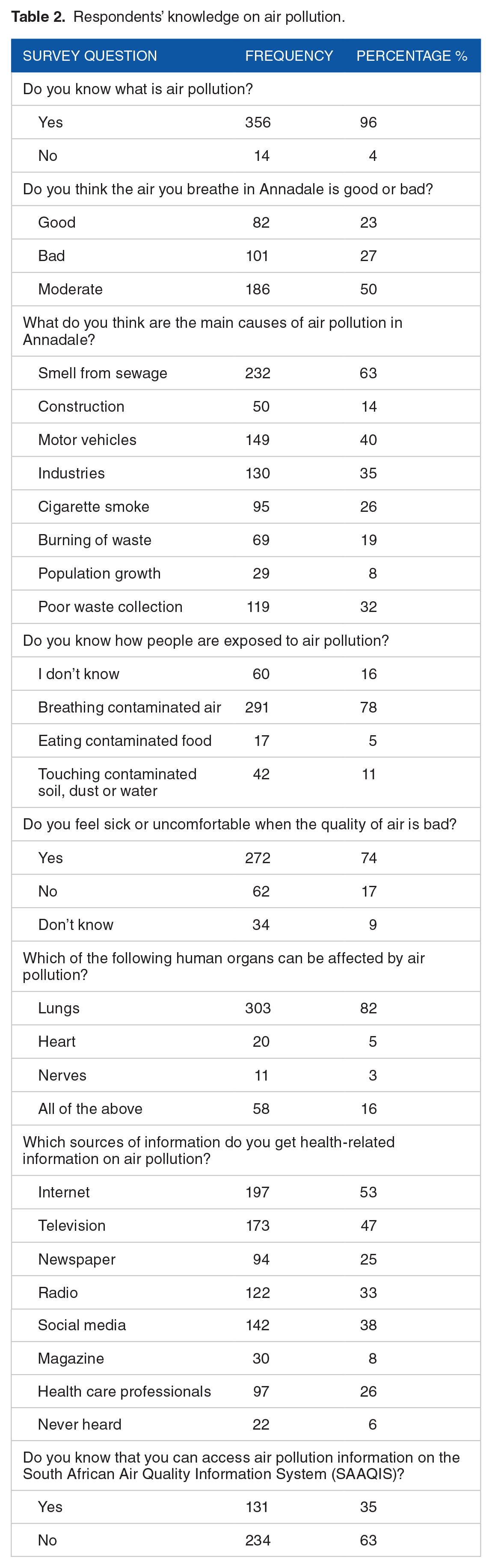
The respondents’ knowledge of air pollution is presented on Table 2. Almost all (96%) of the respondents in Annadale had knowledge of what is air pollution. When the respondents were asked of what they think about the type of air they breathe in Annadale, half (50%) indicated that they think the air they breathe is moderate, while 27% thought the air they breathe is bad and only 23% thought the air is good. More than 63% identified smell from sewage purification plant as the main cause of air pollution in Annadale. On the other hand, motor vehicles (40%), industries (35%), poor waste collection (32%), cigarette smoke (26%), burning of waste (19%), construction (14%), and population growth (8%) were also identified as the causes of air pollution in their area. Majority (78%) of the respondents knew that people are exposed to air pollution by breathing contaminated air. About 11% indicated that people are exposed to air pollution by touching contaminated soil, dust, or water, while 16% did not know how people are exposed to air pollution. Close to 75% of the respondents indicated that they were sick or uncomfortable when the quality of air is bad, as compared to 17% who did not feel sick or uncomfortable. Furthermore, less than 10% did not know how they felt when the quality of air is bad. When the respondents were asked to identify human organs that can be affected by air pollution, considerable number (82%) identified the lungs, while 5% identified the heart, 3% identified the nerves and 16% identified all (lungs, heart, and nerves) as organs likely to be affected by exposure to air pollution. Internet (53%) and television (47%) were identified as the major source of information related to air pollution. Social media (38%), radio (33%), health care professionals (26%), newspaper (25%), and magazine (8%) were the least sources of access to health-related information on air pollution, with about 5% of the respondents indicating that they never accessed any air pollution information on the internet, television, social media, radio, from health care professionals, newspaper, and magazine. Majority (63%) of the respondents did not know that they can access air pollution information on the South African Air Quality Information System (SAAQIS), whereas 35% knew they can access air pollution information on this system. The results of the study show that, the respondents’ general knowledge on air pollution in Annadale was 30%.
Respondents’ knowledge on air pollution.
Awareness of the respondents on air pollution
Table 3 illustrates the respondents’ awareness of air pollution in Annadale. The results of the study revealed that 63% of the respondents were aware that the air they breathe around Annadale is polluted, against 25% not aware and 11% did not know. Eighty-three percent of the respondents were aware that if air pollution is not controlled their lives will be affected. It was also noted that 10% of the respondents were not aware that if air pollution is not controlled, their lives will be affected. It was remarkable that considerable number (94%) of the respondents were aware that if they do not protect themselves against polluted air, they may get sick. Majority (88%) of the respondents were aware that the sewage around Annadale should be treated to avoid odor while 7% were not aware that sewage need to be treated to avoid unpleasant smell. Close to half (48%) of the respondents indicated that they were not aware of actions implemented to reduce air pollution, whereas 33% were aware and 19% did not know of actions implemented to reduce air pollution. When the respondents were asked if they were aware of any law regulating air pollution, it was revealed that more than 40% were not aware of air pollution legislation. On the other hand, only 34% were aware of the law regulating air pollution, while 20% did not know of any law regulating air pollution. The results of the study show that the respondents’ level of awareness on air pollution was good (87%).
Respondents’ awareness on air pollution.

Association between air pollution knowledge and awareness with selected variables
Table 4 presents association of gender, age, educational status, race, employment, income, and air pollution knowledge/awareness. The statistical results using the Chi-square test and P-values, show that there was a significant association of the respondents’ awareness of getting sick if not protected against air pollution with age and educational status (P < .05). Although almost all the respondents were aware that if they do not protect themselves against air pollution, they may get sick, age and education contributed toward their awareness. Regarding the respondents’ awareness that the sewage around Annadale needs to be treated, a significant association with age and gender (P < .05) was observed. On the other hand, there was a significant association between the respondent’s awareness that if air pollution around Annadale is not controlled, the lives of citizens will be affected with race (P < .017) and income (P < .05). Income (P < .042) was found to be associated with the respondents’ awareness of any law regulating air pollution.
Association between air pollution knowledge and awareness with selected variables.

Association is significant at P < .05 level.
Table 5 presents association between age groups (⩽22 years and >22 years) knowledge and awareness. There was association between accessing air pollution information on the SAAQIS and awareness that the air breathed around Annadale is polluted with age group. High prevalence of young people did not know (81.3%) that they can access air pollution information on the SAAQIS (P < .008). Again, there was significant high prevalence of older people being (65.7%) aware that the air they breathe around Annadale is polluted (P < .025).
Association between age groups (⩽22 years and >22 years) knowledge and awareness.
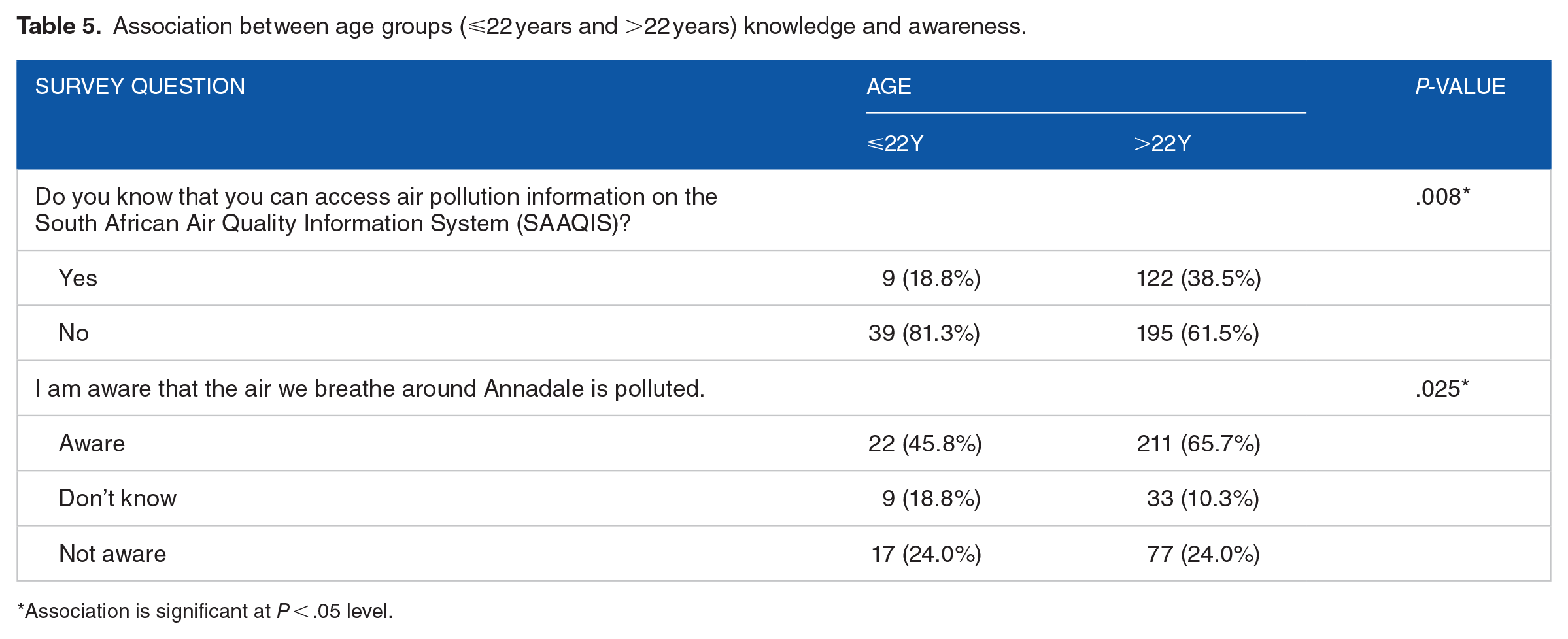
Association is significant at P < .05 level.
Table 6 present the results of Multivariate Logistic Regression of the association of sociodemographic characteristics and knowledge of air pollution. The results of the study show that earning less than R29 999 (odds ratio (OR) = 4.29; 95% CI = 2.53-7.28) and between R100 000 and R200 000 (odds ratio (OR) = 1.77; 95% CI = 0.98-3.20), R50 000-R60 999 (odds ratio (OR) = 8.08; 95% CI = 1.01-64,73) was significantly associated with not having knowledge of air pollution when using Multivariate Logistic Regression Model depicted in Table 6. This show that income was associated with respondents’ level of knowledge of air pollution.
Multivariate Logistic Regression association of sociodemographic factors and knowledge of air pollution.
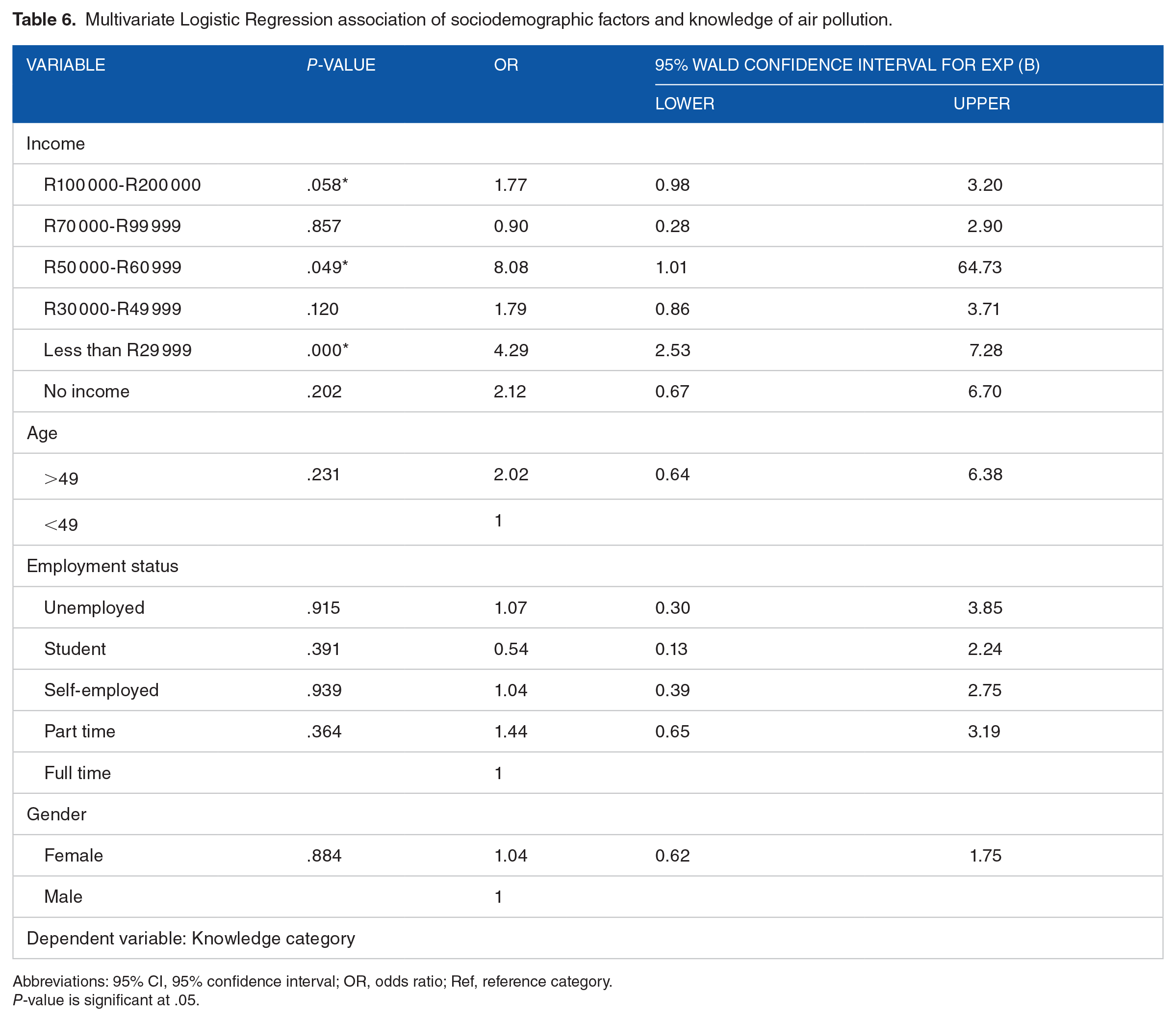
Abbreviations: 95% CI, 95% confidence interval; OR, odds ratio; Ref, reference category.
P-value is significant at .05.
Table 7 present the Multivariate Logistic Regression of the association between sociodemographic characteristics and awareness of air pollution. The results indicate that income and employment were associated with not being aware of air pollution. Earning less than R29 999 (odds ratio (OR) = 0.28; 95% CI = 0.16-0.50), between R30 000 and R49 999 (odds ratio (OR) = 0.12 95% CI = 0.04-0.41) and R100 000-R200 000 (odds ratio (OR) = 0.04; 95% CI = 0.01-0.18) were significantly associated with not being aware of air pollution using Multivariate Logistic Regression Model depicted in Table 7. Furthermore, being part time employed (odds ratio (OR) = 0.27; 95% CI 0.074-0.970) was associated with not being aware of air pollution. This means that residents who earned less than R29 999, between R30 000 and R49 999 and R100 000-R200 000 and those employed part-time were less likely to be aware of air pollution in Annadale (OR < 1).
Multivariate Logistic Regression association of sociodemographic factors and awareness of air pollution.

Abbreviations: 95% CI, 95% confidence interval; OR, odds ratio; Ref, reference category.
P-value is significant at .05.
Discussion
The study investigated the extent of community health risk awareness and knowledge on air pollution in Annadale. The results of the study revealed that despite data from Statistics South Africa 2011 census report showing that Annadale community comprised of 50.80% females and 49.20% males, 18 more males (59%) responded to the questionnaire as opposed to females (41%). The reason for this finding might be because males are considered heads of the households, whenever there is a visitor at home, they are likely to be the first to open doors as opposed to females not always comfortable to give attention to male strangers. 19 The present study revealed that most (70%) of the residents in Annadale were youth and active working age groups representing majority of population in Annadale, 18 followed by 16% young teens. The 14 years old are young teens who just moved out of childhood and therefore understand their surroundings, whereas from 18 to 22 years are youth who are at the stage where they start making choices that may affect their future. The 2 age groups were grouped together because they are of the schooling age in South Africa. Regarding the distribution of ethnic groups, the results of our study show that >90% were Black Africans who make up majority of population in Annadale. The findings were consistent with the results of Census 2011 by Statistics South Africa show that Black African (58.30%) were dominant ethnic group in Annadale followed by White (39.13%), Colored (1.82%), and 0.47% Indian. 18 When it comes to the residents’ level of education, the study discovered that half (50%) of the respondents in Annadale acquired tertiary education compared to 45% secondary education, and 2% primary education. The study by Raghupathi and Raghupathi show that when people are educated with access to information, they have opportunity to gain knowledge on general health related matters that increase awareness of ways to protect themselves against diseases. 20 On the other hand, Liu et al indicate that population with lower education level tend to have less knowledge of air pollution and its health effects as opposed to those with higher level of education. 16 When it comes to the households’ annual income, we found that 38% earned between R30 000 and R49 999 and 37% earned less than R29 999. The study conducted by Liu et al. in 2016 in carried out at Chinese Megacities (Shanghai, Wuhan, and Nanchang) found that 22.36% of respondents earned RM < 2999 whereas 42.71% earned between RM3000 and 4999, 24.38% earned between RM5000 and 7999 and 10.55% earned more than RM8000 per month. 1 About vehicles owned by households in Annadale, 40% owned a single vehicle while 12% owned 2 vehicles, 7% owned 3 vehicles and majority (35%) did not own a vehicle. On the other hand, those who earned less owned one vehicle in their households. Most vehicles (73%) owned by the households in Annadale use petrol as opposed to diesel (12%) and more than 15% used both petrol and diesel. This is an indication that a reasonable number of households in Annadale afford vehicles with their income and those who earn more owned more than 2 vehicles. The study by Tao et al revealed that an increase in vehicles ownership will lead to increase in fuel consumptions that aggravate air pollution. 21 On the other hand, those who earned less owned one vehicle in their households. The study by Mhembu indicate that the more households earn more income, the more their likely to own a vehicle due to their increases buying power. 22
When it comes to the respondent’s knowledge of air pollution, our findings show that almost all (96%) the respondents in Annadale have knowledge of what is air pollution. The findings are consistent with the study by Liu et al that investigated air quality in Wuhan, China which found that majority (96%) of the respondents knew what air pollution is. 16 This is in contradiction with the findings of a study conducted in 2016 by Liu et al in Wuhan that reported more than half of the respondents who did not know what air pollution is. 1 This is encouraging to see that nearly all residents of Annadale have knowledge of what is air pollution, and this knowledge might have occurred because of their personal experience of regular exposure to smell from sewage, malodourous gases and particulate matters emanating from industries surrounding Annadale. When the respondents were asked of what they think about the type of air they breathe in their area, half (50%) indicated that they think the air they breathe is moderate, while 27% think the air they breathe is bad and only 23% think the air is good. This means that more residents in Annadale consider the quality of air to be moderate which may put vulnerable people with chronic medical conditions at risk of being affected. The findings are inconsistent with the studies by Liu et al which found that most of the respondents thought the quality of air they breathe was bad, whereas less than half thought the quality of air they breathe was moderate.16,23 The respondents were asked to identify the causes of air pollution and majority (63%) identified smell from sewage purification plant as the main cause of air pollution in Annadale. This was followed by motor vehicles (40%), industries (35%), poor waste collection (32%), cigarette smoke (26%), burning of waste (19%) whereas construction (14%) and population growth (8%) were identified by few respondents as the cause of air pollution. This show that greater number of residents in Annadale consider smell from sewage to be the main cause of air pollution, this is believed to be because it is easy to smell sewer gas, as opposed to other types of pollutants in the air that may still be harmful without being smelled. 24 Motor vehicles, industries, poor waste collection and burning of waste were also amongst other causes of air pollution identified. Poor waste collection was also identified by residents amongst the causes of air pollution, this may be due to weekly collection of waste by Polokwane Local Municipality that results in waste waiting for several days before being collected creating nuisance and unpleasant smells for the households. Similarly, a study that assessed knowledge of possible causes of air pollution established that almost all (91.43%) of the respondents identified cigarette smoking as the major cause of air pollution. 25 The other study by Guo et al in contrast to this study assessed knowledge and perception of the sources contributing to air pollution established that motor vehicles, industries and constructions were identified as the main sources of air pollution. 26
In this study we found that majority (78%) of the respondents knew that people are exposed to air pollution by breathing contaminated air. This shows that a considerable number of residents in Annadale know that they are exposed to air pollution through the lungs when inhaling polluted air. The results of this study are consistent with the findings by Liu et al that revealed that most (77%) of the respondents knew that people are exposed to air pollution by breathing contaminated air. 16 Eleven percent of the respondents in the study indicated that people are exposed to air pollution by touching contaminated soil, dust, or water and 16% did not know how people are exposed to air pollution. This is a sign that some residents in Annadale do not have knowledge of how people are exposed to polluted air because of lack of air pollution risk communication strategies by public sector, private sectors, municipalities, and NGOs to empower residents. Similarly, Liu et al revealed that 12% of the respondents identified touching contaminated soil, food, or water, followed by 5% identifying eating contaminated food and only 4% not knowing how people are exposed to air pollution. 16 To establish how the respondents felt when the quality of air is bad in Annadale, 74% show that they felt sick or uncomfortable when the quality of air is bad, compared to 17% who did not feel sick or uncomfortable when the quality of air is bad. However, 9% of the respondents did not know how they felt when the quality of air is bad. Gender (P < .017) and age (P < .002) were found to have significant association with the respondents’ negative feelings when exposed to polluted air. 1 This is an indication that Annadale residents felt that when the quality of air is bad, they felt sick or uncomfortable. Lack of knowledge by some residents on how they felt when the quality of air is bad show the need for implementing community awareness and health education measures on air pollution in Annadale. These results are the same as the findings of the studies by Liu et al1,16 and Qian et al 23 that found more than 50% of the respondents agreed that they feel sick or uncomfortable when the quality of air is bad in their areas. On the other hand, the study by Chin et al revealed that two-thirds of the respondents were happy of the quality of air they breathed, despite strong evidence of harmful levels of air pollution in their area. 27 When the respondents were asked to identify human organs that can be affected by air pollution, considerable number (82%) chose the lungs, while the heart (5%), nerves (3%) and 16% selected all (lungs, heart, and nerves) as organs likely to be affected by exposure to air pollution. This means that most of the residents in Annadale know that they can be affected by air pollution mainly through the lungs when inhaling contaminated air and only a few of them knew that the heart and the nerves may also be affected by air pollution. Compared to the findings of the study by Liu et al who found that almost all (98%) of the respondents identified the lungs to be likely affected by air pollution, on the other hand 45% identified the heart and only 36% identified the nerves. 16 Three studies by Morakinyo et al, WHO and Roth indicate that the effects of air pollution in exposed communities may lead to short term and long-term health effects by reducing circulatory performance, causing lung diseases, heart diseases and increase in hospitalization.12,28,29 This also suggest that residents mainly know that exposure to air pollution can cause lung diseases as opposed to other health effects indicated by Morakinyo et al, WHO, and Roth.12,28,29
When it comes to access to air pollution related information the respondents identified internet (53%) and television (47%) as the major source of information. Social media (38%), radio (33%), health care professionals (26%), newspaper (25%), and magazine (8%) were the least sources of access to health-related information on air pollution, with 6% indicating that they never accessed air pollution information on either internet, television, social media, radio, health care professionals, newspaper, and magazine. This shows that internet, television, social media, and radio are commonly used by residents in Annadale as reliable sources of information, which seem to be replacing printed newspapers and magazines that were mostly used in the past.16,23 The results of this study concur with the findings of the previous studies by Liu et al, Qian et al, Carducci et al, and Odonkor et al that identified internet, social media, newspaper, television, and radio respectively to be used by most people to access air pollution information.16,23,30,31 Another study by Veloz et al in 2020 found that 81.6% of the respondents’ access air pollution information on television and 78.5% look outside at the sky to check the quality of air. Veloz et al also reported that 76.6% of the respondents indicated they access air pollution by looking at the mountain to see if is clear from pollutants and 70.8% use their olfactory senses to smell if the quality of air is bad. 32 Our study revealed that 63% of the respondents did not know they can access air pollution information on the South African Air Quality Information System (SAAQIS), whereas 35% knew. This show that majority of residents in Annadale lack knowledge on the existence of the SAAQIS as the source of information on air pollution which may also be due to residents’ low health literacy and lack of knowledge of how to access air pollution information. 33 The Integrated Development Plan for the City of Polokwane show that 36% of the population completed grade 7, 24% acquired grade 12, whereas 5.7% achieved tertiary education. 33 The current study found association between accessing air pollution information on the SAAQIS and awareness that the air breathed around Annadale is polluted with age group. In contrast to these findings, Borbet et al revealed that 53.2% of the respondents knew that they could access updated air quality information on IMECA Air Quality Information System, compared to 46.8% who did not know. 34 High prevalence of young people did not know (81.3%) that they can access air pollution information on the SAAQIS (P < .008). Furthermore, there was significant high prevalence of older people being (65.7%) aware that the air they breathe around Annadale is polluted (P < .025). Contrary to our findings Qian et al revealed high prevalence of knowledge among young people and high prevalence of elderly and less educated people not aware of air pollution in Ningbo, China. 23 Maione et al and UNICEF agree that residents should have the right to access air quality information in their areas, to allow them to take necessary actions to protect themselves against polluted air.35,36 The results of the study show that, the respondents’ general knowledge of air pollution in Annadale was poor (30%) which was less than 50% set standard. This finding confirms the need for communities to be made aware of the level of air pollution they are exposed to, the effects, how to reduce it and how to protect themselves from air pollution. 36
The current study shows that majority (63%) of the respondents were aware that the air they breathe in Annadale is polluted, whereas 25% were not aware that the air they breathe is polluted and 11% did not know. The high level of awareness about polluted air that is inhaled by residents in Annadale may be due to their previous experiences of continuous exposure to polluted air which may have contributed to increasing their awareness of the type of air they are inhaling. 37 Similarly, a study conducted in Mexico City by Borbet et al is consistent with the findings of this study as it reported high level of awareness (53%) of the type of air the respondents were exposed to. 34 On the other hand, our study found that 83% of the respondents were aware that if air pollution is not controlled around Annadale, their lives will be affected. However only 10% of respondents were not aware that if air pollution is not controlled, their lives will be affected. There was a significant association between the respondent’s awareness that if air pollution around Annadale is not controlled, their lives will be affected with race (P < .017) and income (P < .05). The findings show that Annadale residents are not only aware that the air they breathe is polluted, but they are also aware that if actions are not taken to control air pollution their lives will be affected. This is consistent with the findings of the study conducted by Sumndad and Maratas in Iligan City (Philippines) that revealed that 97.14% of the respondents were aware of the impact of air pollution, with only 2.86% of the respondents not aware of the impact. 25 It was worth noting that a considerable number (94%) of the respondents in our study were aware that if they do not protect themselves against polluted air, they may get sick, with only 3% not aware and 3% not knowing that they may get sick. This implies that almost all residents in Annadale are aware that they need to protect themselves from air pollution to avoid getting sick and need to be informed of how to protect themselves against air pollution. A similar study carried out by Qian et al in Ningbo, China found that more than 60% of the respondents were aware that if they do not protect themselves against polluted air, they may experience adverse health effect. 23 Old people, children, people with chronic medical conditions such as diabetes, heart diseases, lung diseases (asthma) were identified as vulnerable population that need to be aware of the precautionary measures available to protect themselves against air pollution. 38 The statistical results using the Chi-square test and p-values, show that there was a significant association of the respondents’ awareness of getting sick if not protected against air pollution with age and educational status (P < .05). Although almost all the respondents were aware that if they do not protect themselves against air pollution, they may get sick, age and education contributed toward their awareness. Air pollution risk communication strategies to include residents of all age groups should be implemented to increase knowledge/awareness in Annadale. In this study we revealed that 88% of the respondents were aware that the sewage plant in Annadale should be treated to avoid unpleasant smell while 7% were not aware that sewage plant needs to be treated. This is an indication that residents of Annadale consider smell from sewage as the main cause of air pollution that needs to be given necessary attention. Aldosari et al suggest that to minimize the smell from sewage, there is a need to have relevant policies for management of sewage treatment plants that consider socio-economic characteristics of the population around the sewage. 39 The results of our study found that a significant association between the respondents’ awareness that the sewage around Annadale needs to be treated with age and gender (P < .05). In Saudi Arabia, it was found that there was a significant association between awareness of untreated sewage that leads to odor with age and educational level (P < .05). 39 This shows that the respondents’ awareness of the need for sewage to be treated in Annadale increased with age and gender. As suggested by Aldosari et al, air pollution information must reach all residents of different age groups and gender. 39
When asked if they were aware of actions implemented to reduce air pollution, close to half (48%) were not aware of actions implemented to reduce air pollution while 33% were aware and 19% did not know. This might be due to lack of knowledge of how to access air pollution related information and low health literacy among residents in Annadale, which requires relevant authorities to empower residents. 38 Previously, a study by Liu et al investigated public awareness on air pollution found that 65% of the respondents were not aware of actions implemented to address air pollution while only 32% were aware of actions implemented to reduce air pollution. 16 In a 2016 study, Qian et al also reported that 45.08% of the respondents indicated that government should take responsibility to deal with air pollution, with at least 42.83% suggesting that citizens must take responsibility for air pollution. 23 When the respondents were asked if they were aware of any law regulating air pollution, it was established that 46% were not aware of air pollution related legislation. Furthermore, 34% were aware of the law regulating air pollution and 20% did not know of any law regulating air pollution, which means that most of the Annadale residents were not aware of legislation regulating air pollution. There was association between the respondents’ awareness of any law that regulates air pollution and income (P < .042). This means that the respondents’ awareness of laws regulating air pollution was associated with income. The study by Yan (2016) found that in China, there was no significant association between the respondents being aware of air pollution law and income, as level of education (P < .018) was instead significant. 40 The main legislations published to control air pollution include National Environmental Management: Air Quality Act 2004 (39 of 2004) regulating air pollution in South Africa and section 24 of the Constitution of South Africa 1996 (No 108 of 1996) that gives citizens the right to the environment that is safe and not harmful to their health. 41 Lack of awareness on legislation related to air pollution in our study was consistent with the findings of the study by Yan 2016 that was conducted in China found that 52% of the respondents were not aware of existing air pollution and prevention law. 40 Generally, the results of the study show that the respondents’ level of awareness on air pollution was good (87%) as it was more than 50% set standard.
Conclusions
This study investigated the extent of community awareness and knowledge on the health risks associated with exposure to air pollution in Annadale. Our study revealed that the general knowledge of Annadale residents on air pollution was poor, however their level of awareness on air pollution was good. High prevalence (81.3%) of young people did not know they can access air pollution information on the SAAQIS. Furthermore, internet and television were used as the main source of information that can be used as part of informing communities. This study established the need for implementation of communication and risk management programs targeting different age groups and settings around Polokwane Local Municipality. This might be because communicating the risks associated with exposure to air pollution will reduce the potential adverse effects on residents. The study may assist policy makers to develop air pollution awareness implementation strategies that target the young people, working groups and elderly.
Supplemental Material
sj-docx-1-ehi-10.1177_11786302241226775 – Supplemental material for Community Health Risk Awareness and Knowledge of Air Pollution in Annadale, Polokwane Local Municipality, Limpopo Province, South Africa
Supplemental material, sj-docx-1-ehi-10.1177_11786302241226775 for Community Health Risk Awareness and Knowledge of Air Pollution in Annadale, Polokwane Local Municipality, Limpopo Province, South Africa by Famola Charles Ngobeni and Mokoko Percy Kekana in Environmental Health Insights
Footnotes
Funding:
The author(s) received no financial support for the research, authorship, and/or publication of this article.
Declaration of conflicting interests:
The author(s) declared no potential conflicts of interest with respect to the research, authorship, and/or publication of this article.
Author Contributions
Famola Charles Ngobeni collected data, analysed it and wrote the research report. He acted as the corresponding author for all submissions. He contributed with the writing of the manuscript including working on all comments from reviewers.
Mokoko Percy Kekana acted as the supervisor, ensuring that the research process went well. He also contributed with the writing of the manuscript including all comments from reviewers.
Supplemental Material
Supplemental material for this article is available online.
References
Supplementary Material
Please find the following supplemental material available below.
For Open Access articles published under a Creative Commons License, all supplemental material carries the same license as the article it is associated with.
For non-Open Access articles published, all supplemental material carries a non-exclusive license, and permission requests for re-use of supplemental material or any part of supplemental material shall be sent directly to the copyright owner as specified in the copyright notice associated with the article.
