



Abstract
Background:
Back pain, such as upper and low back pain are among the most common musculoskeletal conditions that can cause major public health and socioeconomic problems. Back pain is one of the leading causes of disability that reduces worker performance and well-being and increases absence from work, which can cause an enormous economic burden. In developing countries, particularly in Ethiopia, there is no adequate evidence on the overall prevalence of occupational-related upper and low back pain, and they remain less prioritized and empirically unrepresented. Therefore, this study aimed to determine the prevalence of occupational-related upper and low back pain among the working population of Ethiopia.
Methods:
This systematic review and meta-analysis considered studies conducted in Ethiopia, written in English, and published from 2017 to 2020. Articles were searched from 9 electronic databases (Web of Science, SCOPUS, PubMed, Google Scholar, CINAHL, Cochrane Library, African Index Medicus, African Journals Online database, and Science Direct) using a combination of Boolean logic operators, Medical Subject Headings, and main keywords. The quality assessment of the articles was performed using the Joanna Briggs Institute Critical Appraisal tools to determine the relevance of the articles to the study. A random effects model was used to estimate the pooled prevalence, the 95% confidence interval, and the degree of heterogeneity among the included studies. Sensitivity analyses were performed to identify the influence of outliers and to identify sources of heterogeneity.
Results:
Of the 1114 studies identified from the included databases, 20 studies were included in the systematic review and meta-analysis. The pooled prevalence of occupational-related upper and low back pain in the previous year was (27.1% [95% CI: 18.4, 37.9]) and (54.2% [95% CI: 48.2, 60.0]), respectively. Based on a subgroup analysis by publication year, study population, and regions where the studies were conducted, the prevalence of upper back pain was (43.8% [95% CI: 39.3, 47.7]), (34.7% [95% CI: 33.1, 36.2]), and (36.2% [95% CI: 33.6, 39.0]), respectively, while the prevalence of low back pain was (61.8% [95% CI: 58.9, 64.6], (52.8% [95% CI: 51.3, 54.3]), and (55.2% [95% CI: 51.4, 59.0]), respectively.
Conclusions:
This systematic review and meta-analysis found that 54.2% of the included study participants experienced low back pain in the previous year, while 27.1% experienced upper back pain. The highest prevalence was reported among pedestrian back-loading women.
Background
The global population is now living longer with consequences related to musculoskeletal conditions 1 that comprised the second highest global volume of years lived with disability (YLD).1,2 Approximately 1.71 billion people have musculoskeletal conditions worldwide. 3 Among musculoskeletal conditions, back pain is a major cause of disability that reduces workers performance, well-being, and increases absence from work, which can cause an enormous economic burden on individuals, families, communities, industry, and governments.4-7 It has an impact on a person’s mental well-being and productivity, and thus weakens the economy.5,8,9 It is among the most disabling musculoskeletal conditions1,10 that pose a major threat to health by limiting physical and mental capacities and functional ability. 1
Workers involved in various occupational settings such as health care, driving, manufacturing, general labor, maintenance, repair, and cleaning are at the highest risk of back pain. 11 According to the European Working Conditions Survey (EWCS), 47% of workers experienced back pain in the last 12 months. 12 According to the Health and Safety Executive (HSE), about 1.8 million working days were lost in 2016/17 due to back pain 13 and resulted in billions of dollars in medical expenses each year.14,15
Among back pain, low back pain is a work-related disease/injury and leads to a huge worker’s compensation and a decrease in productivity9,16 and increased costs for workers, companies, and society in general.17,18 It is still one of the persistent public health challenges around the world19-21 and the most common type of musculoskeletal disorder (MSD) is usually related to work and work conditions.13,20,22 It results in increased demand for the utilization of healthcare services, causing temporary and permanent disability, and reduced quality of life.18,23 For example, 568 million people experienced low back pain and caused 64 million YLDs globally. 24 It results in a serious social problem, huge worker’s compensation, and a decline in productivity. 16
In developing countries, where there is poor awareness of ergonomic issues, lack of adequate training, and problems are under-reported, occupational-related back pain has increased. 25 In Ethiopia, many studies have reported occupational-related upper and low back pain in different occupational settings.15,19,20,26-44 To our knowledge, there are limited studies conducted to determine and compare the prevalence of upper and low back pain in workplaces that are crucial to health and safety issues and to promote the implementation of environmental, ergonomic, and organizational interventions.
Thus, this systematic review and meta-analysis aimed to determine the prevalence of occupational-related upper and low back pain among the working population in Ethiopia. This study also provides detailed country-based information on the upper and low back pain, which contribute to the needs. Such figures can serve as powerful tools to strengthen and integrate control measures, to prevent upper and low back pain in working environments.
Methods
This study included articles that reported the prevalence of low back pain or/and upper back pain in the previous year. The study was conducted according to the Preferred Reporting Items for Systematic Reviews and Meta-Analysis (PRISMA) protocol. 45
Eligibility criteria
Inclusion criteria
Population: The study reported the prevalence of low and/or upper back pain among workers over or equal to 18 years of age regardless of their occupation.
Study design: Cross-sectional studies
Outcome: Studies that provided quantitative results (magnitude, frequency, proportion, or prevalence) in the last 12 months
Exposure: In the work environment or in the workplace.
Study area: Studies conducted in Ethiopia
Language: Full-text articles published in English.
Publication issue: Articles published from 2017 to 2020 were included in the study to provide current evidence on the prevalence of upper and low back pain to be used by the policy makers and health program planners.
Exclusion criteria
Studies that did not report the prevalence of low or upper back pain in the last year (12 months), case reports, case series, qualitative studies, review articles, surveillance data/reports, conference abstracts, personal opinions, articles written in non-English language, articles had a high risk of bias, study not available in full texts, and studies published before 2017 were excluded from the study.
Information sources and search strategy
Articles were searched from electronic databases (Web of Science, SCOPUS, PubMed, Google Scholar, CINAHL, Cochrane Library, African Index Medicus, African Journals Online databases, and Science Direct) using a combination of Boolean logic operators (AND, OR, and NOT), Medical Subject Headings (MeSH), and main keywords.
The following are the search terms that the authors (DAM, AA, and YMD) used in the initial search of the articles: “Prevalence” OR “Magnitude” AND “Occupational related” OR “Work related” AND “Musculoskeletal” OR “Low back” OR “Upper back” AND “Disorders” OR “Disease” OR “ Problems” OR “Pain” OR “Injury” AND “Working group” OR “Working population” OR “Workers” AND “Ethiopia.” Furthermore, the manual search was conducted to address articles not covered in the included electronic databases. The reference list of all selected articles was searched for more articles.
All identified keywords and index terms were checked by the authors (DAM, AA, and YMD) across the included electronic databases. The last search was done on October 12, 2020.
Study selection
After searching, duplicated articles were removed using the ENDNOTE software version X5 (Thomson Reuters, USA). The authors (DAM, AA, and YMD) screened the articles based on the titles and abstracts of the identified articles by applying the inclusion and exclusion criteria. Finally, the systematic review and meta-analysis included articles conducted in Ethiopia and published from 2017 to 2020 that reported the prevalence of low and/or upper back pain in the last year in different occupational settings to provide current evidence on the prevalence of low and upper back pain.
Data extraction and quality assessment
The authors (DAM, AA, and YMD) extracted the data from the eligible articles independently. A predefined Microsoft Excel 2016 format was used to extract data from selected studies under the following headings: author, publication year, sample size, study participants, occupation, sex, data collection tool, study region, study design, and primary outcomes of interest.
The quality of each article was evaluated to confirm the relevance of the articles to the study. The selected articles were subjected to a rigorous and independent evaluation using standardized critical appraisal tools (JBI Critical Appraisal tools) 46 to determine the quality and relevance of the articles. The score was taken for all studies and classified as high quality (85% and above score), moderate quality (60%-85% score), and low quality (<60% score). The disagreement made between the authors (DAM, AA, and YMD) was resolved by discussion after repeating the same procedure.
Data analysis and statistical procedures
The pooled prevalence of occupational-related upper and low back pain in the previous year was performed using comprehensive meta-analysis (CMA) version 3.0 statistical software. The forest plot and the random effects model were used to determine the upper and low back pain in the previous year.
The publication bias of the included articles was evaluated using funnel plots. A P-value of <.05 was considered as evidence of publication bias. Furthermore, subgroup analysis was performed based on the publication year, occupation categories, study region, and results to minimize random variations between the point estimates of the included articles. Finally, the characteristics of the included articles were presented using text, tables, and graphs.
Heterogeneity
The Cochran Q test (Q) and the I squared test (I 2 statistics) were used to evaluate the heterogeneity between the included articles. I 2 statistics is the proportion of variation in prevalence estimates due to genuine variation in prevalence.47,48 The level of heterogeneity was classified into 4 categories; no heterogeneity (0%), low (25%-50%), moderate (50%-75%), and high heterogeneity (>75%). 49 Subgroup analysis was performed to determine the heterogeneity in prevalence, based on the years of publication, study population, study areas, and outcomes. Sensitivity analyses were performed to determine differences in pooled effects by dropping studies that were found to influence the summary estimates. A P-value of <.05 was considered as evidence of publication bias.
Results
Study selection
A total of 1114 articles were searched from the included electronic databases (Web of Science, SCOPUS, PubMed, Google Scholar, CINAHL, African Index Medicus, African Journals Online databases, and Science direct) from September 10th, 2020 to October 12th, 2020. The search was carried out by the authors (DAM, YMD, and AA) from the included electronic databases independently. Then, 285 duplicate articles were removed using the ENDNOTE software version X5 (Thomson Reuters, USA). A total of 706 articles were excluded after the initial screening based on title and abstract. Thirty-five articles were excluded after the eligibility of full-text articles was evaluated, of which 20 articles were included in the systematic review and meta-analysis (Figure 1).

Study selection process of included articles for a systematic review and meta-analysis, 2020.
Characteristics of the included articles
In this study, a total of 9410 participants were included in 20 articles conducted in Ethiopia and published from 2017 to 2020,15,19,20,28-44 9 (45.0%) articles15,19,29,31,36,38,40,43,44 were conducted in Oromia, 3 (15%) in Tigray,20,30,41 3 (15%) in SNNP,28,33,34 3 (15%) articles in Addis Ababa,32,37,42 and 2 (10%) articles in Amhara region.19,35 The included studies were cross-sectional studies with a sample size ranging from 264 41 to 771 37 study participants.
Among the included articles, 10 (50%)15,19,20,29,32,33,36,37,39 articles reported the prevalence of low back pain alone, 9 (45%)28,30,31,34,38,40-42,44 articles reported both low back pain and upper back pain, and 1 (5%) 35 article reported the prevalence of upper back pain alone.
Furthermore, 8 (40%) articles published in 2020,28,30,31,33,40-43 followed by studies published in 201915,19,20,35,38,40 that represented 6 (30%) of the included articles. Based on the JBI Critical Assessment tool, 46 all articles included had a low risk of bias. Occupational-related prevalence of low and upper back pain in the last year ranged from 25.5% 38 to 74.8% 20 and 10.4% 28 to 60.4%, 34 respectively.
The sex of study participants was specified in 18 (90%) articles15,19,20,28-31,33-37,39-44; there were 4906 (57.2%) males and 3672 (42.8%) females. The Nordic musculoskeletal questionnaire was used for data collection in 18 (90%) studies15,19,20,28-37,39-43 (Table 1).
Overall characteristics of included articles in the systematic review and meta-analysis.

Abbreviations: DMQ, Dutch musculoskeletal questionnaire; NMQ: Nordic musculoskeletal questionnaire.
Prevalence of occupational-related upper and low back pain
Meta-analysis was performed using the Comprehensive Meta-Analysis (CMA) Version 3 statistical package (software) to determine the pooled prevalence of occupational-related low and upper back pain in Ethiopia.
Prevalence of occupational-related upper back pain
The pooled prevalence of occupational-related upper back pain in the previous year was (27.1% [95% CI: 18.4, 37.9]) (Figure 2). After a subgroup analysis was performed based on occupation, the pooled prevalence of upper back pain in the previous year was (34.7% [95% CI: 33.1, 36.2]). The lowest prevalence (10.4% [95% CI: 7.6, 14.1]) was reported among vehicle repair workers, while the highest prevalence (60.4% [95% CI: 55.7, 65.0]) was reported among pedestrian back-loading women (Supplementary File I; Figure 1).

Forest plot shows the pooled prevalence of occupational-related upper back pain in the previous year in Ethiopia, 2020.
After the subgroup analysis was performed based on the publication year, the pooled prevalence of occupational-related upper back pain in the previous year was (43.8% [95% CI: 39.9, 47.7]). The lowest prevalence (15.3% [95% CI: 11.7, 19.8]) was reported in the study published in 2018, while the highest prevalence (60.4% [95% CI: 55.7, 65.0]) was observed among the studies published in 2017 (Supplementary File I; Figure 2).
Furthermore, based on the study region, the pooled prevalence of upper back pain was (36.2% [95% CI: 33.6, 39.0]). The lowest prevalence (22.1% [95% CI: 9.2, 44.5]) was reported among the studies conducted in the Oromia regional state, while the highest prevalence (38.8% [95% CI: 34.2, 43.6]) was reported by the study conducted in the Amhara region (Supplementary File I; Figure 3).

Forest plot shows the pooled prevalence of occupational-related low back pain in the previous year in Ethiopia, 2020.
Prevalence of occupational-related low back pain
The pooled prevalence of occupational-related low back pain in the previous year was (54.2% [95% CI: 48.2, 60.0]) (Figure 3). Based on the subgroup analysis by occupation, the pooled prevalence of low back pain in the previous year was (52.8% [95% CI: 51.3, 54.3]). The lowest prevalence (25.5% [95% CI: 21.5, 29.9]) was reported among construction workers, while the highest prevalence (67.3% [95% CI: 62.7, 71.6]) was reported among pedestrian back-loading women (Supplementary File I; Figure 4).

Forest plot shows the subgroup analysis of pooled prevalence of occupational related upper and low back pain in the previous year based on the outcome, 2020.
After subgroup analysis was performed based on the publication year, the pooled prevalence of low back pain was (61.8% [95% CI: 58.9, 64.6]). The lowest pooled prevalence (46.9% [95% CI: 39.9, 54.0]) was reported among studies published in 2020, while the highest prevalence (65.7% [95% CI: 62.5, 68.9]) was reported among studies published in 2017 (Supplementary File I; Figure 5).

The funnel plot of the prevalence of occupational related low back pain, showings level of publication bias.
Furthermore, after the subgroup analysis was performed by study region, the pooled prevalence of low back pain was (55.2% [95% CI: 51.4, 59.0]). The lowest pooled prevalence (50.7% [95% CI: 25.0, 76.0]) was reported among the studies conducted in the Tigray regional state, while the highest prevalence (56.3% [95% CI: 37.1, 73.9]) was reported among the studies conducted in Southern Nations, Nationalities, and Peoples (Supplementary File I; Figure 6).

The funnel plot of the prevalence of occupational related upper back pain, showings level of publication bias.
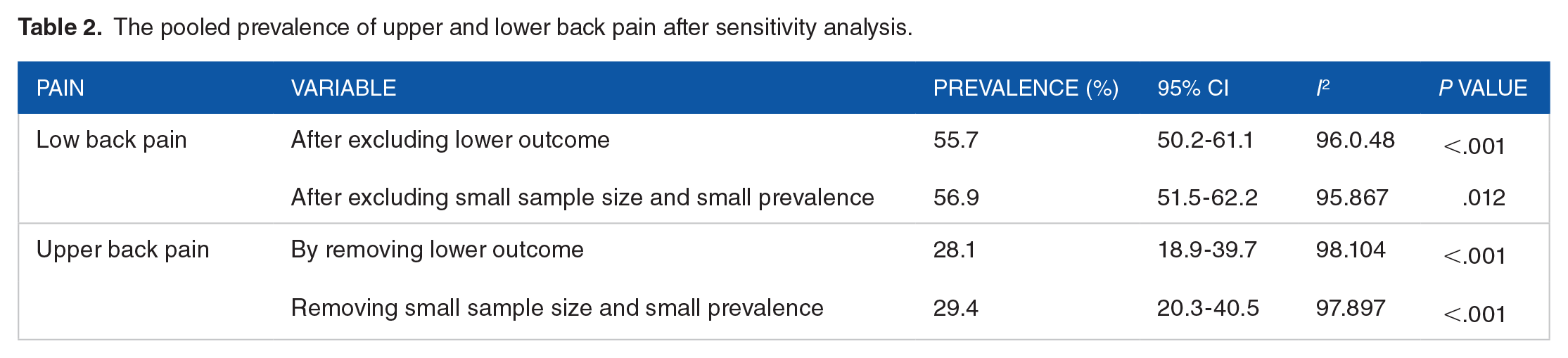
The result of the sensitivity analysis indicated that there was no significant difference between the pooled prevalence, before and after the sensitivity analysis. There is no significant difference between the overall pooled prevalence of upper and low back pain before and after the sensitivity analyzes (Table 2).
The pooled prevalence of upper and lower back pain after sensitivity analysis.
Subgroup analysis based on the outcome
After subgroup analysis was performed based on the outcomes, the pooled prevalence of occupational-related upper and low back pain in the previous year was (54.2% [95% CI: 48.2-60.0]) and (31.0% [95% CI: 21.6-42.3]), respectively (Figure 4).
Publication bias
In this meta-analysis, publication biases were visualized using funnel plots. Publication bias was examined using the Begg and Egger tests. The Begg test found a P-value of .806 and .929 for low back, and upper back pain, respectively. Similarly, Egger tests found a P-value of .8367 and .999 for upper and low back pain, respectively. These results indicated that the probability of publication bias was not statistically significant (Figures 5 and 6).
Discussion
The current study was conducted to determine the pooled prevalence of occupational-related upper and low back pain in Ethiopia (2017-2020). In this study, a total of 9410 study participants, regardless of their occupation categories, were included in the 20 selected articles.15,19,20,28-44 Back pain, such as upper and low back pain are the leading cause of loss of productivity and absenteeism of employees and affects quality of life.50,51 The current study found that the prevalence of low back pain among the Ethiopian working population ranged from 25.5% to 67.3%, which was lower than the finding of another study conducted in Saudi Arabia, which reported the prevalence of low back pain in different professional groups ranged from 64% to 89%. 52
Furthermore, the current study found that the pooled prevalence of occupational-related low back pain was (54.2% [95% CI: 48.2, 60.0]), which was relatively lower than the finding of another study conducted in Africa, which reported a pooled prevalence of 57% of low back pain. 53 The difference may be related to the scope of the study or variation in the implementation of engineering and administrative control measures, low awareness of occupational-related hazards, and physical exercise.
The pooled prevalence of low back pain increased to (61.8% [95% CI: 58.9, 64.6]) and (55.2% [95% CI: 58.4, 59.0]) after subgroup analysis was performed based on publication year and study area, respectively. However, the prevalence of low back pain decreased to (52.8% [95% CI: 51.3, 54.3]), after subgroup analysis was performed based on study participants/occupations. There was variation in the prevalence of low back pain among different study populations or occupations. The variation may be due to differences in occupation or working environments or differences in the implementation of control measures and safety practices. For example, the current study found that the prevalence of low back pain among nurses was 65.4%, which was relatively consistent with the work done in Saudi Arabia and Iran that found that the prevalence of low back pain was 65.0% and 61.2%, respectively.51,54
On the other hand, the current study found that the pooled prevalence of occupational-related upper back pain in the previous year was (27.1% [95% CI: 18.4, 37.9]). However, after subgroup analysis was performed based on publication year, study participants, and study area, the pooled prevalence of upper back pain increased to (43.8% [95% CI: 39.3, 47.7]), (34.7% [95% CI: 33.1, 36.2]), and (36.2% [95% CI: 33.6, 39.0]), respectively. The highest prevalence of work-related upper back pain (60.4%) was reported among pedestrian back-loading women, followed by the prevalence reported among hairdressers (50.4%). The lowest prevalence (10.4%) was reported among vehicle repair workers. Variation may be related to variation in activities, workload, nature of work, and physical exercise.
In general, the current study found that at least 1 out of 4 study participants experienced work-related upper back pain, while 1 out of 2 participants experienced low back pain regardless of occupation categories. Performing physical exercise can reduce low back pain.55-57 “The exercise in combination with education is likely to reduce the risk of low back pain.” 58
Limitations
There was an unequal distribution of occupations among the included articles. On the other hand, the prevalence of upper and low back pain in some regions of Ethiopia was not covered due to the lack of studies in these regions.
Conclusion
Occupational-related upper and low back pain continue to have a potential impact on worker health, productivity, and quality of life worldwide.1-6,10,17,58 This study found that more than half of the participants included experienced low back pain in the previous year, while more than one-fourth experienced upper back pain.
Supplemental Material
sj-docx-1-ehi-10.1177_11786302211067839 – Supplemental material for Occupational Related Upper and Low Back Pain Among the Working Population of Ethiopia: Systematic Review and Meta-Analysis
Supplemental material, sj-docx-1-ehi-10.1177_11786302211067839 for Occupational Related Upper and Low Back Pain Among the Working Population of Ethiopia: Systematic Review and Meta-Analysis by Dechasa Adare Mengistu, Yohannes Mulugeta Demmu and Addisu Alemu in Environmental Health Insights
Footnotes
Acknowledgements
The authors extend their deepest thanks to Haramaya University, Department of Environmental Health staff, for providing their constructive support.
Funding:
The author(s) received no financial support for the research, authorship, and/or publication of this article.
Declaration of conflicting interests:
The author(s) declared no potential conflicts of interest with respect to the research, authorship, and/or publication of this article.
Author Contributions
DAM conceived the idea and played an important role in the review, extraction, and analysis of the data, writing, drafting, and editing of the manuscript. AA and YMD contributed to data extraction, analysis, and editing. Finally, the authors (DAM, AA, and YMD) read and approved the final version of the manuscript to be published and agreed on all aspects of this work.
Availability of Data and Materials
Almost all data are included in this study. However, additional data will be available from the corresponding author upon reasonable request. The PRISMA-P 2015 checklist (Preferred Reporting Items for Systematic Review and Meta-Analysis) is one of the recommended items to address in a systematic review and meta-analysis.

Supplemental Material
Supplemental material for this article is available online.
References
Supplementary Material
Please find the following supplemental material available below.
For Open Access articles published under a Creative Commons License, all supplemental material carries the same license as the article it is associated with.
For non-Open Access articles published, all supplemental material carries a non-exclusive license, and permission requests for re-use of supplemental material or any part of supplemental material shall be sent directly to the copyright owner as specified in the copyright notice associated with the article.
