




Abstract
Cumulative effects of exposure to ionizing radiation results in oxidative-induced damage and genetic mutations that are pre-requisites for many pathologies including cancer. An understanding of term “ionizing radiation,” its injurious effects and mitigation measures is therefore, imperative. The present study aimed at investigating the awareness of the term “ionizing radiation,” its injurious effects and preventive measures among quarry workers within Nyamira County, Kenya. An analytical cross-sectional study design was adopted and data collected through administration of questionnaires. The results revealed that majority of the sampled quarry workers indicated inadequacy in understanding the term “ionizing radiation,” its injurious effects and preventive measures against ionizing radiation exposures. However, it was noted that level of education and working experience of quarry workers positively correlated with the understanding of the term “ionizing radiation,” injurious effects and intervention approaches against ionizing radiation exposures irrespective of gender and age. Therefore, there is need for stakeholders to build capacity on ionizing radiation, its effects, and preventive measures against exposures to ionizing radiation among the quarry workers and the general public.
Introduction
Radiobiology is a branch of clinical science that studies the action and effects of ionizing radiation exposure on living things. 1 Radiation has negative biological effects on living organisms, which may vary depending on the dose and the duration of exposure. 2 Despite some of the experimental and epidemiological studies, a threshold dose of ionizing radiation that could cause cancer in humans has not yet been established.3-4 Globally, it has been assumed that the number of radiation related-illnesses especially cancer could increase from 10.1 million in 2000 to 15.7 million in 2025 which gives a 50% increment. Cancer, one of the radiation illnesses rank third among the main causes of death in the world after infections and cardiovascular diseases. 5 About 5 million people worldwide are exposed to natural and artificial sources of ionizing radiation including high energy UV light, X-rays, gamma rays, and particles (beta, alpha) and neutron emitted by radioactive materials. Miners are usually exposed to radon through inhalation; hence, they are exposed to gamma radiation and alpha particles.6-7 Airline crews are exposed primarily to gamma radiation, as well as neutrons at high altitude. 8 In medical field, radiations are used for treatment but a high and/or long term exposure to the various types of radiations and radionuclides of medical practitioners and patients on diagnostic and treatment activities may elevate biological effects.9-10 International organizations have embraced the challenges imposed by exposure to ionizing radiations and therefore, developing policies, creating awareness and recommending levels for the ionizing radiations with a view to reduce its health detriment to the public . However, there are little or no programs and policies on the awareness of the ionizing radiation in developing countries. 11
Most African countries have no access to screening, diagnosis, treatment and palliative care for radiation-related diseases like cancers due to lack of funds and basic infrastructure whereas there are over a million reported cases of cancer incidence annually.11-13
In Kenya, radiation-related diseases particularly cancer cases are on the increase annually. The total effective dose exposure comes from terrestrial gamma-radiation (0.1-2.0 mSvy−1); cosmic radiation (0.2-0.7 mSv.y−1) and inhalation from radon (222Rn) (0.4-6.0 mSvy−1). The distribution of the population, living habit, relief and geology in Kenya were considered and a report was made that the average effective exposure per annum in Kenya was higher than the global average (3.0 mSvy−1). 14 In Globocan 2018 report in Kenya, 5-year cancer prevalent cases was 31 434 and 55 158 cases for males and females respectively, however, the risk of dying from cancer before the age of 75 years is estimated to be 13.2% for male and 14.8% for female.15-19
In Nyamira County, the recorded cases of radiation-related sicknesses such as lung and skin cancers among the quarry workers and neighboring community dwellers in 2016 accounted for 21% to 23% of the disease burden. 5 One of the postulated causative agent of these pathologies is ionizing radiation especially from rocks that constitutes the building materials of many houses within which the residents dwell. 19 Exposure of human to ionizing radiation even at negligible levels can lead to acute cell disorder. The linear non-threshold model (LNTM) assumes that there is no lower threshold at which stochastic effects occur. Hence, radiation has potential to cause harm at any dose level and the aggregate of several small exposures may cause a stochastic health effect in similar manner to a large radiation dose. It has been noted that radionuclides occurring in trace amount in rocks are the sources of natural ionizing radiation.20-26
Radiation acts primarily by inducing DNA damage in somatic cells through direct energy deposition in DNA or induction of oxidative-mediated DNA damage through facilitated production of free radicals. The ionizing radiation directly cause DNA double-strands breakage while the oxidative-mediated DNA damage often leads to gain or loss of functional mutations.26-36
In Nyamira County where there are high reported incidences of radiation-mediated diseases, it has been noted that hypothetical causative agent is ionizing radiation. These pathologies may be attributed to high radiation emissions from rocks that are mined from various quarries within Nyamira County as established from our previous study. 19 The World Health Organization(WHO) and the International Commission on Radiation Protection(ICRP) reported that certain materials used for the construction of buildings including stones mined from quarries are known to be radioactive and that majority of the people are not aware of ionizing radiations emitted from quarries. Therefore, the present study aimed at evaluating the level of awareness of ionizing radiations exposure among quarry workers in some selected quarries in Nyamira County, Kenya.
Materials and Methods
Research design
A cross-sectional analytical study design with a sub-set representative of the total population of quarry workers in Nyamira County was used at one specific point in time and no follow-ups conducted after completion of the study. The questionnaires were completed under strict control on a one-to-one basis of each participant from every selected quarry. Analytical design was then applied to data collected among the quarry workers after it was cleaned, coded and later exported to the SPSS software for analysis.
Study variables
Independent variables
Independent variables are variables not changed by the other variables being considered for measuring but stand on their own. For this study the variables include the gender of participants, exposure time, the age of workers, as well as the quarry workers’ working experiences.
Dependent variables
Dependent variables rely on other factors. However, the variable considered for the present study was the level of awareness of ionizing radiations among quarry workers because it depends on the factors stated for independent variables.
Study area
Nyamira County (latitude of 0°44′59.99″N and longitude of 35°00′0.00″E) is in the former Nyanza Province of Kenya with mass area of 912.5 km2 (Figure 1). The county area was considered for the present study because it has a larger number of quarries and quarry workers compared to other counties like Kisii County. 19
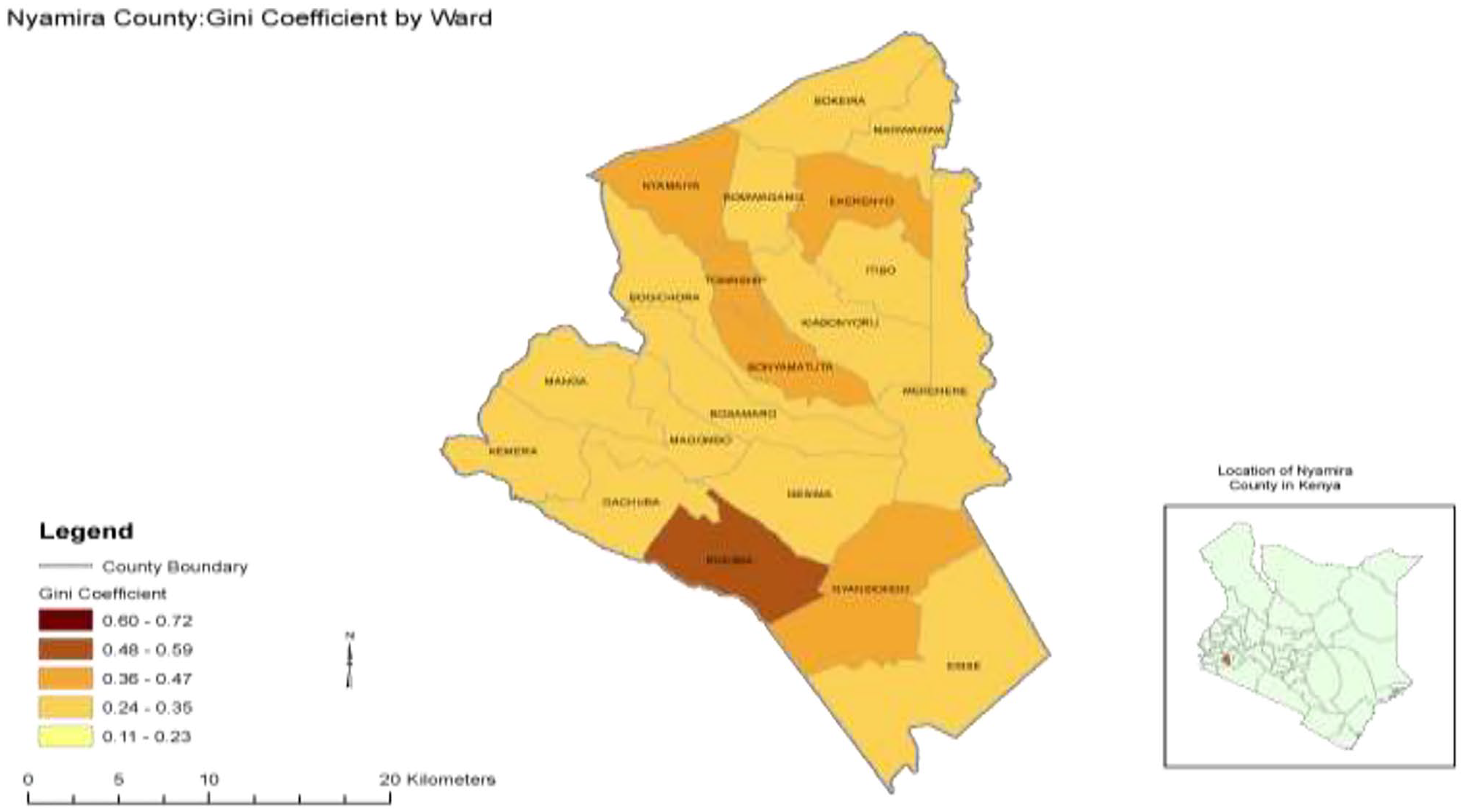
Map of Nyamira County.
Study population
The study population were quarry workers within the quarry sites. The target population sampled 416 quarry workers who met inclusion criteria.
Inclusion criteria
The study included those workers who had worked in the quarry for more than 6 months and those aged above 18 years. It as well included those who gave informed consent in writing, the physically challenged workers whom I was able to handle or had people around themselves who could help them participate in the study.
Exclusion criteria
The study excluded those who were absent from quarry during the study, those not willing to give consent for participation as well as those who are difficult to follow up were excluded for later research.
Sampling techniques
The study area was purposefully selected due to its large number of quarries which are major sources of stones use for building. The number of quarry workers from each sub-county within Nyamira County was determined by proportionate sampling. To determine the number of quarry workers per quarry, proportionate sampling was applied. Simple random sampling technique was used to arrive at the specific participants for the study.
Quarry workers’ sample size determination
The formula given by Yamane and Taro (1976) which assumes that the sample is randomly distributed within the population was used:

where:
n = desired sample size
N = estimate population
e = margin of Error, 0.05 at 95% confidence interval

For the respondents, 10% (38) of the respondents will be added to cater for the non-response. Hence a total of 416 respondents will be interviewed.
Data collection tools
The study used questionnaires to collect data on the levels of awareness on ionizing radiations from the selected primary respondents who were the quarry workers in quarry sites within sub-counties in Nyamira County.
Pilot study and pretesting of study tools
Prior to the main study, the questionnaires were pretested at 5 different quarries in Kisii County due to its proximity and similarity in environmental conditions. The pretest exercise was to determine the questionnaires’ validity.
Validity
Riedl et al 37 ; states, validity is the ability of a research instrument to measure what it is intended to measure. To enhance internal validity, a random sampling method was used to enhance representativeness of the selected population (limiting to quarries workers) and pretesting of the tools was done. To enhance content validity, expert opinion from supervisors and other researchers was sort and their inputs taken into account in the development of the questionnaires.
Reliability
Reliability is the degree to which a research tool can be depended upon to yield consistent results if used by 2 researchers or used repeatedly overtime on the same study. Hence, it is all about precision, consistency, and accuracy of the research instrument. 37 The test and retest technique was adopted to ensure the reliability of the questionnaires twice over a period of time in the quarries. The research assistant was properly selected and well trained.
Data collection procedures
Administration of questionnaires
Interviews were conducted with the help of standard structured questionnaires which had 2 sections. The first part was to obtain participants’ demographic data (age, gender, level of education, and work experience) and the second part was used to evaluate participants to obtain the levels of awareness of ionizing radiation.
Data management and statistical analysis
The data from the questionnaires were coded, entered into Microsoft Excel and later exported to SPSS Software, version 23.0 (IBM, USA) for statistical analysis. Descriptive statistics of frequency and percentages were used for demographic characteristics. Differences in the distribution of awareness responses among the quarry workers were evaluated using both chi-square and Fisher’s exact to test for the significant association. The value P ⩽ .05 was considered statistically significant for the study.
Ethical approval
The research protocols and procedures used were approved by the Ethics Committee of Kenyatta University and National Commission for Science and Technology (NACOSTI), Kenya of serial number A 25486.
Results
Awareness of the term “ionizing radiation” among quarry workers in Nyamira County
The results indicated that among the 416 quarry workers who were interviewed in this study, 15.6% (65 respondents) were aware of the term “ionizing radiation” in Nyamira County. The majority of the quarry workers lacked the awareness of the term “ionizing radiation” as shown in Table 1.
Level of awareness of ionizing radiation among quarry workers in Nyamira County, Kenya.

The values in parenthesis indicate the ratio of respondents to the sampled population expressed in percent.
Awareness of the term “ionizing radiation” among quarry workers with regard to gender
Regarding the gender of quarry workers, the results exhibited that there was no significant association on the awareness of the term “ionizing radiation” in Nyamira County, Kenya (P > .05) as shown in Table 1. 83.8% of the male respondents who constituted a majority of the quarry workers lacked the awareness of the term “ionizing radiation” and only 16.2% were aware of the term. Moreover, 87.7% of the female respondents did not have any awareness of the term “ionizing radiation” and only 12.3% have the awareness of the term as shown in Table 1 and depicted in Figure 2.

Bar charts showing percentage of quarry workers with and without awareness of the term “ionizing radiation” with regard to gender.
Awareness of the term “ionizing radiation” among quarry workers with regard to age
As observed in Table 1, 88.9% representing 36 respondents with less than or equal to age 20 years were not aware of the term “ionizing radiation,” and only 11.1% which was represented by 2 respondents have awareness of the term “ionizing radiation.” For the age group of 20 to 29 years made up of 160 respondents, 83.8% (corresponding to 134 respondents) were not aware of the term “ionizing radiation” while only 16.2% were aware of the term “ionizing radiation.” For the age group 30 to 39 years made up of 145 respondents, 126 respondents (equivalent to 86.9%) did not have the knowledge or awareness of the term “ionizing radiation” and only 13.1% were aware of the term. The age group of 40 to 49 was made up of 55 respondents; out of these, 78.2% (corresponding to 43 respondents) did not have any awareness of the term “ionizing radiation” while only 21.8% were aware of the term. As observed in Table 1, the number of respondents above 50 years of age were 20; while 4 respondents have the knowledge of the term “ionizing radiation,” 16 were not aware of the term in Nyamira County. As depicted in Table 1 the significance level P > .05 was achieved for the age group among the workers in Nyamira County quarries. Figure 3 shows the bar charts for percentage of workers who were either aware or unaware of the term “ionizing radiation.”

Bar charts showing percentage of quarry workers with and without awareness of the term “ionizing radiation” with regard to age.
Awareness of the term “ionizing radiation” among quarry workers with regard to levels of education
There were 11 respondents with no formal education and from the results, it was exhibited that 90.9% of the respondents were not aware of the term “ionizing radiation” and only 1 respondent (corresponding to 9.1%) indicated awareness of the term. Those respondents with a primary level of education were 92 and it was observed that 84 respondents equivalent to 91.3% were not aware of the term “ionizing radiation” while only 8.7% (8 respondents) were aware of the term. 293 respondents were secondary school certificate holders, 84.6% (equivalent to 248) of the respondents were unaware of the term “ionizing radiation”; however, only 15.4% (equivalent to 45) were aware of the term. 20 respondents have tertiary education, 45.0% (equivalent to 9) of the respondents were aware of the term “ionizing radiation” and 55.0% (equivalent to 11) have no knowledge of the term “ionizing radiation.” There was a significant association between having awareness of the term “ionizing radiation” and level of education among quarry workers in Nyamira County, Kenya (P < .05) as shown in Table 1 and Figure 4 depicted the bar chart for the level of education and the awareness of the term “ionizing radiation.”

Bar charts showing percentage of quarry workers with and without awareness of the term “ionizing radiation” with regard to level of education; asterisks (*) indicate statistically significant difference.
Awareness of the term “ionizing radiation” among quarry workers with regard to working experience
The respondents who had an experience of less than 1 year were 24 and it was noted that all of them (100.0%) lacked the awareness of the term “ionizing radiation.” The result indicated that 173 respondents have 1 to 3 years’ experience. 147 (85.0%) of the respondents were not aware of the term ionizing radiation and only 26 (15.0%) have the knowledge of the term. There were 128 respondents with working experience of 4 to 6 years and it was observed that 82.0% which corresponds to 105 respondents lacked the awareness of the term “ionizing radiation” while 18.0% (23 respondents) indicated awareness of the term “ionizing radiation.” The respondents with 7 to 9 years working experience were 72. However, 64 (88.9%) were not aware of the term ionizing radiation and the remaining 8 (11.1%) have the knowledge of the term (Figure 5). The final group of respondents with working experience greater than 9 years were 19. The result presented in Table 1 indicated that only 8 respondents were aware of the term “ionizing radiation” and the remaining 11 respondents have no knowledge in the quarries in Nyamira County, Kenya. The association between the year of experience and awareness of the term “ionizing radiation” achieved significant variation, P < .05, among the respondents working in quarries within Nyamira County, Kenya.

Bar charts showing percentage of quarry workers with and without awareness of the term “ionizing radiation” with regard to working experience; asterisks (*) indicate statistically significant difference.
Awareness of the term “ionizing radiation” among quarry workers in sub-counties in Nyamira County, Kenya
Manga sub-county had 25 respondents and 18 respondents equivalent to 72.0% were not aware of the term “ionizing radiation” while 7 respondents (28.0%) indicated awareness of the term. Masaba North Sub-County as well had 45 respondents, out of which 82.2% (37 respondents) lacked the awareness of the term “ionizing radiation” and only 17.8% (8 respondents) were aware of the term (Figure 6). Furthermore, it was observed that Nyamira North with 25 respondents had 22 respondents (88.0%) not aware of the term “ionizing radiation” while 3 respondents corresponding to 12% were aware of the term. Borabu sub-county had 120 respondents out of which 109 respondents representing 90.8%, did not have any awareness of the term “ionizing radiation” and only 9.2% (11 respondents) have awareness of the term. As also being observed in Table 1, the results showed that out of 201 respondents in Nyamira South Sub-County, 167 respondents corresponding to 83.1% did not have any awareness of the term “ionizing radiation.” The significant level between having awareness of the term “ionizing radiation” and sub-counties in Nyamira County, Kenya is P > .05 which shows no significant association.
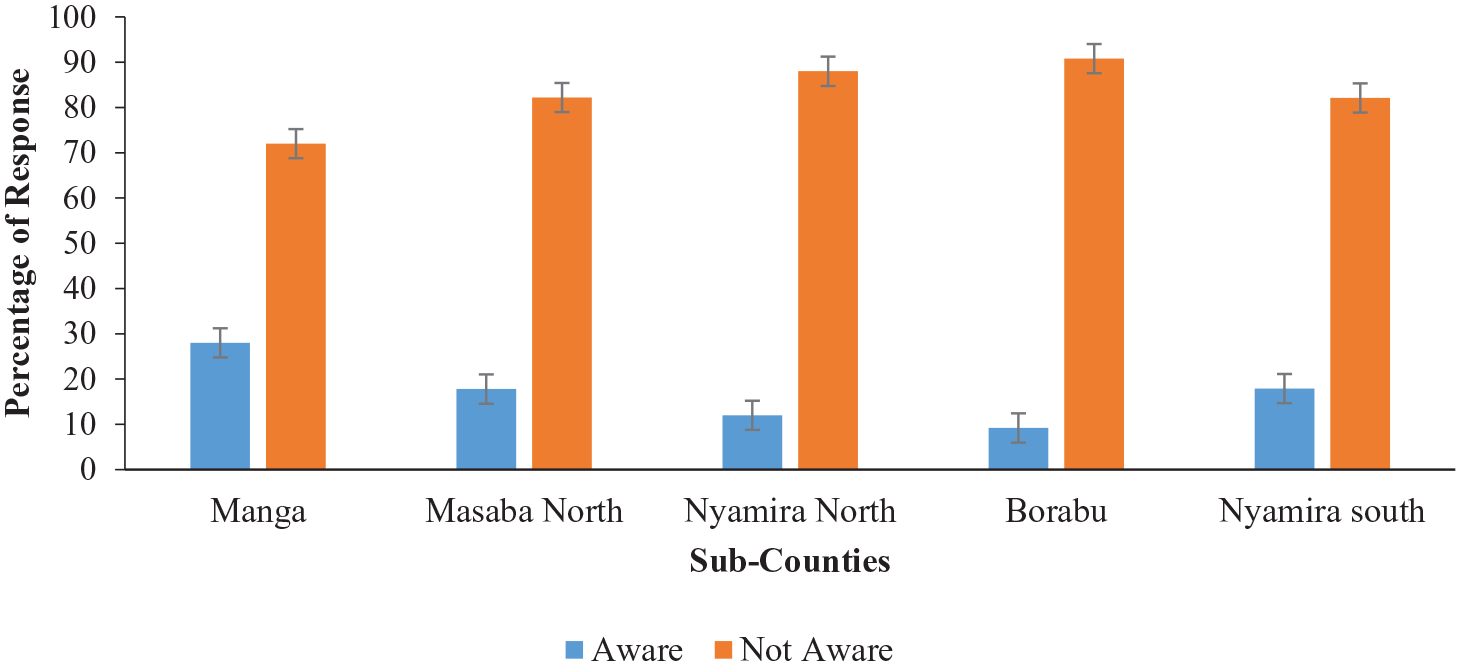
Bar charts showing percentage of quarry workers with and without the awareness of the term “ionizing radiation” in the sub-counties of Nyamira County.
Awareness of injurious effects of exposure to ionizing radiation among quarry workers in Nyamira County
As presented in Table 1, the results indicated that out of 416 quarry workers interviewed, only 33 respondents (7.9%) were aware of the injurious effects of exposure to ionizing radiation in Nyamira County, Kenya. The majority, 383 respondents (92.1%) were unaware of the injurious effect of ionizing radiation.
Awareness of the injurious effects of exposure to ionizing radiation among quarry workers with regard to gender
As exhibited in Table 1, there were 359 males and 57 females who participated as respondents in this study. The results showed that 91.6% representing 329 respondents, lacked the awareness of the injurious effects of exposure to ionizing radiation while only 8.4% (30 respondents) knew the injurious effects of exposure to ionizing radiation. Further, it was noted that out of the 57 female respondents, 54 female respondents did not have any awareness on the injurious effects of exposure to ionizing radiations while only 3 female respondents representing 5.3%, were aware of the injurious effects of exposure to ionizing radiation. The significant level, P > .05 between the gender of the selected quarry workers and the awareness of the injurious effects of exposure to ionizing radiation in Nyamira County, Kenya, shows no serious association. However Figure 7 shows the percentage of quarry workers with and without awareness of injurious effects of exposure to ionizing radiation with regard to gender.

Bar charts showing percentage of quarry workers with and without awareness of injurious effects of exposure to ionizing radiation with regard to gender.
Awareness of the injurious effects of exposure to ionizing radiation among quarry workers with regard to age
As shown in Table 1, the entire 36 respondents with age less than or equal to 20 years were unaware of the injurious effects of exposure to ionizing radiation. It was observed that the age group 21 to 29 years with 160 respondents had 150 respondents (equivalent to 93.8%) who showed to have no awareness of the injurious effects of exposure to ionizing radiation while 6.2% corresponding to 10 respondents were aware of the injurious effects of exposure to ionizing radiation. The result also indicated that the age group 30 to 39 had 145 respondents and 93.1% equivalent to 135 respondents lacked the awareness of the injurious effects of exposure to ionizing radiation and only 6.9% (10 respondents) were aware of the injurious effects of exposure to ionizing radiation. Additionally, it was shown that out of the 55 respondents with 40 to 49 years, 85.5% of them were not aware of the injurious effects of exposure to ionizing radiation. The age group of greater than 50 years comprised 20 respondents. Only 5 (25.0%) respondents have the knowledge of the injurious effects of exposure to ionizing radiation and 15 (75.0%) lacked the awareness of the injurious effects of exposure to ionizing radiation (Figure 8). It was observed that the awareness of injurious effects of ionizing radiation and age groups achieved significant association with P < .05, among the respondents (quarry workers) in Nyamira County.

Bar charts showing percentage of quarry workers with and without awareness of the injurious effects of ionizing radiation with regard to age group; asterisks (*) indicate statistically significant difference.
Awareness of injurious effects of exposure to ionizing radiation among quarry workers with regard to levels of education
Among the quarry workers in Nyamira County who participated in the study, those who had no formal education, primary education, secondary education and tertiary education were 11, 92, 293, and 20 respondents, respectively as observed in Table 1. The results showed that out of the 11 respondents with no formal education, 90.9% of them did not have any knowledge of the injurious effects of exposure to ionizing radiation. For the respondents with primary education, 97.8% equivalent to 90 respondents were not aware of the injurious effects of exposure to ionizing radiation and only 2 respondents (2.2%) were aware of the injurious effects of exposure to ionizing radiation. Majority of the respondents have secondary education. Out of 293 respondents with secondary education, 274 corresponding to 93.5% were not aware of the injurious effects of exposure to ionizing radiation, and only 6.5% (19 respondents) indicated awareness of the injurious effects of exposure to ionizing radiation. Out of 20 respondents who had tertiary education, 9 respondents equivalent to 45.0% lacked the awareness of the injurious effects of exposure to ionizing radiation and 55.0% equivalent to 6 respondents were aware of the injurious effects of exposure to ionizing radiation. The results showed that there was a significant difference with P < .05, in the awareness of the injurious effects of ionizing radiation and level of education among quarry workers in Nyamira County, Kenya. Figure 9 shows the percentage of quarry workers with awareness of injurious effect of exposure to ionizing radiation by level of education
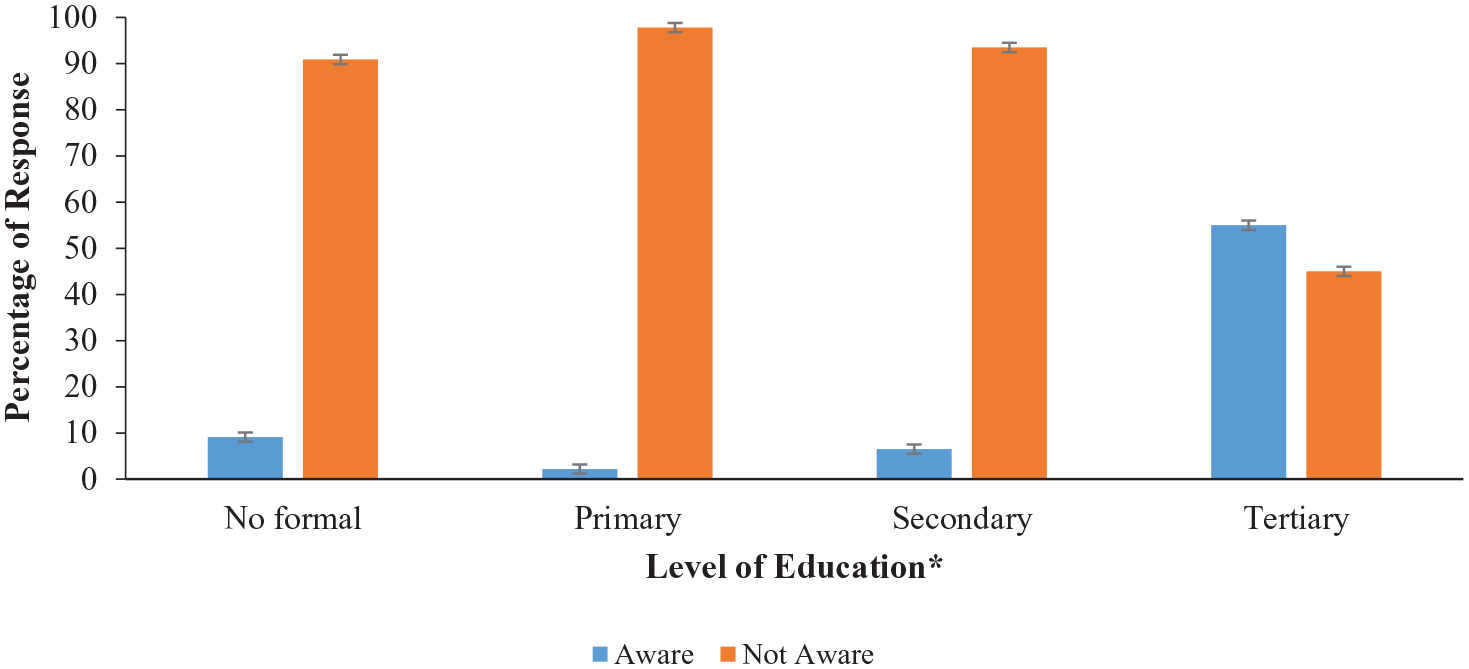
Bar charts showing percentage of quarry workers with and without awareness of injurious effect of exposure to ionizing radiation with regard to levels of education; asterisks (*) indicate statistically significant difference.
Awareness of the injurious effects of exposure to ionizing radiation among quarry workers regarding working experience
As shown in Table 1 and Figure 10, the respondents with less than 1 year experience were 24 and it was noted that the whole of them (100.0%) were not aware of the injurious effects of exposure to ionizing radiation and respondents with 1 to 3 years working experience were 173 respondents, and 94.8% that corresponds to 164 respondents did not have any knowledge of the injurious effects of exposure to ionizing radiation, and only 9 respondents(5.2%) were aware of the injurious effects of exposure to ionizing radiation. Moreover, there were 128 respondents with 4 to 6 years of working experience and it was observed that 92.2% which corresponds to 118 respondents lacked the awareness of the injurious effects of exposure to ionizing radiation and only 7.8% (10 respondents) responded that they were aware of the injurious effects of exposure to ionizing radiation. Additionally, the results of those respondents with 7 to 9 years working experience who were a total of 72 respondents, showed that 91.7% which corresponds to 66 respondents did not have any awareness of the injurious effects of exposure to ionizing radiation. The final group of respondents with working experience of greater than 9 years were 19 respondents, out of which 11 respondents representing 57.9% lacked knowledge of ionizing radiation and only 8 respondents indicated that they were aware of the injurious effects of exposure to ionizing radiation in quarries within Nyamira County, Kenya. The association between working experience and level of awareness of injurious effects of ionizing radiation achieved a significant variation among the respondents working in quarries in Nyamira County, Kenya (P < .05).

Bar charts showing percentage of quarry workers with and without awareness of the injurious effect of exposure to ionizing radiation with regard to work experience; asterisks (*) indicate statistically significant difference.
Awareness of injurious effects of exposure to ionizing radiation among quarry workers in sub-counties
Out of 25 respondents in Manga Sub-County and out of these, 19 respondents (76.0%), have no knowledge of the injurious effects of exposure to ionizing radiation. Masaba North Sub-County has 45 respondents and 41 (91.1%) indicated unawareness of the injurious effects of exposure to ionizing radiation and only 8.9% (4 respondents) were aware of the injurious effects of exposure to ionizing radiation. There were 25 respondents in Nyamira North Sub-County and 23 respondents equivalent to 92.0% lacked the awareness of the injurious effects of exposure to ionizing radiation and only 8.0% were aware of the injurious effects of exposure to ionizing radiation. Borabu Sub-County have 120 respondents and 94.2% (113 respondents) did not know that ionizing radiation is injurious to human health and only 7 respondents (5.8%) indicated awareness of the injurious effects of exposure to ionizing radiation. Nyamira South Sub-County have 201 respondents and 187 respondents corresponding to 93.0% lacked the awareness of the injurious effects of exposure to ionizing radiation while only 14 respondents (7.0%) were aware of the injurious effects of exposure of ionizing radiation (Figure 11). With P > .05, the results indicated that there was no significant association between awareness of the injurious effects of exposure to ionizing radiation and sub-counties in Nyamira County, Kenya.
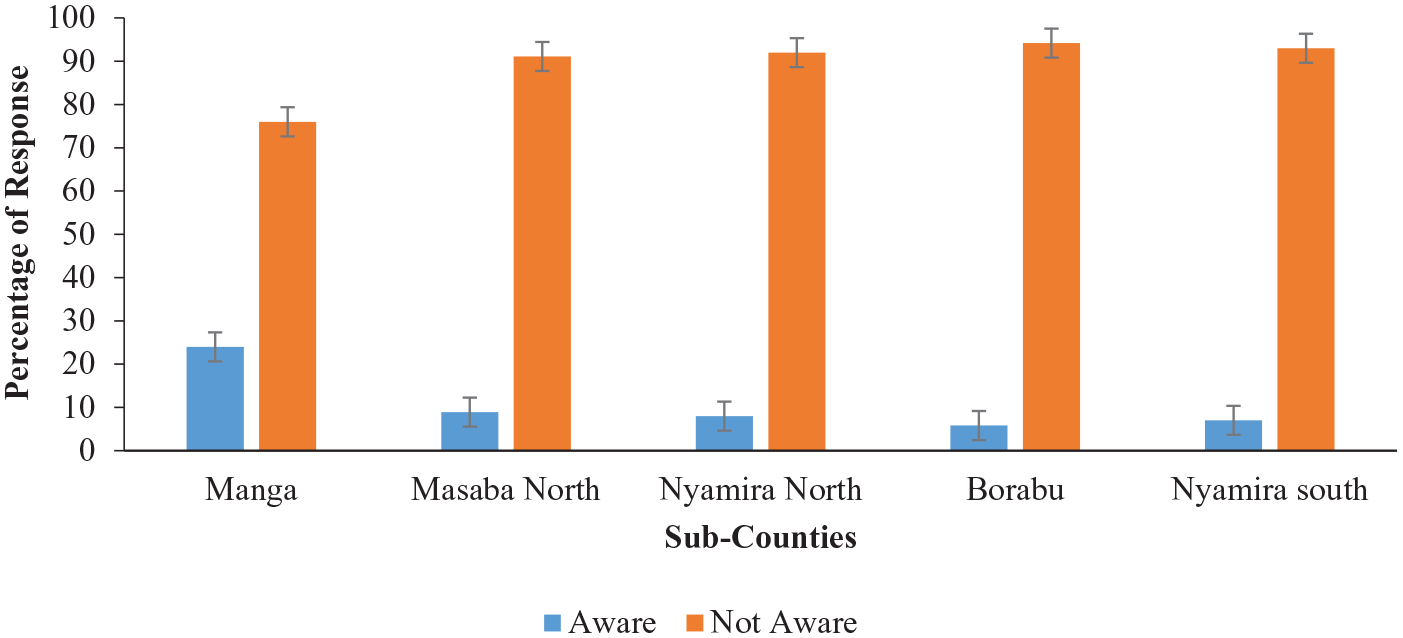
Bar charts showing percentage of quarry workers with and without awareness of injurious effect of exposure to ionizing radiation in Sub-Counties.
Awareness of the preventive measures for exposure to ionizing radiation among quarry workers
The results indicated that only 5.5% (23 respondents) of the entire respondents for the study were aware of preventive measures for exposure to ionizing radiation and the majority, 393 (94.5%) did not know that there were preventive measures for exposure to ionizing radiation.
Awareness of the preventive measures for exposure to ionizing radiation among quarry workers regarding gender
Out of the total respondents who participated in this study in Nyamira County, 359 were male and 339 (94.4%) among them were unaware of the preventive measures for exposure to ionizing radiation while only 20 respondents (5.6%) were aware of the preventive measures for exposure to ionizing radiation. There were 57 female respondents and 54 respondents representing 95.7% did not have the knowledge of the preventive measures for exposure to ionizing radiation while only 3 respondents (5.3%) have the knowledge of the preventive measures for exposure to ionizing radiation in Nyamira County (Figure 12). The value P > .05 indicated that, there was no significant difference between the quarry workers with gender and the level of awareness of the preventive measures for exposure to ionizing radiation in Nyamira County, Kenya.

Bar charts showing percentage of quarry workers with and without the awareness of the preventive measures for exposure to ionizing radiation by their gender.
Awareness of preventive measures for exposure to ionizing radiation among quarry workers with regard to age
As could be seen from Table 1 and Figure 13, the entire 36 quarry workers in Nyamira County with age groups less than or equal to 20 years were never aware of the preventive measures for exposure to ionizing radiation. The respondents in the age group, 20 to 29 years were 160 and 96.2% corresponding to 154 respondents have no knowledge of the preventive measures for exposure to the ionizing radiation while 4.1% (6 respondents) indicated awareness of the preventive measures for exposure to the ionizing radiation. Additionally, respondents in the group of 30 to 39 years were 145 and 95.9% of the total respondents indicated lack of the awareness of the preventive measures for exposure to the ionizing radiation. The respondents in the group of 40 to 49 years were 55 and 87.3% of the total respondents lacked awareness of the preventive measures for exposure to the ionizing radiation and only 12.7% (7 respondents) were aware of the preventive measures for exposure to the ionizing radiation. The group of respondents with age greater than 50 years were 20 respondents and 16 respondents indicated that they were not aware of the preventive measures for exposure to the ionizing radiation while 4 respondents indicated the awareness of the preventive measures for exposure to the ionizing radiation. The value of P < .05 indicated that the awareness of preventive measures for exposure to the ionizing radiation and age groups achieved significant association among respondents working in quarries at Nyamira County.

Bar charts showing percentage of quarry workers with and without awareness of preventive measures for exposure to ionizing radiation with regard to age groups; asterisks (*) indicate statistically significant difference.
Awareness of preventive measures for exposure to ionizing radiation among quarry workers with regard to level of education
As could be observed from Table 1, respondents who had no formal education were 11 and 90.9% have no knowledge of the preventive measures for exposure to the ionizing radiation. Those with primary education were 92 and out of whom 90 respondents (97.8%) lacked awareness on the preventive measures for exposure to the ionizing radiation while only 2 respondents (2.2%) were aware of the preventive measures for exposure to the ionizing radiation. Moreover, there were 293 respondents with a secondary school education and 282 respondents corresponding to 96.2% lacked the awareness on the preventive measures for exposure to the ionizing radiation while only 11 respondents were aware of the preventive measures for exposure to the ionizing radiation. Further, the respondents with tertiary education were 20 and 11 respondents (55.0%) lacked awareness of the preventive measures for exposure to the ionizing radiation while 9 respondents (45.0%) have the knowledge of preventive measures for exposure to the ionizing radiation in Nyamira County. With the of P < .05, the study showed that there was a significant difference between the awareness of preventive measures for exposure to the ionizing radiation and level of education among quarry workers in Nyamira County, Kenya. However, Figure 14 shows the bar diagrams for awareness on preventive measures for exposure to ionizing radiation and the level of education.
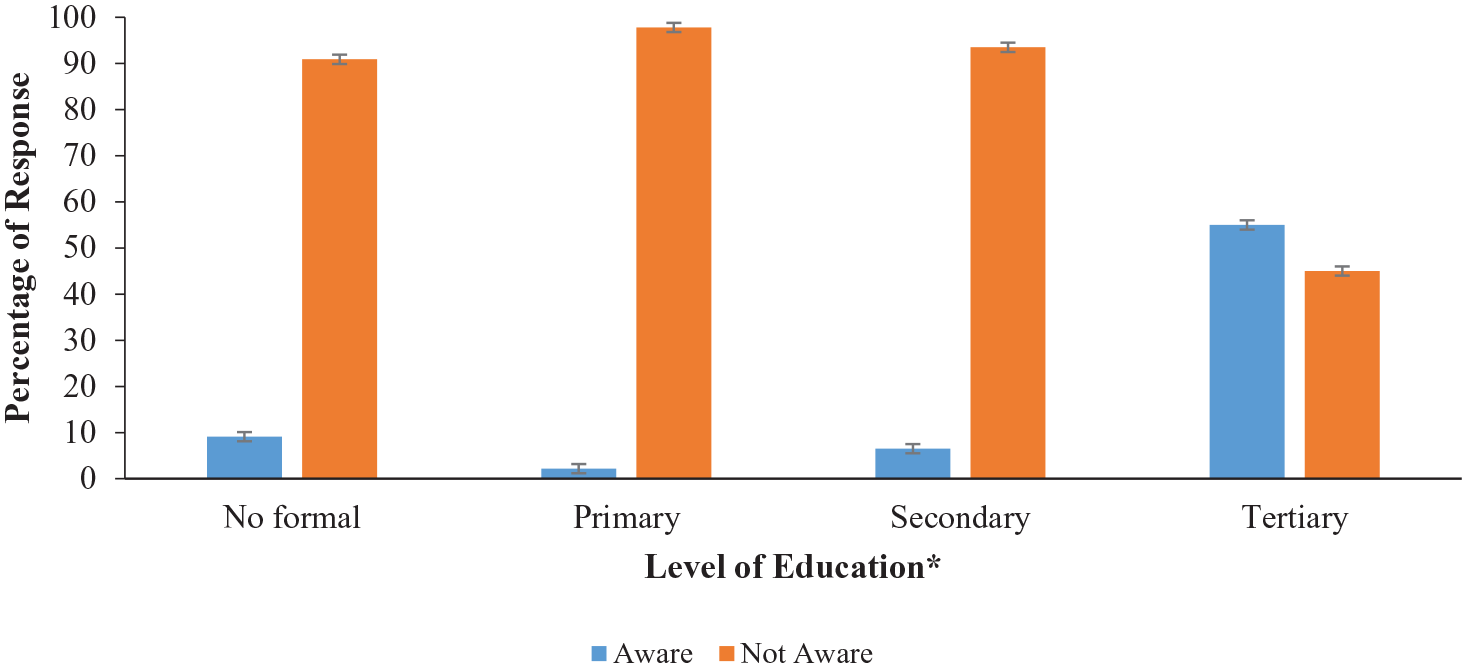
Bar charts showing percentage of quarry workers with and without awareness on preventive measures for ionizing radiation regarding the level of education; asterisks (*) indicate statistically significant difference.
Awareness of preventive measures for exposure to ionizing radiation among quarry workers regarding working experience
The quarry workers who had an experience of less than 1 year were 24 respondents and the entire 24 respondents (100.0%) lacked the awareness on the preventive measures for exposure to the ionizing radiation. The respondents with 1 to 3 years of working experience were 173 and out of these, 166 respondents corresponding to 96.0% lacked the awareness of preventive measures for exposure to the ionizing radiation while 4.0% (7 respondents) were aware of the preventive measures for exposure to the ionizing radiation. Those with 4 to 6 years working experience were 128 respondents and out of these, 95.3% corresponding to 122 respondents lacked the awareness on the preventive measures for exposure to the ionizing radiation. Furthermore, there were 72 respondents with 7 to 9 years working experience, 95.8% corresponding to 69 respondents did not have any awareness of the preventive measures for exposure to the ionizing radiation and only 4.2% (3 respondents) were aware of the preventive measures for exposure to the ionizing radiation. Additionally, 19 respondents have greater than 9 years of working experience and 63.2% (12 respondents) were not aware of the preventive measures for exposure to the ionizing radiation in quarries within Nyamira County, Kenya. The value of P < .05 indicated that the association between working experience and awareness of the preventive measures for exposure to ionizing radiation achieved a significant variation among the respondents working in quarries within Nyamira County, Kenya. Figure 15, illustrated the bar charts of the quarry workers with and without awareness of preventive measures for exposure to ionizing radiation based on working experience.

Bar charts showing percentage of quarry workers with and without awareness on the preventive measures for exposure to ionizing radiation with regard to working experience; asterisks (*) indicate statistically significant difference.
Awareness of preventive measures for exposure to ionizing radiation among quarry workers in Sub-Counties
It was noted that Manga Sub-County had 25 respondents, out of which 19 respondents (76.0%) indicated non-awareness of the preventive measures for exposure to the ionizing radiation while 24.0% (6 respondents) indicated awareness of the preventive measures for exposure to the ionizing radiation. Similarly, Masaba North sub-county had 45 respondents,41 respondents corresponding to 91.1% were not aware of the preventive measures for exposure to the ionizing radiation while 8.9% (4 respondents) indicated awareness on the preventive measures for exposure to the ionizing radiation. The result further showed that Nyamira North sub-county have 25 respondents, with 24 respondents representing 96.0% indicated non-awareness of the preventive measures for exposure to the ionizing radiation while 4.0% (1 respondent) was aware of the preventive measures for exposure to the ionizing radiation. Borabu sub-county had 120 respondents and 117 respondents (97.5%) indicated non-awareness of the intervention approaches for exposure to the ionizing radiation while only 3 respondents were aware of the preventive measures for exposure to the ionizing radiation. However, Nyamira South sub-county have 201 respondents, 192 respondents corresponding to 95.5% were not aware of the preventive measures for exposure to the ionizing radiation while 4.5% (9 respondents) were aware of the preventive measures for exposure to the ionizing radiation (Figure 16). The value of P < .05 indicated that there was a significant association on awareness of preventive measures for exposure of ionizing radiation at sub-counties in Nyamira County, Kenya.

Bar charts showing percentage of quarry workers with and without awareness of preventive measures for exposure to ionizing radiation in Sub-Counties; asterisks (*) indicate statistically significant difference.
Discussion
Radiobiology studies the action and effects of ionizing radiation exposure on cellular and sub-cellular components. Ionizing radiation could be of natural or artificial origin. Natural background radiation is terrestrial radiation and is due to radioactive nuclides present in varying amounts in rocks, building materials, water, soils and atmosphere. Natural radionuclides of uranium (238U), thorium (232Th), and potassium (40K) are present in the earth’s crust. When these parental radionuclides and their daughter radionuclides in the series undergo decays they release gamma rays, beta and alpha radiations into the environment. Therefore, human beings are continuously exposed to ionizing radiation both inside and outside depending on the radionuclides distribution and radiation levels in the environment is important so as to be equipped with knowledge on the biological effects of radiation exposures and take appropriate intervention approaches. 38
The present study revealed that majority of the sampled population (quarry workers) within Nyamira County indicated inadequacy in understanding of the term “ionizing radiation.” However, the results revealed that quarry workers with tertiary and secondary levels of education showed a better understanding of the term “ionizing radiation” as compared to those of lower level of education (primary and no formal). These results therefore, suggest that the level of education correlates with awareness of the term “ionizing radiation” among quarry workers in Nyamira County. Furthermore, the study revealed that majority of quarry workers with a working experience of 1 to 3 years coupled with tertiary level of education were aware of the term “ionizing radiation” irrespective of gender and age. Consistent with these results, study done by Abuelhia revealed that 44% of doctors and 19% of students were unaware of the overall knowledge on “ionizing radiation” emitted by MRI and ultrasound in University of Dammam and King Fahad University Hospital. 39
In regard to the awareness of the injurious effects and intervention approaches due to ionizing radiation exposures, the present study revealed that majority of the sampled quarry workers were unaware of the injurious effects of ionizing radiation and mitigation measures thereof. However, those respondents with a higher level of education (tertiary and secondary) and with a working experience of 1 to 3 years and of age group 20 to 39 years indicated a better understanding of the injurious effects and preventive measures for ionizing radiation–induced effects than those quarry workers with the primary or no formal education of the same category. These therefore, indicates that the level of education and working experience correlates with awareness of the injurious effects and preventive measures for ionizing radiation-induced pathologies. Similarly, a radiological awareness study conducted in Kontagora, Niger State, Nigeria where a total of 35 lecturers and 75 students who were randomly selected from 5 colleges showed that 28.6% of lecturers and 42.7% of students had inadequate knowledge of the “terrestrial ionizing radiation” and its health detriments on humans. 40
Previous studies have shown that naturally occurring radionuclides become trapped in the earth’s crust during the formation of the parent rocks and end up in soils as part of the rock cycle through weathering.41-43 These studies revealed that the radionuclides may show a distinct variation in the radiation level in any environment based on many factors such as geographical and local geology of the area studied.41-43 The relatively high levels of ionizing radiation may be attributed to the quarrying activities which can enhance the natural background radiation levels by bringing out a large amount of otherwise buried materials containing naturally occurring radioactive materials onto the surface of the environment.2,44
According to Kamara and Dunn, 32 any exposure to ionizing radiation tends to change the biological make-up of the human body which may result in radiation-induced diseases. Further, the high radiation levels may be due to the presence of radioactive elements such as Uranium and Thorium in construction stones thereby contributing to the background radiation. 19 Besides, building stones that originate from igneous rocks which are believed to be rich in radioactive minerals such as Zircon, Monazite, Uranite, Potassium, Feldspars, and Biotite also contribute to the ionizing radiation. 2 Acute or chronic exposure to ionizing radiation by quarry workers or dwellers of buildings constructed from radioactive minerals predisposes them to ionizing radiation-induced oxidative stress and genetic mutations.2,45,46
Conclusion
The present study revealed that majority of the sampled population (quarry workers) within Nyamira County indicated inadequacy of an understanding of the term “ionizing radiation,” its injurious effects and intervention approaches of ionizing radiation. However, it was noted that the level of education and working experience of quarry workers positively correlated with the understanding of the term “ionizing radiation,” injurious effects and intervention approaches of ionizing radiation irrespective of gender and age. Therefore, there is need for capacity building on the understanding of the ionizing radiation, its injurious effects and mitigation measures on its exposures. Moreover, the annual cancer incidence index per 100 000 and annual severity index per 1000 working hours in Nyamira County should be followed as suggested by Nyamira County Multiple Indicator Survey (MICS) and Kenya National Bureau of Statistics (KNBS).
Footnotes
Acknowledgements
The authors wish to acknowledge the Department of Environmental and Occupational Health of Kenyatta University for the support accorded during the study. Authors also acknowledge Mr Phillip Ogola and Mr James Kimani of the Department of Biochemistry, Microbiology and Biotechnology of Kenyatta University for guidance in data collection and statistical analysis.
Authors Contributions
MKR carried out the study and wrote the manuscript. JN, PNW, and WA contributed to conception of the review and supervised the manuscript writing. All authors have read and approved the final manuscript.
Funding:
The author(s) received no financial support for the research, authorship, and/or publication of this article.
Declaration of conflicting Interests:
The author(s) declared no potential conflicts of interest with respect to the research, authorship, and/or publication of this article.
