




Abstract
Camelina is a resilient oilseed crop, but its productivity in acidic soils is limited by phosphorus fixation and poor soil fertility. This study examined the combined use of coffee husk biochar and triple superphosphate (TSP) fertilizer to improve soil properties, oil yield, and the nutritional quality of camelina seed cake in the acidic soils of the Hadiya Zone, Central Ethiopia. A split–split plot design was implemented during the 2024 cropping season using two cultivars (Zeytee-1 and Syria), four TSP rates (0, 23, 46, and 69 kg ha-1), and four biochar rates (0, 10, 12, and 14 t ha-1). Integrated biochar and TSP application significantly enhanced soil pH, total nitrogen, available phosphorus, and cation exchange capacity, with the highest amendment levels increasing available P to 45.3 ppm and CEC to 18.4 cmol kg-1. Oil content improved with increasing TSP, reaching 45.7% in the Syria cultivar, while biochar reduced peroxide value, indicating better oil stability. Seed cake quality also improved, with crude protein rising to 39.2% and fiber fractions (ADF and NDF) increasing under higher amendment rates. Economic analysis showed that the greatest net benefit was achieved with moderate inputs (23 kg TSP ha-1 and 14 t biochar ha-1 for Syria), highlighting that economic optima differ from maximum yields. Overall, integrating biochar with TSP effectively ameliorated soil acidity, enhanced soil fertility, and improved both the quantity and quality of camelina products, offering a sustainable intensification strategy for acidic agroecosystems.
Keywords
Introductions
Camelina (Camelina sativa L. Crantz) is increasingly recognized as a versatile and high-potential oilseed crop owing to its remarkable adaptability, resilience to environmental stresses (Manore & Ayalew, 2025), and wide range of applications in the food, feed, cosmetic, and biofuel industries (Ghidoli et al., 2023). Despite its global resurgence, camelina remains largely underutilized in Ethiopia, even though its agronomic traits suggest strong suitability across diverse agro-ecological zones. Recent evidence indicates that camelina responds favorably to improved nutrient management and can perform well under low-input conditions, making it a promising candidate for sustainable intensification in Ethiopian farming systems (Manore et al., 2025). Studies have further shown that agroecological variation and sowing dates significantly influence camelina yield, oil content, and nutritional attributes (Yohannes et al., 2025), while the application of NP fertilizers has been reported to enhance its growth and productivity under Ethiopian conditions (Sido et al., 2023).
Beyond yield, management practices that improve soil fertility particularly organic amendments play a critical role in determining oil quality and the nutritional composition of camelina seed cake, which is increasingly valued as a protein-rich livestock feed (Angelopoulou et al., 2023; Mohan et al., 2024). Among these amendments, biochar has gained considerable attention for its capacity to improve soil physicochemical properties (Dogu et al., 2021), enhance nutrient retention, and increase crop productivity (Ippolito et al., 2020). Biochar is especially relevant in acidic soils, where nutrient fixation, poor soil structure, and low cation exchange capacity severely limit crop performance (Chen et al., 2022).
In Central Ethiopia, particularly in the Hadiya zone, soil acidity remains a major constraint to agricultural productivity (Abure, 2022). High phosphorus fixation and structural degradation reduce nutrient availability, thereby limiting camelina’s yield potential and oil quality (Z. Liu et al., 2022). Although NP fertilization has shown positive effects on camelina (Sido et al., 2023), current soil fertility practices in the region do not adequately address soil acidity while simultaneously improving product quality. As a result, farmers struggle to achieve both improved soil health and value-added outputs such as high-quality oil and nutritionally rich seed cake suitable for feed and industrial applications.
Although Camelina’s response to nitrogen and phosphorus fertilization has been documented in Ethiopia (Yohannes et al., 2025), integrated fertilization strategies that combine biochar with mineral phosphorus sources such as TSP remain underexplored. Biochar has demonstrated strong potential to enhance soil fertility, nutrient retention, and crop yield in acidic soils (Jatuwong et al., 2024), while organic amendments have been shown to influence the nutritional quality of Camelina seed cake (Angelopoulou et al., 2020). However, no comprehensive study has linked these practices to simultaneous improvements in soil physicochemical properties and Camelina product quality within Ethiopian agroecosystems.
This study introduces an integrated fertilization approach that combines biochar and TSP, applied to Camelina cultivars grown on acidic soils in the Hadiya zone of Central Ethiopia. The novelty lies in connecting soil remediation with product quality enhancement, thereby addressing both agronomic and value chain challenges. Specifically, the study aims to evaluate the effects of biochar TSP fertilization on soil physicochemical properties; examine oil yield and seed cake yield performance of Camelina cultivars under varying biochar and TSP rates; determine the influence of these fertilization strategies on the nutritional composition and residual cake quality of Camelina; and assess the overall economic feasibility of integrated biochar–TSP fertilization in smallholder farming systems.
Materials and Methods
Description of the Study Area and Climatic Conditions
The experiment was conducted in the Lemo District of the Hadiya Zone in Central Ethiopia. The district is situated approximately 230 km southwest of Addis Ababa and extends between 7°07′30″ and 7°21′30″ N latitude and 37°50′00″ to 38°05′00″ E longitude, with elevations ranging from 1,700 to 3,028 m above sea level. The area receives 1,000 to 1,400 mm of annual rainfall, and mean temperatures range from 15°C to 24°C (Figure 1). The soils of the district are predominantly acidic, a condition commonly reported in the region and known to influence crop production (Bekele et al., 2018; Niguse, 2018).

Mean monthly rainfall (orange bars) and average maximum temperature (blue line) for Lemo district in 2024. Error bars indicate variability in monthly measurements.
Description of the Experimental Materials
Zeytee-1 is a camelina cultivar released in 2014 by the Ethiopian Institute of Agricultural Research (EIAR) in collaboration with the Debre Zeyit Agricultural Research Center. The cultivar is characterized by its small seed size and exhibits a yield potential of approximately 2.60 t ha-1 under on-station management and about 1.90 t ha-1 under farmers’ field conditions. A related small-seeded line shows comparatively lower performance, producing around 2.40 t ha-1 on research stations and 1.80 t ha-1 in farmers’ fields (Manore, 2019).
Coffee husk biochar was produced using a controlled pyrolysis procedure. Fresh coffee husks were air-dried to reduce moisture content and then placed in a sealed metal drum with limited oxygen supply. Pyrolysis was conducted at 350°C to 450°C for 2 to 3 hr to allow slow carbonization while preventing complete combustion (Flammini et al., 2020). After cooling naturally under airtight conditions, the resulting biochar was crushed and sieved to a 2 mm particle size before field application. The biochar had a pH of 10.6 and contained 0.9% P, 0.74% Ca, 0.22% Mg, and 4% K. TSP served as the phosphorus fertilizer source.
Experimental Design and Treatment Combinations
This study employed a split-split plot design with three replications to evaluate camelina cultivation. The main plot factor consisted of two camelina cultivars. The subplot factor included four TSP rates (0, 23, 46, and 69 kg ha-1), while the sub-subplot factor comprised four biochar rates (0, 10, 12, and 14 t ha-1). This arrangement resulted in 32 treatment combinations and 96 experimental plots. Biochar was applied ten days before sowing. Camelina seeds were hand-drilled on July 26, 2024, at a seeding rate of 7.5 kg ha-1 with 20 cm row spacing and 2 cm depth using a cone seeder. Each sub-subplot featured 18 rows, 0.2 m apart and 1.2 m long, with buffers ensuring precise measurements and preventing interference.
Soil Physicochemical Properties
Before sowing, composite soil samples were collected from ten zigzag sampling points at a depth of 0 to 25 cm to obtain a representative baseline. After crop harvest, additional soil samples were taken from each treatment plot. All samples were analyzed at Wachamo University, where standard laboratory procedures were used to determine soil properties, including texture using the Bouyoucos hydrometer method (Dzokou et al., 2025), pH by the potentiometric method (Mosley et al., 2024), organic carbon following the procedure of Ma et al. (2023), total nitrogen using the Kjeldahl method (Radočaj et al., 2022), available phosphorus using the Olsen extraction method (X. Liu et al., 2024), and cation exchange capacity according to Gómez et al. (2021).
Yield
Grain yield was measured by threshing plants from middle rows, air-drying grains to 9% moisture, and weighing. Harvest index was calculated as the percentage ratio of grain yield to above-ground dry biomass.
Oil Quality Analysis and Data Collection
Camelina seed samples (200 g) were collected from each experimental plot, thoroughly cleaned, air-dried, and ground into a fine powder prior to oil extraction. Oil content was determined using the Soxhlet extraction method with petroleum ether (boiling range 40°C–60 °C) for a continuous 6-hr cycle. The percentage of oil was calculated using the formula:
Oil content (%)

following the procedure described by Kenen Ntalikwa (2021). All extractions were performed in the Food Science and Animal Nutrition Laboratory of Wachemo University. The oil content of the seed was 38%, and the extraction process operated at an efficiency of 75%. Accordingly, the oil yield was calculated by multiplying the seed yield by 0.38 and then by 0.75, giving an effective conversion factor of 0.285 (Rakita et al., 2024). After extraction, the physicochemical properties of the oil were analyzed according to the methods of Kazeem et al. (2022). Acidity, expressed as milligrams of KOH per gram of oil, was determined by titrating the sample with 0.1 N potassium hydroxide using phenolphthalein as an indicator, following Dudi et al. (2021). Relative density at 20 °C was measured using a pycnometer calibrated with distilled water, based on the procedure of Park et al. (2022). Peroxide value, expressed in milliequivalents of active oxygen per kilogram of oil, was determined through iodometric titration after reacting the oil with acetic acid and potassium iodide (Anconi et al., 2022). Volatile matter at 185 °C was assessed by heating the oil in a drying oven and recording the mass loss, following the method of Qin et al. (2021). The refractive index at 40°C was measured using a refractometer calibrated with standard oils, as described by Mansuri et al. (2025). Iodine value, indicating the degree of unsaturation, was determined using the Wijs method according to Piravi-Vanak et al. (2021). Saponification value was measured by refluxing the oil with alcoholic potassium hydroxide and titrating the excess alkali with hydrochloric acid, following the procedure of Pathak et al. (2021).
Camelina Oil Residual Meal Analysis and Data Collection
Camelina seed cake was collected immediately after oil extraction using either cold-press or mechanical pressing methods. To determine residual meal yield per hectare (kg ha-1), the pressed seed cake was weighed following extraction. Oil extraction was carried out using a twin-screw mechanical press operating at 40 revolutions per minute (rpm). Pressing was performed under controlled conditions, ensuring temperatures remained below 40°C to maintain oil quality. Prior to pressing, seeds were conditioned to a moisture content of 8%, which is considered optimal for efficient oil recovery and press performance. Residual meal yield was calculated by subtracting the mass of extracted oil from the total seed yield and adjusting for plot area (Parodi et al., 2021).
The resulting seed cake was air-dried, ground, and stored in airtight containers for laboratory analysis. Crude fat (%) was determined using Soxhlet extraction with petroleum ether, following Association of Official Agricultural Chemists (AOAC) Official Method 920.39 (Hölzl et al., 2022). Crude protein (CP; %) was analyzed using the Kjeldahl method (AOAC 984.13; Razmaitė et al., 2021), with total nitrogen multiplied by 6.25 to estimate protein concentration (Gregg et al., 2024). Acid Detergent Fiber (ADF, %) and Neutral Detergent Fiber (NDF, %) were quantified using sequential fiber analysis, in which samples were digested with acid and neutral detergent solutions, and the resulting residues were dried and weighed (Delver & Smith, 2024). Ash content (%) was measured by incinerating samples in a muffle furnace at 550°C for 4 hr, following AOAC Official Method 942.05 (Ilić et al., 2022).
Data Analysis
Before conducting data analyses, assumptions regarding data distribution were assessed. Normality was verified using the Shapiro–Wilk test, while homogeneity of variance was evaluated with Levene’s test. Multivariate analysis of variance (MANOVA) was performed on both the combined and individual datasets in cases where interaction effects were significant, using SAS version 9.34 (Jin et al., 2022). Camelina cultivars, TSP, and biochar application rates were treated as fixed effects, while replications were considered random effects. Mean separation was conducted using Fisher’s Protected Least Significant Difference (PLSD) test at the 5% significance level. Pearson’s correlation coefficients were calculated for the selected parameters
Partial Budget Analysis Methodology
A partial budget analysis was conducted to evaluate the economic performance of all treatment combinations involving two Camelina cultivars (Zeytee-1 and Syria), TSP rates (0, 23, 46, and 69 kg ha-1), and four biochar rates (0, 10, 12, and 14 t ha-1) Total oil yield was calculated by oil yield per hectare (kg) = seed yield per hectare (kg) × % oil content (Hazrati et al., 2024). The analysis followed CIMMYT’s standard framework, incorporating gross benefit, total variable cost, net benefit, dominance, and marginal rate of return (MRR%; Cubins et al., 2025). Gross benefit = value of oil yield + value of cake yield. Total variable cost included the cost of cultivar seed, TSP fertilizer (kg ha-1), biochar rates, and labor. Net benefit was calculated as gross benefit minus total cost. Treatments were ranked by descending net benefit, and dominance analysis was applied to eliminate economically inferior options. For non-dominated treatments, the marginal rate of return (MRR%) was calculated as MRR% = (change in net benefit/change in cost) × 100.
Results
Effects on Soil Properties
Increasing the rate of biochar application from 0 to 14 tons/ha led to a slight increase in sand content (from 32% to 33.2% in both Zeytee‑1 and Syria) and a reduction in clay content (from 46% to 43.8%–44%). Silt content also showed a modest rise (from 22% to 23%). The chemical characteristics of the soil after crop harvest are presented in Table 1.
Effects of Cultivar, TSP, and Biochar on Soil Chemical Properties.
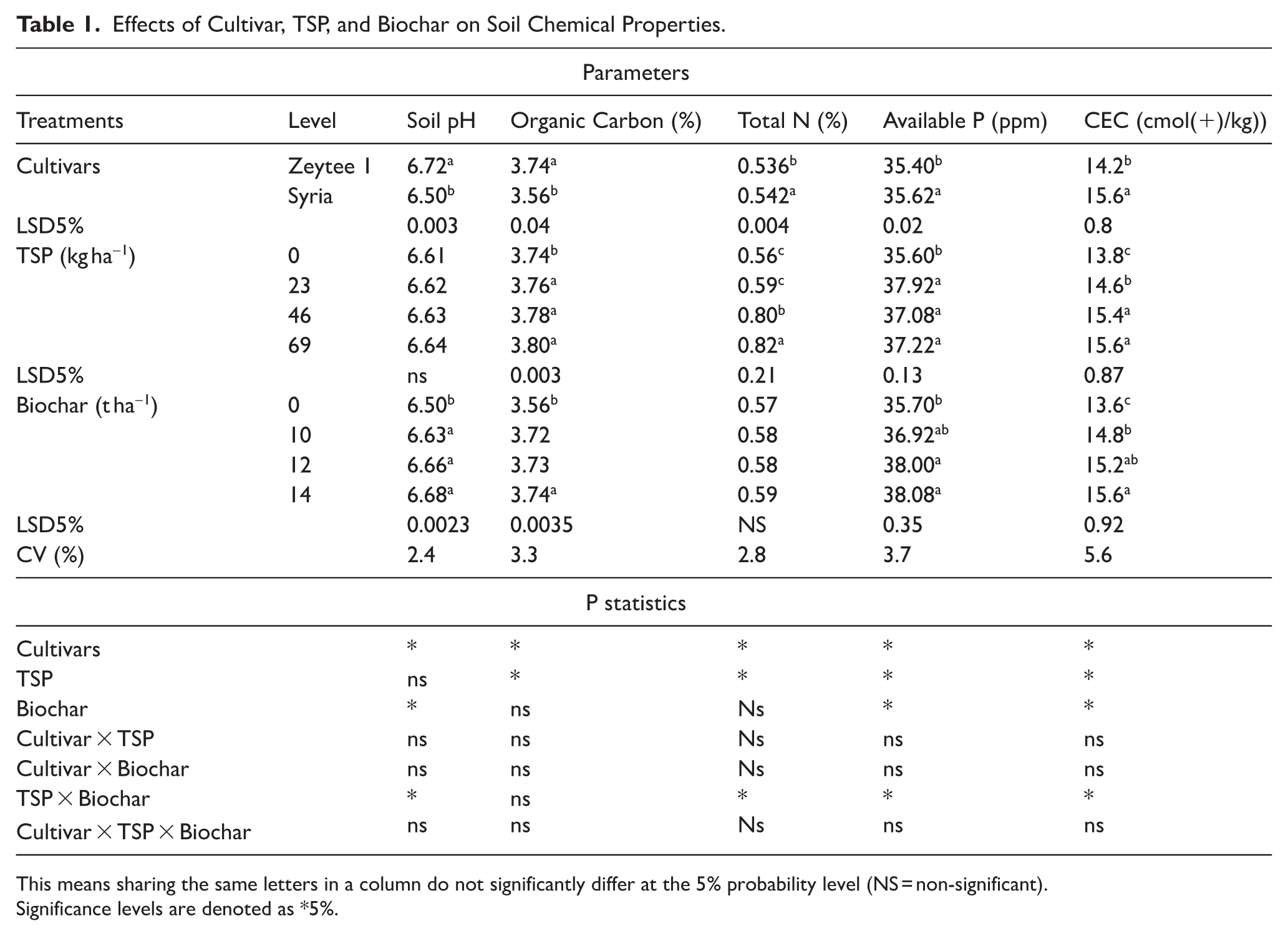
This means sharing the same letters in a column do not significantly differ at the 5% probability level (NS = non-significant).
Significance levels are denoted as *5%.
Interaction Effects on Soil Chemical Properties
The combined effects of biochar rates and TSP fertilizer rates on soil chemical properties after crop harvest are presented in Table 2 at the study site.
Interactive Effects of TSP Fertilizer and Biochar Application rates on Soil Chemical Properties.

Means followed by the same letter within a column are not significantly different at p ⩽ .05 according to LSD.
Main Effects of Camelina Cultivars, TSP Fertilizer, and Biochar Rates on Oil Quality Parameters
The primary effects of Camelina cultivars, varying rates of TSP fertilizer, and biochar application on oil quality parameters are summarized in Table 3. The results highlight how genetic differences between cultivars, combined with nutrient management strategies, influenced key oil quality traits such as oil content, acidity, relative density, peroxide value, volatile matter, refractive index, iodine value, and saponification value.
Effects of Camelina Cultivars, TSP Fertilizer, and Biochar Application Rates on Oil Quality Parameters.

This means sharing the same letters in a column do not significantly differ at the 5% probability level (NS = non-significant).
Significance levels are denoted as *5%, **1%, and ***0.1%.
Effects on the Some Oil Properties
The interaction effects of camelina cultivars and TSP fertilizer rates on oil content, relative density, and saponification values are presented in Table 4. The results indicate that both cultivars responded differently to increasing TSP levels.
Interaction Effects of Camelina Cultivars and TSP Fertilizer Rates on Oil Content, Relative Density, and Saponification Value.

Means followed by the same letter within a column are not significantly different at p ⩽ .05 according to LSD.
Camelina Cake Yield and Feed Quality Attributes
The effects of camelina cultivars, TSP fertilizer rates, and biochar application on cake yield and feed quality attributes are presented in Table 5. The measured parameters included cake yield (kg ha-1), crude fat, CP, ADF, NDF, and ash content.
Effects of Camelina Cultivars, TSP Fertilizer, and Biochar Application on Cake Yield and Nutritional Composition (Two‑Tailed Analysis).
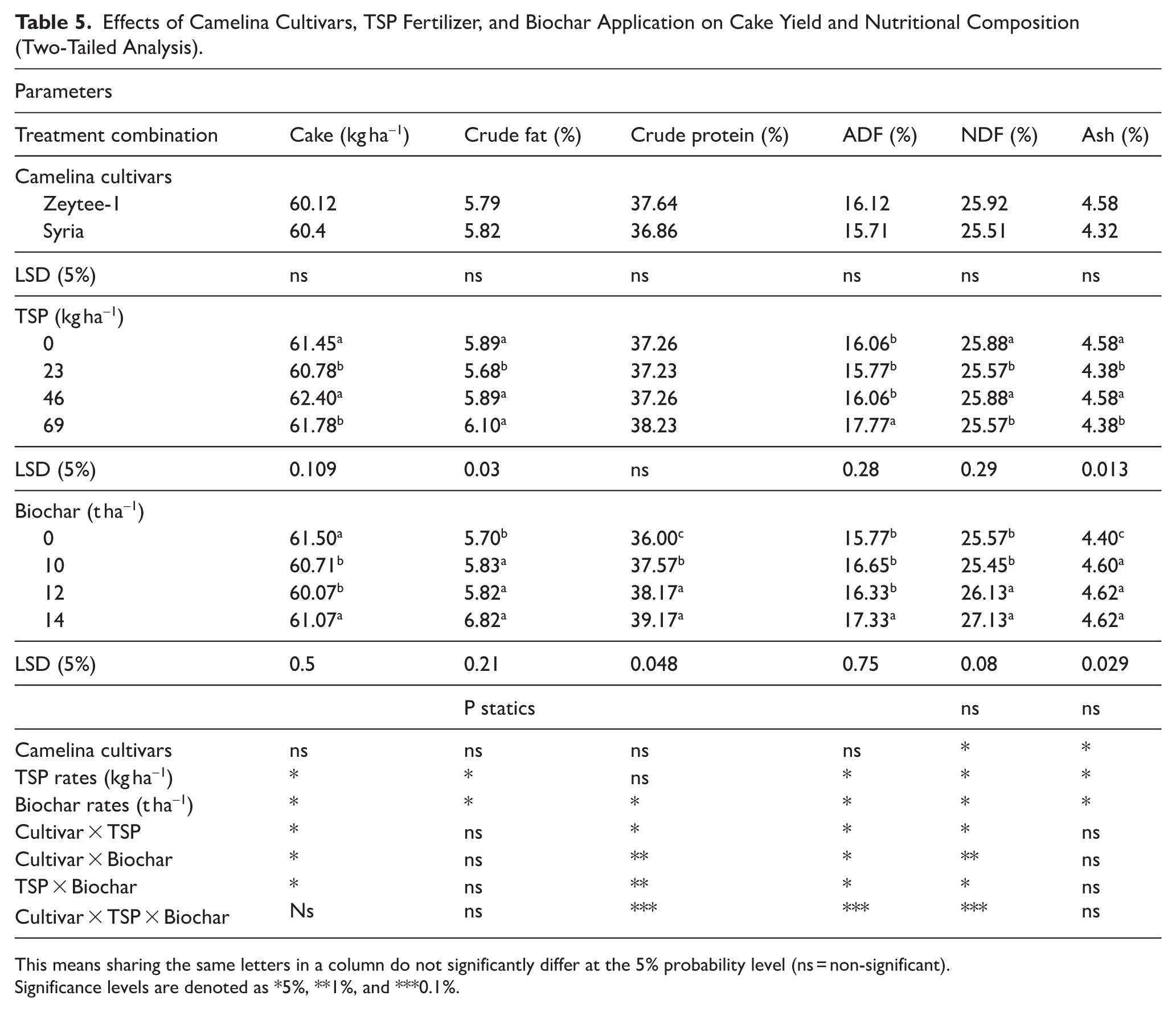
This means sharing the same letters in a column do not significantly differ at the 5% probability level (ns = non-significant).
Significance levels are denoted as *5%, **1%, and ***0.1%.
Nutritional and Residual Cake Yield of Camelina
The nutritional composition and residual cake yield of camelina under different treatment combinations are presented in Table 6. The parameters assessed include CP, ADF, and NDF.
Interaction Effects of Camelina Cultivars, TSP Fertilizer, and Biochar Application on Crude Protein, Acid Detergent Fiber (ADF), and Neutral Detergent Fiber (NDF).

Means followed by the same letter within a column are not significantly different at p ⩽ .01 according to LSD.
Partial Budget Analysis
Partial budget analysis of yield, oil output, cake yield, and economic returns of Camelina cultivars under TSP and biochar treatments is presented in Table 7.
Yield Components and Partial Economic Returns of Two Camelina Cultivars as Influenced by Different TSP Fertilizer and Biochar Application Rates in Acidic Soils.

Total production costs included seed (85 ETB kg-1; 7.5 kg ha-1), TSP fertilizer (12,800 ETB per 100 kg), and biochar (6,500 ETB for 10 t ha-1). Labor costs were 11,420 ETB ha-1 for the control and 14,670 ETB ha-1 for the treated plots. Camelina oil was sold at 285 ETB kg-1, and the residual cake at 6.50 ETB kg-1. ND: Non dominated. ETB: Ethiopian Birr.
Interrelationships among Physicochemical Parameters of Camelina Oil
The correlations among key physicochemical parameters of camelina oil are presented in Table 8. The matrix illustrates the degree of association between oil content, acid value, peroxide value, relative density, volatile matter, refractive index, iodine value, and saponification value.
Correlation Matrix Among Oil Quality Parameters of Camelina (Two‑Tailed Analysis).

NS = non-significant, Significance levels are denoted as *5% and ***0.1% for correlations.
Discussions
Effects of Cultivars, TSP Fertilizer, and Biochar on Chemical Properties
Effects on the Chemical Properties
Soil organic carbon (OC) was significantly influenced by cultivar, TSP fertilization, and biochar application (Table 1). Zeytee-1 exhibited higher OC than Syria, indicating cultivar-specific differences in carbon inputs, consistent with the findings of Angelini et al. (2020). Increasing TSP rates resulted in a modest but significant rise in OC, reflecting the role of phosphorus in promoting plant growth and root turnover, in agreement with Poirier et al. (2025). Biochar application further enhanced OC, with the 14 t ha-1 rate producing the greatest improvement due to direct carbon addition and improved soil conditions that stabilize organic matter, aligning with Ding et al. (2023).
Soil pH increased progressively with higher rates of TSP and biochar, with the highest value recorded under the combined application of 69 kg ha-1 TSP and 14 t ha-1 biochar (Table 2). This increase reflects the liming effect of biochar and the improved nutrient balance associated with phosphorus fertilization. Similar trends have been reported by Kumar et al. (2023), who found that biochar application effectively raises soil pH in acidic soils.
Total nitrogen also improved across treatments, reaching its maximum value (0.90%) under the combined application of 69 kg ha-1 TSP and 14 t ha-1 biochar (Table 2). This enhancement can be attributed to biochar’s ability to increase nitrogen retention and to TSP’s role in stimulating biomass production and root turnover. These results are supported by Li et al. (2023), who demonstrated that biochar improves soil nitrogen availability through enhanced nutrient retention.
Available phosphorus increased substantially with rising TSP and biochar rates, peaking at 45.3 ppm under the highest combined application. TSP provided readily available phosphorus, while biochar reduced P fixation and improved P release. This finding aligns with Murtaza et al. (2023), who reported that biochar enhances fertilizer P efficiency and increases available soil phosphorus.
Cation exchange capacity (CEC) increased consistently with higher biochar and TSP rates, reaching 18.4 cmol(+)/kg at the highest combined treatment (Table 2). This improvement reflects the high surface area and functional groups of biochar, which increase exchange sites, along with TSP-induced improvements in organic matter. These results corroborate the findings of Kumar et al. (2022), who observed significant increases in soil CEC following biochar application.
Effects of Camelina Cultivars, TSP Fertilizer, and Biochar Rates on Oil Quality Parameters
Effects on the Oil Acidity and Peroxide Value
Among the tested factors, only TSP fertilization had a significant effect on oil acidity (p < .05; Table 3). The unfertilized control produced the lowest acidity (1.5 mg KOH g-1), whereas phosphorus application at 23 to 46 kg ha-1 increased acidity to 1.7 mg KOH g-1. This suggests that phosphorus availability influences free fatty acid (FFA) formation during seed development. Such nutrient-driven increases in acidity are consistent with recent reports indicating that phosphorus fertilization can alter lipid hydrolysis and FFA accumulation in camelina and other oilseeds (Mansuri et al., 2025).
TSP fertilization also increased peroxide value, with the highest level recorded at 69 kg ha-1 (1.76 meq O2 kg-1), which was significantly greater than the values observed at 0, 23, and 46 kg ha-1s (Table 3). This indicates that higher phosphorus supply may enhance primary oxidation processes during seed development. Similar findings have been reported by Rodríguez-Rodríguez et al. (2021), who noted that elevated nutrient inputs can accelerate lipid peroxidation in oilseeds by stimulating metabolic activity and reactive oxygen species formation.
In contrast, peroxide value decreased with increasing biochar rates (12–14 t ha-1), with the lowest value observed at 14 t ha-1 (1.53 meq O2 kg-1). This reduction suggests that biochar improves soil chemical balance and nutrient buffering capacity, thereby reducing oxidative stress in developing seeds. Recent studies support this observation, showing that biochar amendments can enhance oil stability by improving soil aeration, pH, and nutrient retention (Tomczyk et al., 2020).
Effects on the Volatile Matter, Refractive Index, and Iodine value
Volatile matter was significantly influenced only by biochar application rates (p < .01; Table 3). Volatile content increased progressively with higher biochar levels, ranging from 0.139% at 0 t ha-1 to 0.156% at 12 t ha-1. This trend suggests that biochar-amended soils may enhance moisture-associated or thermally labile components in the oil. Such effects are consistent with recent findings showing that biochar improves soil water retention and nutrient availability, which in turn can alter seed composition and the thermal behavior of extracted oils (Beiranvandi et al., 2022).
Refractive index was significantly affected by both TSP fertilizer and biochar application (Table 3). TSP fertilization caused small but significant shifts, with the highest refractive index observed in the unfertilized control (1.47) and slightly lower values (1.46) at 23 to 46 kg ha-1. This decline with phosphorus application indicates subtle changes in oil density and saturation level, aligning with reports that nutrient supply can influence fatty acid composition and optical properties in oilseeds (Rodríguez-Rodríguez et al., 2021). Biochar also produced significant effects (p < .01), with refractive index increasing at 10 to 12 t ha-1 (1.47) compared with the control (1.45) and 14 t ha-1 (1.46). These changes suggest that biochar-amended soils may enhance unsaturation or modify lipid packing during seed development. Recent studies similarly show that biochar improves soil nutrient balance and moisture conditions, which can influence oil structural characteristics and refractive behavior (Beiranvandi et al., 2022).
Iodine value was significantly affected by cultivar, TSP fertilization, and biochar rates. Zeytee-1 exhibited slightly higher unsaturation than Syria (Table 3). Phosphorus application substantially increased iodine value relative to the unfertilized control, indicating enhanced fatty acid desaturation under improved P nutrition. Biochar also increased iodine value, with the highest levels recorded at 10 to 12 t ha-1, reflecting improved soil conditions that favor the synthesis of unsaturated fatty acids. These patterns are consistent with recent findings showing that genotype, phosphorus supply, and biochar amendments can all influence oil unsaturation in camelina and other oilseed crops (Hazrati et al., 2024).
Interaction Effects on the Oil Content, Relative Density, and Saponification Value
The interaction between camelina cultivars and TSP fertilizer rates resulted in clear and significant differences in oil content, relative density, and saponification value. Oil content increased markedly with higher phosphorus application in both cultivars (Table 4), with the highest levels observed at 69 kg ha-1 (42.7% for Zeytee-1 and 45.7% for Syria). This pattern demonstrates that phosphorus availability strongly enhances lipid accumulation, consistent with recent evidence showing that P fertilization improves carbon assimilation and seed oil deposition in camelina and other oilseed crops (Javaid et al., 2021).
Relative density exhibited cultivar-specific responses to TSP fertilization. Zeytee-1 showed higher density values at 46 to 69 kg ha-1, whereas Syria recorded its highest densities at 23 and 69 kg ha-1. These variations suggest subtle shifts in oil composition and molecular packing under different phosphorus levels, aligning with reports that nutrient availability can influence oil density through modifications in fatty acid structure (Javaid et al., 2021).
Saponification value decreased progressively with increasing TSP rates in both cultivars, indicating a shift toward longer-chain fatty acids at higher phosphorus levels. The lowest values (187.1–187.3 mg KOH g-1) were recorded at 46 to 69 kg ha-1, supporting evidence that improved phosphorus nutrition promotes the synthesis of higher-molecular-weight lipids (Ghidoli et al., 2023).
Effects of Camelina Cultivars, TSP Fertilizer, and Biochar on Cake Yield and Nutritional Composition
Effects on the Cake Yield and Nutritional Composition
Cake yield was significantly influenced by TSP fertilizer and biochar application rates (p < .05; Table 5), whereas no significant differences were observed between cultivars. The highest cake yields were obtained at 46 kg ha-1 TSP and at 0 and 14 t ha-1 biochar, indicating that both moderate phosphorus supply and improved soil conditions from biochar can enhance residual cake mass following oil extraction. These responses are consistent with recent findings showing that phosphorus and biochar improve seed filling and biomass partitioning in oilseed crops (Rahim et al., 2023). Crude fat content in the seed cake was also significantly affected by TSP fertilizer and biochar (p < .05). The highest crude fat levels were recorded at 69 kg ha-1 TSP and at 10 to 14 t ha-1 biochar, suggesting that enhanced nutrient availability and soil carbon amendments increase residual oil retention in the cake. This aligns with studies reporting that phosphorus promotes lipid biosynthesis, while biochar improves nutrient uptake efficiency and seed biochemical quality (Kabir et al., 2023).
Ash content varied significantly among cultivars, TSP rates, and biochar levels (p < .05). Higher ash concentrations at 0 and 46 kg ha-1 TSP and at 10 to 14 t ha-1 biochar indicate increased mineral accumulation under moderate phosphorus supply and improved soil nutrient retention associated with biochar application.
Interaction Effects on the Crude Protein, Acid Detergent Fiber, and Neutral Detergent Fiber
The interaction among camelina cultivars, TSP fertilizer rates, and biochar application significantly influenced CP, ADF, and NDF (Table 6). CP increased consistently with higher TSP and biochar levels, with the highest concentrations (38%–39.2%) recorded in cultivars 23, 46, and Syria under the combined application of 12 to 14 kg TSP ha-1 plus biochar. This trend aligns with earlier findings showing that biochar enhances nitrogen uptake and promotes protein accumulation in forage and oilseed crops (Smith et al., 2023).
ADF also increased under high fertility conditions, particularly in cultivars 46 and 69, where values reached 18.23%. This response supports reports that biochar and mineral fertilizers stimulate the formation of structural carbohydrates and cell wall components (Enaime et al., 2024). Similarly, NDF rose sharply at the highest TSP + biochar combinations, exceeding 28% in cultivars 46 and 69. These results are consistent with previous evidence indicating that biochar-amended systems increase total cell wall content and fiber fractions by improving soil nutrient availability and root metabolic activity (Pang et al., 2023).
In contrast, lower TSP rates without biochar produced the lowest CP, ADF, and NDF values across most cultivars. Syria and Zeytee-1 maintained comparatively lower fiber fractions under low to moderate fertility, suggesting that these cultivars may allocate fewer resources to structural components when nutrient availability is limited.
Effects on the Partial Budget Analysis
Table 7 shows that both Camelina cultivars responded positively to combined TSP and biochar inputs, with the highest yields (2.63 t ha-1) occurring at 69 kg ha-1 TSP with 10 to 12 t ha-1 biochar, consistent with reports that phosphorus and biochar improve crop performance in acidic soils (Kumar et al., 2025). Although maximum yield did not always produce the highest profit, the greatest net benefit (206,274 ETB) came from Syria at 23 kg ha-1 TSP + 14 t ha-1 biochar, supporting the principle that economic optima often differ from agronomic optima (CIMMYT, 1988). Overall, Syria showed slightly better economic returns, aligning with findings that cultivar differences influence camelina productivity under soil amendments (Ghidoli, 2024).
Correlation Matrix Among Oil Quality Parameters
The strongest correlations were observed among oxidation, unsaturation, and structural quality parameters (Table 8). Peroxide value exhibited an exceptionally strong positive correlation with volatile matter (r = .983*), confirming that lipid oxidation directly increases the formation of volatile oxidative compounds, as similarly reported by Grebenteuch et al. (2021). Peroxide value was also strongly associated with relative density (r = .863***), indicating the accumulation of heavier oxidation products during oil deterioration (Chen et al., 2022). Acid value showed a very strong positive correlation with iodine value (r = .963*), suggesting that oils with higher unsaturation are more susceptible to hydrolysis and FFA formation, consistent with the findings of Vicentini-Polette et al. (2021). Iodine value also demonstrated a strong positive correlation with saponification value (r = .863***), implying that more unsaturated oils tend to contain shorter-chain fatty acids that require greater amounts of alkali for saponification (Y. Zhang et al., 2022).
A strong negative correlation between iodine value and refractive index (r = −1.006*) further indicates that decreasing unsaturation leads to an increase in refractive index, a well-established indicator of oxidative alteration in oils (Petersen et al., 2013).
Conclusions
The integrated application of biochar and TSP fertilizer is an effective strategy for improving camelina production in acidic soils. This combination increases soil pH, enhances phosphorus availability, boosts nitrogen content, and improves cation exchange capacity. As a result, grain yield, oil yield, and oil stability are significantly improved. The approach also enhances the nutritional quality of the seed cake by increasing its CP content.
For smallholder farmers, moderate input levels (23 kg TSP and 14 t biochar ha-1) offer the highest economic return, demonstrating that the practice is both productive and cost-efficient. In addition, the long-term benefits of biochar such as improved nutrient and water retention and increased carbon sequestration help strengthen soil resilience, reduce dependence on mineral fertilizers, and promote sustainable farming in acidic agroecosystems.
This study was conducted at a single location and during a single growing season, and it lacks long-term evaluation. Therefore, future research should include multi-location and multi-year trials to validate and broaden the applicability of the findings.
Footnotes
Acknowledgements
We gratefully acknowledge Wachemo University, especially the lab assistants of the Plant Science, Food Science, and Postharvest Technology Departments, for their valuable support. We also thank Hawassa University College of Agriculture and the NORAD project for providing field and laboratory facilities.

Author Contributions
Daniel Manore (PhD student) designed the study, carried out the field experiments, collected and analyzed the data, and prepared the initial draft of the manuscript. Dr. Tewodros Ayalew (Associate Professor, Main Supervisor) provided overall supervision, guided the study design and methodology, contributed to data interpretation, and critically reviewed and revised the manuscript. Dr. Shimalis Gizachew (Co-supervisor) supported experimental planning, assisted with data analysis and interpretation, and contributed to the review and refinement of the manuscript.
Funding
The authors received no financial support for the research, authorship, and/or publication of this article.
Declaration of Conflicting Interests
The authors declared no potential conflicts of interest with respect to the research, authorship, and/or publication of this article.
Data Availability Statement
The data that support the findings of this study are available from the corresponding author* upon reasonable request.