




Abstract
The cultivation of potatoes is a paramount task since they represent one of the most consumed ingredients in the entire world. Nonetheless, the change from traditional to conventional crop systems has led to an increase in the use of heavy machinery, fertilizers and herbicides that can pose serious risks for future. These effects on soil erosion were studied on a representative conventional farm, located in the municipality of Irati (Paraná, Brazil), through the estimation of soil erosion rates along the different phases (P) of potatoes’ annual cultivation cycle: P1-planting, P2-heaping, P3-tuber growth, P4-maturation and senescence. To do that, six erosion plots were installed of 10 m2 in size in which we have quantified soil and water losses after every rainfall event and irrigation day. In addition, we have determined bulk density, penetration resistance and aggregate stability from 0 to 30 cm in depth. At the end of this research, it was observed that potato cultivation under conventional management promoted severe erosion. The results obtained indicated that soil erosion was significantly higher in certain phases of the cultivation cycle (e.g. heaping) due to changes in soil structure as a consequence of agricultural activities. Therefore, we encourage farmers to look for nature-based solutions and scholars to assess the effectiveness of these
Introduction
Potato (Solanum tuberosum L.) along with rice, wheat and corn is one of the most consumed aliments worldwide due to its nutritive properties. Its cultivation in environments where water scarcity is not a limiting factor is generally annual (about 100 days, once a year) involving some physiological stages that grosso modo coincide to the agricultural phases of the cultivation cycle: budding, vegetation growth, tuber initiation and growth, and potato maturation and plant senescence before harvesting (end of the cycle; Wale et al., 2022). In addition, potato requires deep and fertile well-structured soils on flat terrains that make easy the use of machinery and the ventilation of plants (Mobini et al., 2009).
In Brazil, potato crops occupy ca. 130,000 ha in size. They represent an average annual production of 3.5 million tons that involves about 5,000 farmers in 7 out of its 26 federal states (EMBRAPA, 2016). Nowadays, Paraná is the second state (after Minas Gerais) that produces more potatoes in Brazil: 762,000 tons, 22.4% of the national production. In fact, the land surface used for the cultivation of potatoes has increased 82% since 2007 (Rós, 2017). It happens because the dominant subtropical climate, with rainfall events well-distributed (no dry seasons), makes possible farmers produce potatoes during the whole year (Abuarab et al., 2019). Within Paraná, Irati concentrates 7% of the state production occupying a land surface that ranges from 2,000 to 2,600 ha in size (depending on the annual market context) and reaching annual productions above 75 million tons in specific years (e.g. 2013/14; Thomaz & Bereze, 2021). Potatoes along tobacco (Hamza & Anderson, 2005) and onion (Antoneli et al., 2021) represent the three big crops of this part of Brazil with power to fix rural population (Pulido et al., 2017).
Most of these crops can be considered as conventional (opposite to traditional that focuses on self-consumption), that is, they are managed by using heavy machinery, with additions of fertilizers and herbicides when they are necessary (Cardoso et al., 2013). It means, on one hand, soil must be plowed and upturned every year since potato needs deep and well-aerated soils (Keesstra et al., 2019) and, on the other hand, agricultural activities imply the continuous pass of machinery and workers, compacting the soil which reduces the infiltration rate and increases surface runoff (Antoneli et al., 2021).
Land management also influences on the formation and stability of soil aggregates. For instance, the use of machinery and fertilizers modify the aggregates size and consequently provokes the alteration of another physical attributes such as porosity and density (Antoneli et al., 2021). Conventional crops usually show a lower aggregate stability than crops seeding, particularly in the topsoil layers. In fact, Souza et al. (2012) found larger aggregates (longer diameter) in no-till comparing to conventional crops. It causes a theoretical higher resistance to soil erosion since it involves more difficulties to the transport of particles. Nevertheless, potatoes are seeded in form of small potatoes that must be covered immediately to avoid being eaten by animals or putrefaction. So, no-till is not considered a good alternative by many farmers (personal communication).
In Paraná, where commercial agriculture represents a significant input in the regional economy, it is still foreseen an increase in the land cultivated by potato in next years due to its current profitability. Despite the promising projection, there is the possibility of increased erosion, water pollution and loss of biodiversity as well as damages in strategic infrastructures for farmers (roads, irrigation reservoirs and channels, etc.) (Telles et al., 2011), and reduction in land profitability due to the loss of nutrients (Bertol et al., 2017). In addition, some conservationist practices (e.g. terraces) are not considered a good alternative for many farmers since the use of machinery was considered adequate to guarantee its profitability. For instance, Tormena et al. (2004) state the terrain must be leveled before planting and soil plowed deeply and upturned to favor aeration. In addition, highlighted the necessity of using heavy machinery such as subsoilers to break down compacted layers.
The only feasible way to prevent land degradation in potato crops seems to be promoting the reduction in the number of operations that require the pass of machinery and workers in order to avoid subsurface compaction and excessive pulverization (Antoneli et al., 2021). Therefore, it was evaluated how regular agricultural activities influence on soil erosion as well as on some physical properties along the potato cultivation cycle. Such studies could be useful to identify properly in which phase of the cycle erosion rates are higher and why, that is, if processes are led to soil compaction and reduced infiltration rate. A better knowledge in this matter could serve to think about specific alternatives that can reduce land degradation and they do not suppose inconveniences for farmers.
Material and Methods
Study Area
Figure 1 shows the exact location of the study area. It is a small privately-owned farm located in the rural community of Riozinho (25°56′S, 50°65′W, and 870 m a.s.l.) within the municipality of Irati (south-central region of the federal state of Paraná, southern Brazil). Its climatic conditions are temperate with rainfall events (usually of low intensity) regularly distributed throughout the year, mill summers and winters with several episodes of freeze in the morning (Cfb, Köppen-Geiger classification (Peel et al., 2007). Its soil is classified as haplic (loamy-eutric) Cambisol (IUSS Working Group WRB, 2022) with the presence of clays of high activity and high values of base saturation due to regular amendments of limestone.

Location of the study area.
The farm has 45 ha in size and it is located on an undulated terrain (average slope: 15–20%) that is plowed following the contour lines. The farm includes forested areas (13%) and pasture areas (7%) The agricultural area is divided in three plots (~10 ha each) separated by temporal roads created during the potato harvest. Since 1986 potato is rotationally cultivated in one plot coexisting in the same year with crops of corn (second plot, the year after potatoes) and soya in summer and oats in winter (third plot, the year before potatoes). The cultivation of legumes and grasses before potatoes is necessary to avoid diseases (Phytophthora infestans, Alternaria solani, Rhizoctonia solani, Pectobacterium carotovorum, etc.) and recover soil fertility.
Agricultural Activities
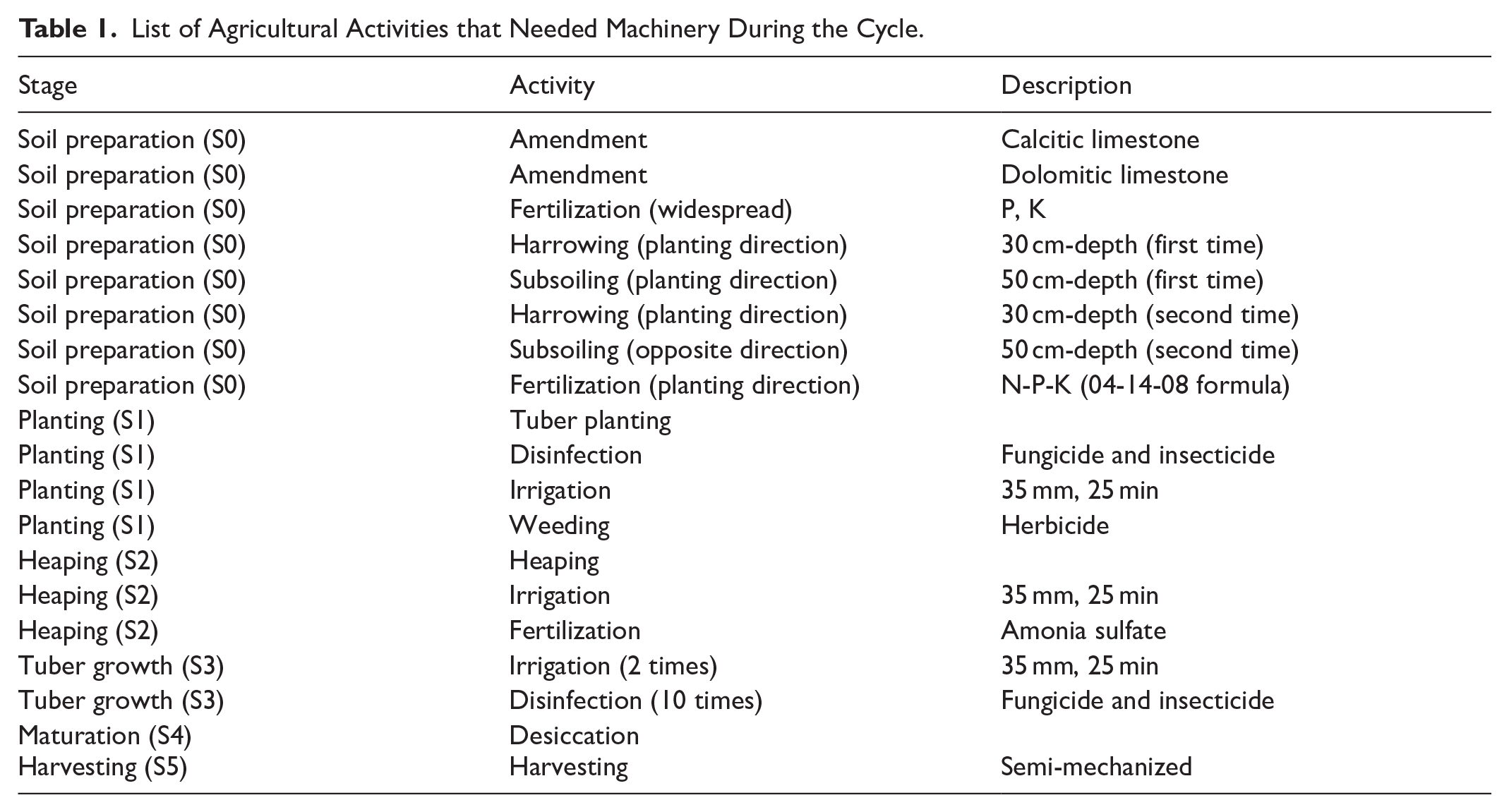
The heavy machinery has passed 29 times during the whole cycle plus eight extra times before planting in March (harrowing, subsoiling, fertilization, etc.). The plants were disinfected 11 times with fungicides and insecticides, once immediately after planting and 10 times during the phase of tuber growth. Weeding was carried out only once, just before heaping that it is aimed at covering tubers to avoid their exposition to solar radiation. Between heaping and desiccation, the machinery had to pass 14 times: three for irrigation, 10 for the application of fungicides and insecticides and one for fertilizing with ammonia sulfate to favor the formation of tubers (Table 1).
List of Agricultural Activities that Needed Machinery During the Cycle.
Soil Sampling
The study was divided into two different tasks of data collection (including fieldwork and/or laboratory analysis), one focused on soil erosion (after every rainfall event) and another one on soil properties: bulk density, aggregate stability and soil penetration resistance. Both tasks lasted a whole year (i.e. the whole cultivation cycle) although soil samples and penetration resistance measurements were made in a single moment of the each one of the four stages of cultivation. We selected six random points to the installation of the Gerlach troughs and the collection of bulk samples (18 at each stage for aggregate stability), soil core rings (40 at each stage for bulk density) and the assessment of soil penetration resistance (20 measurements by using a penetrometer at each stage). The sampling depth intervals were 0 to 5, 5 to 10, 10 to 20, and 20 to 30 cm although the impact penetrometer can record values up to a depth of 60 cm.
Soil Physical Attributes
Firstly, we used an penetrometer OS-70 model (Stolf, 1991) for monitoring the temporal changes of soil penetration resistance. It has a 60 cm-length stem with a cone of 60° at the bottom and a piece of 4.0 kg in weight on the top. The values obtained were processed by using a specific tool developed on MO Excel-VBA file. After that they were converted into MPa (standard unit to interpret values of pressure) through the following Equation 1:

Where:
SPR: Soil Penetration Resistance (MPa)
N: Number of impacts per decimeter of depth
Secondly, we determined bulk density by using metal soil core rings of 100 cm3 in volume. After the collection in field, they were brought to the laboratory where they were initially oven-dried for 24 h at 105°C and finally weighed in dry. The results were obtained from the commonly-known equation with which bulk density is the value of dry mass divided by the core volume.
Aggregate stability was assessed by applying the wet-sieving method developed by Yoder (1936) following a local adaptation proposed by Castro Filho et al. (1998). The aggregates were then separated in seven classes: 8, 4, 2, 1, 0.5, 0.25 and <0.25 mm. After sieving aggregates were oven-dried at 105°C for 24 h and weighed in dry to know the percentage of aggregates of each class. The samples were subjected to correction of the sand content in a 0.053 mm mesh. Finally, we considered three parameters for the determination: average weighted diameter (AWD), average geometric diameter (AGD), and the aggregate stability index (ASI; Castro Filho et al., 1998).
Soil and Water Losses
We installed six Gerlach troughs of 50 cm-width and 30 cm-length along the planting row (1 m-width) separated between them by a woody fragment each 10 m of distance. It means each trough collects water and sediments from a total surface of 10 m2 (Figure 2). After every rainfall and irrigation event we measured the amount of water and sediments collected by the six troughs. For doing that, we filtered and oven-dried water samples to quantify the concentration of sediments. To interpret properly the values of soil erosion and runoff it was also necessary the collection of rainfall and irrigation data to know the inputs of the system. So, we installed a regular pluviometer of accumulation and we estimated the total volume of water after each significant event (at least 20 mm of rainfall/irrigation in 24 hr).
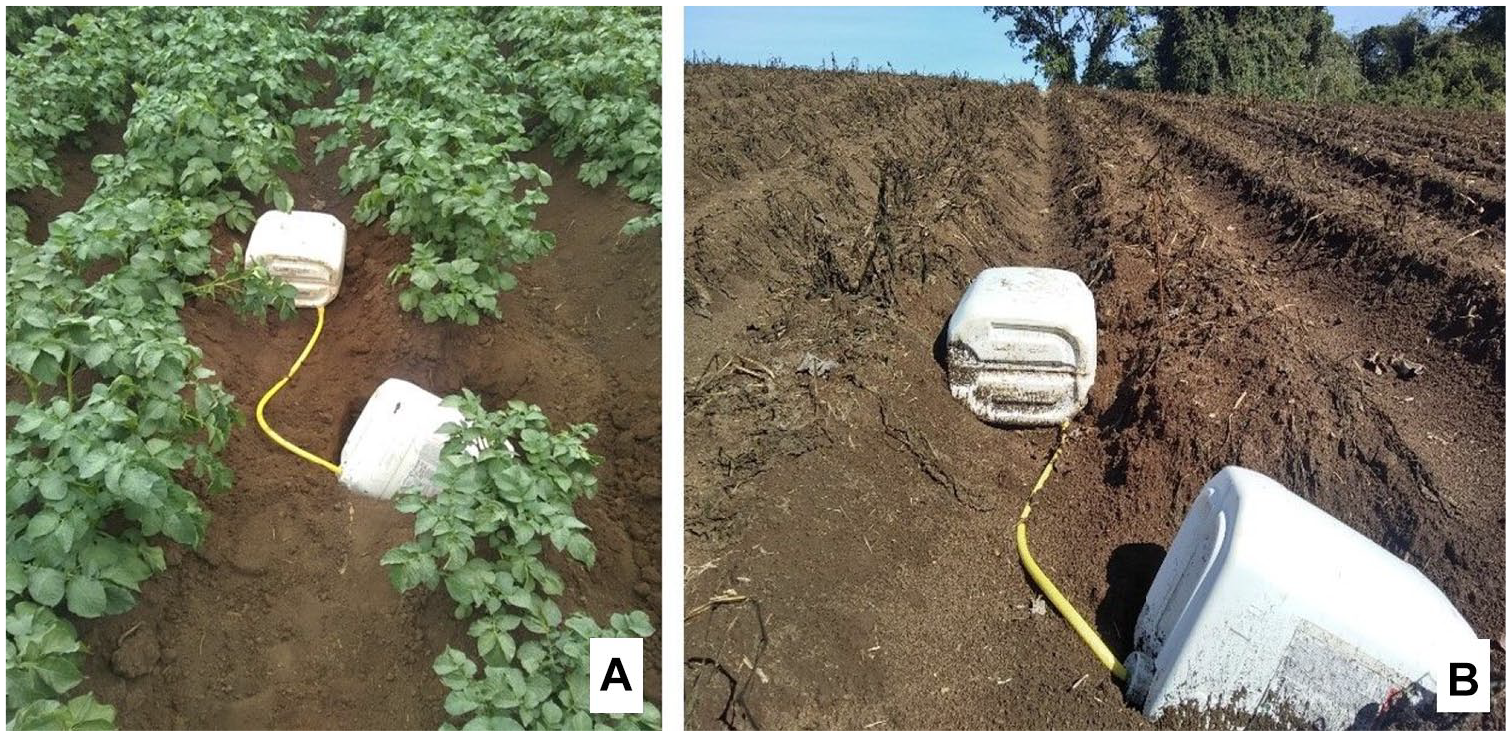
Illustrative picture of one of the six erosion plots: (A) tuber growth, (B) maturation.
The material was collected and transported to the laboratory for the estimation of soil erosion rates (Equation 2) and runoff coefficient (%) for each plot (Equations 3 and 4).


Water Inputs
Table 2 summarizes the significant rainfall and irrigation events that took place in the farm. Only in two moments of the cycle, during the stage of the tuber development and in the final phase of maturation, significant rainfall events were recorded. Therefore, the farmer needed to irrigate potatoes four times along the cycle because land became so dry and putted in risk the survivorship of the crop. Potato in tropical conditions is usually a rainfed crop but in case of necessity farmers must irrigate. The irrigation processes lasted 25 min in which 35 mm dropped. It meant a constant intensity of 1.4 mm min−1.
Significant Events Recorded During the Cultivation Cycle.

Data Analysis
Data were subjected to descriptive analysis (mean value, median, minimum, maximum, standard deviation, etc.) and tested for normal distribution using Shapiro-Wilk. Because data did not follow normal distribution, one way analysis of variance (ANOVA) was done and where F-value was significant, means were separated using Kruskal-Wallis test at 5% level of probability. The statistical procedure was performed by means of the STATISTICA 6.0 software package (Statsoft, 2001).
Results
Soil Penetration Resistance
The values of soil penetration resistance (SPR) showed a temporal pattern of progressive increasing along the cycle as well as in depth. Remarkable differences were also found when values of interrows were compared to those of the planting rows (not shown in any figure). Figure 3 shows the average values of SPR from 0 to 30 cm in depth at each one of the stages of the cultivation cycle. The average global value was 1.50 MPa, ranging from 0.90 MPa at planting to 2.90 MPa in the final stage (maturation). The lowest values of SPR in each stage of cultivation were observed at the surface layer (0–5 cm in depth). The highest values were recorded during the maturation phase, ranging from 1.95 MPa in the surface layer to 2.27 at a depth of 30 cm. In both stages, there was a gradual increase in soil resistance with depth, except during maturation.

Mean values and standard deviation of soil penetration resistance.
Bulk Density
Figure 4 shows the mean values of bulk density, during different phases of potato cultivation. In the initial phase (planting) bulk density increases with depth. The lowest value was observed in the surface layer (0–5 cm in depth): 0.85 g/cm3, while the highest one was recorded at a depth of 30 cm (1.05 g/cm3). In subsequent phases, there was a significant increase in bulk density throughout the profile, when compared to the beginning of planting. The values presented between phases were similar, both in layers and depths.

Mean values and standard deviation of bulk density (rows and interrows).
Aggregate Stability
The highest values of the Aggregate Stability Index (ASI) were observed at the beginning of the cycle (planting) showing a decreasing trend at the next stages (Figure 5). They ranged from 74.2% at the surface to 69.1% at 40 cm in depth. There was a gradual reduction in subsequent phases with the lowest values of ASI at the maturation phase with 57.1% (0–5 cm) to 58.2% at 40 cm. In general, the reduction in the ASI values at the surface was 29.9%, while at 40 cm in depth it was 18.7%. We were not observed remarkable changes at the stages of tuber growth and maturation in the topsoil as well as in the deepest layers. This later can be due to soil is not upturned since the heaping and plants cover a larger soil surface. In addition, sediments transported by erosion are higher at those final phases.
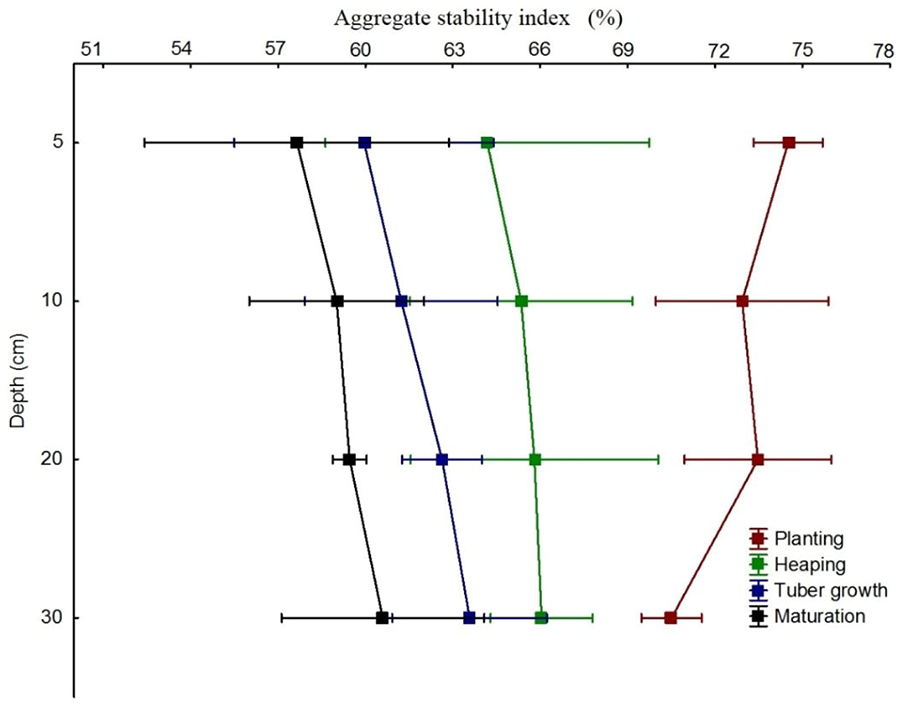
Mean values and standard deviation of the aggregate stability index.
The Average Weighted Diameter (AWD) decreased along the potato cultivation phases. The mean value in the first phase (planting) was 1.45 mm, while in the subsequent phases the values decreased. For instance, heaping: 1.44 mm; tuber growth: 1.43 mm; maturation: 1.30 mm. The average AWD values at all stages of potato cultivation increased with depth. In the same line, the Average Geometric Diameter (AGD) values found in this research also indicated a reduction throughout the cultivation phases. The average at planting was 0.88 mm, heaping 0.85 mm, tuber growth 0.81 mm and maturation 0.71 mm.
Runoff
The lowest mean values were recorded during the planting stage (runoff coefficient: 2.3%) and the highest ones at the next phase (heaping) with a runoff coefficient of 5.9%, that is, an increase of above 150%. During the tuber growth the runoff coefficient decreased up to 4.3% and at the final stage up to 3.2% (Figure 6).

Mean values and standard deviation of the runoff coefficient (rows and interrows).
Soil Erosion
Figure 7 shows the comparison of mean values of soil erosion rates during the whole cycle. The most erosive stage was the heaping (695.9 g/m2) contrasting to the planting when rates were the lowest (235.7 g/m2), that is, an effective increase of 195%. After the heating soil erosion rates decreased progressively and significantly from 520.7 g/m2 during the tuber growth up to 347.1 g/m2 at the maturation stage.
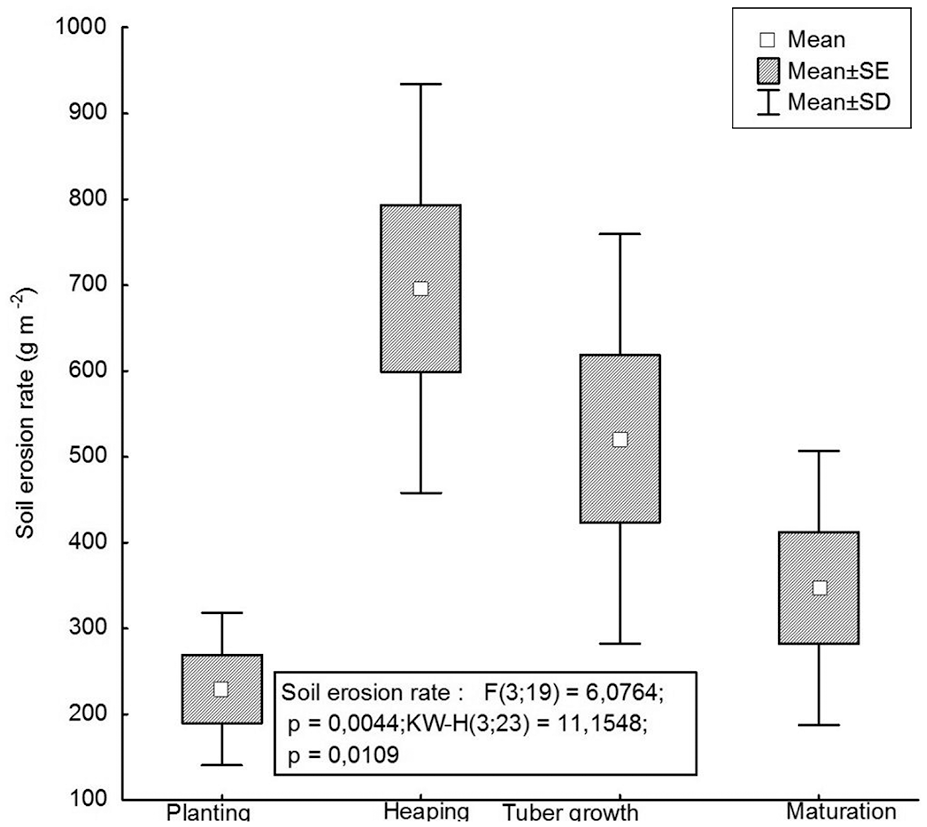
Mean values and standard deviation of soil erosion rates (rows and interrows).
Discussion
The conventional crops of potatoes in Irati-PR mean actually an economic activity that requires a thoughtful design as well as experience and knowledge. For instance, before to start the soil preparation farmers must analyze soil properties in their pieces of land to forecast if initial amendments and fertilizers are needed before planting. If so, it means both more expenses (less profitability) and the extra pass of machinery in the farm (more susceptibility to soil compaction). According to Kaminski et al.( 2005) initial amendments are necessary and they have to be introduced inside the soil to decrease acidity in the deeper horizons, that is, soil must be upturned.
The use of machinery is the only way to keep land profitability in this kind of environments although it can suppose a significant increase in soil compaction, and consequently in soil erosion rates (Abraham & Muluneh, 2022). Nevertheless, to find ways of improving fertility, to promote natural biocides and to reduce irrigation could prevent the pass of machinery (Chinasho et al., 2022). In this particular case of study, we accounted up to 29 passes, the most of them for applying fungicides and insecticides. Perhaps, the main problem, at least for erosion, is soil must be upturned at the beginning of the cycle and also during the harvesting (end of the cycle) since potatoes cannot be only picked up manually.
The harvesting is the period in which soil compaction increases the most because it involves the pass of tractors to take out the potatoes, tractors to carry them outside the farm and also a lot of workers for the manual collection, as other authors demonstrated in other crops such as vineyards (Rodrigo-Comino et al., 2020). So, this increasing in soil compaction at the end of the cycle makes necessary the use of harrowers and subsoilers for soil preparation in the next years although can be another transitional crops meanwhile. In addition, soil compaction can reach up to 50 cm in depth because the subsoiling process for this kind of crops must be very deep. In other words, compaction affects dramatically a large extension of land and also a large volume of soil.
Perhaps, the best parameter to know if soil is ready to be cultivated again is soil penetration resistance since it is a good indicator of rooting restrictions. Curiously, the mean values from soil surface here observed (0.90–2.90 MPa) are lower than those found in other representative crops of Irati (e.g. tobacco: 1.13 MPa) in which soil is less affected by the machinery (Antoneli et al., 2017). Even, in deeper layers the values were relatively low, particularly in the line rows. Furthermore, these values should be considered as low (in the planting rows) or moderate (interrows) according to the classification of Arshad et al. (1997). The lower values found in the planting row can be understood as a consequence of the effects of some activities such as soil scarification (Girardello et al., 2014) as well as a lower pass of tractor wheels in each agricultural activity. Interrows ranged from 0.94 to 2.90 MPa with an increase of 74% from the heaping process.
The consequences of an increase in soil penetration resistance on the potato morphology are well-known: the size of potatoes is smaller and productivity and land profitability are lower (Thomaz & Bereze, 2021). Farmers can ameliorate these negative effects through irrigation since it reduces soil penetration resistance and increase the absorption of nutrients for the plants (Blainski et al., 2008). Nevertheless, these low values largely found in this area should not suppose a real restriction even for other alternative crops less exigent such as maize and/or fodder pastures (Semmel et al., 1990).
Bulk density showed a similar spatio-temporal pattern that soil penetration resistance, where the increase in bulk density indicated an increase in soil resistance to penetration. Nevertheless, according to (Cardoso et al., 2013), the values to interpret soil compaction here observed have been lower in a conventional system like this than in others thought to minimum tillage. Even, in the top 20 cm where the potato rooting system is dominant the values of bulk density here found could be considered as low although potato roots can reach depth above 30 cm. If we compare with other crops, the values of bulk density have been really low (<1.00 g/cm3 at 30 cm in depth). For instance, Gilles et al. (2009) recorded a mean value of 1.21 g/cm3 in a crop of maize where soil was also scarified. According to Reichert et al. (2009) it is probably due to the use of the scarificator.
Actually, it is not easy to find similar works in the literature with which we can compare our results. For instance, Silva et al. (2005) measured bulk density just after potato harvesting and they recorded average values quite comparable to those found in our work: 1.03 g/cm3 (0–10 cm), 1.17 g/cm3 (10–20 cm) and 1.11 g/cm3 (20–30 cm). When the comparison was made by using the aggregate stability index, the values recorded in potato crops (>60%) are higher than in other kind of systems such as shrub reforestations (53%), also assessed by A. S. Silva et al. (2014), although very close to those recorded by Tavares Filho et al. (2012) (73%) and Wendling et al. (2005) (63%) in conventional soya crops. Nevertheless, the aggregate size was generally small, being in consonance with the findings of Ribon et al. (2014). So, we could state agricultural activities for potato cropping do not affect largely on aggregate stability index, at least in soils rich in clay, but yes on aggregates size.
Other factor to be considered is the time lasted since a farm was converted from traditional or direct seeding into a conventional system. In the first years, at least the aggregate stability is not so different in comparison to natural forest soils. On the contrary, Wendling et al. (2005) found a decreasing gradient of aggregate stability: natural forest > direct seeding > conventional system. In addition, Martins et al. ( 2011) conclude that reduction of the aggregates size leads to soil erosion. Regarding soil and water losses, heaping was the most erosive stage. This fact may be in line with Barros et al. (2009) which observed higher rates of soil erosion during planting (first phase of cultivation) due to greater soil exposure. Many authors agree that soil erosion rates vary according to the type of crops. In comparison to direct seeding, soil erosion rates are usually higher in conventional crops although Gilles et al. (2009) emphasized the advantages of scarification promoting soil infiltration, and consequently a reduction of runoff and soil erosion. In fact, they only recorded an average rate of 9.7 g/m2.
The lowest values of runoff at the last two stages of the cultivation cycle can be due to the growth of aerial plant cover. In fact, bare soil was only 40% and 20%, respectively, during this period in comparison to 100% during the planting. The effects of vegetation cover and its mechanism to prevent soil erosion are well-known. Regarding the contrasting results found between planting and heaping they can be perhaps explained by a probable reduction in the infiltration rates, aggregate stability and/or surface roughness. Nonetheless, planting is the stage when both vegetation cover is lower (≈0%) and more agricultural activities are made but it is also the moment of the cycle in which soil is flatter. The erosivity of heaping must be understood within this specific context. Soil initially located in the interrows is moved to the planting row with the goal of covering potatoes used for planting. It forms ridges that pour water to the interrows concentrating there the water flow. In addition, this volume of soil moved from the interrows to the new ridges has had no time to be consolidated and furthermore the process of heaping compacts more the soil located in the interrows because tractors pass on it. Finally, planting did not follow the contour level.
Conclusion
The transformation of farms from a traditional system to a conventional one in which heavy machinery, fertilizers and biocides are a common feature is an unstoppable process in Brazil and crops such as potatoes are not an exception. Our findings confirmed the foreseen effects of this kind of agriculture on soil degradation, that is, more compacted soils and higher soil erosion rates. Nonetheless, we have observed that the increase in soil compaction and erosion did not follow the same temporal pattern. While soil compaction increases progressively throughout the cycle (linear trend) as a consequence of the recurring passage of heavy machines and workers, soil erosion was only remarkable in the second phase, during the heaping when ridges are formed as a result of hilling potatoes.
Since the use of heavy machinery and commercial techniques (fertilization, prevention of plagues, etc.) seems to be unavoidable we suggest farmers look for nature-based solutions that reduce the number of treatments to reduce soil compaction provoked by the pass of tractors involved in every agricultural activity. Regarding erosion we encourage farmers to use straw or any other strategy that reduces soil exposure when potatoes are hilling since this is the crucial moment in which erosion rates are significantly higher.
Finally, we consider that further research is still needed because this study only could be carried out in a single farm and for a single year. The comparison with other farms in which some prevention measures are already taking place could be useful to know how much soil degradation can be reduced without affecting the farm profitability.
Footnotes
Acknowledgements
We want to give special thanks to farm owner.
ORCID iDs

Funding
The author(s) disclosed receipt of the following financial support for the research, authorship, and/or publication of this article: This research was funded by CAPES (Coordenação de Pessoal de Nível Superior) and CNPq (Conselho Nacional de Desenvolvimento Científico e Tecnológico) Chamada CNPq Nº 09/2022 - Bolsas de Produtividade em Pesquisa - PQ.
Declaration of Conflicting Interests
The author(s) declared no potential conflicts of interest with respect to the research, authorship, and/or publication of this article.
Data Availability Statement
The data can be sent to everyone interested in after reasonable request to the authors.