



Abstract
The purpose of this paper is to compare various indicators of microbiological contamination in coastal areas near estuaries around the world. A major factor contributing to the presence of fecal coliforms is the geomorphology of the area, and, more particularly, whether the area concerned is an open or enclosed bay, the climate of the area, its tourism development, and, lastly, the urban, agricultural, livestock, or industrial activities carried out near river mouths. The aim was also to attempt to systematize the microbiological contamination of the above-mentioned estuaries around the world for broader applicability. Initially, four river estuaries from around the world (USA, Brazil, Spain, and Greece) were selected to be compared for the extent of their microbiological contamination. Ultimately, only the river mouths Jucar and Pineios in Spain and Greece respectively were comparable. Since it was not possible to compare the selected sites from all over the world using our own data and the literature, we limited ourselves to determining the microbiological contamination only in the region of Greece. A total of 128 water samples were taken throughout the year (32 water samples per season) from the four deferent sampling points. The only checkpoint in Greece that meets the requirements of Directive 2006/7/EC, for the desirable and maximum limits is Faros Stomio, spot-3. Enterococcus bacteria exceeded the maximum limit of 200 cfu/ml in May 2023 (600 cfu/ml) and February 2024 (426 cfu/ml) in Nea Messangala spot-1. The concentration of E. coli bacteria does not differ statistically from the desirable value of 250 cfu/ml before storm “Daniel” while it is statistically slightly lower than the desirable value of 250 cfu/ml after storm “Daniel” in Greece (before p = .208 > .05 and after p = .015 < .05 where .05 is the significance level).
Introduction
The contamination of ecosystems has either direct or indirect impact on human health (European Environment Agency, 2018). Poor treatment of waste and its discharge into the sea leads to the contamination of coastal recreational areas with microorganisms. Almost all epidemiological studies conclude that there is a significant risk to the health of people swimming in coastal areas where estuaries are found (Cupul-Magaña et al., 2006; Donovan et al., 2008; Elmir, 2018; Klubi et al., 2018; Rodríguez-Tapia et al., 2017; Turner et al., 2019, Yau et al., 2009). The increase of human activities for the purpose of either tourism or recreational activities is evidenced by the fact that two-thirds of the world’s population resides in coastal areas, and this number tends to increase even more (Inal et al., 2018, Ouali et al., 2018). A number of years ago, the quality of bathing waters was a matter of concern for the EU, which had to be safeguarded in the interests of public health and tourism. In this respect, the EU adopted Directive 2000/60/EC (Water Framework Directive [WFD]), which is a landmark. The acceptable quality limits for swimming water, according to this directive, for “Sufficient quality” in 90% of samples are 500 cfu/100 ml for E. coli and 185 cfu/100 ml for Enterococcus. The geomorphology of the soil, the high tourist presence, and other factors on the beach are factors contributing to the increase of the number of Fecal Indicator Bacteria (FIBs; Dakka et al., 2018; Elmir, 2018; Grube et al., 2020; Nevers et al., 2016; Russell et al., 2014; Verhougstraete & Rose, 2014; Whitman et al., 2014). The total number of bacteria present in sewerage is estimated to be 106/ml to 107/ml, of which approximately 105/ml or, according to others, 106/ml to 108/100 ml belong to the E. coli group and constitute 1% of the biomass in the large intestine (Edberg et al., 2000; Leclerc et al., 2001). An average of 1.95 × 10⁹ coliforms are produced from human feces per day (Geldreich, 1962). The bacterium Escherichia coli – irrespective of whether it originates from animal or human feces – is the best biological indicator of fecal contamination of the water (Government of Canada, 2022), indicating the possible contamination of the water with other pathogenic microorganisms. Continuous monitoring of E. coli water contamination has both advantages and limitations (Hart et al., 2023; Jamison et al., 2022; Liu et al., 2024). It can be easily and rapidly counted in recreational waters, as several studies have shown that its presence is associated with the incidence of gastrointestinal disorders in swimmers (Arnold et al., 2017; Besharatipour et al., 2020; Brooks et al., 2020; Frick et al., 2020; Napier et al., 2018; Sanchez et al., 2019; Wade et al., 2003; B. Wu et al., 2020). The prevalence of diarrheal diseases caused by E. coli and norovirus giardia cryptosporidium strains in coastal recreational areas is increasing due to the increased presence of human waste (Holcomb & Stewart, 2020; Kelly et al., 2018). The same results were also confirmed by a more recent study on diarrhea symptoms in children (Arnold et al., 2016). Fecal enterococcus are part of the normal flora of humans and warm-blooded animals. Enterococcus are the best bacterial indicator for assessing fecal contamination of marine waters as well as their association with waterborne diseases (Buer et al., 2018; Dakka et al., 2018; Jennings et al., 2018; Rajapaksha et al., 2019; Tomenchok et al., 2021). Increased phosphorus concentrations in agricultural waste lead to an increased presence and abundance of both fungal and bacterial pathogens (Papaioannou et al., 2006, 2009; Paruch et al., 2019; D. Wu et al., 2019) The main threats to health associated with waterborne pathogenic bacteria are attributable to human feces as well as to domestic waste waters, industrial and hospital sewage, and urban or rural runoff (Al Salah et al., 2020; Cui et al., 2019; D. Wu et al., 2019; Zhang et al., 2021). It is widely documented that increased concentrations of enterococcus and total coliforms are observed following rainfall and storms (Fang et al., 2018; Martinez et al., 2014; Powers et al., 2020; Steichen et al., 2020; Tomenchok et al., 2021; Yu et al., 2018). In addition to the intestinal flora of humans and warm-blooded animals, however, coliforms can also be found in many species of cold-blooded animals (Frick et al., 2018; Gordon, 2013; Tenaillon et al., 2010). In recent years the effort of scientists has been focused on trying to predict contamination in similar areas with innovative and intelligent methods (Suh et al., 2024). In this article four different river estuaries from around the world (USA, Brazil, Spain, and Greece) were compared for the microbiological contamination. The conciseness of this article is the microbiological contamination of Pineios Delta in Greece. Additionally, if Storm Daniel affected these data.
Materials and Methods
The method used for the isolation of bacteria was the membrane filtration method described in ISO 7704:1985 (ISO 7704, 1985) For the growth and enumeration of total coliforms and Escherichia coli the method described in ISO 9308-1/2014 (ISO 9308-1, 2014) was used, while for enterococcus the one described in ISO 7899-2:2001 (ISO 7899-2, 2001).
Sampling, Agar, and Chemicals
The sampling was conducted in the morning hours and the water samples were transported to the laboratory in an isothermal container to preserve the microbial population under the best possible conditions and minimize the effect of external factors, such as heat. The transportation temperature of samples was at 8°C. The analysis of the samples was performed within 8 hr. For each sample, 500 ml were collected in a blue-screw-cap Pyrex bottles, sterilized by autoclave at 121°C for 30 min. The nutrients used are as follows:
A. The agar Harlequin® Chromogenic Agar of the manufacturer Neogenusa (CCA referred to in ISO 9308-1) was used for the enumeration of Escherichia coli and coliforms. CCA was made by dissolving 28.7 g in 1 l of water.
B. The substrate m-Enterococcus agar (Slanetz-Bartley Medium [referred to in ISO 7899-2:2001]) of the same manufacturer was used for enterococcus. Slanetz-Bartley Medium was made by dissolving 43.5 g in 1 l of water.
The method involves the filtration of a sample of 100 ml through a membrane filter; the membrane filter is subsequently placed on a CCA to allow the growth of coliforms and E. coli, and on a Slanetz-Bartley Medium to allow the growth of enterococcus. The incubation was performed at a temperature of 37°C for 24 ± 2 hr. The colonies were counted, the enterococcus having a dark red to brown color, total coliforms and E. coli red and blue-violet color. The confirmatory methods which were used for the enumeration of E. coli and coliforms following the use of Harlequin® Chromogenic Agar are as follows: First confirmation test using Tryptone Soy Agar (TSA). About 10 red/pink colonies were picked from the CCA plate and then each sample was plated on TSA. Finally, an incubation was performed at 35°C to 37°C for 24 ± 2 hr. Second confirmation test using oxidase strips. Test performed on TSA colonies using oxidase strips. Samples are oxidase positive when the color on the strip is changed to blue–light purple. The medium Bile Esculin Agar was used for the detection and enumeration of Enterococcus. The procedure followed for all samples is, as follows: a membrane was placed on a Slanetz-Bartley Medium plate and then transferred to the Bile esculin agar medium plate. Subsequently, the plate was incubated in an inverted position at 44 ± 0.5°C for 2 hr. Furthermore, according to ISO 9308-1: “total coliforms bacteria are the sum of oxidase negative colonies with pink to red color and all dark-blue violet colonies.” The laboratory research was carried out in the Pineios Delta area, very close to the city of Larisa, in the geographical region of Thessaly, and involved the coastal areas of this region. The sampling frequency was during the four seasons of the year. We also got double replicate samples.
Study Area
The selection of control points was based on the criterion that they were located at river estuaries.
Pineios Delta
Pineios Delta (Supplemental Figure S1) occupies an area of approximately 8.585 m2 (2.121 acres) and is in the Municipality of Tempi of the Regional Unit of Larisa of the Region of Thessaly (Figure 1).

Pineios River delta area in Greece.
It is an extensive deltaic system sourced from the largest river in Thessaly. The total length of Pineios River along with its dispersions and meanderings is approximately 262 km. The climate of the area in question is Mediterranean on the eastern side and continental on the central and western sides, with two landscape variations – mountainous and lowland landscape – depending on the geological conformation. The temperature differences in the area between the seasons are large since winters are cold while summers are particularly hot. The coldest months are January, February, and December, while the warmest are July and August (Mahleras et al., 2006). Pineios River is the recipient of the greatest number of pollutants in the area. The major sources of pollution include semitreated urban and industrial waste and the intense agricultural and livestock activity that takes place in the Thessalian plain (Oikonomou, 2005). The delta area is of great ecological and socio-economic significance due to its rich biodiversity and natural beauty. The Pineios Delta area has been registered in the CORINE Biotopes database (1988) and designated as a Special Protection Area for the conservation of wild birds in accordance with Directive 79/409/EEC. Moreover, it belongs to the Natura 2000 network (code number GR1420002) and has wetlands, habitats, wild olive and olive groves, pastures, coastal and riverside forests, sand dunes, and sandy moors (Filotis, 2015).
Cullera Bay
Cullera Bay is a coastline of approximately 6 km on the Mediterranean coast. Jucar River is 509 km long. Cullera Bay is delimited to the north by the cape of the same name and to the south by open sea. The city of Cullera is situated 38 km south of the city of Valencia. As mentioned in the literature (Cupul-Magaña et al., 2006) the samples were collected from 11 sites on the Cullera coastline. The bacteria which were studied are Enterococcus and Escherichia coli. There is a high influx of tourists in the area during summer months (21,500 residents during winter while this figure is 150,000 during summer (Pineda et al., 2003), while the direction of the winds also affects the pollution of the area (Mestres, 2002; Mestres et al., 2004). Furthermore, in Cape Cullera there is a notable increase in bacteria considered that driven by seasonal winds.
Miami Beach–Florida, USA
We obtained all our information from the literature (Elmir, 2018). Enterococcus concentrations were particularly high during the wet season. At area level, the concentrations of microorganisms showed differences regarding the distance from the coast. The concentrations were high in coastal areas and low in offshore areas.
São Vicente, São Paulo, Brazil
The municipality of São Vicente is in Baixada Santista, on the central coast of São Paulo. Its area is divided between the mainland and the Island of São Vicente, with 6 km of beaches. In this municipality, there is a sewage treatment plant that works poorly. The population constitutes a significant contingent, reaching, in the summer and Carnival, more than double the resident population. This seasonal increase causes an increase in the load of domestic sewage in the region, which, ultimately, leads to a worsening of the quality of the waters of the beaches as well as of the sand (Pinto et al., 2012). The results revealed that at Gonzaguinha beach E. coli values were far above the maximum limits with 2,640 cfu/100 ml. At Ilha beach the maximum limits were not exceeded.
Legislation
The legislative frameworks on the parameters in the study areas are summarized in Supplemental Tables S1 and S2, where the bathing water quality classification is shown. Microbiological status of the waters in accordance with Framework Directive 2006/7/EC. Supplemental Table S2 shows the limits (desirable and maximum) for bathing waters. The evaluation of all data will be carried out in accordance with the current European legislation. For “Excellent” water quality, in 95% of samples, the E. coli bacteria must be up to 250 cfu/ml, while for Enterococcus 100 cfu/ml. A total of 4 points were selected from the entire Pineios River delta (Figure S1). From each point, eight water samples were taken at each time of the year. The samples were collected during the months of May, August, November 2023, and February 2024 (duration of 1 year). Supplemental Table S3 presents the results of the microbiological analyses in detail. A total of 128 water samples were taken throughout the year (32 water samples per season) from the four different sampling points.
Results
It should be noted that the samples collected in November 2023 and February 2024 are of particular importance as they allow us to draw useful data for the study areas following the Storm Daniel, which affected the wider area of Thessaly, Greece, an area which is crossed by Pineios River and into which its tributaries empty. Thus, conclusions about the water contamination prior and following the said storm can be drawn.
The number of colony forming units is expressed in cfu/100 ml. Some of the analysis results are given in Figure 2.
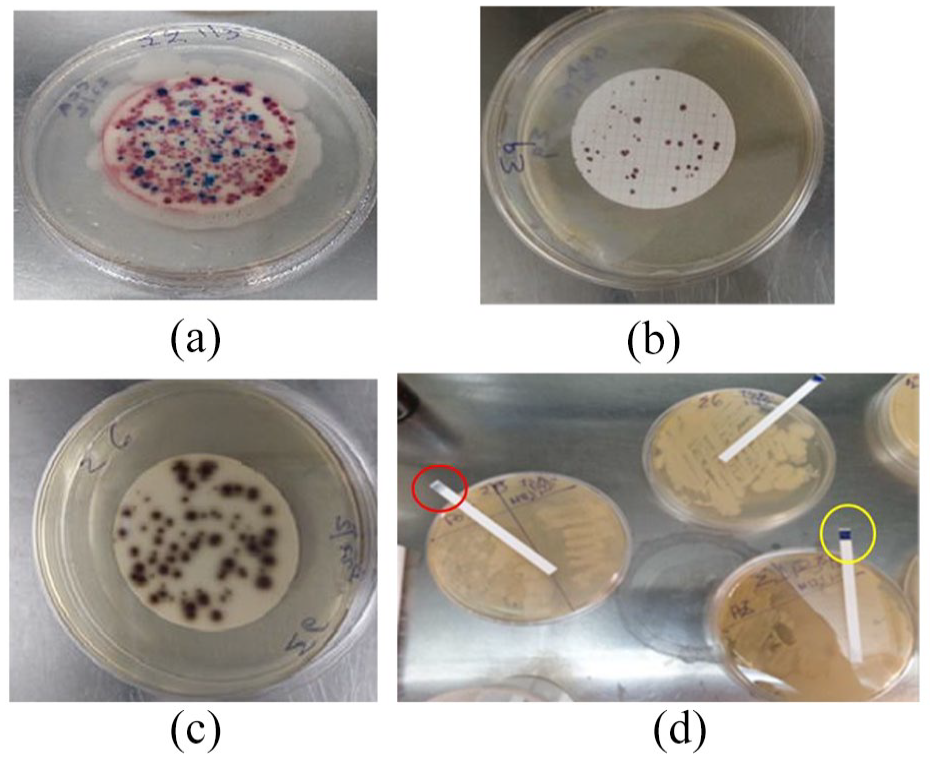
Examples of microorganisms growth in various nutrient substrates in Figure 2(a)–(d). (a) Total coliforms growth on Coliform Count Agar (CCA); (b) Enterococcus growth on Slanetz and Bartley agar; (c) confirmation test for enterococcus using Bile Esculin Azide agar (BEA); and (d) confirmation test using Tryptone Soy Agar (TSA) using oxidase strips. Gray color is negative on the left and black color is positive on the right.
The study results of May 2023 samples showed that Total Coliforms values were within the below the maximum allowable limit on all coastal sites in Τhessaly, Greece. Regarding the E. coli bacterium, the results demonstrated that its values were above the desirable limits in Nea Messangala (280 cfu/100 ml) in the samples of the same month (Supplemental Figure S3). Enterococcus values were also above the maximum limit (600 cfu/100 ml) in Nea Messangala (Supplemental Figure S4). As far as August 2023 samples are concerned, the results showed that E. coli values exceeded the desirable limits in Agia Paraskevi (369 cfu/100 ml), Nea Messangala (373 cfu/100 ml; Supplemental Figure S5). Enterococcus values were within the permitted limits on all these sites in the aforementioned samples. As for November 2023 samples, the results revealed that Total Coliforms values exceeded the desirable limits in Alexandrini (519 cfu/100 ml), Faros–Stomio area (621 cfu/100 ml), and Nea Messangala (528 cfu/100 ml; Supplemental Figure S6). E. coli values were also above the desirable limits in Nea Messangala (360 cfu/100 ml) according to the samples for the same month (Supplemental Figure S7). Enterococcus values were within the permitted limits on all sites in the samples in question. The results of February 2024 samples showed that Total Coliforms values exceeded the desirable limit in Alexandrini (1,446 cfu/100 ml), Faros–Stomio area (1,410 cfu/100 ml), and Nea Messangala (1,347 cfu/100 ml; Supplemental Figure S8). E. coli values were above the desirable limits in Alexandrini (432 cfu/100 ml) according to the same samples (Supplemental Figure S9). Enterococcus values exceeded the maximum legal limits in Alexandrini (399 cfu/100 ml), Faros–Stomio area (225 cfu/100 ml), and Nea Messangala (426 cfu/100 ml; Supplemental Figure S10). Following the completion of microbiological analyses during all seasons of the year, the times series for all microbiological parameters for the period from May 2023 to February 2024 were generated (Supplemental Figure S11–S14). In Alexandrini an increase in Total coliforms and E. coli is observed following the extreme floods in Thessaly, Greece, at the end of 2023. In Agia Paraskevi an outbreak of Total Coliforms (657 cfu/100 ml) and E. coli is observed during August 2023 and February 2024 (Total Coliform count: 384 cfu/100 ml; Supplemental Figure S12). The increase in those values during August is due to the fact that it is summer vacation period and, therefore, the influx of tourists is higher (Soumastre et al., 2022). Furthermore, this is due to the geomorphology of the area and the fact that the bay is enclosed. In Faros–Stomio area an increase in Total Coliforms and E. coli is observed during summer months due to the high influx of bathers and other activities. This Total Coliforms increase was even more pronounced following the flood events occurred in the Region of Thessaly in Greece in the autumn of 2023. Moreover, enterococcus values exceeded the permitted limits in February 2024. In Nea Messangala an outbreak (i.e. values three times higher than the maximum limits) of enterococcus was observed in May 2023. E. coli values exceed legal limits during summer (and 373 cfu/100 ml). A rapid increase of Total coliforms was observed following the floods of 2023, with their value being 528 cfu/100 ml in November 2023 and 1,347 cfu/100 ml in February 2024.
Statistical Analysis
SPSS package was used, and Mann–Whitney U Test was performed. No statistically significant difference was found before and after the flood events, for any of the two (E. coli p = .263 > .05 and Enterococcus p = .938 > .05) pathogenic bacteria (Supplemental Table S5). We also performed the One-Sample Wilcoxon Signed Rank Test for the comparison before and after storm “Daniel” to desirable limits (250 cfu/100 ml and 100 cfu/ml).
Discussion
In this work, a first approach was made to the simple comparison of four river delta regions from around the world. The limitations of the research are that it can be applied to areas with the same geomorphology, climate temperature, winds, and whether they are tourist resorts. The detailed analysis of the study areas shows that the areas of Florida, Miami, Hobie beach, USA, and Gonzaguinha beach in Brazil are enclosed bays with poor water circulation. Furthermore, the climate in Florida, Miami, Grandon beach in the USA, and São Vicente, São Paulo, Brazil is tropical and subtropical, and the said areas located in open ocean waters. Thus, these two areas cannot be compared to the other study areas. The only areas that can be compared to each other are the Pineios Delta areas and the Jucar River areas in Spain. The above areas have common natural, geomorphological, and climate characteristics. In addition, both areas are near city centers – Larissa and Valencia, respectively, and both areas are a magnet of tourists during summer months, and, thus, recipients of treated wastewater, urban and industrial waste, and illegal dumping. Prior to comparing the microbiological analysis results, we should take into account that the length of Pineios River is half the length of Jucar River, on the one hand, and that a flooding occurred in Greece in September 2023, resulting in higher coliform values in those areas, on the other hand. For the above reasons, as well as the fact that the two studies were not conducted at the same time intervals, no comparison will be made between the two regions of the Mediterranean. A future research improvement could be the modeling the two rivers flow in Greece and Spain. For this reason, we focused only on Pineios River estuary in Greece. The concentration of E. coli bacteria does not differ statistically from the desirable value of 250 cfu/ml before storm “Daniel” (Supplemental Table S5) while it is statistically slightly lower than the desirable value of 250 cfu/ml after storm “Daniel” (Supplemental Table S5) in Greece (before p = .208 > .05 and after p = .015 < .05). Both before and after storm “Daniel,” the concentration of Enterococcus bacteria does not statistically differ from the desirable value of 100 cfu/ml (before p = .161 > .05 and after p = .637 > .05). From the results of the One-Sample Wilcoxon Signed Rank Test we see that the enumeration of E. coli and Enterococcus is below the desired value provided by the Legislation and was not affected by the “Daniel” storm (Supplemental Table S6). The seasonal variation at the four selected points (Nea Messangala is the spot-1, Alexandrini is the spot-2, Faros Stomio is the spot-3, and Agia Paraskevi is the spot-4) is described below. In Nea Messangala (spot-1), a gradual increase in Total coliforms is observed from May 2023 (192 cfu/ml) to February 2024 (1,347 cfu/ml), Supplemental Figure S14. It should be noted that it exceeds the desirable limit of 500 cfu/ml but not the maximum limit of 10,000 cfu/ml. Also, the Enterococcus bacteria exceeded the maximum limit of 200 cfu/ml in May 2023 (600 cfu/ml) and February 2024 (426 cfu/ml). In Alexandrini (spot-2), a gradual increase in Total coliforms is observed from November 2023 (519 cfu/ml) to February 2024 (1,446 cfu/ml), Figure S11. This number of bacteria exceeds the desired limit of 500 cfu/ml but not the maximum limit of 10,000 cfu/ml. In Faros Stomio (spot-3), a gradual increase in Total coliforms is observed from November 2023 (621 cfu/ml) to February 2024 (1,410 cfu/ml), Figure S13. The only checkpoint in Greece that meets the requirements of Directive 2006/7/EC, for the desirable and maximum limits is Faros Stomio (spot-3, Supplemental Figure S13). The possible explanation for this spot being swimmable all year round is that it is protected by the small bay. Thus, the possible flows of the Pineios River are diverted into the Aegean Sea by the prevailing winds in the area. For spatial understanding a swimmable and not swimmable beach Figure was made (Supplemental Figure S15).
Conclusions
The conclusion on the microbiological contamination of coastal water in Greece, according to Directive 2006/7/EC, is of excellent quality. The results of the research reveal that the system’s resilience is very good. Continuous monitoring of contamination in sensitive delta areas throughout the Mediterranean Sea is a key issue for the protection of society, public health, and environment.
Supplemental Material
sj-docx-1-asw-10.1177_11786221251336884 – Supplemental material for Microbiological Contamination of River Deltas in Similar Areas Worldwide With a Focus on the Pineios Delta in Greece
Supplemental material, sj-docx-1-asw-10.1177_11786221251336884 for Microbiological Contamination of River Deltas in Similar Areas Worldwide With a Focus on the Pineios Delta in Greece by Marina Lampronikou and Konstantinos Kakavas in Air, Soil and Water Research
Supplemental Material
sj-docx-2-asw-10.1177_11786221251336884 – Supplemental material for Microbiological Contamination of River Deltas in Similar Areas Worldwide With a Focus on the Pineios Delta in Greece
Supplemental material, sj-docx-2-asw-10.1177_11786221251336884 for Microbiological Contamination of River Deltas in Similar Areas Worldwide With a Focus on the Pineios Delta in Greece by Marina Lampronikou and Konstantinos Kakavas in Air, Soil and Water Research
Footnotes
Acknowledgements

Disclaimer/Publisher’s Note
The statements, opinions, and data contained in all publications are solely those of the individual author(s) and contributor(s) and not of SAGE and/or the editor(s). SAGE and/or the editor(s) disclaim responsibility for any injury to people or property resulting from any ideas, methods, instructions or products referred to in the content.
Author Contributions
Conceptualization, K.K.; Methodology, L.M.; software, K.K.; validation, K.K.; formal analysis, K.K.; investigation, K.K.; resources, K.K.; data curation, B.D.; writing – original draft preparation, K.K. and L.M.; writing – review and editing, K.K. and L.M.; visualization, K.K.; supervision, K.K.; project administration, K.K.; All authors have read and agreed to the published version of the manuscript.
Funding
The author(s) received no financial support for the research, authorship, and/or publication of this article.
Declaration of Conflicting Interests
The author(s) declared no potential conflicts of interest with respect to the research, authorship, and/or publication of this article.
Data Availability Statement
Data presented in this study are available on request from the corresponding author.
Supplemental Material
Supplemental material for this article is available online.
References
Supplementary Material
Please find the following supplemental material available below.
For Open Access articles published under a Creative Commons License, all supplemental material carries the same license as the article it is associated with.
For non-Open Access articles published, all supplemental material carries a non-exclusive license, and permission requests for re-use of supplemental material or any part of supplemental material shall be sent directly to the copyright owner as specified in the copyright notice associated with the article.
