



Abstract
The rising temperatures impact the environment, economy, public health, and global climate. This rise can be attributed to greenhouse gas emissions, urbanization, deforestation, and changes in oceanic currents. Higher temperatures pose a health risk and can result in dehydration and heat stroke while also affecting agricultural yields, aggravating water scarcity, increase in the frequency and intensity of hydroclimatic extreme weather events such as heatwaves, flooding, or droughts in different regions. Further, it can affect the construction, energy generation, and tourism industries. This paper highlights the fundamental factors behind the summer temperature rise in India and its impacts. The recommendations aim to improve the adaptation to the changes on individual and governmental levels. There is a need to encourage a carbon-neutral economy and tap into the resources for research and development of technologies. The paper also underscores the relationship between increased temperatures and the possibility of a pandemic in the future, as increased temperatures have the ability to change the pathogen behavior, and understanding the relationship between both is essential to formulate policies and future interventions.
Graphical Abstract
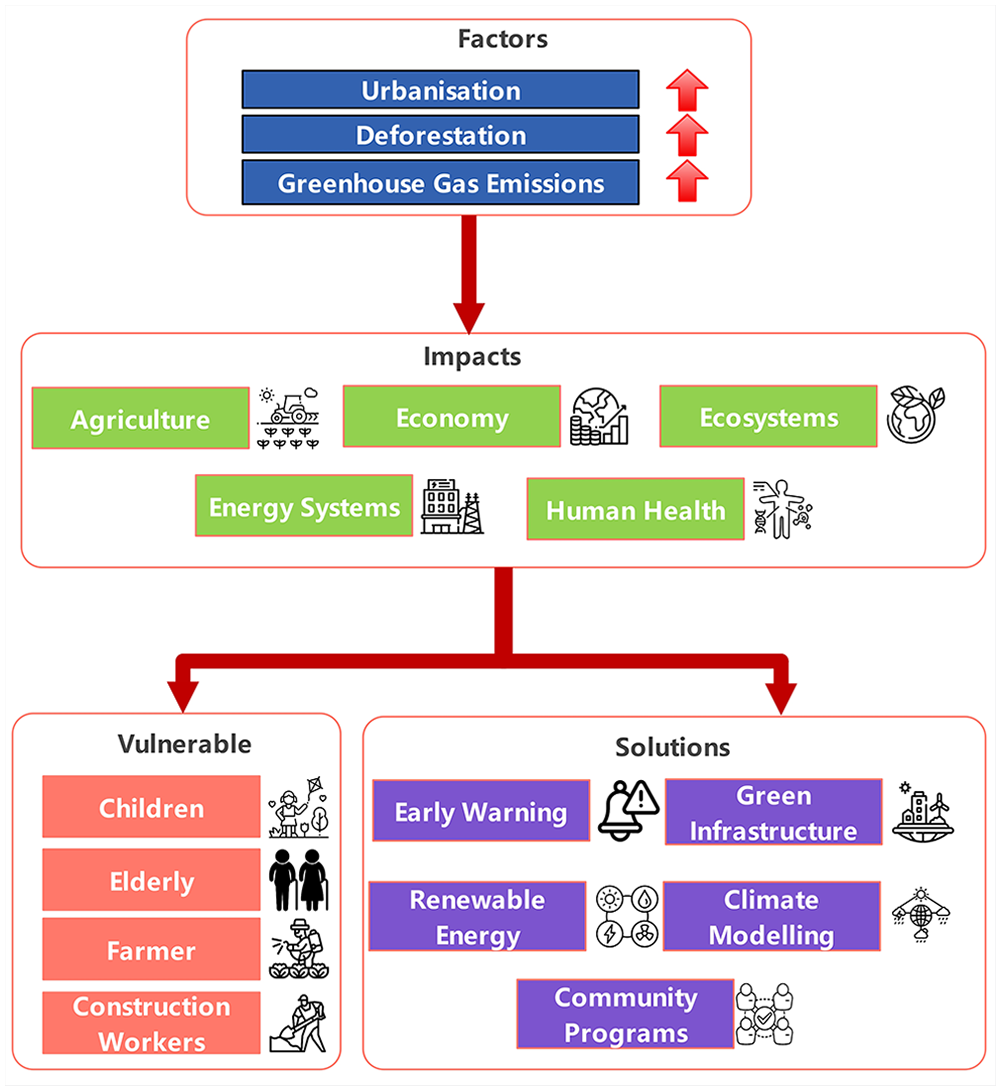
Highlights
Personal precautionary measures are necessary in instances of high heat exposure.
Current heat action plans may prove inadequate in addressing climate challenges.
There is a need for updating building standards to enhance climate resilience.
The emergence of future pandemics can be hastened by higher temperatures.
Climate change mitigation is limited by insufficient funding & policy implementation.
Introduction
The issue of climate change and rising temperatures is an undeniable reality for India, while its geographical location between the tropics and its most populated country status has made it more vulnerable. Climate change requires a multidisciplinary approach and requires continuous assessments to quantify its effects. According to the Global Climate Risk Index 2021, India has been ranked seventh among the countries that are most susceptible to climate risk events in terms of exposure and underlying socioeconomic vulnerabilities (Eckstein et al., 2021). Country’s tropical regions are experiencing a larger increase in extreme heat compared to the midlatitudes primarily due to narrower temperature distributions (Patel et al., 2024).
Climate change is driven by the complex interplay of factors such as human-induced greenhouse gas emissions, air pollution, altered land use patterns, and industrial activities, which have considerably increasing in the last few decades and contributed to unprecedented environmental changes. The impact of climate change on the Indian subcontinent is a multifaceted issue that involves intricate physical mechanisms operating across various spatial and temporal scales (Krishnan et al., 2020). This complexity is primarily due to the region’s climatic conditions being predominantly influenced by the Indian monsoon and distinctive high-altitude topographical features such as the Himalayas, Western Ghats, Tibetan Plateau, and the adjacent Indian Ocean, Arabian Sea, and Bay of Bengal (Das & Meher, 2019).
The 1998 heatwave in the eastern coast of India resulted in more than 2500 deaths which coincided with the El Nino Southern Oscillations (ENSO) in 1997 which also returned during mid-2023 (June 2023), and in turn led to variations in the climatic conditions characterized by above average warming of the sea surface in the equatorial pacific ocean (Satyanarayana et al., 2024), resulting in rise in summer temperature in India (Lian et al., 2023). Considering these, the current article tries to identify the factors behind the summer temperature rise and its various impacts in India. The recommendations aim to improve the adaptation to the changes at individual and governmental policy levels. This paper also aims to examine the relationship between increased temperatures and the possibility of the outbreak of pandemics in the future, as increased temperatures can change the pathogen behavior. Understanding such relations is essential to formulate effective policies and future interventions.
Methodology
This study follows a narrative review methodology to synthesize and analyze the current knowledge on climate change impacts and adaptation strategies centered around India. This methodology captures the relationship between climate science, public health outcomes, and policy implications. Narrative reviews are particularly useful for providing a comprehensive overview of complex topics and informing policy decisions (Ferrari, 2015; Green et al., 2006).
The review process followed a multi-step approach:
Inclusion Criteria: Literature published on climate change and rising temperature in India was prioritized to ensure relevance to the Indian context, and the significance of findings for policy implications.
Data Extraction and Synthesis: Key information was extracted from the selected literature, including main findings, and policy recommendations. Data were synthesized thematically to identify patterns, trends, and gaps in current knowledge.
By synthesizing diverse sources of information, this paper provides a comprehensive overview to inform evidence-based policymaking.
Results/Discussion
Factors contributing to warmer summers
The combined effect of natural climate variability and climate change is causing temperature rise, especially during summer months in India. Moreover, they often create a feedback loop that can amplify their individual effects. Below are the key factors contributing to this increase in temperature rise over India.
Ocean currents & El Nino
The tropical ocean currents of the Pacific Ocean can affect the temperatures over India and lead to hotter weather through complex teleconnections. The El Nino—Southern Oscillation (ENSO) characterized by alternating ocean currents such as El Nino and La Nina alters the sea surface temperatures and atmospheric pressure patterns, which in turn impact the global weather patterns. El Nino disrupts the normal atmospheric circulation patterns which can influence the weather and lead to drier and warmer conditions over India, La Nina is linked to wet and cooler conditions; such variations are more prominent during summer months. In the last 50 years, as shown in Figure 1, three consecutive years of La Nina occurred only three times, 1973 to 1976, 1998 to 2001, and 2020 to 2023 (World Meteorological Association [WMA], 2022). El Nino is also associated with decreased summer rainfall during the (June-July-August-September) JJAS monsoon season in India, leading to increased frequency and prolonged heatwaves (Chakraborty & Singhai, 2021; Kumar Dash et al., 2022). Studying these ocean currents helps researchers and scientists understand the earth’s weather patterns and mitigate the impact of climate change on natural systems and communities.

ENSO event distribution.
Global warming
The overall temperature of the earth is rising due to the increase in the concentration of greenhouse gases such as carbon dioxide and methane. The increase in intensity of multiple human activities, such as burning fossil fuels and clearing forests, aggravates the rise in the concentration of greenhouse gases in the atmosphere. The level of carbon dioxide in the atmosphere has reached 426 ppm as observed at Maona Loa, Hawaii. Unpredictable summer monsoons and more intense dry years will exacerbate the impact of the scorching summers in India (World Bank, 2013). Although El Nino and La Nina events are natural phenomena, global warming may lead to increased frequency of these events, and under certain conditions, the extremes of rainfall and temperature patterns can be of higher intensity (NOAA, 2020). The average global temperature was at least 1.04°C higher than the average of 1880 to 1900, subsequently increasing the land and ocean surface temperatures by +1.45°C and +0.69°C (Ravindra et al., 2024).
Geographical location
The geographical location also plays a significant role in warming the landmass. The country’s location is near the equator and is susceptible to warmer temperatures (Dirmeyer & Shukla, 1996; Lal, 2003; Wu et al., 2015). The tropical position of the subcontinent exposes it to more direct solar radiation than temperate regions. The regions of the east, south, and southeast are near the sea and are humid due to the proximity to the later water bodies such as the Indian Ocean, which results in 40% to 45% warm nights attributed to geographical location (Maharana et al., 2024).
Urbanization
India is undergoing rapid development, and a major push is being given to urbanization. This urbanization transforms natural landscapes to built environments which in turn alters local climate (Boyaj et al., 2024), as it is leading to the surge in temperatures in urban areas compared with the rural areas, as the buildings, roads, and other infrastructure are more heat absorbent. This phenomenon is called the urban heat island effect (Vinayak et al., 2022). This, in turn, causes elevated temperatures during summer. This urbanization with compounded effect of climate change poses an increasing threat to urban areas in the form of Heat-Hazard Risk (Cheval et al., 2024).
There is a need for a better understanding of these variables that contribute to the rise in summer temperatures, as this will help to formulate robust heat action and adaptation plans across the country. The shifting climatic conditions due to ocean currents must be focused on exclusively.
Potential impacts of warmer summers
The India Meteorological Department (IMD) releases the season forecast every year and highlights the rainfall quantity, region-wise distribution, and the rise in temperatures during the upcoming season (https://mausam.imd.gov.in/imd_latest/contents/seasonal_forecast.php). This forecast acts as a tool because its ability to help stakeholders to prepare for climate-related challenges plays a crucial role due to its socioeconomic impact on agriculture, disaster management, economy, energy generation, and the wider umbrella of public health (Troccoli et al., 2008). However, forecasting is the first step toward long-term resilience, and there is a need to emphasize the probable implications of higher summer temperatures, underscoring the imperative of taking timely actions to mitigate the effect of climate change and strengthen resilience among the population.
Health impacts
High temperatures affect human health in varied forms, such as dehydration, heat cramps, heat exhaustion, and heat stroke, especially becoming more acute in vulnerable populations and outdoor workers who have prolonged exposure to high temperatures. Healthcare facilities face a surge in patients during heat waves and this can also overburden the health system and affect the country’s economy by reducing productivity. The phenomenon of climate change has been observed to result in a higher incidence of mortality as compared to a scenario where no such change in climate occurs. Notably, fatalities associated with Malaria are poised to experience a substantial surge, ultimately leading to a staggering economic output loss of 20.7 billion U.S. dollars by the year 2100, solely attributable to Malaria (Amit et al., 2015).
Agricultural and nutritional impacts
High temperatures will change the long-period normal precipitation pattern in the region and can adversely affect crop yields. Temperature change can also lead to changes in crop quality and crop quantity. This can severely impact the marginalized farmer’s community and the nation’s nutrition security. The occurrence of heat waves has the potential to induce detrimental effects on crops, such as wilting, stunting, or premature ripening, ultimately leading to reduced production levels and increased market prices. Heat waves have been observed to elevate the demand for water in irrigation, thereby exerting pressure on water resources in the affected regions.
Insufficient cold-chain infrastructure can result in significant harm to fresh produce during heat waves. Currently, the cold chain facilities in India cover only 4% of fresh produce, resulting in an annual estimated food loss of $13 billion (World Bank, 2022). The impact sensitivity of rice production exhibits a reduction of 4% to 20%; maize production shows a decrease of 32% to 50%; wheat production indicates a decline of 5% to 20% for every 1°C rise (CEEW, 2015). The study conducted by Kompas et al. (2018) examined additional pathways by which climate change could impede the progress of economic growth in India. The authors of the study have directed their attention toward the reduction in agricultural productivity, the rise in sea levels, and the increase in health expenditure. Their findings indicate that a rise of 1°C in global temperatures would result in a 3% annual loss of GDP for India. Furthermore, if the temperature were to increase by 3°C, the cost would escalate to 10% per annum.
Environmental impacts
High temperatures can disrupt the hydrological cycles, and lead to water scarcity and even droughts in some areas. It can also accelerate the evaporation rates, leading to faster melting of glaciers and increasing river water flow, finally causing floods in the monsoon season. Both scenarios will negatively impact the flora and fauna of the region. It can also contribute to city air pollution and may increase public health issues. Warmer climates also increase the transmission and incidence of vector-borne diseases (Rocklöv & Dubrow, 2020). Within India, the El Nino phenomenon—one of the determinants of dry summers has been shown to have a negative and positive correlation with malaria outbreaks in the eastern and western parts, respectively (Dhiman & Sarkar, 2017).
Economic impact
Rising temperatures can also impact sectors like energy, construction, and tourism. Most of our population is employed in these sectors, this can affect their livelihood. Increased energy demands for cooling infrastructure and reduced thermal comfort of visitors during peak temperature periods can directly impact tourism and outdoor activities such as construction. Impact on crop yields creates an economic feedback look which will affect the demand-supply pattern as farm productivity is interlinked to income and purchasing power of the people and demand for other consumer goods. This, in turn, will affect the economy of the country. Estimating the economic and financial costs of climate change impacts poses a challenge due to significant uncertainties across different sectors. The potential consequences of extreme heat include a projected decrease of 15% in the capacity for outdoor work, a reduction in the quality of life for approximately 480 million individuals, and an estimated cost of 2.8% of the Gross Domestic Product by the year 2050 (Debnath et al., 2023). By 2030, it is projected that there will be a global job loss of 80 million due to a productivity decline associated with heat stress. It is estimated that India may contribute to 34 million of these job losses (World Bank, 2022).
Impact on energy
Electricity is essential for cooling in urban areas to safeguard public health, maintain quality of life. It has become an important mode of adapting to extreme weather conditions and climate change. (Harish et al., 2020). India has the fifth largest electricity-generating capacity and is the sixth largest energy consumer amounting to around 3.4% of global energy consumption (Kumar et al., 2014). The increase in peak load and cooling energy demand caused by rising temperatures is projected to result in the installation of an additional 36 GW of capacity by 2050 and 136 GW by 2100 (CEEW, 2015).
Impacts on climate
Rising temperatures have the potential to accelerate the pace of climate change, resulting in rising sea levels, extreme weather events, and natural disasters. World Meteorological Organization (WMO) has reported 11,778 disasters related to weather, climate, or water, resulting in 2 million deaths and economic losses of US$ 4.3 Trillion between 1970 and 2021 (WMO, 2023). About 3,500 reported disasters in Asia led to nearly 10,00,000 deaths and economic losses of US$ 1.2 trillion from 1970 to 2019 (WMO, 2022). India is among the 10 most climate-induced disaster-prone areas in the world, with 2.7 million Indians already displaced by climate change in 2019 and average annual economic losses due to disasters were estimated to be $9.8 billion.
The relationship between warmer weather and the emergence of pandemics
Literary sources suggest that temperature rise expedites the emergence of pandemics. Climate change has increased the exacerbation of malaria in East Africa (Alonso et al., 2011). It is essential to understand the intricate interplay between climatological factors and pandemics to enhance preparedness for future challenges. It is possible that an ideal temperature range exists for the transmission of viruses, and temperature could potentially exert a significant influence on the propagation of contagious viruses, such as the COVID-19 pathogen (Wang et al., 2020). This temperature dependence will also create regional variations in disease risk, whereas the regions characterized by lower temperatures may necessitate more rigorous control protocols in the event of a future outbreak. It is imperative to investigate the association between rising temperatures and the occurrence of pandemics (Kuhn et al., 2005). A study analyzed data-based evidence that showed that a relatively reduced number of COVID-19 cases were registered in Northern Europe who decided to spend more time at home, compared to the people in Southern Europe who decided to spend time outdoors during warm days (Nichita et al., 2024).
Pathogen behavioural change
High temperatures augment the ecological persistence of pathogens and, consequently, increase the likelihood of broader transmission of pathogens (Dobson, 2009).
High temperature expedites the reproductive rate of specific pathogens, thus amplifying their potential to propagate.
The explosion of vector populations, including various species such as mosquitoes, fleas, and rodents, can be attributed to the rise in temperatures. This can result in faster transmission of diseases from vectors to communities.
Impact on human behaviour
The rise in temperature could potentially lead to a higher likelihood of individuals gathering in enclosed, air-conditioned areas, consequently increasing the possibility of the spread of airborne diseases (Jendrossek et al., 2023).
Due to high temperatures, the aggravation of present health conditions, such as cardiovascular and respiratory diseases, can be linked to increased infection vulnerability (Mirsaeidi et al., 2016).
Rising temperatures have the potential to facilitate the proliferation of pathogenic bacteria in stagnant water bodies, thereby leading to a rise in waterborne illnesses (Funari et al., 2012).
Healthcare system challenges
The increased prevalence of diseases during episodes of high temperatures, such as heatwaves, could potentially overwhelm healthcare systems, thereby hindering the effectiveness of pandemic response measures (Hess et al., 2023).
High temperatures can potentially worsen the situation while facing the resource crunch during pandemics, leading to restricted availability of potable water, hygienic facilities, and medical provisions. This can reduce the efficacy of strategies to prevent and contain the spread of diseases (Crisp, 2022).
A fundamental understanding of rising temperatures and the emergence of future pandemics is crucial in formulating effective measures to mitigate risks and enhance resilience in the face of worldwide climate change. By addressing the impacts of warmer weather on pathogen behavior, human health, and healthcare systems, we can better prepare for future pandemics and protect the well-being of our communities.
Preventive measures and strategies for building resilience
The potential consequences of a warmer planet are numerous and multifaceted, affecting both the natural world and human society. It is important to implement measures to mitigate the effects and strengthen the ability of individuals, communities, and governments at both the national and state levels to adapt to them. Various levels of action are necessary to advance climate resilience.
Individual actions
Individuals should refrain from engaging in outdoor activities during the hours of peak sun exposure to avoid direct consequences of heat. Further, while staying indoors, ensure adequately ventilated and thermally comfortable micro-environments.
The individuals should maintain adequate fluid intake and regularly consume ample amounts of water whenever feeling thirsty. It is advisable to refrain from consuming beverages with high caffeine or sugar levels.
The individuals should wear light-colored and loose-fitting linen garments which help to facilitate adequate ventilation of the skin.
Individuals such as the elderly, young children, pregnant women, and even domestic animals should be kept vigilance, ensuring they are adequately hydrated and rest in a cool environment, as they are more susceptible to the effects of rising temperature (World Health Organization, 2013). Cooked food should be refrigerated to mitigate the risk of foodborne illnesses resulting from inadequate handling and storage practices (Duchenne-Moutien & Neetoo, 2021).
Government actions
Government should plan and implement heatwave action plans, including an early warning system, public awareness, and response protocols in case of emergency (Hess et al., 2018).
The government should nudge investment in building climate-resilient buildings, which enable the communities to deal with the effects of climate change, such as sea level rise and increasing temperatures.
Governments should make it mandatory to implement green roof or cool roof technology. Policies such as urban agriculture and green spaces should be promoted to reduce the effect of urban heat island phenomena.
Governments should promote policies that make their economies carbon-neutral, which in turn will reduce the emission of greenhouse gases.
The influence of urbanization on nighttime temperatures emphasizes the necessity for cool housing and engineering recommendations in urbanized regions of India (Boyaj et al., 2024).
Certification of the events (Periyasamy et al., 2022), government programs, and other activities as carbon neutral and zero emission events reporting of the carbon footprint and handprint by all such activities can motivate the adopting green practices by individuals and organizations.
The government should invest in the construction of cooling sheds and increase potable water availability for individuals at higher risk, such as manual laborers.
The government should tap into financial resources to promote research in the field of health and temperature studies to study the impact of higher temperatures on the human body and finance technologies that act as solutions to mitigate the impacts of climate change.
Conclusion
The potential consequences of temperature rise and climate change on the economy, environment, and population must be better understood. The present review highlights the factors responsible for the occurrence of higher summer temperatures, possible effects, and the strategies that can play a positive role in enhancing the environment’s resilience to climate change. We need holistic policies to reduce the emission of gases with higher global warming potential and tap our available resources in urban planning and building more climate-resilient buildings. In light of the challenges presented by increasing summer temperatures, it is imperative to adopt proactive measures designed to reduce the diverse impacts and enhance the adaptability of vulnerable regions. Implementing heat wave action plans, allocating adequate funds by tapping various government schemes toward climate-resilient infrastructure, promoting sustainable land use practices, and safeguarding vulnerable populations should be prioritized. Understanding the intricate correlation between climate change and the onset of pandemics is imperative in formulating future policies and interventions to prevent health crises. Implementing preventive measures and collaborative efforts can mitigate the adverse impacts of heat and climate change on human existence, safeguard communities from potential pandemic threats, and foster a sustainable and resilient future.
Footnotes
Acknowledgements
This study was undertaken under the North India CCG Network, Climate Compatible Growth (CCG) programme, which is funded by the UK Foreign, Commonwealth and Development Office (FCDO). The views expressed in this paper do not necessarily reflect the UK government’s official policies.
Author Contributions
Khaiwal Ravindra: Conceptualization, writing base draft, Formal analysis, Visualization, Writing—review & editing. Sanjeev Bhardwaj: Data analysis and Visualization, Writing—review & editing, Data curation. Aravind P Gandhi: Writing—review & editing. Shiv D Attri: Writing—review & editing. Suman Mor: Conceptualization, Formal analysis, Writing—review & editing. All authors read and approved the final manuscript.
Declaration of Conflicting Interests
The author(s) declared no potential conflicts of interest with respect to the research, authorship, and/or publication of this article.
Funding
Dr SM received partial support under the North India CCG Network, while other author(s) received no financial support for the research, authorship, and/or publication of this article.
Ethical Approval
Not applicable.
Consent to Participate
Not applicable.
Consent to Publish
All authors agree to publish.
Availability of Data and Materials
Available on request.
