




Abstract
Climate change impact is global and Nepal is no exception, posing vulnerability for different communities and regions. Transhumance herding is the culture and identity of indigenous settlement in Himalayan region where herders follow vertical transhumance herding as a part of subsistence mixed agriculture system for their livelihood. It differs from nomadism in terms of its periodicity, regularity, and mobility. This study confers the impacts of climate change and adaptation on transhumance herders in Gatlang of Rasuwa District. Focus Group Discussion, Key Informant Interview, and Questionnaire survey were carried out covering herder’s perception toward climatic variability, changes in the biophysical indicator, its impact and adaptation strategies. Data were analyzed using descriptive statistics, weighted mean, and Index of Usefulness of Practice for Adaptation (IUPA) tools. This study showed increase in mean average temperature (0.0202°C), increase in monsoon precipitation (2.1 mm) and decrease in winter precipitation (0.5 mm). Seasonal movement of livestock was mainly guided for adjusting temperature. The observed changes in biophysical indicator were diverse with shrinking grazing lands as most agreed statements followed by low crop productivity and faster melting of snow in rangeland. Herders perceived different adaptation strategies where reserving some grazing areas scored highest IUPA ranking followed by seasonal movement, storage of grass/hay, and so on. Though transhumance itself is one of the adaptation strategy against climate change people were not aware about changing monsoon precipitation and following same seasonal calendar as before which have affected livestock. These observations suggested that herders were unaware of the underlying cause and its impacts on the system which needed to be monitored scientifically.
Introduction
Transhumance is a form of pastoralism in which livestock are moved seasonally between different agro-ecological zones to use the seasonal availability of grazing resources. 1 This is an age old practice in mountainous region 2 by indigenous settled communities to adjust varying environmental conditions. In the Himalaya, they have transformed the ecosystem into economically productive assets for their livelihoods. 3 Transhumance pastorism (THP) is seen as an adaptation strategy against adverse climatic condition because it uses pasture resources at different elevations depending on seasonal availability. 4
Around 27% of the earth’s land surface is covered by mountain, 5 containing half the world’s biodiversity hotspots and providing a source of fresh water for half the world’s population. Observed impacts of climate change in the mountains include variation in rain, snowfall, drought, glacial lake outburst floods, and landslides leading to crop failure, as well as increasing food and livelihood insecurity, water scarcity, and income insecurity. 6 As a result, these mountain regions are recognized as a “climate change hotspot,” with serious consequences for mountain ecosystems, human settlements, and the economy of downstream areas. 7 Studies conducted in the Himalayas of Sikkim 8 showed that there is little knowledge about the vulnerability of mountain ecosystems to climate change, particularly the Himalayan region. 8
Nepal is the most vulnerable region to climate variance in the world. More than 2 million Nepalese people depend on agriculture and forestry for livelihood and have limited capacity to cope up with climate-related disasters. 9 The incidence of poverty is higher in the mountains than in the plains in the same region. People in mountain communities regard livestock as a capital asset, source of wealth and power because agriculture is difficult due to cold climate and difficult topography. 10
Modifications of livelihood options due to changes in demography, migration, and labor shortage, diversification of agriculture, and market influence on rural economy, as well as privatization and nationalization of rangelands are reported as constraints to THP in the mountains. 11 The impacts of climate change upon the rangelands could be more complex as it can alter the competition between plants and their growth habits, productivity and the plant-animal interactions 12 along with decrease in rangeland quality. 13 Projected warming trends for many years alter the timing of snowmelts, grass production, and phenology of plants. 14 Decades of research have shown that rangelands can sustainably produce a variety of goods and services even in the face of extreme climatic events, if managers respond quickly and appropriately to changes. Specifically, livestock can be affected in two ways by climate change: the quality and amount of forage from grasslands may be affected and there may be direct effects on livestock due to higher temperature. 15 For example, warmer summer temperatures are estimated to have a suppressing effect on livestock appetite, which leads to lower weight gain. 16
The impacts of climate change upon the rangelands could be more complex as it can alter the competition between plants and their growth habits, productivity and the plant-animal interactions 12 along with decrease in rangeland quality. 13 Projected warming trends for many years alter the timing of snowmelts, grass production, and phenology of plants. 14 Decades of research have shown that rangelands can sustainably produce a variety of goods and services even in the face of extreme climatic events, if managers respond quickly and appropriately to changes. Thus it is necessary to study climate change and livestock farming because due to difficult topography and extreme condition, agriculture is less preferred than livestock farming for livelihood.
Despite its cultural significance and various contributions to livelihoods, THP in the mountain regions of Nepal is uncertain, and the practice may even disappear due to climatic factors. 17 Indigenous communities can better respond to changing climatic condition. 18 Emerging evidence indicates that adaptation and coping strategies by the poor people in developing countries are highly varied and local-level studies are needed for development policies to be effective. 14 In this changing environmental condition and social context, this study is aimed to explore the observed changes in biophysical indicators, perceptions of transhumance herders toward changes in climatic variables, and adaptation measures adopted by transhumance herders in the Gatlang of Rasuwa district. There are very less knowledge on how herders have perceived climate change and adapted to changes. Thus this study is a baseline for the sustenance of THP in mountain region.
Materials and Methods
Study area
Rasuwa district lies in Bagmati province of Nepal. “Rasowa” old name which is believed to be derived as a combination of two Tibetan words ra (meaning: lambs) and sowa (meaning: grazing) as it was famous for its lamb and grazing lands. This study was carried out in Gatlang village (also known as Black Village), ward-3 of Amachhodingmo rural municipality of Rasuwa district. Amachhodingmo was previously known as Parbatikunda rural municipality, named from the religious lake Parbatikunda, densely populated village with compact settlement pattern (Figure 1). Gatlang located west of Langtang National Park corresponds mountain ecosystem 19 and the study area was selected on the basis of sustenance of THP with traditional institutional arrangements and practice various indigenous knowledge for adaptation of this system in context of changing climate. In this area, the climate limits agricultural production; therefore, livestock rearing is the main option for livelihood. Most of the household keep cattle for domestic purpose. Some household who have in large number, they keep their cattle in Kharka for the purpose of cash income by selling Chhurpi, cheese, and ghee. Despite the income from the out-migration and other non-farm income activities, a significant proportion of households still mainly depends on agriculture and livestock for their food security and livelihood, with almost 70% of the households. Farmers on an average household sells 40 bags of potato (50 kg/bag/year) earning approximately gross income of NRs 53 000 (US$ 500) per annum. Likewise, farmers sell local beans and barley, ranging from Rs 15 000 to 25 000 (US$ 142-236) per annum per household. 19

Map of research site.
Methods of data collection
Both primary and secondary data were collected. The staffs from veterinary office, herders, secretariat of Amachhodingmo rural municipality, individuals associated with “Thiti samaj” and local elderly persons were taken as key informants. Purposive sampling technique was used to find key informants. Semistructured questions were prepared for household questionnaire survey with herders and families associated with herding. The 32 questionnaire survey was carried out with the help of local guide as a translator. Snow ball sampling method was used to select the respondents for household questionnaire survey. Focus Group discussions were carried out separately with local community herders and women group. Direct observation was done in potential site of Ammachhodigmo rural municipality to acquire in-depth information on biophysical changes, challenges, and local adaptation measures for the seasonal movement cycle.
Secondary data on herd size and other research-focused elements were collected from different government and nongovernment organizations. All the relevant journal papers, books, and published and unpublished reports were consulted as secondary data. Monthly temperature and rainfall data were obtained from the Department of Hydrology and Meteorology for the years 1988/89 and 2018. The data were collected from the Dhunche Climatology Station (1982 m).
The data analysis was done both using qualitative and quantitative method. Further clarification was shown by statistical tool SPSS (IBM SPSS 22 software) and presented through graph and charts. Similarly, Likert-type scale was used to measure perception on changes in biophysical indicators and reason for livestock movement, and Index of Usefulness of Practice for Adaptation (IUPA) tools was used to evaluate the prioritization of adaptation measures. General linear regression was used to find the trends of temperature and precipitation.
Likert-type scale

where SI = Satisfaction index; Fi = frequency scale; and N = number of respondents.
Likert-type scale was used to measure the different perceptions of the local community.
Preference ranking of adaptation measures
Index of Usefulness of Practice for Adaptation tool 20 was used to evaluate the general usefulness of practices for prioritization of adaptation strategies to climate change variability on the basis of criteria and indicator. It is obtained by,
Multiplying individual variable scores with assigned variable weight;
Consequently summing the weighted individual parameter scores (weighted sum)

where n = total number of criteria (variables); Ci = score (1-10) assigned to criterion i; Pi = weight of ith criterion in total index score (value between 0 and 10; an indicator of its relative importance in global evaluation of practice’s usefulness).
Results and Discussion
Climatic data analysis
Temperature analysis
The linear regression analysis of overall trends of mean annual maximum, minimum, and average temperature since 29 years (1989-2018) showed an increment of maximum temperature by 0.0532°C, decrement in minimum temperature by 0.00128°C, and increment in average temperature by 0.0202°C (Figure 2). Thus, the temperature is in increasing trend which supports the evidence of climate change in the study area 21 which matches the people’s perception.

Trend of mean annual maximum, minimum, average temperature from 1989 to 2018.
Rainfall variability
Similarly, rainfall data were collected from Dhunche station for 30 years. The linear regression analysis showed winter rainfall decreased by 0.5 mm and monsoon rainfall which increased by 2.1 mm (Figures 3 and 4).

Annual monsoon rainfall trend line from 1988 to 2018.

Annual winter rainfall trendline from 1988 to 2018.
People perception on climatic variability
Climate change is a global issue faced by the world today. In Gatlang village, more than 66% of respondent have not heard about climate change while only 34% of people knew about climate change through radio.
Perception on temperature variability
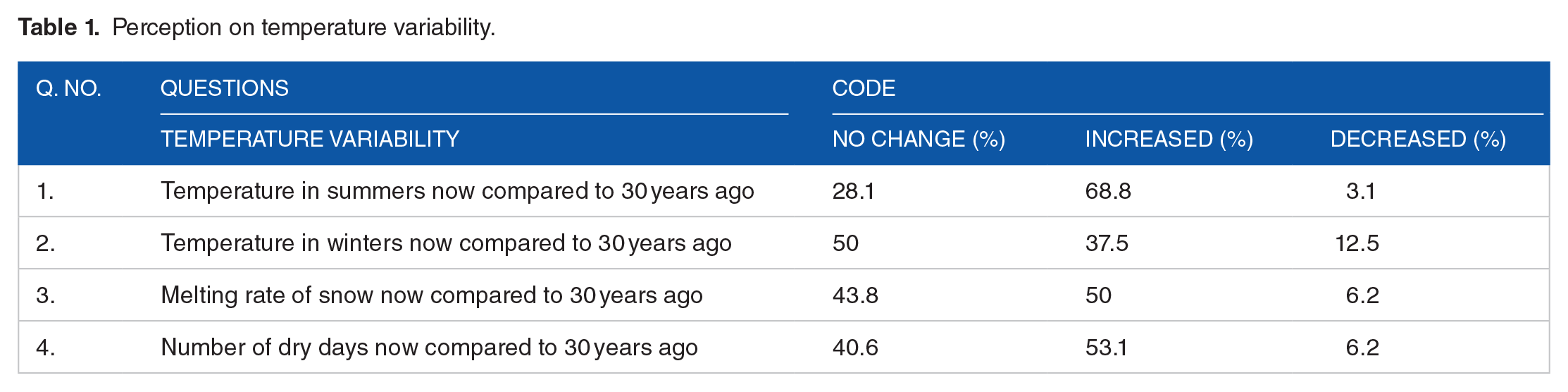
Most of respondents had opinion that temperature in summer now is increased (68.8%) followed by melting of snow is increased (50%) and number of dry days is increased (53.1%) except for temperature in winter is not changed (50%) (Table 1). Temperature in winter has mismatch perception by respondents. Thus this result supports long-term temperature data (Figure 2).
Perception on temperature variability.
Perception on rainfall variability
Average winter rainfall, monsoon rainfalls were observed in decreasing trend which is 40.6% and 56.2%, respectively. Herders experienced increased erratic rainfall (53.1%) and unpredictable rainfall (62.5%). Similarly erratic events of snowfall (56.2%), thunderbolt (53.1%) events, and hailstorm (71.9%) were in increasing trend. Long-term rainfall analysis supports the decrement of winter fall but is controversial with decrement of monsoon rainfall (Table 2).
Perception on rainfall variability.

Socio-economic characteristics of respondents
In Gatlang, people regard livestock as their important asset for livelihood, and they are practicing transhumance system from ancestor period. This village is inhabited by Tamang community. 22 Among 32 respondent involved in transhumance system, 59% of male and 41% of female participate in questionnaire survey. Mostly livestock were taken by male member to higher altitude in summer. The age group of 25 to 50 years (>72%) were mostly involved in transhumance herding system. Their major livelihood strategy was agriculture and livestock rearing and majority of herders were illiterate (81.2%).
Livestock holding
Livestock rearing was one of the main sources of income for people residing in the study area (Figure 5). Livestock such as cattle, Yak (Nak/Chouri), sheep, goat, and buffaloes were reared to meet their basic needs. Herders in Gatlang move their livestock from low lying area to higher altitude to use the pasture resources which is known as transhumance system.

Livestock details of the Gatlang (source: MLD, 2018).
Status of transhumance system
There were 475 households in the study site and maximum residents were engaged in livestock farming with mixed agriculture. About 80% of people were engaged in transhumance system rather than sedentary system or stall feeding.
According to key informant there were 39 chouri goths (herds of chouri), 1 Nak goth consisting of about 20 to 30 nak or yak at each goth. Similarly there were 18 to 19 sheep goth (commonly known as bhedi goth) consisting 300 to 400 sheep. Each herd was taken care of by 3 to 4 people.
In Gatlang, there were around 108 rangelands (also called kharka). The rangelands, grazing spots, routes, and water sources were managed by their indigenous arrangement called Thiti “system is traditional custom started by ancestors, helps to maintaining the grazing spots, routes, check water availability and in return herders have to pay some amount of money or collect chouri ghee annually.”
Seasonal movement of livestock
In Gatlang, livestock movement was two way movements where herders took their livestock to higher altitude for about 5 to 6 months and return back to low altitude to escape from harsh climatic condition (Figure 6). The elevation of Gatlang ranges from 2238 to 5000 m above sea level. The livestock were moved between fixed summer and winter range land (commonly called kharka). In winter, the people grazed their livestock in the local periphery or descend down till Mailung kharka while in summer the livestock were taken to high altitude to Jasukunda, Sangden Mountain, Khurpubhanjyang kharka, and so on. According to focus group discussions and key informant cattle like cow, oxen were moved from 2000 to 3000 m above sea level. In contrast, sheep and mountain goat were moved between 1200 to 4000 m, while yak and chouri were moved above 4500 m above sea level. Rangeland in higher altitude was only accessible during summer season (June-September). Herders moved to low valley in the winter season (November-February). Livestock used alpine meadow in higher altitude and stubbles from fallow agricultural land at lower elevation. During the movement undergrowth in the forest was the major forage source.

Seasonal movement of livestock of Gatlang.
Contribution to livelihood
Livestock was found as a powerful asset for people livelihood in Gatlang. As per the survey, we found herders sold about 10 to 12 sheep and goats annually each costing NRs. 10 000 to 15 000 (US$90-130). But herders rarely sold chouri as it added income to their livelihood with major product diversification (milk and cheese). They sold milk at the rate of NRs 70 per liter (US$0.7). There were no governmental or institutional supports for product diversification. Thus it was done on individual basis. According to one herder, I sell sheep and goats for the income and invest again to buy chouri as the milk can be easily sold at cheese factory.
Furthermore, the wool from sheep were sold at the individual initiation, thus livestock rearing contributed about 1 lakh NRs. (US$900) income annually.
Reason for livestock movement
There were many reasons for seasonal movement of livestock. The main reasons was adjusting temperature followed by searching for forage availability, examining water availability, avoiding overgrazing, and adjusting time of medicinal plant collection (Table 3).
Reason for livestock movement.

Strongly agree = 5, agree = 4, neither agree nor disagree = 3, disagree = 2, strongly disagree = 1.
Perception on changes in biophysical indicators
Most of the respondents agreed on all the statements except to the statement “Grassland zones are shifting up” strongly disagreed (2.25). Similarly shrinking grazing lands was agreed by most of the respondents followed by decrease in crop productivity, fast melting of snow in the rangelands which is 4.15, 4.12, and 4.03, respectively (Table 4).
Perception on changes in biophysical indicators.
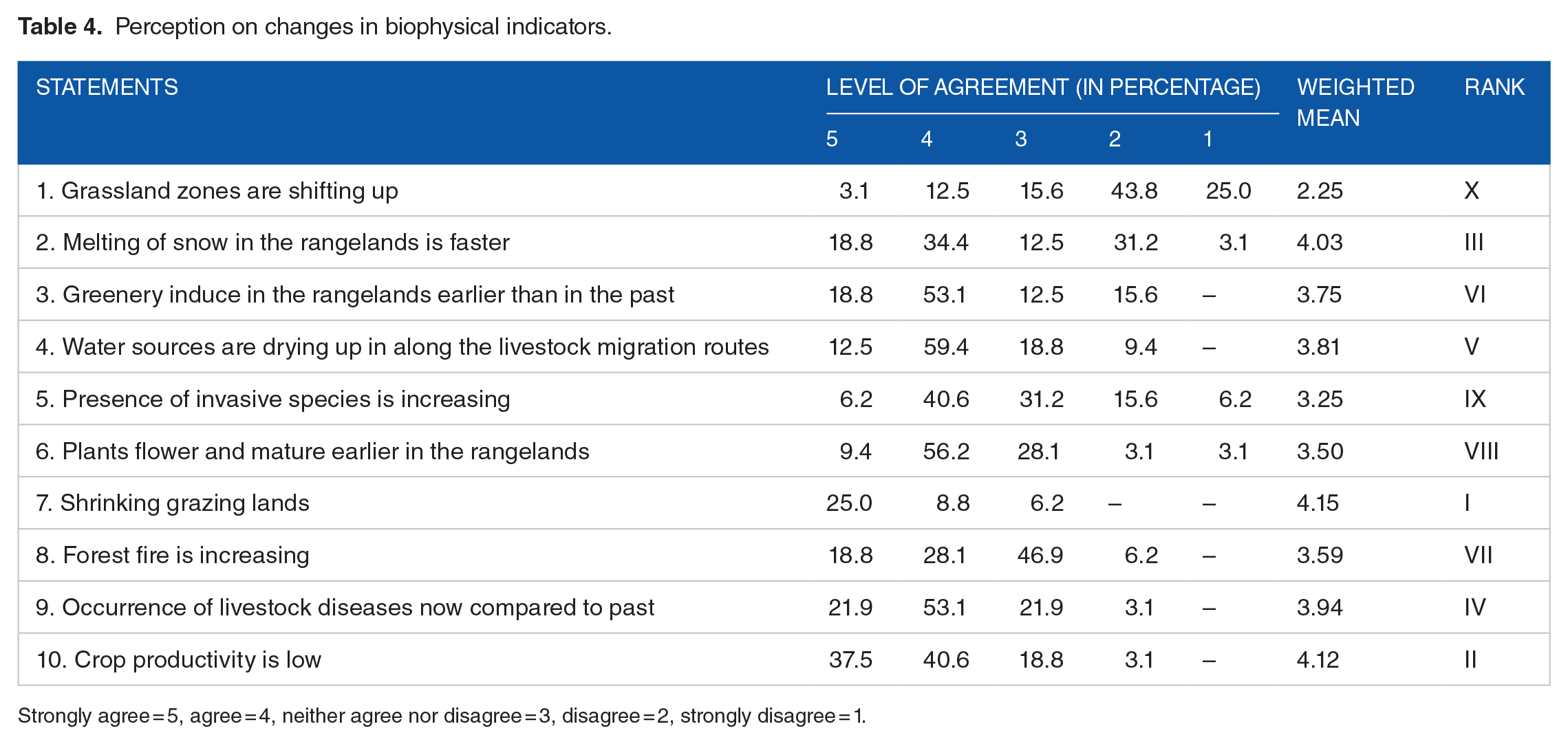
Strongly agree = 5, agree = 4, neither agree nor disagree = 3, disagree = 2, strongly disagree = 1.
Figure 7 shows that the statement “Shrinking Grazing lands” was agreed most (93.6%) while “Grassland zones are shifting up” was least agreed (15.6%).

Percentage of respondents (Strongly agree + agree) on the statements.
Water sources in rangelands
There were around 108 kharka in Gatlang with different water sources available for livestock grazing in the area. But water sources were dried up as explained in (Figure 7) and some of the water sources status of study site is shown in (Table 5).
Water sources and their status.

Presence of invasive species
Many people agreed to the statement of presence of invasive species. According to herder, Invasive weeds such as Nilo gandhe (Ageratum sp) and Banmara (Eupatorium sp) covered the lands which is seen mostly in lower altitude, traditional nutritious grasses such as Nigalo (Drepanostachyum sp.), White clover (Trifolium repens) etc. are highly replaced.
Similarly, herders also claimed that previously they used to graze livestock in one rangeland for 4 to 5 days but now they have to move to more rangelands for nutritious grasses. Many livestock were dying due to fall while searching for forage in high altitudes.
Occurrence of new livestock diseases
Similarly, herders agreed to the statement “occurrence of livestock diseases.” The common diseases seen in livestock were khoret (foot and mouth rusting), pneumonia, diarrhea, urine infection, eye disease, namle parasite, tick infection, and so on.
Adaptation strategies
Herders are practicing different strategies for overcoming impacts of climate change. Many respondents did not know about adaptation strategies since very few program were carried out in the study area for their awareness. The recent program was done by ecosystem-based adaptation which was attended by least people.
Table 6 shows the adaptation strategies that local people adapted in the area. Here, reserving some grazing area was preferred more with IUPA ranking 4.75 followed by seasonal movement of livestock 4.5 (Table 7). Similarly, change in the livelihood option was least preferred with IUPA ranking 2.09. Reserving some grazing area implied taking livestock to other wards to graze in return of which herders had to pay NRs 500 to 600 for each yak/nak/ chouri for 5 to 6 months. Changing livelihood option was less preferred because very few people were engaged in carpeting, labor pottering, and NTFP collection. In addition to storing grass hay, crop residue, and grains, many herders mentioned they bought concentrates which was equal to 128 kg approximately per year. Along with traditional adaptation strategies such as seasonal movement of livestock, reserve some grazing area herds are also practicing some other adaptation measures such as changing livestock variety, shifting toward other livelihood options.
Climate change impacts and adaptation measures.

Adaptation strategies score.

Abbreviation: IUPA, Index of Usefulness of Practice for Adaptation.
Discussion
The linear regression analysis of 30 years temperature showed increase in mean maximum temperature by 0.05°C which was near as reported by DHM. 23 Average annual temperature was increasing (0.0202°C) which was slight change as predicted 24 for increase in temperature of HKH at 0.3°C at the end of 21st century. Thus temperature is increasing which is in line with people’s perception. The people perceived no change in winter temperature. Monsoon precipitation increased by 2.3 mm which was not in line with people perception. The mismatch perception might be because they forgot the distant events. 25 The seasonal movement of livestock was found vertical with 5- to 6-month duration, which is similar as reported by Dong. 26 The main reasons for movement were ranked as adjusting temperature, searching for forage availability, and examining water availability. Similar findings were mentioned except avoiding overgrazing in Langtang. 27 Most of the respondents agreed changes in biophysical indicators such as spring budding, flowering, drying water sources, early flowering and maturing, presence of invasive species, shrinking grazing lands, greenery induce earlier than past are strongly agreed by people which collides with the explanations by Aryal et al. 25 Similarly, many respondents disagreed the shift of grassland zone which is not in favor of previous scholars 28 who reported shift of range for many plant species, tree line, and vegetation belt. Rangelands can produce goods and services even in extreme climatic events, 15 but there is no proper practice for rangeland management, the locally developed institutional arrangement known as Thiti is responsible for it. The seasonal movement of livestock is an ecological necessity as well as herder’s rational approach to use grazing resources. 29 Mixed herding also helped to reduce the vulnerabilities to climate change, 30 increasing food diversity and security, efficient utilization of grazing resources available at different location and altitude because all grazing areas are not equally accessible to all livestock types. Same is noticed in the study area as they rear different livestock. The adaptation measures adopted by herders are in line with previous scholars17,27,31 reserving some grazing area was most preferred followed by seasonal movement of livestock except reducing the length of stay at points, reducing herd size, and stall feeding animals.
Conclusion
Rasuwa observed increase in mean average temperature (0.0202°C), increase in monsoon precipitation (2.1 mm) and decrease in winter precipitation (0.5 mm). Livestock was considered the main source of income combined with subsistence agriculture with direct contribution to the livelihood of the people. The vertical movement was found to be related to culture and identity of the people in the area. Transhumance herders have perceived increase in summer temperature, increase in winter temperature, melting of snow and increase in number of dry days. Herders have observed changes in biological indicators such as emergence of new plant species, appearance of new livestock diseases, early induce of greenery and early flowering/maturing of grasses, shrinking grazing lands in the rangelands along with decrease in agricultural productivity and change in physical indicators such as fast melting of snow in the rangelands and drying of water resources. Herders did not perceive shift in grassland zone which could be related to topographical factors. Similarly, increment in forest fire is seen for last few years. Although people perceived impact of climate change, they did not know the underlying cause for it. There were various adaptation strategies against climate change with transhumance system itself as a second ranked strategy after reserving some grazing areas. Livestock were moved to high altitude from June to September which is a monsoon season with increased rainfall in the area, but they follow the same seasonal calendar as previous years where they are affected in some ways. This study suggests that perceptions of transhumant herders provide important foundation to know the status in data-deficient areas which further helps to design adaptation and intervening strategies for sustainability of the transhumance system in the Himalayas.
Footnotes
Funding:
The author(s) disclosed receipt of the following financial support for the research, authorship, and/or publication of this article: The authors received student research grant from Hariyo Ban Program, WWF Nepal for the research.
Declaration of conflicting interests:
The author(s) declared no potential conflicts of interest with respect to the research, authorship, and/or publication of this article.
Author Contributions
NR and BM conceptualized the research idea, prepare research tools, manuscript preparation, first author conducted field work, data analysis.