




Abstract
An experiment was conducted on maize at Omo Nada district on a split-plot design with the objective of determining the optimum combination of furrow length and inflow rate under smallholder farmers’ conditions. The treatments include furrow lengths (10 m, 30 m, and 50 m) in the main plot and three inflow rates based on the maximum non-erosive inflow rates in the sub-plot. The data reveals that the plant height was affected (p < .01) by the variation of the furrow length, but the inflow rate had no significant effect (p > .05). The maximum and minimum plant heights of 224 and 209 cm were recorded at 30 and 50 m furrow length, respectively. Furrow length has an effect on the dry biomass of maize (p < 0.01), but there was no significant effect from the inflow rate. At a furrow length of 30 m, there was a maximum biomass production of 29,842 kg/ha, and the lowest dry biomass of 10,575 kg/ha was obtained at a 50 m furrow length. The grain yield of the maize crop was significantly (p < .01) affected by furrow length. The maximum average grain yield obtained was 9,811 kg/ha. The minimum grain yield of 5,576 kg/ha was obtained from a 50 m furrow length. There was a 43.17% yield increment between the 30 and 50 m furrow lengths. The interaction effect shows that L2Q1, L1Q1, and L2Q3 had the maximum correlation for grain yield, dry biomass, and water productivity, respectively. The maximum grain yield of 9,864 kg/ha and the minimum grain yield of 7,527 kg/ha were obtained at L2Q1 and L3Q3 treatments, respectively. It is evident to recommend that a combination of 30 m furrow length at a 0.99 L/s inflow rate could be effective for water management.
Introduction
Maize (Zea Mays L.) is one of the staple cereal crops grown in Ethiopia and is the second most cultivated cereal crop in Ethiopia (Abate et al., 2015) and is the third highest production potential cereal crop next to rice and wheat in the world (Nansak, 2016). Reports show that it ranks first in area coverage and total production in Ethiopia (CSA, 2021; FAO, 2014). According to the report, the total annual area coverage and production were 3,419,008 ha and 11,737,528 t, respectively (CSA, 2021). Many grain crops were produced in the Jimma Zone of the Omo Nada District. In the district, maize makes up 27% of the total cultivated land, while cereals (86.7%), pulses (12.5%), and oil seed (0.8%) make up the remaining 46,811 ha of cultivated land, according to the Omo Nada District Agriculture Office’s 2014 report (unpublished document). However, its productivity and output have suffered because it was subjected to water stress as a result of water scarcity and frequent drought (Admasu et al., 2019).
Irrigation is crucial for sustainable food production and development in order to increase productivity, fulfill the food security of smallholder farmers in water-limited areas, and reduce farmers’ reliance on rainfall (Chinasho et al., 2023; Haile & Kasa, 2015). According to Gebrehiwot et al. (2017), irrigated agriculture has had positive and considerable impacts on increasing agricultural production, productivity, and livelihood improvement of smallholder farmers by increasing their income. It has a positive impact on the grain yield of maize and irrigated land productivity (Abate et al., 2015; Mehari et al., 2020; Tagheinaghdam et al., 2015). However, inadequate application of irrigation water limits the growth and development of maize, which has a negative impact on the attained yield. Even though the use of irrigation is essential for sustainable crop production through combating drought, water stress, and climate change impacts, identifying and selecting the best crop and site-specific irrigation technique is the basic for effective water management. In Ethiopia and other maize producing nations, furrow irrigation is typically the most widely used irrigation technique (Narayanan & Seid, 2011; Sakenian Dehkordi & Farhadi, 2015).
Furrow irrigation is widely used in Ethiopia because of its ease of use, low initial investment cost, and ability to use unskilled labor (Abdel-Maksoud et al., 2002; Awulachew et al., 2007; Dibal et al., 2015). Most small and large-scale irrigation schemes use it widely (Teklu, 2017). More than 97.8% of the irrigation in Ethiopia is done by surface methods, especially in farmer’s fields and the majority of commercial farms (Faures et al., 2001). Though furrow irrigation is the most common and mainly practiced irrigation method, it is not optimal for water use efficiency and needs a critical study on the design parameters that determine the water efficiency in order to regulate the length of the furrow with the respective inflow rate. Since furrow length and inflow rate are the major factors that affect its efficiency.
Furrow length and flow rate are the main design and management variables affecting the effectiveness of furrow irrigation (Khalifa & Ghannam, 2021). According to Schwankl et al. (2000), inflow rate, infiltration, geometry, and roughness affect the variability of furrow physical characteristics on irrigation performance. The rates at which water infiltrates and incorporates the soil, the field’s slope, the timing of irrigation and water recedes from the soil surface, the moisture content of the soil before irrigation, the spatial variability of the soil texture, the climate, and the shape of the furrow are among the factors that affect the performance of irrigation method. Additionally, availability of water, crop type, soil characteristics, topography of the land, and cost of water also affect the performance and have to be incorporated in the design (Ali et al., 2007; Holzapfel et al., 2010). In order to guarantee equal application across the whole length of the furrow and to identify the appropriate amount of water application, it is crucial to realize the function and interrelation of these components.
However, inappropriate design and poor management of irrigation cause low water use efficiency and may lead to yield reduction and food insecurity. Inappropriate management of irrigation has contributed not only to food insecurity but also to environmental problems including excessive water depletion, water quality reduction, water logging, and salinization (Beatrice et al., 2015; Hillel & Vlek, 2005). According to Eldeiry et al. (2005), a furrow irrigation system using a large inflow, a small furrow length, and a long cut-off time loses more water than one using a large furrow length, a small inflow, and a small cut-off time. For a field with highly variable soil and infiltration characteristics, spatially varying infiltration may have a greater impact than variable furrow inflow on irrigation performance. Hence, it needs to regulate the inflow of water with respect to the length of the furrow to manage the scarce water that can be lost due to deep percolation and overflow.
There are studies conducted for determining the furrow length with the respective inflow rate for effective irrigation water management in a water scarce area. To determine the inflow rate and furrow length, Eshetu (2007) evaluated the effects of flow rates and furrow lengths and found higher application efficiencies on the longest furrow and the lowest flow rate. Fikadu et al. (2022) conducted a study on the inflow rate and furrow length to enhance irrigation efficiency for cotton production and obtained the maximum water productivity of 1.37 kg/m3, the maximum lint yield of 6.86 t/ha, and the highest water application efficiency of 65% from a combined application of 50 m furrow length and 1.2 L/s inflow rate. According to their findings, efficient application and distribution of water by furrow irrigation is dependent on furrow parameters such as flow rate, soil textural class, field slope, soil infiltration characteristics, roughness coefficient, and irrigation management (Fikadu et al., 2022). Similarly, Yigezu et al. (2016) conducted a study to evaluate the performance of furrow irrigation on maize crops using furrow lengths (16, 32, and 48 m) and inflow rates of (0.52, 0.79, and 1.05 L/s) at Melkassa. Their findings show that the combination of 48 m of furrow length and a 0.79 L/s flow rate can be used for better crop yield and irrigation efficiency. However, there was a limited study on the performance evaluation of inflow rate and furrow length of furrow irrigation in the southwestern part of Ethiopia, mainly in Jimma Zone cereal crop-producing areas.
Farmers use furrow irrigation to grow maize and other root crops in the Jimma zone’s Omo Nada District. Nevertheless, they are unaware of the furrow’s length and the maximum discharge to be used to irrigate the area without causing water stress and erosion. As a result, some of their fields lost their seed and fertilizer, while in other fields, water logged and accumulated on the field, causing aeration issues in the crop’s roots that resulted in failures and plant loss, which decreased productivity. Fixing the right furrow length in relation to the inflow rate is therefore important.
Therefore, the overall objective of our study was to determine the combined effect of furrow length and inflow rate on the growth, production, and water productivity of maize for effective irrigation water management under small holder farmers condition. The specific objectives were (1) to determine the effect of furrow length on the production of maize and (2) to determine the effect of the inflow rate on the growth, production, and water productivity of maize.
Materials and Methods
Description of the study area
Location of the site
The study area is located in Oromia Regional State, Jimma Zone, Omo Nada District, at a distance of 96 km from Jimma town. Geographically, it is situated between 7°37.26′N and 37°7.86′E at an altitude of 1,752 m above mean sea level (Figure 1). The main rainy season in the study area stretches from May to September, with a bimodal distribution. The average mean annual rainfall recorded was 1,198 mm, and the minimum and maximum temperatures were about 12.3°C and 28.7°C, respectively (Figure 2). Nitisol is the dominant reference soil group on the upper slopes in the low-lying plain areas, which are clayey and red in color (Hailu et al., 2015).

Location of the study site.
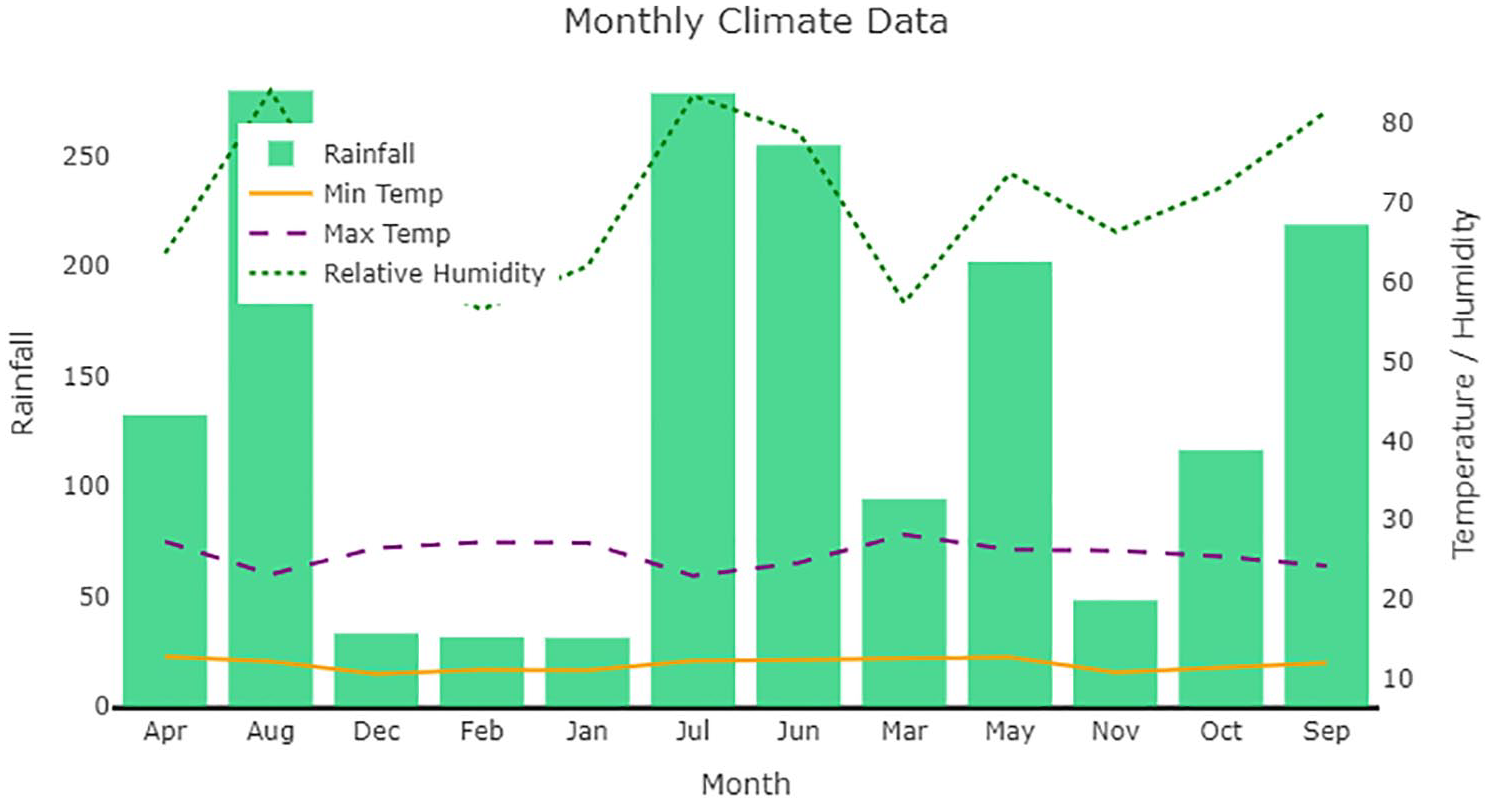
Climatic condition of the study site.
Experimental design and treatment set up
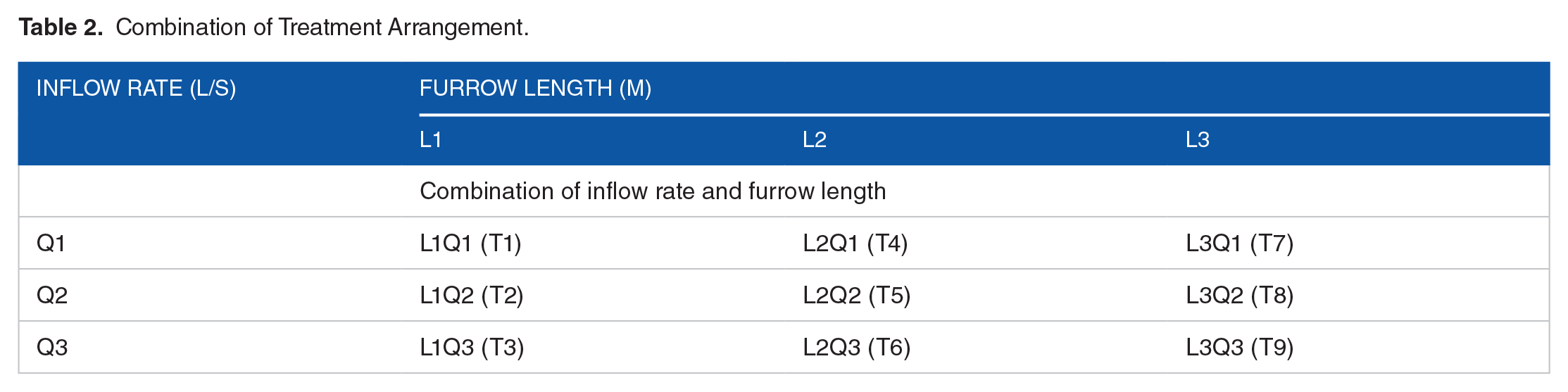
An experiment was conducted on maize at Omo Nada district on a split-plot design for three consecutive years, from 2017/2018 to 2019/2020. The treatments include two factors, namely furrow length and inflow rate. The levels of treatments include three rates of both furrow length and inflow rates. Furrow lengths constituted the main plot factors, and inflow rates constituted the sub-plot factors (Tables 1 and 2). The furrow lengths were 10, 30, and 50 m, and the inflow rates based on crop evapotranspiration (ETc) were 50% ETc, 75% ETc, and 100% ETc of the maximum non-erosive flow rate.
Treatment Arrangement Based on the Soil Group of the Study Site.

Combination of Treatment Arrangement.
The furrow flow parameters, such as field size, field slope, flow rate, cut-off time, soil infiltration characteristics, flow resistance, advance time, recession time, infiltrated depths, and accompanying irrigation efficiencies and uniformities, were all determined by interactions between the variables as follows. The inflow rate at the upstream end of the furrow, Qo, is assumed to be constant, such that at time t, the product of Qo and t equals the volume of water on the soil, Vy (t), and the volume infiltrated into the soil, Vz (t). The infiltration process described by the Kostiakov equation was the basic for deriving the different flow measuring design parameters of the surface flow and it was derived as shown by Equation 1 (Bautista et al., 1998; Clemmens, 1981; Seyedzadeh et al., 2020). Unlike Kostiakov’s equation, the Kostiakov Lewis equation is valid regardless of the infiltration duration in a linear form (Hasan et al., 2015; Kostiakov, 1932) as discussed by (Gebul, 2022), Equations 2 and 3.

Where Z: is the volume of infiltrating water per unit length, τ: denotes the opportunity time, fo: denotes the basic intake rate in terms of volume per unit length per unit time, and k and a denote empirically fitted parameters.



Where A: is the average area of the furrow shape, Wf : is the furrow width, Ao : is the cross-sectional flow area at the field entrance, y : is the surface shape parameter, z (s, t) : is the infiltrated volume per unit length throughout the advance length, and s: is the distance travelled by the advancing flow.
The sub-surface shape factor was considered through the following formula;

Where:
The volume balance equation was fitted using the following equation suggested as per the Lewis-Milne equation (Clemmens et al., 1999).

Where Qo = inflow per furrow at the upstream end of the field (m3/min), t = time from the start of inflow (min), σy = surface flow shape factor from 0.77 to 0.80, Ao = the flow area at the flow’s upstream end at time tx(m2), x = the distance from the inlet that the advancing front has travelled in tx minutes, σz = subsurface shape factor, f0 = basic infiltration rate, k = empirical parameters (m2/min/m), r = power advance, a = empirical coefficient.
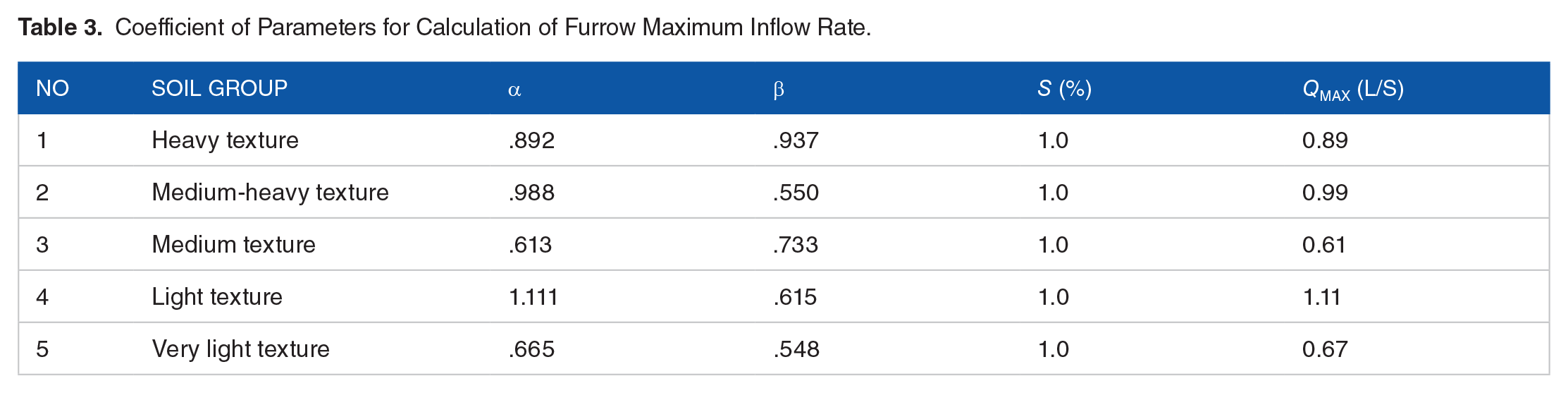
The maximum non-erosive inflow rates with the respective furrow slopes were estimated based on a study suggested by Hamad and Stringham (1978) Equation 7 below.

Where Qmax = maximum inflow rate (L/s), S = furrow slope (%), β is coefficient which depends on soil texture (soil type), and
Coefficient of Parameters for Calculation of Furrow Maximum Inflow Rate.
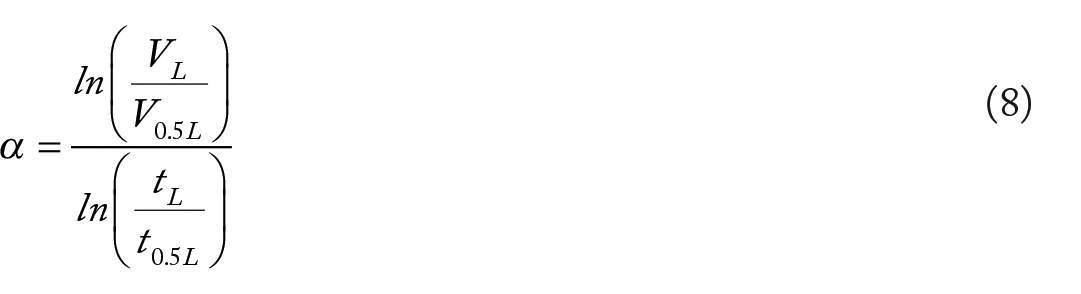
Where α = empirical coefficients, VL = volume of water at the end of the field, V0.5L = volume of water at the mid of the field, tL = the advance time at the end of the field, and t0.5L = the advance time at the mid of the field.
Long-year climate data (Figure 2) from the nearby meteorological station of Sekoru from 1985 up to 2016 was collected to determine the average reference evapotranspiration (ETo). It was used as input data for the CROPWAT 8.0 software to determine the reference evapotranspiration (ETo) and the water requirement of the crop (CWR). The crop water requirement (CWR) or crop evapotranspiration (ETc) was determined by the product of ETo and crop coefficient (Kc) at each growth stage in the growing season (Equation 9), and the net irrigation requirement was determined by deducting the effective precipitation (Pe) from the crop evapotranspiration (ETc; Savva and Frenken, 2002).

Where, ETc = Crop evapotranspiration (mm), Kc = crop coefficient at a specific growth stage, ETo = reference evapotranspiration (mm), and calculated using Penman equation (Equation 10).

Where: ETo = is the reference evapotranspiration (mm/day), Δ = is the slope of the saturation vapor pressure curve (kPa/℃), Rn = is net radiation at the crop surface (MJ/m2 day), G = is the soil heat flux density (MJ/m2 day), T = is the mean daily air temperature at 2 m height (℃), U2 = is the wind speed at 2 m height (m/s), es − ea = is saturation vapor pressure deficit (kPa), es = is the saturation vapor pressure at a given period (kPa), ea = is actual vapor pressure (kPa), and γ = is the psychrometric constant (kPa/°C).

Where; NIR = Net irrigation requirement (mm), ETc = Crop evapotranspiration (mm), Pe = effective precipitation (mm), GW = Ground water recharge (mm), and ΔSW = the variation of soil stock (mm).
Since the water table was below 2 m deep and there was no contribution for irrigation below 2 m depth, ground water recharge was considered to be zero in Equation 11 above.
The irrigation application time was computed using Equation 12 below as suggested by Israelsen and Wiley (1950) and Hart et al. (1980).

Where; T = Inflow cut-off time (min), L = furrow length (m), W = furrow spacing (m), Fg = gross depth of application (mm), and Qo = inflow rate in (L/s).
After determining the crop water requirement, the amount of water to be applied during each irrigation event (Zreq) was determined based on the soil moisture deficit level at root depth. Flow rates were measured using 3″ Parshall flumes, which were placed upstream of the furrows. Prior to the test, the flow rates were calibrated by fixing opening areas, pipe outlets, and the required pressure heads. During the test, flow rates were initially measured every 2 min until they became steady. After stabilization, measurements were taken every 10 min. The flow rate was measured using Equation 13, as suggested by Michael (1978).

Where; Q = flow rate in the Parshall flume, Ce = Coefficient of discharge, and he = height measured with respect to the vertex of the notch.
Using an auger and core sampler, composite soil samples were taken from the field, and standard methods were used to determine soil texture, field capacity, permanent wilting point, and bulk density. The soil sample collected by the core sampler was used to determine the soil bulk density, and the soil that was collected by the auger was used to determine the soil physical and chemical properties (Tables 4 and 5). To determine the different efficiencies, a soil sample before and after irrigation was also taken using an auger. Soil moisture samples from each plot were taken along the furrows at three depths: 0–30, 30–60, and 60–90 cm, at three depths before and after application of irrigation events. The contents of the samples were then determined in the soil laboratory.
Soil Physical Properties of The Study Site.
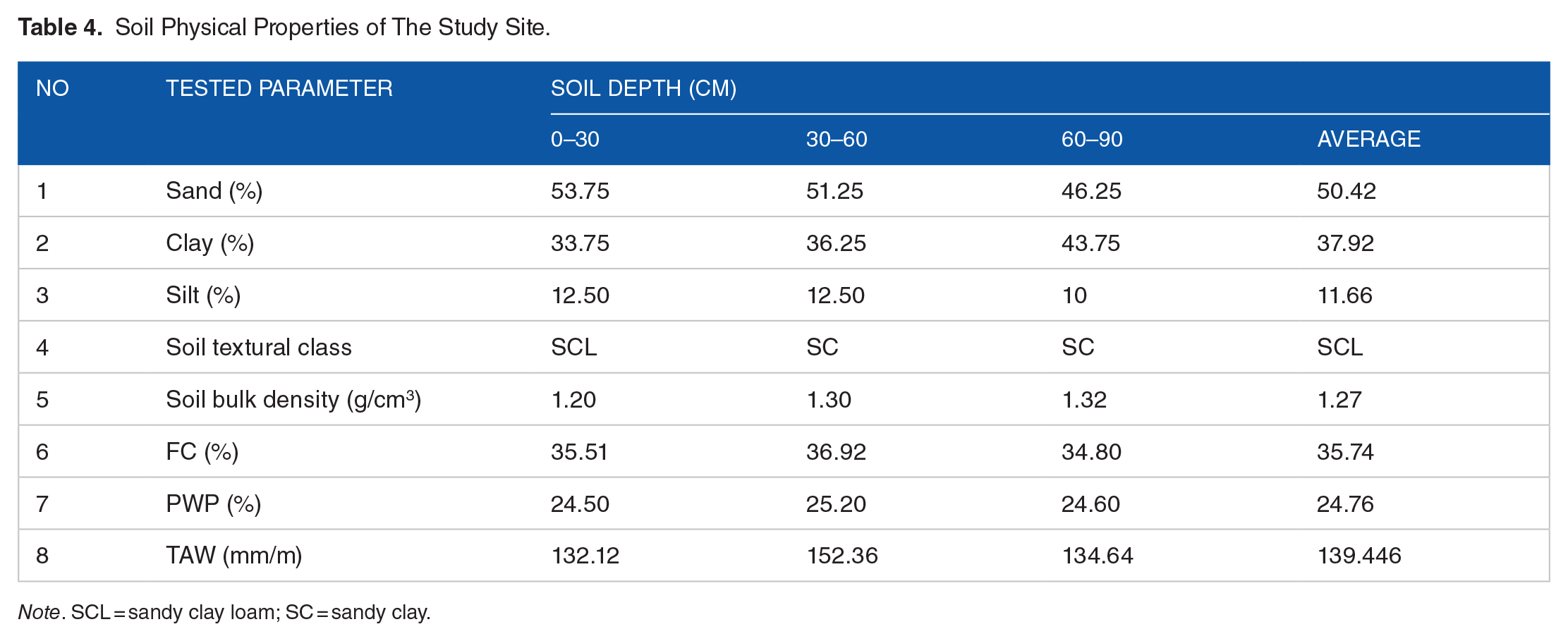
Note. SCL = sandy clay loam; SC = sandy clay.
Soil Chemical Properties of the Study Site.

The water productivity, which is the physical mass of production or the economic value of production measured against water applied in m3, was determined by the following Equation 14 as discussed by Molden (1997).

Determination of the different efficiencies of the inflow and furrow length
To select the best combination of furrow length and inflow rate, the different performance of the irrigation efficiencies in percent (%) were evaluated. Accordingly, the application efficiency (Ea), the storage efficiency (Es), the distribution uniformity (Du), and the deep percolation ratio (DPR) were determined as follows.




Where Zy = Depth of water retained in the root zone (mm),
Z = Depth of water applied to the furrow (mm),
ZS = depth of water stored in the root zone (mm),
Zreq = water required in the root zone prior to irrigation (mm),
Zmin = the minimum infiltrated depth (mm),
Zav = the mean of depths infiltrated over the furrow length (mm), and
RR = runoff or tailwater ratio.
To determine the economic analysis, the partial budget analysis was carried out using the methodology described in CIMMYT (International Maize and Wheat Improvement Center, 1998) by using grain yield data for analysis. During the cropping year, the prices of 1 kg of maize grain at the local market close to the Omo Nada experimental site, 1 kg of fertilizer overall, the cost of water for 1 m3 of water, and the average labor cost for incorporating 1 ha of farmland from sowing to harvesting were calculated to be 18, 1, and 1,920 Ethiopian Birr (ETB), respectively. The cost of 1 kg of maize was considered 16 Ethiopian birr (ETB) during the cropping season. In light of this, the total variable cost (TVC) was determined by adding up all expenses that vary with a treatment in comparison to the irrigation treatment under control. The gross benefit (GB) is estimated by the product of the average adjusted grain yield and grain price. The net benefit was calculated by subtracting TVC from the GB. The marginal rate of return (MRR) was calculated as the ratio of differences between net benefits to the difference between TVC and the control treatment using Equation 18. The sensitivity analysis was also determined, considering if there would be an unexpected loss of the product.

Where MRR: Marginal rate of return, ∆NB
Finally, the general linear model (GLM) in statistical analysis system (SAS) software version 9.0 (SAS Institute, 1996) was used to examine the gathered data (Gomez, 1984). The differences in the treatment means were compared using mean separation, which was achieved at a 1% and 5% probability level using the least significant difference (LSD). Generally, the methodology followed is shown in chart below (Figure 3).

Flow chart showing methodology followed for conducting the study.
Result and Discussion
Soil physical and chemical properties
The soil in the study site of the irrigation field was black to reddish and has a sandy-clay-loam (SCL) texture (Table 4). Table 4 provides information on the field capacity (FC), permanent wilting point (PWP), and total available water content (TAWC) values of the soil. Accordingly, the average field capacity and wilting point of the soil in the study area were 36% and 25%, and the TAWC is 139 mm/m of water. The average bulk density of the soil was 1.27 g/cm3. The average soil pH of the site was 4.76 (Table 5), and it is an acidic soil. According to MPCA (2021), a sandy clay loam soil with a bulk density of less than 1.4 g/cm3 is ideal for plant growth and does not affect or restrict root growth. Soil physical and chemical properties have a significant impact on water-holding capacity, which can affect agricultural water output in irrigation schemes. To improve soil structures in the irrigation scheme, appropriate organic matter addition, tillage, soil conservation, crop management, cropping practices, and rotations are essential.
The topography of the land is approximately flat, and the slope of the land is approximately, on average, 1%, with a soil group of medium- to heavy-textured soil. In addition to the physical and chemical properties of the soil, since the topographical location of the field is flat, which is on average 1% slope, it is vulnerable to water logging and affecting the root zone of the crop. Hence, it needs appropriate drainage for the removal of the water.
Water and irrigation requirement of the crop
The seasonal crop water requirement of maize was 565 mm of water in the agroecology of Omo Nada for a crop sown in the middle of November (Table 6). Table 6 shows that full development demands a net irrigation of 543 mm, accounting for 96% of the crop’s water requirement. The irrigation requirement (IR) is almost equal to the crop water requirement, and the climatic condition was the major factor. This irrigation requirement was supplied to the crop based on the arranged treatments (Table 7). The average effective rainfall determined in the cropping season was below 5%, which is very low, and from this, for the production of crops, irrigation is critical. This effective rainfall occurs during the initial and late seasons, is not useful for the development of the crop, and can be omitted.
Water and Irrigation Requirement of the Crop in Each Cropping Season.

Note. ETc = reference evapotranspiration; CWR = crop water requirement; Eff RF = effective rainfall; NIR = net irrigation requirement.
Irrigation Requirement Supplied in Each Treatment in a Furrow (mm).

To obtain maximum yields, the approximate value of the seasonal crop water requirement of maize was in the range of 500 to 800 mm of water based on the climatic conditions (Critchley et al., 2013). Similarly, Igbadun et al. (2006) obtained the water requirement of maize to be in the range of 400 to 700 mm of water. However, the crop water requirement of the study area for maize crop was relatively higher than other sites (Abirdew et al., 2018; Ayana, 2011; Tariq & Usman, 2009; Tilahun et al., 2023). This could be due to the hottest period, resulting in an increased crop water requirement. Based on the evidence from the agroecology properties of soil and climatic conditions, supplementary irrigation could not be recommended for the production of maize, but full irrigation should be recommended.
Effect of inflow rate and furrow length on the yield and growth parameter of maize
Effect of inflow rate and furrow length on the plant height
The average consecutive 3-year data reveals that the plant height was highly affected (p < .01) by the variation of the furrow length, but the inflow rate had no significant effect (p > .05). The result shows that, at 30 m of furrow length, the plant had a high plant height (Table 8). The main reason could be that the water that was released from the Parshall flume was easy to manage and had the possibility of wetting the crop area. The wetting pattern has an effect on the gravitational force of the soil and the evapotranspiration rate. Since it is possible to manage the flow of water easily through the furrows, it has the possibility to cover the whole area, and accordingly, the plant does not need extra osmotic force for water extraction and has the possibility to grow freely. The maximum and minimum plant heights of 224 and 209 cm were recorded at 30 and 50 m furrow length, respectively. Even though the plant height was not affected by the flow rate, the flow rate with a 100% ETc has shown the highest plant height relatively, as shown in Table 8.
Effect of the Furrow Length and Inflow Rate on the Grain Yield and Growth Parameter of Maize.

Similarly, Moles et al. (2009) found that plant height is highly correlated with life span, seed mass, and time to maturity. Additionally, it is a major determinant of species ability to compete for light and determine the carbon storage capacity of the plant. A gradient of negative pressure is required to lift water against the force of gravity from the stem base to leaves elevated above the ground for water transport. If these forces are insufficient to provide the water necessary for lifting the turgor pressure, the growth in height may be slowed or entirely curtailed (Koch et al., 2004; Woodruff et al., 2004). This height of the plant can be advantageous for high production of biomass, and this biomass can be fodder for livestock.
According to Koch et al. (2004), water has an effect on plant height; as the growth in height increases, their ability to maintain a favorable water status may become progressively more limited, and this may slow growth in ways that intrinsically limit maximum tree height. The availability of water has an impact on the transpiration of the plant and the gravitational force that holds the soil and water tightly together, which has an effect on plant height. If the tensile strength of the water column is exceeded between gravity and transpiration, the xylary elements that deliver water may cavitate, resulting in tissue or organ death (Pockman & Sperry, 2000; Tyree et al., 1994). In addition to the hydraulic friction occurring in xylary conducting elements, osmotic limitations on turgor maintenance during periods of tissue expansion may set limits on growth in height. A reduction in stomatal conductance can maintain cell turgor pressure; however, this response to water stress limits photosynthesis and, thus, growth and crop yield.
Based on the observation, at a furrow length of 30 m and inflow rate of 100% ETc, the highest plant height was recorded. This might be due to sufficient soil moisture content in the root zone and a higher irrigation depth application than the others.
Effect of inflow rate and furrow length on dry biomass
As shown in Table 8, furrow length has an effect on the dry biomass of maize (p < .01); however, there was no significant effect from the inflow rate. At a furrow length of 30 m, there was a maximum biomass production of 29,842 kg/ha, and the lowest dry biomass of 10,575 kg/ha was obtained at a 50 m furrow length. There was a 35% difference between the maximum and minimum biomass obtained at 30 and 50 m furrow length, respectively. Even though there was no statistically significant difference between the different inflow rates, the maximum and minimum dry biomass were obtained at an inflow rate of 0.99 and 0.50 L/s, respectively. The maximum and minimum dry biomass obtained were 19,810 and 18,410 kg/ha at an inflow rate of 0.99 and 0.5 L/s, respectively.
The amount and distribution of water in the root zone of the plant have an effect on biomass production. According to Makino (2011), more than 90% of plant biomass was resulting from photosynthesis products, of which the main input was water. From the current study, the inflow rate at 100% ETc gave the highest biomass relatively because of the higher water application depth at the root of the plant. Similarly, Yenesew and Tilahun (2009) reported that an increase in water application depth favors the photosynthesis rate and decreases the respiration rate, which results in high dry matter production. Additionally, maize yield components were linearly related to the depth of water application (Admasu et al., 2019; Djaman et al., 2013).
Effect of inflow rate and furrow length on grain yield
The grain yield of the maize crop was significantly (p < .01) affected by furrow length. The maximum average grain yield obtained from three consecutive years data was 9,812 kg/ha at 30 m furrow length. The minimum grain yield of 5,576 kg/ha was obtained from a 50 m furrow length (Table 8). There was a 43.17% yield increment between the 30 and 50 m furrow length. This occurs because better irrigation uniformity was attained in a relatively shorter furrow length. As shown in Table 8, there was no statically significant (p > .05) difference between the inflow rate on the grain yield. However, the maximum and minimum grain yield of 7,741 and 6,993 kg/ha was obtained at 0.99 and 0.5 L/s inflow rate, respectively.
Interaction of furrow length and inflow rate on the yield growth parameter and water productivity
As shown in Table 9 the grain yield, dry biomass, and water productivity were significantly (p < .05) affected by the interaction effect of furrow length and inflow rate. It reveals that L2Q1, L1Q1 and L2Q3 gave the maximum correlation for grain yield, dry biomass and water productivity, respectively. The maximum grain yield of 9,864 kg/ha and the minimum grain yield of 7,527 kg/ha were obtained at L2Q1 and L3Q3 treatment, respectively. The maximum and minimum dry biomass of 25 and 18 t/ha were obtained at L1Q1 and L3Q1, respectively. The maximum and minimum water productivity of 3.05 and 1.5 kg/m3 were obtained at L2Q3 and L3Q1, respectively. Even though there was no difference between the plant heights due to the interaction effect of inflow rate and furrow length, there was a maximum plant height of 264 cm at L1Q3 and a minimum plant height of 245 cm at L2Q1 (Table 9).
Interaction Effect of Inflow Rate and Furrow Length on The Grain Yield, Yield Component and Water Productivity.

Treatments with the same letters are not statistically different at 5% significance level.
Effect of furrow length and inflow rate on different efficiencies
Application efficiency (Ea)
The application efficiency was significantly (p < .001) affected by the different inflow rates and furrow lengths (Table 10). The result shows that at L2Q1, there was an application efficiency of 36.72%, and at L1Q3, there was an application efficiency of 20.82%, which were the maximum and minimum application efficiencies, respectively. From this, it was evident that a maximum inflow rate with an average furrow length of 30 m could enhance the application efficiency. However, if the inflow rate is low since there is undulating topography, it is impossible to manage, and the application efficiency could be lower. From this finding, the combined application of a maximum inflow rate of 0.99 L/s and a 30 m furrow length could be managed effectively and could give the highest application efficiency for maize cultivation.
Efficiencies of the Combined Effect of Inflow Rate and Furrow Length.

Treatments with the same letters are not statistically different at 5% significance level.
Deep percolation ratio (DPR)
As shown in Table 10, the mean deep percolation ratio (DPR) was significantly (p < .001) affected by the inflow rate and furrow length. The result shows that as the inflow length increases, the rate of DPR shows an increasing trend. The maximum and minimum DPR of 69.13% and 51.02% were recorded from the combination of inflow rate and furrow length of L3Q1 and L1Q3, respectively (Table 10). This shows that, due to a higher inflow rate, there could be a high DPR, and vice versa. This is due to the maximum infiltration rate caused by a long contact time at the maximum inflow rate and the lower infiltration rate caused by the lower inflow rate. Even though the application efficiency of the current study was poor, it could be enhanced through training farmers on how to manage the water at the field and also the crop nature has an impact on the application efficiency. The intention of the study was to evaluate at which furrow length and inflow rate the efficiency could be higher relatively and this value could be improved through training the farmers.
Storage efficiency (Es)
The adequacy of water applied to the field that could be stored in the root of the plant was measured by the storage efficiency of the water at the root of the crop. Due to the varying inflow rate and furrow length, there was a significant (p < .01) effect on the storage efficiency (Es; Table 10). As shown in Table 10, the maximum and minimum of 51.69% and 29.22% Es were recorded at a combination of the inflow rate and furrow length of L2Q1 and L1Q3, respectively. The longest furrow (50 m) has shown more infiltrated water due to more contact time; antagonistically, the shortest furrow (10 m) provided lower storage efficiency. From this finding, it could be observed that the Es was highly reduced by the use of short furrows, where most of the water was lost through runoff.
Distribution uniformity (DU)
The interaction effect of inflow rate and furrow length had a significant (p < .001) effect on the distribution uniformity (Du). This distribution uniformity and its efficiency could be affected by the furrow length and width, nature of the furrow, type of soil, contact time, and also the root structure of the crop. As shown in Table 10, the maximum and minimum DU of 69.13% and 26.19% were obtained at an interaction of inflow rate and furrow length of L2Q1 and L3Q1, respectively. It could be observed that for an effective distribution of the delivered water, that is, inflow water, the shortest and longest furrow was not recommended. The furrow length has to be medium to accommodate the inflow and deliver it to the root of the crop for effective water management and crop production. Based on the current observation, a combination of an inflow rate of 0.99 L/s and a furrow length of 30 m could be appropriate for the distribution of the water to the field and hence increase productivity and efficient water management by improving efficiency.
Economic analysis
As shown in Table 11, the partial budget analysis shows that there was a maximum and minimum net benefit of 115,670 and 77,562 Ethiopian birr (ETB) from yield obtained from the combination of L1Q1 and L3Q1, respectively. There was a 32.9% economic difference between the maximum and the minimum benefit. At a furrow length of 10 m, it is easy to prepare the furrow, and the labor force required is also low. However, there was a loss of water due to the maximum inflow rate at the furrow end. If the net economic benefit were considered, this treatment could be considered the best, no matter how much there was a loss of water. Loss of water means that there could be water scarcity, and hence, a yield reduction as well as a yield loss could occur. Therefore, for the betterment of irrigation water management through sustainable production, the treatment with the 30 m furrow length and 0.99 L/s inflow rate could be economical in the topographical features of the Omo Nada maize-producing areas (Table 12).
Partial Budget Analysis of the Treatments.

Note. TVC = total variable cost; TRC = total return cost; MRR = marginal rate of return.
Sensitivity Analysis of the Partial Budget Analysis.

Conclusion
Determining the efficiency of the highly practiced furrow irrigation method in Ethiopia was essential to adhering to the best recommendations for the area and similar agroecology. Inflow rate and furrow length had an effect on the yield, growth parameters, and water productivity of maize crop production in the current study. The interaction effect of the inflow rate and furrow length showed that the maximum grain yield and water productivity were obtained at a combination of 30 m furrow length and a 0.99 L/s inflow rate. Additionally, the application efficiency, storage efficiency, and distribution uniformity were higher at an interaction of 30 m furrow length and 0.99 L/s. Generally, a combination of 30 m furrow length and a 0.99 L/s inflow rate on medium-to-heavy textured soil that has a maximum non-erosive slope of up to 1% could be effective for water management and economical for the production of maize in the agroecology of Omo Nada and similar agroecology. However, for cluster-based farming, which has a relatively long furrow, it may need another investigation.
Footnotes
Acknowledgements
The authors are thankful to the Ethiopian Institute of Agricultural Research for providing financial support for conducting the experiment. They also express appreciation for Jimma Agricultural Research Center and staff members of the Irrigation and Water Harvesting Research program technical staff, mainly Ms. Kalisa Aba Jihad, Mr. Aliyi Ababulgu, and Mr. Abdurazak Abazinab. We are also thankful for the staff members of the Jimma Agricultural Research Center soil and plant tissue analysis laboratory.
Declaration of Conflicting Interests
The author declared the following potential conflicts of interest with respect to the research, authorship, and/or publication of this article: The manuscript entitled “Determination of Appropriate Furrow Length and Inflow Rate for Furrow Irrigation Practice on Smallholder Farmers at Omo Nada District for Maize (Zea Maize L.) Production” was a research conducted at Jimma Zone Omo Nada District for three consecutive years from 2017/2018 up to 2019/2020 by the responsible researchers, namely Minda Tadesse, Addisu Asefa, and Robel Admassu. The necessary collected data were analyzed and written by Etefa Tilahun, Minda Tadesse, Addisu Asefa, and Hewan Tadesse as a manuscript for publication. We hereby declare that this research is our original work, and all information in this document has been worked on responsibly and with ethical conduct. We also declare that, as required by these rules and procedures, all sources of materials that are not original to this work have been cited and duly acknowledged.
Funding
The author(s) received no financial support for the research, authorship, and/or publication of this article.
Availability of Data and Materials
The necessary data are available upon request from the corresponding author.
