




Abstract
Wastewater treatment plants need their reliability to be properly assessed to preserve society’s health and availability of water resources. To date, no wastewater treatment plant framework comprehends the reliability of the system, considering the influence of uncertain parameters, and the total costs during the lifespan of the project. Here, an innovative framework combining a reliability analysis, a reliability-sensitivity analysis, and a life-cycle cost assessment is presented as a proof-of-concept tool for reliability-based life-cycle cost optimization of an activated sludge process due to its common application in sanitation worldwide. The results indicate (1) great variability of the reliability scenario due to the influent loads, (2) the sludge volumetric index exerts the most influence on the system’s reliability and risk expenditures, and (3) an optimum scenario associated with the lowest life-cycle cost and an annual failure rate of 19 day of failure year−1 can be obtained via an exhaustive simulation protocol. The framework demonstrates to be a promising tool for techno-economic analysis of activated sludge processes, as well as to optimize project expenditures based on its reliability to withstand different influent loads. This proof-of-concept optimization framework is expected to find multiple applications not only in sanitation and water treatment but also in other industries while supporting sustainable development goals.
Keywords

Introduction
The disposal of wastewater with sufficient treatment is a major challenge. Recent estimates indicate that nearly 50% of the world’s wastewater production is released into the environment without receiving any kind of treatment (Jones et al., 2021). In this vein, recent trends indicate that only a small portion of the remainder of wastewater production undergoes a biological treatment to be cataloged as safely treated (UN Habitat & WHO, 2021).
The activated sludge process is the most applied biotechnology for conventional wastewater treatment. However, the management of these systems faces current and forthcoming challenges, which are particularly accentuated in developing countries (Awad et al., 2019). The previous include: aging infrastructure, improper design, operation, and maintenance of wastewater infrastructure, as well as a lack of infrastructure required to meet the increasing wastewater production and pollutant loading (Pamidimukkala et al., 2021). Consequently, aquatic environments have deteriorated threatening human health. Moreover, the managers of the sanitation infrastructure may be subjected to fines and other economic impacts when the effluent quality transgresses a specified discharge standard (Casal-Campos et al., 2018).
This paper is concerned with improving the design of activated sludge processes by incorporating reliability analysis as an essential criterion for assisting stakeholders’ decision-making process. A reliability analysis is defined as the assessment of “the degree to which the system minimizes the level of service failure frequency over its design life when subject to standard loading” (Butler et al., 2017). In an activated sludge process, reliability focuses on the determination of the frequency of failure of the system to produce an effluent discharge that meets specific treatment standards. Commonly, the failure states are measured as the percentage of time the plant effluent infringes pre-set discharge standards established by operating codes (Oliveira & Von Sperling, 2008; Taheriyoun & Moradinejad, 2015), or the time-lapse the plant effluent exceeds the threshold of a river quality indicator (e.g., dissolved oxygen) (Casal-Campos et al., 2018; Sweetapple et al., 2018, 2019).
Regardless of the progress in the analysis of activated sludge systems, research to date has not dealt with the implications or possibilities related to reliability assessments, highlighting the gaps in the literature that simulation experiments conducted here are intended to fill to some extent. First, the quantification of the sensitivity of the reliability metrics in the presence of multi-uncertainty remains a challenge (examples of reliability-sensitivity analysis in other engineering systems include the studies of Cadini et al., 2020, and Ehre et al., 2020; evidence in terms of a wastewater system can be found in Casal-Campos et al., 2018). Second, the determination of risk expenditures and their integration into techno-economical tools to evaluate the feasibility of wastewater treatment plants (WWTPs) is missing, regardless these analytic tools have been developed in the assessment of other types of infrastructure (see, for example, Lee et al., 2016, and Sweetapple et al., 2018).
This paper introduces an innovative framework for reliability-based life-cycle cost optimization to economically investigate design and upgrade alternatives of an activated sludge process in terms of reliability. The framework consists of (1) a simplified activated sludge model for ease of the simulation work, (2) a reliability analysis to determine the failure rate of the system in terms of transgression of pre-set discharge standards, (3) a reliability-sensitivity analysis to ascertain the influence of model parameters in the failure rate of the system, and (4) a life-cycle cost assessment (LCCA) considering risk expenditures (RISKEX), that is, the monetized effect of the failure rate of the system.
The reliability-based life-cycle cost optimization framework presented here provides a useful tool for world engagement to achieve the Sustainable Development Goals (SDGs) set by the United Nations General Assembly (2015), particularly, with SDGs 6.3, 9.1, and 9.4. The rationale is that, as far as the authors are concerned, the simulation work presented here is one of the first investigations into the cost-effectiveness evaluation of alternatives to provide safe wastewater treatment coping with multi-uncertainty and considering the RISKEX during the WWTP life. Moreover, this study presents the very first reliability-sensitivity analysis performed on an activated sludge process, highlighting the use of the Sobol technique to apportion the variance of reliability metrics into the uncertain variables.
Notwithstanding, one should be aware that the framework is at a proof-of-concept stage, hence, it leverages an unsophisticated activated sludge model based on Monod’s first-principle biokinetics due to its simplicity and reduced computational cost because of the low number of parameters and biological processes included. Moreover, cost approximations were considered to conduct a high-level economic assessment. The rationale for both decisions was to simplify the kinetics and cost expressions to evaluate the techno-economic performance of a theoretical activated sludge process in terms of different influent conditions (i.e., wastewater production and pollutant loading), thereby determining the reliability of the facility, the sensitivity of reliability influential parameters, and life-cycle cost considering capital, operational, and risk-related expenditures. Fortunately, the proposed framework is versatile, thus, it is expected it can be upgraded to include more sophisticated activated sludge and cost models described in existing literature (Gernaey et al., 2014; Henze et al., 2000; Martinez-Sanchez et al., 2015). However, the introduction of more pragmatic models will require refinements to the framework for leveraging its potential.
The remainder of the paper proceeds as follows. First, the reliability-based life-cycle cost optimization framework is presented in Section 2, including the structure for the numerical analysis and a detailed description of the techno-economic assessment. Section 3 introduces the illustrative activated sludge model under evaluation against different wastewater and pollutant loading rates as well as different design/operational parameters. This section also covers the refinements of the implemented analysis tools, for proper framework application. In Section 4, the results and discussion of the reliability-based life-cycle cost optimization framework are presented. The discussion of the findings of this research focuses on the advantages of this framework, its limitations, and recommendations for future research. Finally, conclusions are raised in Section 5.
Materials and Methods
Framework overview
The overall procedure of the proof-of-concept reliability-based life-cycle cost optimization framework to perform the techno-economic analysis of an activated sludge system is presented in Figure 1. The framework is divided into a technical and an economical section. The former includes the activated sludge process modeling, reliability analysis, and sensitivity analysis. Meanwhile, the latter comprehends a life-cycle cost assessment for selecting the optimum scenario.

Proposed framework for techno-economic analysis of an activated sludge system.
System definition
The activated sludge system is represented in a basic configuration as shown in Figure 2. It consists of a completely stirred tank reactor (CSTR) coupled with a secondary clarifier. The purpose of the bioreactor unit is to biodegrade the organic matter via the controlled growth of active biomass, that is, pollutant-eating microorganisms. Meanwhile, the main function of the secondary settler is to receive a high concentration of microorganisms leaving the bioreactor and remove the microbial flocs by settlement. The configuration was chosen due to its simplicity and low computational demand to assess WWTP performance under steady-state conditions, and the ease of integration with techno-economic analyses included in the framework.

Schematic of a simple completely stirred tank reactor coupled with a secondary settler.
The activated sludge system considers two state variables, the biodegradable substrate


where


in which
Coming back to equations (1) and (2),


Here,
Finally, the total effluent biochemical oxygen demand serves as a performance indicator and is measured as

where
Reliability analysis
For the quantitative reliability analysis, a limit state function

in which
In order to divide the limit state function domain into failure and safe regions, the following criteria are established:
a) if
b) if
In this study, the Monte Carlo simulation (MCS) method is employed to determine the failure states by sampling possible events of a random vector

where
A reliability index of the activated sludge system is proposed as an adjuvant measurement to

where µZ and
Reliability-sensitivity analysis
In order to assess the influence of

Structure for the reliability-sensitivity analysis: (a) process to determine the failure rate per scenario of design variables, (b) process to determine the distribution of the failure rate, and (c) process to conduct Sobol reliability-sensitivity analysis.
Sobol’s sensitivity analysis is one of the most common procedures used for apportioning the uncertainty in random variables on an outcome of interest. It is a variance decomposition method that yields indices for ranking individual effects and total effects (considering factor interaction) of uncertain input variables (Saltelli et al., 2008). The first-order sensitivity index


where
Both indices can be used for factor prioritization; high index values indicate a strong influence on model output. Like reliability analysis, the sensitivity indices are determined using MCS, while the expected values of conditional distributions are assessed via Latin hypercube sampling (LHS).
Life-cycle cost model
A life-cycle cost assessment (LCCA) is employed to investigate the cost implications of an activated sludge process. Generally, this technique encompasses the assessment of the system’s whole cost expressed as:

where LCC, CAPEX, OPEX, and RISKEX are the total life-cycle cost, capital expenditure, operational expenditure, and risk expenditure, respectively. CAPEX refers to the initial investment for system development (i.e., construction, equipment, installation), and OPEX concerns electricity costs, management costs, salaries, and chemical reagents, among other expenses. Meanwhile, RISKEX accounts for external costs due to system failure (e.g., replacement costs, fines, and environmental damage, among others).
In this study, the scope of the LCCA is cost optimization concerning system reliability. In particular, the assessment of CAPEX can be problematic due to the low availability of cost data. To overcome this issue, Ilyas et al. (2021) suggest using cost estimation relationships (CERs), that is, a mathematical relationship that defines the infrastructure cost as a function of one or more variables, for example, performance, operating characteristics, or physical characteristic, among others. Using the cost estimations per volume unit

It has been found that OPEX is the major cost driver of activated sludge in LCCA; previous studies report it to be approximately 50% (or higher) of the total cost of a WWTP using an activated sludge process (Kamble et al., 2019; Rashidi et al., 2018). Here, OPEX is estimated as (Lee et al., 2016):

where

where
RISKEX quantification is done by adapting the procedure of Lee et al. (2016). RISKEX is estimated as

in which
Hence, the life-cycle cost of a WWTP can be calculated as

Finally, the minimum cost can be found via exhaustive optimization. It is expected that the scenario with the lowest cost may also be associated with appropriate reliability and safety; hence, this scenario will be deemed as the optimum.
Illustrative Example
Target activated sludge system
A hypothetical case study of an activated sludge system is used to demonstrate the potential of the reliability-based life-cycle cost framework. The system performance is evaluated based on design and operational factors, along with environmental conditions. Synthetical data is used to represent daily environmental conditions (inlet wastewater volumetric flow rate, BOD5 loading, and temperature). The kinetics parameters listed in Table 1 are taken from Metcalf and Eddy (2014).
Kinetic Parameters.

The sources of uncertainty are the influent data (volumetric flow rate, BOD5 loading, and temperature; aleatory variables), and the hydraulic & design-related parameters (bioreactor volume, retention time factor, and sludge volumetric index; design variables). In order to cope with uncertainty, the PDFs are presented in Table 2. Normal distributions are used to fit influent data, except for temperature (which follows a uniform distribution), whereas design variables are assumed to follow uniform distributions due to the absence of previous knowledge of their likelihood.
Random Variables and Probabilistic Characteristics.

Distribution truncated to 60 l second−1.
Distribution truncated to 150 gBOD5 m−3.
One should be aware that the simulations of the activated sludge model were conducted under steady-state conditions, thus, the values for aleatory variables, that is, the volumetric flow rate, BOD5 loading (contemplates average concentration of COD in the inlet of an activated sludge process, where soluble and particulate readily biodegradable organic matter is transformed into BOD5), and temperature, represent the average values observed during a day of operation. Consequently, no daily variations or seasonal effects were considered in this theoretical example. Similarly, no equalization tank, pretreatment nor primary treatment is considered in this example. Finally, the boundaries for the design variables were established to achieve hydraulic retention time (HRT) solids retention time (SRT), and sludge compaction within the usual ranges for an activated sludge process.
Reliability
The random variables were fitted to their PDFs (see Table 2). Notice that reducible uncertainty arises from hydraulic & design-related variables. For evaluation of the limit state function (see. equation (8)), the system’s resistance was set to a
In order to conduct the reliability analysis, MCS is employed considering steady-state conditions of the AS system. Figure 4 provides an example of the main characteristics considered in a reliability scenario. Figure 4a, c, and e present synthetically created profiles for inlet volumetric flow rate Q, influent BOD concentration, and temperature, respectively. A total of 100,000 simulations were assessed to guarantee results, each one representing a day of operation where aleatory variables represent the average values observed during 100,000 days of operation. Similarly, Figure 4b, d, and f portray the PDFs for inlet volumetric flow rate, influent BOD5 concentration, and temperature, respectively. The PDFs for

An illustrative example of the reliability analysis response (Scenario 100, V = 11,702 m3, α = 12.44, SVI = 99.93): (a) synthetic profile of the inlet flow, (b) PDF of the inlet volumetric flow rate, (c) synthetic profile of the influent BOD5, (d) PDF of the influent BOD5 concentration, (e) synthetic profile of the influent temperature, (f) PDF of the influent temperature, (g) histogram of the model output effluent BOD5 concentration, and (h) profile of the limit state function Z.
The frequency of the activated sludge model organic matter effluent concentrations represented by
One should be aware that all scenarios consider the same level of service requirement (i.e., the influent profiles derived from PDFs shown in Table 2) for failure events to be comparable. Ergo, what distinguishes the devised scenario is the combination of design variables. Consequently, the 10,000 design scenarios (derived from combinations of design variables) were simulated under 100,000 scenarios of influent conditions. The process took approximately 2 minutes to simulate.
Reliability is a primary criterion for the design of WWTP. In this study, the inability to meet code-required discharge standards is considered a system failure (Oliveira & Von Sperling, 2008; Taheriyoun & Moradinejad, 2015). The rationale for this failure state is that it provides an instant indicator of plant performance via measurement of effluent quality. On the other hand, measuring failure events via water quality indicators downstream is possible (Casal-Campos et al., 2018; Sweetapple et al., 2018, 2019), although this technique may be counterproductive and confounded by uncertainty since this failure state strictly depends on the river’s (or water body) assimilation capacity and pollution degree, leaving aside other alternatives for wastewater discharge. Anyhow, it may be a potential adjuvant indicator to evaluate particulate effluent discharge standards, whenever river quality (or water body) data is available.
Sensitivity to design variables
In order to determine reliability metrics for the sensitivity analysis, a total of 100,000 simulations and 10,000 simulations by MCS are conducted for aleatory and design variables, respectively. In this way, a probabilistic distribution of the failure rate
The distribution of the reliability metrics of the WWTP is shown in Figure 5, each point representing a scenario. The relationship between
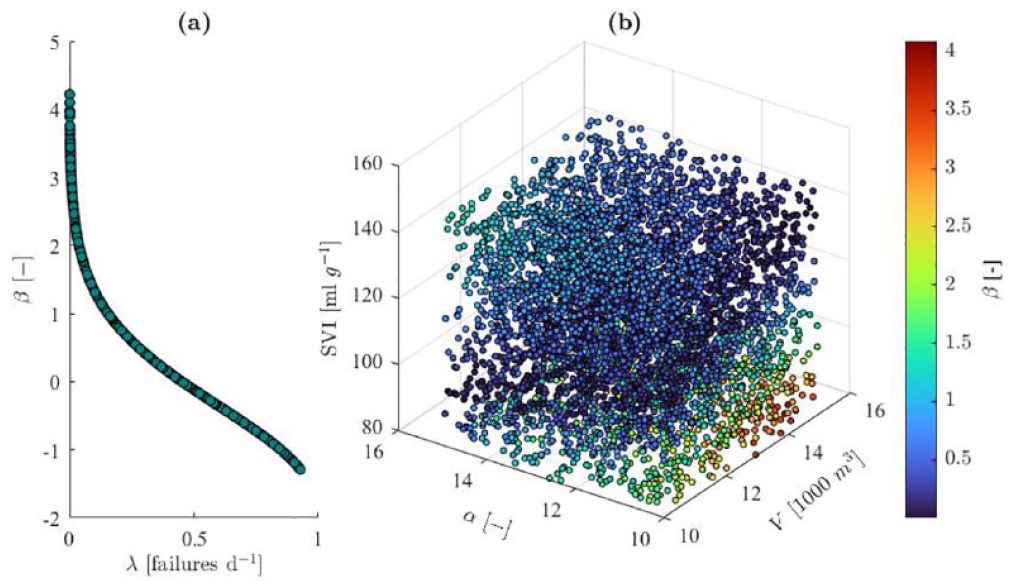
Reliability analysis performance indicators for all scenarios: (a) reliability index variation curve in the function of the failure rate, and (b) three-dimensional response of the hydraulic & design-related parameters and the reliability index β. In (b) only 5,000 scenarios were plotted to improve the visualization of the results.
Figure 5 captures all possible reliability indices for the scenarios, enabling visualization and mapping of the relationship between reliability and design variables. A similar approach was reported by Sweetapple et al. (2018), who assessed the changes in reliability, risk, and resilience of an activated sludge WWTP provoked by combinations of operational control and design variables (e.g., increase in sewer storage tanks and bypass flows), and increasing population. However, the sensitivity of these metrics was not explored by those authors.
In general, great variability was noticed in the failure rate and reliability index for all displayed scenarios. The extent of variability depends on the behavior of influent loads and the design criteria of the treatment process. The rationale is that systems with a higher volume have a higher HRT, hence a higher buffer capacity, and vice-versa. Similarly, operational control exerts influence on plant behavior, particularly because adjustment of the retention time factor controls the solid retention time
In order to measure the failure rate sensitivity via Sobol’s sensitivity analysis, the structure for numerical analysis shown in Figure 3c was employed; the simulation time was approximately 48 hours. Regarding the influence of hydraulic & design-related parameters on the failure rate, Figure 6 shows that SVI exerts the most influence in both Sobol indices. The rationale is that SVI dictates the amount of solids escaping the secondary settler, that is, if the sludge has good compaction properties, fewer solids will finish in the treated effluent thereby minimizing

Sobol sensitivity indices of the failure rate for all the scenarios of the activated sludge model.
Finally, the retention time factor
Overall, sensitivity results show the role of design variables in failure frequency minimization. Therefore, it is expected that combinations of these variables reduce the failure rate of the activated sludge system, particularly due to the influence of SVI in the degree of sludge settling capacity, and the role of
Life-Cycle Cost Analysis Results
Cost optimization
Regardless of parameter sensitivity, it is essential to determine the cost implication of the devised alternatives, because increasing the system’s reliability may place in judgment the economic feasibility of the project under evaluation, either by high CAPEX, OPEX, or RISKEX. It is foreseen that the system’s SVI is the most influential parameter on RISKEX. The rationale is the influence exerted by SVI on the failure rate, which is directly related to RISKEX as it promotes failure events that eventually translate to monetized consequences. Nevertheless, it is important to account for the economic impacts of selecting the system’s volume, because the superficial area needed for WWTP construction and overall operational conditions affect CAPEX and OPEX.
Here, the cost expenditures are reported in millions of United States dollars (MM-USD). A CER = 125 USD (m3 of built infrastructure)−1 is considered to determine CAPEX as it represents an indicative cost required per unit volume of the activated sludge process (Saleh et al., 2018). OPEX is estimated by assuming a factor
In order to determine CODEXC, the failure region of the limit state function with its associated flow is separated; excess BOD is transformed into biodegradable COD using the method of Roeleveld & Van Loosdrecht (2002). Later, the sum of the product between the pollutant exceedance concentration and the effluent flow was averaged, this product results in a distribution of CODEXC per failure for each of the devised scenarios.
In order to envisage the relationship between the total cost and system reliability, Figure 7 presents the life-cycle cost of the 10,000 scenarios and its related annual failure rate. Each circle represents a scenario, where the optimum scenario (3 m3, α = 10.8, and SVI = 80.766 ml g−1) is highlighted as a red dot, that is, the scenario with the lowest LCC and an accessible annual failure rate of 3.227 MM-USD and 18.75 failures year−1, respectively. Additionally, two scenarios were included to track cost optimization, a base scenario (

Relationship between the life-cycle cost and the annual failure rate in the case study. The red-dotted line encloses scenarios with both affordable life-cycle cost and failure frequency.
In the extent to distinguish between the scenarios highlighted in red, a spider plot is presented in Figure 8. For simplicity of the comparison, the results of the 10,000 scenarios are normalized to a range of 1–10 (minimum and maximum values, respectively; reported in Table 3). The scenarios denominated as the base, over-safe, and optimum, are presented in Figure 8. There was a significant difference between the three scenarios. For example, the base scenario has the highest life-cycle cost compared to the other two scenarios as it demonstrates a positive increment of the total cost made by the high number of system failures, hence, increasing the RISKEX (0.796 MM-USD). On the other hand, the over-safe scenario shows to have a high life-cycle cost, with only 0.171 MM-USD less than the base scenario, this, regardless has the lowest failure rate and RISKEX. The rationale is that the pursuit of the lowest RISKEX is counterproductive because it demands a higher volume, which significantly increases both CAPEX and OPEX.

Overall performance of the red-highlighted scenarios. All data were normalized to a range of 1–10 considering the 10,000 scenarios.
Extreme Values of All Simulated Scenarios.

Note. MAX is reported as 10 while MIN is reported as 1 in the normalized dataset in Figure 8.
Meanwhile, the optimum scenario exhibits a clear trend in the reduction of project expenditures, a low failure rate coupled with an increase in the removal efficiency (REMEFF), estimated as the percentage of effectively treated wastewater, and a low failure rate, consequently, achieving higher reliability. It is also noticeable the symmetry portrayed by the mix of the indicators; this demonstrates the suitability of the optimum scenario.
Although all scenarios achieve REMEFF > 85%, a total of 20 scenarios (marked within the dotted box in Figure 7) put through an annual failure rate of rate 10 ⩽
Summary of Indicators for the Dotted Box Scenarios in Figure 7.

Note. SD = standard deviation; HRT = hydraulic retention time.
A comparison between the cost expenditures of this study and the works of Kamble et al. (2019) and Rawal & Duggal (2016) is presented in Figure 9. For ease of comparison, an average treated flow of 9.8 megaliters per day (MLD) was considered, the cost expenditures were transformed from Rupees (Rs) to MM-USD and OPEX per year was multiplied by 15.5374, that is, the resulting PVF of this study. No greater difference was observed from the cost expenditures of Kamble et al. (2019), regardless that in this study RISKEX was considered within the LCCA. On the other hand, the work of Rawal & Duggal (2016) significantly differs from the cost expenditures of this study, suggesting that a detailed examination of the project cost expenditures is essential to provide accurate cost estimations.

LCCA comparison with other published studies.
Figure 10 compares the hydraulic & design-related parameters along with the reliability index. What is striking in the figure is that combinations of the system volume, the retention time factor, and SVI may abruptly soar system reliability (owing to their influence on HRT, solid retention time, and the amount of solids escaping the secondary settler), hence probably achieving a negligible failure rate. One should notice that here the system is portrayed by an ideal reactor (a CSTR) which has low efficiency for biological treatment compared to more sophisticated reactor configurations. Fortunately, the framework analysis is useful regardless of the configuration and mixing conditions. For the CSTR case, the system volume can be extended as high to meet effluent discharge requirements. Nevertheless, these alternatives can be deemed as economically unfeasible, particularly, because the superficial area for the construction of the WWTP and the equipment dimensions may heighten CAPEX and OPEX enough to jeopardize the project.
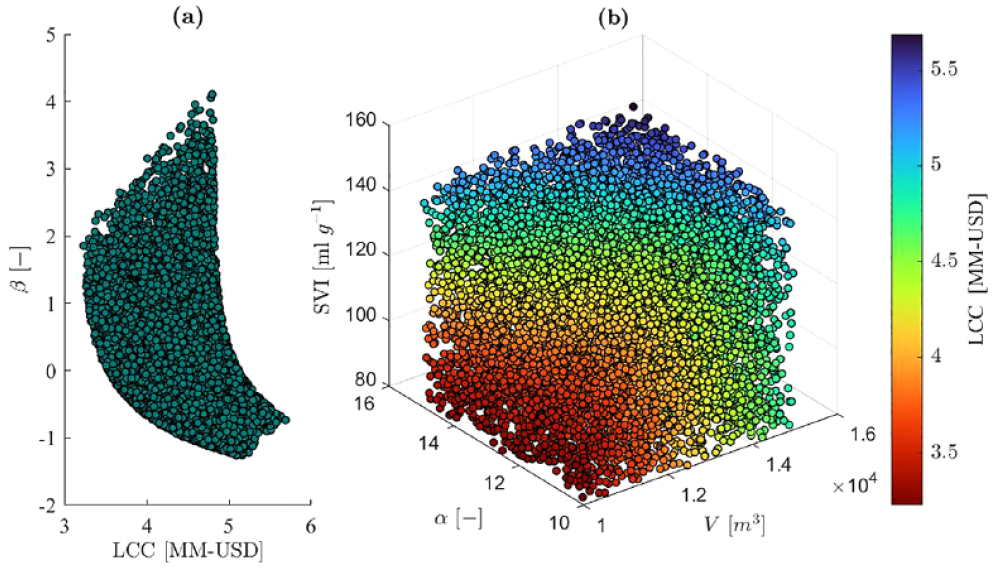
Life-cycle cost analysis performance indicators for all scenarios: (a) reliability index variation curve in terms of the life-cycle cost, and (b) three-dimensional response of the hydraulic & design-related parameters and the life-cycle cost.
Figure 11 presents the relationships of project costs to provide a holistic view of the economic impacts of the WWTP. For instance, the figure compares the RISKEX to CAPEX, and RISKEX to OPEX, respectively, making it evident that both comparisons follow the same pattern. This is explained by the proportional relationship used to calculate OPEX per year as a fraction of the CAPEX. Meanwhile, note that the linear relationship between CAPEX and OPEX, coupled with the distribution surface of RISKEX, indicates that cost reduction and optimization must balance CAPEX and OPEX to reduce RISKEX associated with the reduction of COD over-discharge.
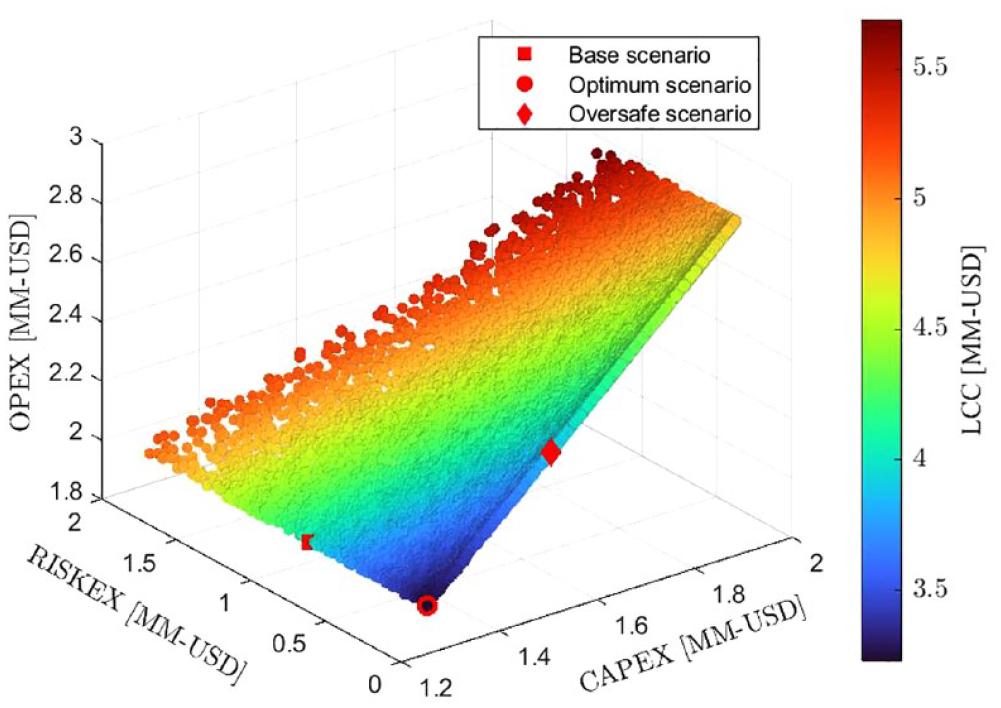
Relationship between life-cycle cost indicators.
Finally, Figure 12 sets out the relationship among the reliability metrics, cost expenditures, and the mass of COD being over-discharged per failure. Figure 12a demonstrates a parallel reduction in the annual failure rate and RISKEX, evidencing that the lower the failure rate, the CODEXC is also reduced. On the other hand, Figure 12b supports the rationale of the economically unfeasible alternatives, revealing the reduction of RISKEX along with the pursuit of neglecting CODEXC, significantly augments CAPEX and OPEX of the sanitation infrastructure. Consequently, demonstrating an inflection point between system reliability and total cost, that is, aiming for too high reliability can be counterproductive because of financial limitations.
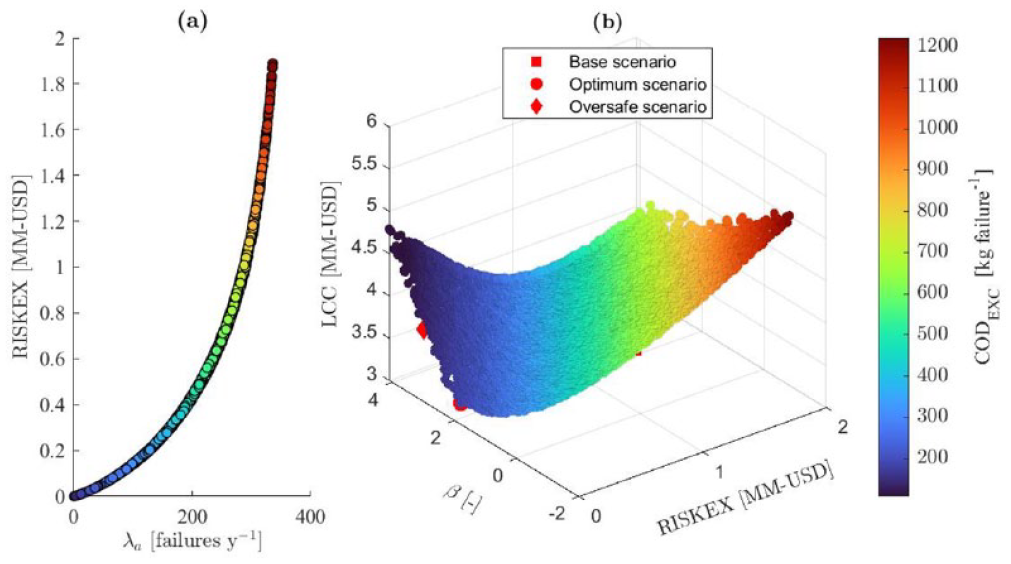
Relationship between reliability metrics and project expenditures: (a) RISKEX response curve in the function of the annual failure rate, (b) three-dimensional responses relating to the reliability index β, the RISKEX, and LCC.
Discussion
Through the years, scientific research has been concerned with the determination of reliability metrics such as reliability per se, risk, and even resilience. For example, reliability has been determined by leveraging influent and effluent data (i.e., without modeling the AS process), through statistical concepts like coefficients of variations and associated percentiles (Oliveira & Von Sperling, 2008), or using probabilistic approaches like fault tree analysis (Taheriyoun & Moradinejad, 2015). Meanwhile, Ramin et al. (2022) conducted a reliability analysis to determine the compliance with effluent limits of several nutrient removal WWTPs (i.e., focused on nitrification/denitrification and enhanced biological phosphorus removal) for different plant layouts. Additionally, the previous authors conducted a global sensitivity analysis on the concentration of nutrients in the effluent and other key performance indicators but did not determine sensitivity indices on reliability metrics. Sweetapple et al. (2018) evaluated urban wastewater systems in terms of reliability, risk, and resilience. However, the annual failure rate was not determined, and risk was not estimated as a monetized consequence of exceeding the threshold of a river quality indicator. Finally, Casal-Campos et al. (2018) conducted a reliability-sensitivity analysis in an urban wastewater system but without dealing with the concept of multi-uncertainty to differentiate the parameters with reducible and non-reducible uncertainty, where only the former can be adjusted to increase the reliability of the system.
Similarly, research has evaluated different LCCA approaches (Ilyas et al., 2021). Nevertheless, in general, the relationship and integration of reliability analysis with cost models have been under-explored (Juan-García et al., 2017), despite cost estimation being essential for the development of any engineering system. Consequently, the innovative framework highlights the role of techno-economic analyses to evaluate reliability, failure rate sensitivity, risk, and total cost, for the identification of an option that performs well under a wide range of loading conditions, thereby assisting wastewater practitioners in their decision-making process.
The framework provides a holistic analysis of data and the identification of key issues that warrant managerial attention. For example, Figure 8 provides a strategic evaluation of all WWTP scenarios in terms of normalized key performance indicators. Consequently, the framework allows the evaluation of the strengths, weaknesses, opportunities, and threats for all design scenarios quantitatively and graphically to enable the formulation of tailored and informed decisions. In this vein, the findings indicate the optimum scenario anticipates alterations in wastewater production and pollutant loading while assessing potential risks and their monetized consequences, ensuring alignment with the long-term performance of the activated sludge process.
One should be aware that the goal of this paper is to demonstrate the potential of the reliability-based life-cycle cost optimization framework. In this respect, the framework is at a proof-of-concept stage, particularly, because the CSTR model and the Monod biokinetics were leveraged due to their ease of computation, although the latter models are the fundamentals of more advanced activated sludge modeling frameworks like the activated sludge models (ASM1, ASM2d, and ASM3) or the benchmarking simulation models (BSM1 and BSM2). Similarly, the plant layout could be extended to include an equalization tank or sludge treatment operations. Fortunately, the framework is versatile, so it can be expanded to include the aforementioned process/units, whereas the life-cycle cost model can also consider these units, including the large area of land required for its construction and associated costs. In fact, the authors have adapted some of the analyses included in the framework with the BSM1, and the results are promising.
The reliability-based life-cycle cost optimization framework is still at a proof-of-concept stage (as discussed in the following sections). However, the results are promising as they indicate the framework can be leveraged by wastewater professionals to design or retrofit activated sludge processes under a wide range of influent conditions, and to understand the influence of hydraulic & design-related parameters on the system’s annual failure rate. The rationale is that the innovative framework presented in this study will assist in the decision-making process to alleviate the most frequent technical, infrastructural, environmental, financial, and economic challenges such as aging infrastructure, improper maintenance of the WWTP, water pollution, and lack of infrastructure capital (Pamidimukkala et al., 2021).
Understanding the role of system failure rate brings numerous advantages in the wastewater sector. Engineers can optimize WWTP design by making informed choices to enhance reliability and performance through parameter adjustments. Identifying influential parameters enables innovative design strategies for increased system reliability. Identifying influential parameters on the failure rate also aids in risk assessment and mitigation; focusing on parameters significantly affecting failure rates allows water utilities to allocate resources effectively, minimizing potential risks and their economic consequences. In this regard, the framework also allows wastewater practitioners to optimize the life-cycle cost of the WWTPs without compromising its likelihood of compliance with environmental regulations. Regulatory compliance benefits from understanding parameter influence on failure rates, as it ensures WWTP design adheres to standards, exhibiting the commitment of relevant stakeholders for safe and reliable wastewater treatment. Additionally, it supports continuous improvement to refine WWTP designs using innovative data-driven approaches to maximize the impact of reliability, reliability-sensitivity, and life-cycle cost assessments. Consequently, decision-makers can use the framework to inform strategic decisions regarding investments either in upgrades, replacement, or new sanitation facilities.
The framework is the very first attempt to combine reliability, reliability-sensitivity, and life-cycle cost assessments in one simulation work to techno-economically assess an activated sludge process. It offers distinct contributions, particularly, because previous frameworks overlooked at least one of the following elements: failure rate estimation, determination of external costs associated with system failure, the sensitivity indices on the failure rate, and cost optimization. In this sense, this study synthesizes insights from activated sludge modeling, wastewater treatment, scenario analysis, multi-uncertainty, global sensitivity analysis, risk management, economics analysis, and data analytics. Consequently, the significance of the framework lies in its uniqueness to improve the project costs without compromising its efficiency to safely treat wastewater, its enrichment of existing knowledge, and its potential application to enhance system performance, reduce system failures, risk mitigation, cost reduction, regulatory compliance, adaptation to changing conditions and requirements, and informed decision-making, ultimately advancing extending understanding and driving practical advancements in the wastewater sector.
For instance, the reliability analysis is an assessment of the integrity of the WWTP. Therefore, the reliability metrics allow ranking the overall performance of the treatment process under current influent characteristics or even future demands. The concept of reliability provides deeper insight to project stakeholders on design and operation strategies for the improvement of WWTP system reliability to meet the effluent discharge quality standards required by the authorities (Oliveira & Von Sperling, 2008). Therefore, the findings corroborate wastewater practitioners can design/evaluate AS processes to meet regulatory standards and demonstrate their commitment to safe wastewater treatment via reliability analysis because of the reduced likelihood of failure at least in terms of transgression of mandated effluent quality under scenarios with alteration of wastewater production and pollutant loading.
The reliability-sensitivity analysis systematically identifies the relevant factors influencing the WWTP failure rate (Cadini et al., 2020; Ehre et al., 2020). This holds a modeling strategy to apportion the reducible uncertainty of the design variables on the failure surface, ranking the uncertain variables to the reliability metrics, and improving process understanding. The rationale is that sensitivity indices highlight how different variables affect the failure rate. Consequently, engineers can make informed decisions to enhance reliability by adjusting or selection appropriate hydraulic & design-related parameters, thereby optimizing AS design. Moreover, the improved knowledge of parameters influence assists in mitigating external costs associated with system failures which are eventually quantified in the LCCA. In this vein, the reliability-sensitivity analysis demonstrates an original contribution and a research opportunity area in the wastewater field, expressly, due to its potential to cope with social, environmental, and economic challenges, which are confounded by uncertainty, supporting decision-making and policy-making.
Finally, the integration of LCCA within the framework is also an original contribution to the wastewater field since no similar approach has ever been published before. The results from the LCCA demonstrate its effectiveness for resource allocation which can lead to cost reduction, which is particularly important in scenarios where financial resources are limited, and informed decisions must be made to maximize the impact of the WWTPs. This is exemplified by the cost optimization conducted here, which was achieved by balancing WWTP reliability and project expenditures via an appropriate selection of hydraulic & design-related parameters (see Figure 10). This is explained by the exhaustive simulation protocol because it allowed finding the most balanced design scenario in terms of performance indicators, for example, removal efficiency, the failure rate, and the project expenditures, among others (see Figure 8).
One interesting observation is that Figure 7 provides a large set of reliability clusters each with a wide range of total project expenditures. However, this matches the findings of Sweetapple et al., (2018), who demonstrated the possibility of acquiring the same reliability scenarios each with different associated risks, although, here risk was measured as an indicator rather than as an expenditure. Additionally, the previous study supports the idea that aiming for high-reliability scenarios with negligible RISKEX is possible, but caution is essential to avoid exacerbated costs (CAPEX and OPEX) that may jeopardize the project. Fortunately, the reliability-based life-cycle cost optimization framework provides a holistic view of the system investments during its operating life and the influence of its components for the stakeholder to make strategic decisions.
However, it is worth noticing that the cost expenditures of Rawal & Duggal (2016) differ from those of this study (see Figure 9). These differences can be explained by the approximation of CAPEX and OPEX based on CERs and linear relationships derived from the literature (see Figure 11). Another possible explanation is that CAPEX and OPEX are subjected to changes in the price of materials, consumables, electricity, and so on, provoked by inflation, and supply chain challenges (at either scale), among other stressors. Consequently, using more rigorous approaches such as system inventory and/or benchmarking (Gernaey et al., 2014; Martinez-Sanchez et al., 2015) to account for energy and material flows associated with the WWTP will provide more accurate cost data.
As part of the LCCA, RISKEX was deemed as an external cost; quantified as the product of the failure frequency and the monetized magnitude of the effect due to COD exceedance discharge (see Figure 12b). The RISKEX results need to be interpreted with caution because wastewater contains a wider range of pollutants and nutrients in different forms, which may be riskier even at lower concentrations, and can increase RISKEX if more pollutant failure states as integrated in the framework. Additionally, if stricter environmental regulations are established or foreseen, the magnitude of the failure is expected to be higher, resulting in increased RISKEX. However, the proposed methodology can be expanded to cover these eventualities by evaluating any regulatory compliance set by the user and appropriate treatment kinetics.
On the other hand, the determination of external costs could also be extended by quantifying the economic impacts on society due to damages or mitigation of environmental and public health issues caused by WWTP operation. The previous include direct and indirect costs provoked by global warming, terrestrial acidification, eutrophication, toxicity, and abiotic depletion of resources, along with the users’ willingness to pay for good sanitation services, among others (Martinez-Sanchez et al., 2015). Hence, whenever data is available, this innovative framework could be extended to include broader threats, thereby providing a wider picture of unforeseen external costs the WWTP may be subjected to.
The significance of the reliability-based life-cycle cost optimization framework relies on the introduction of an innovative methodology that incorporates interconnected disciplines to enrich the holistic perspective of reliability to improve the techno-economic efficiency of an AS process. The integration of reliability analysis, reliability-sensitivity analysis, and life-cycle cost assessment not only refines our understanding of the influence of parameters on the failure rate of wastewater treatment plants but also lays the groundwork for cross-disciplinary collaboration for the optimization of AS processes in terms of cost savings without compromising the reliability of the facility to meet the effluent quality standards.
Although the framework is at a proof-of-concept stage, the results obtained have substantial implications in multiple areas. First, it refines existing theories and methodologies by making them work together, that is, although the potential of reliability, sensitivity, and life-cycle cost analyses is well known, their interconnectivity has never been exhibited before for evaluating a WWTP, which was done through the concept of reliability. This prompts specialists to consider the framework as standard practice and to push research in innovative directions. Secondly, the implications extend to the industry as the results offer practical applications to optimize treatment efficiency, awareness of influential parameters, risk mitigation, and cost reduction through decision support systems for the wastewater sector to remain competitive in a rapidly evolving landscape to improve environmental quality and align their practices with sustainable goals to ensure the provision of safe sanitation services to improve the quality of life of human beings and the natural environment.
In addition, the results have economic, environmental, and social significance, implying the promotion of sustainable practices that encourage proper resource allocation to ensure wastewater treatment leads to economic growth, conservation of natural resources, promotion of good environmental quality for aquatic ecosystems, affordable tariffs for sanitation users, and improved knowledge of operators and improved efficiency of wastewater treatment plants, among other benefits. In this regard, the results underscore the importance of continuing the research, so that sufficient technological maturity can be reached for wastewater professionals and industry to make informed decisions for the benefit of sustainable development. The rationale is that the adoption of the reliability-based life-cycle cost optimization framework in the wastewater sector is expected to contribute to the development of more sustainable, reliable, and resilient WWTPs.
Amendments to the environmental regulations
The reliability-based life cycle cost optimization framework can be used regardless of the environmental regulation being evaluated. In this regard, the illustrative example was compared to a more stringent regulation. The rationale is that Mexico is undergoing a paradigm shift towards stricter environmental regulations. The current regulation remains in effect (NOM-001-SEMARNAT-1996, n.d.), although it will cease to apply soon due to the introduction of a new environmental regulation (NOM-001-SEMARNAT-2021, n.d.). The new standard requires a concentration of 60 g COD m−3 in the effluent, compared to the 75 g BOD5 m−3 promoted by the current legislation. Hence, COD fractionation protocols were used to transform effluent BOD5 into COD to test the illustrative example with the new regulation (Roeleveld & Van Loosdrecht, 2002).
Figure 13 shows the results obtained from the comparative analysis of the illustrative example in terms of current and future regulations. It is observed that when evaluating the activated sludge system considering NOM-001-SEMARNAT-2021,

Relationship between the life-cycle cost and the annual failure rate: (a) NOM-001-SEMARNAT-1996 (current regulation); and (b) NOM-001-SEMARNAT-2021 (forthcoming regulation).

Overall performance of the scenarios of interest in terms of current and future environmental regulation. All data were normalized to a range of 1–10 considering the 20,000 scenarios, that is, 10,000 scenarios per environmental regulation.
Consequently, the framework can cope with the imposition of any environmental regulations, with significant advantages in anticipating the rate of change of performance indicators when imposing stricter regulations. This demonstrates the framework’s versatility to adapt to the evolving regulatory environment to embrace sustainability, making it useful for policymakers and relevant stakeholders regarding the impacts of regulatory adoption offering valuable insights in terms of the rate of change of external expenditures that the WWTP owners will be subjected in case of transgressing the effluent limits, which is expected to drive research and development efforts to properly balance environmental protection, economic efficiency, and social equity in the wastewater treatment sector.
Relevance in the context of sustainable development
The reliability-based life-cycle cost optimization framework for activated sludge processes aims to prevent common sanitation challenges and align with Sustainable Development Goals (SDGs) 6.3, 9.1, and 9.4 (United Nations General Assembly, 2015). SDG 6.3 aims to halve the proportion of untreated wastewater to promote good ambient water quality in aquatic ecosystems. SDG 9.1 encourages the development of quality, reliable, sustainable, and resilient infrastructure, to provide affordable services that patronize economic development and human welfare. And, SDG 9.4 emphasizes the need to upgrade or retrofit service infrastructure as a rationale for achieving sustainability, per the economic and technological capabilities, along with the challenges of each country.
Recent estimations suggest that most of the global WWTPs have already surpassed their design capacity, nearing the end of their usefulness or proximately reaching it (Pamidimukkala et al., 2021). Meanwhile, in the evidence of risks associated with water pollution, stricter environmental legislation is foreseen. These observations should be interpreted with caution, as they imply a potential decline in the progress of safely treated wastewater as advocated by SDG 6.3. The rationale is that WWTP’s reliability to safely treat wastewater is a function of the discharge standards to be met, which can hinder the progress on SDG 6.3. In the face of the current and forthcoming challenges in the wastewater sector, accelerated progress is needed to improve wastewater treatment rates to improve water quality in aquatic environments. Hence, an intensified demand for new or retrofitted reliable infrastructure that arises to combat water pollution is expected, which is promoted by SDGs 9.1 and 9.4.
New (or retrofitted/upgraded) infrastructure, while essential, must be designed and operated properly to guarantee wastewater treatment reliability. In this sense, the implementation of digital water solutions is a natural progression toward sustainable wastewater management due to its role as a Decision Support System. The reliability-based life-cycle cost optimization framework stands out due to its versatility to evaluate the performance of an activated sludge process to meet any existing regulation, understanding hydraulic & design-related parameters’ influence on WWTP failure rate, while optimizing the project cost, which are crucial criteria for safe wastewater treatment.
The framework conducts data-driven risk management as it copes with all possible combinations of wastewater production and pollutant loading events the plant can be subjected to during its project life, determines the sensitivity indices of influential parameters on the annual failure rate, and estimates RISKEX as part of a life-cycle costing protocol. Therefore, the reliability analysis, reliability-sensitivity analysis, and life-cycle cost assessment, which integrate the framework, offer several advantages from an engineering perspective, like optimized design, enhanced reliability, risk mitigation, regulatory compliance, continuous improvement, resource allocation, and decision support. Therefore, the framework stands as an adjuvant tool to guarantee the progress on safely treated wastewater through the determination of the plant’s reliability to cope with a wide range of influent conditions expected during the project life, as encouraged in SDGs 6.3, 9.1, and 9.4.
In this sense, the reliability-based life-cycle cost optimization framework for activated sludge processes is profoundly significant in advancing global knowledge on sanitation infrastructure and wastewater treatment. This framework not only addresses pressing challenges faced by existing wastewater systems but also aligns with SDGs 6.3, 9.1, and 9.4 by promoting water quality improvement, sustainable infrastructure development, and upgrades. It responds to technological trends by optimizing costs and reliability, while tackling challenges of economic integration and adaptability in line with SDG principles. The transformative potential of this framework lies in its capacity to revolutionize wastewater treatment practices, offering solutions that closely align with SDGs and significantly improve the quality of life for communities facing sustainability-related challenges.
Moreover, it is recognized that climate change will affect the spatial-temporal distribution of water availability, water demand, and water quality, affecting wastewater production and pollutant loading patterns (Boretti & Rosa, 2019; Tian et al., 2021). On the other hand, circular economy principles drive resource recovery from wastewater, thereby promoting on-site production of energy and waste-sourced fertilizers, as well as the use of treated wastewater as a non-conventional water resource (Puyol et al., 2017; Qadir et al., 2020). Consequently, sustainable development, climate change, and the circular economy dynamically interplay towards minimizing the anthropogenic impacts, highlighting opportunities for resource efficiency, waste valorization, and carbon footprint reduction, among other sustainable practices to engage with environmental stewardship, economic prosperity, and climate action in the wastewater sector.
While the framework’s maturity is early, its versatility implies that different plant configurations and kinetics can be considered in the techno-economic assessment, and the results show promise in coping with altering wastewater production and pollutant loading. In this sense, with the appropriate refinements, the framework is suitable for conducting a climate impact analysis or integrating resource recovery platforms. Consequently, it is inferred that it would address other SDG targets such as 7.1, 12.5, and 13.1, which promote access to affordable, reliable, and modern energy services, reduction of waste generation through prevention, reduction, recycling, and reuse, as well as test the adaptive capacity of WWTPs to climate change. Therefore, the anticipated potential of the framework highlights promising research avenues.
Areas for improvement and future work
The overall goal of this study is to highlight the potential of the reliability-based life-cycle cost optimization framework. Some areas for improvement are discussed. The plant layout (see Figure 2) and the activated sludge model (see Section 2.2) lack volume fractionation (i.e., the division into anaerobic, anoxic, and oxic zones) along with detailed recycling streams (mixed liqueur and activated sludge) and hinder the bioreactor-settler interaction via more pragmatic biokinetic-settling models, respectively. This limits the solid retention time
All areas for improvement prove that the reliability-based life-cycle cost is still at a proof-of-concept stage. Fortunately, the framework is versatile and it could be extended to assess different plant layouts, hydrodynamics (if necessary), and different failure states regardless of current or forthcoming (more stringent) environmental legislation of any country. Consequently, extending the simulation work with pragmatic activated sludge models, environmental failure states, and costing techniques (Gernaey et al., 2014; Henze et al., 2000; Martinez-Sanchez et al., 2015) might bring a broader discussion of the results, and elaborate a wider picture of the framework potential.
Regarding future research, the authors are working on reliability assessments within the benchmark simulation model for long-term simulations (BSM1_LT; described in Gernaey et al., 2014). A Modified Luzdack-Ettinger (MLE) plant layout is considered. The WWTP performance is assessed under different influent dynamic loading conditions (volumetric flow, organic matter, and nutrients), where preliminary results indicate an annual failure rate consistent with the values reported in this study, and with a solid retention time within the reported values by Winkler et al. (2012). The results are positive, thereby suggesting promising research avenues.
The research outlook suggests the development of more realistic models, such as the ASM family (Henze et al., 2000), benchmarking frameworks (Gernaey et al., 2014), and/or system inventory models (Martinez-Sanchez et al., 2015), to envisage raw materials needed for construction, environmental impacts, energy requirements, and societal approval of the sanitation infrastructure. The previous will allow reliability and risk assessment under long-term dynamics to determine the WWTP annual failure rate under influent dynamic loading conditions over a year of operation. The detailed estimation of OPEX is another area of study, including energy requirements (aeration, pumping, chemical dosing), sludge management, salaries, and incomes. Attention should be given to the evaluation of the rate of change in the performance due to future demands (climate change, population growth, urbanization, altered precipitation, etc.), to guarantee the WWTP can withstand fluctuations caused by forthcoming stressors.
Additional directions of research include the determination of reliability metrics sensitivity of specific hydraulic & design-related parameters, The detailed estimation of CAPEX through system inventory, the inclusion of environmental and social failure states within the innovative framework to account for a wider picture that encourages environmental protection and social equity, and the appraisal of reliability in resource recovery infrastructure to reclaim treated wastewater for reuse, nutrient-rich biosolids for use as fertilizers, and in-situ energy production in the face of a self-sufficient bio-based economy, are identified among other research avenues.
The findings and the potential research directions suggest that the reliability-based life-cycle cost optimization framework holds potential impactful outcomes on multiple levels. For example, globally it poses an interesting area for research because the framework is likely to be amended to cope with economic, social, and environmental targets in the wastewater sector. At a national level, it anticipates informed policy and engineering-oriented decisions in line with meeting environmental regulations even upon amendments to stricter effluent quality standards. Finally, at a local scale, is expected that the framework will guarantee the effectiveness of the AS process to provide safe sanitation services, which will reduce the pollution levels within a catchments or services area.
Practical applications
Introducing the reliability-based life-cycle cost optimization framework at its proof-of-concept stage illuminates a realm of potential applications within the wastewater treatment sector. While nascent, this technology’s reliability, sensitivity, and life-cycle cost assessments hold promise to revolutionize cost optimization, compliance with environmental legislation, and determination of the influential parameters on system reliability to safely treat wastewater. Acknowledging the areas for opportunity, that is, introducing sophisticated schemes for activated sludge modeling (or other biological processes) and budgeting, as well as the future research avenues, ongoing development aims to refine and augment the technology’s capabilities. As the reliability-based life-cycle cost optimization framework progresses along its developmental pathway, collaborative engagement with stakeholders and industry partners, this innovative proof-of-concept will solidify its role as an innovative force driving efficiency, innovation, and progress in wastewater treatment.
The proof-of-concept framework has promising technological applications, addressing challenges such as wastewater production, pollutant loading, regulatory compliance, and aging infrastructure which will require replacement, upgrading, or new WWTPs. By evaluating various influent conditions and design scenarios, the framework offers tangible benefits like cost optimization, fair service tariffs, and environmental compliance even in terms of foreseen amendments. It quantifies these advantages through metrics like life-cycle cost, annual failure rate, Sobol Indices, and RISKEX. With a growing market for digital water solutions, this framework bridges a significant gap by effortlessly evaluating multiple treatment alternatives under a wide range of influent conditions to compare life-cycle costs, including commonly unforeseen RISKEX, improving WWTP design in terms of reliability for better decision-making. To advance its technology readiness level, leveraging engineering, industry, and scientific expertise is vital to bring this pioneering technology to its full potential.
One should be aware that its application in a real infrastructure relies on migrating from theoretical research to applied research. This transition involves introducing more sophisticated activated sludge models, developing of unit price catalog, quantification and monetization of consumables, energy, and labor workforce, and conducting a data measurement campaign to calibrate the model, that is, acquiring a minimal error between the observed data and the model outputs for quality control and quality assurance of the results. This entails the successful transfer of the results into a more realistic and commercially viable environment.
Conclusions
This work studied the potential of an innovative reliability-based life-cycle cost optimization framework to conduct a techno-economic assessment of an activated sludge process for wastewater treatment. For this purpose, the reliability of a hypothetical activated sludge process was evaluated to comply with pre-specified effluent discharge standards. Subsequently, a reliability Sobol’s sensitivity analysis was performed to evaluate the influence of design parameters on the failure rate. Finally, a life-cycle cost assessment determined the capital, operational, and risk expenditures of the project during its lifespan, where risk expenditures were quantified as penalty fees due to transgressing effluent quality standards mandated by environmental legislation. The following conclusions were drawn:
The variability of the failure rate to meet effluent limits depends on the behavior of the influent loads, that is, wastewater production and pollutant loading, as well as the design/operational criteria of the treatment process.
The system Sludge Volumetric Index exerts the most influence on the system’s failure rate due to its relationship with sludge compaction within the settler, thereby influencing the amount of solids escaping the secondary settler. In this regard, it is the most influential variable of risk expenditures.
All scenarios accomplished a removal efficiency REMEFF > 85% however, adjustments to hydraulic & design-related parameters significantly altered the system’s reliability along with its risk expenditures.
Aiming to achieve high-reliability scenarios can be counterproductive as these may be financially unfeasible.
An exhaustive simulation determined an optimum scenario that exhibited balanced performance indicators, high reliability, and affordable cost.
Although the innovative framework is still at a proof-of-concept stage, it makes up a promising engineering tool to assist wastewater practitioners when designing or upgrading an activated sludge process, by evaluating the system's capacity to effectively treat the incoming wastewater, the influence of performance stressors, and the economic feasibility of the project. Future framework refinements suggest promising research avenues.
Footnotes
Acknowledgements
This study was undertaken as part of the Doctorate in Water Science program at Universidad de las Américas Puebla (UDLAP). R. A. Borobio-Castillo would like to thank UDLAP and CONAHCYT for granting an academic scholarship and partially funding this research.
Declaration of Conflicting Interests
The author(s) declared no potential conflicts of interest with respect to the research, authorship, and/or publication of this article.
Funding
The author(s) disclosed receipt of the following financial support for the research, authorship, and/or publication of this article: The APC of this article was supported by the Dean’s Office of Research and Graduate Studies at UDLAP..
Author Contributions
R. A. Borobio-Castillo: Conceptualization, Methodology, Software, Formal Analysis, Investigation, Writing (Original Draft), Visualization. J. M. Cabrera-Miranda: Conceptualization, Methodology, Software, Validation, Writing (Review & Editing), Supervision. B. Corona-Vásquez: Conceptualization, Validation, Writing (Review & Editing), Supervision, Project administration.
