




Abstract
As mediators in soil formation, lichens play an essential role in the physical and biological formation of the natural environment. A recent study showed that they are capable of biodegrading stone substrates in a little amount of time, despite being excluded in a geological setting. Many species, mainly those able to produce an oxalate at the thallus-substratum interface, can alter the surface, affecting it chemically. The oxalate remains a noticeable increase even after the lichen has faded, and it makes a major contribution to the structure and composition of the thallus itself. These severe oxalate deposits on historical sites have been alternatively attributed to the earlier as the consequence of air pollutants, prior mechanical/chemical renovation treatments, as well as environmental deterioration. Lichen growth on building materials and biodegradation are frequently based on environmental variables. The biogeophysical and biogeochemical weathering of the substrate by the lichens is the mechanism underlying biodegradation. For stone surfaces, lichens can endeavor bio protection by acting as a barrier against weathering, holding humidity, improving permeability, reducing heat stress and erosion, and absorbing contaminants. Lichen’s significance as a biodeteriorant, its colonization and impact on monuments, as well as bioprotection, are all discussed in the current review.
Introduction
Biodeterioration is the term used to describe the adverse modifications to a material’s or a monument’s attributes by organisms (Allsopp et al., 2004). The appearance of buildings and the damage to their construction is one of the most common symptoms of biodeterioration. Various materials can have unique surface characteristics, such as being smooth or rough, as well as distinctive structural characteristics, including being porous or semi-porous (Nayaka et al., 2017). Biological organisms like blue-green algae, microgreen algae, bryophytes, and lichens colonize as well as fade away the texture of historic buildings which are made of porous or semi-porous substances (Joshi et al., 2015). In general, monuments are at risk due to harsh climatic circumstances, such as the usually heat and humidity existing in a tropical nation like India, which favors biodeterioration. Numerous types of rock or surface undergo multiple variations of the biodeterioration mechanism (Keshari & Adhikary, 2014). Monument conservation becomes difficult as well as prohibitive after these structural damages were caused. Therefore, it is crucial to halt living organism formation in its initial stages for the ideal quality of the monuments or constructions. However, studies on the pioneering organisms, or lichens, as well as their influence on degradation is crucial (Ortega-Morales et al., 2013).
Lichens’ tendency to deteriorate is primarily caused by the partner of lichen mycobiont, which is in direct contact with the substrate (Verma et al., 2014). The fungus forms a thallus or lichenized stroma in all lichens, which may include special secondary metabolites. Crustose, foliose, and fruticose are the three different types of lichens that utilize rocks as their substrate and are referred to as saxicolous species (Nayaka et al., 2017). Crustose lichens can also be classified into two groups: epilithic lichens that exist on the rock’s surface and endolithic lichens that reside inside the rock. Euendolithic forms aggressively bore into rocks, while cryptoendolithic forms occupied structural cavities and chasmoendolithic forms resided in fissures and cracks within rocks (Figure 1).
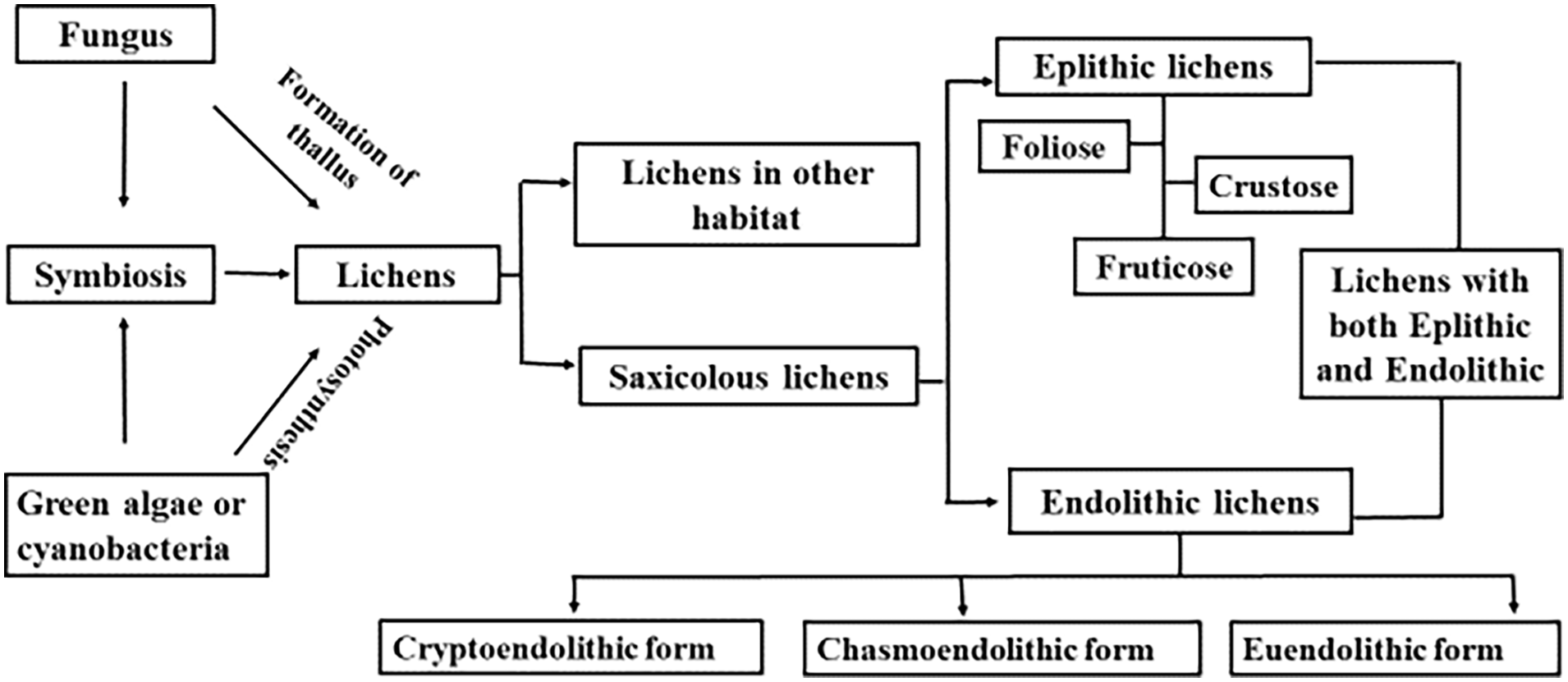
Diagrammatic representation of lichens based on habitat variation.
Generally, lichen species present in buildings may not differ from the organisms on the surrounding rocks there as well, only if the potential to needing samples from sandstone monuments is typically terribly narrow, several studies on lichen-sandstone exchanges have been carried out on samples returning from natural rocks (Mehta & Shah, 2021). Owing to the interface of advanced character components of carbon dioxide, organic acids, as well as lichens, biodeterioration is sometimes recognized as a mixture of physical methods like growth strain, thalli expansion, rhizin sticking, and mycelium incursion and chemical effects (Bajpai & Upreti, 2014).
The activity of epilithic species on entirely different lithotypes was studied extensively, for instance, sedimentary rock, limestone, marble, serpentinize, geological siltstones, schist, quartzite, stone, volcanic ash, as well as dolomite (Salvadori & Municchia, 2016). In general, endolithic lichens have not studied its huge dispersal on buildings as much, although studies in subsequent years coped with the hyperbolic issue (De los Ríos et al., 2009). Thalli of epilithic lichens thrive on the sedimentary rock substrate, but an excessive volume or a lower proportion of substrate usually penetrates their mycelium (Upreti et al., 2009). The ability of lichens to change the substrate is susceptible to physiological variations between individuals, in addition to the physicochemical parameters, composition, and also composition of the substrate (Bajpai & Upreti, 2014). In particular, the incursion of thallus within the stone concerns its composition or mineralogical-petrographic characteristics. Without any generally significant penetration, epilithic cover lichens may tightly stick to the substrate forming a definite lip, invading pre-existing fractures as well as cleavage planes of natural resources or showing an extreme hyphal incursion among the rock matrix (Seaward, 2015).
They also showed signs of degradation and engraving on their faces from oxide or intermediate minerals within lichen thalli, clasts of various minerals, limestone, granite, sandstone, and dolomites, besides the frequently observed surface (Adhikary & Kovacik, 2010). Minerals extracted from the substrate are less commonly observed in sandstone thalli. Several clasts are collected from airstream or precipitation transport as well as are enclosed by passive conveyance processes within the thalli, in addition to inorganic microspheres of distinct formation the robust and submissive ability of lichens to curb or postpone surface weathering (Salvadori & Municchia, 2016). Exposure to lichen could strongly protect a surface by protecting through the thallus and hence the necessary waterproofing via mycobiont hyphae of the rock surface as well as undersea (Clair & Seaward, 2004). Through the composition of an insoluble encrustation, like metal oxalate, passive defense of granite substrates can also be induced at the lichen stone surface. Research has demonstrated that mycelium perishing, induced through variations in micro-ecological circumstances, necrosis, unity, or normal physiological behavior of particular lichen species, might well result in absorption of chemicals as well as physically damaged surface, due to the comparatively frequent weathering-related decline of the substrate (Adhikary & Kovacik, 2010). As a result, some epilithic crustose, as well as endolithic lichens, may induce the level of substrate firmness during their lifetime, proceed with a process of unsteadiness, or accelerate relatively small geographic progression when both demise and rot (Salvadori & Municchia, 2016). Due to biodeterioration, ancient monuments are diminishing both their aesthetic and archaeological significance. Studying the lichen biofoulants and their function during the deterioration process is essential for understanding biodeterioration. This review examines lichen's mechanism as a biodeteriorant, its colonization and consequence on monuments, as well as protection.
Lichens as Biodeterioration
Due to their macroscopic composition, their occurrence on sandstones is apparent as an obvious film on the sandstone surface (Kranner et al., 2005). Mycobionts as well as photobiotic (mainly green photobionts) or fungi and blue-green algae (less common) are symbionts of lichens (Oksanen, 2006). These are intrinsically sensitive to warmth and drought, enabling species to thrive and grow in an incredibly wide range of habitats, several of which may also be hostile to alternative forms of life. Among the pioneer organisms which inhabit the exposed stone surfaces are lichens (Vráblíková et al., 2006).
Their creation may be preferred by the presence of organic nitrogen-rich excretes of birds (crows and pigeons). They need to contribute significantly to the monumental stone’s biogeophysical as well as biogeochemical degradation (Bültmann et al., 2015) (Figure 2). The dioxide produced in the thallus is converted into carbonic acid (an effective weathering mediator) during respiration (Oksanen, 2006). With the assistance of their specialized devices like hyphae (crustose lichens) as well as rhizoids (foliose and shrubby lichens), lichens enhance the interaction as well as infiltrate the pores, cracks, or fissures of the sedimentary rocks, leading to structural as well as physical injury (Favero-Longo et al., 2005) Their biochemical processes are usually associated with the deposition of extremely toxic organic compound group acids like ethanedioic compounds, respectively, and solubilizing substances whereby the substrate’s mineral cations are a series of complexes (Adamo & Violante, 2000; Kiurski et al., 2005). Biological processes are also best established across them to boost the ability to weather (Seneviratne & Indrasena, 2006). Lichen compounds are a category of polyphenolic constituents like polar moiety anthraquinones that merge metallic cations through contributing electron coagulants to induce chemical degradation of the colossal sedimentary rocks by the weathering method (Adamo & Violante, 2000). Once dead, due to their metabolic activity and the acculturation of mineral particles into the thallus, lichens depart from roughness corrosion with print marks. As a result of drought or rehydration, the contraction expansion of the lichens leads to separation and indifference of the surface mineral layers (Oksanen, 2006). Their incidence is jointly suspected of having a salt coating on the dampness composition (Adamo & Violante, 2000; Oksanen, 2006).

Diagrammatic representation of lichens mediated biodeterioration of monuments.
It is well known that mycobiont develops several hundred components within lichens introduced as lichen substances. Efficient organic acyclic compounds, constituents of aromatic polyphenols such as depsones, depsidones, depsides, as well as carotenoids, and chelating agents like norstic, psoromic, iso-usnic, and usnic acid are the components of lichen (Dakal and Cameotra, 2012). A number of these components of lichens were expected to have functioned in extracting nutrients from the mineral outside of sandstone (Dakal & Cameotra, 2012). Within many studies, the lichen-sandstone mineral interface is indisputable wherever the presence of few lichen components such as zeroin, usnic, and thamnolic acid (Ophioparma ventosa and Pertusaria corallina), leucotyline (Lecanora muralis), divaricatic and usnic acid (Ophioparma ventosa), parietina and rhizocarpic acid (Xanthoria elegans), and has not documented to be associated with various any sort of biodeterioration (Bjelland & Thorseth, 2002; Cicek et al., 2009).
Lichens Colonization and Its Effect on Monuments
Several reports have revealed lichen species found on monuments and their function in deteriorating the monuments. A description of a few of these investigations is provided below (Table 1). Upreti et al. (2009) have emphasized the significance of lichen study in biodeterioration. They had a list of various factors that contributed to the lichen flora’s degradation of Indian monuments. They asserted that the initial biophysical stone degradation initiated when the thallus’ attachment mechanisms entered the stone's pores, pre-existing cracks, and fissures. Due to an increase in the mass of the thallus during growth, these cracks and fissures may eventually increase over time. This could cause the particles to become finer in the form of granules, which eventually change to weathering of rocks. They had also indicated that lichens were more likely to effectively penetrate the permeable and calcareous stone. Bajpai and Upreti (2014) studied different Indian monuments from the specified states of Karnataka, Madhya Pradesh, Maharashtra, Orissa, and Uttar Pradesh. More than a thousand lichen specimens that had been detected on the structures or monuments were analyzed. The systematic analysis of 112 species growing over a few favored Indian monuments is the result of this study. Additionally, they recognized ways of measuring the deterioration of monuments, factors that cause deterioration, and biomonitoring that uses both active and passive assessment.
Some Lichen Species as Biodeteriogens of the Historic Monuments.

Chen et al. (2000) studied the weathering of rocks carried on by lichen colonization. They assert that lichens' effects on their mineral substrates can be due to both physical and chemical factors. In the process each process of physical or chemical weathering of rocks as well as minerals, lichens may play a vital role (Figure 3). The physical weathering of rocks through lichens normally returns via the subsequent processes (Chen et al., 2000).

Diagrammatic representation of lichens effects on monuments soil formation.
These processes are as follows: (1) mycelium infiltration through intergranular voids as well as mineral cleavage planes; mycelium infiltration, is one of the most significant processes, contributes to the physical weathering and mechanical damage of each natural rock as well as building stones, or jointly stimulates and accelerates alternative physical weathering varieties. (2) Thallus enlargement or contractibility by microclimatic humidification as well as aeration; the mechanical interruption of the substratum rocks caused by lichen thallus growth and tightening has long been established. A variety of colonized mineral substances suggested that mechanical vigor be exhibited via the development and regulation of gelatin-like glutinous components of the medulla via hydrating or aerating lichen thalli vital inside the mechanical sedimentation framework of the surfaces. It is evident that the medulla of lichens is a wonderful absorptive component and includes great capacity for aqua assets, up to 300% of the dehydrated mass once sufficient wetness is available. It can be estimated that; thus, moistening as well as aeration is frequent, through this process, significant physical weathering of the substrate rocks may manifest itself in an extremely comparatively limited amount of era. (3) Freezing, as well as the thawing of lichen thallus or related microenvironment, has been well established; it is a crucial method of mechanical sedimentation and pedogenesis, particularly within frosty regions (Aptroot & James, 2002).
However, there are a limited number of alleged studies of this technique linked to lichen colonization. In each microenvironment produced by the lichen group as well as within the lichen plant part itself, freeze and thaw resulting from the temperature difference could take place. Surface aqua can attain a huge level as a result of mycelium penetration, wherever the supposed ice-wedging action is induced by the phase transition growth of the thallus and the encompassing microenvironment which occur once the heat drops below zero. (4) Bulge activity of lichen action-formed organic or inorganic acids; it is known that the crystallization of porous acids along with rock cracks could use enough pressure to retrieve mineral resources and otherwise weather sandstone residue methods triggered through microbial communities (Chen et al., 2000).
Crystallization of secondary salts arising from the responses of organic and inorganic acids absorbed through species with mineral substances could also be caused by mechanical fragmentation as well as sandstone partitioning of minerals (Pinna, 2014). The prevalence of secondary crystalline salts, particularly varied oxalates, at the lichen-rock interface as well as within the lichen thallus itself, may have caused the mechanical interruption of the instant substrate rock globally, or (5) The colonization of mineral segments into the thallus lichens on their surfaces begins with the intrusion of hyphae lichens via various voids within the rocks, which can integrate the alienated or disaggregated stone and also mineral segments through such a physical process (Chen et al., 2000).
The biochemical potency of lichens on minerals and rocks has been thoroughly assessed for their soil importance, and also their utility in the biodeterioration of natural minerals as well as building stones. Each ascertains the importance of lichens as chemical sedimentation substances by the frequent distribution of limestone neoformation, mainly metal oxalates, consistently among the features of weathered surfaces (Bajpai & Upreti, 2014). The lichen emission has a great chelating ability. The chemical weathering behavior of microbes is described by a diverse process of solubilization of mineral elements. Accumulation requires methods of acidolysis, complexolysis, and alkalinolysis, equivalent to the composition of the compound, complexing, as well as alkaline metabolic component. Of the above three biosorption methods, at least two induce lichens (Chen et al., 2000).
Soil formation refers to the pedogenesis process. Rock mold is a natural phenomenon. Within a large gauge of the breakdown of substance, soils are imitative. Naturally, this progression is comfortable, but constant, always functioning on a geological timescale and linking a multifaceted or interactive mixture of physical, chemical, and biological activities (Clair & Seaward, 2004). Some forms of progression are severely abiotic, like moisture, drying, warming, freezing, as well as cooling, and defrosting, as many are biological in the environment, including the intrusion into cracks and crevices inside sandstone substrates of roots, rhizin, or mycelium, the bio-mediated chemical corrosion of cementing agents, and the bio-transformation of molecular formatting agents (Jackson, 2015). The effectiveness of one emphasizes the efficacy of the other, the constant infringement of huge and diminutive rocks to form the sandstone composition of the pedogenesis, and both biological and abiotic forces operate collectively (Salvadori & Municchia, 2016). Numerous factors determine the atmosphere and the rate of soil formation: the chemical as well as physical virtues of the rock, including the essential formation, cementing agents, molecular structure, thickness, porosity, pH and origin nature, structure as well as the amount of epilithic as well as endolithic biological community development, and confined and provincial climate part for both natural rocks and artificial “rock” substrates, the dynamics of rock decay are important (Upreti et al., 2009). Human-induced environmental changes have altered the structure as well as levels of stone deterioration with the onset of the development cycle, especially modifications throughout the environment or aqua eminence (Clair & Seaward, 2004). In particular, rising levels of atmospheric contaminants followed by precipitation acidification have changed dramatically or have destroyed certain biological communities within the metropolitan site in different cases. In certain situations, a collision has occurred in neighboring regular communities as well (Salvadori & Municchia, 2016). However, in the metropolitan situation, as the collision of the biological mechanism on rock decline has decreased ecological deterioration, the effect of certain abiotic variables has increased significantly (Clair & Seaward, 2004).
Lichens as Biodeterioration of Rock Substrata
In the soil formation process, lichens have an important role (Jackson, 2015). Previously, their exposure to the degradation of concrete surfaces was somewhat fairly overestimated; currently, however, it is therefore drastically exaggerated. In recent bare rock surfaces, lichens are often the most current items to live in. Numerous factors determine the incursion of rock substrates by lichens, including 1) the immediacy of inhabitant lichen populations on similar substrates, 2) the reproductive (asexual and sexual) strategies of inhabitant lichens, and 3) the dispersal ability of the community lichens (Chen et al., 2000). Many species of saxicolous lichen suffer typical patterns of altered progression; for example, one group of species could inhabit a given rock surface for many years, gradually modifying the surface informs that ultimately improve an existing new mixture of organisms (Seaward, 2015). Therefore, the changing population of lichen continuously alters the substrate of the rock over time.
Lichens lead to the physical rock weathering through four categories: 1) incursion of fungal mycelium (equivalent to about 15−20 mm) as well as rhizin into cracks or gaps inside rock formations that are generally stirring, 2) enlargement as well as reduction of lichen thalli with regular and nomadic variations in ambient warmth and humidity, 3) bulge accomplishment with organic salts formed by lichens, and 4) fracturing and assimilation of sandstone wreckage through lichen thalli (Chen et al., 2000). Aqua is critical for many of the organic compounds linked to the collapse of the sandstone surface. On a lichen-enclosed concrete surface, physical and chemical sedimentary mechanisms are exacerbated since lichens are capable of holding moisture in either the form of liquid or vapor (Seaward, 2015). The assimilation of respiratory carbon dioxide into aquatic lichen tissues leads to carbonic acid output that also increases the absorption of concrete substratum by reducing the pH of its substratum’s surrounding environment adjacent to lichen thallium (Salvadori & Municchia, 2016). In addition, lichens generate secondary substances, such as various weak chemical compounds that effectively chelate substratum cations, alter the physical as well as the chemical structure of mineral substrates, such as oxalic acid, generated in notable quantities through numerous lichen species, to form organic compounds with substratum oxides (Chen et al., 2000). In particular, oxalic acid responds to concrete surfaces containing calcium carbonate that produces the unsolvable compounds of calcium oxalate that accumulate upon this substrate within lichen thalli as well as at the edge of the lichen surface (Seaward, 2004). Calcium oxalate residues often linger on such substrates, with extensive separation and sometimes horrid white deposits following the lichen’s disappearance. This event may be particularly serious in the case of fine or complex sandstone buildings since calcium oxalate residues often confuse an aspect as well as the chronological importance of these formations (Seaward, 2015).
The ability of oxalic acid to dissolve magnesium silicates has also been demonstrated. Different lichen species naturally associated with enhancing metropolitan lichen communities emerge to be surprisingly harmful in manipulating, altering, and, in a few instances, harming significant chronological and artistic structures (Municchia et al., 2018). Moreover, some species are capable of dramatically degrading rock surfaces above a moderately reduced period of instance. If the exacting concern is the fact that, under circumstances peculiar to recent metropolitan ecosystems, many of these strangely destructive sandstone-demeaning organisms are rising. (Clair & Seaward, 2004) Various methods have been studied to regulate or eradicate the expansion of lichen on rocks. Additionally, the control system’s processing expanded from physical exclusion to the evaluation of various biocides. Physical exclusion of lichen would only briefly decrease exposure to lichen although having caused significant physical damage to the concrete surface as several lichen species can stimulate from thallus remains. Biocides have provided assorted effects, such as 1) usually reduced therapeutic activity; 2) changes in community dynamics, with species assertively utilizing empty areas during existence; 3) determined departed thalli that gradually decay, particularly in dry communities; and 4) high-quality results in lichen exclusion and harm to substratum surfaces, which changes ranging through dry habitats (Kakakhel et al., 2019). The problem is more intense because of the detail that, in many situations, lichen thalli may play a significant role in unifying as well as protecting a substrate of the rock, effectively decreasing the system stability, including its rock layer by excluding the lichen (Seaward, 2015).
Lichens for Surface Bioprotection
Lichens could be accountable for protecting rock surfaces both directly and indirectly from abiotic processes such as weathering, far from contributing to the thrashing of external substances as a result of external chemical and physical bio modification (De La Rosa et al., 2013). Naylor et al. (2002) identified three main processes that are involved in geomorphological processes: bioerosion, bioconstruction, as well as protection. Bioprotection is characterized as the active or passive function of organisms in preventing or delaying their achievement of former geomorphological processes (by forming a protective patina or crust on a rock surface) (Carter & Viles, 2005).
Epilithic crustose and endolithic varieties are the mainstream of lichens exhibiting active bioprotective properties, able to substitute as a defensive inhabitant, and provided that the causal surface is covered throughout their lifetime. Certain species have been described to alter their growth habits and influences, depending on ecological factors (Concha-Lozano et al., 2012). Endolithism, for example, is a technique by which lichens must protect themselves from ultraviolet light, great intensity of lighting, and dehydration, allowing endolithic species to develop into glacial and warm arid areas, through which the insufficiency of aquatic and epilithic lithobionts can play an imperative role in defining surface biomodification. Foliose lichens are, in general, phenotypically able to supply a uniform protective surface layer (Carter & Viles, 2005). As mycobiont mycelium infiltrates the rock surface, either epilithic crustose or true endolithic varieties have an endolithic constituent to secure themselves to their substrate, securing the material substrate within the mechanism. Numerous damaging lichens, though, like Dirina massiliensis f. Sorediate (De La Rosa et al., 2013), as well as some mostly biochemically toxic lichen species, are too crustose forms. Therefore, lichen development type in itself is an insufficient method for assessing the potential biomodification of the surface induced by exacting lichen. Passive protection can occur at the lichen-rock substrate through the formation of a lichen-induced soluble encrustation, such as calcium oxalate. Even though contrasted to effective protection, which is only effective throughout the lifetime of the lichen, the passive defense may persist through soluble corrosion to relieve a broad surface after the lichen has perished as well as decomposed (Favero-Longo et al., 2009).
Thallus shielding
An indistinct, diverse organizing event of a mycobiont-photobiont association is the lichen thallus. A lot of studies provide documentation for the successful thalline defense of surfaces by many lichens on a particular substrate both inside the natural and manmade environment. (McIlroy de la Rosa et al., 2012). Thallus defending is sometimes referred to as the “habitat umbrella” effectiveness within academic literature (Mottershead & Lucas, 2000). In a study of biopatinas on cretaceous oolitic sandstone from French heritage sites as well as caverns, Concha-Lozano et al. (2012) examine whether an absorbent limestone substrate is being defended to sedimentation through crustose lichens and mycobiont exposure. The authors show that the opaque mycobiont mycelium network becomes sufficient with large external gaps, binding both the mineral and surface waterproofing conditions. In addition, the authors emphasize how lichen mycelium often acts as a sulfate contagion obstacle by preventing aqua flow during the stone surface, inhibiting access into the pore network of contamination particles, and sulfate or calcium ions. In hydraulic conductivity, these decreases prevent degradation associated with the resulting crystallization within the rock matrix of salts such as gypsum. A previously unexplored micromorphology associated with the endolithic lichen Verrucaria baldensis on the carboniferous sandstone pavement of the Burren, Ireland is recognized by McIlroy de la Rosa et al. (2012). The researchers developed nanoscale biopits formed by lichen fruiting bodies (c. 0.2 mm in diameter) to enhance the bare reactive surface area for further weathering procedures or even have the ability to unify and dissolve through aqua films or further lithobiontic action. In the end, the resulting micromorphology, called troughs, could generate the growth of a solution basin with mesoscale Karren landform features (Lisci et al., 2003).
The assertion provided forth by the researchers is that, at some level, the lichen cover would have formed a rather homogenous surface layer. Therefore, the structure noted of immediately elevated coasts of rapidly synthesizing lichen, accompanied by lichen-free depressions, suggests a moderately gradual reduction in substrate area as soon as mycelium began to decompose as a result of substantial absorption of lichen under eminence aqua (De La Rosa et al., 2013). The existence of this endolithic lichen, therefore, effectively stimulates a substrate steadiness period. Consequently, when lichen demise emerges, often caused by alternation in microenvironmental circumstances, mycelium decomposition can produce episodic surface lowering. The bioprotective features of Aspicilia calcarea as well as Diploschistes diapsids were calibrated by Mottershead and Lucas (2000) on a limestone surface throughout Gobantes-Meliones (Malaga, Spain).
Depending on substrate properties and the nature of the weathering environment, the substance weathering levels to sandstone typically vary from 0.003 to 0.19 mm a−1. Limestone or calcium sulfate (CaSO42H2O) seems to be more vulnerable to solutional sedimentation with a Calaforra analysis evaluating a 1.6 mm a−1 reduction of gypsum in Sorbas (Almeria) (De La Rosa et al., 2013). On a lithology so inclined to dissolution weathering, a protective layer upon its surface acts as a resident shield, prohibiting the covered area from having to interact with environmental sedimentation factors while retaining bare surfaces to be lowered. Warscheid and Braams (2000) emphasized that the mechanical stresses exerted as biogenic slimes expand as well as contract before the formation of sandstone within the mineral aperture process.
Calcium oxalate patina
The majority of calcium oxalate (CaC2O4), acidic calcium salt (Giordani et al., 2003), is commonly produced by the chelation of rock oxalic acid, mainly where calcium ions from the rock layer are enthusiastically available. Calcium oxalate generally precipitates as dehydrate weddellite (CaC2O4 [2 + x] H2O), or generally as the monohydrate whewellite, depending on thermodynamic conditions (CaC2O4. H2O). In crystal shape, these two types of calcium oxalate differ as well in steadiness with zeolitic aqua-containing dehydrates crystals that can depart the crystal lattice when minerals are dehydrated (Modenesi et al., 2001). Calcium oxalate encrustations, or patinas, derive predominantly from calcareous resources such as calcareous, dolostone and marble, and are mainly obtained from calcium oxalate (weddelite or whewellite), calcium carbonate, and the remains of departed lichen thalli or mycobiont (Chen et al., 2000). Weddellite crystals bare to ethylenediaminetetraacetic acid (EDTA) endure notable nanoscale etching for ten minutes, according to Modenesi et al. (2001), which generates rectangular destruction characteristics on the minerals.
Spatiotemporal alterations in surface biomodification
The weathering effect of ecological processes includes protection. Crustose lichen may be bioprotective by the thalline defense in a cruel weathering atmosphere, although the lichen is subject to lichen processes of the rock surface as well as the subsurface. In addition to protection being atmosphere-specific, Carter and Viles (2003, 2004, 2005) emphasize precisely that a different species substitutes bioprotective within one ecological situation but bio-deteriorative within another. In a moderate and damp atmosphere, Verrucaria nigrescens behaves protectively (as an inhabitant shield as well as warmth incline buffer although damp) however bio deteriorative in dehydrated areas of extreme warmth environments (resistance to heat exposure as well as damage created by low albedo) (Carter & Viles, 2005). Since the effectiveness of demanding lichen organisms on a given substrate is known to change over the year due to seasonal variations in warmth, insolation, precipitation, and humidity, protection differs not only in time but also in space. In addition, some of the studies discussed have shown how bioprotection and biodeterioration are influenced by life cycles, physiology, and expansion features of lichens. Mottershead and Lucas (2000) contain facts that function side by side under a separate lichen thallus for both bioprotective as well as biodeterioration methods, with spatial differences within the biological processes of a mature thallus occurring throughout the lifetime of the lichen and also after the disappearance of lichen within the occurrence of a mature thallus in the operation of different methods.
Impact of Ecological Conditions and Pollutants on Biodeterioration
Through this period, degradation, as well as weathering of heritage monuments along with artworks, has become apparent from the manufacturing revolution. In the colonization or steady of microorganisms groups on the stone substrate of monuments as well as artworks, an ecological situation such as relative humidity, warmth, airstream, illumination, as well as precipitation plays a decisive role (Dakal & Cameotra, 2011). The problem is especially prevalent in tropical conditions where elevated warmth, humid conditions, as well as elevated average rainfall promote the development of a diverse population of microbes. Microbial production or movement is a role of the environment that surrounds those (Nuhoglu et al., 2006). Discharge of the precipitation source, for example, as well as subsequent dampening along with moistening of the erect ramparts of the buildings facilitate the invasion of different classes of species that enhance decay, like green algae, photobiont, mycobiont, and lichens. The range of lichens in various Italian cities is also distressed by nitrogen oxides as well as particulate matter (Isocrono et al., 2007). Rising manufacturing actions as well as contamination had too adapted the conformation of the atmosphere as well as subsequently favored the incursion of a few destructive species of lichens for instance Dirina massiliensis form a sorediate, Lecanora muralis, and Xanthoria parietina whose existence had been noticeable within ancient times in diverse buildings of Portugal, Italy, and Spain (Cicek et al., 2009). The surrounding material of the mineral sandstone functions as a suitable rock layer for the production of microbes. The sandstone formations, rock surface climate, as well as underlying ecosystem functions are the primary factor in the nature and amount of microbial communities (Gaylarde et al., 2003). The setting, however, produces abundant contaminants from a variety of sources (manufacturing or automobiles) that have the excessive potential for biodeterioration. Constant air contaminants of the metropolitan environment, such as sulfur oxides, nitrogen, as well as other carbonate particles, fly ash, and particulate matter, obliterate their aesthetic and artistic magnificence when settled on the exterior of the monumental stones (Grossi et al., 2007). Nitrogen, as well as sulfur oxides, merges with the precipitation water, which makes it acidic and rains on the monuments as acid rain. Through the moist atmosphere and other humidity there on the clammy sandstone substrate of buildings, these oxides could be oxidized into their equivalent acids intensifying their corporeal resilience as well as agility (Webster & May, 2006). One of the major causes of damage to the substantial rock surface as well as the artwork is also considered to be the crystallization of soluble salts such as sulfates or the composition of the black crust (Warscheid & Braams, 2000).
Conclusion
In particular, by situating the cracks of the stones by pressure exerted in fungal hyphae, the lichens can induce serious damage to the processing of the sandstones. Lichens play a major role in both physical and biological characteristics. Their function as biological agents seems to be known in soil growth even in the historical context, however early survey has shown that inside a comparatively short timescale, lichens can deteriorate stone substrates. Chemical alteration of the substrate is caused by destructive actions of several organisms, especially some able to produce oxalate(s) at the thallus-substratum interface. More finding suggests that lichens turn into significant agents of surface defense. The protection as an earth surface mechanism seems to have been underexplored and under-recognized and might have major implications for the application and management of geomorphic processes. The efficient protection of the surface layer by lichens is directly affected only by the type of adherence to the substrate, its ability to attach as well as be water-resistant, and if its thallus provides efficient protection. Passive protection can be caused by an unresolvable encrustation emergence only at lichen-rock substrate (calcium oxalate). In addition, the close association between the environment and the colonizing monuments and buildings of lichen groups is usually disregarded. Despite several studies showing the degradation of rock as well as resources caused by lichens, several factors of the biodeterioration processes achieved through endolithic lichens need more in-depth study. A lot remains to be known about the degree of diffusion between various organisms and the function of certain unusual characters. Some experimental studies have supported and demonstrated the bioprotective effects of epilithic and endolithic lichens. However, this is usually difficult to determine if the biodeteriorant or bioprotective impact of an organism, but more so of a lichen population, is also influenced by the characteristics of the stone and the environment. Similarly, the community as well as ecological processes surrounding stone carvings require more study before and after restoration and might make a major contribution to cultural heritage scientific research.
Footnotes
Declaration of Conflicting Interests
The author(s) declared no potential conflicts of interest with respect to the research, authorship, and/or publication of this article.
Funding
The author(s) received no financial support for the research, authorship, and/or publication of this article.