




Abstract
Breast cancer has been one of the most common form of malignancy globally among women, for more than a decade. Despite various preventive and treatment measures, it remains associated with high incidence and mortality rate. Pterocarpus santalinus Linn. f. has been extensively used in Indian medicine system Ayurveda, due to its various medicinal properties. However, despite various research works on the anticancer activity of P santalinus, no studies have been reported on animal model. Therefore, this study was aimed to decipher the antitumour activity of ethanolic seeds extract of P santalinus on DMBA (7,12-dimethylbenz(a)-anthracene)-induced breast cancer in rats. Fifty-five-days-old weighed (150 ± 10 g) female Charles Foster rats (12 females) were used for the study. The rats were divided into 3 groups of 4 rats each. 7,12-Dimethylbenz(a)-anthracene (single dose of 20 mg/mL dissolved in olive oil) was induced orally, to develop breast tumour. After the development of breast tumours (about 0.5 cm), the rats were treated with P santalinus ethanolic seeds extract (300 mg/kg body weight/day) orally for 5 weeks and then volume of tumour was measured. Oral administration of P santalinus extract resulted in about 49.5% tumour growth inhibition in the final week of treatment in DMBA + P santalinus group as compared with the DMBA group. Pterocarpus santalinus administration also significantly reduced (P < .0001) the serum malondialdehyde level from 58.81 ± 4.09 nmol/mL in DMBA group to 10.87 ± 1.20 nmol/mL in the DMBA + P santalinus group. Serum tumour necrosis factor-α level reduced significantly (P < .0001) from 80.43 ± 2.45 pg/mL in DMBA group to 28.30 ± 3.24 pg/mL in the DMBA + P santalinus group. The blood serum glucose level also reduced significantly (P < .0001) from 205.9 ± 22.22 mg/dL in DMBA group to 86.44 ± 8.36 in DMBA + P santalinus group. There was significant (P < .0001) improvement in the both the liver and kidney serum biomarkers level after P santalinus administration. The histological study of mammary tissues of rats shows that, in the DMBA group immature fibrocytes are completely replacing the normal adipocytes suggestive of fibroma molle, whereas in the DMBA + P santalinus group mature fibrocytes with multilayer glandular cells were seen denoting fibroadenoma. Thus, the P santalinus ethanolic seed extract possesses antitumorigenic, antioxidant and hypoglycaemic properties as well as hepato-renal protective effect. Hence, it may be concluded that P santalinus has therapeutic role against DMBA-induced breast cancer in rats and has a greater potential to develop as a chemotherapeutic agent in breast cancer treatment.
Introduction
Cancer is the second leading cause of death globally. About 1 in 6 deaths around the world is due to cancer. 1 Among all cancer, breast cancer is the most common form of cancer among women worldwide. Since year 2008, there has been more than 52% increase in the incidence of new breast cancer cases in over a decade, worldwide. Globally, the number of new breast cancer cases which was 1.38 million in 2008 has risen to 2.1 million in 2018.2,3 According to Globocan 2018 report, breast cancer with 1 62 468 new cases is the most common form of cancer in India, comprising 14% of all new cancer cases.
The breast cancer aetiology includes hereditary factors, reproductive factors, prolonging exposure to oestrogen, lack of breastfeeding and other lifestyle-associated factors. Besides these factors, environmental factors have also been proposed as a possible contributing factor for breast cancer development. Improper food intake and poor food quality are responsible for numerous health problems with the rise of several diseases including breast cancer. In recent times, for better crop productivity, pesticides are widely used by farmers in agriculture practice. But these pesticides contain xenoestrogens, which are also found in food preservatives used in packaging food products. 4 These synthetic xenoestrogens are classified as endocrine disrupting chemicals (EDCs), which increase the risk of breast cancer through impeding with the endocrine system. 5 Grilled or barbecued and smoked meat, which contain polycyclic aromatic hydrocarbons (PAHs), also increase the risk of breast cancer.6,7 The PAHs are the pro-carcinogens that get metabolically activated through a series of reactions by cytochrome p450 enzymes in the body, to the active carcinogens. 8
Considering these risk factors with the ever-changing lifestyle, the women are at high risk of developing breast cancer, sooner or later in their lifetime. With the advancement in medical science, cancer research has also advanced, along with improvement in cancer treatment measures like chemotherapy, radiotherapy and development of several new anticancer drugs. Although these treatment measures have proven to be very efficient in improving the life expectancy of patients with cancer, there are several side effects that cannot be overlooked. Among the various side effects of the chemotherapeutic drugs, liver and kidney have been found to be the most severely affected organs.9,10 Therefore, the research and development of low cost, more efficient and less toxic anticancer drugs have become necessary. Medicinal plants and dietary supplements are found to be very effective as chemopreventive and antitumour agents and they are also found to be reasonably safe in experimental animal models. 11
Pterocarpus santalinus Linn. f. commonly known as ‘Red-sander’ or ‘Rakt-chandan’ belongs to family Fabaceae. The tree is native to the southern part of Eastern Ghats mountain range of south India. The phytochemical analysis of P santalinus showed the presence of flavonoids, alkaloids, saponins, triterpenoids, sesquiterpenes, polyphenols, β-eudesmol and savinin. In addition to the above-mentioned phytochemicals, other compounds such as pterocarpol; pterostilbene; santalin A, B and Y; pterolinus B; pterolinus K and L; pterocarptriol; pterocarpodiolones; and isopterocarpalone are also present. The phytochemical studies of P santalinus also indicates the presence of constituents such as isoflavonoid glucosides, isoflavones, triterpenes and related compounds such as lupeol, lignans, β-sitosterol and epicatechin.12-15
In Ayurveda, the Indian traditional medicine system, the P santalinus extract prepared from the heartwood is credited to possess various medicinal properties. It has been used as an antipyretic, anti-inflammatory, antibacterial, anthelmintic, antihemorrhagic, aphrodisiac, tonic and diaphoretic agents, as well as to treat eye diseases, mental aberrations and ulcers.12,16 The heartwood decoction in combination with other drugs is also prescribed for snake-bites and scorpion-stings. 13 Savinin, a lignan isolated from P santalinus, has been reported to possess anti-inflammatory property by suppressing the tumour necrosis factor (TNF)-α production and T-cell proliferation. 17 The various bioactive components isolated from P santalinus also exhibit cytotoxic activity against various cancer cell lines.17-20 The P santalinus methanolic stem extract has also been reported to induce apoptosis through the mitochondrial pathway involving cytochrome-c release in HeLa cells. 21 However, despite various research works on the anticancer activity of P santalinus, no studies have been reported on the animal model and also there are very limited reports on the medicinal properties of the P santalinus seeds. Therefore, this study was aimed to investigate the antitumour property of ethanolic seeds extract of P santalinus on DMBA (7,12-dimethylbenz(a)-anthracene)-induced breast cancer in rats.
Materials and Methods
Chemicals and reagents
7,12-dimethylbenz[a]anthracene manufactured by Sigma Aldrich, USA, product number D3254-1G, (CAS Number: 57-97-6), lot# SLBX1136, p code: 1002660800 was purchased from the Scientific chemical store of Patna, Bihar, India. All the other solvents and chemicals used were of analytical grade 99%.
Preparation of Pterocarpus santalinus seed ethanolic extract
The seeds of P santalinus were collected from the tree present in the Simri village at Buxar district of Bihar, India. The seeds were identified by Prof. Manorma Kumari, Department of Botany, A. N. College Patna, Bihar, India, with excicata number of the P santalinus (PC16 Doc. 10.2). The seeds were crushed and dried in incubator at 37°C temperature. The seeds were then grinded to fine powder which was further soaked in absolute ethanol for 48 hours. After that it was passed through filter paper to remove any undissolved material from the ethanolic mixture of seeds. The filtrate was then moved to rota vapour apparatus and was finally extracted with absolute ethanol. The ethanolic extract dose was calculated after the LD50 estimation and the final dose was titrated to 300 mg/kg body weight.
Animals
Female Charles Foster rats (12 females) were provided by the animal house of Mahavir Cancer Sansthan and Research Centre, Patna, India (CPCSEA Registration no. 1129/bc/07/CPCSEA). The experimental work was approved by the Institutional Animal Ethics Committee (IAEC) with IAEC No. 2017/1G-10/08/17. All animal experiments were performed in accordance with Committee for the Purpose of Control and Supervision of Experiments on Animals (CPCSEA), New Delhi, guidelines and regulations. Diet including food and water to rats was given ad libitum (prepared by laboratory itself). Rats were acclimatized for 7 days before the start of experimental work. These experimental rats were housed in standard polypropylene cages having 2 animals in each cage and they were randomly distributed into control and treatment groups. The mean room temperature of the animal house was maintained at (24°C ± 2°C) for the rats with 12-hour light/dark cycle.
Experimental design
Animals (12 females, Charles Foster strain rats), age 55 to 60 days, weighing around (150 ± 10 g) were classified into 3 groups of 4 animals each:
Group I: Control group.
Group II: DMBA group – DMBA-induced rats only.
Group III: DMBA + P santalinus group – DMBA-induced rats treated with P santalinus ethanolic seed extract (300 mg/kg body weight/day) for 5 weeks after tumour development (about 0.5 cm).
After the completion of the entire treatment, rats were anaesthetized by diethyl ether and sacrificed in the diestrous phase of their estrous cycle. Blood samples were collected through the orbital puncture of the experimental rats. Serum were separated for biochemical test, lipid peroxidation (LPO) estimation, TNF-α estimation and oestrogen, progesterone hormonal analysis. Tissues of breast were fixed in 10% formalin for the histopathological study.
Tumour induction
Mammary gland tumours were induced in 55-days-old female Charles Foster rats weighing (150 ± 10 g). A freshly prepared single dose of 20 mg/mL of DMBA diluted in olive oil was administered intragastrically through gavage method following the method of Liu et al. 22 Rats were palpated weekly starting from fourth week after DMBA administration, to check for the tumour appearance. The first tumour appeared in the 16th week, whereas by 18th week tumours were observed in all the 08 rats.
Measurement of mammary tumour volume
Mammary tumours were measured through vernier caliper. Tumour volume (V) was calculated as V (cm 3 ) = (L × B2)/2, where L (large diameter) and B (small diameter) are perpendicular, stated in centimetres (cm).
Biochemical assay
Biochemical analysis was performed by the standard kit process (Coral crest) through UV-visible spectrophotometer (UV-10, Thermo Scientific, USA). The serum glucose level was estimated through glucose oxidase (GOD)/peroxidase (POD) method by Trinder. 23 The liver biomarker parameters as alanine transaminase (ALT) and aspartate transaminase (AST) were measured according to the method by Reitman and Frankel, 24 alkaline phosphate (ALP) by Kind and King 25 method, total bilirubin by Jendrassik and Grofs 26 method and albumin level was measured by Dumas et al 27 method. The kidney biomarker parameters were analysed through urea by Berthelot 28 and Fawcett and Scott 29 ; creatinine by Bones and Tausky 30 ; and uric acid by Fossati and Prencipe 31 methods.
Lipid peroxidation
Thiobarbituric acid reactive substances (TBARS), as a marker of LPO, were evaluated through the double heating method 32 based on the principle of spectrophotometric measurement of colour reproduced during the reaction to thiobarbituric acid (TBA) with malondialdehyde (MDA). For this study, 2.5 mL of 10% solution of trichloroacetic acid (TCA) was mixed with 0.5 mL serum in a centrifuge tube and heated in the water bath at 90°C for 15 minutes. After cooling at room temperature, the mixture was further allowed to centrifuge at 3000 r/min for 10 minutes, and 2 mL supernatant was mixed with 1 mL of 0.675% TBA solution in a test tube which was further heated in water bath at 90°C for 15 minutes and left for cooling at the room temperature. Thereafter, further absorbance was measured by UV-visible spectrophotometer (UV-10, Thermo Scientific) at 532 nm.
Hormonal assay
Hormonal assessment was done using the enzyme-linked immunosorbent assay (ELISA) method, and Estradiol (Lot No. EIA-49K2I8) and Progesterone (Lot No. EIA-48K2E8) were measured by a kit manufactured by Monobind Inc. (Lake Forest, USA). The estradiol and progesterone hormone levels were estimated according to the manufacturer’s instructions and Saunders, 33 through Merck ELISA reader.
TNF-α assay
The serum TNF-α assessment was done using ELISA method. The rat TNF-α ELISA kit was manufactured by Diaclone, France (Cat. No. 872.010.001). The serum TNF-α level was estimated according to the manufacturer’s instructions and Beutler and Cerami, 34 through Merck ELISA reader.
Histopathology study
Small pieces of breast tissues of rats were fixed into 10% formalin for 24 hours. The tissues were then dehydrated through ethanol and then tissues were embedded into paraffin. The section of 5 µm was cut and stained with haematoxylin and eosin for histopathological investigation under light microscope.
Statistical analysis
Results are presented as mean ± SEM. The significance between DMBA group and DMBA + P santalinus group for tumour volume was analysed by 2-way analysis of variance (ANOVA) using time and drug as the 2 factors. The statistical significance among the studied groups for biochemical, LPO and hormonal assay was analysed by 1-way ANOVA followed by Tukey multiple comparison test. The value of P < .05 was considered statistically significant and the analysis was done using software GraphPad Prism 5 Programme (GraphPad Software, Inc., San Diego, USA).
Results
Morbidity and mortality
In DMBA group, tumour appeared in each of the 4 rats near mammary teat number 1, 3, 4 and 5. In the rest 4 rats in teat number 2, 3 and 4, there was significant very slow tumour progression in DMBA + P santalinus group. No mortality was observed in any of the studied groups. Figure 1 shows gross photographs of DMBA group and DMBA + P santalinus group.

Gross photographs of rat mammary tumour: (A, C) DMBA group (single dose of DMBA at 20 mg/mL in olive oil) and (B, D) DMBA + P santalinus group (P santalinus at 300 mg/kg body weight/day for 5 weeks after about 0.5 cm tumour development). DMBA indicates 7,12-dimethylbenz(a)-anthracene.
Effect on tumour volume
With increase in time duration, tumour volume increased in both DMBA group and DMBA + P santalinus group. However, there was a nonsignificant decrease (P = .1342) in tumour volume in the group that received P santalinus ethanolic seed extract treatment after DMBA administration in comparison with the group that received DMBA alone (Figure 2). Hence, there was a more than 32.39% reduction in the mean final tumour volume of the DMBA + P santalinus group in comparison with the DMBA group.

Effect of different treatments on tumour volume in the studied groups. DMBA group (single dose of DMBA at 20 mg/mL in olive oil) and DMBA + P santalinus group (P santalinus at 300 mg/kg body weight/day for 5 weeks after about 0.5 cm tumour development). Values are expressed as mean ± SEM (n = 4, P = .1342). DMBA indicates 7,12-dimethylbenz(a)-anthracene.
Effect on tumour growth
A considerable decrease in the tumour growth rate was observed in the group that received P santalinus ethanolic seed extract after DMBA administration in comparison with the group that received DMBA alone. Figure 3 shows the percentage of tumour growth inhibition per week in the DMBA + P santalinus group as compared with the DMBA group. Here, the tumour growth per week in the DMBA group was taken as 100%, to calculate the tumour growth inhibition rate. A maximum of 49.5% tumour growth inhibition was observed in the final week of treatment.
Calculation
The percentage of tumour growth inhibition in each week was calculated using formula

where T is the tumour volume of DMBA group (initial tumour volume was considered as T0, and in subsequent weeks it was considered as T1, T2, T3, T4 and T5, respectively), and t is the tumour volume of DMBA + P santalinus group (initial tumour volume was considered as t0, and in subsequent weeks it was considered as t1, t2, t3, t4 and t5, respectively).

Graph showing percentage of tumour growth inhibition in each week in the DMBA + P santalinus group (P santalinus at 300 mg/kg body weight/day for 5 weeks after about 0.5 cm tumour development) with respect to the DMBA group (single dose of DMBA at 20 mg/mL in olive oil). DMBA indicates 7,12-dimethylbenz(a)-anthracene.
Effect on MDA level
The level of MDA which is a marker of LPO was found significantly (P < .0001) higher in DMBA group as compared with the control group. However, the MDA level reduced significantly (P < .0001) in DMBA + P santalinus group as compared with the DMBA group (Figure 4).

Effect of different treatments on serum MDA (malondialdehyde) level in the studied groups: DMBA group (single dose of DMBA at 20 mg/mL in olive oil) and DMBA + P santalinus group (P santalinus at 300 mg/kg body weight/day for 5 weeks after about 0.5 cm tumour development). Values are expressed as mean ± SEM (n = 4). DMBA indicates 7,12-dimethylbenz(a)-anthracene.
Effect on oestrogen and progesterone hormone
There was no significant changes observed in the oestrogen and progesterone hormone level between control and DMBA group in the diestrous phase of the estrous cycle (Table 1).
Effect of different treatments on estradiol and progesterone hormone levels in the studied groups.

DMBA group (single dose of DMBA at 20 mg/mL in olive oil) and DMBA + P santalinus group (P santalinus at 300 mg/kg body weight/day for 5 weeks after about 0.5 cm tumour development). Values are expressed as mean ± SEM (n = 4). Abbreviations: DMBA, 7,12-dimethylbenz(a)-anthracene; P santalinus, Pterocarpus santalinus.
Effect on glucose level
There was a significant (P < .0001) higher blood glucose level in DMBA group in comparison with the control group. However, the blood glucose level reduced significantly (P < .0001) in the DMBA + P santalinus group as compared with the DMBA group (Figure 5).
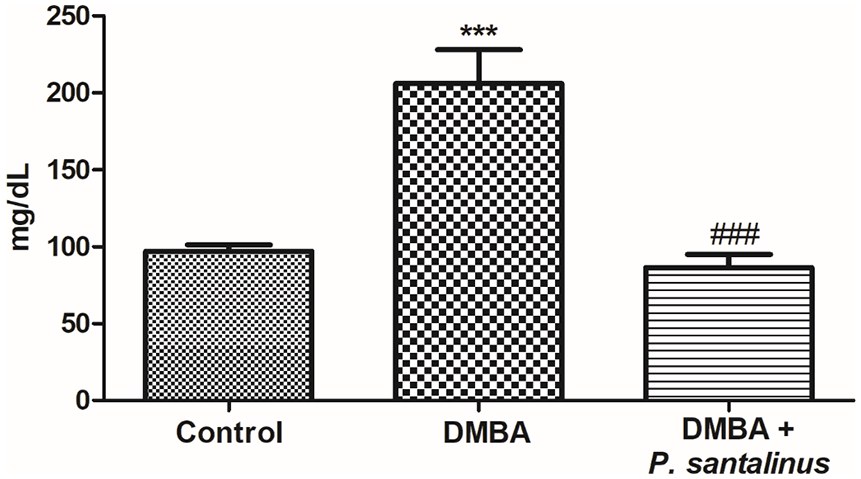
Effect of different treatments on glucose level in the studied groups. DMBA group (single dose of DMBA at 20 mg/mL in olive oil) and DMBA + P santalinus group (P santalinus at 300 mg/kg body weight/day for 5 weeks after about 0.5 cm tumour development). Values are expressed as mean ± SEM (n = 4). DMBA indicates 7,12-dimethylbenz(a)-anthracene.
Effect on TNF-α level
There was a significant (P < .0001) increase in the serum TNF-α level in DMBA-treated group as compared with the control group. However, the serum TNF-α level reduced significantly (P < .0001) in the DMBA + P santalinus group as compared with the DMBA group (Figure 6).

Effect of different treatments on serum TNF-α level in the studied groups. DMBA group (single dose of DMBA at 20 mg/mL in olive oil) and DMBA + P santalinus group (P santalinus at 300 mg/kg body weight/day for 5 weeks after about 0.5 cm tumour development). Values are expressed as mean ± SEM (n = 4). DMBA indicates 7,12-dimethylbenz(a)-anthracene; TNF-α, tumour necrosis factor-alpha.
Effect on liver serum biomarker parameters
The liver serum biomarker parameters showed significantly (P < .0001) higher serum total bilirubin, ALT, AST and ALP levels and nonsignificant decrease in the serum albumin levels in DMBA group compared with the control group. However, in the DMBA + P santalinus group, the serum total bilirubin, ALT, AST and ALP levels reduced significantly (P < .0001) in comparison with the DMBA group (Table 2).
Effect of different treatments on liver and kidney serum biomarker parameters in the studied groups.

DMBA group (single dose of DMBA at 20 mg/mL in olive oil) and DMBA + P santalinus group (P santalinus at 300 mg/kg body weight/day for 5 weeks after about 0.5 cm tumour development). Values are expressed as mean ± SEM (n = 4). Abbreviations: ALP, alkaline phosphate; ALT, alanine transaminase; AST, aspartate transaminase; DMBA, 7,12-dimethylbenz(a)-anthracene; P santalinus, Pterocarpus santalinus.
P < .0001 versus control group.
P < .0001 versus DMBA group.
P < .001 versus DMBA group.
Effect on kidney serum biomarker parameters
The kidney serum biomarker parameters showed significant (P < .0001) higher serum creatinine, urea and uric acid level in DMBA group as compared with the control group. However, in the DMBA + P santalinus group, the serum creatinine, urea and uric acid levels reduced significantly (P < .0001) in comparison with the DMBA group (Table 2).
Histopathological findings
In the present histopathological examination (Figure 7A), the mammary tissue section of control rat shows normal architecture of mammary tissue. The DMBA group rat shows mammary tumour section (Figure 7B). The section shows criss-cross and streaming distribution of fibrocytes and fibroblast cells, which are completely replacing the normal adipose tissue of mammary gland. Most of the fibrocytes are immature and vascularity is less, hence are suggestive of fibroma molle or soft fibroma. The DMBA + P santalinus group rat shows mammary tumour section (Figure 7C and D). In these sections, tumorous growth was found in both fibrous tissue and mammary gland. The cells do not show features of malignancy as the basement membrane was intact. However, multilayer glandular cells could be evident. The fibrous tissues were mostly of mature type and completely replacing the normal adipose tissue of mammary gland, hence suggestive of mixed mammary tumour, that is, fibroadenoma.

Microphotograph of rat mammary tissue stained with haematoxylin and eosin. (A) Section of control rat mammary tissue showing normal arrangement of adipocytes (A) and lobule (L) ×500. (B) Mammary tissue section of DMBA group rat showing criss-cross and streaming distribution of immature fibrocytes (IF) ×500. (C, D) Mammary tissue section of DMBA + P santalinus group rat showing mature fibrous tissues (MF) and multilayer glandular cells (MG) ×500 and ×800. DMBA indicates 7,12-dimethylbenz(a)-anthracene; P santalinus, Pterocarpus santalinus.
Discussion
DMBA after metabolic activation by cytochrome p450 enzyme becomes an ultimate carcinogen DMBA-3,4-dihydrodiol-1,2-epoxide (DMBA-DE). During this metabolic activation various reactive oxygen species (ROS) are generated causing disruption of the tissue redox balance.35,36 These reactive species enhance formation of excessive LPO that is in the form of MDA. High levels of MDA have been widely accepted as an indication of oxidative stress and antioxidant status in experimental animal models and in human cancer patients as well. 37 In the present study, there was significant increase in the serum MDA levels observed in the DMBA group as compared with the control group. However, in the DMBA + P santalinus group, the serum MDA levels reduced significantly as compared with the DMBA group. The decreased MDA level denotes the antioxidant potential of P santalinus ethanolic seeds extract. This antioxidant effect is due to the presence of pterostilbene and santalins A and B, the main phytochemical constituents of P santalinus.12,14,38,39 The antioxidant potential may have helped in maintaining the redox status of the cells that usually gets imbalanced by the carcinogen metabolism and thus could have prevented the uncontrolled cellular proliferation that occurs due to redox imbalance. 40
DMBA carcinogenesis process involves increase in expression of TNF-α, a pro-inflammatory cytokine and TNF-α-mediated increase in nuclear translocation of NF-κB (nuclear factor-κB), a transcription factor responsible for survival and proliferation of neoplastic cell.41,42 The increase in expression of TNF-α plays very crucial role in promoting growth of breast cancer. 43 In the present study, a marked significant increase in the serum TNF-α level was observed in the DMBA group as compared with the control group. However, in the DMBA + P santalinus group, the serum TNF-α level reduced significantly as compared with the DMBA group. The decreased serum TNF-α level denotes the anti-inflammatory property of P santalinus ethanolic seeds extract. The decrease in the TNF-α level was also observed by Cho et al. 17 The savinin, isolated from P santalinus, considerably inhibited the TNF-α production in RAW264.7 cells. The inhibitory activity of savinin against T-cell proliferation has also been reported. 17 The β-eudesmol present in the P santalinus has also been reported to possess the anti-inflammatory activity by shutting down NF-κB pathway. 44 The newly found benzofurans, neoflavonoids and pterolinus isolated from heartwood, including pterolinus B, also showed potent anti-inflammatory activity. The phytochemicals pterolinus B, pterolinus D, pterolinus Ha and S-30-hydroxy-4,40-dimethoxydalbergione isolated from the methanolic heartwood extract of P santalinus showed cytotoxic activity against breast cancer cell lines MCF7 and MDA-MB-231. 18 The specific lignans, namely, savinin, calocedrin and eudesmin, are reported to be present in the P santalinus, which possess antiproliferative activity. Apart from these above phytochemicals, benzofuran, pterolinus K and pterolinus L present in the P santalinus, which also possess anticancerous property. 19 The therapeutic efficacy of pterostilbene found in the P santalinus was also reported against breast cancer. 20
In the present study, although a nonsignificant decrease in the mammary tumour volume after the 5 weeks of treatment was observed in DMBA + P santalinus group as compared with the DMBA group. But a maximum of 49.5% tumour growth inhibition was also observed in the last week of treatment, and it is quite possible that there could be a significant decrease in the mammary tumour volume of the medicinal plant–treated group, if the treatment could have been prolonged for a longer duration.
Hyperglycaemia or high blood glucose level is an important risk factor for the cancer progression. 45 The high glucose level provides energy source for cancer cells to proliferate at a rapid rate. Hyperglycaemia has also been found to severely affect cancer treatment as it leads to chemoresistance, impaired immune responses and drug deactivation. 46 In the present study, a significant upsurge in serum blood glucose level was observed in the DMBA group. The increased blood serum glucose level is likely due to the pancreatic beta cell damage, as the beta cells are very prone to get damaged by the DMBA.47,48 However, in the DMBA + P santalinus group, the blood glucose levels reduced significantly as compared with the DMBA group. The reduced blood glucose levels in the DMBA + P santalinus group denotes the hypoglycaemic effect of the plant extract. The observed hypoglycaemic effects may be due to the presence of epicatechin, polyphenols and flavonoids, the active constituents of the plant. These phytochemicals have been reported to work by regenerating the pancreatic beta cell, improving the insulin secretion from the remnant pancreatic beta cell and insulin-like activity of epicatechin.49-51 Thus, reducing the blood glucose levels and diminishing the fuel source for cancer cells.
The increase in the steroid hormones level, oestrogen and progesterone, are an important factor responsible for the progression of breast cancer. These hormones bind to the receptors present on the mammary epithelial cells leading to the growth of neoplastic cells.52,53 In our present study, we have not observed any significant changes in the oestrogen and progesterone hormone levels in the diestrous phase of the estrous cycle of the rats. The result is in line with the report from other similar study. 54 However, we cannot completely rule out the possibility of hormonal dysregulation. As the hormone levels could be altered in the other phase of the estrous cycle and there are also some reports on the DMBA, mimicking the activity of estradiol (E2) through binding with the estradiol receptor (E2R).55,56
Although the several anticancer drugs that are being used proves to be quite useful in the treatment of cancer, these drugs often carry significant side effects, covering a whole spectrum of body systems, including serious disturbances to the liver and kidney function.9,10 So, accessing the impact of P santalinus seed extract on the functions of vital organs such as liver and kidney is very important. Liver is the primary organ, responsible for the detoxification of the xenobiotic compounds like DMBA. The resulting oxidative stress occurred due to the metabolism of the chemical carcinogen which is also responsible for the liver impairment. In the present study, a significant increase in the serum liver biomarker parameters, namely serum total bilirubin, ALT, AST and ALP levels, was observed in the DMBA group. The increased hepatic serum biomarker is indicative of the liver degeneration.57-59 However, in the DMBA + P santalinus group, the serum total bilirubin, ALT, AST and ALP levels reduced significantly as compared with the DMBA group. The reduced serum liver biomarker parameters in the DMBA + P santalinus group denotes hepatoprotective effects of P santalinus ethanolic seeds extract. The hepatoprotective activity of the P santalinus seed extract was also observed by Dutta et al 14 in Coragen-induced toxicity in rats. Pterocarpus santalinus heartwood extract has also been proven to restore the CCl4-induced hepatic damage in rats.12,60
Kidney is an important organ responsible not only for the excretion of various toxic metabolic waste products but also for the production of various important compounds. Thus, the renal impairment can result in delayed drug excretion and metabolism of chemotherapeutic agents resulting in increased general toxicity. 61 In the present study, a significant increase in the serum kidney biomarker level, namely urea, creatinine and uric acid, was observed in DMBA group. The elevated kidney biomarker level indicates the nephrotoxic effects of DMBA.53-58 However, in the DMBA + P santalinus group, the serum kidney biomarker such as serum urea, creatinine and uric acid levels reduced significantly as compared with the DMBA group. The efficient recovery of serum kidney biomarker levels reflects the therapeutic effects of P santalinus seeds extract against the DMBA-induced renal toxicity in rats. The renal protective effect of the P santalinus seed extract was also observed by Dutta et al 14 in Coragen-induced toxicity in rats. The observed hepato-renal protective effects of P santalinus ethanolic seed extract is may be due to the presence of phytochemical constituents’ alkaloids, saponins, triterpenoids and flavonoids in the plant.14,15
The histopathological study also confirms the antiproliferative property of P santalinus ethanolic seed extract. As, in the DMBA group, most of the fibrocytes are of immature type, this suggests the higher growth rate of the tumour. While in the DMBA + P santalinus group most of the fibrous tissues are of mature type, this suggests the reduced growth rate of the tumour. The antiproliferative nature was also confirmed by measuring the final tumour volume of the 2-treatment group.
Although the exact mechanism of the antitumour action of P santalinus ethanolic seeds extract is not completely clear, but it would be based on antioxidant and hypoglycaemic property.
Conclusions
Therefore, from the entire study, it suggests that P santalinus ethanolic seed extract possesses antitumorigenic property by providing antioxidant and hypoglycaemic effect. The plant extract also has hepato-renal protective property. Hence, it may be concluded that the plant extract has therapeutic role against DMBA-induced breast cancer in rats. The P santalinus ethanolic seed extract also has a greater potential to develop as a chemotherapeutic agent in breast cancer treatment. However, our findings are on benign tumour, the antitumorigenic property of P santalinus extract on malignant tumour still needs to be validated.
Footnotes
Acknowledgements
The authors are thankful to A. N. College, Patna, Bihar India, for infrastructural facilities, Mahavir Cancer Sansthan and Research Centre for the Animal and laboratory facilities and Dr. Sanjiv Kumar, Assistant Professor-cum-Scientist, Department of Pathology, Bihar Veterinary College, Patna, Bihar (India) for histopathological confirmation.
Funding:
The author(s) received no financial support for the research, authorship, and/or publication of this article.
Declaration of Conflicting Interests:
The author(s) declared no potential conflicts of interest with respect to the research, authorship, and/or publication of this article.
Author Contributions
VA, AK and MK contributed to design of experiments and preparation of manuscript. VA and AK conducted laboratory studies. AK and MK proofread the manuscript. All authors read and approved the final manuscript.
