




Abstract
Purpose:
The objective of this study was to evaluate the relationship between brain-derived neurotrophic factor (BDNF) gene (Val66Met, rs6265, G>A) polymorphism and breast cancer (BC) among females of Southern Pakistan.
Methods:
This case-control study consisted of 300 females (BC cases [n = 100] and controls [n = 200]) with age range of 18 to 45 years. All participants were recruited during January to December 2014 and were screened for depression using Zung depression scale. Isolation of genomic DNA (gDNA) followed by polymerase chain reaction-restriction fragment length polymorphism (PCR-RFLP) analysis was done. All statistical analysis was carried out on IBM-SPSS version 22 at P-value <.05. Hardy-Weinberg equilibrium (HWE), Pearson chi-square, and odds ratios (ORs) with 95% confidence interval (95% CI) were calculated.
Results:
Genotype distribution of BDNF gene polymorphism lies in the goodness-of-fit model among controls. The statistical analyses reveal a significant association between genotype frequencies (χ2 = 12.709, P-value = .002) of BDNF and BC among cases and controls. The AA genotype (OR = 5.2, 95%CI = 0.632-42.804) increases the risk of having BC.
Conclusions:
Our results suggest that BDNF gene polymorphism may have an association with BC risk among Pakistani females. However, the present finding needs to be replicated with greater sample size with BC risk.
Introduction
Breast cancer (BC) is an assorted group of the malignant disease having incidence more than 1.2 million/year worldwide. 1 It is a major health problem in developing countries including Pakistan. 2 It is aggravated by many factors including family history, nulliparity, being single, being older, early menarche, and late menopause. 3
Cancers including BC has an association with depression. 4 Depression may exist with misery, harshness, lowered self-esteem, and bleakness, and suicidal mania also occurs in patients with cancer and confuses the findings of cancer. The severity of depression depends on the cancer types and reaction to its treatment. 5 An inverse correlation was found between social support and depressive disorder among Pakistani BC survivor (BCs). 6 Many factors including marital status, 7 early menarche, 8 nulliparity, 9 obesity, 10 and use of oral contraceptives (OC) 11 increase the depression which can modify BC risk.
Depression is one of the complex psychiatric disease phenotypes, with etiological factors which are under genetic control. 12 However, no particular risk genotype has been confirmed yet, but some minor genes and their mutations may act as an etiological factor for the depression. Among which brain-derived neurotrophic factor (BDNF) gene is one of them which is present at chromosome 11p14.1 along with various polymorphic markers. A 196 G/A variation causes Val-Met substitution in pro-BDNF molecule at codon 66 related to reduced BDNF activity. 13 However, depression can be more frequently found in patients with Met allele than Val allele. 14 BDNF is positively associated with depression among BCs undergoing mastectomy. 15 Although many studies have reported the association between the BDNF gene polymorphism and depression,16,17 no study determined the relationship between BDNF gene polymorphism and BC risk. Breast cancer contributing factors increase the depression, which enhances the odds of developing BC. However, if we control the BC contributing factors, depression will be reduced which could prevent BC. So the rationale of this study was to carry out the association between BDNF gene polymorphism and BC risk.
Materials and Methods
Ethical approval
This study was approved by the Board of Advanced Studies and Research (Approval#10; dated March 28, 2012), University of Karachi. This research was conducted in accordance with Helsinki declaration, and all participants have given their informed consent for participation in the study.
Study participants
In this case-control study, we enrolled premenopausal women (100 cases and 200 controls) randomly from a tertiary care hospital located in Karachi, Pakistan, from January to December 2014. Cases were histopathologically diagnosed with BC with age range of 18 to 45 years, whereas controls were age matched with cases. The sample size was calculated using online sample size calculator (http://www.openepi.com/SampleSize/SSCC.htm) with 95% confidence interval (CI) and 80% of statistical power. A self-structured questionnaire was also provided to collect the information about the person’s demographics and other parameters.
Zung Self-Rating Depression Scale
All study subjects were screened for depression using a qualitative scale known as Zung Self-Rating Depression Scale (ZSRDS). 18 The response of each subject was interpreted using SDS Index formula: SDS Index = (Raw Score/80 total points) × 100 or SDS Index = Raw Score × 1.25. The scores then determined the severity of depression. Score <50 is normal whereas >50 indicates depression.
gDNA isolation
The isolation of genomic DNA (gDNA) performed from the venous blood using kit method (ReliaPrep Blood gDNA Miniprep System, Promega) is in accordance with the manufacturer’s instruction.
BDNF genotyping
The primer-specific polymorphism was done using polymerase chain reaction-restriction fragment length polymorphism (PCR-RFLP) analysis. The gene-specific forward primer (FP)-5′ACTCTGGAGAGCGTGAATGG3′ and reverse primer (RP)-5′ACTACTGAGCATCACCCTGGA3′ 19 were used. The reaction mixture for PCR contained 25 µL of 2× DNA polymerase ready mix (Kapa Biosystem, USA), 0.3 µL of both primers (10 pmol), 4 µL of gDNA, and 20.2 µL of nuclease free water in a total reaction volume of 50 µL. Amplification was performed in an automated thermal cycler (Veriti, Applied Biosystem, USA) under PCR conditions: initial denaturation at 94°C (5 minutes), 40 cycles of 94°C (30 seconds), 62°C (2 minutes), and 72°C (1 minute), followed by 7 minutes of final extension at 72°C. The products were then analyzed using gel electrophoresis on 1.5% agarose gel at 80 V run in 0.5× TBE buffer for 30 minutes staining with 0.5 µg/mL of ethidium bromide followed by the gel visualization using ChemiDoc-It2 (UVP, UK) Vision works LS software (ver-7.1).
The amplified products were then digested with 5 U of the enzyme Eco72I (Fermentas, USA) at 37°C followed by 2.5% agarose gel electrophoresis and visualized gel images using the same imager. The size of amplified product is 171 bp denoted as A-allele (Met-allele), whereas the size of post digestion product is 99 and 72 bp denoted as G allele (Val-allele).
Statistical analysis
The association between BDNF genotyping and BC was calculated by Pearson chi-square. The deviation of allele frequencies was calculated by Hardy-Weinberg equilibrium (HWE). Risk of depression-associated BC was evaluated using odds ratios (ORs) and 95% CI via conditional logistic regression analysis. All analysis was performed using IBM-SPSS version 22 at a significance level <0.05.
Results
This study consisted of 100 BC cases and 200 controls. Out of 100 cases and 200 controls, 82 and 198 were positively amplified, respectively. All selected females were in the age group 18 to 45 years and were premenopausal. The clinical characteristics of patients with BC are summarized in Table 1. Demographic, anthropometric profile, and other parameters are described in Table 2.
Clinical characteristics of BC.

Abbreviation: BC, breast cancer.
Demographics, anthropometry profile, depression, and other parameters.

Abbreviations: BC, breast cancer; CI, confidence interval; OC, oral contraceptives; OR, odds ratio.
All significant values are presented in bold.
Binary logistic regression analysis, all the controls matched with age.
Hardy-Weinberg equilibrium was calculated for the whole sample and genotype distribution of BDNF polymorphism lies under goodness-of-fit model among controls (χ2 = 1.98; P = .159), not in cases (χ2 = 15.565; P < .001). Our study found a significant association between BDNF gene polymorphism and BC. However, AA and GA genotypes were at risk of having BC (Table 3).
Relationship between BDNF gene polymorphism and BC.
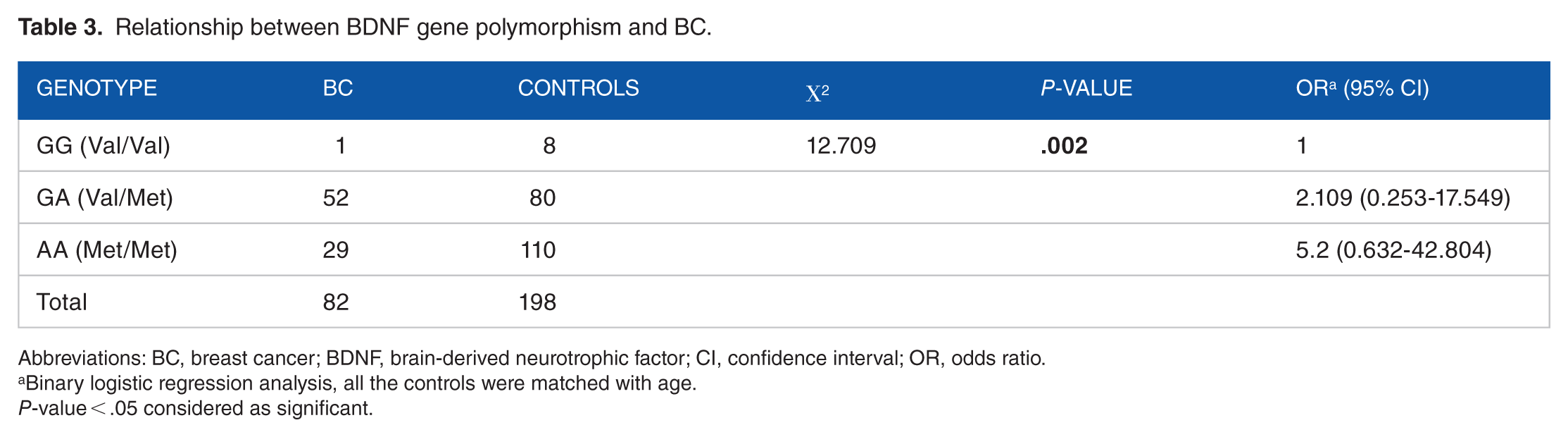
Abbreviations: BC, breast cancer; BDNF, brain-derived neurotrophic factor; CI, confidence interval; OR, odds ratio.
Binary logistic regression analysis, all the controls were matched with age.
P-value < .05 considered as significant.
Discussion
This investigation was performed on 100 BC cases and 200 controls. Out of 300, 280 samples were positive. The findings of this study showed that early-onset menarche, short and long cycle length, age at first birth, overweight, obesity, positive family history of BC or any other cancers, use of OC, and depression were significantly related to the BC. Previous studies showed the relationship between BC contributing factors like marital status, 7 early-onset menarche, 8 nulliparity, 9 increased basal metabolic index (BMI), 10 increase waist-to-hip ratio (WHR), 10 and use of OC 11 with depression.
This study also reports that the functional BDNF “AA” genotype was associated with BC. A study showed that Met allele of BDNF increases the risk of new depressive episode following a severe life event. 20 Among Chinese BC population, BDNF Met allele was found to be prevalent in patients with cognitive impairment induced by chemotherapy. 21 Furthermore, a report on Han Chinese population documented that BDNF Met allele was related to bipolar disorders (BPD) among non-cancerous depressive patient, 14 whereas the Met allele did not show an association with major depressive disorders among Asians. 22
Brain-derived neurotrophic factor is a peptide usually synthesized by the posttranscriptional modification as a precursor protein called prepro-BDNF present in rough endoplasmic reticulum (RER). Mammalian pro-BDNF molecule proteolytically cleaved to form truncated-BDNF also called pro-BDNF which is a 28-kDa BDNF followed by the second cleavage to form mature 14-kDa BDNF (mBDNF). The formation of pro-BDNF is by Ca2++-dependent serine proteinase which is also called as membrane-bound transcription factor site-1 protease (MBTFS-1) or Subtilisin/kexinisozyme 1 (SKI-1). 23 pro-BDNF is not an intermediate product for this pathway, which is further not involved in the conversion of mBDNF molecule and seems to be a true final product 24 whose biologic importance remains elusive. It was thought that only free mBDNF in plasma is active biologically than pro-BDNF which was inactive and located inside the cell. The biological functions of mBDNF and pro-BDNF elicited opposite effects. 25 mBDNF is specifically bound with the low-affinity cell surface tyrosine kinase B (Trk-B) receptor 26 and plays a vital role in controlling various signaling pathways such as mitogen-activated protein kinase (MAPK), phosphatidylinositol 3-kinase (PI3K), and phospho-lipase C (PLC) 27 to stimulate formation of dendritic bristles. Conversely, it also has a suppressing effect on dopamine release by down-regulating GABA (A) receptor’s expression, 28 whereas pro-BDNF performed its activity via binding on p75 receptor that triggers apoptosis and prevents BC.
This investigation has the following limitation. The sample size was modest, and the association might be stronger by enrolling a large number of subjects in both cases and controls.
Conclusions
The results from this study suggest that BDNF Val66Met gene polymorphism may be associated with BC and that the Met allele increases the risk of BC.
Footnotes
Declaration of Conflicting Interests:
The author(s) declared no potential conflicts of interest with respect to the research, authorship, and/or publication of this article.
Funding:
The author(s) received no financial support for the research, authorship, and/or publication of this article.
Author Contributions
MI and TAK did the conception and design of the study.
TY, MI and SAA did extraction, analysis and interpretation of data.
MI did the drafting of article or critical revision for important intellectual content; and
TAK did final approval of the version to be published.
