



Abstract
Introduction:
Patients seeking first time treatment for opioid consumption reflect the characteristics of the consumer population. This group has not been studied in Spain in decades. The objective of this study was to characterize the opioid user population seeking first time treatment (incidents) and compare them group with those with prior treatment (prevalents).
Methods:
Cross-sectional study (N = 3325) with patients with opioid addiction seeking care at public addiction centers in the Community of Madrid from 2017 through 2019. Differentiation and comparisons were carried out using bivariate analysis, adjusted by sociodemographic characteristics related and those related to substance use consumption in incident and prevalent patients.
Results:
About 12.2% were incidents. Compared to prevalents, there were more foreigners (34.1% vs 19.1% P < .001), but with a better social network. Regarding opioid use, incidents were less likely to use injection (10.7% compared to 16.8% P = .008), but had greater daily frequency (75.8% vs 52.2%, P < .001). The age of initial consumption was greater (27 years vs 21.3 years, (P < .001)). About 15.5% of incidents sought care for non-heroin opioids, compared to 4.8% of prevalents (P < .001). Women sought care at twice the rate of men (29.3% vs 12.3%; P > .001).
Discussion:
New patients presented a profile with many stable characteristics, but which highlighted an increase in the use of other opioids, as occurs in the international context. Surveillance of the new patient characteristics can serve as an early indicator of consumption changes in. Thus, periodic monitoring is important.
Introduction
Opioid use, especially heroin use, has been an enormous problem in Europe and in Spain in the past 40 years.1,2 In Spain recreational use of opioids reached its highest incidence of problematic use in the 1980s.2,3 Since then, there has been a continuous decrease. 3 Current estimates indicate that 0.1% of the population has consumed opioids in the past thirty days, a trend that has been stable since 2005.2,3
The profile of drug users of the1980s and 1990s consumed heroin, was male, born in Spain, young, and a polydrug user with a significant level of disease related to injected use.4,5 From the end of the 1990s to 2010 the profile changed very little. 6 However, there are no studies focused on the new profile of drug consumers. Characteristics of newer users are diluted among those of people who began consuming years ago. 7 In an international context of flourishing opioid use other than heroin, 1 knowledge of these characteristics is of interest. A new user profile could be useful to identify novel characteristics and to monitor trends in the consumer population. 8
The objective of this study was to describe opioid users who seek treatment for the first time and compare it with those who have sought prior treatment, considering the type of substance.
Methods
A cross-sectional study was carried out in all of the Public Centers of Addiction Care in the Community of Madrid (Spain) between 2017 and 2019. The study population included patients that entered treatment and were diagnosed with opioid addiction (either opioids only or accompanied by another addiction).
The main variable was whether it was a person’s first treatment [“new patients” (NP)] or not [“old patients” (OP)]. This information was collected from patients’ medical records when they entered treatment. Patients were asked whether this was their first treatment or not, without specifying whether any previous treatment had been carried out in public or private centers.
Sociodemographic variables, opioid and other substance use, and human immunodeficiency virus (HIV) and hepatitis C virus (HCV) infection status were determined.
A descriptive analysis was carried out of all of the variables, followed by a bivariate analysis of the characteristics of our sample, controlling for the main variable (NP or OP). The χ2 test (or Fisher exact test where appropriate) was used for the qualitative independent variables. Finally, a multivariate analysis (dependent variable was NP or OP) was carried out using logistic regression. The adjustment variables included sex and those variables with significance less than 0.1 in the bivariate analysis.
We also analyzed the type of opioid (heroin or other) that had resulted in seeking care, by sex, for both the incident cases as well as the prevalent cases.
Results
This study included 3325 patients entering into treatment (12.2% NP, 87.8% OP). Table 1 shows the characteristics of the patients in the study.
Sociodemographic and opioid use characteristics related to consumption patterns of patients in treatment for opioid use (n = 3325).

Institutions or homeless.
Institutions, friends, or others.
Adjusted by: Age, sex, country of birth, place of residence, and marital status; HIV; Opioid; Frequency of use and method.
In terms of sociodemographic variables, NP were younger (P < .001), with a greater proportion of people born outside of Spain (34.1% vs 19.1%, P < .001), and a greater likelihood of being married (27.7% vs 17.5%, P < .001). NP were more likely to be seeking care due to their own initiative, rather than being sent to treatment by family members (P = .008). No differences were found in other variables such as sex, unemployment, educational level, place of residence, living situation, or having children.
Regarding opioid use, injection use was less frequent among NP (10.7% vs 16.8% P = .008), but daily consumption of opioids was greater (75.8% vs 52.2%, P < .001). The average age of initiation of consumption was lower among OP (21.3 years vs 27; P < .001). Overall, heroin was the most frequently used opioid (93.9%). Nevertheless, 15.5% of NP sought care for addiction to other opioids, compared to 4.8% of OP (P < .001). In the analysis by sex, women in the NP sought care for an opioid other than heroin at a rate double that of men (29.3% vs 12.3%; P > .001), while no such difference was observed among OP (6.0% vs 4.6%; P = .16; Figure 1).
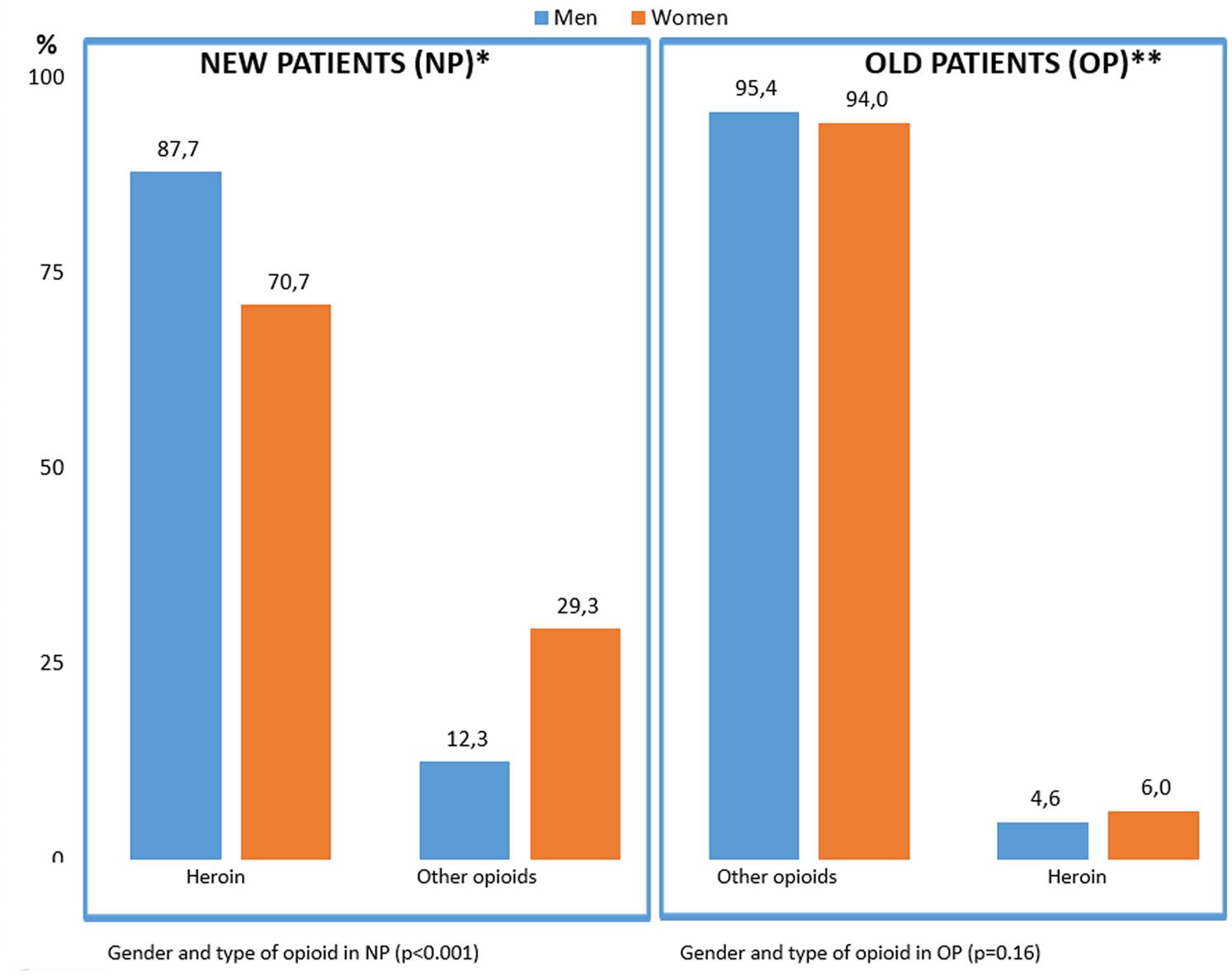
Primary opioid of consumption by times seeking treatment and gender.
In terms of use of other substances, there were lower levels of co-addiction to 2 substances among NP (41.5% vs 47.6%, P = .006) and a lower consumption of cocaine, cannabis, or alcohol in the past month (P = .006, .042, and .017). Finally, the number of VIH and HCV positive patients was lower among NP compared to OP (P < .01).
Discussion
This study is the first in decades to focus on new patients addicted to opioids in Spain and the first to differentiate these patients from those who have received prior treatment. Despite that the profile of patients with new opioid addictions presents many stable characteristics compared to patients with a prior history of treatment, we have observed an increase among new patients in the demand for treatment for opioids other than heroin, especially among women.
Not all those who begin to consume opioids require treatment, and not all those who need treatment seek it out, but there is a correlation between these populations. Those who are in treatment are a reflection of the larger group. 8 Thus, these results can serve as a proxy to a new patient profile.
Regarding the characteristics of the study population, both user age and age of initiation of opioid consumption suggests that new users are beginning opioid use more than 5 years later than prior generations.4,5,9 Finally, in terms of nationality, nearly 35% of NP was foreign-born, nearly double the percent among OP, and more than double the percent documented in recent studies. 10 Although the foreign-born population in Spain has increased in recent decades, it still represents less than 15% of the total Spanish population. 11 Thus, the higher proportion of foreign-born among new patients is not simply due to demographic change. Periodic monitoring of patient profiles, especially sex, nationality, and age of initiation of consumption can serve to detect changes in drug use patterns, to implement prevention policies, and to support access to the health system for users. 2
In this study NP seemed to have a better social network as well as a greater likelihood of living with a partner. This corresponds to what has been described in other studies that indicate that a greater number of years of opioid use is associated with a weaker social network.8,9
While heroin is the principal opioid of 94% of all users, the rate among NP is lower, at 84.5% (70.7% in women and 87.7% in men). During the years when this information was collected, there did not seem to be an upturn in opioid consumption in Spain. 6 What these figures suggest, and which agrees with the international context, 1 is that although heroin continues to be the primary opioid in terms of general addition, other opioids are beginning to play a relevant role in addiction processes, especially among women. This finding could be explained by the so-called “telescope effect,” in which women tend to progress more rapidly from their first use to problematic use and from problematic use to needing treatment.8,12
In Spain, injection is no longer the main route of opioid use as it was decades ago,2,4,5 which is reflected in this study. However, more than 10% of NP inject. In comparison with Europe, 1 Spain’s rate of injection use is considered low, but we should not stop being vigilant.2,9 In this study we also observed a greater daily consumption of opioids among NP, but with lower levels of co-addiction and/or consumption of other substances, which has also been shown in prior studies.4,5 Cocaine continues to stand out as the other substance that requires response. Complete treatment cannot be considered without addressing the use of other substances.
This study has the limitations of any cross-sectional study. In addition, this study was conducted in public treatment centers, therefore private centers (which are very scarce) 13 are not represented. Finally, in terms of the representativeness of these results in the Spanish context, prior studies in users that combine information from different Spanish regions have shown that the findings can be extrapolated to the entire territory.5,10
This study focuses on new patients, who represent more than 10% of the overall population. Knowing their characteristics allows us to establish new user profiles and provides the opportunity to detect trends and develop preventive measures, especially in the context of an increase in the prescription of opioid medications. 14
Footnotes
Author Contributions
José Pulido: Conceptualization, data curation, formal analysis, investigation, writing – original draft. Guadalupe Pastor-Moreno: Formal analysis, methodology, software, writing – review and editing. Guerras, Juan Miguel, Cáceres Ana and Cea-Soriano Lucía: Conceptualization, methodology, resources. Belza, María José: Methodology, supervision, writing – review and editing. Sordo, Luis: Conceptualization, methodology, resources, supervision, writing – original draft.
Funding:
The author(s) disclosed receipt of the following financial support for the research, authorship, and/or publication of this article: This study has been funded by Instituto de Salud Carlos III (ISCIII) through the project “ PI19/00982” and co-funded by the European Union.
Declaration of Conflicting Interests:
The author(s) declared no potential conflicts of interest with respect to the research, authorship, and/or publication of this article.