




Abstract
This cross-sectional survey aims to study the behaviors and predictors for smoking behaviors among women who frequent nightlife entertainment venues around a university in the northern region of Thailand. Samples comprised 279 women who visited nightlife venues around a university in the northern region of Thailand. A questionnaire was used for data collection. Data were analyzed by chi-square and binary logistic regression. The results found that women who frequented nightlife venues and smoked accounted for 32% and 22% of those who smoked inside such venues. Furthermore, the factors identified as predictive of smoking behavior among women who frequented nightlife entertainment venues included frequently visiting nightlife venues more than 3 days per week (odds ratio (OR) = 8.89, 95% confidence interval (CI): 3.31-23.90), having a positive attitude toward smoking (OR = 3.13, 95% CI: 1.56-6.28), having a smoking family member (OR = 2.78, 95% CI: 1.37-5.66), and having a smoking partner (OR = 4.86, 95% CI: 2.38-9.93). Therefore, relevant agencies should continuously promote the right attitudes about smoking to Thai women who frequent nightlife entertainment venues.
Introduction
At present, approximately 250 million women all over the world smoke. Furthermore, the overall smoking rate has the potential to continually increase. 1 In Thailand, approximately 616 100 women 2 are smokers, accounting for 2% of women. The World Health Organization predicts that by 2035 the smoking rate among Thai women will have risen to 15%. 3
Currently, more than 7000 Thai women die of smoking-related causes each year, with most cases due to various forms of cancer, pulmonary emphysema, cardiovascular diseases, respiratory diseases, and other physical illnesses.3,4 Factors that contribute to Thai women smoking include having family members and/or close friends who smoke, having a positive attitude toward smoking, being subjected to cigarette commercials and a general lack of knowledge about smoking. 5 Nightlife venues such as pubs and bars are recognized as being associated with smoking among women, especially girls in their late teens and those who study in higher education. Such venues are considered enjoyable, relaxing places with dim lights and other people smoking, making nightlife venues the places where Thai women mostly smoke.6,7
Although Thailand has been the subject of a number of previous studies about smoking behavior among women,5,7–9 there have been few studies focused on the influence of nightlife venues on smoking behavior among Thai women. Therefore, this study aimed to study the predicting factors for smoking behavior among women who frequent nightlife entertainment venues. The data and results obtained from this research would be beneficial for the development of preventive measures for smoking in nightlife venues and the reduction of smoking rates among Thai women.
Methods
This was a cross-sectional survey research and was approved by the Ethical Review Committee for Research Involving Human Research Subjects, Naresuan University, Thailand (Certification No. 500/58). The samples comprised 288 women who frequented nightlife entertainment venues around a university in the northern region of Thailand. Samples were selected based on the calculation of sample size using a ratio between independent variables per number of samples at 1:30 10 equal to 240 samples. To prevent mistakes from occurring due to incomplete questionnaires, we increased the number of samples by 20% (48 samples). Stratified random sampling was used for 6 classes by number of all nightlife venues around a university and the sample quota was set for each pub and bar in the same amount (48 people per venue). Samples were randomly selected from people who visited an entertainment venue on Friday night from 19:00 to 21:00 and fit the following criteria: (1) women and (2) student (undergraduate or graduate). If samples did not voluntarily respond to the questionnaire, they were excluded.
This study coordinated with the owners of 6 nightlife venues to explain the objectives and procedures for conducting the research. After that, we distributed the questionnaire to samples for completion, which were meant to be returned immediately (approximately 10 minutes per questionnaire). There were 279 completed questionnaires, which accounted for a 97% completion rate and met the specified criteria of more than 70%. 11
Instruments
The research instrument was a questionnaire containing 3 parts, as follows:
Part 1. Personal characteristics of women visiting nightlife venues, comprising 8 questions with a checklist and short answer for sex, age, educational level, income per month, amount of alcohol consumption, frequency of nightlife, number of smoking family members and partner, and general opinion about smoking;
Part 2. Attitude toward smoking behavior among women visiting nightlife venues, comprising 13 questions with a rating according to the Likert scale, namely, “strongly agree,” “agree,” “neutral,” “disagree,” and “strongly disagree”;
Part 3. Smoking behavior among women visiting nightlife venues, comprising 6 checklist questions including smoking experience in the past 30 days, number of cigarettes smoked per day, brand of cigarettes smoked regularly, cost of smoking per month, method of acquisition of cigarettes, and typical smoking locations.
The questionnaire used in this study had a content validity index as a whole (S-CVI/Ave) of 0.82. When tested with 30 women who frequented nightlife venues that were not a part of the study, questions in the second and third parts had Cronbach’s alpha coefficients of 0.75 and 0.83, respectively, and met the specified criteria of more than 0.70. 12
The criteria for data rating by an ordinal scale were considered from the mean of scores for the samples. The results showed 2 scales including attitude toward smoking (positive attitude is a score greater than the mean and negative attitude is a score less than the mean) and income (income more than the mean is 10 317 baht and above, and income less than the mean is 10 317 baht and below). For age of samples, we considered the minimum age of people legally able to visit nightlife venues, which is 20 years (older than 20 years and under 20 years).
Data analysis
The data analysis included descriptive statistics such as the mean, percentage, number, and standard deviation as well as inferential statistics, ie, chi-square test and binary logistic regression analysis with statistical reliability at 95%.
Results
Sample characteristics
The mean age of samples was 22 ± 1.84 years (max = 28 years, min = 19 years), with 86% of samples having a bachelor’s degree or above and an average income of 10 317 ± 5784 baht per month (max = 40 000 baht, min = 3000 baht). Approximately 94% drank alcohol, with 22% visiting nightlife venues more than 3 days per week, whereas 77% visited them fewer than 3 days per week. Approximately 6% had a smoking family member, whereas 33% had a smoking partner. Women who frequented nightlife entertainment venues and smoked accounted for a total of 32%.
Attitudes and smoking behavior among samples
Approximately half of the samples or 50% had a positive attitude toward smoking. For instance, 100% agreed that smoking made women “look modern,” whereas 100% also agreed that smokers have more friends than non-smokers. Approximately 30.5% agreed that smoking in pubs and bars by women was social normalization. And 20% believed that smoking while drinking alcohol helped to prevent one from easily getting drunk.
Approximately 41% of the samples who smoked, stated that they smoked for the first time when they were approximately 19 years old. This was followed by 16 to 18 years old and 13 to 15 years old at 38% and 17%, respectively. About 61% smoked between 1 and 5 cigarettes per day, followed by 6 to 10 cigarettes per day and more than 11 cigarettes per day at 33% and 6%, respectively.
The cigarette brands that were most frequently purchased were premium priced brands imported from foreign countries, including L&M (46%) and Marlboro (43%). Most samples (63%) stated that the cost of smoking was less than 600 baht per month, whereas the highest cost of smoking found was 3000 baht per month. A total of 73% of the samples purchased cigarettes from grocery stores or franchise stores, whereas 6% purchased cigarettes online. Regarding access to cigarettes on arrival at nightlife venues (ie, the venue sells cigarettes on site), it was found that women who used this service or brought the cigarettes themselves accounted for 51%, followed by purchasing from convenience stores or nearby places, asking friends for cigarettes, and purchasing in nightlife venues at 39%, 7%, and 3%, respectively.
Regarding the location for smoking, all of the participants smoked in nightlife venues, followed by their own apartment, a friend’s apartment, public places, a boyfriend’s apartment, at home, and in the workplace at 58%, 21%, 8%, 6%, 10%, and 4%, respectively. For smoking in nightlife venues, those who smoked inside the venue accounted for 22%, whereas those who smoked in provided areas accounted for 28%, and smoking outside the venue accounted for 50%.
Predictors of smoking behavior among women visiting nightlife venues
After testing with chi-square, it was found that the factors that were related to smoking behavior among women who visited nightlife venues with statistical significance included 6 variables including income (P = .019), alcohol consumption (P = .006), frequency of visits to nightlife venues (P < .0001), attitude toward smoking (P < .0001), having smoking family member(s) (P < .0001), and having a smoking partner (P < .0001). However, a correlation with age and educational level was not found (Table 1).
Factors related to smoking behavior among women visiting nightlife venues.

P-value < .05.
Analyzed by Fisher’s exact test.
When analyzed with binary logistic regression, 4 variables were identified that predicted smoking behavior among women visiting nightlife venues with statistical significance, included frequently visiting nightlife venues more than 3 days per week (odds ratio (OR) = 8.89, 95% confidence interval (CI): 3.31-23.90), having a positive attitude toward smoking (OR = 3.13, 95% CI: 1.56-6.28), having a smoking family member (OR = 2.78, 95% CI: 1.37-5.66), and having a smoking partner (OR = 4.86, 95% CI: 2.38-9.93). These variables could jointly predict smoking behavior 57% of the time (Pseudo R2 = 0.573; Table 2).
Predictors of smoking behavior among women visiting nightlife venues.
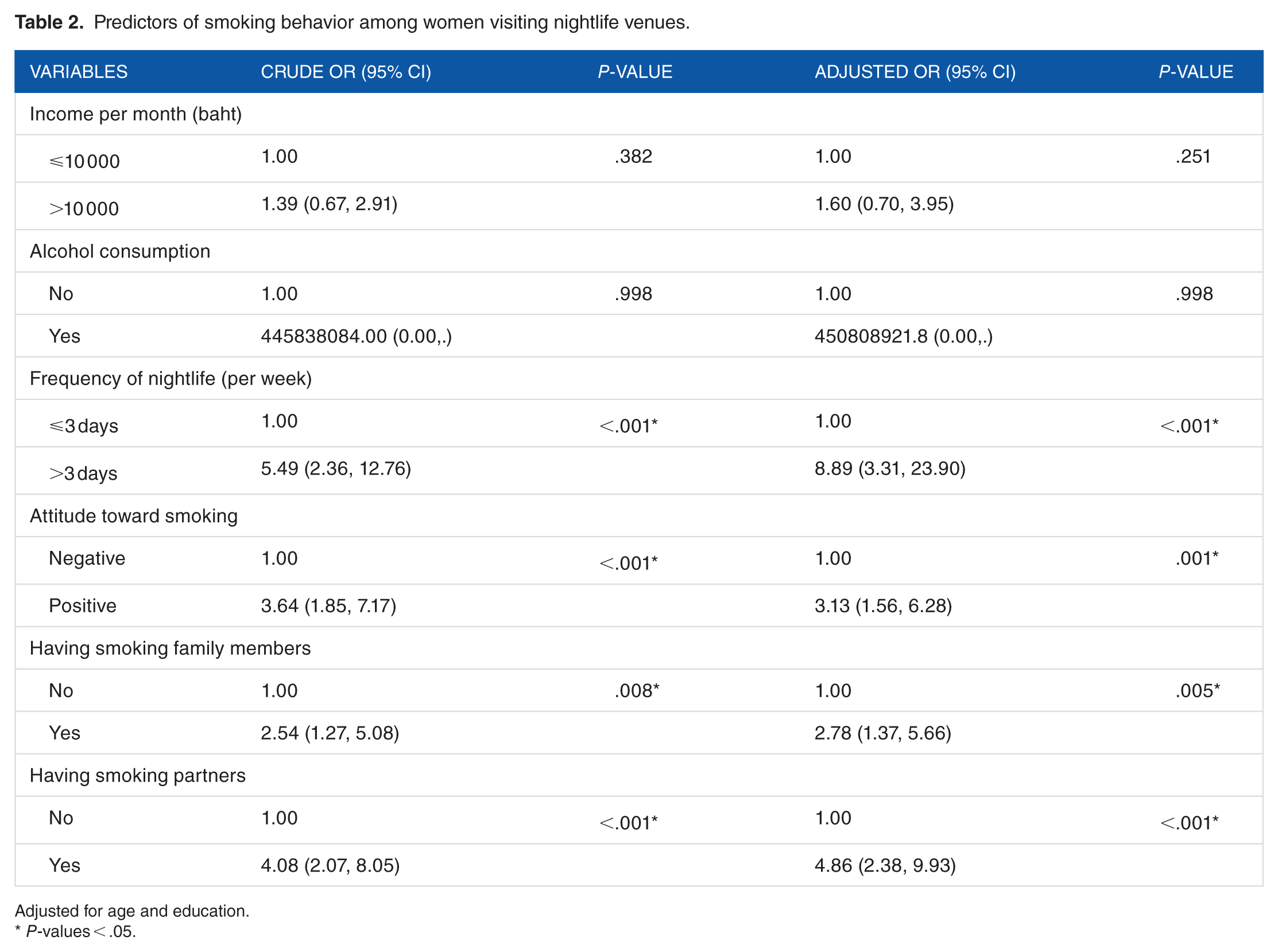
Adjusted for age and education.
P-values < .05.
Discussion
The results found that 32% of Thai women who visited nightlife venues smoked, which was a higher average than the overall smoking rate of Thai women, accounting for 2%. 13 This is likely because nightlife venues are recognized as being an enjoyable environment to smoke and drink alcohol. Thus, it is not surprising that pubs and bars are places where women can smoke without fear of social stigmas or concern about being judged negatively. In contrast, women who smoke in nightlife venues are often perceived as looking modern or recognized as having high self-confidence and strong attraction to the opposite sex.6,14–19 This is confirmed by the results of this work, which found that most women who frequented nightlife entertainment venues had positive attitudes toward smoking behavior (look modern and friendly while helping them to not get drunk easily). The results are also consistent with a study conducted on female college students in Malaysia, which found that women stated they smoked to attract attention and for self-image (to look sophisticated and mature). 20 In addition, a positive attitude toward smoking led to a higher possibility of smoking compared with those with a negative attitude at a rate of up to 3.13 times.
Women who visited pubs and bars more than 3 days per week had 8.89 times higher chance of smoking than those who visited fewer than 3 days per week. This agrees with previous studies which found that those who visited nightlife venues more frequently over the past 3 months were more likely to smoke, particularly in terms of the behavior of female teenagers. 9 These places are considered free spaces with people normally drinking alcohol to create a more enjoyable atmosphere. Nevertheless, drinking alcohol was positively related to smoking behavior among women 9 and most women visited nightlife venues with friends; when their friends smoked, this resulted in imitation behavior or thoughts of trying to smoke, which potentially led to greater acceptance and solidarity. 10 All of these factors are considered to be reasons for why nightlife venues are places where women smoke the most. In addition, smoking can enhance confidence and create the appearance by smokers of being more straightforward and able to think and do anything freely. 6 Thus, women are more likely to visit nightlife venues and easily be led to smoking through direct and indirect influence from the surrounding environment and people as smokers; they wanted to follow or to be a part of the group. 7 Concerning the taste of cigarette brands that were most popular among women who frequented nightlife entertainment venues, those imported from foreign countries were the most popular, likely because imported cigarettes were perceived as having a better taste than local cigarettes in addition to being easy to smoke and specifically designed for women. 16
Approximately 20% of women who smoked and frequented nightlife venues smoked inside pubs or bars (closed building), which is in violation of the smoking ban in pubs and bars enacted as a part of the Non-smoker’s Health Protection Act of Thailand. Some stated that they could easily purchase cigarettes at the nightlife venues. This fact is aligned with previous studies that have shown that approximately 15% of pubs and bars around a university sold cigarettes. 21 Thus, this is a facilitating factor for women to gain access to cigarettes more easily and comfortably.
The results of this study indicated that both familial and partner influences were important predictors of smoking. The social influences of parents and peers are important determinants of smoking that are well supported in the literature.22–26 This is an adoption of a particular attitude that smoking is normal for women, 8 which is consistent with previous studies which found that relatives and family members who lived together affected the smoking behavior of women. These women smoked more.7,9 Moreover, women would follow the behavior or habits of their partners, which is aligned with previous studies indicating that having close friends or partners as smokers influenced the chances of women smoking by up to 18 times compared with those without these kinds of relationships. 5 Consistency with a qualitative study among adolescents in Malaysia showed that school-aged girls between the ages of 13 and 17 in the states of Penang and Kelantan cited influence from male friends as one of the main reasons for taking up smoking. 20
Limitations and Strengths
This study advantageously collected data from a sampling of female students who currently visited real bars or pubs with some degree of frequency, resulting in a prevalence rate of smoking close to reality for planning purposes in terms of resolving tobacco cigarette problems among women in Thailand. However, this research also had some significant limitations. As a cross-sectional survey collecting data about independent variables and variables at the same time, the researcher was unable to clearly identify the causes and effects. For example, it cannot be definitively determined that visiting nightlife venues is the cause for smoking. However, female smokers are most likely to smoke at nightlife entertainment venues.
Conclusions
In conclusion, pubs and bars are the most common places where Thai women smoked. This finding confirms that the violation of the smoking ban in nightlife entertainment venues (pubs and bars) remains a serious problem in Thailand. Moreover, it was found that the frequency of visits to nightlife venues, positive attitude toward smoking, and having family member(s) and/or partners as smokers could predict the smoking behavior among Thai women. However, age, income per month, and alcohol consumption did not appear to affect smoking. Therefore, relevant agencies should monitor and strictly enforce the law concerning the smoking ban in nightlife entertainment venues, as well as continuously strengthening the right attitudes about smoking to women who frequent nightlife entertainment venues.
Footnotes
Funding:
The author(s) disclosed receipt of the following financial support for the research, authorship, and/or publication of this article: This study was funded by Tobacco Control Research and Knowledge Management Center, Thailand.
Declaration of conflicting interests:
The author(s) declared no potential conflicts of interest with respect to the research, authorship, and/or publication of this article.
Author Contributions
CP and JH conducted the research design and data collection; WM carried out data collection; BP carried out the data analysis and assisted in editing the manuscript.