




Abstract
This study advocates a novel spatio-temporal method for accurate prediction of COVID-19 epidemic occurrence probability at any time in any Brazil state of interest, and raw clinical observational data have been used. This article describes a novel bio-system reliability approach, particularly suitable for multi-regional environmental and health systems, observed over a sufficient time period, resulting in robust long-term forecast of the virus outbreak probability. COVID-19 daily numbers of recorded patients in all affected Brazil states were taken into account. This work aimed to benchmark novel state-of-the-art methods, making it possible to analyse dynamically observed patient numbers while taking into account relevant regional mapping. Advocated approach may help to monitor and predict possible future epidemic outbreaks within a large variety of multi-regional biological systems. Suggested methodology may be used in various modern public health applications, efficiently using their clinical survey data.
Patient and Public Involvement Statement
The development of the research question and outcome measures are related to patients’ priorities, experience and preferences by giving an accurate risk assessment of the future epidemic outbreak at any local state province at any time. This study involved only public patient health data.1,2 Patients were not involved in the recruitment to and conduct of this study. Results will be disseminated by journal publication. No randomized controlled trials were done, and no patients and public have been involved.
Introduction
Statistics of COVID-19 is well receiving attention in the modern biomedical research community.3-10 It is challenging to estimate biological system reliability factors and epidemic outbreak probability under realistic epidemic conditions by using classic statistical methods.9,11 The latter is due to a multi-degree-of-freedom (MDOF) nature of the governing dynamic biological system, spread over extensive non-homogeneous terrain. For COVID-19, the only available clinical observation numbers were limited by the beginning of the year 2020. Recent studies were focused on COVID-19 epidemic in Brazil,12-18 but without focus on cross-correlations between different national regions/states. Brazil was chosen of course because of its COVID-19 origin and extensive health observations and related research available online.19-36
Thomas and Rootzen 37 used extreme value theory (EVT) to predict and detect anomalies of influenza epidemics. As there is not much statistical research done to predict the probability of influenza or contagious diseases outbreak or its spread, the newly proposed novel method will be able better insight and an indication of the possible spread of diseases.
In this article, epidemic outbreak is viewed as an unexpected incident that may occur at any region of a given country at any time; therefore, spatial spread is accounted for. Moreover, specific non-dimensional factor
Biological systems are subjected to ergodic environmental influences. The other alternative is to view the process as being dependent on specific environmental parameters whose variation in time may be modelled as an ergodic process on its own.
The incidence data of COVID-19 in 12 Brazil states from February 2020 until today were retrieved from the public websites.1,2 As this valuable data set is per Brazil state, the biological system under consideration can be regarded as an MDOF dynamic system with highly inter-correlated regional components/dimensions. Some recent studies have already used statistical tools to predict COVID-19 development; for linear log model, see Chu. 38
Note that while this study aims at reducing risk of future epidemic outbreaks by predicting them, it is solely focused on daily registered patient numbers and not on symptoms themselves. For long-lasting COVID-19 symptoms, the so-called ‘long COVID’, and its risk factors and whether it is possible to predict a protracted course early in the disease. 11 Figure 1 presents map of Brazil states. 1

Map of Brazil with COVID cases.
Main motivation of this study has been a need to improve existing forecasting tools that should be able to take into account spatio-temporal epidemic nature. In this study, authors advocate a novel reliability method that has been well validated by authors on numerous epidemiologic data sets.19-21
Methods
Let one consider MDOF structural dynamic response or load or combined response/load vector

being probability of dynamic system survival with critical values of system components being denoted as

making all 2 responses non-dimensional and having the same failure limit equal to 1. Next, unidimensional system components’ local maxima are merged into one temporally non-decreasing synthetic vector

Example of how two components, X and Y, being merged to create a new synthetic vector
Having introduced non-decreasing synthetic vector
Figure 3 presents schematic flowchart, illustrating suggested methodology, as a tool for epidemic spread surveillance.

Flowchart, illustrating the suggested methodology.
Results
Prediction of influenza-like epidemics has long been the focus of attention in epidemiology and mathematical biology. It is well known that public health dynamics is a highly non-linear multidimensional and spatially cross-correlated dynamic system that is always challenging to analyse. Previous studies have used a variety of approaches to model influenza-like cases. This section illustrates the efficiency of the above-described methodology using the new method applied to the real-life COVID-19 data sets, presented as a new daily recorded infected patient time series, spread over large terrains.39-49
COVID-19 and influenza are contagious diseases with high transmissibility to spread worldwide with considerable morbidity and mortality. They occur most frequently seasonally in late autumn, winter and early spring, reaching their peak prevalence mostly in winter. Seasonal influenza epidemics caused by influenza A and B viruses typically occur annually during winter in temperate regions and present an enormous burden on worldwide public health, resulting in around 3–5 million cases of severe illness and 250,000–500,000 deaths worldwide each year, according to the World Health Organization (WHO). 30
This section analyzes a real-life biomedical application of the above-described reliability method. The statistical data in the present section are taken from the official Brazil Web sites.1,2 The Web site provides the number of newly diagnosed cases every day in Brazil from 22 January 2020 to 6 April 2022. Patient numbers from 12 different Brazil regions were chosen as components
In order to unify all 12 measured regional time series
Figure 4 presents a new daily recorded patient number plotted as a surface. Figure 5 presents the number of new daily recorded patients as a 12D vector

New daily recorded patients number plotted as a surface.
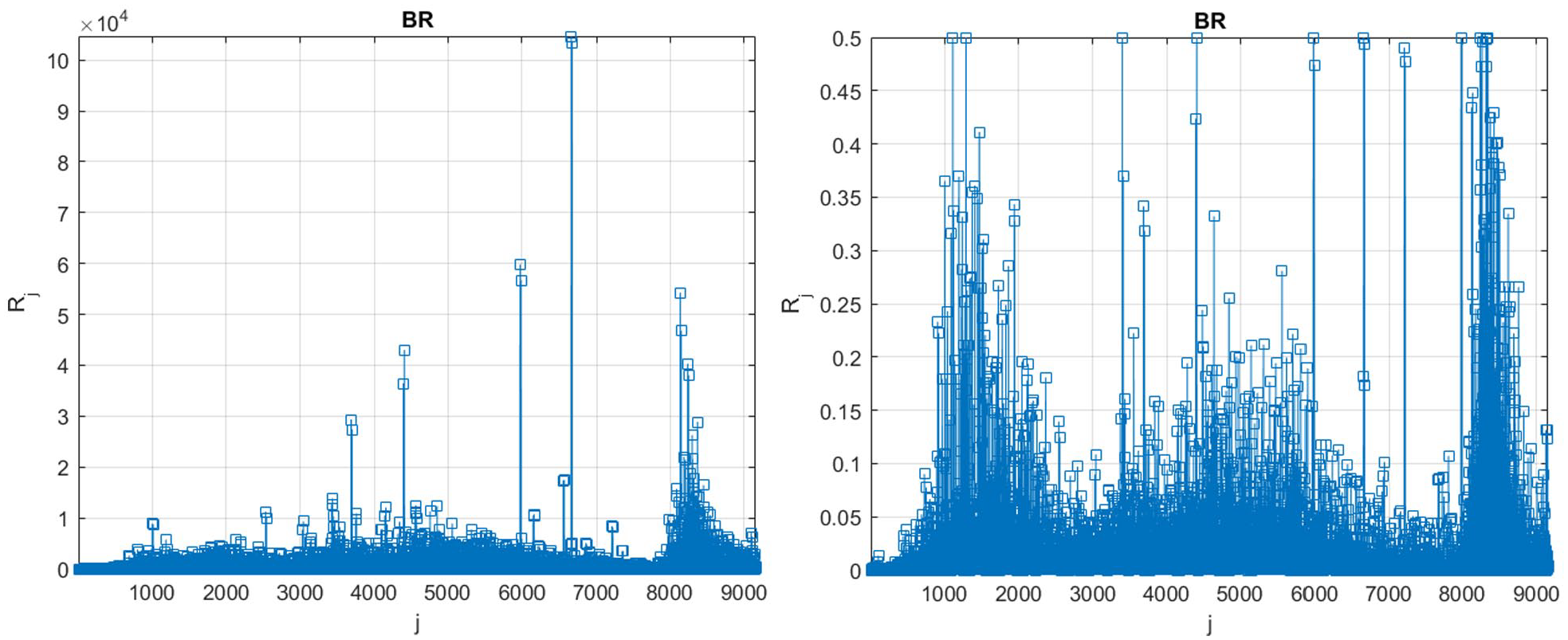
Number of new daily recorded patients as 12D vector
Figure 6 presents 100 years return-level extrapolation towards epidemic outbreak with 100-year return period, indicated by the horizontal dotted line, and somewhat beyond;

100 years return-level (horizontal dotted line) extrapolation of
Regarding suggested method validation, it is seen from Figure 6 that even 10 times reduced data set will yield similar predictions. More specifically, the underlying data set has been thinned by selecting only each 10th data point; then extrapolation, similar to Figure 6, has been done.
As being novel, the above-described methodology has an advantage in efficiency of using available measured data set. This is due to the method’s ability to tackle biological system multi-dimensionality, as well as being able to perform accurate extrapolation based on a relatively limited data set. Note that the predicted non-dimensional
The second-order difference plot (SODP) originated from the Poincare plot. The SODP provides observing the statistical situation of consecutive differences in time series data.
Figure 7 presents SODP plot; these kinds of plots can be used for data pattern recognition and comparison with other data sets, for example, for the entropy artificial intelligence (AI) recognition approach. 61 COVID-19 epidemic data have been analysed recently by researchers, using AI diagnostic tools.62,63 Note that EVT is asymptotic and 1DOF, while this study introduces MDOF and sub-asymptotic approaches. To summarize, the predicted non-dimensional λ level, indicated by the star in Figure 6, represents the probability of world cancer deaths in the years to come. The methodology’s limitation lies in its assumption of the underlying bio-environmental process quasi-stationarity.

COVID Brazil national statistics, SODP plot.
Conclusions
Despite the simplicity, this study successfully offers a novel multidimensional modelling strategy and a methodological avenue to implement the forecasting of an epidemic during its course.
This article studied recorded COVID-19 patient numbers from 12 different Brazil regions, constituting an example of a 12D observed in 2020-2022. The novel reliability method was applied to new daily patient numbers as a multidimensional system in real time. The theoretical reasoning behind the proposed method is given in detail. Note that the use of direct either measurement or Monte Carlo simulation for dynamic biological system reliability analysis is attractive; however, dynamic system complexity and its high dimensionality require the development of novel robust and accurate techniques that can deal with a limited data set at hand, using available data as efficiently as possible.
The main conclusion is that if the public health system under local environmental and epidemiologic conditions in Brazil is well managed, the predicted 100-year return period risk level
Various authors with different approaches have shown the usage of statistics through EVT and other models in medicine. One such method used the block maxima (BM) approach, while another used the peak over threshold (POT) approach to estimate the distribution of extremes. Even though both these studies showed their suitability for estimating the extreme values, each of them had its limitations, with one of them requiring a large amount of data.
This study aimed to develop a general purpose, robust, and straightforward multidimensional reliability method further. The method introduced in this article has been previously validated by application to a wide range of simulation models, but for only 1-dimensional system responses, and in general, very accurate predictions were obtained. Both measured and numerically simulated time series responses can be analysed. It is shown that the proposed method produced a reasonable confidence interval. Thus, the suggested methodology may become an appropriate tool for various non-linear dynamic biological systems reliability studies. Finally, the suggested methodology can be used in many public health applications. The presented COVID-19 example does not limit areas of new method applicability by any means.
Footnotes
Acknowledgements
Authors confirm that all methods were performed in accordance with the relevant guidelines and regulations according Declarations of Helsinki.
Funding:
The author(s) received no financial support for the research, authorship and/or publication of this article.
Declaration of Conflicting Interests:
The author(s) declared no potential conflicts of interest with respect to the research, authorship, and/or publication of this article.
Author Contributions
All authors contributed equally.
Ethics Approval and Consent to Participate
Not Applicable.
Consent for Publication
All authors agreed.