




Abstract
The current coronavirus disease 2019 (COVID-19) outbreak is alarmingly escalating and raises challenges in finding efficient compounds for treatment. Repurposing phytochemicals in herbs is an ideal and economical approach for screening potential herbal components against COVID-19. Andrographis paniculata, also known as Chuan Xin Lian, has traditionally been used as an anti-inflammatory and antibacterial herb for centuries and has recently been classified as a promising herbal remedy for adjuvant therapy in treating respiratory diseases. This study aimed to screen Chuan Xin Lian’s bioactive components and elicit the potential pharmacological mechanisms and plausible pathways for treating COVID-19 using network pharmacology combined with molecular docking. The results found terpenoid (andrographolide) and flavonoid (luteolin, quercetin, kaempferol, and wogonin) derivatives had remarkable potential against COVID-19 and sequelae owing to their high degrees in the component-target-pathway network and strong binding capacities in docking scores. In addition, the Kyoto Encyclopedia of Genes and Genomes (KEGG) pathway analysis showed that the PI3K-AKT signaling pathway might be the most vital molecular pathway in the pathophysiology of COVID-19 and long-term sequelae whereby therapeutic strategies can intervene.
Keywords
Introduction
The coronavirus disease 2019 (COVID-19) outbreak has recently been supposed to be over in some areas of the world, and weekly recorded COVID-19 mortality has dropped to levels comparable to those seen earlier in the pandemic, but the spread of COVID-19 in some countries still shows no apparent signs of abating. The recent emergence of new viral variants that spread out more easily and rapidly has caused a relapse of new infections with a higher contagious risk in many countries. As of 20 April 2022, the World Health Organization’s (WHO’s) latest updated data reached 50.4 million confirmed cases of severe acute respiratory syndrome coronavirus-2 (SARS-CoV-2) infection, including 6.2 million deaths worldwide. 1 Since the first SARS-CoV-2-infected case was reported at the end of 2019, there have been numerous research attempts to screen and identify active compounds that have the potential to inhibit SARS-CoV-2 and treat symptoms caused by COVID-19. In addition, the term “post-COVID-19 syndrome” or “COVID sequelae” have recently gained widespread recognition among social communities and in scientific and medical organizations. The pathogenesis of post-COVID syndrome is multifactorial and involves multiple mechanisms that result in several clinical manifestations lasting more than 3 months after the onset of first symptoms. However, there has not been an official announcement of a specialized therapeutic strategy for post-COVID syndrome yet, and there is not much clinical data about such a treatment plan.2 -4
With the rapid progress in bioinformatics, systems biology, and polypharmacology, a new discipline called network pharmacology has emerged, which attempts to understand drug actions and interactions with multiple targets. 5 This methodology has been becoming a frontier research field of drug discovery and development in traditional medicine. Network pharmacology combined with molecular docking is a practical and advantageous approach to discovering the therapeutic potential of bioactive components in herbs or traditional medicine formulae, especially exploring the mechanisms of action and biological pathways of potential candidates for COVID-19 treatment and sequelae.6 -8
Andrographis paniculata, also known as Chuan Xin Lian, has been used traditionally as an anti-inflammatory and antibacterial herb for centuries. According to an assessment of the benefits/risks of medicinal plants listed by the WHO and European Medicines Agency (EMA), Chuan Xin Lian is classified as a promising adjuvant herbal remedy in treating respiratory diseases because this herb has safety margins superior to those of the reference drugs, such as paracetamol, ibuprofen, and codeine. It was also recommended as an adjuvant therapy to relieve early symptoms of COVID-19 with the consideration of high clinical evidence and medium safety. 9 Within bioinformatics methodologies and computational approaches, some molecular docking studies indicated the potency against SARS-CoV-2 of andrographolide, a main phytochemical in Chuan Xin Lian, and its suppression of COVID-19-induced cytokine storms.10 -12 However, the clinical application of andrographolide is limited largely due to poor aqueous solubility. 13 Likewise, several network pharmacological analyses based mainly on the traditional Chinese medicine systems pharmacology (TCMSP) database were conducted to investigate the anti-inflammatory and immunomodulatory effects of Chuan Xin Lian.14,15 The A. paniculata dried extract was also tested in patients with common colds and showed preventive effectiveness.16,17
Accordingly, our study, based on databases and tools serving the bioinformatics field, aimed to screen Chuan Xin Lian’s bioactive components that interact with key COVID-19 targets to elucidate the potential mechanisms and pathways through which Chuan Xin Lian can act on SARS-CoV-2 and ameliorate COVID-19 and its sequelae using network pharmacology combined with molecular docking. To the best of our knowledge, this is the first study to collect data on Chuan Xin Lian from the HERB database, while most previous studies collected data from the TCMSP database. HERB is a high-throughput experiment- and reference-guided database that integrates multiple medicinal plant databases, such as TCMSP, TCMID, TCM-ID, and SymMap, for investigating traditional Chinese medicine (TCM). Hence, it contains the most comprehensive list of herbs and ingredients. 18
Materials and Methods
The detailed stepwise of the study is described in Figure 1.

The stepwise workflow of the research. These steps were taken in the following order: collecting data on Andrographis paniculata and COVID-19; screening bioactive components and retrieving the common gene targets; conducting the analyses of the distribution of gene targets in tissues and systems, Gene ontology (GO) enrichment and KEGG pathway; constructing a C-T-P network. From the C-T-P network, the main components with high node degrees were selected to perform molecular docking with the pathogenic SARS-CoV-2 structures, including the spike protein, main protease, and ADP ribose phosphatase of Nsp3 of the virus.
Identification of chemical components of Chuan Xin Lian and screening of the bioactive components
Information on Chuan Xin Lian’s chemical components was obtained from the HERB database. 18 We used the term Chuan Xin Lian or Herba andrographitis to look for information on all of the ingredients in Chuan Xin Lian. Then, we screened for bioactive components using SwissADME, a free web tool for evaluating and predicting the physicochemical characteristics, pharmacokinetics properties, drug-like features, and medicinal chemical friendliness of small molecules to aid drug discovery. 19 The screening criteria were based on absorption, bioavailability, and drug-likeness factors, including high gastrointestinal absorption; a bioavailability score of ⩾ 0.55; no violation of drug-like rules (Lipinski, Egan, Ghose, Muegge, and Veber); and synthetic accessibility of < 6. 19
Common gene target collection of COVID-19 and bioactive components
In particular, 3 large databases of human genes were used to mine for gene targets related to COVID-19, including GeneCards, a freely and user-friendly database providing comprehensive and integrative information on all predicted and annotated human genes (https://www.genecards.org/), 20 DisGeNET, one of the biggest publicly accessible integrated databases of human disease-associated genes and variants that is available for mining gene targets related to COVID-19 (https://www.disgenet.org/), 21 and the National Center for Biotechnology Information (NCBI) gene database (https://www.ncbi.nlm.nih.gov/). 22 The keywords “COVID” and “SARS-CoV-2” were used to mine relevant genes. To find the gene targets of bioactive components, the ingredient name or ingredient ID was used to search in the HERB database. The overlapping gene targets of COVID-19 and bioactive components (common gene targets) were generated using the Venny 2.1 tool (https://bioinfogp.cnb.csic.es/tools/venny/).
Construction of a protein–protein interaction network and analysis of target distribution in tissues and systems
Common gene targets were entered into the STRING database (https://string-db.org/) to analyze and establish a protein-protein interaction (PPI) network of overlapping targets of COVID-19 and bioactive components.23,24 The corresponding species was Homo sapiens; the minimum required interaction score was set to high confidence (0.700). The PPI network result was loaded into tab-separated values (TSV) format and entered into Cytoscape 3.9.1 software for visualization. 25 Gene targets in the PPI network with node degrees greater than the average node degree were considered hub targets. They were selected to analyze target distributions in tissues and systems using the STRING database at a false discovery rate (FDR) cutoff value of < 0.01 and perform Gene Ontology (GO) enrichment and Kyoto Encyclopedia of Genes and Genomes (KEGG) pathway analyses using the ShinyGO tool.
GO enrichment and KEGG pathway analyses
Hub gene targets were imported into the ShinyGO V0.75 tool to perform GO enrichment and KEGG pathway analyses and obtain visual graphs of cellular components (CCs), molecular functions (MFs), biological processes (BPs), and KEGG pathways. 26 When submitting the list of gene targets in the Gene Official Symbol format, the selected matching species were human, and the FDR was set to ⩽ 0.05 (P ⩽ .05). After running the analysis, the top 30 CCs, MFs, BPs, and KEGG pathways that matched the conditions were sorted and visualized in the graphs.
Construction of the component-target-pathway network
Cytoscape 3.9.1 software was employed to construct and visualize an interactive graph of the component-target-pathway (C-T-P) network.
Molecular docking
The SwissDock tool (http://www.swissdock.ch/) 27 was executed to validate the association of Chuan Xin Lian’s main bioactive components with SARS-Cov-2 target proteins and predict molecular interaction parameters at the active sites inclusive of the full fitness and Gibbs free energy ΔG. SARS-Cov-2 target proteins chosen for docking were the spike (S) protein (PDB ID: 7bz5), main protease (Mpro) (PDB ID: 6lu7), and ADP ribose phosphatase (ADRP) of Nsp3 (PDB ID: 6vxs). The 3-dimensional (3D) structures of target proteins were retrieved from the Protein Data Bank (PDB) database (https://www.rcsb.org/). 28 The Computed Atlas for Surface Topography of Proteins (CASTp) provided active sites of target proteins (http://sts.bioe.uic.edu/castp/).29 -31 The ligands were main bioactive compounds of Chuan Xin Lian selected from the C-T-P network and their 3D structures were loaded from PubChem (https://pubchem.ncbi.nlm.nih.gov/) in mol2 format. Docking results were visualized with UCSF Chimera software32,33 and were scrutinized to detect active pockets where the ligands were bound to targets, and their full fitness (kcal/mol) and Gibbs free energy ΔG (kcal/mol) were estimated. It is generally assumed that the binding mode of a ligand is stronger and more favorable to a target when the full fitness and the Gibbs free energy ΔG show negative scores, and the lower the value, the stronger the binding.
Results
Identification of chemical components in Chuan Xin Lian and screening of the bioactive components
The data on 145 chemical components were loaded from the HERB database (Supplementary Material S1). After that, a list of 24 bioactive components was obtained by matching the chemical components to the screening criteria and mining the gene targets in the HERB database (Table 1).
Information of Chuan Xin Lian’s bioactive components.

Abbreviation: GI, gastrointestinal.
Common gene target collection of COVID-19 and bioactive components
In total, 5311 COVID-19-related gene targets were obtained from the GeneCards, NCBI, and DisGeNET databases after deleting duplicate gene symbols (Supplementary Material S2). From the HERB database, 24 bioactive components were used to get a list of 454 gene targets after deleting duplicate gene symbols (Supplementary Material S3). Then, overlapping genes of COVID-19 and bioactive compounds were generated by a Venn diagram, yielding 240 common genes (Figure 2A).

Common gene targets of COVID-19 and bioactive components. (A) Venn diagram of common gene targets. (B) The PPI network of 240 common gene targets. Node color changing from blue to green to yellow indicates a decrease in the node degree’s value. (C) The PPI network of 88 hub gene targets. Node color changing from dark green to light green and node size getting smaller indicate a decrease in node degree’s value.
Construction of the PPI network and analysis of the distribution of common genes in tissues and systems
Common genes were imported into the STRING database to generate the PPI network with an average node degree of 14.3 (Figure 2B). In an interactive network, the node degree is considered a direct measure of node centrality. The higher a node degree is, the greater its centrality level and the more significant its role becomes. As a result, there were 88 hub gene targets with node degrees greater than the average node degree. The top 15 hub gene targets sorted by node degree order from high to low value included STAT3, AKT1, TNF, JUN, EGFR, IL6, MAPK3, TP53, VEGFA, CTNNB1, IL1B, MAPK1, CASP3, EGF, and RELA. These targets have an essential role in the PPI network and take primary responsibility for the bioactivity of Chuan Xin Lian (Figure 2C).
In addition, the distribution analysis of 88 hub genes showed that most of the genes were distributed in tissues or organs that were COVID-19-related pathogenic and damaged targets, such as the respiratory system (33 genes), the lung (27 genes), bronchoalveolar system (6 genes), platelets (8 genes), the reproductive system (57 genes), the hematopoietic system (44 genes), the central nervous system (40 genes), the cardiovascular system (25 genes), etc. The immune system and immune cells are targets that may be overactivated in SARS-CoV-2 infection and lead to cytokine storm. The gene distribution to these targets was 24 genes located in the immune system, 9 genes in macrophages, 7 genes in B-lymphocytes, 9 genes in T-lymphocytes, and 6 genes in inflammatory cells (Table 2, Figure 3).
Distribution of hub gene targets in tissues and systems.

Abbreviation: FDR, false discovery rate.

Distribution analysis of hub gene targets in tissues and systems. The bubble size denotes the value of −log(FDR). FDR < 0.01.
GO enrichment and KEGG pathway analyses
BPs, CCs, and MFs were the 3 primary outputs of the GO enrichment analysis. The hub genes from the PPI network were input into the ShinyGO V75 tool for the GO analysis, and the top 30 significant GO terms are depicted in Figure 4A to C.

The GO enrichment and KEGG pathway analyses. Lollipop charts are sorted by fold enrichment. (A) Top 30 CCs. (B) Top 30 MFs. (C) Top 30 BPs. (D) Top 30 KEGG pathways.
The CC and MF terms showed that Chuan Xin Lian’s bioactive components mainly acted on the IkappaB kinase complex, serine/threonine protein kinase complex, platelet alpha granule lumen, vesicle lumen, plasma membrane protein complex, RNA polymerase II transcription regulator complex, secretory granule, etc and were involved in MAP kinase activity, G protein activity, cytokine activity, cytokine receptor binding, transcription factor binding, protease binding, protein kinase activity, signaling receptor activator activity, signaling receptor binding, enzyme regulator activity, etc.
In the BP category, Chuan Xin Lian’s bioactive components were significantly enriched in processes associated with cellular responses to chemical stress, cytokine-mediated signaling pathways, responses to cytokines, inflammatory responses, regulation of the apoptotic process, circulatory system development, regulation of cell death, regulation of responses to stress, protein phosphorylation, regulation of intracellular signal transduction, etc. The BP results of the GO enrichment analysis distinctly demonstrated that numerous BPs that hub gene targets regulated were closely related to pathophysiological mechanisms caused by COVID-19. These findings contribute to a better understanding of the body’s biologically functional changes due to treatment with Chuan Xin Lian preparations.
The top 30 KEGG pathways ranked by fold enrichment (Figure 4D and Supplementary Material S4) disclosed several significant pathways through which Chuan Xin Lian’s bioactive components influence COVID-19, such as the PI3K-AKT signaling pathway, MAPK signaling pathway, IL-17 signaling pathway, coronavirus disease, tumor necrosis factor signaling pathway, Th17 cell differentiation, C-type lectin receptor signaling pathway, T-cell receptor signaling pathway, AGE-RAGE signaling pathway in diabetic complications, lipids and atherosclerosis, EGFR tyrosine kinase inhibitor resistance, pathways in cancer, etc. Numerous investigations have verified the correlations between the above pathways and relevant symptoms and complications of COVID-19. Hence, the importance and rationale of these pathways in COVID-19 are self-evident.
Construction of the C-T-P network
Using Cytoscape 3.9.1, we further built the C-T-P network of bioactive components and COVID-19-related significant KEGG pathways. The KEGG pathways involved coronavirus infection, inflammation, and immunology which were proven to play a significant role in COVID-19-related disorders, and they were thus selected to construct the C-T-P network. The selected KEGG pathways included the PI3K-AKT signaling pathway, MAPK signaling pathway, IL-17 signaling pathway, coronavirus disease pathway, TNF signaling pathway, C-type lectin receptor signaling pathway, T cell receptor signaling pathway, and Th17 cell differentiation.
As per the quantity of annotated genes, 65 out of the 88 hub genes were involved in the selected KEGG pathways above. The established C-T-P network displayed that the Chuan Xin Lian’s bioactive components with high node degrees had a central role in interactions with COVID-19-related targets. They were likely the main bioactive components, including quercetin, wogonin, luteolin, apigenin, kaempferol, oroxylin A, panicolin, andrographolide, deoxyelephantopin, flavone der., andrographin, deoxycamptothecine, etc (Figure 5). Notably, 5 of them, apigenin, kaempferol, luteolin, quercetin, and wogonin, interacted with 6 common gene targets (ie, CHUK, IKBKB, IKBKG, MAPK1, MAPK3, RELA) of the selected KEGG pathways. Quercetin occupied the highest node degree, exhibiting an essential and important role in the impact of Chuan Xin Lian on COVID-19.
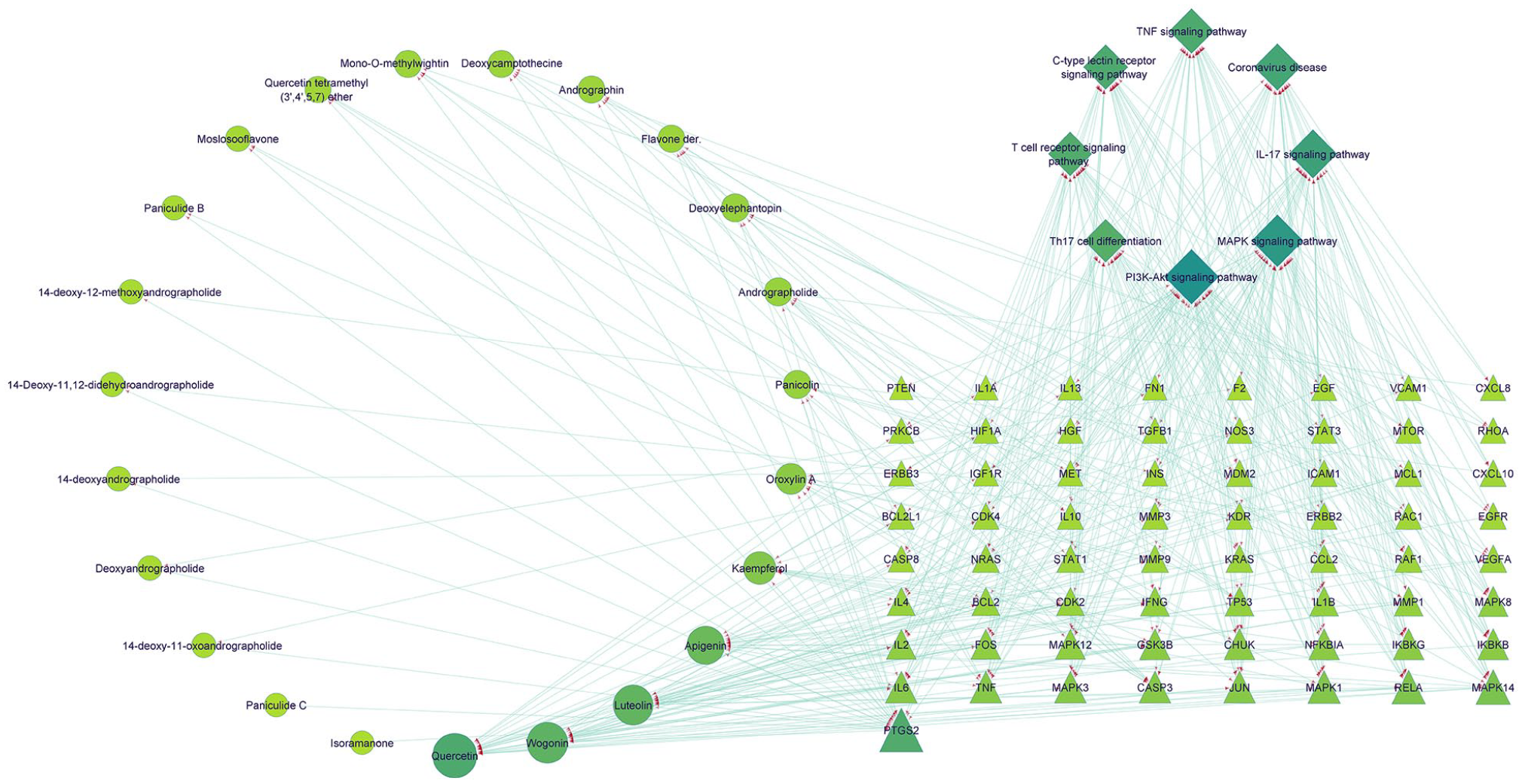
The C-T-P network. Circles indicate components, triangles indicate targets, and diamonds indicate pathways. Node color changing from dark green to light green and node size getting smaller indicate a decrease in node degree’s value.
According to the node degree in the constructed network, the top 15 key hub targets at the highest node degrees were PTGS2, MAPK14, RELA, MAPK1, JUN, CASP3, TNF, IL6, IKBKB, IKBKG, NFKBIA, CHUK, GSK3B, MAPK12, and FOS. Interestingly, 3 of them, PTGS2, TNF, and IL6, have been mentioned in lots of literature due to their participation in many molecular pathways involved in COVID-19, and their overproduction or overexpression can cause the hyperinflammatory response, also called the cytokine storm, that is a critical factor leading to severe cases or even death in SARS-CoV-2 infection. In addition, the persistent and aberrant elevation of TNF and IL-6 in individuals after COVID-19 recovery is supposed to be associated with COVID sequelae. The PI3K-AKT signaling pathway is likely the most vital pathway (Figure 6), thanks to its highest node degree in the C-T-P network. The viral entry into the host cell and inflammatory exacerbation in response to infection are presumed to be closely related to this pathway.

The PI3-AKT signaling pathway. Genes marked in color red indicate the common gene targets of COVID-19 and Chuan Xin Lian.
Molecular docking
After building the C-T-P network, the Chuan Xin Lian’s main bioactive components ranked at high node degrees, including quercetin, wogonin, luteolin, apigenin, kaempferol, oroxylin a, panicolin, and andrographolide, were selected to perform molecular docking with SARS-CoV-2 target proteins, including the spike (S) protein, Mpro, and ADRP of Nsp3 to validate compound-target associations.
Docking results displayed the binding poses at the active pockets of SARS-CoV-2 target proteins obtained from CASTp and estimated the full fitness (kcal/mol) and Gibbs free energy ΔG (kcal/mol) at the binding sites. The negative values of ΔG and full fitness scores indicate that the compounds can bind to protein targets and the smaller the value, the stronger the bond is. In our study, compounds with ΔG values of ⩽ −7 kcal/mol showed a stronger and more stable binding affinity with the SARS-CoV-2 targets, and hydroxychloroquine and molnupiravir were used as reference drugs for comparison. Active pockets of SARS-CoV-2 targets and binding poses of bioactive compounds are presented in Figure 7A to D. Docking scores with values of full fitness and ΔG are shown in Table 3.
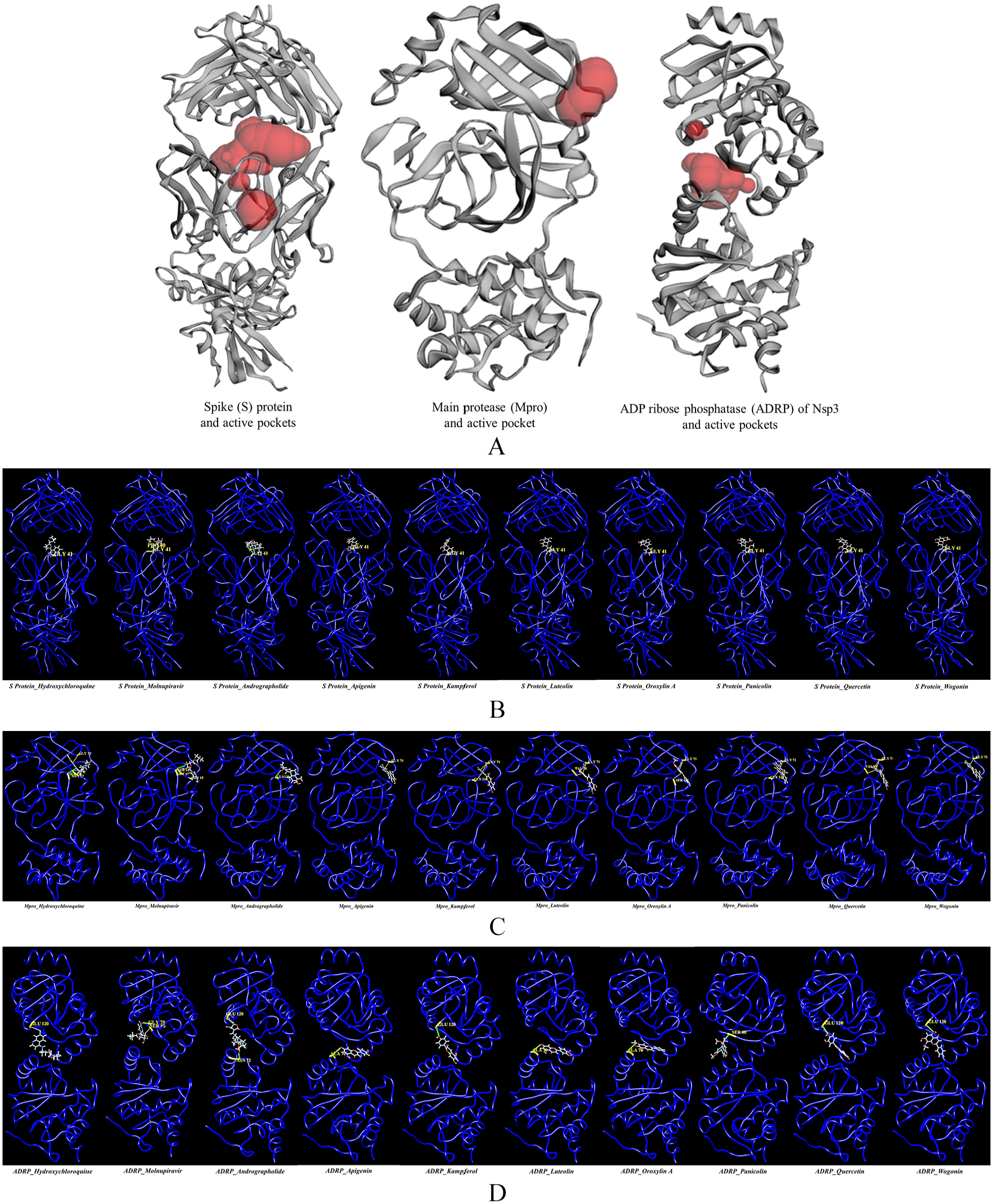
Binding poses of SARS-CoV-2 target proteins and compounds. (A). Active pockets of SARS-CoV-2 target proteins. (B). Binding poses of spike (S) protein and compounds. (C). Binding poses of Mpro and compounds (D). Binding poses of ADRP of Nsp3 and compounds.
The estimation of Gibbs free energy ΔG and full fitness values for bioactive components docked with SARS-CoV-2 target proteins by SwissDock.

Abbreviations: ADRP, ADP ribose phosphatase; Mpro, main protease; SARS-CoV-2, severe acute respiratory syndrome coronavirus-2.
According to the docking result, most compounds fit well in the active pockets of all 3 SARS-CoV-2 target proteins with the negative values of ΔG and full fitness scores close to those of the 2 reference drugs. Andrographolide, luteolin, and panicolin were found to have ΔG values of ⩽ −7 kcal/mol with all 3 targets, similar to hydroxychloroquine and molnupiravir, suggesting that these compounds have a strong binding force with SARS-CoV-2 targets and may be promising candidates for COVID-19 treatment. Furthermore, the scores of quercetin exhibited ΔG values of ⩽ −7 kcal/mol when bound to Mpro and ADRP, as wogonin did when bound to the S protein and Mpro, indicating that quercetin and wogonin might play indispensable roles in combination with other bioactive components to create a mutually synergistic effect for combating SARS-CoV-2 infection.
Discussion
A. paniculata, also known as Chuan Xin Lian (穿心蓮) in Chinese, is a well-known medicinal plant thanks to its multitargeted pharmacological effects and is traditionally used as a precious herb in many Asian countries, such as Hong Kong, China, Bangladesh, Pakistan, India, Malaysia, the Philippines, Vietnam, Indonesia, and Thailand.34,35 In modern pharmacology, Chuan Xin Lian has been confirmed both experimentally and clinically to have a wide spectrum of pharmacological activities, including antiplatelet aggregation, 36 immunomodulatory activity,37,38 anticancer,39,40 anti-inflammatory,41,42 antivirus, antibacteria, antimicrobial,43,44 antimalarial,44,45 antihepatitis,46,47 hepatoprotective,48,49 anti-oxidant,49,50 sexual dysfunctions, 51 and other myriad health benefits. Furthermore, the effectiveness of preventing and treating common colds using Chuan Xin Lian preparations was assessed in some double-blind, placebo-controlled clinical trials. The outcomes showed that treatment with Kan Jang tablets made from A. paniculata dried extract successfully prevented the common cold and significantly improved clinical symptoms, such as sore throat, shivering, muscular aches, tiredness, headaches, sinus pain, and rhinitis.16,17
The pharmacological activities of Chuan Xin Lian may be associated with the existence of roughly 142 components, including terpenoids, flavonoids, xanthones, rare noriridoids, quinic acid derivatives, and other phytochemicals. 52 Diterpenoid lactones are the commonest terpenoid compounds isolated from the aerial parts and roots of Chuan Xin Lian, and flavones are the major flavonoids that have been isolated from the aerial parts, roots, and whole plant of Chuan Xin Lian. 53 Among the documented components, andrographolide, an ent-labdane diterpenoid, is responsible for most of the reported pharmacological activities. 54 Andrographolide has many different pharmacological effects, including anti-inflammation induced by bacterial or viral infections, anti-pulmonary inflammation, immunosuppressive activity in sterile inflammation, anticancer, and other activities. 43 A. paniculata extract and andrographolide were investigated for inhibition against SARS-CoV-2 through cellular assays with a 50% inhibitory concentration (IC50) of 9.54 mg/mL for A. paniculata extract and an IC50 of 1.68 mM for andrographolide. 55 Andrographolide is also the main ingredient of Xiyanping injection, used for decades in treating viral pneumonia, upper respiratory tract infections, and bronchitis. A multicenter, prospective, open-label, and randomized controlled trial was conducted to confirm the efficacy and safety of this medicine. 13 In addition, studies on mechanisms of action demonstrated that andrographolide possessed anti-inflammatory and immunomodulatory activities through which cytokine storms, one of the vicious pathogenic mechanisms leading to death in COVID-19, were controlled.12,14,15 In our study, andrographolide stood at a high degree position in the C-T-P network and showed a strong binding force to SARS-CoV-2 targets, indicating that it takes the important responsibility for the therapeutic effects of Chuan Xin Lian on COVID-19. Clinical application of andrographolide is limited largely due to poor aqueous solubility. 13 However, its gastrointestinal absorption and bioavailability score are equivalent to some flavonoids, such as luteolin, quercetin, kaempferol, and apigenin, based on the SwissADME tool for predicting ADME parameters and pharmacokinetic properties. These flavonoid derivatives are well known as popular bioactive ingredients in various oral herbal formulae for health improvement and disease treatment, for instance, luteolin, quercetin, and kaempferol in Lianhua Qingwen capsule for treating COVID-19. Furthermore, Chuan Xin Lian has had a very long-term usage history since the ancient period. The efficiency of Kan Jang tablets made from A. paniculata dried extract was also tested in patients. Hence, its beneficial effects in the oral form are obvious and likely not only from andrographolide but also from other bioactive constituents, especially flavonoid derivatives. Notably, flavonoid derivatives have been suggested as pivotal nutritional supplements for relieving the symptoms and decreasing the period of the COVID sequelae in recent literature. Quercetin appears to be the most effective flavonoid with a remarkable therapeutic and preventive role. 56 There is a likelihood that patients after COVID-19 recovery will develop post-COVID-19 chronic disorders linked to damage to the lung, heart, and brain, and persistent problems with abnormal immune response and blood clotting formation. According to a review of the scientific literature from 2003 to 2021 on flavonoids-based molecular mechanisms associated with post-COVID-19 complications, apigenin, quercetin, and luteolin have been reported to play therapeutic and preventive roles in post-COVID-19 complications affecting the respiratory system, and benefits of kaempferol, apigenin, quercetin, and luteolin in the cardiovascular system, and the function of luteolin in the neurological system. 56 In addition, numerous studies have been published supporting the inhibitory action of flavonoids on SARS-CoV-19. In theory, flavonoids are a prerequisite for successful respiratory viral infections and COVID-19 supportive therapy. The severity of COVID-19 is related to high concentrations of inflammatory mediators, such as arachidonic acid, prostaglandins, leukotrienes, and NO, and their production is activated by the rise in the activity of inflammatory inducible enzymes such as cyclooxygenase-2 (COX-2 or PTGS2), phospholipase A2 (PLA2), lipooxygenases, and tyrosine kinase. Quercetin and kaempferol show significant inhibition of PLA2, PTGS2, and C-reactive protein (CRP), in which quercetin shows a more potent action57 -59 and even the possible use in COVID-19 treatment owing to the structural similarity to dexamethasone. 60 Luteolin can be administered to COVID-19 patients in the acute phase with dexamethasone, thanks to its antiviral and anti-inflammatory properties and inhibition of mast cells, an essential source of cytokines. 61 Lianhua Qingwen Capsules with the major bioactive compounds inclusive of quercetin, kaempferol, luteolin, and wogonin were evaluated clinically for the treatment efficacy in the early-stage COVID-19. 62
Regarding BPs and KEGG pathways, the BPs primarily respond to chemical stress, inflammation, cytokines, apoptosis, cell death, and intracellular signal transduction, which are closely involved in the COVID-19 pathophysiology and consistent with previous findings of the molecular mechanisms against SARS-CoV-2 infection. The alteration in the above processes represents the cell’s state or activity in the defensive and protective reaction to infection or injury caused by viruses. In addition, most of the critical pathways for C-T-P network construction are significantly associated with a viral attack of a host, the immuno-inflammatory cascade, and likely with ongoing persistent symptoms after recovery, so-called post-COVID syndrome, such as the PI3K-AKT signaling pathway, MAPK signaling pathway, IL-17 signaling pathway, coronavirus disease pathway, TNF signaling pathway, C-type lectin receptor signaling pathway, T-cell receptor signaling pathway, and Th17 cell differentiation. These pathways are mentioned extensively in the literature on the SARS-CoV-2 life cycle, human innate immune system, and COVID-19 clinical complications and have been proved to link to molecular mechanisms, COVID-19 pathophysiological features, and treatment strategies in SARS-CoV-2 infection.63 -67
There is an immunological “bridge” between acute COVID-19 infection and post-COVID-19 syndrome. Many COVID-19-Chuan Xin Lian overlapping hub targets, such as IL-1A, IL-1B, IL-2, IL-4, IL-6, IL-10, CRP, and TNF, are biomarkers found to be elevated in several post-COVID-19 complications, such as central nervous system disorders, ongoing neuroinflammation, post-COVID fatigue, orthostatic intolerance, irreversible sensorineural hearing loss, vascular impairment, post-COVID pulmonary fibrosis, lung dysfunction, post-viral infection destruction of β-pancreatic cells, etc. 68 Meanwhile, overexpression of these biomarkers accounts for the formation of cytokine storms, a severe condition of acute COVID-19 infection that can lead to life-threatening illnesses. 68 Remarkably, an aberrant increase in the levels of potent inflammatory cytokines, such as TNF and IL-6, further stimulates immunopathological events, activates the coagulation cascade, and engages the participation of multiple organs. 69 Prolonged pathological inflammation may be responsible for numerous neurological complications, cognitive dysfunction, and other symptoms. 68 Therefore, the intervention in the pathways and targets mentioned above may be significantly effective in treating COVID-19 and alleviating the post-COVID-19 syndrome.
The current understanding of the pathophysiology of the post-COVID syndrome has revealed that well-known or hypothetical mechanisms include the overlapping of delayed resolution of inflammation, autoimmunity, and viral persistence. 69 Through the viral persistence process, SARS-CoV-2 can integrate into the genome of the host cells and form defective viruses. Thereby, it may live on in a host forever and turn into an integral part of the host. 70 Surprisingly, the excessive increase in IL-6 levels facilitates the generation of Th17 cells. Then, the synergistic effect of both IL-6 and IL-17 helps the virus stay alive in cells or boosts viral persistence by shielding virus-infected cells from apoptosis, 71 suggesting that the Th17 cell differentiation pathway and the IL-17 signaling pathway may be potential pathways to prevent and limit viral persistence, one of the putative pathophysiologies of the post-COVID syndrome. Besides, the entry into host cells, viral protein synthesis, inflammatory cytokine production, and the survival of infected cells are supposed to depend on the PI3K-AKT signaling pathway. 72
There are 3 steps in how SARS-Cov-2 attacks host cells: attachment and cell entry, replication and transcription, and virus assembly and release. In our study, SwissDock results revealed significant bonds of andrographolide, luteolin, panicolin, quercetin, and wogonin to 3 SARS-CoV-2 protein targets with ΔG and full fitness scores that were nearly similar to those of 2 FDA-approved drugs for COVID-19 treatment, hydroxychloroquine and molnupiravir. This means that these compounds show a potent binding affinity and a powerful impact on cell entry (the S protein), and replication and transcription (Mpro and ADRP) of SARS-CoV-2.
Even though this research discovered some striking findings, especially main bioactive compounds, key targets and vital pathways which potentially influence COVID-19 and sequelae, our study still had a few possible limitations. First, since the analysis was primarily based on data retrieved from platforms and databases used for bioinformatics research, the obtained results need to be validated experimentally or clinically. Second, limitations related to updating these platforms and databases.
Conclusions
Our research found key hub targets related to COVID-19 that Chuan Xin Lian’s bioactive components interacted with and uncovered potential therapeutic pathways that could help ameliorate COVID-19 and sequelae based on the combination approach of network pharmacology and molecular docking. Diterpenoid (eg, andrographolide) and flavonoid derivatives (eg, luteolin, quercetin, wogonin, kaempferol, etc) are important phytochemicals, thanks to their high node degrees in the C-T-P network and significant binding force to SARS-CoV-2 targets in the docking scores. The PI3K-AKT signaling pathway with the highest node degree in the C-T-P network is likely the most vital pathway because the entry into host cells, viral protein synthesis, inflammatory cytokine production, and the survival of infected cells are supposed to depend on this pathway.
Supplemental Material
sj-xlsx-1-bbi-10.1177_11779322221149622 – Supplemental material for The Potential of Ameliorating COVID-19 and Sequelae From Andrographis paniculata via Bioinformatics
Supplemental material, sj-xlsx-1-bbi-10.1177_11779322221149622 for The Potential of Ameliorating COVID-19 and Sequelae From Andrographis paniculata via Bioinformatics by Hien Thi Nguyen, Van Mai Do, Thanh Thuy Phan and Dung Tam Nguyen Huynh in Bioinformatics and Biology Insights
Footnotes
Acknowledgements
The authors sincerely thank Professor Chien-Ming Hsieh in the Department of Pharmaceutical Sciences at Taipei Medical University for supporting the conduct of this study as well as reviewing and proofreading the manuscript. The authors acknowledge BioinfoGP Service (https://bioinfogp.cnb.csic.es/) for providing the Venny 2.1 tool ( ) to assist in the analysis of overlapping genes
Funding:
The author(s) received no financial support for the research, authorship, and/or publication of this article.
Declaration of Conflicting Interests:
The author(s) declared no potential conflicts of interest with respect to the research, authorship, and/or publication of this article.
Author Contributions
DTNH was in charge of the entire research and responsible for developing hypotheses, interpreting results, and performing the network analysis. DTNH, HTN, VMD, and TTP participated in the manuscript’s writing and discussion. Data collection and screening were carried out by HTN, VMD, and TTP. All authors have read and agreed to the published version of the manuscript.
Data Availability Statement
The datasets used and/or analyzed in the current study are available from the corresponding author upon reasonable request.
Supplemental Material
Supplemental material for this article is available online.
References
Supplementary Material
Please find the following supplemental material available below.
For Open Access articles published under a Creative Commons License, all supplemental material carries the same license as the article it is associated with.
For non-Open Access articles published, all supplemental material carries a non-exclusive license, and permission requests for re-use of supplemental material or any part of supplemental material shall be sent directly to the copyright owner as specified in the copyright notice associated with the article.
