



Abstract
Background:
Exploring the epigenetic regulations, such as microRNA, in newborns holds significant promise for enhancing our ability to address and potentially prevent early-life developmental delays.
Objectives:
Hence, this research seeks to investigate if the expression of miRNA in the umbilical cord blood of infants can forecast their developmental outcomes as they grow older.
Design and method:
We enrolled 143 full-term newborns, delivered either via cesarean section (CS) or through natural spontaneous delivery (NSD). We then analyzed the profiles of specific miRNAs (miR-486-5p, miR-126-5p, miR-140-3p, miR-151a-3p, miR-142-5p, and miR-30e-5p) in the umbilical cord blood of these infants. Subsequently, we performed follow-up assessments using Bayley-III scores when the cohort reached 1 year of age. Furthermore, we conducted pathway-enrichment analyses on the target genes associated with these examined miRNAs.
Results:
When comparing newborns delivered via cesarean section (CS) to those born via natural spontaneous delivery (NSD), we observed notable differences. Specifically, newborns through NSD displayed significantly higher ΔCt values for miR-486-5p, alongside lower ΔCt values for miR-126-5p and miR-151a-3p in their cord blood. At 1 year of age, cognitive development was significantly linked to the ΔCt values of miR-140-3p and miR-142-5p, while language development showed a significant association with the ΔCt values of miR-140-3p. Moreover, our pathway enrichment analyses revealed that the target genes of these miRNAs were consistently involved in the pathways related to neurons, such as axon guidance and the neurotrophin signaling pathway.
Conclusion:
In summary, this study represents a pioneering effort in elucidating the potential connections between miRNA levels in cord blood and the health indicators and neurodevelopment of newborns at 1 year of age. Our findings underscore the significance of miRNA levels at birth in influencing mechanisms related to neurodevelopment.
Introduction
Child development encompasses the structured progression of interrelated skills encompassing sensorimotor abilities, cognitive aptitude, language proficiency, and social-emotional functioning. 1 Infancy serves as a critical period for neurodevelopment, influencing an individual’s susceptibility to future neuropsychiatric conditions. 2 Various prenatal factors can influence child development; for instance, heightened psychosocial stress and exposure to environmental chemicals during pregnancy can lead to increased risks of preterm birth, reduced birth weight, and compromised neurodevelopment. 3 The determinants affecting infant neurodevelopment are multifaceted, adding complexity to follow-up research and contributing to disparities in reported outcomes.4-6 Genetic variations in genes linked to neural signaling molecules interact with early-life adversity experiences, influencing child neurodevelopment, primarily through epigenetic mechanisms. 7 Consequently, identifying molecular and neurobiological markers during the perinatal period holds the potential to address early-life origins of developmental delays.
Epigenetics serves as the molecular framework explaining how environmental factors impact development and subsequent health, encompassing early brain development and temperament.8,9 Epigenetic mechanisms play a crucial role in regulating gene activity and neurobiology, mediating the link between early life exposures and enduring biobehavioral outcomes. 10 MicroRNAs (miRNAs), small noncoding RNA molecules, function to downregulate gene expression in human cells. 11 MiRNAs are actively involved in the development of the central nervous system (CNS), influencing processes such as cell proliferation, differentiation, and synaptic plasticity. 12
Previously, our research team employed next-generation sequencing (NGS) techniques to identify 13 miRNA-based biomarkers associated with attention-deficit/hyperactivity disorder (ADHD). 13 Notably, among these miRNA markers, miR-486-5p, miR-126-5p, miR-140-3p, miR-151a-3p, miR-142-5p, and miR-30e-5p displayed the most pronounced correlations with ADHD. Furthermore, brain imaging studies indicated a correlation between gray matter (GM) volume and ΔCt values of miR-126-5p, miR-140-3p, and miR-30e-5p. 14 In an in vitro cell model, miR-140-3p and miR-126-5p were found to enhance the differentiation of HCN-2 cells by promoting neuron length and the number of junctions. 15
Cord blood contains unique cells known as hematopoietic stem cells and may also be enriched with epigenetic information, such as miRNA, which could potentially influence early neuronal development during the perinatal period.16,17 There is existing evidence indicating that prenatal factors, like alcohol exposure, can lead to changes in the relative expression of miRNAs in the developing fetus, consequently affecting the mRNAs expression. 18 New evidence suggests that miRNA may regulate gene expression bidirectionally by either repressing translation or inducing gene expression. 19
Furthermore, human mesenchymal stem cells have been shown to influence neuritic outgrowth in primary neuronal cultures. 20 Additionally, miR-34a and miR-206 found in human umbilical cord tissue have been associated with mesenchymal stem cell neurogenesis. 21 Despite these findings, no prospective study has yet explored the connection between miRNAs in the cord blood of newborns and their subsequent neurodevelopment.
Comprehending the molecular and neurobiological processes that underlie epigenetic influences on brain function and psychopathology during critical early postnatal phases holds significant promise for improving strategies to treat or prevent developmental delays that originate in early life. Consequently, this study seeks to explore 2 key aspects. First, we aim to investigate the potential associations between miRNA expression in the cord blood of newborns and various characteristics of these newborns. Second, we aim to ascertain whether miRNA expression in the cord blood of newborns can serve as a predictive factor for their developmental outcomes later in life.
Methods
Our research team comprises members from the Department of Pediatrics and the Department of Child and Adolescent Psychiatry at Kaohsiung Chang Gung Memorial Hospital (KCGMH). The protocol of this observational cohort study underwent thorough review and received approval from the Human Ethical Committee of KCGMH. We strictly adhered to ethical standards as outlined in the Helsinki Declaration of 1964, which were subsequently revised in 2013. Prior to their participation in this study, each mother of a newborn provided informed consent. They were provided with a comprehensive explanation of the study and potential consequences before giving their consent.
Participants
We consecutively enrolled 145 full-term newborns (with a gestational age of ⩾36 weeks) and their mothers in this study during Jun 1, 2021, to May 31, 2022. The inclusion criteria comprised newborns who were delivered full-term at KCGMH and admitted to either the babyroom or intermediate medical unit for newborns, with no significant congenital anomalies or illnesses linked to adverse neurological outcomes. The exclusion criteria encompassed prenatal examinations indicating major congenital anomalies or conditions with the potential for adverse neurological outcomes, such as meningitis, hypoxic-ischemic encephalopathy, inborn errors of metabolism, or hypothyroidism.
Throughout the study period, we closely followed all participating infants and their mothers, documenting any environmental adverse events that occurred. Among the initial group of 145 participants, 83 underwent neurodevelopmental assessments when they reached 1 year of age.
Collecting cord blood samples and extracting RNA samples
We gathered lifestyle and prenatal event questionnaires from pregnant women as part of our data collection process. To ensure the integrity of the cord blood samples obtained from 145 volunteer pregnant women, we employed glass bottles to minimize the risk of contamination. We strictly adhered to the manufacturer’s guidelines for both sample preparation and chemical analysis.
Approximately 5 ml of blood was drawn from each subject using EDTA anticoagulant tubes. Subsequently, the whole blood samples underwent centrifugation at 3000 rpm for 10 minutes. During this process, a red blood cell (RBC) lysis buffer (RBCBioscience) was added to effectively remove the red blood cells. The resulting RBC-free samples were then subjected to further processing using the mirVana miRNA isolation kit (Life technology) to extract total RNA from white blood cells (WBCs). We assessed the RNA samples’ integrity using the 2100 Bioanalyzer (Agilent Technologies), and any samples with an RNA integrity number (RIN) below 7 were excluded from the analysis.
Real-time qPCR validation of miRNA
As per our previous investigations,13,15 miR-486-5p, miR-126-5p, miR-140-3p, miR-151a-3p, miR-142-5p, and miR-30e-5p have previously been associated with ADHD or brain development. 22 Hence, we selected these specific miRNAs for analysis using real-time quantitative reverse transcription polymerase chain reaction (qRT-PCR) in this study.
To assess the expression profiles of these 6 miRNAs across all samples from our enrolled subjects, we employed the TaqMan® MicroRNA Transcription Kit (Applied Biosystems, Foster City, CA, USA) for cDNA preparation. The reverse-transcription reactions were carried out using a Veriti 96 well thermal cycler (Applied Biosystems), following the manufacturer’s instructions. The qRT-PCR analysis was conducted using the ABI 7500 Real-Time PCR System and the TaqMan Universal PCR Master Mix II without UNG. The real-time PCR cycling conditions consisted of an initial step at 95°C for 10 minutes, followed by 40 cycles of 95°C for 15 seconds and 60°C for 1 minute. The abundances of miRNA expression were determined based on ΔCt values, using small nucleolar RNA U6 as the endogenous control.
Pathway enrichment analysis on miRNAs’ target genes
To explore the potential roles of particular miRNAs, we retrieved their target genes from TargetScan Human 8.0. 23 Subsequently, these target genes were submitted to ShinyGO 24 for pathway enrichment analysis, utilizing default parameters and referencing the KEGG pathway database. 25 To delve into the relationships between the enriched pathways, we performed additional analyses to construct pathway networks, employing a specified parameter of edge cutoff = 0.2.
The prenatal adversity events
To identify markers of adversity, we gathered information on various factors, including pre-pregnancy obesity, pre-pregnancy overweight, pre-eclampsia, hypertension, maternal acetaminophen exposure during pregnancy, maternal smoking during pregnancy, and childhood atopic diseases. This information was collected through interviews with the newborn’s mother and by reviewing medical records. A previous comprehensive review has shown a significant association between these factors and the risk of neurodevelopmental abnormalities.26,27 The sum of total events of prenatal adversity were counted and set as one of the independent variables in the regression model. The questionnaire used in this study was listed as Supplemental Table 1.
Outcome assessments
At the age of 1 year, trained child psychologists conducted neurological and developmental assessments on the infants using the Bayley Scales of Infant and Toddler Development, Third Edition (Bayley-III). The Bayley-III evaluates the development of infants and toddlers within the age range of 1 month to 42 months across 5 domains: Cognitive, Language (Receptive & Expressive), Motor (Gross & Fine), Social-Emotional, and Adaptive. The Bayley-III can be administered to children aged 1 month to 42 months, with the assessment duration ranging from 30 to 90 minutes, depending on the child’s age. The normative mean for each outcome score is set at 100, and delayed development is defined as a score below one standard deviation from the mean (ie, a score of 85 on the Bayley-III scale). 28 In Taiwan, the Bayley-III is a well-established and widely used instrument for contemporary child developmental assessment, known for its reliability. 29
Statistical analysis
The sample size was measured with the software package G-Power 3.1, based on the settings of 80% power, P = .05. The sample sizes were estimated to be 6 to detect a large effect size (Cohen’s d = 0.8); 21 to detect a medium effect size (Cohen’s d = 0.5); and 150 to detect a small effect size (Cohen’s d = 0.2). Data were subjected to statistical analysis using SPSS software, version 20.0 (SPSS Inc., Chicago, IL, USA). Descriptive statistics were used to present variables as either mean values (± standard deviation) or as frequencies and percentages. A two-tailed P value less than .05 was considered statistically significant.
To investigate the impact on miRNA levels, linear regression was employed as the primary analytical approach to identify factors associated with miRNA levels in cord blood. The dependent variables encompassed miRNA levels (miR-486-5p, miR-126-5p, miR-140-3p, miR-151a-3p, miR-142-5p, and miR-30e-5p), while the independent variables were defined as gestational age, gender, mode of birth (normal spontaneous delivery [NSD] vs cesarean section [CS]), Apgar score, birth height, body weight, head circumference, maternal age, and prenatal adversity. The outcomes (miRNA levels and development at 1 year old) between newborns underwent scheduled CS and those underwent CS due to prolonged labor / emergency were compared using the Mann-Whitney U test.
Additionally, linear regression was utilized to explore the factors associated with infants’ cognitive, language, and motor development at 1 year old, taking into account miRNA levels in cord blood and other potential confounding variables (sex, mode of delivery, Apgar scores, gestational age, birth weight, mothers’ age, and prenatal adversity). We further performed t test to examine the group differences in continuous variables. Finally, Pearson’s correlation coefficient was used to examine potential correlations between miRNAs and children’s developmental outcomes.
Results
Demographic data
The cohort consisted of 145 infants, 79 male and 66 female, with a mean gestational age of 38.5 ± 0.97 weeks and birth weight of 3093.2 ± 396.5 g. Table 1 provides an overview of detail information about the 145 full-term newborns who participated in our study. Among them, 59.3% were delivered through normal spontaneous delivery (NSD), while 40.7% were born via cesarean section (CS). Additionally, the infants suffered from an average of 0.59 ± 0.74 prenatal adversity events. Among the 145 infants, 83 received neurodevelopment assessments at the age of one year. Among them, 6 (7.2%), 4 (4.8%), and 12 (14.5%) exhibited a score <85 on cognitive, language, and motor domains of the Bayley-III scale, respectively. Among the 83 infants who were available for neurodevelopmental outcome, 37 (44.6%) and 46 (55.4%) were delivered by cesarean and vaginal mode, respectively.
The characteristics of the 145 newborns recruited in this study.

Data were presented as N (%) or mean ± SD.
The factors associated with miRNAs levels
We employed qPCR assays to quantify the levels of the 6 miRNAs (miR-486-5p, miR-126-5p, miR-140-3p, miR-151a-3p, miR-142-5p, and miR-30e-5p) in the total white blood cells (WBCs) of cord blood. Following the qPCR assays, we obtained ΔCt values using RNU6 as the internal control. As presented in Table 2, in comparison to newborns delivered via cesarean section (CS), those born through normal spontaneous delivery (NSD) exhibited significantly higher ΔCt values for miR-486-5p (β = .79, P = .023), as well as lower ΔCt values for miR-126-5p (β = −1.19, P = .001) and miR-151a-3p (β = −.61, P = .043). Additionally, birth height showed a significant association with ΔCt values of miR-486-5p (β = .25, P = .007). The ΔCt values of miR-486-5p, miR-126-5p, and miR-151a-3p between newborns delivered via NSD and CS are illustrated in the violin plots (Figure 1).
The independent effects of newborns’ characteristics on miRNAs levels in cord blood of the 145 newborns recruited in this study.

Abbreviations: CI, confidence interval; CS, cesarean section; NSD, normal spontaneous delivery.
Data represent as β (95% CI) based on linear regression. The variables revealed statistically significance (P value < .05) were shown in bold-face type.
P = .023.
P = .007.
P = .001.
P = .043.

Differential miRNA expression profile (A: miR-486-5p; B: miR-126-5p; C: miR-151a-3p) between normal spontaneous delivery (NSD) and cesarean section (CS). The P values of comparisons were derived with a t test. * and ** denote P value < .05 and P value < .01, respectively.
The factors associated with infants’ cognitive, language, and motor development at 1 year old
Neurodevelopment assessments were conducted when the infants reached the age of 1 year. As presented in Table 3, while controlling for the characteristics of both the newborns and mothers, cognitive development exhibited a significant association with the ΔCt values of miR-140-3p (β = 14.4, P = .042) and miR-142-5p (β = −12.25, P = .026). Furthermore, language development showed a significant connection with the ΔCt values of miR-140-3p (β = 13.8, P = .039), with female infants demonstrating better language development than their male counterparts (β = 15.16, P = .001), and the findings were consistently found in comparison of composite score (females: 103.1 ± 10.7 vs males: 96.6 ± 7.3, P = .002) and percentile (females: 56.2 ± 22.7 vs males: 41.9 ± 16.2, P = .002) using t test. Motor development was found to be associated with prenatal adversity (β = 6.7, P = .049).
The independent effects of newborns’ characteristics and miRNAs levels in cord blood on neurodevelopment among the 83 newborns recruited for one-year follow-up.

Abbreviations: CI, confidence interval; CS, cesarean section; NSD, normal spontaneous delivery.
Data represent as β (95% CI) based on linear regression. The variables revealed statistically significance (P value < .05) were shown in bold-face type.
P = .042.
P = .026.
P = .001.
P = .039.
P = .049.
The outcomes (miRNA levels and development at 1 year old) between newborns underwent scheduled CS and whom underwent CS due to prolonged labor/emergency were compared using the Mann-Whitney U test (Supplemental Table 2). We found the ΔCt values of miR-486-5p in newborns underwent scheduled CS were significantly lower than those underwent CS due to prolonged labor/emergency (P = .047). No differences in other miRNAs expression and infants’ cognitive, language and motor development at one-year old were observed between the conditions of CS.
The neuron-related pathways commonly involved by the miRNAs’ target genes
miRNAs play a diverse role in regulating gene expression by suppressing their target genes. Therefore, it is common practice to investigate the potential functions and enriched pathways of these target genes to understand the possible roles of specific miRNAs. We obtained the target genes and conducted pathway enrichment analysis. As illustrated in Figure 2, the target genes regulated by miR-151a-3p were found to be linked to neuron-related pathways such as axon guidance and the neurotrophin signaling pathway. This pattern was consistently observed in other analyzed miRNAs (Supplemental Figures 1–5). Furthermore, there were frequent and close interactions among these pathways, suggesting a synergistic regulatory effect. In summary, the pathway analysis results align with our findings, indicating a strong association between these miRNAs and neurodevelopment.
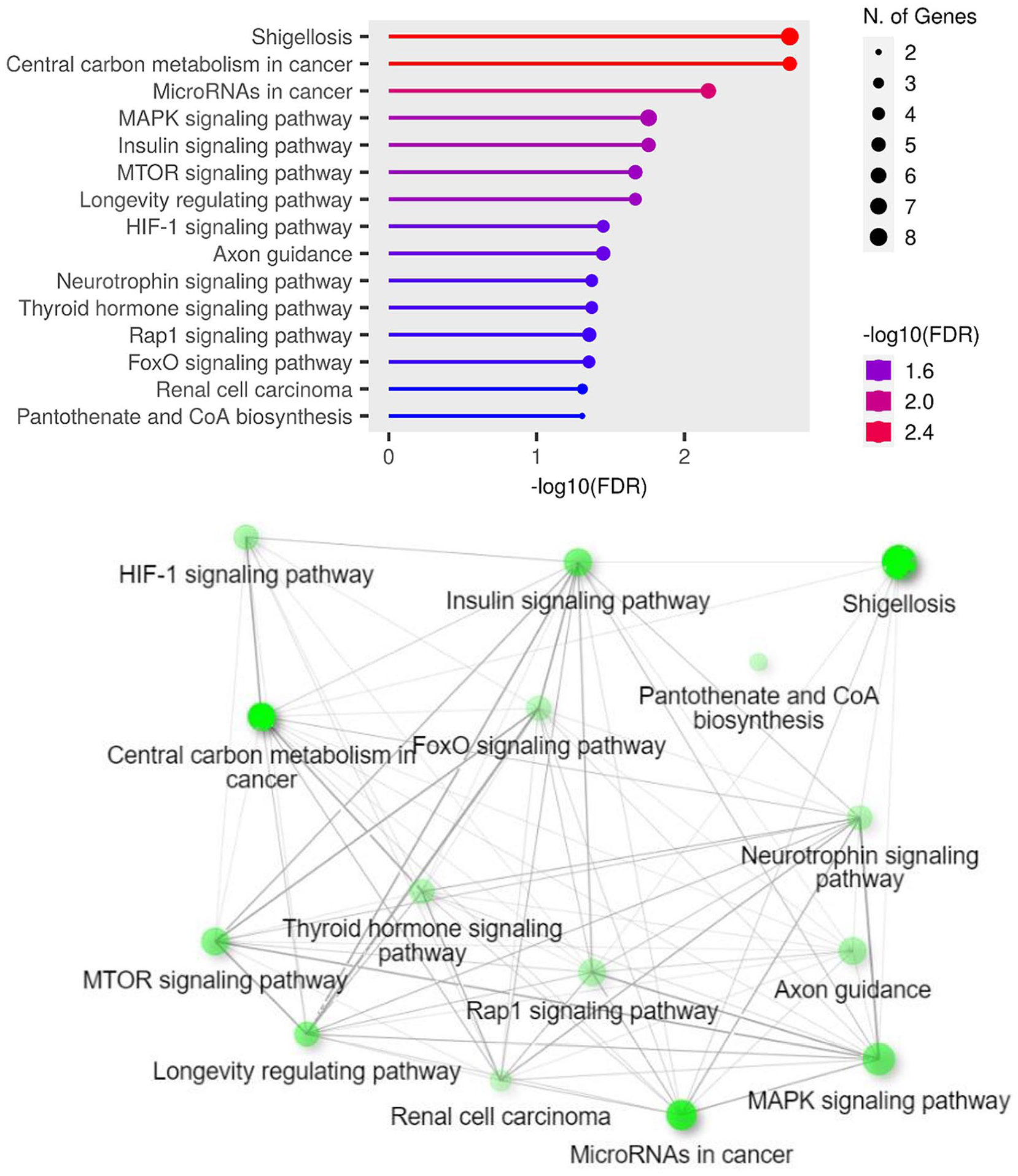
Results of pathway enrichment analysis and interactions among pathways of miR-151a-3p. We had the target genes of miR-151a-3p analyzed with ShinyGO to identify the significant pathways (FDR < 0.05). The top 20 most significant pathways (if applicable) enriched by the target genes were tabulated (the upper panel). N. of Genes denoted the number of the genes commonly shared by the input target genes and the member genes of specific KEGG pathway. Pathway network indicated frequent and close interactions among these significant pathways (the lower panel).
Discussion
To the best of our knowledge, this study marks the first attempt to concurrently explore potential relationships between miRNA levels in cord blood, newborn health indicators, and neurodevelopment at the age of 1 year. Our findings provide compelling evidence that the mode of delivery (NSD or CS) is significantly linked to ΔCt values of miR-486-5p, miR-126-5p, and miR-151a-3p. Furthermore, we observed significant associations between cognitive development and ΔCt values of miR-140-3p and miR-142-5p. Additionally, language development demonstrated significant connections with ΔCt values of miR-140-3p.
In our healthy community sample, 40.7% of individuals underwent cesarean section (CS), and maternal preference for CS played a role in the increasing CS trends. 30 Cultural factors, such as son preference, have an influence on women’s choice of childbirth method in Asian cultures, where mothers are more inclined toward CS compared to Western countries. 31 Our study provides evidence that, even after controlling for newborn characteristics (birth weight) and maternal factors (gestational age), the mode of delivery (NSD or CS) was significantly correlated with ΔCt values of miR-486-5p, miR-126-5p, and miR-151a-3p. Effect of labor on epigenetic changes has been previous reported. 32 The process of labor may cause repetitive uterine contractions and subsequent disturbance to myometrial perfusion may cause hypoxia at the placental interface, leading to increased cff-DNA and cell-free, pregnancy-associated, interfering placenta-specific miRNA. 33 A previous study discovered elevated cord blood concentrations of endothelial markers and microvesicles following spontaneous vaginal delivery, possibly reflecting the natural activation of endothelial cells during labor. 34 Prior research has suggested CS births exhibiting higher DNA methylation levels in leukocytes compared to those born via NSD. 35 Furthermore, a study indicated a significant upregulation of 17 miRNAs in the colostrum of mothers who had undergone CS. 36 In conjunction with our study’s findings, it is evident that the mode of delivery can influence miRNA levels in cord blood.
However, it is noteworthy that maternity resulting in a CS may be related to specific indications, such as fetal distress, failure to progress in active labor, or antepartum hemorrhage. 37 Newborns who undergo a CS due to emergency indications show biochemical differences from those delivered by elective pre-labor CS. We found that the ΔCt values of miR-486-5p in newborns who underwent scheduled CS were significantly lower than those who underwent CS due to prolonged labor or emergency situations. An animal study demonstrated that the expression of miR-486a/b-5p plays a role in neural progenitors and newborn neurons during cortical development. 22 A prospective case-control study revealed that miR-486-5p levels in subjects born small for gestational age were associated with metabolic risk in adulthood. 38 Therefore, the difference in miRNAs may be related to the indication for CS or inherent genetic variation, but not directly attributed to the mode of delivery.
We observed significant associations between the ΔCt values of cord blood miR-140-3p and cognitive as well as language development in one-year-old infants. Additionally, miR-142-5p exhibited a significant relationship with cognitive development. Our prior research unveiled that reduced expression of miR-30e-5p, miR-126-5p, and miR-140-3p is linked to immature grey matter development in regions like the cingulate gyrus and the left fusiform gyrus. 14 Furthermore, our in vitro study provides supporting evidence that upregulation of miR-126-5p and miR-140-3p may promote the growth of HCN-2 human neuronal cell lines. 15 Another study revealed that overexpressing miR-140-3p may exert cytoprotective effects by mitigating inflammation, oxidative stress, and cell apoptosis in OGD/R conditions. 39 It’s worth noting that miR-142-5p is abundant in cells of hematopoietic origin and has garnered considerable attention for its central role in regulating immune responses. 40 However, none of the studies have explored the role of miR-142-5p in neurodevelopment. Previous research also suggests that miR-126-5p and miR-140-3p may promote neuronal growth and are associated with susceptibility to ADHD.14,15 In summary, the findings from our study indicate that the prenatal expression levels of miR-140-3p and miR-142-5p in cord blood could potentially serve as markers for assessing neurodevelopment in infants later in life.
In this study, we would like to derive the possible functions and roles of the predicted target genes of the miRNAs interested. Most of the registered target genes of miRNAs are based on computational prediction. The numbers of experimentally confirmed target gene are few, making it difficult to conduct further analyses. Therefore, we conducted pathway enrichment analysis on the predicted target genes. Since most assays were based on cancer-related studies, it is reasonable that cancer-related pathways, in addition to neuron-related pathways, were also observed. This is the limitation of this study.
This study presents several methodological issues and limitations that warrant discussion. Firstly, it is important to note that miRNAs in cord blood may not fully represent postnatal miRNA expression, particularly in newborn brain tissue. Furthermore, our assessment solely focused on cord blood miRNAs, and whether these miRNAs undergo progressive alterations that impact neurodevelopment throughout an infant’s life remains uncertain. Secondly, the study experienced a certain level of attrition, with an initial participation of 145 newborns, but only 83 of them completed the assessments at the age of 1 year. This attrition bias has the potential to influence the study’s results. Thirdly, the selection of miRNA markers was based on our prior research and potential target gene functionality, lacking a comprehensive global screening using Next-Generation Sequencing (NGS). Additionally, the pathway analyses relied on data from the KEGG website, and the underlying mechanisms require further validation. Forth, some critical information was not collected (eg, the duration of labor). Because the sample size was not large enough, the effect of individual prenatal adversity event on miRNA expression was not analyzed. Lastly, it’s essential to acknowledge that the participants in this study were recruited from a single site in Taiwan. The generalizability of our findings regarding miRNAs to different ethnicities or countries warrants confirmation through further research.
In summary, this study represents a pioneering effort to simultaneously explore potential connections between miRNA levels in cord blood, newborn health indicators, and neurodevelopment at one year of age. Our findings offer compelling evidence that the mode of delivery (NSD or CS) significantly influences miRNA expression. Specifically, the expression of specific miRNAs, such as miR-140-3p and miR-142-5p, at birth exerts a substantial impact on infants’ cognitive and language development. These results underscore the pivotal role of miRNA levels at birth in neurodevelopmental mechanisms.
Conclusion
To identify the potential connections between miRNA levels in cord blood and the health/development indicators in newborns, we examined miRNA profiles with qPCR and conducted follow-up assessments using Bayley-III scores on the enrolled infants. As a result, significant connections between cord blood’s miRNA profiles and health/development indicators were derived. In addition, our findings also underscore the significance of miRNA levels at birth in influencing mechanisms related to neurodevelopment.
Supplemental Material
sj-doc-1-bmi-10.1177_11772719241258017 – Supplemental material for MicroRNAs in Umbilical Cord Blood and Development in Full-Term Newborns: A Prospective Study
Supplemental material, sj-doc-1-bmi-10.1177_11772719241258017 for MicroRNAs in Umbilical Cord Blood and Development in Full-Term Newborns: A Prospective Study by Liang-Jen Wang, Ching-Chang Tsai, How-Ran Chao, Sheng-Yu Lee, Chih-Cheng Chen and Sung-Chou Li in Biomarker Insights
Footnotes
Acknowledgements
The authors would like to thank Dr. Hsing- Fang Lu for the neurodevelopment assessment for the newborns.
Abbreviation list
miRNA: microRNA
CS: cesarean section
NSD: spontaneous delivery
ADHD: attention-deficit/hyperactivity disorder
GM: gray matter
RBC: red blood cell
WBC: white blood cell
RIN: RNA integrity number
qRT-PCR: real-time quantitative reverse transcription polymerase chain reaction
NGS: next-generation sequencing
KEGG: Kyoto Encyclopedia of Genes and Genomes
Declarations

Supplemental material
Supplemental material for this article is available online.
References
Supplementary Material
Please find the following supplemental material available below.
For Open Access articles published under a Creative Commons License, all supplemental material carries the same license as the article it is associated with.
For non-Open Access articles published, all supplemental material carries a non-exclusive license, and permission requests for re-use of supplemental material or any part of supplemental material shall be sent directly to the copyright owner as specified in the copyright notice associated with the article.
