



Abstract
Kaumātua (Māori [Indigenous people of Aotearoa New Zealand] elders over 55 years of age) often experienced disconnection from their cultural roots because of colonisation and policies that discouraged use of the Māori language, and cultural protocols, which had negative effects on well-being and sense of identity. This article describes a strength-based co-design process and programme that is kaumātua-led, for and by Māori communities, to help address this disconnection due to colonisation. He Huarahi Tautoko (a pathway of support) (HHT) is a cultural revitalisation model for integrating the Māori language, culture, intergenerational knowledge exchange and physical activity. Through HHT, we assert that self-determination, Indigenous cultural continuity, language revival, valuing Māori epistemologies and existing strengths of kaumātua are all positive determiners of kaumātua health. This article outlines the methods of co-design with each provider. We highlight the aspirations of kaumātua around ways to integrate cultural revitalisation and physical activities into learning spaces.
Hei mihi | Traditional greeting
E te tī, e te tā, naumai, haramai ki runga i te waka rangahau, anei mātou o te kāhui rangahau e mihi atu nei ki a koutou kua whai whakaaro ki tēnei tuhinga kōrero. Me mihi hoki ka tika ngā pēperekou kua whai wāhi i roto i tēnei rangahau, nā koutou katoa tēnei kaupapa i whakarangatira, me kore ake ko koutou kua kore he mana o tēnei rangahau. Nō reira, kei aku kākā wahanui, kei aku manu tīoriori o runga i ngā taumata kōrero, anei te reo mahana o te kāhui rangahau e mihi atu nei ki a koutou katoa.
E ai ki ō tātoui tīpuna: Ki te kore ngā pūtake e whakamākūkūngia, e kore te rākau e tupu tōtika ake.
Ko ō tātou kaumātua ērā, ko ngā puna o te mātauranga, ko ngā kaipupuri i ngā kōrero a kui mā, a koro mā, ko ngā kaipupuri hoki i ngā tikanga Māori, ko rātou, ko koutou te tūāpapa o tēnei rangahau, mei kore ake ko koutou kua kore tēnei rangahau e whakatutuki i ōna hiahia. Nō reira, kāore i ārikarika ngā mihimutunga kore ki a koutou katoa.
Greetings and welcome everyone, we appreciate your interest in our research project. We would like to thank all the kaumātua (Māori [Indigenous people of Aotearoa New Zealand]) that participated in this research project. Without you this research would not have had the depth of value that you have all added.
We have a proverbial saying that aptly demonstrates this: If the roots of the tree are not watered, nourished, nurtured with all the goodness needed, then surely the tree will not grow and fruit to its full potential.
Metaphorically, our kaumātua are the trees that must be nurtured so they can flourish and continue to be significant contributors to our societies. Afterall, they are the carriers of knowledge handed down from one generation to the next, including language and culture. So, with this in mind we humbly thank you for your significant contribution and your notable participation in this research project.
Whakatūwheratanga | Introduction
The Aotearoa New Zealand population is ageing, and numerous studies demonstrate that with this phenomenon comes health and social challenges including chronic conditions, cancer, end-of-life issues, and social isolation (Dawes et al., 2022; Hayman et al., 2012; Hokowhitu et al., 2020; Ministry of Health, 2020). This phenomenon is also not immune to social inequity with negative indices surrounding, for example, Māori ageing and health. As consistently outlined in multiple research fora, these inequities are due to structural racism such as unjust and unequal distribution of social determinants, including income, education, and housing (Brown & Bryder, 2023; Cassim et al., 2021; Harris et al., 2012; Kidd et al., 2021; Langley et al., 2013; Ministry of Health, 2019; Reid et al., 2019; Russell et al., 2013; Walsh & Grey, 2019).
Structural racism and inequitable distribution of social determinants have been shaped by Aotearoa New Zealand’s colonial history. Modern New Zealand was founded in 1840 with the signing of Te Tiriti o Waitangi (The Treaty of Waitangi) between the British Crown and Māori leaders. The document was in two languages and the translations were not equivalent about the rights granted to Māori under the Crown. Throughout the 1800s, there were land wars with settlers and the Crown taking Māori lands and killing Māori who resisted. In the 1900s, more peaceful existence was found although educational and health systems under the Crown sought to force Māori assimilation (Hokowhitu, 2003). For example, the Tohunga Suppression Act 1907 took away rights of Māori to use traditional medicines and healers (Woodard, 2014) and was not repealed until 1962. Further, schools forbade speaking of te reo Māori (the Māori language) and practicing tikanga (cultural protocols) (Hokowhitu et al., 2022; Simon, 1986) with language revitalisation efforts not beginning until the 1980s. The kaumātua of today were directly impacted by these forced assimilation practices as many do not speak the language and that limits their participation in some marae (complexes where Māori gather)-based activities (Hokowhitu, 2003). As noted by Sir Mason Durie et al. (2010), “A hallmark of wellbeing for older Māori is the capacity to provide leadership and direction, despite advancing years, and regardless of socio-economic position” (p. 14). Thus, not being able to learn about language and culture inhibited the ability to provide leadership and had negative impacts for well-being.
The forced assimilation also has negative impacts for younger generations. Kaumātua are “carriers of culture, anchors for families, models for lifestyle, bridges to the future, guardians of heritage, and role models for younger generations” (Durie et al., 2010. p. 10). Although the nature of cultural transfer varies across iwi (tribe) and hapū (sub-tribe), the loss of language and culture for kaumātua creates a loss of language and culture for all. The overall effects of colonisation on the well-being of Māori and other Indigenous cultures, communities and individuals are well known, researched, and documented and are, unsurprisingly, consistent across colonial contexts (Hokowhitu et al., 2010; Kauanui, 2008; Laenui, 2000; Marrone, 2007; Moreton-Robinson, 2016; A. Simpson, 2014; Tallbear, 2013; Tobias et al., 2009).
This history and the subsequent trauma led Hokowhitu et al. (2020) to hypothesise about the importance of cultural dissonance in Indigenous peoples’ health, describing the significance of culture and language loss, and the dispossession of land due to colonisation, as precursors to future poor Indigenous health. To help address cultural dissonance, we propose a programme to enhance Indigenous cultural revitalisation to increase the well-being of Indigenous communities. The programme of research that the present project stems from was named Kaumātua Mana Motuhake Pōī (Elder’s self-determination) (KMMP) and derived from a National Science Challenge Ageing Well grant (Hokowhitu et al., 2020). Broadly, the programme of research promoted a Māori kaumātua-led approach, the assertion of independence and autonomy by kaumātua who desire lives of longevity, quality, and equity in positive ageing. We hypothesised that supporting kaumātua, as esteemed and valued contributors to communities and whānau (family), would enable a better quality of life for Aotearoa New Zealand’s ageing Indigenous population. KMMP was composed of two interrelated projects that foregrounded dimensions of well-being within a holistic te ao Māori (Māori epistemology) view of well-being.
This article is focused on the second of these projects, Mātauranga Tuku Iho (knowledge intergenerationally passed down) and, specifically, its design. Comprising an intergenerational and cultural revitalisation model for learning, this model was named, He Huarahi Tautoko (a pathway of support) (HHT) and focused on increasing physical activity and the intergenerational exchange of mātauranga Māori (Māori knowledge), which included te reo Māori centred around tikanga Māori (Māori cultural practices). This model of learning was co-designed with kaumātua, kaumātua service providers and other health and social service experts through a series of wānanga (thinking spaces for discussion). Paramount to the process was co-design with kaumātua as the end-users, with the aim of centralising culture, creating a model for future sustainability, providing evidence to influence policy makers and, ultimately, the enhancement of kaumātua hauora (holistic health) and mana motuhake (self-determination). The aim of this article is (a) to describe the co-design process in developing HHT, a cultural revitalisation model for integrating the Māori language, culture, intergenerational knowledge exchange and physical activity, and (b) to present the nature of the programme for each of the providers that participated, guided by the kaumātua aspirations identified in the co-design process. The HHT programme will be implemented in subsequent research to determine if it increases physical activity and cultural knowledge exchange including te reo Māori.
He huarahi rangahau | Methods
Six providers from across the country were invited to be partners in this project based on a kaumātua service provider network called Kotahitanga Research Network, which we created as part of funding from the Ageing Well National Science Challenge (Hokowhitu et al., 2020). The network was formed to promote innovation in research for kaumātua well-being. The six specific kaumātua service providers for the current project were: Te Hiku Hauora, in Kaitaia, Rauawaawa Kaumātua Charitable Trust (RKCT) in Hamilton, Te Rūnanga o Ngāti Manawa (a tribal people residing in the Murupara area) in Murupara, Te Pūkenga o ngā Koeke o Te Arawa, in Rotorua, Turanga Health in Gisborne, and Kāti Huirapa Rūnaka ki Puketeraki in Karitāne, South Island (Figure 1). The six providers include a mix of iwi (tribal) and pan-iwi supported providers of health, social and education services. Each provider has kaumātua programmes that include aspects of cultural renewal as well as the other health and social services. Brief descriptions of the providers are presented in Supplementary Material 1.
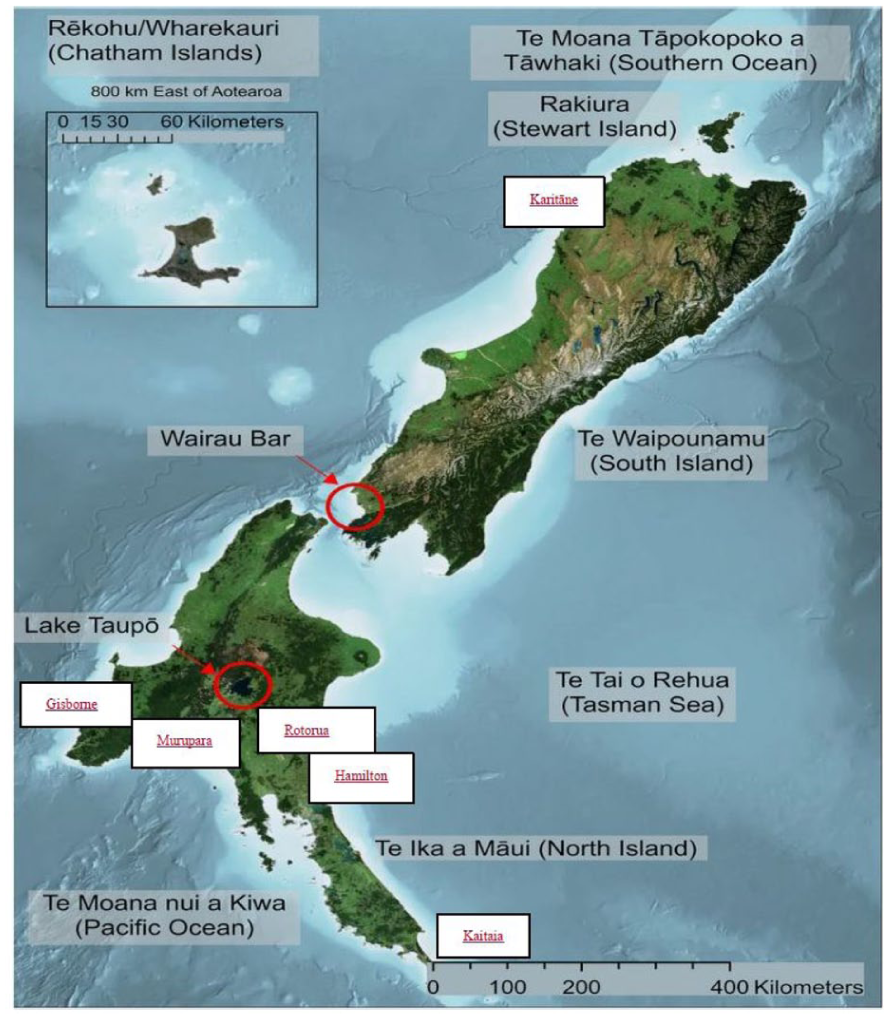
Location of the six Māori providers and kaumātua communities (adapted from Bailey-Winiata et al., 2024, p. 3).
This following section describes the methodology, advisory boards, ethical processes and data collection processes.
He pikinga waiora | Enhancing well-being
The co-design process was guided by the He Pikinga Waiora Implementation Framework (HPW) (Oetzel et al., 2017) which utilises co-design, co-implementation, and co-evaluation of interventions with communities. HPW centres kaupapa Māori (Māori approach) along with best practice from the international literature: community engagement, culture-centredness, systems thinking, and integrated knowledge translation (Frerichs et al., 2016; Smith, 2000; Wallerstein et al., 2018). The framework emphasises self-determination and mātauranga Māori along with a participatory research approach where projects are co-designed with end-users both those who implement it and those who use or benefit from it. In the present research, HPW facilitated the translation and uptake of research into systemic practice, thereby increasing the potential of a sustainable intervention determined by kaumātua. This overall methodology reflects kaupapa Māori in that it ensures the project is kaumātua-led and end-user-led, that is, kaumātua service providers and other stakeholders.
He kāhui tohunga | Advisory groups
As part of this project’s participatory design, we used advisory groups to ensure cultural safety and effective programmes. For the overall KMMP programme of research, a Board Advisory Group (BAG) was established to oversee both projects. For this project an Expert Advisory Group (EAG) was also formed. The BAG comprised trustees of RKCT, all kaumātua providing programme governance, cultural oversight, guidance, and input into all the research methods, procedures, data-collection processes, and analysis undertaken. This group has served in this capacity on prior projects and applies the guiding principles upon which RKCT operates as a for-kaumātua-by-kaumātua organisation. The EAG comprised six experts in health and social issues related to the project who ensured the project aligned with best practices. The members were also predominantly Māori with two non-Māori representatives, who are linked into the government, and aware of relevant tikanga.
Te huarahi o te tikanga me te whakatakotoranga | Ethical and structural processes
Ethical approval from the University of Waikato Human Research Ethic Committee to conduct this research was approved January 2021. During 2021 the research team set about visiting each provider to hold the initial wānanga with kaumātua and representatives from each provider. The research team travelled a Māori nei (in a Māori culturally prepared and appropriate way) ensuring a kaikōrero (orator), and a kaikaranga (caller) were present to uphold tikanga Māori and kaupapa Māori protocols. This also ensured that the wānanga could be conducted in te reo Māori. Each provider, through existing relationships, was previously invited and had accepted to be a collaborator in the research and, therefore, was already aware of the overall purpose, aims, and objectives of the project.
Each provider was provided with the financial resources to appoint community researchers. with funding for 0.5 Full-Time Equivalent for 18 months to administer the programme and complete data collection including conducting focus groups. The community researchers received training in research ethics and the specific research protocols prior to the commencement of data collection and the programme; they also received training in specific research protocols. Typically, the community researchers had existing positions within the providers and existing relationships with kaumātua; three of the providers had kaumātua as community researchers. The roles and responsibilities included ensuring the smooth operation of data collection for the larger project and this current co-design process.
For the co-design process, we used purposive sampling, criterion-based, to recruit kaumātua to participate in a focus group to discuss the design of the programme. As already alluded to, the community researchers already had existing relationships with the kaumātua they were to work within the project, some very long-standing, some through whakapapa (genealogy). Many of the community researchers had relationships with kaumātua based on weekly or even daily interactions given the wrap-around health and social and cultural services that was a practice of all the providers. Kaumātua were selected because they had knowledge of the community history and local culture or were likely to be participants in the eventual programme. Kaumātua were initially contacted regarding participation by the community researcher through an in-person meeting, phone call, or another activity, for example, weekly kaumātua activities. The community researcher provided an overview and gauged interest. If yes, an information sheet was provided and a consent form completed.
Ngā wānanga me te kohikohinga rauranga | Discussions and data collection
HHT is an intergenerational and cultural revitalisation model for learning; it is to provide a platform to facilitate cultural continuity and intergenerational transference of mātauranga (knowledge), te reo (the language) and tikanga while enhancing kaumātua hauora and mana motuhake. To develop the HHT for each provider, kaumātua and providers had tino rangatiratanga (self-determination, rights of leadership) to create and design their own HHT which would serve the needs and aspirations of their respective kaumātua and providers.
In the initial wānanga with the providers, the research team gave an overview of HHT to give a contextual setting prior to discussing the project’s design. The project overview included five topics that essentially described the drivers behind the research: (a) building on kaumātua strengths to holistically enhance hauora and mana motuhake, (b) creating cultural revitalisation model for learning te reo Māori centred around tikanga, (c) developing an intergenerational model for increasing physical activity and cultural knowledge exchange including te reo Māori, (d) increasing the well-being of kaumātua by focusing on and valuing te ao Māori (the Māori world) surrounding ageing, and (e) creating a better quality of life for kaumātua as esteemed and valued contributors to communities and whānau. Providing kaumātua and the providers with the background underpinning the research allowed for more effective engagement, a better understanding of the aims of the project and the mana motuhake (decision-making) to align their aspirations with the design of their HHT, which was particular and contextualised to each of the six providers. Following on from the project overviews, the research team presented the foundational pou (posts) to be included in each HHT. That is, the intergenerational transference of mātauranga Māori, tūhakahaka (physical activities) and te reo Māori. The research team also provided suggestions regarding logistics, for example, for the purpose of collecting and recording data we outlined that running wānanga every 2 months would allow for consolidation activities to occur in the interim between wānanga.
No time limit was placed on the initial wānanga which allowed kaumātua to talk freely among themselves about their aspirations, their needs, and their dreams in respect to the design of their HHT, some of which is captured in the following sections. Open-ended questions were used to guide the process of the initial wānanga including, “What would your ideal HHT look like, and what important aspects should be included?” The initial wānanga were then transcribed and thematised. The data for each provider was then presented back to the kaumātua and providers in a follow-up wānanga held 3 to 6 months after the initial discussions where the final HHT programme was created. We asked providers and kaumātua to create four wānanga that would address the aspirations identified.
Ngā wawata me ngā maruāpō o ngā kaumātua | Kaumātua aspirations and dreams
Table 1 presents a summary of the four wānanga for each provider that were inspired by the aspirations.
He Huarahi Tautoko wānanga for each provider.
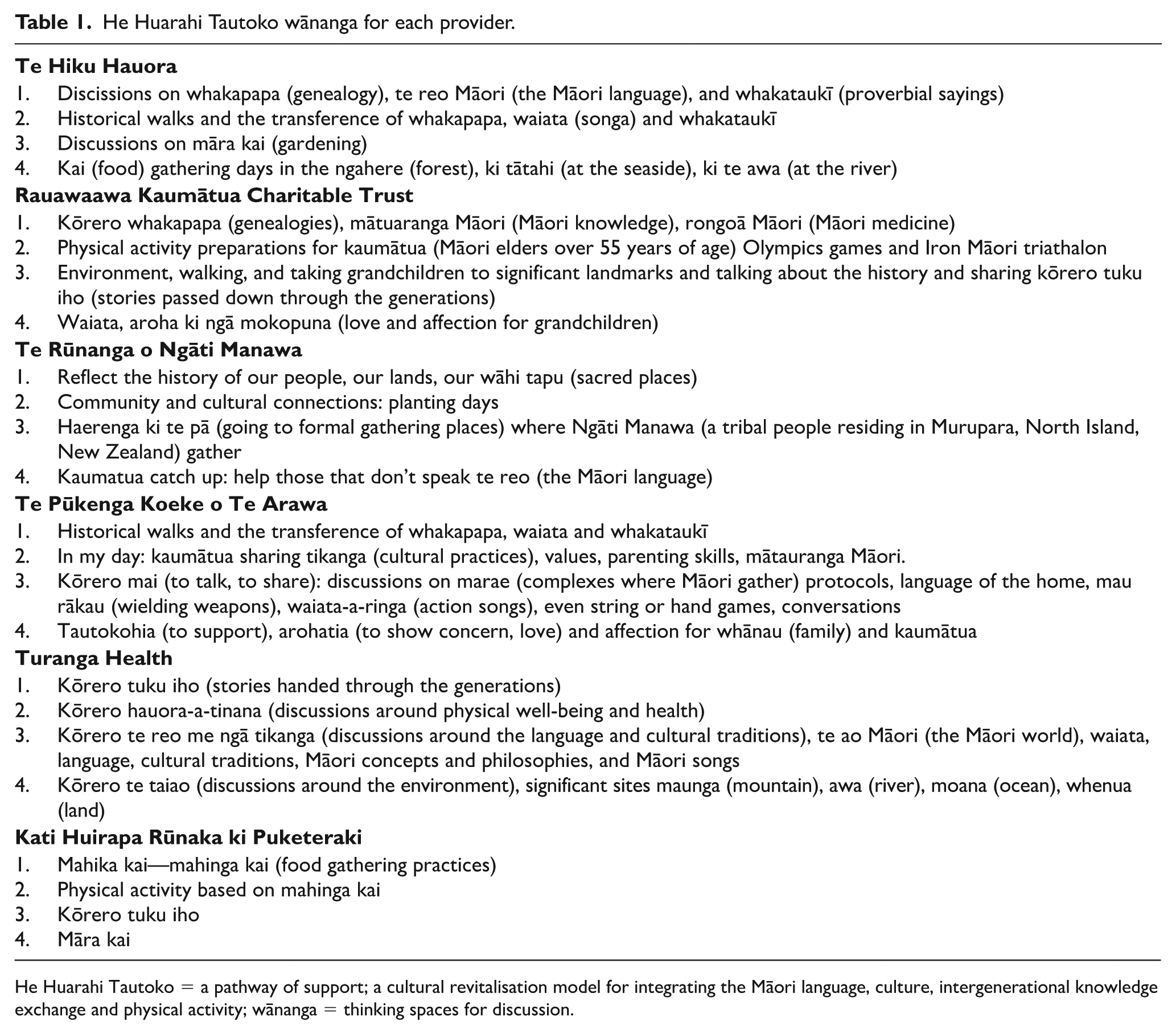
He Huarahi Tautoko = a pathway of support; a cultural revitalisation model for integrating the Māori language, culture, intergenerational knowledge exchange and physical activity; wānanga = thinking spaces for discussion.
The following section discusses the first wānanga with each provider. Through direct quotes, we demonstrate the many aspirations that the kaumātua held for HHT.
Te Hiku Hauora
The initial wānanga with Te Hiku Hauora was attended by seven kaumātua, comprising four kuia (elder female) and three koro (elder men), as well as two kaimahi (worker) and three researchers. The research team was formally welcomed onto Te Hiku Hauora premises in Kaitaia. During this wānanga, the kaumātua articulated their specific expectations for the HHT project. Their priorities included whakapapa, te reo Māori, whakataukī (proverbial sayings), mātauranga Māori, waiata (songs), hītori (histories), and wānanga focused on māra kai (food gardens) and traditional food gathering practices. In addition, the kaumātua emphasised the Māori values they wanted to underpin the wānanga, such as whanaungatanga (building and maintaining relationships), kotahitanga (unity and collective action), tautokotanga (mutual support), and manaakitanga (hospitality and caring for others).
The kaumātua also expressed concern for those elders who were isolated, viewing this project as a potential means to alleviate such loneliness. This sentiment was poignantly captured by kuia tuatahi (first elder female), in her eighties, who lamented, “and that’s what I miss, is my moko[puna] [grandchildren]; they’re in Australia and they’re in Rotorua, and I’ve got to go to them.” Kuia tuarua (second elder female), in her seventies, articulated a desire to delve into the histories and backgrounds, noting, “it was the actual histories and the backgrounds” that intrigued her. She further emphasised the importance of learning te reo Māori, adding, “all I wanted to know was te reo, how they speak it properly” (kuia tuarua). Koro tuatahi (first elder male), in his seventies, highlighted the significance of pepeha (tribal sayings) for his family, stating, “I think the most important for me and my whānau is pepeha.” In addition, kuia tuatahi expressed her passion for gardening, saying, “my passion is the garden, and that’s where I’d like to get us involved, the garden.” Koro tuatahi also stressed the importance of whanaungatanga, emphasising the need for “connecting with other interested groups or organisations.”
Throughout this initial wānanga, the desire to transmit whakapapa and mātauranga Māori to future generations was a dominant theme. Koro tuarua (second elder male), in his 60s, discussed the importance of passing down this knowledge to his mokopuna to help them connect with their wider whānau that they may not yet know, saying, I would like to pass that on to my moko[puna], for the purpose of them being able to connect to their wider whānau that they don’t know. But if they have that confidence of the pepeha, then it will inspire or make them realise they belong to a bigger family. This is just not them.
The importance of preserving and sharing traditional mātauranga was further illustrated by the reflections of one of the kaimahi from Te Hiku Hauora, who shared, For us, we had three or four acres of kūmara (sweet potato) that we all moaned and groaned about planting . . . But while we were doing that, there was all the kōrero [discussions] that was happening. And that for me is one of the most valuable things that you could possibly be given. And that’s when I realised when my son said to me, “But how do you know the mullet are coming?” And for me to be able to share with him how I knew. And things like I know when certain Pōhutukawa bloom, that’s when we need to go and get our crayfish. That’s when the kinas are gonna be the sweetest, and all those kinds of things. (kaimahi 1)
The kaumātua were resolute in their desire to use HHT as a platform to enhance the use of te reo Māori by increasing kōrero in the language, introducing new words, whakataukī, whakapapa, hītori, and waiata. However, they were equally determined to integrate these activities within the existing framework provided by Te Hiku Hauora, ensuring that the research project would not only preserve but also invigorate the cultural practices that are vital to their identity and well-being.
Rauawaawa Kaumātua Charitable Trust
The original wānanga with RKCT was attended by three kuia and three koro, all in their 70s, alongside four researchers. This wānanga was at the RKCT premises in Frankton, Hamilton. Central to the discussions were the Māori values that RKCT and their kaumātua wished to incorporate into the HHT project. Much like the approach taken by Te Hiku Hauora, the focal themes identified included whakapapa, mātauranga Māori, rongoā Māori (Māori medicine), physical activities such as walking, and the cultural practice of waiata. In addition, the concept of a Kaumātua Olympics, an event bringing together elders from various providers to engage in a range of games with varying activity levels, was proposed as a means of fostering physical well-being and friendship among kaumātua.
These themes were deeply intertwined with the kōrero shared during the wānanga, which highlighted the importance of whakapapa, whanaungatanga, and physical activity. For instance, kuia tuatoru (third elder female), in her seventies, highlighted the significance of whakapapa in relation to land stewardship, stating, “knowing your whakapapa when you start dealing with whenua [land] . . .. for me, what else is there but whakapapa.” This emphasis on the centrality of whakapapa reflects the intrinsic connection between identity, land, and ancestry within Māori cultural values. Similarly, kuia tuawhā (fourth elder female), also in her seventies, articulated a broader cultural aspiration: “what I’ve been doing with them is trying to get them to think Māori in a way.” This comment stresses the importance of fostering a Māori-centric worldview among participants, encouraging them to engage with the wānanga through a distinctly Māori lens.
The social and cultural value of whanaungatanga was also brought to the fore during the wānanga. Koro tuatoru (third elder male), in his seventies, observed, “I think with kaumātua they like to sit together and reminisce in te reo. . . . They like to rekindle how they grew up, where they grew up.” This sentiment highlights the role of te reo Māori in fostering connections among elders, allowing them to reflect on shared experiences and strengthen their bonds through the recollection of their past. The importance of maintaining these connections was further emphasised by kuia tuawhā, who spoke of the “wonderful skills of whanaungatanga” that are integral to the kaumātua community.
In relation to physical activity, kuia tuatoru expressed the value of group exercise in promoting well-being, stating, we’ll go swimming. We go walking as a group around the lake. We go to gym classes when we get there. So, all those kinds of activities have helped promote the well-being and physical activity. . . . But I think that being physically active is a good thing. When your body gets tired, you know, and you stop. . . . learn how to live. Go walking.
This insight underscores the importance of physical activity in enhancing the health and well-being of kaumātua, while also providing opportunities for social interaction and community engagement.
As the wānanga progressed, kaumātua conveyed a deepening appreciation for the personal mātauranga shared by their peers, particularly through activities centred around significant cultural and historical sites. As was the case with Te Hiku Hauora, the kaumātua at RKCT expressed a strong desire to transmit their knowledge to future generations, particularly to their mokopuna.
Te Pūkenga Koeke o Te Arawa
The initial wānanga with Te Pūkenga Koeke o Te Arawa commenced with a pōwhiri (traditional welcome ceremony) at Owhata Marae in Rotorua. The event was attended by four kuia, two koro, two kaimahi, and two researchers. Upon the conclusion of the formalities of the pōwhiri, the group transitioned to the designated kaumātua space located behind the marae. The kaumātua of Te Pūkenga Koeke o Te Arawa were deliberate in articulating the content they wished to include in their HHT. Key areas of focus included historical walks, the transmission of whakapapa, waiata, and whakataukī. In addition, they proposed the establishment of a legacy day dedicated to sharing tikanga, values, and life-parenting skills. Given the proximity of their location to the marae, the kaumātua also emphasised the importance of integrating local taonga (treasures), such as guided walks to significant sites, the sharing of local history, and the recounting of ancestral narratives. The kaumātua present expressed the concepts and values they wanted to see embedded in the HHT, which included the sharing of knowledge, kōrero mai (to talk, to share), tautokohia (to support), and arohatia (to show concern, love).
To illustrate these values, kuia tuarima (fifth elder female), in her seventies, appreciated the idea of holding wānanga that allow for the sharing of diverse whakaaro (thoughts, ideas), stating, “I like the idea of the wānanga, because you can have somebody talking to you about one thing and then someone talk about something else and it’s interesting, not just having that one kōrero.” This sentiment highlights the value of multifaceted discussions and the richness they bring to the learning environment. Reflecting on mātauranga, kuia tuarima further observed, “I notice with a lot of the younger ones, they say, ‘Sit and talk to us.’ It’s the memories eh. . . . We had people that went to the bush all the time.” This statement highlights the intergenerational transmission of knowledge and the desire of younger generations to connect with their cultural heritage through shared experiences and stories.
Koro tuawhā (fourth elder male), in his eighties, stressed the importance of this knowledge transfer across generations, asserting, “Mai i tō reanga ki ā tatou tamariki” [from your generation to our children]. . . . I think this is about gathering information that can be utilised for the next generations to come and how do we hand down knowledge.” This perspective reinforces the notion that mātauranga is not only about preserving cultural practices but also about ensuring that such knowledge is effectively transmitted to future generations.
Further reflecting on mātauranga Māori, kuia tuaono (sixth elder female), also in her eighties, provided specific examples of traditional knowledge, such as the correct tikanga when going fishing or gathering seafood, and the significance of understanding the stars. She recalled, Don’t use a metal thing eh, getting a pipi [a common edible shellfish]. . . . Our people tell us . . . . back to shore and eat it away. Because our other divers in that area, they might drown . . . . you knew within your hapū who was the one who had the knowledge about the stars, the one who had the, you know, the knowledge for this and that.”
This example highlights the intricate and practical nature of mātauranga Māori and its application in everyday life, highlighting the importance of preserving and passing on these teachings.
Te Rūnanga o Ngāti Manawa
The initial wānanga with Te Rūnanga o Ngāti Manawa was convened at their headquarters in Murupara, attended by three kuia, three koro, two kaimahi, and three researchers. The kaumātua of Ngāti Manawa were unequivocal in articulating their desires and intentions for the project, emphasising their tino rangatiratanga and the centrality of te reo Māori in the proceedings, as most of the discussion was conducted in te reo Māori. Central themes that emerged from the discussion included concerns about loneliness and the use of technology. As articulated by kuia tuawhitu (seventh elder female), in her seventies, “I guess that’s part of this loneliness thing you talk about; and that is one way that you can keep in touch with them. . . . I think technology is a huge one for us, at our age”
Further reflections highlighted the importance of intergenerational knowledge transmission. A kaimahi (worker) emphasised the need for connecting with tamariki (children) to share knowledge, stating, “I’m thinking about the connection to the tamariki and being able to share your knowledge with them” (kaimahi 2). The elders were resolute that the project should be Ngāti Manawa-centric, as emphasised by koro tuarima (fifth elder male), in his eighties, “me ngā āhutanga e pā ana ki a Ngāti Manawa tūturu [with all aspects pertaining only to Ngāti Manawa].” This sentiment was echoed by two koro, with koro tuaono (sixth elder male) expressing the importance of cultural practices, “karakia i roto i te ngahere [incantations in the bush],” and koro tuawhitu (seventh elder male) adding, “waiatatia rātou ngā waiata, ngā wāhi tapu . . . ki ngā kupu ki ngā wāhi tapu [singing the songs, the sacred places. . . to the words, to the sacred places].”
Topics such as the iwi’s history, community, and cultural connections were identified as priorities. Koro tuawhitu reflected on the spiritual significance of the environment, stating, “He tika tērā kōrero mō te taiao, taka ērā kōrero i raro i te wairua. Pakeke mai au i tērā reanga . . . . Tā mātou he whakawātea [That talk is correct for the environment . . . . that talk came from the spiritual realm. I grew up in that generation . . . . to us it was cleansing].” Koro tuawaru (eighth elder male) reinforced the importance of cultural heritage, noting, well that’s a wonderful experience; they’re planting trees . . . . e kōrero ana mō ngā kōrero hitori e pā ana ki ngā wahi i roto i a Ngāti Manawa [talk about the history of Ngāti Manawa] . . . There’s a platform and a foundation for the very things that this kaupapa [topic] is based on . . . . that’s what I love about your kaupapa.
The theme of community connection was also highlighted by the kaimahi, who remarked on the role of kaumātua in fostering generational links to the land, We also involve the kaumātua in our planting days. . . . They’re also part of the community who connect different generations to the whenua, because of the kōrero and the stories that they have; and what they do with. . . . That kind of connection is something that we want to grow. (kaimahi 2)
Turanga health
The initial wānanga with Turanga Health was attended by four kuia and three koro, two kaimahi along with three researchers. This wānanga was held at Turanga Health premises in Gisborne. Turanga Health shared similar whakaaro with other providers concerning their aspirations and goals for cultural and intergenerational knowledge transmission. These aspirations encompassed kōrero tuku iho (ancestral stories to be passed down), intergenerational mātauranga, the transmission of cultural knowledge, kōrero hauora-a-tinana (discussions around physical well-being and health), kōrero te reo me ngā tikanga (discussions around the language and cultural traditions), concepts from te ao Māori, whakapapa, and the preservation of waiata tawhito (ancient songs).
An example of cultural knowledge transmission was poignantly illustrated by koro tuaiwa (ninth elder male), in his eighties, who reflected, “and you had karakia [prayers]. . ..in the māra kai (food gardens) . . ..What you’ve got you always share it out. Those were the values that I was brought up with, and I shared it with my kids and my mokopuna.” This sentiment stresses the deep commitment to ensuring that traditional values and practices are passed down to younger generations. Kuia tuawaru (eighth elder female), in her eighties also reminisced about the importance of living off the land, stating, “It was a beautiful life in our days with the tīpuna (ancestors). We didn’t care about town; we didn’t care about money; we lived off the land.” The importance of preserving and sharing traditional knowledge was further emphasised by koro tuaiwa, who shared, “I know with my nan, she had a certain way of planting kumaras [sweet potatos], and you had to plant it to the east. . . .‘Why plant it to the east?’ And she used to whack me. . . . it was the sun.”
The emphasis on understanding and practicing the values of manaakitanga, tika (correctness), and pono (truthfulness) was further highlighted by kuia tuaiwa (ninth elder female), who remarked, “manaakitanga, tika and pono is something that . . . need to know. . . . we’ve got our kaumātua and all their knowledge; they want to share it. They enjoy it when you talk about old times.” However, alongside the importance of cultural preservation, the kaumātua expressed concern regarding contemporary health issues, particularly obesity within the whānau. This concern was captured by kuia tuangahuru (tenth elder female), in her seventies, who stated, “To me, the kai [food] part was very important because we’ve got a lot of obesity in our whānau. . . . eating correctly and exercising.” In addition, kuia tuawaru expressed her support for kaumātua who engaged in swimming activities, noting, “A lot of the older generation are going into the pools, at eighties.” Supporting the importance of physical activities, a kaimahi added, “Māori Olympics gives us an opportunity to look at how we can create a pathway for our people, and maybe have inter-marae, inter-hapū, inter-iwi competitions” (kaimahi 3).
The significance of te taiao (the environment) was also emphasised by the kaumātua, who identified it as a crucial aspect of their world. This included visits to significant sites such as maunga (mountain), awa (river), moana (ocean), whenua (land), and marae (tribal meeting grounds). The kaumātua discussed the importance of providing opportunities and spaces for knowledge holders to share and recount whakapapa stories, as well as promoting healthy eating practices and nutrition education. These topics were supported by their kōrero, as illustrated by an account of visiting significant landmarks: “we came up with the idea of a heritage trail that goes from Titirangi right around the moana, right to the Waipaoa River, the Wherowhero Lagoon, where the waka Horouta (ancestral canoe of the East Coast Māori, Hawkes Bay, New Zealand)is buried, in that lagoon” (koro tuaiwa).
Like other kaumātua from different regions, the kaumātua of Turanga Health were deeply committed to ensuring that whakapapa, waiata, mātauranga Māori, tikanga, and te reo Māori were preserved and passed down to the next generation. This commitment to cultural preservation and intergenerational knowledge transmission reflects the broader aspirations of Māori communities across Aotearoa New Zealand, who continue to prioritise the maintenance and dissemination of their rich cultural heritage.
Kāti Huirapa Rūnaka ki Puketeraki
Kāti Huirapa ki Puketeraki kaumātua focused on mahika kai—mahinga kai (food cultivation and gathering), kōrero tuku iho, māra kai, and weaving. Kaumātua present valued integrating Māori values such as whakawhanaungatanga (forging relationships and connections) through trips to mahika kai—mahinga kai sites of importance. Accordingly, these trips were to include learning and sharing practices of gathering at specific locations and specific kōrero surrounding the names of those places. Kaumātua highlighted the importance of knowledge holders within whānau sharing this knowledge with all involved. Kai knowledges included māra (garden) sites, the history of the māra, and knowledge of planting and growing kai. Other knowledges referred to the practices and activities of weaving, such as harvesting, and tidying up pā harakeke (flax bush, flax plantation) at marae. Finally, kaumātua present desired the integration of te reo Māori, mātauranga and physical engagement across all HHT wānanga.
Te matapakitanga | Discussion
Central to the KMMP’s programme of research and to this project is a strengths-based approach that conceptually reframes the notion of ageing away from being grounded in a deficit model (Oetzel et al., 2021; Rolleston et al., 2020; M. Simpson et al., 2022). In Māori terms, this foregrounds kaumātua mana motuhake (kaumātua self-determination and decision-making), which has conceptually driven all aspects of this research (Hokowhitu et al., 2017, 2020, 2022; Oetzel et al., 2020). Not surprisingly, although not always referred to as strengths-based or mana motuhake, the six providers we have worked with in this research inherently recognise the importance of centralising kaumātua in the decision-making processes that affect their lives. As a methodological framework then, mana motuhake and HPW determined appropriate kaupapa and methods beginning with the kaumātua, and sector led board and EAGs.
The present article has highlighted the initial wānanga with each provider and their respective kaumātua, which took place to enable the co-construction of the HHT project for each provider. The wānanga initiated this research project by focusing on the aspirations of kaumātua, and by collaborating with the service providers from the outset, reflecting the research programme’s kaumātua mana motuhake ethos. Common themes and critical concepts that came out of the wānanga included whakawhanaungatanga, kotahitanga, rangatiratanga (leadership), and māramatanga (enlightenment) while the integration of te reo Māori, tikanga Māori, and mātauranga Māori within each HHT was viewed as critical to the sharing of intergenerational knowledge as a strategy to engage with rangatahi (younger generation) and whānau. These critical concepts and strategies were viewed by kaumātua as valid methods for supporting identity, whakapapa, waiata, tikanga, and history specific to each place, whether that be directly tied to an iwi or hapū, for example, Te Rūnanga o Ngāti Manawa, Te Pūkenga Koeke o Te Arawa, and Kāti Huirapa Rūnaka ki Puketeraki or to a provider such as RKCT, Te Hiku Hauora, and Turanga Health. These initial aspirations led to the development of the four wānanga for the HHT programme for each of the providers.
The majority of health research on Indigenous peoples simply fails to acknowledge the causative effects of colonisation (Atkinson, 2013; Chandler & Lalonde, 2008; Duran et al., 1998; Hirini et al., 2005; Moreton-Robinson, 2016; Paradies et al., 2015; Vizenor, 2008). Many of today’s kaumātua were, for example, punished for speaking te reo (the Māori language) through the colonial education system including in Native Schools (Hallett et al., 2007; Hokowhitu, 2003; Oster et al., 2014; Pihama et al., 2014; Simon, 1986). Although physical activity (Rolleston et al., 2017, 2019) was a core component of each HHT, what was more significant was the cultural integration already described and as prescribed by kaumātua themselves. KMMP’s central thesis asks whether programmes for Māori elders, which integrated te reo Māori, tikanga Māori, and mātauranga Māori, if underpinned by kaumātua mana motuhake, would reduce social isolation, cultural dissonance, disruption of intergenerational transference of knowledge, and language loss which, ultimately, would lead to healthier outcomes for kaumātua.
The Mātauranga Tuku Iho project, with the HHT programme, aims to provide a strengths-based approach focused on cultural revitalisation to help address the ravages of colonial history. The aim of this article was to describe the co-design process that centred kaumātua aspirations for the HHT programme and the HHT programme itself for each of the six providers. The HHT programmes focus on intergenerational cultural knowledge exchange, tikanga, te reo Māori, and physical activity as guided by kaumātua in each rohe (district). Each HHT has unique attributes related to the specific areas, but all provides a positive, culturally grounded approach to enhance kaumātua well-being. The programme will be evaluated through a mixed method approach including kaumātua voices. Future research will present the results of that evaluation.
Whakapainga | Closing
Hei whakakapi ake me hoki anō ki te whakataukī, “Ki te kore ngā pūtake e whakamākūkūngia, e kore te rākau e tupu tōtika ake.” Ko ō tātou pēperekōu ērā, ko ngā puna o te mātauranga, ko ngā kaipupuri i ngā kōrero a kui mā, a koro mā, i ngā tikanga Māori me te reo Māori, ko rātou, ko koutou te tūāpapa o tēnei rangahau, mei kore ake ko koutou kua kore tēnei rangahau e eke Tangaroa. Nā koutou tēnei kaupapa i whakarangatira, nō reira, kua kore e mimiti ō mātou aroha ki a koutou, koutou hoki i tautoko i tēnei rangahau kia rongo ai te ao i tōna kakara. In closing let us return to the proverbial saying at the beginning of this article, “If the roots of the tree are not watered, nourished, nurtured with all the goodness needed, then surely the tree will not grow and fruit to its full potential.” Metaphorically our kaumātua are the trees that must be nurtured so they can flourish and continue to be significant contributors to our societies. Afterall they are the carriers of the knowledge handed down from one generation to the next, they are also the carriers of the language, and of the culture. So, with this in mind we humbly thank you for your significant contribution and your notable participation in this research project.
Supplemental Material
sj-docx-1-aln-10.1177_11771801251374127 – Supplemental material for He Huarahi Tautoko: intergenerational model for learning
Supplemental material, sj-docx-1-aln-10.1177_11771801251374127 for He Huarahi Tautoko: intergenerational model for learning by Sophie Nock, Brendan Hokowhitu, Pare Meha, Huia Huriwaka, Maramena Vercoe, Tania Tahu, Joanne Urlich, Rachel Warbrick, Honor Vercoe, George Brown, Shirley Keown, Poia Rewi, Bevan Erueti, Tracy Perry, Rangimahora Reddy, Yingsha Zhang and John G Oetzel in AlterNative: An International Journal of Indigenous Peoples
Footnotes
Acknowledgements
We acknowledge the support of the six Māori service providers from around the country, their managers, community researchers and their kaumātua who willingly agreed to participate in this research. We also acknowledge the Expert Advisory Group and the Board Advisory Group supported by Rauawaawa Kaumātua Charitable Trust.
Tauākī pūtea | Funding
The authors disclosed receipt of the following financial support for the research, authorship and publication of this article: Ageing Well National Science Challenge, New Zealand’s Ministry of Business, Innovation and Employment #18566SUB1953.
Whakapuakanga o ngā paanga taupatupatu | Declaration of conflicting interests
The authors declared no potential conflicts of interest with respect to the research, authorship and publication of this article.
Haurongo | Authors’ note

Kuputaka | Glossary
a Māori nei in a Māori culturally prepared and appropriate way
ariā abstract
aroha ki ngā mokopuna love and affection for grandchildren
arohatia to show concern, love
awa river
haerenga ki te pā going to formal gathering places
hapū sub-tribe
hauora holistic health
he huarahi rangahau methods
He Huarahi Tautoko a cultural revitalisation model for integrating the Māori language, culture, intergenerational knowledge exchange and physical activity
he kāhui tohunga advisory groups
he pikinga wairua enhancing well-being
Hei Manaaki Ngā Kaumātua’ to enhance the quality of life and well-being of kaumātua
hei mihi formal greeting
hītori history
iwi tribe, tribal
kai food
kaikaranga caller
kaikōrero orator
kaimahi workers, worker
karakia prayers
Kāti Huirapa Rūnaka a kaumātua service provider inki Puketeraki Karitane
kaumātua Māori elders over 55 years of age
kaumātua mana motuhake kaumātua self-determination and decision-making
Kaumātua Mana Motuhake Pōī Elder’s self-determination
kaupapa topic
kaupapa Māori Māori approach
kōrero talk, discussion, speech
kōrero hauora-a-tinana discussion around physical well-being and health
kōrero mai to talk, to share
kōrero te reo me ngā tikanga discussions around the language and cultural traditions
kōrero te taiao discussions around the environment
kōrero tuku iho stories passed down through the generations, ancestral stories to be passed down
kōrero whakapapa geneologies
koro elder male
koro tuatahi first elder male
koro tuarua second elder male
koro tuatoru third elder male
koro tuawhā fourth elder male
koro tuarima fifth elder male
koro tuaono sixth elder male
koro tuawhitu seventh elder male
koro tuawaru eighth elder male
koro tuaiwa ninth elder male
kotahitanga unity and collective action
kuia elder female
kuia tuatahi first elder female
kuia tuarua second elder female
kuia tuatoru third elder female
kuia tuawhā fourth elder female
kuia tuarima fifth elder female
kuia tuaono sixth elder female
kuia tuawhitu seventh elder female
kuia tuawaru eighth elder female
kuia tuaiwa ninth elder female
kuia tuangahuru tenth elder female
kūmara sweet potato
mahika kai—mahinga kai food cultivation and gathering
mahinga kai food gathering practices
mana motuhake self-determination, autonomy and decision making
manaakitanga The practice and value of caring and sharing, hospitality, and caring for others
Māori Indigenous people of Aotearoa—New Zealand
māra garden
māra kai food gardens
marae complexes where Māori gather, tribal meeting grounds
māramatanga enlightenment
mātauranga knowledge
mātauranga Māori Māori knowledge
mātauranga tuku iho knowledge intergenerationally passed down
mau rākau wielding weapons
maunga mountain
moana ocean
mokopuna grandchildren
ngā wānanga me te discussions and data collection
kohikohinga raraunga
ngā wawata me ngā maruāpō kaumātua aspirations and o ngā kaumātua dreams
Ngāti Manawa a tribal people residing in the Murupara area
pā harakeke flax bush, flax plantation
pepeha tribal saying
pipi a common edible shellfish
pono truthfulness
pou posts
pōwhiri traditional welcome ceremony
rangatahi younger generation
rangatiratanga leadership
rohe district
rongoā Māori Māori medicine
tamariki children
taonga treasures
tautokohia to support
tautokotanga mutual support
te ao Māori Māori epistemology; the Māori world
te huarahi o te tikanga
ethical and structural processes
matatika me tewhakatakotoranga
Te Hiku Hauora a kaumātua service provider in Kataia
Te Pūkenga o ngā Koeke a kaumātua service provider in o Te Arawa Rotorua
te reo Māori; te reo the Māori language
Te Rūnanga o Ngāti Manawa a kaumātua service provider in Murupara
te taiao the environment
Te Tiriti o Waitangi The Treaty of Waitangi
tika correctness, right
tikanga cultural practices
tikanga Māori Māori cultural practices
tino rangatiratanga self-determination, rights of leadership
tipuna ancestors
tūhakahaka physical activities
wāhi tapu sacred places
waiata song, songs
waiata tawhito ancient songs
waka Horouta ancestral canoe of the East Coast Māori, Hawkes Bay, New Zealand
wānanga thinking spaces for discussion
whakaaro thoughts, ideas
whakapapa genealogy
whakataukī proverbial sayings
whakawhanungatanga forging relationships and conncetions
whānau family
whanaungatanga building and maintaining relationships
whenua land
He rauemi tāpiri | Supplemental material
Supplemental material for this article is available online.
References
Supplementary Material
Please find the following supplemental material available below.
For Open Access articles published under a Creative Commons License, all supplemental material carries the same license as the article it is associated with.
For non-Open Access articles published, all supplemental material carries a non-exclusive license, and permission requests for re-use of supplemental material or any part of supplemental material shall be sent directly to the copyright owner as specified in the copyright notice associated with the article.
