




Abstract
Indigenous Communities worldwide stress the vital role of Land in their health and identity. Colonisation has intentionally disrupted this connection; however, Indigenous Communities are reclaiming and reviving their cultures by resisting colonial influences and enacting Indigenous methodologies and pedagogies. This scoping review aimed to understand the ways in which Land-based healing is conducted and understood globally by Indigenous Communities. Two reviewers searched five databases to identify records eligible for inclusion. Principles of content analysis were used to synthesise patterns across the data. The systematic search located 9,018 unique articles, of which 27 fully satisfied the inclusion criteria. Findings represented 13 Indigenous Communities across four countries. The included articles collectively applied a set of seven shared principles in their practice. Based on the evidence discussed in this review, combined with the wealth of global Indigenous Knowledges the significance of Land-based healing for the well-being of Indigenous Peoples is indisputable.
Introduction
Within Indigenous Communities worldwide, the Land holds a maternal and paramount role in health and overall well-being “Mother Earth is like our spiritual grandmother, Nokomis [my grandmother], she taught us to live the good and correct life. Now we should do the same she did, we should respect and listen to our elders. As our spiritual Grandmother, we have the responsibility of taking care of her and not abandon her. We will have to cure ourselves first in order to be able to heal the land . . . that means reconnect the land with our Mother Earth”; it serves as the foundational space where Indigenous Knowledges are conceived and put into practice (Marquina-Márquez et al., 2016, p. 10).
Indigenous education has consistently focused on the Land as its primary teacher (Haig-Brown & Dannenmann, 2008). For Indigenous Peoples, connection to the Land is integral to their sense of identity, encompassing both a physical and spiritual bond that sustains life (Fast et al., 2021). The United Nations Declaration on The Rights of Indigenous Peoples made it abundantly clear that the fundamental human right to access and connect with one’s traditional Lands is critical for self-determination: Indigenous Peoples have the right to maintain and strengthen their distinctive spiritual relationship with their traditionally owned or otherwise occupied and used lands, territories, waters and coastal seas and other resources and to uphold their responsibilities to future generations in this regard. (United Nations, 2007, Article 25)
Colonisation intentionally disrupted these critical connections to Land and continues to obstruct this basic human right (Paradies, 2016).
For Indigenous Peoples, colonisation has given rise to deep and troubling experiences, including government-endorsed assimilation efforts, such as Australia’s Stolen Generations, which caused lasting trauma and disruption to families and Communities (The Australian Institute of Aboriginal and Torres Strait Islander Studies, 2023), as well as widespread instances of sexual, psychological, and physical abuse within Canada’s Residential School system (Hanson et al., 2020). Colonisation also reduces Indigenous Peoples’ access to Lands and traditional resources are decreased, thereby severing individuals’ physical, emotional, and spiritual relationships with their traditional Lands and with each other, processes collectively termed environmental dispossession by Richmond and Ross (Big-Canoe & Richmond, 2014). There are both direct and indirect forms of environmental dispossession; examples of direct forms include the physical removal of individuals from their local Communities and environments. Indirect forms often result in policies and regulations that are intended to decrease Indigenous Peoples’ relationships with the Land and Indigenous Knowledges, such as Residential Schools (Richmond & Ross, 2009). Indigenous Communities around the world are reclaiming their ancestral cultures and resisting the continuation of colonisation by enacting Indigenous methodologies and pedagogies, including through Land-based healing (Fast et al., 2021).
Land-based healing has been a long-standing practice among Indigenous Communities, dating back to before colonial invasion. These practices are diverse in design, structure, and purpose, having unique values for each Indigenous Community globally. The homogenisation and generic labelling of unique processes which comprise Land-based healing in different contexts is a consequence of the legacies of colonisation and environmental dispossession (Redvers, 2020). Land-based healing is a process of reclamation which combats colonisation and environmental dispossession through practices of environmental repossession. Environmental repossession refers to the social, cultural, and political processes by which Indigenous Peoples and Communities are reclaiming their traditional Lands and ways of life (Big-Canoe & Richmond, 2014). Through access to Lands and traditional territories, Indigenous Peoples are empowered to engage in a variety of activities, including hunting, food preparation, weaving, and ceremonial practices such as smudging (Shawanda, 2023), smoke ceremonies, and sweat lodges (Redvers, 2020). The idea of environmental repossession embodies the principle of the seven generations, emphasising the role of Indigenous Peoples as stewards of the Land and everything living on Mother Earth. Consequently, each generation bears the responsibility of safeguarding the well-being and survival of the next generations (Julian, 2016).
The importance of Land-based healing to Indigenous Peoples’ culture, identity, and way of life is indisputable as the well-being of the Lands are intrinsically linked to the well-being of the Peoples (Ahmed et al., 2021). Expanding upon an accumulating body of evidence that highlights the importance of reclaiming Land and the connections between Land, water, sky, and territory for Indigenous well-being, this scoping review aimed to understand the ways in which Land-based healing is being conducted and to synthesise global Indigenous perspectives of Land-based health and healing.
Materials and methods
This review has been registered with the Joanna Briggs Systematic Reviews register, and in accordance with scoping review (Peters et al., 2021) methodologies, the protocol was published with the Centre for Open Science (Poirier, 2023). This review is reported in alignment with the Preferred Reporting Items for Systematic Reviews and Meta-Analyses guidelines (Supplementary Material 1). No similar studies either registered or published were identified through a search of PubMed and PROSPERO.
Positionality statement
In recognition of the deeply relational nature of Indigenous research, we intentionally position ourselves within this work, acknowledging our responsibilities, connections, and the relationships that shape and inform our approach (Russell-Mundine, 2012; S. Wilson, 2008; Yunkaporta, 2019). We are guided by a proud and culturally connected Mushkegowuk (an Indigenous people, Northern Ontario, Canada) woman, who leads with the strength of her identity as a daughter, sister, auntie, and researcher (Samms Hurley & Jackson, 2020). Our team includes both Indigenous and non-Indigenous members from various regions: northern Turtle Island, colonially known as Canada, so-called Australia, and Aotearoa New Zealand. Our team brings together diverse perspectives to confront racial inequities, advance decolonisation, and prioritise Indigenous health. We approach this work with deep humility and gratitude, sharing the immense honour of collaborating with Indigenous Communities around the globe. Our partnerships, spanning numerous projects, are grounded in a collective dedication to supporting the self-determination and well-being of Indigenous Peoples. We are committed to continuous learning and growth throughout this ongoing journey.
Theoretical foundations
The methodological approach to this scoping review was grounded in decolonising theories, which foreground the ongoing impacts of colonisation as related to the marginalisation from dominant culture experienced by those who do not align with colonial values (Klein, 2008; Peacock et al., 2014). Decolonising methodologies work to disassemble settler supremacy by dismantling colonial ways of knowing that continue to dispossess Indigenous Peoples and centring Indigenous identity and cultural action, grounded in self-determination (Corntassel, 2012; de Leeuw & Greenwood, 2017; Smith, 2012). Within this work, the weaving of the seven generations serves as an illustration of a decolonising theory that has influenced the content of this article.
Identifying articles for inclusion
Five databases were searched in January 2023, using keywords and index terms related to “Land-based,” “healing,” and “Indigenous.” The search was first developed for PubMed and then modified for Scopus, Web of Science, Embase, and ProQuest Central—grey literature (Supplementary Material 2). The search was not limited by language, location, study design, or publication date. Although “well-being” was not included as a specific search term, it was a key element in the inclusion criteria. This included, but was not limited to, studies examining Community-based Land healing programmes, culturally relevant practices, and the broader impacts on Indigenous health outcomes, with a particular focus on physical, emotional, mental, and spiritual health. Articles had to focus on Indigenous populations and their healing practices, whether or not explicitly framed within the context of well-being. To be included in this review, articles needed to explore Land-based healing in relation to Indigenous well-being (United Nations, 2007). Records identified during the search were compiled into Covidence (https://www.covidence.org). After the removal of duplicates, Authors 1 and 2 completed title and abstract screening against the inclusion criteria. At this stage, articles considered relevant by either reviewer progressed to full-text review, where reviewers then screened full texts against the inclusion criteria. During the screening phases, any discrepancies were resolved through discussion with a third reviewer. In accordance with scoping review methodologies, critical appraisal was not conducted as this review did not aim to generate critically appraised findings but rather, to collate existing evidence and stories related to Land-based healing (Rowden, 2009).
Data extraction and synthesis
Data from included studies were extracted in a form by the two reviewers. This form was designed to capture key information related to Land-based healing practices in Indigenous Communities and their associated outcomes. These categories were then analysed for common themes related to the shared principles of Land-based healing. This process was conducted utilising principles of content analysis to identify patterns across the data, without introducing reviewer assumptions but rather, maintaining author and participant voices (Pollock et al., 2023).
Results
Search results
The systematic search located 10,337 articles, of which 1,256 were duplicates, leaving 9,018 articles eligible for inclusion in the scoping review. After title and abstract screening, 63 articles were retrieved and assessed for eligibility against the inclusion criteria during full-text review. Thirty-six articles were removed due to non-Indigenous participants and not related to Land-based healing. Therefore, a total of 27 articles were included in this systematic scoping review (Figure 1).
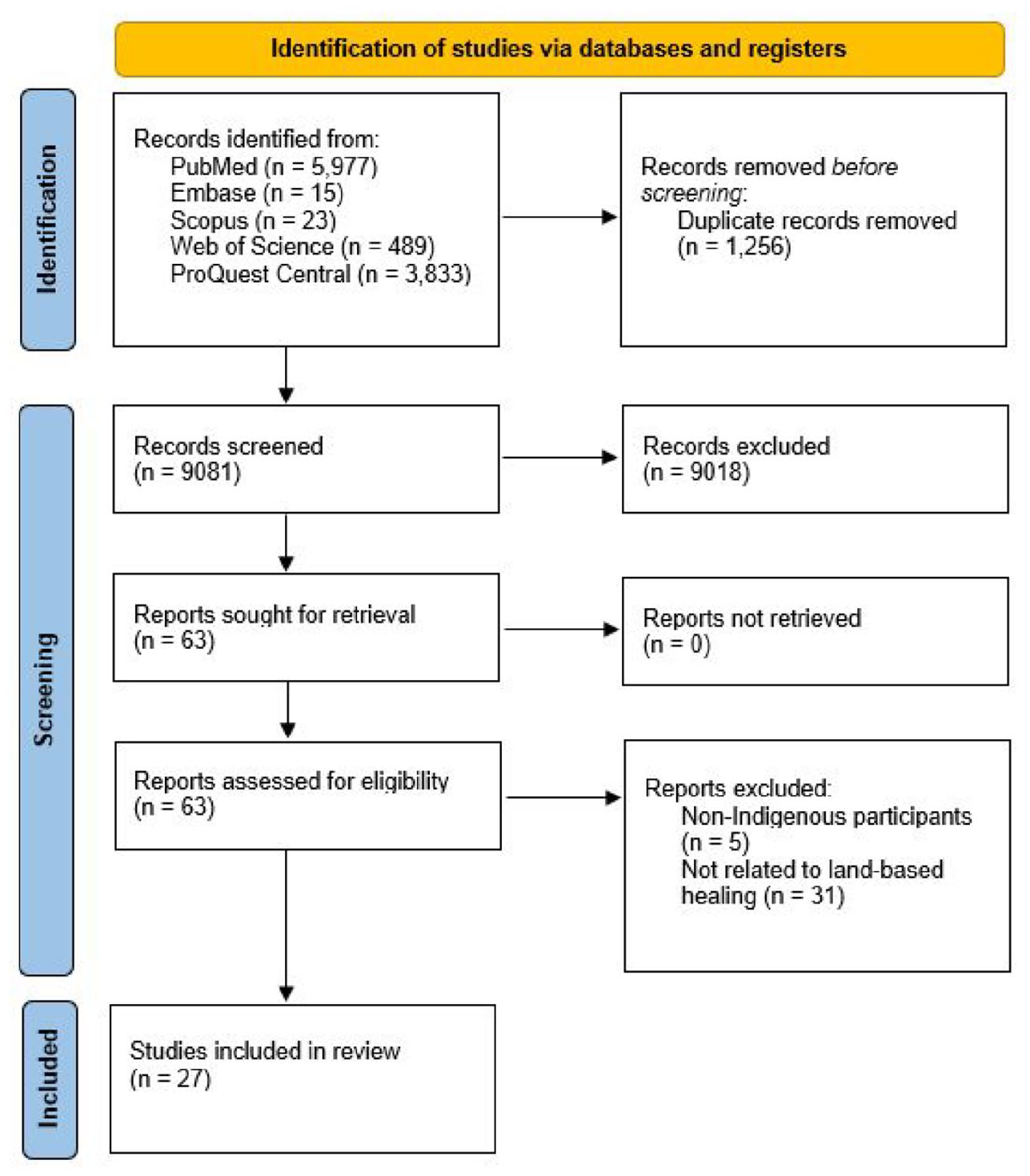
PRISMA flowchart.
Study characteristics
The included articles were published between 2009 and 2022. Sixteen articles were from Canada (Clark et al., 2021; Fast et al., 2021; Galway et al., 2022; Gaudet, 2021; Gaudet & Chilton, 2018; Hatala et al., 2019, 2020; Luig et al., 2011; Marquina-Márquez et al., 2016; Mikraszewicz & Richmond, 2019; Nightingale & Richmond, 2022; Redvers, 2020; Redvers et al., 2021; Stelkia et al., 2021; Tobias & Richmond, 2016; Ward et al., 2021), five were from Australia (Cavanagh et al., 2022; Kingsley et al., 2009; Marchetti et al., 2022; Munro et al., 2017; Waran et al., 2016), two were from each of Aotearoa New Zealand (Hond et al., 2019; Mark et al., 2022) and Hawai’i (Ho-Lastimosa et al., 2014; Keli‘iholokai et al., 2020), and two of the included articles had a global or multiple country focus (Freeman, 2019; Priest, 2022). The included articles employed a range of methods and study designs such as: Commentaries (Priest, 2022; Waran et al., 2016), Ethnography (Freeman, 2019; Gaudet, 2021; Mikraszewicz & Richmond, 2019), Yarning (Cavanagh et al., 2022; Munro et al., 2017), Interviews (Fast et al., 2021; Galway et al., 2022; Gaudet, 2021; Gaudet & Chilton, 2018; Hatala et al., 2019; Ho-Lastimosa et al., 2014; Hond et al., 2019; Keli‘iholokai et al., 2020; Luig et al., 2011; Mark et al., 2022; Marquina-Márquez et al., 2016; Redvers, 2020; Townsend et al., 2009; Ward et al., 2021), Photovoice (Hatala et al., 2020), Sharing circles (Hatala et al., 2020; Redvers et al., 2021; Stelkia et al., 2021; Tobias & Richmond, 2016), and Land-based activities (Gaudet & Chilton, 2018; Marchetti et al., 2022; Mikraszewicz & Richmond, 2019; Nightingale & Richmond, 2022; Redvers, 2020; Redvers et al., 2021; Tobias & Richmond, 2016). Papers discussed health concerns among Métis (Clark et al., 2021), Rotinohshonni (Freeman, 2019), Fort William First Nation (Galway et al., 2022), Moose Cree First Nation (Gaudet, 2021; Gaudet & Chilton, 2018), Stó: lō Nation (Stelkia et al., 2021), Māori (Hond et al., 2019; Mark et al., 2022), Native Hawaiians (Ho-Lastimosa et al., 2014), Labrador Innu (Ward et al., 2021), Kanaka Maoli (Keli‘iholokai et al., 2020), Dene (Luig et al., 2011), Aboriginal and Torres Strait Islander (Cavanagh et al., 2022; Marchetti et al., 2022; Munro et al., 2017; Townsend et al., 2009), Biigtigong Nishnaabeg (Mikraszewicz & Richmond, 2019; Nightingale & Richmond, 2022), and other First Nations Communities (Fast et al., 2021; Hatala et al., 2019, 2020; Marquina-Márquez et al., 2016; Priest, 2022; Redvers, 2020; Redvers et al., 2021; Tobias & Richmond, 2016; Waran et al., 2016). The majority of studies were grounded in Indigenous methodologies which included the Medicine Wheel framework (Clark et al., 2021; Galway et al., 2022), and decolonising methodologies (Fast et al., 2021; Hatala et al., 2019; Hond et al., 2019; Luig et al., 2011; Marchetti et al., 2022; Marquina-Márquez et al., 2016; Mikraszewicz & Richmond, 2019; Nightingale & Richmond, 2022; Redvers, 2020; Redvers et al., 2021; Stelkia et al., 2021; Ward et al., 2021) (Supplementary Material 2).
Synthesis of evidence
The phrase Land-based healing has been used relatively infrequently in academic literature to-date. To that end, the review team aimed to explore the ways in which authors in the included studies used this term in their papers. The research presented in the papers sought to improve various aspects of well-being, including identity (Clark et al., 2021; Fast et al., 2021; Freeman, 2019; Gaudet, 2021; Gaudet & Chilton, 2018; Hatala et al., 2019, 2020; Ho-Lastimosa et al., 2014; Keli‘iholokai et al., 2020; Luig et al., 2011; Marquina-Márquez et al., 2016; Munro et al., 2017; Nightingale & Richmond, 2022; Redvers, 2020; Stelkia et al., 2021; Ward et al., 2021), spirit (Fast et al., 2021; Gaudet, 2021; Gaudet & Chilton, 2018; Mark et al., 2022), Land stewardship (Galway et al., 2022; Hond et al., 2019; Mark et al., 2022; Nightingale & Richmond, 2022), knowledge/cultural continuity (Gaudet, 2021; Gaudet & Chilton, 2018; Keli‘iholokai et al., 2020; Luig et al., 2011; Marchetti et al., 2022; Mikraszewicz & Richmond, 2019; Nightingale & Richmond, 2022), and environmental repossession (Tobias & Richmond, 2016; Townsend et al., 2009) among others.
Shared principles of Land-based healing
Although none of the papers provided a specific definition for Land-based healing, they collectively applied a set of shared principles in their practice: (1) Grounded in Indigenous worldviews and knowledges, (2) Knowledge sharing; (3) Elder guidance; (4) Respecting connections between all living things; (5) Reclaiming one’s identity; (6) Cultural practices and ceremonies, and (7) Indigenous leadership. Embracing a strength-based approach, these seven principles reflect the wisdom of the seven generations, offering resistance to the institutional systems rooted in settler colonialism (Fish et al., 2023). These principles outline a framework adaptable to each Community and context, aiming to preserve respect for cultural values in Land-based healing pursuits (Figure 2).
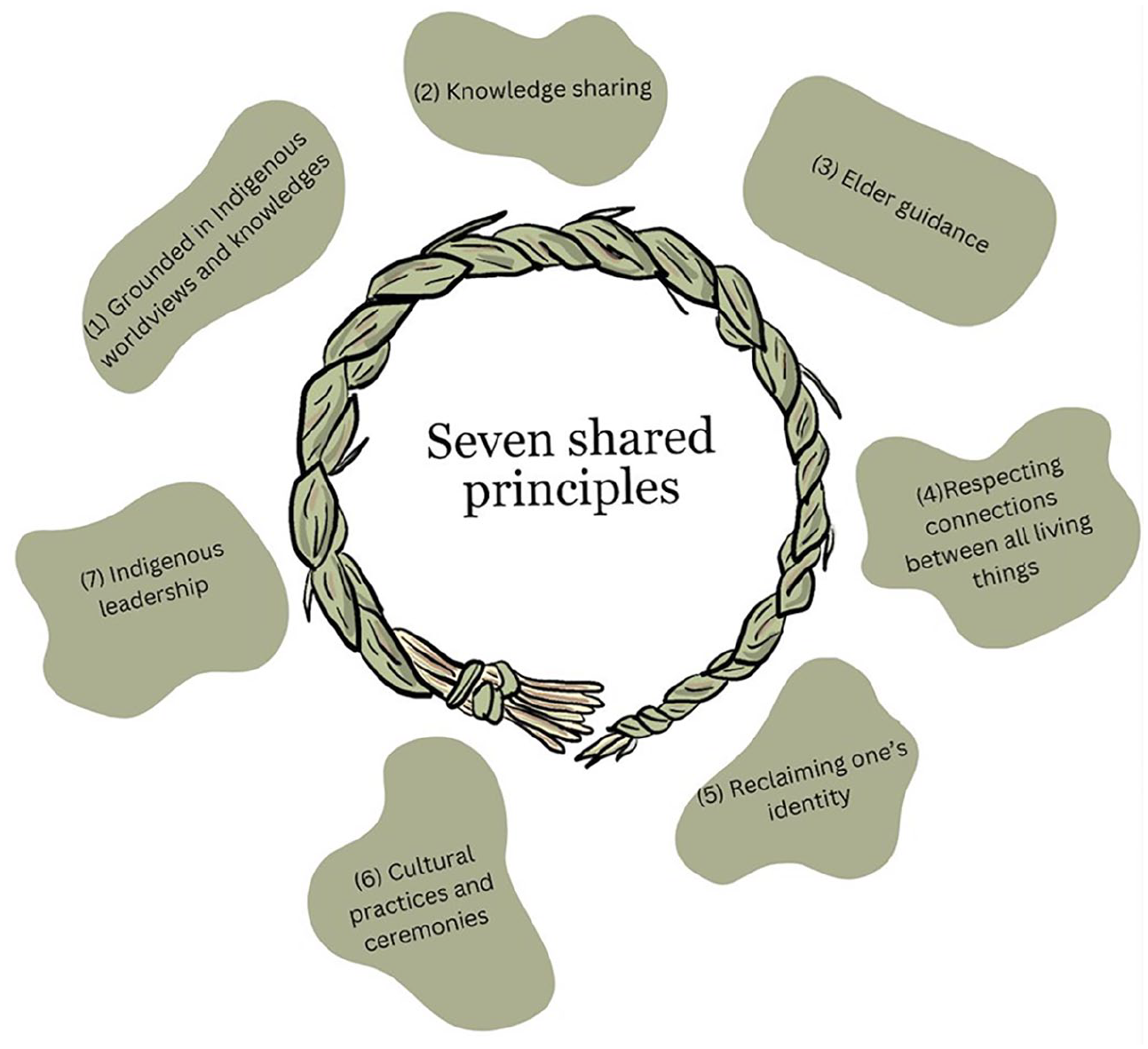
Seven shared principles of Land-based healing.
Recognising that Indigenous Communities possess distinct worldviews that have evolved through their connections with and being on the Land, Land-based healing pursuits must be grounded in Indigenous worldviews and knowledges. Indigenous worldviews encompass shared knowledges, values, and beliefs, which are often interwoven into cultural customs and languages (Mashford-Pringle & Shawanda, 2023). An example of braiding worldviews and customs together is using the medicine wheel as a framework which, from a nêhiyawak (an Indigenous people of the Great Plains region of North America) perspective, recognises individuals as four-bodied people (mental, emotional, spiritual, and physical). This framework incorporates the concept of four in various aspects, such as the cardinal directions, elements, seasons, and life stages. A Community member in one of the studies used this framework as a guide to achieve wholeness and balance within herself, and to emphasise the significance of reciprocity in her connections with the Land: “her body is not simply on the land, it is nested within the land” (Clark et al., 2021 p. 7). The Medicine Wheel framework was also utilised to assist in project planning of another included study: “The Medicine Wheel was used to orient project activities, to inform the development of our interview guide, and to emphasize our interest in understanding the links between climate change and physical, mental, emotional, and spiritual health” (Galway et al., 2022, “Introduction” section, para. 9). Centring Indigenous worldviews and knowledges is imperative for any Land-based healing initiatives with Indigenous Communities to ensure cultural values are fulfilled and an environment for healing is established.
Communities among the included studies have applied the principle of knowledge sharing in various ways, including storytelling, generational learning, workshops and sharing circles, among others (Galway et al., 2022; Hatala et al., 2019, 2020; Hond et al., 2019; Keli‘iholokai et al., 2020; Mikraszewicz & Richmond, 2019; Nightingale & Richmond, 2022; Tobias & Richmond, 2016; Ward et al., 2021). The Land has consistently offered a secure environment for learning through intergenerational connections which is facilitated through knowledge sharing. An illustration of this is when Mikraszewicz and Richmond (2019) collaborated with the Biigtigong Nishnaabeg Community to reclaim ancestral sites with historical significance along the Biigtig Ziibii River, northwest Ontario, Canada, during a canoe trip. This trip allowed for youth and Elders to learn on the Land together and from each other, one youth was able to establish a connection between the stories and their ancestors, I learned a lot about how our people used the river, like [Elder] said about hunting and fishing. And almost like all of the activities [our ancestors] did involve the river in some way. And like extra little things, like how to know where a beaver is. And just how they lived, it’s just a lot more understandable when you can actually see it for yourself and experience it somewhat. (Mikraszewicz & Richmond, 2019, p. 6)
For Indigenous Peoples, the Land has been characterised as the origin of all essential resources and knowledges for a thriving and fruitful life; knowledge sharing as a part of Land-based healing progresses Indigenous reclamation of Traditional Knowledges and the continuation of culture across generations (Mikraszewicz & Richmond, 2019).
Elders hold a pivotal position within Indigenous Communities worldwide, as they safeguard the memories, traditions, and cultures for all generations past and present (Viscogliosi et al., 2020). Seeking guidance from Elders is of utmost importance due to the integral knowledges they hold that ensure intergenerational well-being; this principle needs to be actively implemented when working in partnership with Indigenous Communities. Elders hold a profound insight into what is most suitable for their Communities, yet their voices are often overlooked in health research (Tobias & Richmond, 2016). Included in this review was work led by Tobias and Richmond, who took great care to amplify the voices of Elders by conducting a community-based participatory research study with Elders from two Anishinaabe (an Indigenous people, Great Lakes region, North America) communities located on the north shore of Lake Superior, Ontario, Canada. These discussions took place during a 2-day period in the format of talking circles, during which Elders were invited to share their thoughts on potential strategies for reclaiming their traditional Lands and territories. Seeking Elder guidance from the beginning of Land-based initiatives ensures that respect of Land, culture, and Peoples is foregrounded in the project. When projects create space for Elders to connect with youth they ensure that strong and meaningful strategies to enhance Land repossession, promote well-being and recovery, and nurture a sense of Community pride are developed (Nightingale & Richmond, 2022). Elder guidance and governance are necessary throughout all stages of the projects, not just at one point in time.
The essence of Indigenous identity and relationship with the world around us lies in the foundational principle of honouring the interconnectedness of all living things. As we journey through the cities and towns we inhabit, it is crucial to envision these locations as once, and still, hubs of cultural connection and spiritual practice for many. We must pay homage to the Land while also recalling what lies beneath the asphalt (Fast et al., 2021). An established tradition in Indigenous pedagogies across Turtle Island involves presenting tobacco as a form of protocol. As tobacco interacts with the spirit, offering it serves as a reciprocal gesture to recognise and express gratitude for shared knowledge (D. D. Wilson & Restoule, 2010). Tobacco is also offered when harvesting medicines, roots, berries, and other resources from Mother Earth (Saskatchewan Indian Cultural Centre, n.d.). As a cultural protocol, this act demonstrates that Indigenous Peoples are consistently respecting and acknowledging the connections between all living things around them. Tobacco was used and mentioned by several of the authors who utilised Land-based healing (Clark et al., 2021; Fast et al., 2021; Hatala et al., 2019, 2020; Marquina-Márquez et al., 2016; Mikraszewicz & Richmond, 2019; Tobias & Richmond, 2016). The Milo Pimatisiwin Project, a participatory research project with Moose Cree First Nation in Moose Factory, Turtle Island, considered and honoured interconnectedness throughout their study design. The objective of this project was to explore the influence of milo pimatisiwin on youth programming and well-being initiatives within the Community. All the steps of the project were led by the teachings of pimatisiwin (living the good life), “We did not try to fit the world around us and we fit into it. We cannot schedule fasting until the buds formed around the trees. We worked with the natural cycles. The land told us when to do these things” (Gaudet & Chilton, 2018, p. 4). Indigenous ways of being, doing, and knowing are all deeply rooted within the ground below us; honouring these connections is required for Land-based healing initiatives.
The profound ties that Indigenous Peoples share with their environment are integral to their identity (Redvers et al., 2021). Having the opportunity, ability, and resources to reclaim one’s identity is key to enhancing well-being for any Indigenous person, particularly when participating in Land-based activities and ceremonies. An example of recognising and incorporating the importance of identity is reflected in the development of an urban Land-based healing camp opened in Yellowknife, Northwest Territories. One of the first of its kind on Turtle Island, this camp crafted their programming to adapt to user requirements, emphasising the cultivation of cultural identity, self-esteem, agency, and the capacity to manage stress (Redvers et al., 2021). Regardless of the physical or cultural distance, Indigeneity is ingrained in one’s blood and bones. Intergenerational trauma has impacted Indigenous peoples for numerous generations, emphasising the ongoing need to nurture and console the spirit (Clark et al., 2021). Inherently, any Land-based activity relates to one’s identity; therefore, the need to ensure safe spaces that facilitate individual needs and consideration is paramount.
Land-based healing is comprised of cultural practices and ceremonies for Indigenous Communities across the globe. When pursuing Land-based initiatives, prioritising specific cultural traditions unique to each Community must be a fundamental principle in the project design. Ceremony creates a path for individuals to delve deeper and establish connections to what the Cree (an Indigenous people and language, North America) call mom-tune-ay-chi-kun (the sacred place inside, where we can dream, imagine, create and talk to the grandmothers and grandfathers) (Clark et al., 2021). Healing practices and ceremonies used among projects within this review included sweat lodges, which represent a ceremonial form of purification and smudging, which creates a space and communication line to the spirit world to contact Ancestors, Grandmothers, Grandfathers and the Creator (Marquina-Márquez et al., 2016).
Indigenous Communities are among the most researched individuals worldwide (S. Wilson, 2008) and much of this research has been conducted on Indigenous Peoples employing Western methodologies. Many Indigenous scholars argue that research lacking decolonising methods can be seen as a form of oppression against Indigenous Communities (Datta, 2018). Indigenous leadership is among one of the most important principles to adhere to when partnering with Communities for Land-based healing projects. This is exemplified in the Milo Pimatisiwin Project where Community members guided the researcher to the primary research question, acknowledging that the Community holds the most valuable insight into their own needs and best interests (Gaudet & Chilton, 2018). Another study that ensured Indigenous leadership was priority took place in Waimānalo, Oahu, Hawai’i, USA. This study utilised community-based participatory research, ensuring that Community members were actively consulted and involved in all stages, also serving as co-authors for the final manuscript (Keli‘iholokai et al., 2020). Indigenous Peoples are relational people, emphasising the important journey of respectful engagement and the continuous nurturing of relationships throughout the entire research process (Kiatkoski Kim et al., 2021). As described throughout these principles, the need for consideration of cultural values, ceremonies, connections, and knowledges is essential for any successful Land-based healing project; none of these factors can be fulfilled without Indigenous leadership.
Discussion
In response to the enduring impact of colonisation and the persistent struggle for access to traditional Lands crucial to Indigenous well-being, this systematic scoping review aimed to bring together Indigenous viewpoints and experiences of implementing Land-based healing projects. Evidence from 27 included articles representing Communities from four countries were synthesised into seven guiding principles of Land-based healing. We hope that these principles will be considered as imperative factors that demand understanding and acknowledgement when engaging in partnerships with Indigenous Communities. Based on the evidence discussed in this review, combined with the wealth of global Indigenous Knowledges the significance of Land-based healing for the well-being of Indigenous Peoples is indisputable.
Food security and Indigenous sovereignty initiatives are one of the most well-documented aspects of Land-based practices in the literature (Cidro et al., 2015; Poirier & Neufeld, 2023). The success of such movements further reflects the centrality of Land-based initiatives for Indigenous well-being; for example, the Haudenosaunee Peoples of Eastern Turtle Island rallied together to design and implement a 90-day initiative known as Healthy Roots, which aimed to reverse the disruption of colonial practices on dietary traditions. Through this project, Community members experienced positive outcomes related to physical measurements, ectopic fat—including visceral and liver adipose tissue, serum lipids, and Haemoglobin A1c as well as chronic conditions such as type 2 diabetes and obesity (Gordon et al., 2021). An accessible method of integrating Land-based healing into health care systems is permitting smoke ceremonies or smudging to be conducted within health care settings. Advocacy by Aboriginal leaders on Kaurna Country in South Australia resulted in a smoking ceremony to welcome a new organ and offer support and strength to a kidney disease survivor (Owen et al., 2023). There remain several contexts yet to be fully explored with relation to Land-based healing practices, and there are few policies that support inclusion of ceremony in health settings. Increased prioritisation and integration of Land-based practices within Community-led projects focused on Indigenous health is warranted due to the depth of healing and increased well-being possible.
The complete impacts of integrating Land-based healing practices into the Western systems, such as health care settings and education, remain unknown for Communities. As researchers committed to decolonial values (Hedges et al., 2023), our ongoing task is to advocate for improved methods that better align with the unique needs of each Community. Non-Indigenous researchers, partners, and allies hold a collective responsibility to champion the recognition of Indigenous methodologies as valid medical interventions. It is crucial for space to be created within the Western system to secure funding and support for Indigenous Knowledges. Researchers in this space who benefit from working alongside Indigenous Communities have ethical obligations to not misuse or misappropriate Indigenous Knowledges, including ceremonial knowledges related to Land-based healing. It is for that reason we elected to outline guiding principles that require immense Community engagement and connections for successful Land-based healing initiatives. The incorporation of research practices that protect sacred knowledges, such as Indigenous data sovereignty (Kukutai & Taylor, 2016) and bicultural accountability (Windchief & Cummins, 2022) need to be woven together to ensure meaningful and ethical work.
Strengths and limitations
Utilising a synthesis approach whereby common features of Land-based healing practices were collated was a strength of this piece. Rather than creating a prescriptive and narrow definition, as scientific works often do, this approach honoured the range of ceremonies and practices within Community understandings of Land-based healing. The flexibility embedded within these shared principles will allow future works to be developed in a place and context specific way. While the authors made all attempts to limit publication bias through the inclusion of all languages and locations across the world, as well as grey literature, limitations remain. Systematic searches fail to capture knowledges and stories not contained within written and published literature as well as traditional languages. Due to unique context to each Nation, a uniform definition and terminology will never exist so there are elements that have not been captured. Furthermore, terminology around Land-based healing can vary and all the studies included in this review did not explicitly define Land-based healing in relation to their works. As such, it is likely that this work captures only a snapshot of the ways Land-based healing has been implemented into Community-led projects and Western systems.
Conclusion
We firmly emphasise the necessity of acknowledging Land-based healing as a vital component of health sovereignty for Indigenous Peoples. Non-Indigenous researchers have an obligation to be guided by Indigenous leadership within the health space and most importantly in Land-based healing. These practices warrant recognition as a legitimate form of medical practice. It remains crucial for all Land-based healing projects to remain rooted in Indigenous Knowledges. This is not a step-by-step guide for fellow researchers; rather, we have outlined guiding principles to be tailored to each Community and project. There remains a necessity to create spaces and environments to explore Land-based healing practices within the context of intergenerational well-being for global Indigenous Communities. Future research must focus on rigorously documenting the effectiveness of Land-based healing, centring Community-led methodologies that empower Indigenous voices and experiences. This work calls for an unwavering commitment to placing Indigenous voices at the heart of all research involving Indigenous Communities, ensuring that their knowledge, leadership, and perspectives are not simply included, but are the driving force behind the research process and its outcomes. By fostering a deeper understanding and integration of Land-based healing, we can advance holistic health models that honour and promote the sovereignty of Indigenous Communities, ultimately benefitting individuals, families, and the larger health care system.
Supplemental Material
sj-docx-1-aln-10.1177_11771801251334772 – Supplemental material for Nurturing roots: a scoping review on Indigenous acts of resistance through Land-based healing practices
Supplemental material, sj-docx-1-aln-10.1177_11771801251334772 for Nurturing roots: a scoping review on Indigenous acts of resistance through Land-based healing practices by Madison Cachagee (Omushkego Mushkegowuk), Brianna Poirier, Clarence Cachagee (Omushkego Mushkegowuk), Lisa Jamieson and Hannah Neufeld in AlterNative: An International Journal of Indigenous Peoples
Supplemental Material
sj-docx-2-aln-10.1177_11771801251334772 – Supplemental material for Nurturing roots: a scoping review on Indigenous acts of resistance through Land-based healing practices
Supplemental material, sj-docx-2-aln-10.1177_11771801251334772 for Nurturing roots: a scoping review on Indigenous acts of resistance through Land-based healing practices by Madison Cachagee (Omushkego Mushkegowuk), Brianna Poirier, Clarence Cachagee (Omushkego Mushkegowuk), Lisa Jamieson and Hannah Neufeld in AlterNative: An International Journal of Indigenous Peoples
Supplemental Material
sj-docx-3-aln-10.1177_11771801251334772 – Supplemental material for Nurturing roots: a scoping review on Indigenous acts of resistance through Land-based healing practices
Supplemental material, sj-docx-3-aln-10.1177_11771801251334772 for Nurturing roots: a scoping review on Indigenous acts of resistance through Land-based healing practices by Madison Cachagee (Omushkego Mushkegowuk), Brianna Poirier, Clarence Cachagee (Omushkego Mushkegowuk), Lisa Jamieson and Hannah Neufeld in AlterNative: An International Journal of Indigenous Peoples
Footnotes
Acknowledgements
The research team expresses deep gratitude to the diverse Indigenous Peoples and Communities around the globe for their collaborative efforts on projects concerning Indigenous health. These partnerships inspire our dedication and exploration of pathways aimed at achieving health sovereignty for Indigenous populations.
Authors’ note
Declaration of conflicting interests
The authors declared no potential conflicts of interest with respect to the research, authorship and publication of this article.
Funding
The authors received no financial support for the research, authorship and publication of this article.

Supplemental material
Supplemental material for this article is available online.
Glossary
Anishinaabe an Indigenous people, Great Lakes region, North America
Cree an Indigenous people and language, North America
mom-tune-ay-chi-kun the sacred place inside, where we can dream, imagine, create and talk to the grandmothers and grandfathers
Mushkegowukan Indigenous people, Northern Ontario, Canada
Nokomis my grandmother
nêhiyawak an Indigenous people of the Great Plains region of North America
pimatisiwin living the good life
References
Supplementary Material
Please find the following supplemental material available below.
For Open Access articles published under a Creative Commons License, all supplemental material carries the same license as the article it is associated with.
For non-Open Access articles published, all supplemental material carries a non-exclusive license, and permission requests for re-use of supplemental material or any part of supplemental material shall be sent directly to the copyright owner as specified in the copyright notice associated with the article.
