




Abstract
The co-authors, a racialized woman from India and a Nanualco (Indigenous Mesoamerican peoples whose ancestral territory encompasses central Mexico to the tip of Costa Rica) man from Nahua-Pipil (another name for Nanualco people) territory in El Salvador are encountering increasing discourse and action about diversity, equity, and inclusion (DEI) within academia in Canada. The DEI initiatives rooted in the Eurocentric worldview are found to reproduce the same inequities they are attempting to address. Given this context, the co-authors engaged in a process of dialogic reflections and co-learning over a period of 6 years to critically examine the notions of DEI considering their lived experiences, the domination of Eurocentric worldview, and an emerging understanding of their own ancestral worldviews. The co-authors express the need to dismantle the domination of the Eurocentric worldview and to expand the notions of DEI by honouring diverse worldviews within and beyond academia.
Introduction
In post-secondary education system in Canada, where the co-authors have worked, there is an increasing emphasis on the discourse and action around matters pertaining to diversity, equity, and inclusion (DEI). The DEI discourse and initiatives have emerged in response to an increasing awareness among scholars about the inequities permeating through various systems (Duarte et al., 2023; Goriss-Hunter et al., 2020; Hogan et al., 2023; Lee & Cox, 2022; McCarter et al., 2023). This awareness is primarily informed by the civil rights framework (McDonald, 2020; Tuck & Yang, 2012), anti-oppressive approach (Mullaly & West, 2018), critical consciousness raising (Freire, 1998, 2000, 2013) and critical theories (Caterino & Hansen, 2019; Lois, 2022). The DEI discourse and actions have empowered the co-authors, a racialized woman from India and a Nanualco (Indigenous Mesoamerican peoples whose ancestral territory encompasses central Mexico to the tip of Costa Rica) man from Nahua-Pipil (another name for Nanualco people) territory in El Salvador, to acquire the language and skills necessary to make sense of their lived experiences of inequities.
At the same time, the co-authors have gained awareness that the DEI initiatives are rooted in Eurocentrism (Ahmed, 2012; Henry et al., 2017). Hence, no matter what the theoretical and applied lens of the DEI scholars or practitioners are, these initiatives often reproduce the same inequities they are attempting to eliminate. For instance, racialized people are encouraged by leaders and colleagues to occupy the position of power within the Eurocentric education system. This encouragement is driven by the institutional agenda to promote an image of itself as being benevolent, diverse, and inclusive in the global market (Ahenakew, 2016; Ahmed, 2012; Henry et al., 2017). Once appointed, the racialized leaders are expected to conform to the parameters of leadership set by the dominant Eurocentric hierarchical structure and may represent tokenism without any real authority to bring about systemic changes (Carbado & Gulati, 2013; Cukier et al., 2021). Under the pressures of the Eurocentric imperatives, racialized leaders perpetuate the social construction about race and racial hierarchy, participate in the ongoing colonization of Indigenous peoples, and may reproduce such inequities as classism, ableism, homophobia for those who are at the bottom of this power structure.
Within academia, DEI initiatives take the form of committees, taskforces and conferences with an intention to develop toolkits, checklists and best practices (Ahmed, 2012). At times, there is a subtle pressure on the employees to applaud the academic leaders who show strong commitment to DEI while remaining complacent in maintaining the status-quo of power and privilege. Hence, DEI initiatives become the site of superficial changes, self-congratulatory postering, reinforcement of Whiteness and neoliberal ideology, mistrust, and silencing (Ahmed, 2012; Chambers, 2023; Henry et al., 2017).
The co-authors have come to understand that their employment within different post-secondary education institutions was partly driven by the equal opportunity policy for those individuals who are deemed deserving of equity and are perceived as non-threatening to Eurocentric power structures (Ahenakew, 2016). These hiring policies placed both authors in the category of immigrants and refugees, thus erasing their ancestral roots, complex histories, distinct journeys, and Indigeneity. The presence of their brown bodies was considered a significant change within these institutions; as Chambers (2023) states, “the dominant culture deludingly convinces itself that a splash of colour or splash of diversity in and itself represents meaningful and structural change” (p. 6). On the contrary, there was no critical examination of the concepts of DEI within these institutions, and these terms were utilized as if they contained certain degree of truth to them.
Given this context, the co-authors intend to articulate their lived experiences, elucidate three worldviews, including Eurocentric, Indigenous from the perspective of a Blackfoot scholar, and Tantric, meaning liberation through expansion, and present their dialogic reflections about DEI from the perspective of diverse worldviews. The reflections in this paper allow the co-authors to turn their gaze inward and outward simultaneously, to recognize the pervasiveness of Eurocentrism in their lives, and to rekindle the deepest longing to honour their ancestral worldviews. By sharing their journey and reflections, the co-authors invite the readers to recognize that there are other ways, that is non-Eurocentric ways of understanding, knowing and valuing the notions of DEI, and these other ways may allow us to restructure academia in a way that diverse cosmologies, ontologies, epistemes, and pedagogies can co-exist in a respectful manner. The co-authors acknowledge that the DEI initiatives are often combined with efforts to decolonize (DEI-D) post-secondary education (Chambers, 2023; Mawhinney et al., 2020); however, the scope of this paper is limited to the concepts of DEI. Decolonization is about sovereignty of Indigenous peoples across the globe and cannot be conflated with the current understanding of DEI rooted in Eurocentrism (McDonald, 2020; Tuck & Yang, 2012).
The question arises of how the co-authors recognized this need to explore their ancestral worldviews and to critically reflect upon the concepts of DEI. At a post-secondary education institution, the co-authors found an opportunity to engage in a conversation about themselves and the world around them. During this conversation, the second author, who was immersed in the Frierian (1998, 2000, 2013) critical consciousness-raising approach and liberation theology (Romero, 2004[1988]), asked the first author to clearly identify her ideology and articulate her responsibility in relation to the community. This question about ideology baffled the first author, who stated “I do not have an ideology, I have a Tantric worldview.” A detailed explication of worldviews appears later in this paper.
The above statement by the first author shifted the conversation as it became necessary to articulate what a worldview is and how this can potentially inform our understanding of DEI. The first author initially found it difficult to translate her worldview in the English language. Also, the question arose as to what is meant by the term worldview. There is no single definition of worldview; however, a worldview may constitute three dimensions, including ontology meaning the nature of reality, epistemology meaning ways of knowing reality, and axiology meaning values or ethics (Little Bear, 2000; Stenmark, 2022). A worldview is a foundation, often invisible, upon which we build our ideological vision as well as our religious, cultural, social, political, and communal structures.
Over a period of 6 years, the co-authors embarked on a journey of sharing their lived experiences, emerging understanding of distinct worldviews, and reflections about the notions of DEI. This became a living inquiry where questions, reflections and actions emerged from daily life and an academic inquiry metamorphosed into a way of being and becoming in the world (Ahmed, 2017). The co-authors reviewed scholarly publications and engaged in deep conversations with Inuit (Indigenous people of Arctic North America) Elder and Métis (Indigenous peoples who trace their ancestry to First Nations and French colonizers in Canada) leaders at their workplaces (Kirmayer et al., 2011). First Nations, labelled as Indians, are those Indigenous peoples in Canada who are neither Métis nor Inuit as per the Constitution Act 1982 (Voyageur & Calliou, 2001).
The co-authors travelled through Nahua-Pipil territory in central America to learn about the worldview, knowledge systems and language of Nanualcos, and encountered silence or fragmentary information from family and community members. These barriers were the result of violent imposition of capitalism and Christianity on Nanualcos and other Indigenous peoples of Mesoamerica by Spanish conquerors, decimation of various Mesoamerican Indigenous communities, including those of Nanualcos, during civil wars in the twentieth century, and fragmentation of identity and relationships among diverse groups of Mesoamerican Indigenous peoples due to forced displacement (Stephen & Velasco-Ortiz, 2023). Given this context, the exploration of worldviews became a simultaneously challenging and fulfilling journey. In the following sections, the co-authors present their lived experiences, three worldviews, and reflections about the notions of DEI.
Lived experiences of a racialized woman
The first author was born in an upper-middle class family in the state of Gujarat, India. She was born to a Hindu mother and a Muslim father who came from different regions of the country, spoke different languages, worked in France for seven years and resettled in India in the late 1970s. The first author often found herself navigating the tensions between the Hindu and Muslim communities embedded within the larger structures of coloniality of power (Dussel, 1993; Mignolo & Ennis, 2001; Quijano, 2000, 2007). Within this context, she endured ontological, epistemic, and cultural violence in the form of glorification of modern European or Western culture and rational knowledge system and denigration of her own Tantric worldview, local culture, and diverse forms of local knowledge.
After completing graduate studies in Western psychology in India, she came to Canada as an international student in 2002. The decision to migrate to Canada was taken due to escalating violence between the Hindu majority and Muslim minority in Gujarat. A pathway to higher education in Canada appeared to be a safe escape. Prior to her departure from India, she was given a clear message by her parents to assimilate into the dominant White world to succeed as a student. Canada was presented as a peaceful country with international students and immigrants coming from different parts of the world. On her part, she had no awareness that this was Indigenous land and that Indigenous people were still alive.
One day while searching for academic literature on Laurentian University’s library website, she came across the term Ministry of Indian Affairs. This created a sense of surprise, confusion and curiosity, leading to further investigation of this Ministry which in her mind worked with people from India. To her greatest shock, she came across the reality of Indigenous people being alive and being mislabelled as Indians by the government of Canada. She remembered her high school history lesson which stated that early European explorers and settlers had mistakenly labelled Indigenous peoples of Americas as Indians, assuming that they had reached the subcontinent of India. She further learned that the Canadian Indian Act 1876, divides the First Nations into the categories of status- and non-status Indians (Hick & Stoke, 2017). Hence, the term Indian continues to be used for certain groups of Indigenous peoples in Canada.
As she continued her education at Laurentian University, she received an opportunity to complete a placement with Kashechewan First Nation, which is situated in northern Ontario, Canada, in partial fulfilment of her Master of Social Work degree. This experience proved to be a turning point as she gained an understanding of deceptive treaty-making process, appropriation of Indigenous land, genocide of Indigenous peoples and the devastating impact of violence on those who survived. Further details about her learnings are published elsewhere (Shaikh et al., 2017).
After completing graduate studies, the first author was appointed as a tenure track faculty in an interdisciplinary department at a Canadian University. A process of further assimilation into the Eurocentric academia continued and she attained tenure by meeting the requirements around teaching, scholarship and service. However, this process had very little inner resonance for her, and she felt a deep sense of spiritual dislocation in the patriarchal Eurocentric academia (Ahmed, 2017), which remains oblivious to matrilineal Tantric cosmologies, ontologies and epistemes (Kali, 2003; Odier, 1996/1997, 1999/2001).
Consequently, she turned her gaze towards her ancestors in India and began an arduous journey of tracing the roots of the Tantric worldview, traditions and practices (Chinnaiyan, 2017; Kempton, 2013; Odier, 1996/1997, 1999/2001). This journey rekindled the loving memory of the festival of Navratri, a nine-night dance festival which honours Shakti, the sacred feminine known as innate power within reality. The first author engaged in extensive readings about the Tantric worldview in the Sanskrit, English, and regional languages of India, received initiation into deity meditation and contemplative practices as a lay practitioner, reconnected with Indian classical music, and developed a process of inquiry guided by inner spiritual unfolding. This inquiry was further channelled into deeper conversations about worldviews and DEI with the second author.
Lived experiences of a Nanualco man
The second author was born in the land of the Nanualco, also known as the Nahua-Pipil, currently situated in El Salvador, whose ancestral territory encompassed landmass from central Mexico to the tip of Costa Rica. Nourished by the fertile land, trees and streams, his childhood was spent under the violent impact of coloniality, Christianization, and capitalism (Dussel, 1993; Mignolo & Ennis, 2001; Quijano, 2007). The terms campesino (peasant) and Indio (Indian) were imposed on his community by the Spanish conquerors, who diminished his connection to his Nahua-Pipil ancestry, relationship with Mother Earth, and forced his family to commodify their land within a capitalist agrarian system. He felt a deep connection with the land, which was called a land of Indio Aquino, a Nahua-Pipil leader who rebelled against the Spanish conquerors. However, this connection to Indio Aquino and the land had to be kept hidden to ensure safety of one’s self, family members and communities from ongoing persecution.
During the civil war fuelled by the USA’s imperial agenda (Chomsky et al., 2016), he, along with his family and community, was forced to leave their ancestral land and flee to the vicinity of San Salvador as internal refugees. Amid grave uncertainty, he and his family channelled their hope through Archbishop Romero, who raised his voice against the oligarchy for unjustly using the military and political power to appropriate land from those people whose dignity and livelihood depended upon it (Whelan, 2019). In those days, the liberation theology expressed by Archbishop Romero (2004[1988]) resonated with the second author. Much later, did he come to realize that such ideologies perpetuate coloniality on Indigenous land (Mignolo & Ennis, 2001; Quijano, 2007).
Following the assassination of Archbishop Romero, the second author, along with family members, transitioned to Mexico and received deeper understanding of liberation theology from Mixteco (Indigenous Mesoamerican peoples of Mexico from the regions of Oaxaca, Puebla, and Guerrero) and Zapotec (Indigenous Mesoamerican peoples from the southwestern-central highlands of Mexico) scholars. In Mexico, the second author experienced a shift in his identity as he was labelled a Salvadoran man and not recognized as a Nanualco. After spending adolescence as a Salvadoran man in Mexico, he arrived in Canada as a Latino refugee, thus experiencing further erasure of his Nanualco ancestry and identity.
In Canada, he experienced fear, confusion, and hope as he encountered language barrier, cultural differences, and a lack of reliable networks. Driven by a need to gain clarity, he gravitated towards gaining post-secondary education. He chose this path believing the broader message that if he received the Eurocentric education, he will be able to serve his community better. In the face of multiple interruptions, he completed undergraduate and graduate studies in Canada. He learned the Eurocentric academic language and skills suitable for clinical and community-based social work practice. While navigating different systems, he remained oblivious to the inner spiritual need to return to his ancestral land. Even though the post-secondary education allowed him to critically examine the systemic inequities rooted in coloniality, none of the courses required him to engage in a process of reconnecting with his Nahua-Pipil roots and reclaiming his identity as a Nanualco man.
One day, he expressed a desire to learn about worldviews to an Inuit Elder Jean Becker, who pointed him in the direction of writings of Dr Leroy Little Bear, a scholar from the Blackfoot Nation which is situated in Southern Alberta in Canada (Rosen et al., 2019). The second author found the essay titled Jagged Worldviews Colliding (2000) written by Dr Little Bear; however, none of his professors and colleagues were aware of its existence. Reviewing this essay proved to be a turning point in the life of second author as he set out to explore distinct worldviews of Indigenous peoples in Mesoamerica, including that of his own ancestors. In this paper, the second author shares the Indigenous worldview from the perspective of the Blackfoot scholar whose writings significantly impacted his life and enabled him to change his narrative about his own self from being a Latino refugee in Canada to a forcibly displaced Nanualco man from Mesoamerica.
During a conversation with the first author, the second author shared a childhood memory of when he was an 8-year-old boy and was walking on a path covered by tall trees in the forests where Nanualcos lived. As he looked up at the trees swaying in the wind, a question emerged from within as to “Do we really need Jesus Christ from some foreign land to come and save us?” At that age, he could turn to no one to receive an answer to this inner question. Once this memory was rekindled, the second author recognized the enormity and urgency of reconnecting with his ancestral roots.
Three worldviews: emerging understanding
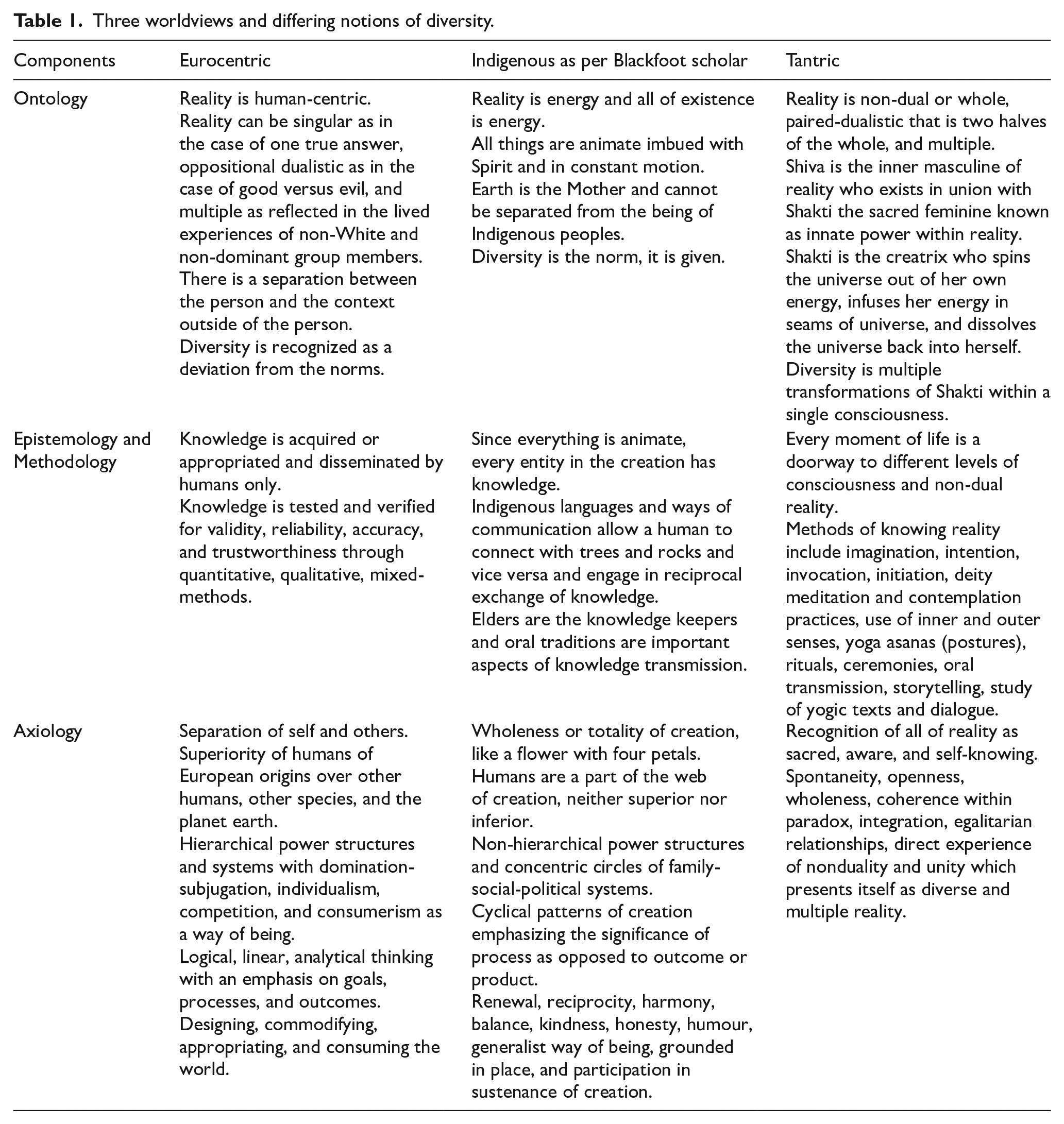
In this section, the co-authors describe their emerging understanding of three worldviews and present Table 1, wherein the readers can compare the ontology, epistemology and axiology of the three worldviews.
Three worldviews and differing notions of diversity.
Eurocentric worldview
The dominant worldview, within and beyond Canada, is Eurocentric founded upon the notion of White supremacy and universal abstract knowledge (Battiste, 2018; Little Bear, 2000). As can be seen in Table 1, the Eurocentric worldview is human-centric. According to this worldview, reality can be singular as in the case of one true answer, oppositional dualistic as illustrated by good versus bad, and multiple as represented in the deviation from the norm. Reality is explained as a separation between the spirit and matter as well as the separation between the person and the context. This separation is inherent in the othering process that the co-authors have experienced as their lived experience. Within this worldview, reality has limited space for fluidity, spontaneity, reciprocity, and plurality.
Knowledge is valid when it is gained or appropriated and verified through empirical measures developed and implemented by humans only (Battiste, 2018; Little Bear, 2000). Knowledge is valued when it allows humans to measure, control, design, and commodify the reality for the benefit of those humans who ascribe to Eurocentric worldview (Little Bear, 2000). At times, Eurocentric knowledge-producers approach the non-European world, extract only those elements of non-Eurocentric knowledge systems that can be understood through Eurocentric ontology and epistemology (Ahenakew, 2016), and further commodify it for the benefits of Eurocentric structures (Smith, 2018). In this process, the Eurocentric knowledge-producers claim their expertise in specific areas of knowledge, while erasing the original sources (Hall, 2018).
Within Eurocentric world, knowledge is often utilized to organize life in a hierarchical structure where humans of European origins have higher and superior position in relation to other humans, living beings and the planet Earth (Battiste, 2018; Hernandez, 2022; Yale Divinity School, 2018). The values emanating from this worldview include domination over others, logical and linear analytical thinking, competition, individualism, modernism, commodification, and consumption of the world (Battiste, 2018; Chomsky, 2003; DiAngelo, 2018; Dussel, 1993, 2020; Little Bear, 2000).
Within this worldview, diversity is understood as a deviation from the norms (Little Bear, 2000), particularly manifesting through the multiplicity of lived experiences and voices of marginalized people. The norms are set by those individuals who hold power due to their ideology of White supremacy, patriarchy and capitalism. Within this context, equity is about removing barriers for marginalized humans to participate in the Eurocentric systems (Henry et al., 2017), and inclusion is a form of assimilation which does not pose a threat to the Eurocentric onto-epistemic hegemony (Ahenakew, 2016). In this process, the DEI initiatives, while recognizing the diversity and multiplicity of experiences among people living in the margins, become a site of White saviourism and glorification (Ahmed, 2017).
Indigenous worldview from the perspective of a Blackfoot scholar
The term Indigenous, in the context of this paper, refers to any person who identifies as a First Person/Original Inhabitant of Mesoamerica. There are diverse worldviews among Indigenous peoples within and beyond Mesoamerica (Castaneda, 1981; Hernandez, 2022; Wagamese, 1994/2006, 2014, 2021; Yale Divinity School, 2018). In this article, the second author shares the Blackfoot scholar Dr Little Bear’s articulation of Indigenous worldview which had a profound impact on his life as stated earlier.
According to Little Bear (2000), Indigenous worldview recognizes reality as energy and asserts that all of creation is imbued with energy or Spirit. Hence, everything is animate. Reality emerges as cyclical and wholistic, as can be seen in the cycles of seasons, migration of animals and birds, and renewal ceremonies and songs. Earth is the Mother and cannot be separated from the being of Indigenous peoples. Hence, there is no separation between the person and the context.
Since everything is animate, every entity in the creation has knowledge and a way of knowing (Little Bear, 2000). According to Sinclair (2017), an Anishinaabe (a group of culturally related Indigenous peoples living in the Great Lakes regions of Canada and the USA) scholar, the trees, lakes, rivers and rocks are the libraries of Indigenous peoples. Indigenous languages and ways of communication allow reciprocal knowledge exchanges among all of creation (Little Bear, 2000). This means humans and non-humans can communicate and learn from one another.
The values of all our relations, wholeness or totality of creation, cyclical patterns, and reciprocity preclude any formation of hierarchical and linear structures within and beyond the human world (Little Bear, 2000). The human life unfolds within concentric circles of living entities. Humans are part of the larger web of creation and are neither superior nor inferior in relation to all of creation. In essence, this worldview is non-human-centric, unlike the Eurocentric worldview. Elders are the knowledge keepers and oral traditions are important aspects of knowledge transmission. The values emanating from Indigenous worldview include kindness, humour, harmony, balance, honesty, process-orientation and being grounded in a place (Little Bear, 2000).
Within this worldview, diversity is the norm (Little Bear, 2000); hence, equality and inclusion are a given. Also, the DEI are not human-centric concepts. The ontology of reality as energy, the epistemology of knowledge exchange between humans and non-humans, and the values of all our relations emphasize reciprocal and egalitarian relationships among humans and non-humans across cosmos.
Tantric worldview
The matrilineal Tantric worldview is believed to have its roots in the Indus Valley civilization, which flourished between 2600 and 1900 BCE in the Indian subcontinent (Kali, 2003; Odier, 1999/2001). The co-authors acknowledge diversity of Tantric traditions, schools, and paths (Kempton, 2013; Odier, 1996/1997, 1999/2001), while presenting the foundational elements of the Tantric worldview.
The word Tantra (liberation through expansion) is derived from two Sanskrit roots, tan—which means to develop or expand, and tra—which means to liberate (Kempton, 2013). In Tantric worldview, reality is both non-dual that is a unified whole and paired-dualistic that is two halves of the whole. The non-dual aspect of reality is called consciousness. Traditionally, this is known as Shiva, the inner sacred masculine of reality. At the non-dual level, Shiva exists in undifferentiated union with Shakti, the inner sacred feminine of reality. Shakti is the creative potency or dynamic energy, and literally means the innate power of reality. Shakti is the creatrix who spins the universe out of her own energy, infuses her energy in seams of the universes, and dissolves the universe back into herself (Kempton, 2013). Shakti’s dance of creation, sustenance, and dissolution is continuous and contained within a single consciousness called Shiva. Reality is the union of inner masculine and feminine principles manifesting as stillness and dynamism, stability and transformation, void and fullness, and being and becoming (Kempton, 2013).
In the Tantric worldview, true power comes from within the reality (Kempton, 2013). From its undifferentiated non-dual state, Shakti, with her creative impulse, begins to stir her imagination (Chinnaiyan, 2017). Her cosmic imagination works its way through many levels of consciousness, progressively condensing energy and becoming denser matter. This process of creation is called involution or contraction, by which formlessness bursts into myriad forms, and oneness becomes many realities. As she further condenses herself into physical matter, she takes forms such as universes, galaxies, black holes, suns, moons, planets, animals, trees, plants, and humans. In this entire process, she embodies herself. On higher levels of consciousness, she manifests as beings with subtle bodies of light and sounds which can be accessed through meditation practices.
Within humans, Shakti manifests as breath, cells, bodily organs and functions, mind, thoughts, emotions, memories, sensations, perceptions, interpretations, and experiences (Chinnaiyan, 2017; Kempton, 2013). Furthermore, she remains coiled as kundalini, the power of spiritual awakening within humans. When kundalini is asleep, we may experience the split between self and the world. When kundalini awakens inside us, even momentarily, we experience the oneness or nonduality underneath the diversity.
Within Tantra, reality is sacred, aware, and self-knowing; that is, everything knows itself and everything else (Kempton, 2013). For humans, different methods and practices are available to access different levels of consciousness and to directly experience oneness or nonduality (Chinnaiyan, 2017; Odier, 1996/1997, 1999/2001). These methods include, but are not limited to imagination, invocation, initiation, oral transmission, use of inner and outer senses, yoga asanas (postures), deity meditation, contemplation, rituals, ceremonies, storytelling, study of yogic texts, and dialogue. The major values emanating from this worldview include spontaneity, openness, wholeness, coherence within paradox, egalitarian relationships, and oneness or nonduality (Odier, 1996/1997, 1999/2001).
Within this worldview, diversity is the multiple projections and transformations of this primordial energy called Shakti within a single consciousness known as Shiva. In other words, oneness manifests as diversity (Kempton, 2013). Hence, equity and inclusion refer to oneness which can be experienced through expansion of our awareness, dissolution of our limited sense of self, and realization of the Tantric teaching that the world is inside us (Kempton, 2013). This oneness consciousness allows us to experience diversity as a scared expression of wisdom, love and creative potentiality. In other words, in the boundless formlessness of oneness, there is a space for every form to exist and express itself without violating one another.
Reflections about DEI
The co-authors recognize that the terms DEI have different meanings across three worldviews. Within Canada, the Eurocentric worldview dominates and informs our understanding of DEI. Consequently, people ascribing to Eurocentric ontology and epistemology define what is diversity, explain why and how inequities emerge, and how inclusion can be achieved. The message given to everyone is that those who fully ascribe to the Eurocentric worldview will hold special rights, privileges, and power, and these are inherently desirable, worthy of pursuit, and most legitimate. From this perspective, as stated by Ahenakew (2016), inclusion is a form of assimilation where people with non-Eurocentric worldviews are recognized and included only when they fit the frame of modern Eurocentric institutions. Consequently, the DEI measures continue to reproduce the same inequities (Ahmed, 2012; Henry et al., 2017).
Within this DEI discourse and action, there is no recognition that there is a diversity of worldviews. There is no critical questioning about the prevalent notions of DEI and where they come from. There is no recognition that there are other ways of understanding, knowing, experiencing, and valuing diversity. These other worldviews make it clear that diversity does not have to be understood as a deviation from the norm, rather diversity is the very essence of creator, creation, and creative process.
In this journey of reflections, the co-authors have asked themselves several critical questions. These questions include, but are not limited to, (1) what exactly are we seeking when we engage in discussions and actions about DEI? (2) are we seeking the same kind of power and privilege that our oppressors have? (3) Are we seeking a piece of pie within Eurocentric world? (4) If racialized and religious minorities are seeking equal rights and resources from the dominant group members, are they further dispossessing Indigenous people of their land and land-based ways of living? (5) By sharing our lived experiences, are we reinforcing the Eurocentric notion of diversity and multiplicity as deviation from the norm? or (6) Are we seeking to create a different world founded upon a different worldview?
As the co-authors begin to question further, they recognize the inner imperative to dismantle the domination of Eurocentric worldview and to embrace their ancestral worldviews within their own lives. The co-authors feel the need to uphold their ancestral values of oneness, integration within paradox, all our relations, reciprocity, and wholeness while acknowledging that they are not just a limited time and place-bound self, rather they are boundless energy full of creative potentiality.
In the past 1 year, the co-authors engaged in dialogues about diverse worldviews, violence of Eurocentrism, and the notions of DEI with academic leaders, colleagues and students. In the process, the co-authors invited the attendees to explore their own ancestral roots, understand their own ancestral worldview and to contemplate the possibilities for DEI initiatives based on this understanding. The co-authors would like to invite the readers of this paper to do the same.
Journey ahead
There is no linear and clear path ahead. The co-authors recognize the tensions arising from inner polarities and spiritual dissonance under the impact of apparently solid Eurocentrism. To alleviate this impact, they are engaging in the process of reconnecting, remembering, rekindling, and renewing. Moving forward, the co-authors are committed to deepening their understanding of cosmologies, ontology, and episteme of their ancestors, nurturing their egalitarian relationship, and sharing their reflections within and beyond the post-secondary education system. There is a recognition among the co-authors that a dignified life requires them to relinquish human-centrism, acknowledge their place within the larger cosmos, and assume responsibility in relation to all of creation, which includes Mother Earth and life beyond. This is a lifelong journey of co-learning, unlearning and relearning, a way of being and becoming in the world.
Footnotes
Acknowledgements
We express our deepest gratitude to Elder Jean Becker at the University of Waterloo and Dave Skene, former Director of White Owl Native Ancestry, for many conversations about Indigenous worldview and ways of being. We are deeply thankful to our colleague Dr Trish Van Katwyk for her insightful comments on the earlier draft of this manuscript.
Authors’ note
Declaration of conflicting interests
The authors declared no potential conflicts of interest with respect to the research, authorship and publication of this article.
Funding
The authors received no financial support for the research, authorship and publication of this article.

Glossary
asanas postures
kundalini the power of spiritual awakening within humans
Shakti the sacred feminine known as innate power within reality; the creatrix who spins the universe out of her own energy, infuses her energy in seams of universe, and dissolves the universe back into herself
Shiva the inner sacred masculine of reality
tantra liberation through expansion
tan to develop or expand
tra to liberation
Spanish language
campesino peasant
Indio Indian
Indigenous peoples
Anishinaabe a group of culturally related Indigenous peoples living in the Great Lakes regions of Canada and the USA
Inuit Indigenous people of Arctic North America
Métis Indigenous peoples who trace their ancestry to First Nations and French colonizers in Canada
Mixteco Indigenous Mesoamerican peoples of Mexico from the regions of Oaxaca, Puebla, and Guerrero
Nahua-Pipil another name for Nanualco—Indigenous Mesoamerican peoples whose ancestral territory encompasses central Mexico to the tip of Costa Rica
Nanualcos Indigenous Mesoamerican peoples whose ancestral territory encompasses central Mexico to tip of Costa Rica
Zapotec Indigenous Mesoamerican peoples from the southwestern-central highlands of Mexico