




Abstract
Emerging from a need for culturally grounded speech-language therapy in Aotearoa (New Zealand), this study examined Māori (Indigenous people of New Zealand) values and perspectives on communication held within a data set of 2,669 pepeha (ancestral sayings). Analysis of literal translations, context, literary features, and philosophical meanings led to identification of 368 sayings relevant to communication. Thematic analysis of these sayings resulted in eight themes: (a) āhuatanga karere (message and messenger characteristics), (b) mana reo (power and influence of language), (c) reo ā-tinana (body language), (d) te whē (sound), (e) tohu (signs, instructions, marks, visions, omens), (f) whakarongo (listening, hearing, obeying), (g) whanaungatanga (relationships), and (h) whatumanawa (open expression of emotion). These themes identify a holistic view, beyond interpersonal interactions, emphasising the interconnectedness of the human, spiritual, and natural worlds in ancestral communication. Findings contribute a deeper understanding of traditional Māori communication and add to the foundations guiding culturally grounded therapeutic approaches.
Introduction
This work originated with an undertaking to incorporate Māori (Indigenous people of New Zealand) knowledge and practice in the speech-language therapy field in Aotearoa (New Zealand). Recognising cultural nuances is important for providing effective communication supports. However, communication therapies have historically been driven by Western scientific perspectives. Past research highlighted misalignment of therapeutic approaches with Māori worldviews, and little evidence exists to support speech-language therapy that is tailored to Māori (Eustace et al., 2023; Meechan & Brewer, 2022). This study is part of an ongoing venture to better align contemporary speech-language therapy with Māori needs.
Communication holds great significance within te ao Māori (the Māori world). Language is considered a gift from the gods. It is sacred, connects Māori to the living world, and affords power and identity (Barlow, 1991). While oral tradition features prominently in Māori histories, language can present as any mode of expression (Mika, 2016). Symbols, words, sound, body language, art, and even silence can take a role in message transmission (Matthews, 2004; Mika, 2007; Rewi, 2010; Witehira, 2013) and are embedded in traditions, such as whakataukī (ancestral sayings of unknown authorship) and whakatauākī (ancestral sayings of known authorship), karakia (incantations, prayer), pūrākau (narratives), waiata (song), haka (posture dance), whaikōrero (oratory), tukutuku (latticework), raranga (weaving), and whakairo (carving). These practices play a pivotal role in communicating cultural narratives (Haami, 2004; Hikuroa, 2017; McRae, 2017; Whaanga et al., 2018). Evidently, communication has long been a central pillar of Māori culture and identity.
As a fundamental part of human interaction, communication is shaped by culture (Solomon & Theiss, 2012). Māori philosophical and spiritual viewpoints are infused throughout Māori interaction and influence the ways that communication is thought about and takes place. On a philosophical level, Mika (2016) relates an entanglement of language with the interrelationship and totality of all things in the world. Through the lens of whakapapa (layering; genealogy), an inseparability between language and spirituality exists (Mika, 2016). Cultural nuances also manifest in physically evident forms, with contrasts noted between Māori and Western communication. Durie (1985) described a “culturally different communication style” (p. 484) with emotional expression naturally accompanying cognitive expression in Māori communication. Physicality in expression is also prominent throughout communicative practices such as haka and whaikōrero (Matthews, 2004; Rewi, 2010), and empirical evidence has shown some differences in gestures used between Māori and Pākehā (New Zealanders of predominantly European ancestry) (Gruber et al., 2016). Culturally specific elements of Māori communication traverse philosophical, spiritual, and physical realms, extending beyond oral language.
Communication and culture, however, change over time. Understanding modern Māori communication requires consideration of colonisation and its impacts. Inscribed transmission of symbols and messages was not new to Māori upon European arrival. It was evident in tukutuku, raranga, whakairo, and ancestral cave inscriptions (Haami, 2004). However, the introduction of written English, used particularly to civilise and convert to Christianity, brought significant consequences (Witehira, 2019). Imposition of English language disrupted Māori linguistic traditions and led to substantial decline in Māori language speakers, underlying ongoing endeavours to preserve and revitalise Māori language and culture (King, 2001).
This revitalisation is cardinal to overcoming colonial impacts and walking into the future with Indigenous footing (Royal, 2005). This study draws on oral tradition, benefiting from the wisdom contained within ancestral sayings and its continued contemporary relevance (Edwards, 2010; Mead & Grove, 2001; Pihama et al., 2015, 2019; Wehi et al., 2018; Whaanga et al., 2018). Māori perspectives on communication are evidently embedded within oral tradition, an example being the well-known whakatauākī given by Sir James Henare, an esteemed tribal leader, military officer, and advocate for Māori rights, “Ko te reo te mauri o te mana Māori (The language is the life force of the Māori people)” (Waitangi Tribunal, 1986, p. 34). We undertook a comprehensive analysis of ancestral sayings, aiming to share insights into the perspectives, values, and practices involved in traditional Māori communication.
Methods
Positionality
Before discussing our research process and findings, we wish to acknowledge our varying standpoints as influential to our approach and lens on the data. All authors are Aotearoa based and either engaged in te ao Māori or undergoing a process of learning about and connecting to Māori language, culture, and research. For the first author, reconnection to whakapapa and Māori language is supported by her doctoral research, which the current project forms a part of. Although not immersed in Māori spaces from a young age, the first author has spent considerable time engaging with Māori philosophical literature and growing relationships with Māori communities in recent years. The fourth author is also on a reclamation journey, having grown up as an urban Māori, through whānau (family) support, self-directed learning, and engagement within local Māori communities. She is committed to supporting others on their own journey, supporting tauira (students) completing kaupapa Māori research and facilitating connection within the communities she is connected with. The second author is Pākehā. She has been learning and teaching te reo Māori (the Māori language) for over 45 years and has long-standing relationships with many knowledge holders in various iwi (tribes). The third author is also Pākehā, with predominantly Western European ancestry. His neurological practice occurs within a Western model of medicine, although he is personally motivated to make health services more accessible and appropriate for Māori. The fifth author also identifies as Pākehā, originating from and completing her clinical speech-language therapy and research training in Belgium. She was immersed in different languages from a young age and began learning about Māori language and culture when relocating to Aotearoa over a decade ago.
Inquiry paradigm and methodology
We chose to base our study on Edwards (2010) for the in-depth analysis of ancestral sayings grounded in a Māori theoretical base. Guided by this research, we aligned our interpretation with a mātauranga Māori (Māori knowledge) inquiry paradigm (Edwards, 2010) and its three elements, te ao mārama (a Māori perspective on the nature of reality), whakapapa (a Māori way of relating the knower to the known), and kaupapa rangahau (a Māori way of selecting the best means of acquiring knowledge). Te Ao Mārama, emerged from Te Korekore (realm of potential being) and Te Pō (realm of becoming), explains existence from a Māori perspective of the universe. Whakapapa is a central concept, ordering existence through a system whereby all things are related and traceable to Papatūānuku (Earth Mother) and Ranginui (Sky Father). A Māori philosophy or “worlding” of language (Mika, 2016, p. 174) places language in this interrelated existence, its nature governed by whakapapa so that it is inseparable from all other present and absent things. With its relationship to the whole world, including to the origins of the universe, we consider language as naturally spiritual, arational, and all-encompassing (Mika, 2016). The third element of the paradigm is kaupapa rangahau, the way of undertaking the research. Our approach followed well-established principles of kaupapa Māori research, focusing particularly on the foundational points raised by G. W. Smith (1992, pp. 2–3):
The validity and legitimacy of Maori [as written in original work] is taken for granted.
The survival and revival of Maori [as written in original work] language and culture is imperative.
The struggle for autonomy [emphasis in original work] over our own cultural wellbeing, and over our own lives is vital to Maori [as written in original work] survival.
Considering these philosophical bases supported appropriate method selection and centred te ao Māori in our interpretation of data.
Data set
Māori ancestral sayings were sourced from a collation by Mead and Grove (2001). This collection of 2,669 sayings remains the most comprehensive in number of sayings, diversity of topics, and interpretation of meaning. It also holds credibility through the reputation of the authors who have significantly contributed to the strengthening of Māori language, knowledge, and heritage. Mead and Grove (2001) label all ancestral sayings in their collection as pepeha; this term will be used throughout this article. To enrich our interpretation of pepeha sourced from the primary data set (Mead & Grove, 2001), we sought varying explanations and hence, consulted additional written collections of oral tradition (Grey, 1853; Grey, 1857; Ihaka, 1957; Kawharu, 2013; Ngata & Te Hurinui, 1959; Pihama et al., 2015, 2019; Te Waka Māori o Niu Tireni, 1875).
Data selection and analysis
Pepeha were screened for inclusion by the first author, with assistance from the second and fifth authors, and included if they provided a message about communication. As there are multiple interpretations of communication in te ao Māori (R. Haupapa, personal communication, October 11, 2023), the first author consulted the kaumātua (elder) of the New Zealand Speech-language Therapists’ Association and reviewed literature on Māori language and communication. This highlighted the necessity for selection to be guided by the various forms of expression, comprehension, and connection that exist in te ao Māori.
Identifying relevant pepeha, interpreting pepeha, and generating themes followed the process outlined in Figure 1. Four interpretive techniques, based on Edwards (2010), were used. First, English translations were obtained from Mead and Grove (2001) and literal meanings interpreted. In some cases, additional translations were made using Te Aka Māori Dictionary (Moorfield, n.d.) and the Dictionary of the Māori Language (Williams, 1971). We used two dictionaries for greater possibility of finding variety in meaning. The former provided clear explanations of Māori concepts, helping to align our interpretations with Māori thought, while the latter, in some cases, provided metaphorical meanings that were not found from other sources. Second, contextual information was obtained to identify conditions in which the pepeha were used and social, environmental, and cultural circumstances surrounding pepeha production. Contextual information included interpretations from Mead and Grove (2001) and information within additional literature. Third, literary features, such as metaphor and imagery, were interpreted. Fourth, philosophical meanings were considered with particular focus on communication.
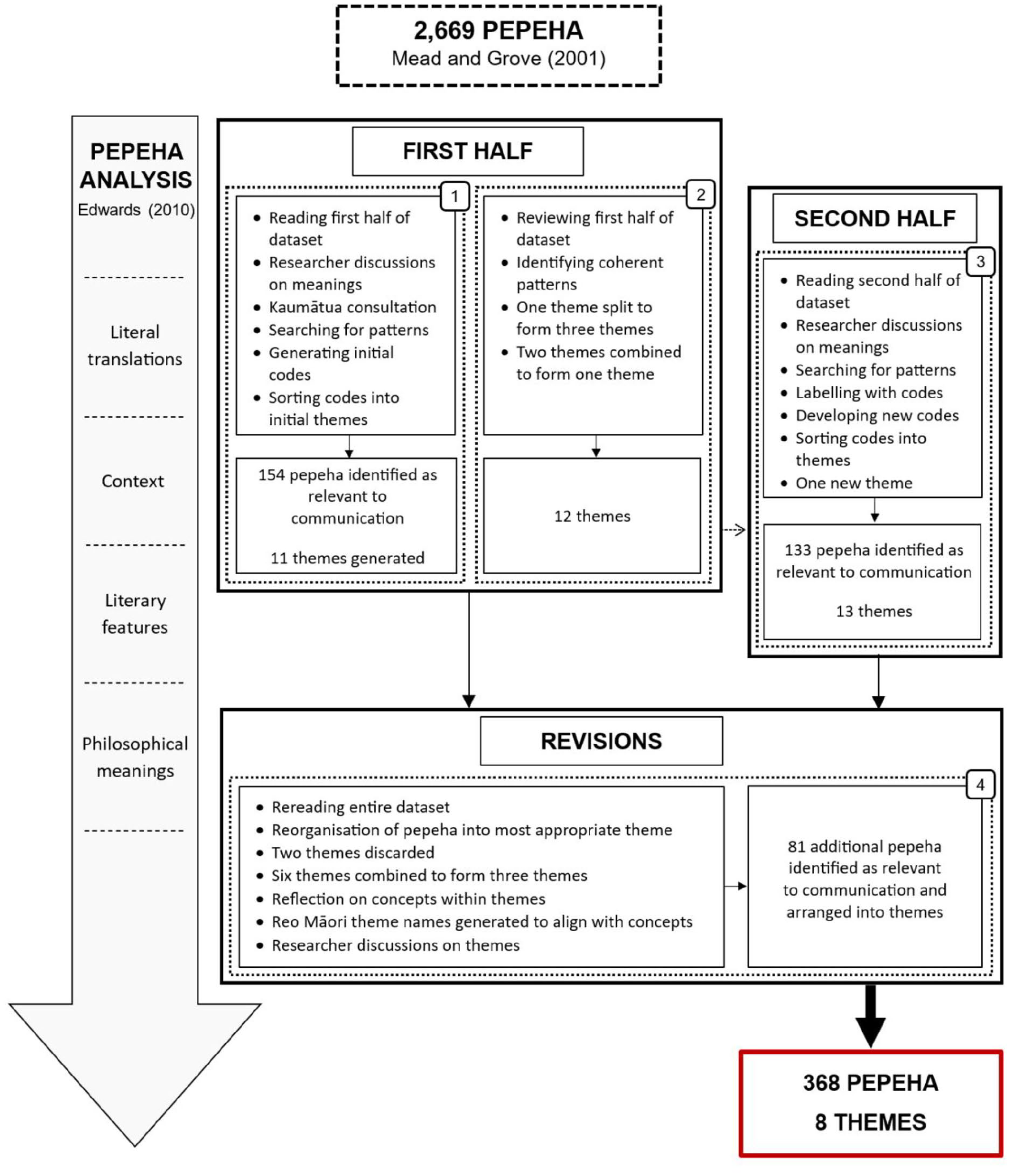
Flowchart of the analytic methods.
The analysis of pepeha lay primarily with the first and second authors. In interpreting pepeha, we were looking to deepen our understanding of meanings, incorporating diverse perspectives, rather than seeking a single true meaning. Through discussion with the kaumātua, we discovered that knowledge held within oral tradition can be adapted to various contexts and made to fit into varying worlds (R. Haupapa, personal communication, October 11, 2023). Consequently, we sought to comprehend multiple meanings that can co-exist within pepeha.
The first author integrated information obtained through these analytic techniques to generate themes for the first half of the data set. Themes were then checked against the data and combined or split as appropriate. The four interpretive techniques were then applied to the second half of the data set. Approaching analysis in halves aided management of the large data set and identified early patterns that could be explored in more depth in the second half. Themes from the first half of the data set guided theme arrangement for the second half of the data set and one new theme was created at this point of analysis. The two halves of the data set were then integrated, and themes were rechecked, combined, and discarded, with some reorganisation of pepeha into the most appropriate theme. Themes were renamed during this stage. Where pepeha crossed multiple themes, they were placed into the theme of best fit based on their primary message.
Results and discussion
Three hundred and sixty-eight pepeha were identified as relevant to communication and arranged into eight themes: (a) āhuatanga karere (message and messenger characteristics), (b) mana reo (power and influence of language), (c) reo ā-tinana (body language), (d) te whē (sound), (e) tohu (signs, instructions, marks, visions, omens), (f) whakarongo (listening, hearing, obeying), (g) whanaungatanga (relationships), and (h) whatumanawa (open expression of emotion). Table 1 shows the number of pepeha per theme, ordered from most to least included pepeha. All identified pepeha are listed in Supplementary Material 1. While each of the following sections focuses on one theme to illustrate distinct concepts, there was substantial interconnection between themes. In the following sections, we present a model of ancestral Māori communication, Tāmata Te Reo Tūpuna. The model supports revitalisation of ancestral language and cultivation for knowledge integration into therapeutic practice.
Number of included pepeha (ancestral sayings) by theme.

Four pepeha fell outside of the identified themes; āhuatanga karere = message and messenger characteristics; whanaungatanga = relationships; tohu = signs, instructions, marks, visions, omens; mana reo = power and influence of language; whatumanawa = open expression of emotion; whakarongo = listening, hearing, obeying; reo ā-tinana = body language; te whē = sound.
Āhuatanga karere
Kia kotahi kī. Let there be only a single word. (Stowell, n.d., as cited in Mead & Grove, 2001, p. 212)
This theme consists of pepeha describing valued attributes of the karere (message, messenger). As is evident in the opening pepeha of this theme, consistency was a valued message characteristic. Multiple sayings reference Rauru, ancestor of Ngā Rauru (Māori tribe in the south of Taranaki, North Island, New Zealand), famously known for using few words and never diverting from his word (Mead & Grove, 2001): “Rauru kī tahi (Rauru of the one word)” (Broughton, 1983; Ihaka, 1957; Shortland, 1980, as cited in Mead & Grove, 2001, p. 349). Pepeha also critique inconsistent messages, described through symbols of double tongues, “Arero rua! (Two-tongued)” (Brougham, 1957; Colenso, 1879, as cited in Mead & Grove, 2001, p. 19), double hearts, “Ngākau rua (Double heart)” (Brougham 1975; Colenso, 1879, as cited in Mead & Grove, 2001, p. 324), or taiaha (close-quarters staff weapons with carved faces on either side), “He arero taiaha (A tongue like a taiaha)” (Stowell, n.d., as cited in Mead & Grove, 2001, p. 66). The lesson is to avoid changeability or attempts to remain neutral and instead, communicate in a forthright, honest manner.
With pono (truth) as a central component of tikanga (correct practice) (Mead, 2016), warnings were given for deceptive messages. “He kōrero kei runga, he rahurahu kei raro (Talking above but meddling below)” (Brougham, 1975; Kōhere, 1951; Williams, 1908; Williams, 1971, as cited in Mead & Grove, 2001, p. 86) alerts listeners of the potential for messages to misalign with a person’s true intentions. Caution and scepticism were applied to those who spoke in deceitful or untruthful ways. The saying, “Ko kōrua pea ko Tama-arero i haere tahi mai? (Did you perhaps travel here together with Tongue’s-Son?)” (Brougham, 1975; Grey, 1857; Te Toa Takitini, 1923, as cited in Mead & Grove, 2001, p. 232), personifies lying to question the sincerity of a person’s statements.
Speech required co-occurring modesty. Boasting of one’s own skills and achievements was unfavourable (Mead & Grove, 2001). It was best for endorsement to come from others (Holmes, 2018), as described in the pepeha, “E kore te kūmara e kī ake ki a ia he māngaro (The kūmara does not announce it is tasty)” (Mead & Grove, 2001, p. 36), and affirmed through others such as, “Waiho mā te tangata e mihi (Let another sing your praises)” (Brougham, 1975; Kōhere, 1951; Williams, 1908, as cited in Mead & Grove, 2001, p. 418). Boastful expressions could be described as “He pikitanga hoki tō te kakī (A difficult uphill job for the throat)” (Brougham, 1975; Kōhere, 1951; Mitchell, 1944, as cited in Mead & Grove, 2001, p. 108), perhaps given their negative receptions.
In the process of coming to know, Māori appreciate observation and silence (Edwards, 2009). There was little value in verbose or empty speech. “E pā, tāngia te wai o tō waha (Bail out your mouth)” (Shortland, 1980, as cited in Mead & Grove, 2001; Te Manukura, 1923; Williams, 1971, as cited in Mead & Grove, 2001, p. 43) expresses this concept as a statement given to loquacious individuals (Mead & Grove, 2001). While empty talk existed, described, for example, as “He waha huka ki te kōrero (Frothy-mouthed in speaking)” (Brougham, 1975; Williams, 1908, as cited in Mead & Grove, 2001, p. 134), messages would ideally contain substance with due consideration given. This is metaphorically described in the pepeha, “Ki te kainga weratia te karaka, ka roria (If the karaka berry is eaten hot, giddiness results)” (Kōhere, 1951; Williams, 1971, as cited in Mead & Grove, 2001, p. 223). The karaka berry required patient preparation to avoid its poison. Metaphorically, appropriate consideration was needed before speaking or acting (Mead & Grove, 2001).
Flavour and wit were also notable characteristics, giving value to messages and contributing to the eloquence of speech. In the pepeha, “Haere ki te moana kia whakapūharutia koe ki te kete maoa (Go to the sea to get tasty morsels for the baskets of cooked food)” (Grey, 1857; Williams, 1971, as cited in Mead & Grove, 2001, p. 54), whakapūharutia (to make into a tidbit) refers to literary devices that enrich spoken word (Mead & Grove, 2001). Tūī (parson bird; Prosthemadera novaeseelandiae) were also used to describe witty speakers: “He kōkō tatakī (A witty tūī)” (Williams, 1908; Williams, 1971, as cited in Mead & Grove, 2001, p. 86). This was the sign of a person who could effectively convey their message and hold leadership capabilities: “Kōkō tatakī nō te wao tū, he tangata tohu taua, tohu marae (A fluent speaker of the forest, one marked for military activities, as well as those of the marae)” (Best, 1977, as cited in Mead & Grove, 2001, pp. 232–233). Embellishing speech with linguistic flavour and keen intelligence were attributes of capable orators who could capture the interest of listeners and wake the brain (Rewi, 2010). These features contributed to the value, significance, and mana (power, authority, prestige, status) of the message.
The concepts detailed in this theme provide evidence of the mauri (life force) that permeates words and language (Mika, 2007). They portray the animacy of expression through descriptions of personalities, attributes, forms, and characteristics of messages and messengers.
Whanaungatanga
He riri whaka Ngāi Te Rangi, muri iho kata atu ana kata mai ana tāna mahi. Disputes between members of Ngāi Te Rangi are followed by mutual laughter. (S. P. Smith, 1915, as cited in Mead & Grove, 2001, p. 117)
Communication in te ao Māori is a contribution to the establishment and maintenance of relationships and the harmony of the collective. Relationships are rooted in the concept of utu (balance restoration, reciprocity) (Mead, 2016), with restorative acts required to maintain balance. The opening pepeha in this theme describes reciprocal laughter, used by Ngāi Te Rangi (Māori tribe of Matakana Island and north Tauranga, North Island, New Zealand) to restore harmony following conflict. In another example, balance was restored through the surrender of one party, seen as a gift from one to the other: “Te mutunga a Tautahi, te koha a Rua (The end for Tautahi, the victory granted by Rua)” (Brougham, 1975; Grey, 1857; Williams, 1908, as cited in Mead & Grove, 2001, p. 377).
Maintaining harmonious relationships required careful and purposeful communication. The ancestors were cognisant of the capability for conflict with lasting and growing consequences. Numerous pepeha advise against communicative acts that create unnecessary dissension. Specifically, pepeha mention avoidance of insult, complaint, and pointless argument. Insult created conflict and could be followed with a restorative consequence. “Kia mahara ki te hē o Rona (Let the sin of Rona be remembered)” (Best, 1977; Grey, 1857; Ihaka, 1956, as cited in Mead & Grove, 2001, p. 213), raises the story of Rona, who cursed the moon with the offensive phrase, “Pokokōhua! (boil your head!)” (Mead & Grove, 2001, p. 213), and was snatched (Mead & Grove, 2001). Complaint, although a regular occurrence from some, “E whiti te rā, e haku (As long as the sun shines there is complaining)” (Williams, 1908, as cited in Mead & Grove, 2001, p. 50), could also yield dissension and disrupt forward movement of projects: “He ika haehae kupenga (A fish that tears the net)” (Grey, 1971; Ihaka, 1958; White, 1887, as cited in Mead & Grove, 2001, p. 73). The pepeha, “E tohe ana koe i ngā tohe a Pōtoru (You are as stubborn as Pōtoru)” (Buck, 1974; Grey, 1857; Grey, 1971; Williams, 1908, as cited in Mead & Grove, 2001, p. 48), for example, warns against unnecessary argument, relating to the story of Pōtoru, chief of Te Rīrino (canoe that brought Pōtoru and his people from Hawaiki (traditional homeland of Māori) to Aotearoa). Pōtoru argued about sailing directions with Turi, chief of the Aotea (canoe that brought Turi and his people from Hawaiki to Aotearoa). As a result, Te Rīrino was lost at sea (Mead & Grove, 2001). These sayings guide descendants away from unconstructive forms of communication with potentially undesirable consequences.
Conflicting perspectives, however, were accepted and expressed openly, although they required appropriate management. The preparation for a successful marriage, for example, involved discussion from all concerned (Heuer, 1969): “Kōrerotia ki runga ki te takapau wharanui (Let the discussion be on the nuptial mat)” (Best, 1903; Williams, 1908, as cited in Mead & Grove, 2001, p. 243). In the old times, diverse perspectives would be heard with decisions focused on reaching agreement among the group (Marsden, 2003). Chiefs were key to this process, expected to embody leadership qualities such as mediating disputes (Te Rito, 2006): “Kia ai he tā kōtuku ki roto o te nohoanga pahī, kia tau ai (Let there be a white heron feather in the assembly so that all may be well)” (Williams, 1971, as cited in Mead & Grove, 2001, p. 208). The practice of openly addressing conflicting viewpoints highlights the significance of dialogue and the importance of communication for harmonious relationships within Māori society.
Tohu
Ka rere a Matariki, ka wera te hinu. When the Pleiades rise the fat is heated. (Williams, 1908, as cited in Mead & Grove, 2001, p. 181)
In precolonial times, Māori gained information on critical matters from nonverbal, often environmental indicators. Tohu provided instruction and guidance for essential activities, such as timing of planting, harvesting, food gathering, and food preservation. The pepeha above refers to Matariki (Pleiades) as a signal to capture and preserve large quantities of birds in winter (Mead & Grove, 2001). Tohu were nature’s clock, timing the work to be carried out largely for survival.
Māori also observed signs indicating a change in season or forecasting weather. The pepeha, “Ka tangi te pīpīwharauroa, ko te karere a Mahuru [the fourth lunar month of the Māori year; the star Alphard, whose reappearance indicates the start of the fourth month] (When the cuckoo cries, that is the herald of spring)” (Fulton, 1903; Grey, 1857; Williams, 1971, as cited in Mead & Grove, 2001, p. 187), describes the pīpīwharauroa (shining cuckoo; Chrysococcyx lucidus) announcing their arrival following migration (Fulton, 1910). The song of the pīpīwharauroa was a message to Māori that Mahuru was beginning (Mead & Grove, 2001). Other birds, namely the matuku (brown bittern; Botaurus poiciloptilus), were observed for messages relating to coming weather: “Mehemea ka haere te matuku i te pō, he tau waipuke (If the brown bittern goes about crying at night, a season of floods will ensue)” (Best, 1977, as cited in Mead & Grove, 2001, p. 294).
Tohu commonly signalled fortune, often foretelling survival, death, disaster, illness, defeat, or victory. “Te tōtara wāhi rua, he aitua; kia kotahi, he waimarie (The tōtara that splits in falling is a misfortune but one that remains whole means good fortune)” (Best, 1976, 1977, as cited in Mead & Grove, 2001, p. 393) provides examples of tohu ora (signs of good fortune) and tohu mate (signs of misfortune). These signals could serve as warnings, for example, indicating the likely outcome if a war party were to attack: “He whetū ka haere ki te kai i te marama, kei te taha ki tōna hoariri e kore rā ia e toa (A star that goes to feed on the moon is beside the enemy and they will not be victorious)” (Turnbull, n.d.; Williams, 1908, as cited in Mead & Grove, 2001, p. 138). Tohu were closely followed for their guidance on important activities and prediction of outcomes.
Those exceptional in reading tohu were known as tohunga (skilled people, priests, healers) (T. Smith, 2008). Following European contact, a common translation of the word tohunga is “expert” (T. Smith, 2008, p. 268), a translation which drops the meaning of the root word, tohu, and removes the sacredness involved in reading and using tohu (T. Smith, 2008). Tohu were connected to spirituality, with some being clear communications through wairua (spirit): “Māna e kī mai te pakoko a te tiaki, pakoko tawhito (Let the image of the protecting warrior chief speak)” (Te Rangikāheke, 1849, as cited in Mead & Grove, 2001, p. 280). This pepeha describes visions, accepted phenomena for Māori (Cherrington, 1994), communicated through wairua (Moorfield, n.d.). While commonly used, tohu retained a sacred nature, connecting people to spiritual and natural realms.
Mana reo
Ka ora koe, ka pihea. If the dirge has been chanted you will be immortal. (Tregear, 1888, as cited in Mead & Grove, 2001, p. 173)
It has long been understood that there is power and prestige at the heart of te reo Māori. Sir Āpirana Ngata, a prominent Māori leader, scholar, and politician, expressed this sentiment when he advocated for the recording of Māori oral tradition to be passed on to future generations: “Utaina!” (Ngata, 1959, as cited in Mead & Grove, 2001, p. 414). Te Hurinui translates this as “Load! (the precious freight on board)” (Ngata & Te Hurinui, 1959, p. xiv), the precious freight being ancestral wisdom captured within mōteatea (chants). In addition, te reo Māori was closely associated with the presence of mana within people: “Kia mau ki ō tikanga me te reo Māori, koinei rā tō tūranga teitei e (Cling to your Māori customs and language for there is where you will find your high position)” (Kāretu, 1974, as cited in Mead & Grove, 2001, p. 214).
Reo (language, voice, utterance) manifests the diversity of perspectives, knowledge, practices, and ways of being among people. Like the three native birds in the pepeha, “E koekoe te tūī, e ketekete te kākā, e kūkū te kererū (The tūī chatters, the parrot gabbles, the wood pigeon coos)” (Brougham, 1975; Kōhere, 1951; Williams, 1908, as cited in Mead & Grove, 2001, p. 30), we each possess unique reo. These differences tend to be viewed by Māori in a positive light (Edwards, 2009), suggesting a degree of power in the reo that individuals bring to the collective. Not all statements were equal, however, in authority. Certain people had greater mana, through birthright or skill acquisition (Mead, 2016). There also exists a deep respect for elders in te ao Māori (Durie, 1999) and a hierarchical rank by sibling birth order (Mead, 2016). Thus, the words of those with higher status, such as ancestors, chiefs, parents, and elder siblings, were to be respected and obeyed: “He nui muringa hei kī mai i tōna angaanga (The youngest, even if an important person, must accept the bidding of the elder)” (Brougham, 1975; Grey, 1857; Williams, 1971, as cited in Mead & Grove, 2001, p. 102); “Kia mau ki te kupu a tōu matua (Hold fast to the words of your father)” (Brougham, 1975; Colenso, 1879; Firth, 1959, as cited in Mead & Grove, 2001, p. 215). Inversely, words from a person of low rank or status could be challenged: “Māu e kī mai te kākahi whakairoiro o te moana (Is it for you to speak as the ornamental mussel of the lake?)” (Grey, 1857; Te Rangikāheke, 1849; Williams, 1971, as cited in Mead & Grove, 2001, p. 289).
The mana associated with language is evident in its sacred capability to manifest the power and influence of atua (gods). Karakia are a channel for Māori to speak to atua, binding the person with the spiritual world (Barlow, 1991). Most prominently, in the pepeha analysed, karakia were a means of influencing wairua and mitigating environmental or tribal dangers. “Ka uea te pou o te whare (The post of the house was loosened)” (Best, 1903; Williams, 1971, as cited in Mead & Grove, 2001, p. 195) refers to karakia used in the practice of umu hiki (lifting ceremony) (Mead & Grove, 2001). Through karakia, tohunga were able to shake the strength of the pou (metaphoric post; someone who provides strong support), inciting unease in a nearby group and driving them away (Mead & Grove, 2001).
Alongside the positive potential to influence wairua and alleviate dangers, there was a balanced appreciation for the harmful potential of words. This can be seen through metaphorical descriptions of words as stings of stingrays and spears: “Tēnei te whakangungu nei ki ngā tara-a-whai o Ārai-te-uru (Here I am fending off the stings of the stingray of Ārai-te-uru)” (Grey, 1857; Te Toa Takitini, 1923; Williams, 1971, as cited in Mead & Grove, 2001, p. 382); “He tao huata e taea te karo, he tao kī e kore e taea (The thrust of a spear can be parried but not the thrust of words)” (Stowell, 1913, as cited in Mead & Grove, 2001, p. 122). Words have a regenerative nature, like the persistent regrowth of the tī kōuka (cabbage palm; Cordyline australis): “He uru ā kī, he uru tī, e pihi ake (A grove of words and a grove of tī trees; both spring up)” (Best, 1977, as cited in Mead & Grove, 2001, p. 133). Once released, harm tended to live on. It is this life force imbued within words (Mika, 2007) that gives effect to their mana.
Whatumanawa
Ka auē, ka mōhiotia he mate; ka nohopuku, ka pōhēhētia he ora, he ngākau tatū. People cry out when they are in pain; sit quietly and no one will know you are hurting. (Kōhere, 1905, as cited in Mead & Grove, 2001, p. 151)
Emotional expression is regarded as woven into te reo Māori (Pihama et al., 2019). The pepeha above encouraged emotional expression on a collective level. This saying was a response to disparagement of Te Tiriti o Waitangi (the founding document of New Zealand) by Tūhaka Mōkena Kōhere, a chief of Ngāti Porou (Māori tribe in the area north of Gisborne to Tihirau, East Coast, North Island, New Zealand) (Kohere, 1949). It expresses the viewpoint that emotional expression can inform others of a person or group’s inner state and promote understanding and change. The important message is that outcry was necessary to communicate pain felt within.
A range of emotions were expressed in traditional Māori society. As in the pepeha, “Aroha mai, aroha atu (Love toward us, love going out from us)” (Brougham, 1975, as cited in Mead & Grove, 2001, p. 19), the reception and expression of aroha (love, affection, compassion) was important for relationships with all living things (Barlow, 1991). As aroha could involve itself in communicative acts, so could anger, frustration, and annoyance. These emotions emanated from atua (Barlow, 1991; Mead & Grove, 2001), with angered outbursts or talk sourced from Whatitiri (goddess of thunder): “Ka mahi ngā uri o Whatitiri (Well done, descendants of Whatitiri)” (Brougham, 1975; Grey, 1857; Te Rangikāheke, 1849, as cited in Mead & Grove, 201, p. 165). The saying, “Te puna whakatotō riri (The spring from which war gushes forth)” (Brougham, 1975; Grey, 1857; Williams, 1908; Williams, 1971, as cited in Mead & Grove, 2001, p. 386), metaphorically described a person or tribe involved in frequent dispute (Mead & Grove, 2001), evoking the image of riri (anger, quarrel) pouring from a spring. The array of emotions woven into communicative acts shaped interpersonal relationships and reflected connection with atua, emphasising the interplay between human emotions and broader spiritual and cultural contexts.
Emotional expression through tangi (wailing), roimata (tears), and hūpē (mucus), was commonly released by ancestors during ritual mourning (Pihama et al., 2019). In the pepeha, “Wahine tangi haehae, he ngaru moana, e kore e mātaki (The mourning and laceration by women, like the waves of the sea, never cease)” (Best, 1924; Brougham, 1975; Williams, 1971, as cited in Mead & Grove, 2001, p. 415), expressions of grief are likened to constant ocean sounds. Tears and mucus are described in pepeha as ea (restoration of peaceful interrelationships) or utu (Mead, 2016): “Ko te roimata i heke, ko te hūpē i whiua ki te marae, ka ea a Aituā (Tears and nose mucous that fall upon the marae avenge Death)” (Kāretu, 1975, as cited in Mead & Grove, 2001, p. 259); “Ko roimata, ko hūpē anake ngā kai utu i ngā patu a aituā (Tears and mucous only are the avengers of the strokes of misfortunes)” (Best, 1901, 1976; Brougham, 1975, as cited in Mead & Grove, p. 244). These expressions, connected to ancestral rituals, are deeply rooted in Māori worldviews (Pihama et al., 2019).
Whakarongo
He whakarongo pīkari. Listening like a nestling. (Williams, 1908, as cited in Mead & Grove, 2001, p. 137)
With oral transmission as the sole form of verbal communication in old times (McRae, 2017)—although by no means the only mode of communication—listening was imperative to capture and retain knowledge. During whaikōrero, for example, it was the role of the listener to attentively tune in to the messages conveyed by the speaker (Rewi, 2010). The saying above describes attentive listening through the metaphor of a young bird waiting attentively for a parent to bring food to the nest (Mead & Grove, 2001). This is also framed inversely, with descriptions of inattentive or selective listening indicating that information or advice may be missed. In the pepeha, “Tā te rangatira tāna kai he kōrero, tā te ware he muhukai (The chief’s sustenance is discussion but the low-born is inattentive)” (Brougham, 1975; Kōhere, 1951, as cited in Mead & Grove, 2001, p. 362), inattentiveness is associated with low status, suggesting a favouring of attentive ears.
Listening to advice was counselled with warnings of adverse outcomes if advice was ignored. A prominent lesson emerged from five pepeha relating to the story of Maka, a Māori ancestor who voyaged to Aotearoa on Te Arawa canoe which brought the ancestors of the Arawa (a group of tribes in the Rotorua-Maketū area, central North Island, New Zealand) and Ngāti Tūwharetoa (tribal group of the Lake Taupō area, central North Island, New Zealand) to Aotearoa. Maka slept overnight covered only by his dogskin cloak. Blinded by pride in his cloak, he paid no attention to the warnings of his friends and froze to death in the cold (Mead & Grove, 2001). “Kia mahara ki te hē o Maka (Remember the mistake of Maka)” (Brougham, 1975; Grey, 1857, as cited in Mead & Grove, 2001, p. 213), serves as a reminder to take on advice and avoid suffering. A similar message is given through the pepeha, “Haere ki Ō-te-rangi-pā-karu ki te kai pua mānuka (Go to Ō-te-rangi-pā-karu and eat mānuka seeds)” (Turnbull, n.d., as cited in Mead & Grove, 2001, p. 54). Ō-te-rangi-pā-karu refers to a figurative place that is “your ears that don’t hear” (Mead & Grove, 2001, p. 54) while pua mānuka are the seeds of native scrub bush and metaphorically, seeds of trouble (Williams, 1971). It is implied that when the ears fail to hear something valuable, trouble is the result.
Despite valuing attentiveness to important content, the same may not apply for one who listened intently to unimportant remarks. The saying, “Tangaroa piri whare (Tangaroa is hiding in the house)” (Brougham, 1975; Colenso, 1879; Grey, 1857, as cited in Mead & Grove, 2001, p. 359), highlights this, representing the ebb and flow of the tide and of Tangaroa (god of the sea and fish), and metaphorically representing the pattern of talk and silence involved in gossip, a likely cause of conflict or dispute (Clarke et al., 2001). With Tangaroa comprising a significant part of the universe and our bodies (Hanara, 2020), his omnipresence warns against eavesdropping (Mead & Grove, 2001). The pepeha offers a reminder to reserve attentiveness for significant messages.
Reo ā-tinana
Ka kawea e te manamana-hau ka aroarohaki. Affected by a new exultation, the person began moving the hands in a quivering motion. (Andersen, 1924, as cited in Mead & Grove, 2001, p. 162)
Te reo Māori has frequently been described as solely oral, however, conversing in te ao Māori engages both the body and face (Clément, 2017). “Me he rau whārangi te kanohi (The face is like the leaf of the whārangi)” (Brougham, 1975; Grey, 1857; Williams, 1971, as cited in Mead & Grove, 2001, p. 297), likens the pale green leaves of the whārangi (a large shrub with large mottled leaves; Brachyglottis repanda) with the facial colour of a person who was visibly ashamed (Mead & Grove, 2001). Whakamā, the Māori word for shame, means to become pale (Mead & Grove, 2001; Moorfield, n.d.), an example of the connection between outer facial appearance and inner emotional state.
Expression through body movement has enduringly been a prominent part of Māori interactions and performance (Gruber et al., 2016). As in the pepeha opening this section, aroarohaki (quivering of the hands) is often used to express emotion during performance (Matthews, 2004). This saying describes the expression of manamanahau (elation, ecstasy, excitement) (Moorfield, n.d.). Quivering of the hands is also known as the “Dance of Tānerore” (Clément, 2017, p. 325), symbolising shimmering heat rising from the ground. In this sense, wairua provides a medium for the universe to speak through (Clément, 2017), such that the spiritual and environmental realms are intimately tied with bodily expression.
Dress or adornments worn on the body also conveyed information, particularly of inner mental or emotional states, kinship, or status. One example is the huia (an extinct species of New Zealand wattlebird; Heteralocha acutirostris) feather worn on the head: “Toroa e! Toroa whakapai tangata. Huia e! Huia tangata kotahi (O albatross! Albatross to decorate people. O huia! Huia for a single person)” (Best, 1977, as cited in Mead & Grove, 2001, p. 406). As a rarity, these feathers were reserved for chiefs and people of high importance, and the adornment was known to symbolise high rank (Mead, 1969).
Although physical expression or presentation could impart messages, pepeha caution that outward appearance or demeanour may not reveal one’s inner thoughts or feelings nor accurately present substance within a person. “He kiri ki waho, he puku ki roto (Skin on the outside, a stomach within)” (Ruawai, 1981; Williams, 1908, as cited in Mead & Grove, 2001, p. 84) contrasts the superficial skin of a person with the puku (stomach, secret, something hidden in silence) (Moorfield, n.d.). In some cases, thoughts or feelings could be kept in silence, and deceptive messages delivered outwardly. The ancestors treated deceptive messages carefully, with pepeha advising caution in interpretation of outward appearances.
Te whē
Me te wai e rere ana. Like flowing water. (Best, 1977, as cited in Mead & Grove, 2001, p. 307)
“Te whē” (Marsden, 1992, p. 5) can be considered as clothing or sound that wraps around words. Sound was inseparable from the meaning of words just as it was inseparable from wānanga (imparting of knowledge) (Raerino, 2000, as cited in Mika, 2007). Raerino (2000, as cited in Mika, 2007) suggests that sounds of the environment are present within words, talk, incantation, and performance. This concept surfaced in pepeha which liken animated conversations, chatter, talk, and the noise of children at play to songs of cicadas, parrots, and swamp hens; the loud feeding of tarakihi (deep sea perch; Nemadactylus macropterus); and the noisy popping of tawa (a broadleaf canopy tree; Beilschmiedia tawa) berries roasted on the fire: “Me he kihikihi kei te waru (Like cicada in the summer)” (Taylor, 1870, as cited in Mead & Grove, 2001, p. 293) and “He ahi tawa ki uta, he kumu tarakihi ki te moana (A tawa fire on land and a tarakihi fish at sea)” (Best, 1907, 1977; Brougham, 1975, as cited in Mead & Grove, 2001, p. 64). These are displays of the environmental imprint found within human voices.
The ancestors were evidently observant of vocal sound. Vocal quality, including the fluency, sweetness, volume, and softness or harshness of the voice, was described in multiple pepeha. Fluid, clear, or loud voices could be complimented through association with the song of the kōpara (bellbird; Anthornis melanura), birds known for their loud, clear, liquid-like voices: “He rite te kōpara e kō nei i te ata (Like a bellbird singing at dawn)” (Best, 1977; Williams, 1971, as cited in Mead & Grove, 2001, p. 117). Loud and resounding sound was complimented by likening voice, particularly of an orator, to pūtaratara (conch shell trumpet): “Me he pūtaratara (Like a horn)” (Brougham, 1975; Grey, 1857; Te Rangikāheke, 1849, as cited in Mead & Grove, 2001, p. 296). A sweet sounding voice, particularly of an orator or singer (Mead & Grove, 2001), may receive the compliment “Me he korokoro tūī (Like the throat of a tūī)” (Brougham, 1975; Colenso, 1891, as cited in Mead & Grove, 2001, p. 294). Each demonstrates appreciation for the quality of sound attached to expressions.
While fluent, clear voices were largely valued, one pepeha described the disfluent speech of some speakers descended from an ancestor who stuttered. “Ngā tamariki reo kīkiki a Rūtaia (The stuttering children of Rūtaia)” (Graham, n.d., as cited in Mead & Grove, 2001, p. 330) appreciates communication styles as inherited from the ancestors, in this case from Rūtaia, an ancestor of people from Taranaki (Mead & Grove, 2001). Considering things passed down from the ancestors were seen as correct, as in the pepeha “Kia heke iho rā i ngā tūpuna, kātahi ka tika (If handed down by the ancestors, then it would be correct)” (Best, 1947, as cited in Mead & Grove, 2001, p. 210), stuttering may have been an accepted manner of speech in the Taranaki region, aligning with the appreciation for diversity in te ao Māori (Edwards, 2009).
Conclusion
Analysis of ancestral sayings identified the intricacies of communication from the perspective of Māori ancestors. Pepeha portrayed verbal, oral, symbolic, emotional, and bodily forms of communication practised and interpreted by the ancestors. They situated communication firmly within Māori society and the interconnected world.
Through the lens of these pepeha, Māori communication can be viewed holistically. Although themes were generated to aid understanding of concepts, there were strong connections between themes. This was evident through overlapping ideas such as emotional expression and relationships, and through homonyms, which in te reo Māori are considered part of the interconnectedness of the world (Mika, 2016). For example, multiple ideas lay within the metaphor of a tūī, which could refer to vocal quality, wit, and more generally, eloquence in speaking. Rather than seeking to separate one meaning or theme from another, it is more fruitful to recognise them as intricately interwoven. These interconnections enrich understandings of Māori communication and its place within a broader Māori worldview.
Pepeha additionally showed a clear interrelationship between communication with spiritual, natural, and human worlds. Māori tend to view themselves as inseparable from nature (Henare, 2001). Words were wrapped with fibres from the natural world and much information was transmitted to people from environmental surroundings and signs. The natural realm was also inseparable from the spiritual realm and the sacrality of language and communication. An example is aroarohaki, a bodily expression which, through wairua, manifests the elements of Tānerore (son of Tama-nui-te-rā, the sun, and Hine-Raumati, the summer maiden; originator of the haka), or the shimmering air (Clément, 2017; Matthews, 2004). This interconnectedness between nature, spirituality, and humanity, reflects a holistic understanding of existence. An artistic interpretation of findings, shown in Figure 2, highlights the interconnectedness of Māori communication. The three panels represent te ao wairua (the spiritual world), te ao tūroa (the physical world), and te taiao (the natural world). Each figure represents the varying perspectives that make up a whole person, symbolising contributions of spirituality, physicality, and nature to a holistic understanding of communication.
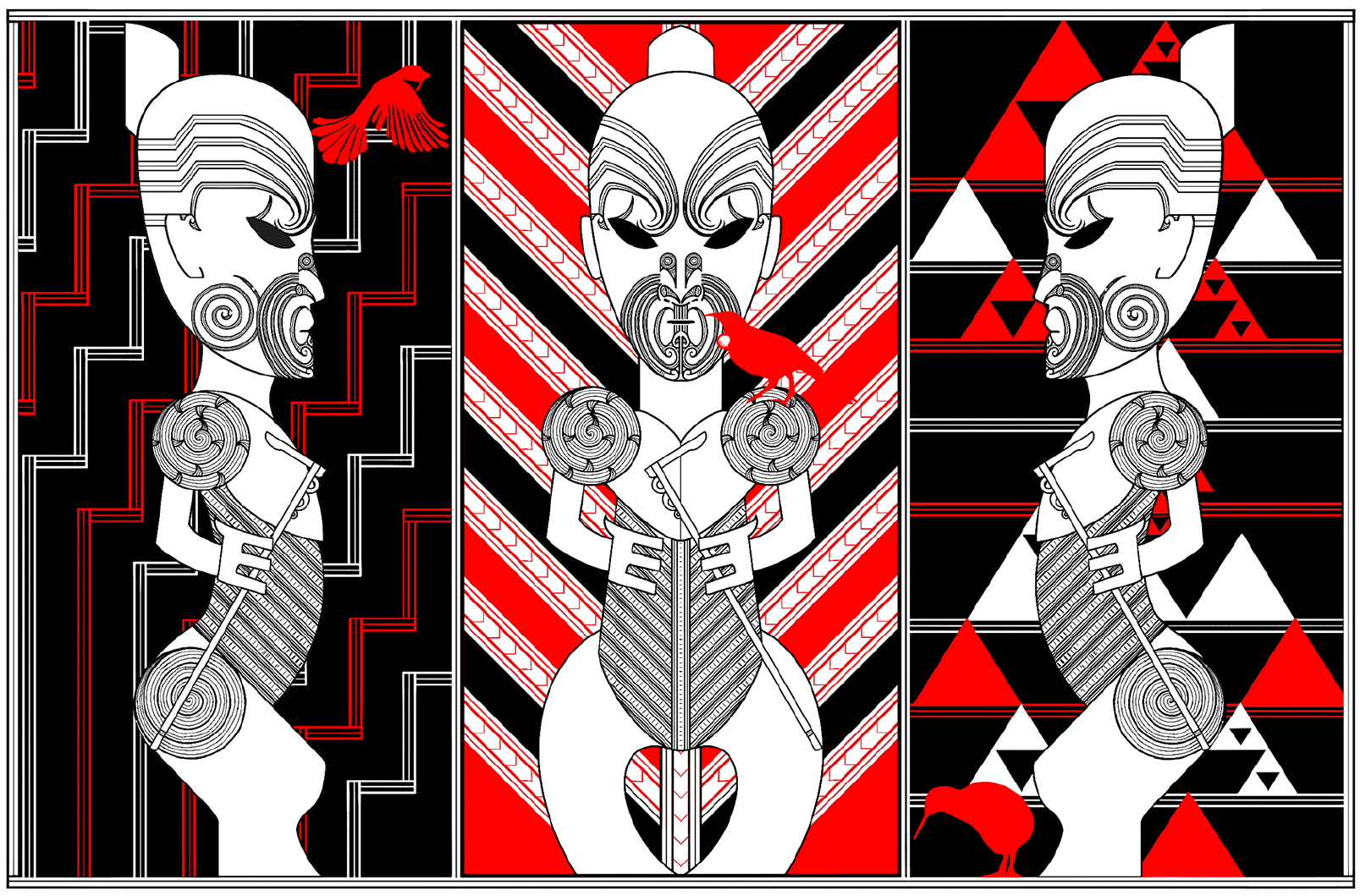
An artistic interpretation of Māori communication as told through pepeha (Eustace & Tuhura, 2024).
Findings also highlight the integral role of communication in Māori interpersonal relationships and social dynamics. Communicative acts were powerful forces, capable of promoting or diminishing harmony and holding potential to restore it following conflict. Thus, communication was integral to maintaining social balance and nurturing harmonious relationships. Mana, which mediates relationships (Mead, 2016), held significance in communication. The status of a person was reflected in the authority of their word, highlighting the link between communication and social influence.
This knowledge has practical implications for the speech-language therapy field, with potential to align services with culturally grounded therapeutic approaches. The model described in this research, Tāmata Te Reo Tūpuna, presents a traditional Māori, yet novel research perspective on the nature of language and communication, reframing these concepts for the speech-language therapy field. Tāmata means to revitalise or cultivate. We suggest this model be used initially to revitalise ancestral views on language in contemporary speech-language therapy and cultivate space for further growth in applying mātauranga Māori in practice. This may involve promoting Indigenous communication as connected to worldview and holism; guiding further discussions in Māori spaces on the nature, meaning, and forms of communication; and aiding discourse in professional contexts on the diversity and pluralism of communication. Tāmata Te Reo Tūpuna should be considered alongside obligations to Te Tiriti o Waitangi and existing approaches to decolonising the field.
Our findings invite further research on Māori conceptualisations of communication and the integration of mātauranga Māori into speech-language therapy. With limited Māori speech-language therapy research (Meechan & Brewer, 2022) and the Eurocentric origins of the field (Wylie et al., 2016), it can be challenging for speech-language therapists to draw on mātauranga Māori in contemporary practice. This research validates Māori ways of approaching communication, of particular importance to Māori clients, whānau (family groups), and Māori speech-language therapists. Future research may explore how this knowledge interacts with the identities and practices of Māori speech-language therapists, how Māori communication models may be applied cross-culturally, resources that are needed to support integration into practice, and the effects of Māori communication models on the health and wellbeing of Māori. Additional interpretations of pepeha by kaumātua or mātauranga Māori experts could further enrich Māori models of communication knowledge.
To conclude, pepeha convey rich knowledge of traditional communicative values and practices in te ao Māori. In addition to positioning communication within a holistic, relational philosophy, the selected pepeha highlighted the power of language, the valued features of messages, and multiple modalities used by the ancestors to communicate. These understandings contribute to discourse on Māori communication, offering one perspective and inviting additional interpretations for further enrichment. They hold potential to shape therapeutic practices and benefit Māori wellbeing through culturally grounded communication support.
Supplemental Material
sj-docx-1-aln-10.1177_11771801241290117 – Supplemental material for Māori ancestral knowledge of communication
Supplemental material, sj-docx-1-aln-10.1177_11771801241290117 for Māori ancestral knowledge of communication by Megan Paige Eustace, Jeanette King, Campbell Le Heron, Katrina McGarr and Catherine Theys in AlterNative: An International Journal of Indigenous Peoples
Footnotes
Acknowledgements
The authors acknowledge Rukingi Haupapa, kaumātua of the New Zealand Speech-language Therapists’ Association, and Lisa Davies, kaitakawaenga ako at the University of Canterbury for their guidance and support. The authors also acknowledge the tūpuna (ancestors) who have preserved mātauranga Māori across generations.
Authors’ note
Declaration of conflicting interests
The authors declared no potential conflicts of interest with respect to the research, authorship, and publication of this article.
Funding
The authors disclosed receipt of the following financial support for the research, authorship, and publication of this article: University of Canterbury Aho Hīnātore—Accelerator Scholarship received by ME; Vision Mātauranga Development Fund grant received by ME, KM, and CT.

Supplemental material
Supplemental material for this article is available online.
Glossary
āhuatanga karere message and messenger characteristics
Aotea canoe that brought Turi and his people from Hawaiki (traditional homeland of Māori) to Aotearoa (New Zealand)
Aotearoa New Zealand
Arawa a group of tribes in the Rotorua-Maketū area, central North Island, New Zealand
aroarohaki quivering of the hands
aroha love, affection, compassion
atua gods
ea restoration of peaceful interrelationships
haka posture dance
Hawaiki traditional homeland of Māori
Hine-Raumati the summer maiden
huia an extinct species of New Zealand wattlebird; Heteralocha acutirostris
hūpē mucus
iwi tribes
karakia incantations, prayer
karere message, messenger
kaumātua elder
kaupapa rangahau a Māori way of selecting the best means of acquiring knowledge
kererū pigeons
kōpara bellbird; Anthornis melanura
Mahuru the fourth lunar month of the Māori year; the star Alphard, whose reappearance indicates the start of the fourth month
mana power, authority, prestige, status
mana reo power and influence of language
manamanahau elation, ecstasy, excitement
Māori Indigenous people of New Zealand
Maka Māori ancestor who voyaged to Aotearoa on Te Arawa canoe
Matariki Pleiades
mātauranga Māori Māori knowledge
matuku brown bittern; Botaurus poiciloptilus
mauri life force
mōteatea chants
Ngā Rauru Māori tribe in the south of Taranaki, North Island, New Zealand
Ngāi Te Rangi Māori tribe of Matakana Island and north Tauranga, North Island, New Zealand
Ngāti Porou Māori tribe in the area north of Gisborne to Tihirau, East Coast, North Island, New Zealand
Ngāti Tūwharetoa tribal group of the Lake Taupō area, central North Island, New Zealand
ō-te-rangi-pā-karu a figurative place; your ears that don’t hear
Pākehā New Zealanders of predominantly European ancestry
Papatūānuku Earth Mother
pepeha ancestral sayings
pīpīwharauroa shining cuckoo; Chrysococcyx lucidus
pono truth
Pōtoru chief of Te Rīrino canoe
pou metaphoric post; someone who provides strong support
pua mānuka seeds of native scrub bush; seeds of trouble
puku stomach, secret, something hidden in silence
pūrākau narratives
pūtaratara conch shell trumpet
Ranginui Sky Father
raranga weaving
Rauru ancestor of Ngā Rauru Māori tribe in the south of Taranaki, North Island, New Zealand
reo language, voice, utterance
reo ā-tinana body language
riri anger, quarrel
roimata tears
Rūtaia an ancestor of people from Taranaki, North Island, New Zealand
taiaha close-quarters staff weapons with carved faces on either side
Tama-nui-te-rā the sun
Tānerore son of Tama-nui-te-rā and Hine-Raumati; originator of the haka
Tangaroa god of the sea and fish
tangi wailing
tarakihi deep sea perch; Nemadactylus macropterus
tauira students
tawa a broadleaf canopy tree; Beilschmiedia tawa
te ao Māori the Māori world
te ao mārama a Māori perspective on the nature of reality
te ao tūroa the physical world
te ao wairua the spiritual world
Te Arawa canoe which brought the ancestors of the Arawa and Ngāti Tūwharetoa tribes to Aotearoa
Te Korekore realm of potential being
Te Pō realm of becoming
te reo Māori the Māori language
Te Rīrino canoe that brought Pōtoru and his people from Hawaiki to Aotearoa
te taiao the natural world
Te Tiriti o Waitangi the founding document of New Zealand
te whē sound
tikanga correct practice
tī kōuka cabbage palm; Cordyline australis
tohu signs, instructions, marks, visions, omens
tohu mate signs of misfortune
tohu ora signs of good fortune
tohunga skilled people, priests, healers
tūī parson bird; Prosthemadera novaeseelandiae
tukutuku latticework
umu hiki lifting ceremony
utu balance restoration, reciprocity
waiata song
wairua spirit
wānanga imparting of knowledge
whaikōrero oratory
whakairo carving
whakamā shame; to become pale
whakapapa layering; genealogy; a Māori way of relating the knower to the known
whakapūharutia to make into a tidbit
whakarongo listening, hearing, obeying
whakataukī ancestral sayings of unknown authorship
whakatauākī ancestral sayings of known authorship
whānau family; family groups
whanaungatanga relationships
whārangi a large shrub with large mottled leaves; Brachyglottis repanda
Whatitiri goddess of thunder
whatumanawa open expression of emotion
References
Supplementary Material
Please find the following supplemental material available below.
For Open Access articles published under a Creative Commons License, all supplemental material carries the same license as the article it is associated with.
For non-Open Access articles published, all supplemental material carries a non-exclusive license, and permission requests for re-use of supplemental material or any part of supplemental material shall be sent directly to the copyright owner as specified in the copyright notice associated with the article.
