




Abstract
Te Awa Tupua (The Whanganui River Claims Settlement Act 2017), which granted legal personhood to the Whanganui River) is often discussed as a leading example of the Rights of Nature movement, which aims to grant rights to non-humans. Rather than discussing Te Awa Tupua in relation to Rights of Nature, this article offers new data on the relationships between Māori (Indigenous peoples of New Zealand), tauiwi (non-Indigenous person who has recently settled in New Zealand), and Pākehā (New Zealanders of predominantly European ancestry) stakeholders in Te Kōpuka nā te Awa Tupua (advisory body that works to uphold Te Awa Tupua; Te Kōpuka). I argue that these relationships are positive and based on collaboration because tauiwi and Pākehā stakeholders seem to grasp Māori values. However, Te Kōpuka’s mandate is challenging to achieve because of colonial and Western-minded government structures in New Zealand.
Introduction
The process of granting rights to rivers has gained traction as part of the larger Rights of Nature (RoN) movement (Boyd, 2017; Kauffman & Martin, 2021). The RoN aims to recognize the fundamental rights of non-humans to protect them from continued degradation caused by the human-induced climate crisis (Kauffman & Martin, 2021; Tǎnǎsescu, 2022). In recent years, there has been a rising trend in granting rights to rivers, especially since the signing of Te Awa Tupua (The Whanganui River Claims Settlement Act 2017; O’Donnell et al., 2020; Tǎnǎsescu, 2020). The Legal Personhood Model (LPM) is a model used to recognize the RoN and focusses on the ability for certain ecosystems to hold human rights, with human guardians typically speaking for them at court (Kauffman & Martin, 2021). The LPM is argued to be “pioneering” because it allows non-human entities to “participate directly in these decision-making processes” (Kauffman & Martin, 2021, p. 192).
The LPM model is typically associated with Te Awa Tupua because human guardians represent the river via Te Pou Tupua (the human face and voice of the Whanganui River; Kauffman & Martin, 2021). RoN literature assumes that nature requires human rights for nature to be protected, meaning that humans must speak for nature (Kauffman & Martin, 2021). However, this ecocentrically implies that humans have this power to speak for nature (Houart, 2022; Tǎnǎsescu, 2020), a way of thinking that emerges from the West and exploits Indigenous traditional knowledge: such moves are in and of themselves a form of colonization, which seeks to subsume Indigenous ways of knowing within Western governance frameworks (Shiva, 2016).
Te Awa Tupua has been celebrated in the international public eye within the RoN movement because of how pioneering the concept of legal personhood seems to be (Cribb et al., 2024). Legal personhood is often understood by Western academia as being in line with Indigenous ontologies (Kauffman & Martin, 2021; Tǎnǎsescu, 2020). This is because many RoN paradigms arguably emerge from countries with strong Indigenous mobilizations (O’Donnell et al., 2020): yet not all RoN cases are headed by Indigenous groups (Houart, 2022). Although Indigenous peoples connect with nature differently than Western resource-drive entities (Houart, 2022), this does not mean they are necessarily “empowered” by RoN because it seems to align with their “ecocentric” views of nature (Tǎnǎsescu, 2020, p. 434). Indeed, much of the discussion around Te Awa Tupua originates from the West, outside of New Zealand, and has centered around discussions of legal personhood (Cribb et al., 2024). The Whanganui model, which recognizes the Whanganui River as a legal person, has been positioned as having guardians that speak for nature, thus following Western ideals of conservation where nature is separate from humans (Cribb et al., 2024). RoN literature has used Te Awa Tupua as “evidence of an Indigenous origin to the rights of nature movement” but has not focused on its potential for Indigenous value-based law within New Zealand (Cribb et al., 2024, p. 4).
In New Zealand’s case, there is an ontological difference between the Western legal system and that of Māori (Indigenous peoples of New Zealand; Te Aho, 2018). Within Western systems, there is a push to recognize Indigenous groups, an idea that draws from legal pluralism, which stipulates that Indigenous rights or lore remain outside of Western state law and, therefore, need to be recognized (Macpherson & Ospina, 2018). Although recognition aims to acknowledge Indigenous identity based on their “prior” “status as inhabitants of colonized territories” to fix colonial mistakes (Macpherson & Ospina, 2018, p. 6), it does not allow for a complete return to “pre-contact” Indigenous lore and jurisdictions (Macpherson & Ospina, 2018, p. 8).
Within these existing colonial and Western dynamics, Te Awa Tupua should be better seen as an example of Indigenous lore in practice, which acknowledges New Zealand’s state commitment to Indigenous rights and self-determination (Cribb et al., 2024). The RoN has failed to frame Te Awa Tupua this way because it has confusingly shied away from embracing an “explicit anti-colonial or decolonial position” (Gilbert et al., 2023, p. 61), thus universalizing the colonization story as if all Indigenous groups around the world were the same (Kiddle et al., 2020). This is because the decolonizing story is often told by Western governments, usually made up of a non-Indigenous majority (Jackson, 2020). The RoN has failed to understand what is innovative about Te Awa Tupua: It is how Te Awa Tupua paves the way for a decision-making model entrenched in Indigenous lore and kawa (set of principles that denote appropriate cultural practices, behaviors, rules, protocols, and rituals) that is unique, not its use of legal personhood (Cribb et al., 2024). This model allows for “place-based authority” to take place, unifying “the whole community in conversation with the river as part of deliberative local democracy” (Cribb et al., 2024, p. 2).
This article, therefore, seeks to step outside of existing RoN scholarship related to the Whanganui River, which is located in the lower central North Island, drawing on new empirical data from New Zealand to unearth nuances about the mandate of Te Kōpuka nā te Awa Tupua (advisory body that works to uphold Te Awa Tupua; Te Kōpuka). In contrast to existing work that largely focuses on Western academic interpretations and analysis, this article centers the testimonials of Māori community members who are closely connected to the Whanganui River. This research responds to guidance from local researchers and other Māori participants, who I was introduced to through a Māori gatekeeper, that documenting the nature of stakeholder relationships related to Te Kōpuka would be a useful intervention. This article argues that stakeholder relationships are deeply collaborative as Te Kōpuka allies seem to inherently understand Māori values; however, Te Kōpuka’s mandate is made more difficult to achieve because of the overarching Western or Westminster governmental structures.
A brief history of Te Awa Tupua
The signing of Te Awa Tupua resulted from decades of attempts by Whanganui iwi (large kinship group related to a specific territorial area), to assert agency over the Whanganui River (Mika & Scheyvens, 2022). These struggles find their roots in colonization, the European displacement of Māori since the 19th century (Mutu, 2018), and te Tiriti o Waitangi (the Treaty of Waitangi) that, while granting Māori rangatiratanga (chieftainship or authority), reasserted the implied sovereignty of the Westminster system within New Zealand (Mead, 2003; Te Aho, 2007). Te Tiriti o Waitangi was signed in 1840 as a supposedly friendly agreement between the British Crown and Māori chiefs (Morris & Ruru, 2010; Mutu, 2018). Significantly, since then, there has been no agreement on what Treaty-based relationships consist of (Bargh, 2020). For example, while the Treaty of Waitangi Act 1975 established the Waitangi Tribunal—a commission of inquiry for Māori to claim breaches of the Treaty against the Crown (Mead, 2003), the Treaty was deceptively worded to gain Māori agreement; two versions of the Treaty were signed, one in English and one in Māori, perpetuating false translations and severe misinterpretations of Māori interests throughout the years (Mead, 2003; Te Aho, 2007). While the British and Māori legal systems co-existed, sovereignty was essentially devolved to the British Crown (Jones, 2016), thus reasserting their implied sovereignty within New Zealand. Carwyn Jones, Māori author and legal scholar, suggests that Treaty relationships are met when the Indigenous nations are “self-determining” and there are “nation-to nation relationships” between the government and the community (Jones, 2016, pp. 58–59). Fulsome Treaty relationships are therefore not exercised in New Zealand (Bargh, 2020; Jones, 2016), especially given that the obligations set out in Te Tiriti o Waitangi have not been reciprocal (Bargh, 2020).
After 1840, Whanganui iwi attempted to assert agency over the Whanganui River through petitions to parliament and courts (Hsiao, 2012; Macpherson & Ospina, 2018). This continued until the signing of Wai 167, the Whanganui River report, in 1999, which recognized Māori interests and authority in the Whanganui catchment, the area passing through the Whanganui National Park and the city of Whanganui (Hsiao, 2012; Mika & Scheyvens, 2022). Between 2002 and 2011, Māori continued to push for the recognition of their special relationship with the awa (river), with little to no agreement from the Crown (O’Donnell & Macpherson, 2023). Specific demands from iwi included the treatment of the Whanganui River as a whole catchment (Cribb et al., 2024), which ultimately went against the decision-making hierarchy set up within the Resource Management Act 1991 (RMA; Cribb et al., 2024). The RMA establishes a resource consent process based in a first come first served system that regulates water use through renewable permits akin to property claims (O’Donnell & Macpherson, 2023).
The awa was eventually recognized as a legal person in 2017, when the Whanganui River Claims Settlement was signed (Charpleix, 2018), to settle a long-standing socio-cultural dispute between the Crown and Māori (see Figure 1; Kramm, 2020; Macpherson & Ospina, 2018). Te Awa Tupua sets up a framework, which includes the legal “recognition” of Te Awa Tupua as an “indivisible and living whole” and a legal person (New Zealand Government, 2017, Part 2, s12). It also sets up a framework based on the legal acknowledgment of Tupua Te Kawa (set of Māori principles that denote the core of Te Awa Tupua), the four guiding principles of Te Awa Tupua, which affirm the intimate relationships between all the awa’s elements (Cribb et al., 2022; Mika & Scheyvens, 2022; New Zealand Government, 2017; Tǎnǎsescu, 2022).
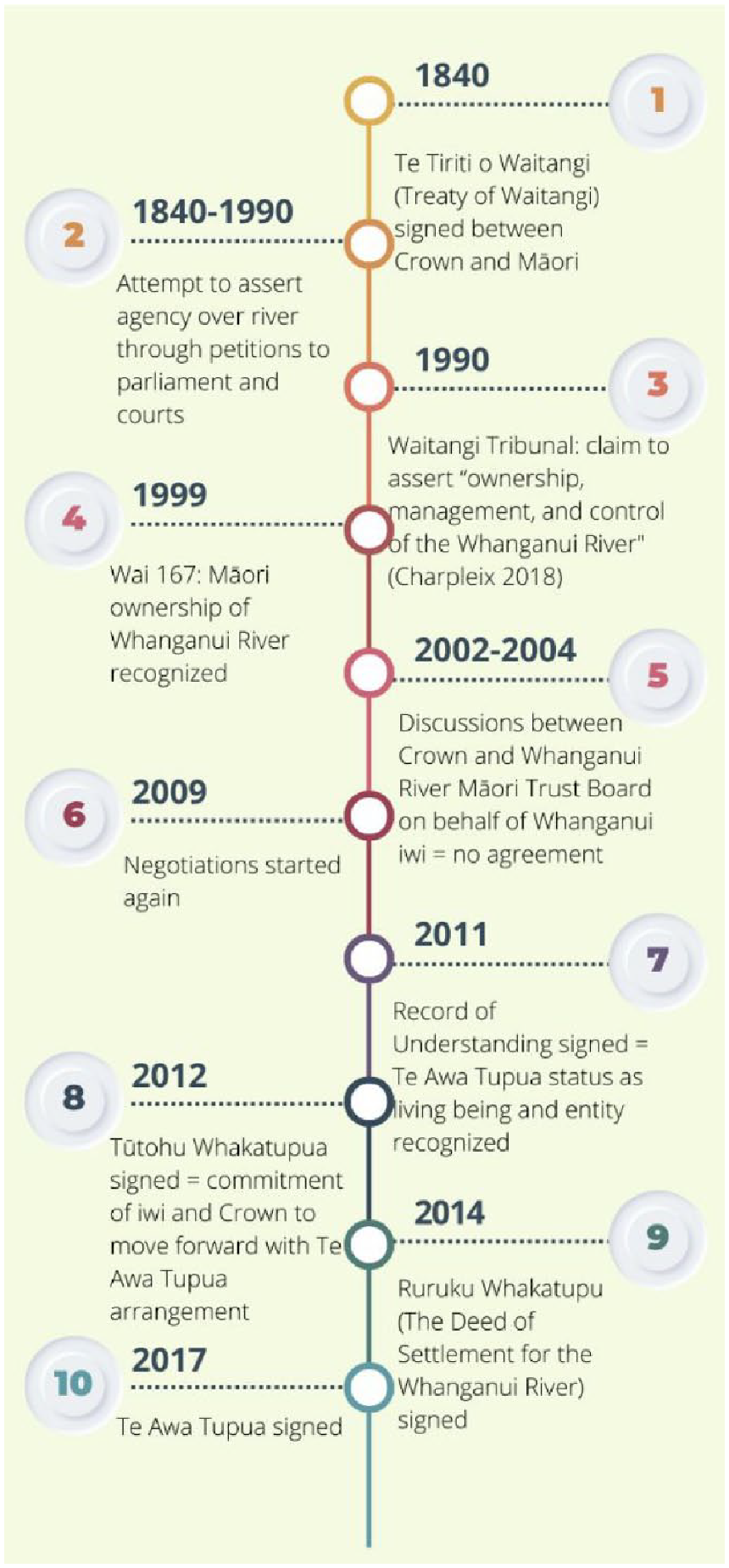
Timeline of events leading up to Te Awa Tupua (Adapted from Charpleix, 2018; Hsiao, 2012; Macpherson, 2019).
Te Awa Tupua establishes new institutional arrangements, which promote bottom-up decision-making (Talbot-Jones & Bennett, 2022). This includes the “establishment” of Te Pou Tupua and Te Kōpuka, and the development of Te Heke Ngahuru (a long-term strategy for the health and well-being of Te Awa Tupua and the Whanganui River), a long-term collaborative strategy for the “health and well-being of Te Awa Tupua” which sets out guidelines for how to engage appropriately with the Whanganui River (New Zealand Government, 2017, Part 2, s1, paras. 10c–e, 10g). Te Pou Tupua speaks for the awa, with one Crown and Māori representative, respectively (Ruru, 2018). Te Pou Tupua is mandated by law to take advice from Te Karewao (advisory group to Te Pou Tupua) and Te Kōpuka, the “permanent joint committee,” all of which work to uphold the provisions and values of Te Awa Tupua (New Zealand Government, 2017, Part 2, s33, para. 1).
Te Kōpuka, made up of government and iwi district and regional councils, is specifically mandated to draft Te Heke Ngahuru, which sets out guidelines for how to engage appropriately with the Whanganui River (New Zealand Government, 2017). Te Kōpuka’s general mandate is to work in collaboration with the Whanganui community to ensure the implications of Te Awa Tupua are respected and understood by all who intend to engage with the Whanganui, in line with tikanga Māori (socially embedded Māori customary value systems) that denote the core of Te Awa Tupua and kawa (see Table 1), thus affirming the intimate relationship between all the awa elements (New Zealand Government, 2017). Tikanga Māori is the “intellectual property of Māori” (Mead, 2003, p. 21) that has been developed as a web of values, norms, principles, and protocols that steer interactions among community members, with their ancestors and nature (Te Aho, 2007). Now that Te Heke Ngahuru has been written and passed, Te Kōpuka works in collaboration with the Whanganui community to monitor its implementation, discuss concerns linked to the well-being and health of Te Awa Tupua, and fill functions set out by local authorities (Te Kōpuka, 2023).
Tupua Te Kawa principles (Adapted from Ngā Tāngata Tiaki Whanganui, 2023).

Tupua Te Kawa = set of Māori principles that denote the core of Te Awa Tupua (The Whanganui River Claims Settlement Act 2017).
Methods
Kaupapa Māori
Kaupapa Māori (Māori approach and principles) research is, according to Graham Smith, “related to being Māori” and, therefore, intersects deeply with Māori philosophy, principles, language, and culture (as cited in Smith, 1999, p. 191), all of which have been “claimed” by Western Science as theirs (Smith, 1999, p. 191). The goal of research for Māori is to “enhance” learning, with research protocols following tikanga Māori, rather than Western research standards (Mead, 2003, p. 315). Smith positions Māori research “within the wider project of Māori self-determination,” specifically over Māori cultural health (Smith, 1999, p. 185). While kaupapa Māori avoids placing itself directly opposite of Western Science, Linda Tuhiwai-Smith (1999) explains that kaupapa Māori confronts the pervasive impact of Western research on Māori communities, challenging ingrained attitudes toward theory and academic knowledge. This approach transcends the limitations imposed by Western research legacies that have caused Māori to reject “all theory and all research,” while honoring Māori experiences, and advocating for research methodologies that are “culturally safe,” emphasizing the importance of active participation from Māori researchers (Smith, 1999, pp. 183–184).
Positionality
As someone deeply interested in the Whanganui case, I had been reading about it for a couple of years and felt there was a lack of Indigenous testimonials regarding opinions of Te Awa Tupua. I therefore felt an ethical responsibility to change what was said about RoN’s narrative of Te Awa Tupua, which my Māori interviewees eventually told me was powerful for them. As a White, Canadian, English-and-French-speaking woman, I initially questioned both my authority and legitimacy to undertake this research (England, 1994; Moffat, 2016), having only a partial understanding of the Māori context (Haraway, 1988). As a non-Indigenous researcher, I understand that I cannot participate in kaupapa Māori alone. In this research, I have acknowledged my positionality as a non-Indigenous person and sought to uphold the exclusive ownership of Māori research by the communities themselves. My research protocols were inspired by Tuhiwai-Smith who discusses how non-Indigenous researchers can be included in the “support of Māori research” as “useful allies” within kaupapa Māori (Smith, 1999, p. 184).
Research design
Given these positionality considerations, I went beyond the recognition of assumptions and biases by designing the research in response to Linda Tuhiwai-Smith’s guidance on kaupapa Māori. The project was designed with the help of a Māori scholar and gatekeeper who helped me understand that this research was important for Whanganui community members because it documented the nature of stakeholder relationships related to Te Kōpuka, a resource not yet provided to this community.
To design the consent requests for this research, I worked with Māori knowledge keepers from Te Kōpuka and from New Zealand-based universities, having a discussion with them regarding the appropriateness and goals of this research. As part of the ethics procedures from Oxford University, each participant was provided with a participant information sheet, which outlined the research goals and outcomes, the details of data storing and protection, the potential disadvantages of the research—including mental fatigue and data sovereignty concerns, and the potential benefits of the research—the documentation of New Zealand-based testimonials on stakeholder relationships within Te Kōpuka. The participants were then given a consent form to sign, which included consent to participate, be audio and video recorded, and be identifiable or anonymized in the research. Participants were reminded that they could decline to sign or leave the research at any point. Many participants from Te Kōpuka confirmed the consent of Te Pou Tupua before agreeing to participate. All participants have given their explicit consent for data use in this article and were invited to provide feedback.
Once the project was approved by ethics procedures at Oxford University, my gatekeeper introduced me to key contacts who had been involved in Te Awa Tupua discussions and Te Kōpuka. Once my participants agreed to join the research, I conducted eight in-depth interviews via Microsoft Teams. This group was made up of Māori, tauiwi (non-Indigenous person who has recently settled in New Zealand), and Pākehā (New Zealanders of predominantly European ancestry) participants working in Te Kōpuka or other advisory groups, such as Te Karewao, and a New Zealand-based law firm, that were deemed relevant because they were involved in and knowledgeable of the Te Awa Tupua process. Each conversation lasted about an hour, allowing for a respectful and richer understanding of Te Awa Tupua context (Morris, 2015). I took a conversational approach, with a focus on active listening, letting the participant drive the conversation (Valentine, 2005). When the research was over, I gave back to my participants by sending them a copy of the original article submitted to Oxford University and engaging in a post-research kōrero (conversation) in March 2024 about the key findings.
This research process also entailed a deep reflection on potential unintended consequences of the knowledge-sharing process. I mainly questioned the potential perpetuation of colonial research standards. I attempted to counter this by creating a hybrid project where I was able to analyze allyships, bridging academic and political spaces, deliberately centering the experience and understandings of my participants, rather than creating my own assessment framework for the research. I am aware that this research is not perfect. One of my Māori interviewees, Wiari Rauhina, told me: “you will not hit the bullseye with this.” This may not be a complete retelling, but it brings international audiences closer to the on-the-ground challenges faced when different entities attempt to understand, interpret, and apply Te Awa Tupua.
Results
My findings expand on RoN’s narrative of Te Awa Tupua and focus on participant understanding of stakeholder relations in Te Kōpuka and Western-dominated governmental arrangements in New Zealand. I argue that Te Kōpuka stakeholders seemingly grasp Māori values and understand the significance of Te Awa Tupua for the Whanganui and have, therefore, developed confidence in each other through collaborative efforts to advocate for its importance.
The strength of allyships
In this section, I explore the influence of stakeholder allyships on Te Kōpuka, where relationships based on collaboration are forged between Māori, tauiwi, and Pākehā members. Tables 2 and 3 give firsthand accounts of how allyships are understood by tauiwi, Pākehā, and Māori. Tauiwi and Pākehā understand allyships to be predicated on discerning Māori needs and putting the awa first. The quotes emphasize this is a Māori-led process meaning that tauiwi and Pākehā stakeholders understand the central role of iwi. During interviews, these participants discussed how important it was for them to build trust with Māori community members, which they have done over their careers and lives in the Whanganui area. From the perspective of the Māori participants, these allyships are central in promoting Te Awa Tupua’s message, but these relationships only work with certain tauiwi and Pākehā stakeholders who understand te taiao (environment), which lays the foundation for positive, productive, and collaborative relationships between diverging stakeholders.
Evidence of allyships from tauiwi and Pākehā participants.

tauiwi = non-Indigenous person who has recently settled in New Zealand; Pākehā = New Zealanders of predominantly European ancestry; Māori = Indigenous peoples of New Zealand.
Evidence of allyships from Māori participants.

Māori = Indigenous peoples of New Zealand; awa = river; te taiao = environment; hapū = sub kinship group; Te Kōpuka = advisory body that works to uphold Te Awa Tupua.
Based on this oral evidence, Pākehā and tauiwi members work very well together. Although tikanga Māori sets up principles of living for Māori, it also extends beyond Māoridom. Pākehā and tauiwi allies even refer to the Māori worldview as their own, as seen above. They, therefore, seem to embrace and grasp, as best they can, Tupua Te Kawa and the values written into Te Awa Tupua, based on tikanga Māori. According to this view, all living things have a mauri (life force, the core quality of a being), an “internal energy or life force” that “provides” life (Harmsworth & Awatere, 2013, p. 276), especially the awa that holds a specific importance for Māori (Hook & Raumati, 2011). One would argue that it is inappropriate for tauiwi to embrace these ideals as theirs. However, within the context of Te Kōpuka, where many members of Te Kōpuka have grown up in New Zealand with these ideals, participants feel there is a deep respect for and understanding of Māori ways, emphasized by deep connections with the awa. A few testimonials to exemplify this understanding from Pākehā and tauiwi allies.
Power of the awa, as seen by Annette Main (Pākehā, participant): the Whanganui is a “life-changing” force whose mana (spiritual power) needs to be cared for.
“I’m not a spiritual person, but that body of water out there brings me closer than anything else,” says Rory Smith (Pākehā, participant).
The river has always been a person for Māori: “you wouldn’t chuck rubbish at your grandmother,” says Colleen Sheldon (tauiwi, participant) who is referring to the awa.
It’s really simple for me—you treat the river and its tributaries as a living thing, which of course rivers are,” explains Annette Main (Pākehā, participant).
While they are non-Indigenous like me and do not have an inherent understanding of tikanga Māori, tauiwi and Pākehā members of Te Kōpuka seem to understand the awa’s personhood to be reflective of tikanga Māori and the awa’s power (Hook & Raumati, 2011; Mead, 2003; Ruru, 2018), rather than Western ideals. Within Te Kōpuka, participants feel that Pākehā and tauiwi interests do not prevail, but are considered of equal importance to that of Māori (Kiddle, 2020). Te Kōpuka is a forum where Māori, tauiwi, and Pākehā share a commitment to start to dismantle New Zealand’s colonial structures by having a vigilance of “continuing coloniality” (Mercier, 2020, p. 23). They therefore engage in what Moana Jackson calls reMāorification (Jackson, 2020), by leading with iwi and hapū strategies that “restore Indigenous ways and knowledges” (Mercier, 2020, p. 24).
As explained by Keith Beautrais (Pākehā, participant), Te Awa Tupua is written with “Māori in mind rather than Pākehā in mind.” This allows Te Kōpuka processes to be Māori led, with equal support from all stakeholders. Wiari Rauhina (Māori, participant) and Bubs Smith (Māori, participant) explain how these allyships lead to equal decision-making processes, which can be understood through the concept of mana ōrite (equal governance), meaning the “same level of likeness, positional stance” between stakeholders. This means there is a non-hierarchical process in matters of governance, with a mutual respect between parties that allows Māori to have the same veto power as other tauiwi or Pākehā members. Overall, Te Kōpuka allyships allow Māori, tauiwi, and Pākehā to understand the importance of the awa, the need to protect her, and the core values of Te Awa Tupua.
Māori representation in local government, as seen with the allyships within Te Kōpuka, is key to advancing Te Heke Ngahuru. However, current reasoning against Māori representation in decision-making stems from a lack of coherence in government obligations toward Māori, as set out by Treaty of Waitangi principles (Bargh, 2016). Within environmental governance and policy in New Zealand, there has been a marginalization of Māori and their values, especially in the realm of water management that has followed Western control (Parsons et al., 2019). This pattern has set up a path dependency, which is defined by historical occurrences of events leading to the development of institutional patterns that, in this case, has perpetuated the marginalization of local Māori knowledge and values (Parsons et al., 2019). While river management in New Zealand continues to abide by Western views of human–nature relationships (Parsons et al., 2019), Te Kōpuka allyships demonstrate a shift toward a foregrounding of Māori rights to decision-making and authority over the Whanganui area.
Te Kōpuka’s challenges
“Who’s the Treaty settlement for? It’s not for us. We already know the river,” states Wiari Rauhina (Māori, participant).
Treaty-based local government relationships are hard to achieve in New Zealand because “equal attention” has not been given to either side of the partnership (Bargh, 2020, p. 82). In this section, I look at the countless issues still faced by Whanganui iwi and their tauiwi and Pākehā allies, demonstrating that the situation is positive, but far from perfect. I argue that participants feel Te Kōpuka’s mandate is complicated by having to convince people outside this space of Te Awa Tupua’s mandate and the government’s inability to break away from Western governmental arrangements. Interviewees understand this difficulty of convincing others about the Te Awa Tupua’s importance to be heightened in government spaces. While Te Awa Tupua was passed as law in 2017, interviewees made it clear that current government representatives, especially right-wing officials, do not grasp the importance of Te Awa Tupua. As such, there are fears that acts of this kind may be repealed in the future.
The work of stakeholders within Te Kōpuka involves complex conversations with other tauiwi and Pākehā community members who do not recognize the values of Te Awa Tupua in the same way that they do. As explained by Wiari Rauhina, a Māori participant, and Rory Smith, a Pākehā participant, the challenge lies in getting others to fully comprehend the values written into Te Awa Tupua and selling the message outside of Te Kōpuka. By understanding that convincing is required, Pākehā and tauiwi stakeholders help take on part of the burden of allowing tikanga Māori to survive in the colonial governance structures of New Zealand (Mead, 2003; Te Aho, 2007). Te Kōpuka allyships allow Māori, tauiwi, and Pākehā to acknowledge the importance of the awa and the need to protect her. Nevertheless, this understanding is not ubiquitous beyond Te Kōpuka. Te Kōpuka members emphasized the assumption from non-Te Kōpuka allies that the hard work is over. However, as explained by Wiari Rauhina and Rory Smith, the challenge lies in getting others to fully comprehend the values written into Te Awa Tupua and selling the message outside of Te Kōpuka. As Rory Smith, a Pākehā participant, says, many non-Indigenous community members do not understand Te Awa Tupua’s inherent values and can, therefore, only understand Te Awa Tupua if its principles are put into Western understandings of personhood. As explained by Maxine Ketu (Māori, participant) and Nicole Dryden (Māori, participant), the legislation is really about the tauiwi who do not “grasp” the river as being a person. Participants feel that Te Awa Tupua, while legally embracing tikanga Māori, is written for the non-Indigenous person who does not understand its inherent values. A misleading translation of tikanga Māori, therefore, occurs in the work of convincing people outside of Te Kōpuka, meaning that Māori must “articulate their knowledge” according to Western frameworks (Ludwig, 2016, p. 43).
Despite the increasing influence of tikanga Māori in New Zealand governance spheres, there is still a sense that Pākehā leadership prevails (Kiddle, 2020). Tikanga Māori has been suppressed due to pervading colonial racism within New Zealand’s Western legal system (Mead, 2003; Te Aho, 2007), leading some Māori scholars to believe Pākehā needs to take precedence over those of Māori (Hook & Raumati, 2011). For example, to this day, there is a misinterpretation of Māori needs related to resource management in New Zealand, especially with frequent te Tiriti o Waitangi breaches coming from the Crown rather than Māori (Ross, 2020). As seen in the previous section, participants observe that Pākehā interests within Te Kōpuka do not prevail. Rather, there is trusting cooperation happening between all members. However, turning one’s attention to the challenges faced when Te Kōpuka works with New Zealand governmental representatives, it becomes clear that this trusting work is not pervasive.
Although the standardized or Western model of democracy presupposes a fair process of representation and power-sharing, it is underpinned by the Doctrine of Discovery ideals that “permeate” life in New Zealand, explains Wiari Rauhina (Māori, participant), and seems to justify the displacement of Māori (Mutu, 2018). This refers to the European harnessing of the illegitimate Doctrine of Discovery, an international law based on the religious and ethnocentric domination of European Christians over communities of the world (Miller et al., 2012). Maxine Ketu (Māori, participant) exemplifies this by explaining that racist microaggressions and micromanagement of Māori still occur because there is a sense that Māori are not “part of the [wider] community,” meaning they are treated as outsiders within their own home. Although Māori are meant to be included in processes of community democracy, Colleen Sheldon discusses that democracy in New Zealand has been ideal in suppressing Māori and tikanga Māori. Wiari Rauhina (Māori, participant) explains that democracy is a “hopeless case” for Māori who have had to jump through governmental hoops to get what they want, thus extending the process of legitimizing their relationship with the awa. Although multiple governmental representatives are included in Te Kōpuka discussions, Annette Main (Pākehā participant) describes that the challenge lies in getting “everybody on the same page.” Colleen Sheldon (tauiwi, participant) adds that it is also about moving away from the government’s “transactional” or “we know best” approach. This proves challenging still because of a reluctance from the government to break from the colonial system of governance still in place. Keith Beautrais (Pākehā, participant) explains the government’s “vested interests” remain set in stone regardless of them making supportive noises about Te Awa Tupua.
By being unable to break away from the traditional governance approach, participants discern that New Zealand’s government fails to truly grasp the Māori values included in Te Awa Tupua. Te Kōpuka’s allies have no choice but to play the government’s game: working with government agencies indeed sets up a process of lengthy back and forths where democratic processes and mana ōrite are not upheld. This echoes some Māori literature, which indicates that: “While Pākehā strive to accommodate Māori cultural values the results are essentially Pākehā structures decorated with Māori influences” (Hook & Raumati, 2011, p. 3). The strong allyships in Te Kōpuka are tested because their mandate of spreading Te Awa Tupua’s message is met with resistance from government spheres where Western ideals prevail (Hook & Raumati, 2011; Kiddle et al., 2020; Mead, 2003).
Discussion: the potential of Te Awa Tupua?
Despite these challenges, Te Awa Tupua really does flip an inherent cultural tension within New Zealand on its head—a tension between the Western system that prioritizes property and individual rights and tikanga Māori, which is more focused on holistic relationships with people and te taiao, as summarized by Kuru Ketu, a Māori participant and environmental litigation lawyer. Te Awa Tupua dismantles this by setting up a framework for decision-making that allows for place-based local Indigenous leadership (Cribb et al., 2024).
Nevertheless, Te Awa Tupua is ultimately written on Western terms, meaning it does not fully equate to the way the awa is seen in tikanga (custom, correct procedure) terms, discusses Kuru Ketu. While Te Awa Tupua has attempted to remedy water ownership-related injustices, Māori are still unable to claim ownership of the awa, which “remains a significant grievance for Whanganui iwi” (Macpherson, 2019, p. 119). Te Awa Tupua is vital for Māori, but it is only a “stake in the ground” to help advance Māori “ownership” of the awa, says Maxine Ketu (Māori, participant). Kuru Ketu (Māori, participant) emphasizes three main issues with the legislation. It is to be noted that these arguments only represent one point of view. When my Māori gatekeeper read over this, they disagreed with some of these points, specifically the cons of Te Awa Tupua. They emphasized that within consent cases, hapū have been involved, even if this was done in a roundabout manner. The three main issues identified by Kuru Ketu are:
“There’s no obligation or provision that requires a person seeking resource consent to engage with a hapū about how Te Awa Tupua works.” This means that the consultation process is only implied and hapū consultation does not always happen.
There is no clear delegation of power regarding the management of resources, such as that of the awa. This means that Māori are stuck with tauiwi decision-makers in power, making the consent process unclear.
Te Awa Tupua defines the river through its physical aspects, leaving out the metaphysical and spiritual aspects of the river. This not only makes it ambiguous to define flowing ground water beneath the Whanganui River, but also makes it complicated for Māori to push for the recognition of the spiritual aspects of the river, such as the mauri of the water, in addition to what is already written into Te Awa Tupua.
Looking at Te Awa Tupua in relation to the RMA, Māori water governance under the RMA is still inconsistent with what was set out in the te Tiriti o Waitangi (Mutu, 2018). Linda Te Aho points to the fact that the Waitangi Tribunal originally proclaimed that Māori had specific claims to waterbodies, meaning that the Waitangi Tribunal should have helped with some recognition (Te Aho, 2018). Kuru Ketu (Māori, participant), however, does not advise iwi to engage with the Waitangi Tribunal process because it is one of constant “compromise” that “has the ability to completely dislocate relationships between people within an iwi, but also with one iwi and another iwi.” In the RMA, the Māori right to water is not recognized: to this day, the British Crown is persistent in denying “Māori propriety claims for water rights on the basis that ‘no one can own water’” (Macpherson, 2019, p. 106). Arguably, Māori have authority over the awa following their holistic view of nature, but they are not recognized to own it, causing issues with resource consent (Ruru, 2018). Māori interests have not been protected and Māori have attempted to appeal council decisions, meaning there is still more room for “respectful consideration” of Māori within New Zealand (Ruru, 2018, p. 222).
While Te Awa Tupua was “endorsed” by the government, there is a sense that this was “rooted” in the settler-state’s embracing of human rights that required no big change in “domestic” policy (Collins & Esterling, 2020, p. 21). Indigenous values and customs are merely translated into legal pluralism frameworks through a process of compromise and “accommodation” (Macpherson & Ospina, 2018, p. 8). Te Awa Tupua may recognize the intrinsic and holistic nature of the awa, but it requires Māori to write their values on Western terms rather than tikanga terms. Te Awa Tupua is masked as a framework of “improved river governance” which is painstakingly crafted to “engender enforceability” within a Western rights system that does not grasp “what legal personality entails” for Māori (Macpherson & Ospina, 2018, p. 30). Arguably, Te Awa Tupua has been positive and has been a step forward for Māori, especially because of the decolonizing potential of allyships within Te Kōpuka, but it has not completely improved “river governance” for Māori because it has been articulated via Western frameworks.
While Te Awa Tupua offers a space for kawa-based river governance to strive and allows New Zealand to accept its colonial past by settling state promise regarding Indigenous rights (Cribb et al., 2024), the fact remains that Te Kōpuka faces challenges regarding getting government actors consistently on the same page. Speaking to people via interviews brought out more nuances about these challenges and, indeed, there is more work to be done to build a legislative framework that fully acknowledges Māori rights and interests in fresh and salt waters in New Zealand (Ruru, 2016). Ultimately, New Zealand’s water governance arrangements have been heavily shaped by settler colonialism because water laws are entrenched in the British legal system (O’Donnell & Macpherson, 2023).
Conclusion
While Māori have always understood the awa to be akin to them, their fight to assert their relationship with the Whanganui has been marketed as a radical way of breaking Western legal paradigms. Yet, Māori have only been forced to push for asserting their relationship with the awa because the Western system understands their worldview to be outside of Westminster ideals. This article has argued that, while allyships are strengthened by the work done within Te Kōpuka, research participants feel that Te Awa Tupua’s language targets people who do not meaningfully understand tikanga Māori, which demonstrates that the New Zealand system still caters to tauiwi needs within a Western system. As such, these allyships are positive and help in actioning the local place-based river governance alongside the Whanganui community set out by Te Awa Tupua (Cribb et al., 2024), but Te Kōpuka’s work is still complicated by the Western structures in place in New Zealand.
Ultimately, Te Awa Tupua is not just about the unique relationship between the awa and the community: rather, it is a way to prioritize local place-based leadership and to “settle Indigenous rights issues” following a colonial past (Cribb et al., 2024, p. 15). Within spaces such as Te Kōpuka, there is clearly a continued opportunity for Pākehā and tauiwi allies to become more central in the process of decolonization (Thomas, 2020). In fact, Māori scholars suggest a new term for decolonization: “ethic of restoration,” where the focus is placed on tikanga Māori and an embracing of Pākehā as part of the folds of New Zealand (Jackson, 2020, p. 62). Doing so via an awakened ethic of restoration within the government should involve a self-reflexive conversation critiquing Western models of governance (Dutta, 2015), one that does not assume the control of non-Indigenous groups over Indigenous groups or vice versa (Cribb et al., 2022).
Footnotes
Acknowledgements
I acknowledge the invaluable insight, time, and support of my colleagues in New Zealand who made this work possible. An immense thank you to Wiari Rauhina, Rory Smith, Annette Main, Colleen Sheldon, Bubs Smith, Keith Beautrais, Kuru Ketu, Maxine Ketu, Nicole Dryden, and to my other gatekeepers. Thank you for sharing your stories and for allowing me to learn and listen from you all. I acknowledge the direction and encouragement of my supervisors and peers at the University of Oxford. I also acknowledge the unwavering motivation of my partner, Eric, and my best friend, Emy. I especially acknowledge the guidance and boundless expertise of my late mentor, Karen Bakker. Having been her student and her employee, she was the reason I chose to undertake this research. She ignited my passion for the Rights of Nature and taught me so many wondrous things about listening to our natural world. Thank you, Karen. Your impact on the world of Geography will last many lifetimes.
Author’s note
Declaration of conflicting interests
The author declared no potential conflicts of interest with respect to the research, authorship and publication of this article.
Funding
The author disclosed receipt of the following financial support for the research, authorship, and publication of this article: Brasenose College, University of Oxford AF/HT23/103; Royal Geographical Society PAF 01.23; School of Geography and the Environment, University of Oxford.

Glossary
Aotearoa New Zealand
awa river
hapū sub kinship group
iwi large kinship group related to a specific territorial area
kaupapa Māori Māori approach and principles
kawa set of principles which denote appropriate cultural practices, behaviors, rules, protocols, and rituals
kōrero conversation
mana spiritual power
mana ōrite equal governance
Māori Indigenous peoples of New Zealand
mauri life force, the core quality of a being
Pākehā New Zealanders of predominantly European ancestry
rangatiratanga chieftainship or authority
Ruruku Whakatupu The Deed of Settlement for the Whanganui River
tauiwi non-Indigenous person who has recently settled in New Zealand
Te Awa Tupua The Whanganui River Claims Settlement Act 2017
Te Heke Ngahuru a long-term strategy for the health and well-being of Te Awa Tupua and the Whanganui River
Te Karewao advisory group to Te Pou Tupua
Te Kōpuka advisory body that works to uphold Te Awa Tupua
Te Kōpuka nā te Awa Tupua; Te Kōpuka advisory body that works to uphold Te Awa Tupua
Te Pou Tupua the human face and voice of the Whanganui River
te taiao environment
Te Tiriti o Waitangi the Treaty of Waitangi
tikanga custom, correct procedure
Tikanga Māori socially embedded Māori customary value systems
Tupua Te Kawa set of Māori principles that denote the core of Te Awa Tupua
Tūtohu Whakatupua agreement signed between the Crown and Whanganui iwi to commit to the development of Te Awa Tupua