




Abstract
This article examines the contemporary phenomenon of decolonial Māori memes, created by young urban Māori to advance the project of decolonizing Aotearoa (New Zealand). We weave Kaupapa Māori (philosophy and practice of Māori people) theory with Foucauldian visual analysis and critical multimodality to analyze 154 memes posted on three Instagram accounts from 2019 to 2021. We demonstrate how the Māori meme creators use discursive strategies to advance decolonization locally, drawing on Māori concepts and practices, including kotahitanga (solidarity), whanaungatanga (relationship-building), whakapapa (ancestry), tino rangatiratanga (self-determination), and use of te reo Māori (the Māori language). We distinguish two functional categories: boundary-marking memes that reference racist Pākehā (New Zealander with European ancestry) behaviors that perpetuate colonization, and solidarity-building memes that reference Māori acts of decolonization. We argue that the humor of the memes provides a potential decolonization roadmap for New Zealanders via its critique of Pākehā actions and cultivation of kotahitanga among Māori.
Introduction
The recent political hashtag movements #blacklivesmatter and #landback marked a digitally significant moment for Black and Indigenous People of Color, raising awareness of the ongoing violence they endure. While Māori have been careful not to co-opt these international struggles as their own, such movements have provided a boost to Māori seeking to speak out about the continuing violence of colonization and its racist results, giving voice, as elsewhere in the world, to local struggles for social justice (Shahin et al., 2021). Rangatahi (Māori young people) are enmeshed in web 2.0 and its new technologies: memes are one such phenomenon, and the localization of Indigenous memes addressing decolonization represents a flourishing discursive genre.
In this article, we argue that Māori memes are well positioned to serve as a voice for decolonization. We use a data-driven approach, analyzing 154 memes posted by young urban Māori between 2019 and 2021. We argue that the creators are engaging with discourse that could help decolonize both non-Māori who engage in behaviors that continue to harm Māori, and Māori, many of whom grapple with alienation from their culture.
In the following sections, we discuss the context of colonization in Aotearoa (New Zealand) and the appearance of decolonial memes coinciding with the local #landback movement Protect Ihumātao. We set out the theoretical framework and methodology used to analyze the data, drawing out what colonization and, by extension, decolonization, mean for the Māori meme creators. Our analysis weaves Foucauldian visual discourse analysis (Rose, 2016), critical multimodality (Ledin & Machin, 2020) and Kaupapa Māori (philosophy and practice of Māori people) theory, to foreground Māori concepts and practices used by the meme creators, including kotahitanga (solidarity), whanaungatanga (relationship-building), whakapapa (ancestry), tino rangatiratanga (self-determination), and use of te reo Māori (the Māori language).
We use the adjective decolonial in this article to refer to actions that seek to counter the three phenomena of colonization, colonialism, and coloniality. Colonization refers to the political, physical, and intellectual occupation of space achieved via displacing Indigenous populations, colonialism refers to systems, and practices that “seek to impose the will of one people on another and to use the resources of the imposed people for the benefit of the imposer” (Asante, 2006, p. 9), and coloniality refers to the control of knowledge by dominant western systems of thought (Mignolo & Walsh, 2018). We use the term Pākehā to reference the ethnic identity of European origin New Zealanders where appropriate and the more inclusive non-Māori wherever practicable.
Our analysis reveals two distinct ways the memes have decolonial potential: first, in their sharp critique of the racist behavior of some Pākehā, via out-group boundary marking humor; and second, in their cultivation of kotahitanga among Māori, via in-group solidarity-building humor. Through these functions, the memes provide a potential decolonization roadmap for both Māori and non-Māori.
Kaupapa Māori approaches to research topics affecting Māori require reflexive engagement on the part of researchers. The Community-Up model devised by Cram (2009) and Smith (2021) includes the concept of kia tūpato (being cautious) urging researchers to take care, be politically astute, and reflect on the implications of their in or out-group status. Our reflexive approach was in-built from our differing subjectivities as discourse analysts: the first author as an emerging Māori and Pākehā researcher beginning to work in decolonization, and the second author as an established Pākehā researcher with a long-standing engagement in bicultural topics, specifically the attitudes of non-Māori toward te reo Māori. Our bicultural collaboration in the project, drawing on our respective positionalities in analyzing the memes, aligns with the broader project of decolonization: one that necessarily involves the commitment and distinct contributions of both Māori and non-Māori, as we will discuss in this article.
Colonization and decolonization in Aotearoa
In Aotearoa, colonization is an ongoing violence, taking innumerable forms, where the dominant Pākehā group impose themselves on Māori: Colonisation transforms a land and a society in profound ways. Its imposition of alien political and social structures leaves deep impressions and scars on landscapes and on peoples. The ongoing process of colonisation, and the mental and emotional weight of coloniality, take a toll on colonised people like Māori—what and how they know and think, their health, lifeways and spirit. While others, like most Pākehā, may enjoy the comfort of the colonial framework, even the least impacted of us may have a sense of unease, a sense that something is not quite right. (Mercier, 2020, p. 105)
Decolonization is the reduction and removal of these impositions, led by Māori resistance (Elkington & Smeaton, 2020). But decolonization must not be left to Māori alone: non-Māori must also be active and engaged. Through understanding who, how, and why they are in relation to their power, Pākeha can honor the provision of power sharing, an exercise not of moving out, but of moving over and realizing the benefits in doing so. While commonly discussed in terms of being beneficiaries of colonial structures, Pākehā and other non-Māori can benefit from decolonization alongside Māori (Kiddle, 2020; Thomas, 2020). The awareness of one’s social reality can trigger the process of conscientization (Freire, 1970); that is, a change of consciousness that exposes unjust social and political realities.
We prioritize the Māori meme creators’ own definition of colonization via the memes: that is, we center their subjectivities as wāhine (women), rangatahi (Māori young people), and takatāpui (Māori queer people) who attest their lived realities with colonization. We identify the thematic categories of institutional racism; erasure, cultural appropriation, claiming indigeneity, linguistic tokenism, Pākehā fragility, and surveillance. The effects of colonization and its racist byproducts are counteracted by the thematic categories of memes we identify as depicting ethnic humor, trauma and resistance, and intersectionality. These demonstrate how the Māori concepts of kotahitanga, whanaungatanga, whakapapa, and tino rangatiratanga uplift, and empower the meme creators to sit with their painful experiences and enact discursive resistance. This builds on the concept of “e-whanaungatanga (electronic relationships/networks)” introduced by Waitoa et al. (2015, p. 46), who argue that for disenfranchised groups, inexpensive social media provides another way to build solidarity and advance Indigenous self-determination.
The thematic categories we identify are not an exhaustive list of the effects of colonization on Māori; rather, they reflect the creators’ present-day realities as Māori in their multiplicity of identities, grappling with colonization in Aotearoa and raising consciousness among Māori and non-Māori alike to transform the unjust status quo.
Memes, humor, and politics
Shifman (2013) defines memes as “(a) a group of digital items sharing common characteristics of content, form, and/or stance, which (b) were created with awareness of each other, and (c) were circulated, imitated, and/or transformed via the Internet by many users” (p. 41). They are inherently participatory, culturally situated, and context-dependent. Milner claims that memes are “essentially multimodal; they mix verbal text, visuals, hyperlinks, and hashtags through an endless process of reappropriation, imitation, and readaptation” (Ben Moussa et al., 2020, p. 5,922). It is this interaction between these visual modes in varying arrangements combines to convey meaning (Ben Moussa et al., 2020). Memes come in a range of genres, including text, image, and video, united by their common feature of circulability (Frazer & Carlson, 2017). In this article, we focus on the prototypical genre of the image macro: an image with overlaid text, as adopted by our meme creators. These memes are generally of low production quality and adopt what Douglas (2014) defined as “Internet Ugly,” functioning as a “celebration of the sloppy and the amateurish,” forming part of their popular appeal (p. 314).
A central feature of memes is intertextuality: the incorporation of existing texts in new texts. This operates both in terms of their links to previous memes using the same basic format and their references to popular culture. Memes are created due to their viralbility, and their intertextuality is part of what “ensures they will spread and replicate over time” (Williams, 2020, p. 4). In each new meme, the previous layers of meaning are recontextualized (Milner, 2013), creating further meanings.
Humor plays a central role in most memes and is perhaps the main contributor to their appeal. Humor frequently operates via incongruity: the anomalous juxtaposition of elements that serve to maximize “the susceptibility of the idea being passed from mind to mind” (Knobel & Lankshear, 2006, p. 215). Appreciation of humor generally requires shared cultural knowledge, making it fertile in a context of ethnic and inter-ethnic relationships. Williams (2020) observes that “internet memes are cultural artifacts that provide insight about the cultures that create them. They can also do the ideological work of communicating information about a subculture to the broader pop culture zeitgeist” (p. 5).
While funny, memes are frequently more than “just jokes” (Yoon, 2016, p. 97). In some, humor and politics combine to form what Tay (2014, p. 47) calls “LOLitics”—laugh-out-loud politics. The focus of this political humor can be in any direction, meaning that “social media and mimetic content can just as easily be used for reactionary ends as progressive ones” (Frazer & Carlson, 2017, p. 5). Some recent studies analyze memes about racism in the USA. Yoon (2016) uses critical race theory to analyze color-blindness in race-based memes, to raise color-consciousness among students in art classes, finding that the humor serves racist ends and propose that “internet memes on racism should be investigated as a site of ideological reproduction” (p. 93). Williams (2020) focuses on memes as a site of contestation: analyzing satirical memes by Black creators that comment on the racist behavior of White women in the USA. Williams finds that “Black memes position humor as a tactic for engaging in difficult dialogues about race and racism” (p. 11), arguing they provide a vital social function, holding individuals accountable for racist attitudes and behavior.
Some further studies analyze Indigenous memes addressing colonization. Frazer and Carlson (2017) remark that “there endures a lack of critical work on the ways in which Indigenous people engage with memes to deconstruct colonial power relations and produce alternative political arrangements” (p. 1). They analyze memes made by Aboriginal creators to investigate “the ways in which memes are entangled in the achievement of an anti-colonial politics” (Frazer & Carlson, 2017, p. 1). They suggest that the memes “function as an anti-colonial assemblage” (p. 2), following Deleuze’s notion of invention of a people: “those who are excluded from Australian colonialism and those who recognize it as violence” (Deleuze, 2013, p. 217). Land (2021) analyzes how Indigenous meme artists on Instagram “deliver Indigenous critique through fannish engagements with mainstream media and digital culture” (p. 181). In doing so, Land (2021) posits that they “lay claim to meme-making as Indigenous practice tied to traditional culture and decolonial action” (p. 184). Carlson and Frazer (2021) demonstrate how Indigenous people are powerful agents utilizing available technologies to challenge settler narratives, such as the view that Indigenous people are merely oppressed and weak. Their concept of “Indigenous fun” (Carlson & Frazer, 2021, p. 436) has particular relevance to our study: exploring the way in which Indigenous Australians use social media platforms, such as Instagram, Twitter, and TikTok to thwart settler narratives that serve as part of the “logic of elimination” articulated by Wolfe (2006, p. 387), where settler colonial power relies upon the destruction of Indigenous Peoples and polities.
Scholars are divided on the real-life effects of politically oriented memes. Morozov (2009) dismisses online political participation as “slacktivism”: a “feel-good but useless internet activism” (p. 13) that ultimately supports the status quo. Marichal (2013) instead argues that such small-scale activism can genuinely influence mainstream political discourse. Ben Moussa et al. (2020) demonstrate that meme-making and sharing renders political participation available to those normally prohibited from it, opening “spaces of agency” (p. 5,936) and allows “the weak to carve out a space from where to effectively challenge the dominant power structures” (p. 5,920). In this article, we align with research that takes political memes seriously, and approach Indigenous memes as a site of ideological contestation serving decolonial goals.
Māori memes in Aotearoa
Frazer and Carlson (2017) argue that “social media such as Facebook and Twitter are key technologies in Indigenous political and anti-colonial movements globally” (p. 2). The numerous Indigenous and decolonial meme accounts emerging on Instagram point to the growing Indigenous voice online—where individuals and groups adopt the most readily accessible mainstream technologies to protect their land and culture from devastation. Projects, such as The Trans Mountain Pipeline, Coastal Gaslink Pipeline, Mauna Kea, and Australia Day, used hashtags to communicate their cause. In Aotearoa, the movement associated with the hashtag #protectihumātao engaged in non-violent, direct action to raise public consciousness about a private company seeking to build a development at Ihumātao, on the borders of the Ōtuataua Stonefields at Māngere, Auckland.
For our analysis, we focus on three Māori meme creators who created and shared memes coinciding with the Protect Ihumātao movement, from 2019 to 2020. These were chosen due to their focus on colonization and racism, as well as their localization—adapting international pop culture references and discourse genres to the local context. The creators all call out the racist effects of colonization for Māori, yet each have a unique approach. Insights into the people and motivations behind the accounts are provided by a media article, which originally drew our attention to this phenomenon (Muru-Lanning, 2020). Here we learn that the Instagram account @ngati_half_ caste (Ngāti Half Caste, n.d.) was created by a 20-year-old university student of Māori and Pākeha descent, who says she has been inspired by the occupation at Ihumātao and First Nations memes accounts, particularly @decolonial.meme.queens (DMQ, n.d.), who remixes North American memes. She blends critical commentary with pop culture references to call out problematic Pākehā behaviors, as well as playfully referencing everyday Māori cultural practices. The person behind the @spacific_memes (Māori // salish memez, n.d.) was prompted to make her meme page when she realized her “entire Instagram feed was slowly being filled up with Indigenous memes made by other people” (Muru-Lanning, 2020, para. 9), so that, she gave it a go, inspired by the occupation at Ihumātao, which helped her find her political voice and reconnect with her Māoritanga (Māori identity), having grown up in urban environments with little Māori community around her (Muru-Lanning, 2020). Her memes focus on the complexities of intergenerational trauma and resistance, expressing the realities that come with being young, urban, and Māori, via self-deprecating humor. A third Instagram account, @decolonial_meme_māori (MeanMaoriMemes, n.d.), the creator of which we know less about, is distinctive in highlighting what we call intersectional memes—critically addressing the convergence of patriarchal, colonial, and capitalist power within the decolonial movement.
We collected a total of 154 memes across these accounts, selecting those which spoke directly to colonization and its effects for Māori. Although we took account of captions, hashtags and comments to aid in our process of categorization, our discourse analysis is of the memes themselves.
Theoretical and analytical framework
To analyze the memes, we incorporate Foucauldian visual discourse analysis, critical multimodality, and Kaupapa Māori theory. Discourse analysis is often associated with verbal data, but the same principles and methods can be applied to visual images. In analyzing images from a Foucauldian perspective, “the task of the discourse analyst is to make explicit the ways in which discourses operate and their effects within particular contexts” (Cheek, 2008, p. 356). As Rose (2016) observes, “looking carefully at images . . . entails, among other things, thinking about how they offer very particular visions of social categories such as class, gender, race, sexuality, able-bodiedness and so on” (p. 18). Our approach follows the steps proposed by Rose (2016), which involve identifying strategies used to “visually and verbally assert the truth of a particular discursive claim” (p. 214). These steps comprise: paying detailed attention to the image’s composition, color, and size to identify key themes in the form of recurring visual features; noting techniques of persuasion; attending to complexity and contradictions that orient to multiple discourses; and looking for the invisible as well as the visible. The discursive strategies we identify in our data include satire, contradiction, ridicule, infantilization, metaphor, contrast, parody, exaggeration, incongruity, imitation, localization, and self-deprecation.
Critical multimodal analysis assists us in identifying visual meanings (Ledin & Machin, 2020). Multimodal analysis, in the tradition of social semiotics, focuses on choices between visual design elements in areas, such as composition, perspective, color, materiality, typography, and diagrams, to create multimodal configurations that advance truth claims about the world (Jewitt, 2009). When used to explore underlying power relationships, it has been termed critical multimodality (Machin et al., 2016). This approach implies a close focus on analyzing modes, both verbal and visual: including color, size, facial expression, pose, dress, character choice, hairstyle, and objects.
Kaupapa Māori theory, according to Pihama (1993), shares fundamental elements with critical theory frameworks: Intrinsic to Kaupapa Māori theory is an analysis of existing power structures and societal inequalities. Kaupapa Māori theory therefore aligns with critical theory in the act of exposing underlying assumptions that serve to conceal the power relations that exist within society and the ways in which dominant groups construct concepts of “common sense” and “facts” to provide ad hoc justification for the maintenance of inequalities and the continued oppression of Maori people. (p. 57)
From this understanding, Kaupapa Māori theory brings local relevance to our analysis of the memes, situating it in the historical, political and social context specific to Aotearoa.
Analysis
In this section, we present our analysis of the memes, with illustrative examples. We concentrate our analysis around two overarching categories, relating to the actions of Pākehā and Māori when it comes to colonization and decolonization. This allows us to focus on decolonization as an activity that requires engagement from both Māori and non-Māori. It also allows us to differentiate between the (de)colonizing behaviors of Māori and Pākehā. And it enables us to focus on two types of humor present in the memes: boundary-marking and solidarity-building.
Humor serves a range of functions besides amusement. It can create and maintain solidarity, emphasize or attenuate power relationships, provide tension release, and construct social identity (Holmes & de Bres, 2012). Within the category of ethnic humor, two broad functions can be distinguished: solidarity-building humor, which reinforces belonging and cultural identity within an ethnic group, and boundary-marking humor, which defines who is not part of the group and reinforces ethnic difference (Holmes & Marra, 2002). Often humor serves both functions simultaneously. Previous research on workplace discourse in Aotearoa has shown how Māori use humor creatively in both these ways to enact Māori cultural norms and resist Pākehā domination (de Bres et al., 2010).
Our first analytical section focuses on boundary-marking memes relating to Pākehā (82 memes), our second on solidarity-building memes relating to Māori (72 memes). Each of these is separated into further themes that emerged from the data, relating to Māori experiences of colonization and decolonization. We maintain an overarching focus on ethnicity in analyzing the humor in the memes, but our approach is intersectional: the central dimension of ethnicity cannot be separated from other elements in the data, particularly gender and sexuality, which form part of our analytical lens.
It is important to clarify the nature of the binary we construct in this section between Māori and Pākehā, which could be taken as presenting these cultural groups as fully distinct from each other and as internally homogeneous. In focusing our analysis on Pākehā and Māori behaviors in turn, we are echoing the Māori-Pākehā binary the meme creators present in their memes. As researchers, we do not subscribe to such a binary ourselves; we acknowledge that Pākehā occupy a nuanced position within the space of decolonization, and that some work alongside Māori to further decolonial goals. This binary also does not include the large numbers of non-Pākehā non-Māori people living in Aotearoa, who may align or disalign with decolonization in their own culturally situated ways. As noted above, some of the meme creators have bicultural identities and, as we will see in the analysis, the memes they create draw some distinctions between sub-groups of Māori and Pākehā, based on features of gender and sexuality. It is clear, nonetheless, that the memes referring to Pākehā behaviors generally present an unsympathetic, stereotypical, and homogeneous vision of a Pākehā character. While this may seem questionable at first glance, we suggest that this binarization and essentialization on the part of the meme creators is more complex than it seems. We refer here to the concept of Indigenous fun put forward by Carlson and Frazer (2021), who observe that Indigenous humor often plays upon pejorative essentialized stereotypes attached to Indigenous people by non-Indigenous people. We contend that the stereotypical portrayal of Pākehā in these memes involves flipping this script to apply the same treatment to Pākehā that is often applied to Māori, and in doing so represents a form of satire and subversion—key discursive strategies in political humor. To our eyes, the key point being made by the meme creators in their portrayal of Pākehā is not that all Pākehā behave thus, but rather that Pākehā—and indeed all non-Māori—should not behave like that type of Pākehā. We believe this is likely to be received by the target audience of the memes in the spirit of irony that is intended.
Boundary-marking humor: calling out Pākehā behaviors
The 82 boundary-marking memes reference behaviors among Pākehā that perpetuate colonization. The memes use the term Pākehā to reference Caucasian individuals with attachments not only to Aotearoa but also to colonial mindsets, and describe their behaviors as demonstrating caucasity—a neologism blending the words Caucasian and audacity. The themes in this category included: institutional racism (19), erasure (16), cultural appropriation (13), claiming indigeneity (7), linguistic tokenism (7), Pākehā fragility (15), and surveillance (5).
Some memes depict overtly racist behaviors, including the group addressing institutional racism. The meme in Figure 1 refers to Oranga Tamariki (The Ministry for Children) uplifting Māori babies from their whānau (family) at a rate disproportionate to that of non-Māori. The meme depicts this institution’s behavior as reprehensible, describing Oranga Tamariki as “acting shocked” (MeanMaoriMemes, 2019a) by the behavior of their social workers echoed visually by the character practicing an expression of open-mouthed surprise in a mirror. The character feels obliged to convey regret, but this regret is performative, as they knew what they were doing all along. Visually, the character’s white skin associates Pākehā identity with the institution, and the old-fashioned oil painting and formal European-style dress recall the early colonial period, orienting to the continuity of such racist actions over time. The use of a small child indexes the innocence of childhood, which is at odds with the behavior of the Ministry, while implicitly referencing the population it is supposed to serve. Actions referenced in the institutional racism memes are dark in nature, referring to pervasive systemic racism, but the response of commenters is largely amusement. This highlights the boundary-marking functions of the satirical humor involved. Oranga Tamariki has a legacy of not serving Māori populations, and government institutions in general have a legacy of violence against Māori. Criticizing the colonizing actions of these institutions allows Māori to create distance from the threat, release tension, and express solidarity in the face of racism.
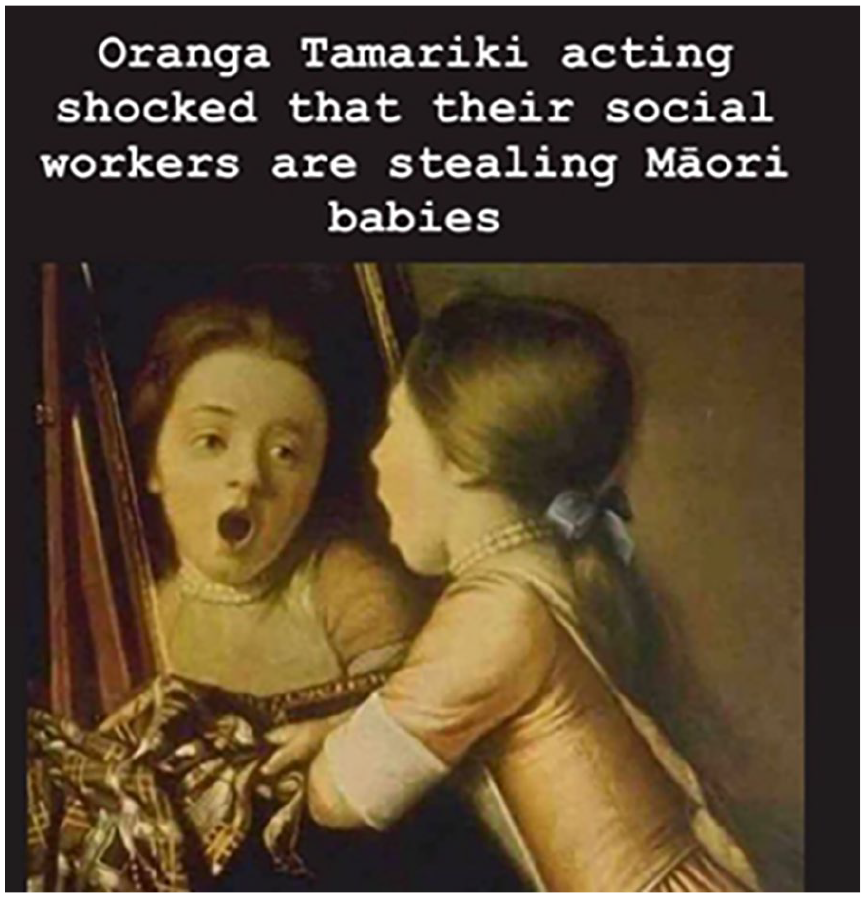
“#Māorimemes #colonisation #decolonialmemes” (MeanMaoriMemes, 2019a).
Pettigrew (1979) outlines a shift of new forms of racism that moves from “blatantly exclusionary practices to more subtle, procedural, ostensibly ‘non-racial’ forms” (p. 114). We see the memes highlighting these more implicit forms of racial discrimination, and while they are less overt, these behaviors can be just as pernicious due to their subtlety and plausible deniability. The memes in this group direct attention to behaviors that are racist in effect, but of which some Pākehā may be wilfully unaware. One theme is erasure, where Pākehā subjects are portrayed as denying the history of colonization, alongside its ongoing effects in maintaining their social privilege, while perpetuating self-serving historical myths. The meme in Figure 2 uses a two-panel template to depict a scene of two characters in conversation, one of whom is labeled “pākehā” (Ngāti Half Caste, 2019d). This character is portrayed as a burly white masculine figure with a raised eyebrow, droopy eyes and a scowling expression, gesturing to his interlocutor saying “Look, I’ve been around the world, okay? Whatever it is, I’ll understand” (Ngāti Half Caste, 2019d). While the other character responds “you might not have been the ones to beat our ancestors or steal our land. But you still benefit from a system that allowed it to happen” (Ngāti Half Caste, 2019d). In response, the Pākehā character rescinds their prior commitment to understanding, contradicting their earlier statement, saying “There’s nothing about this I understand” (Ngāti Half Caste, 2019d). This points to the social power afforded to Pākehā, implying that colonialism continues through denial of their privilege, their miscomprehension acting as a form of gaslighting. In referencing this behavior, the creators demonstrate their awareness of the critical race theory tenet of interest convergence (Bell, 1980), whereby dominant groups invest in racial justice only insofar as it benefits them to do so. By claiming to understand, Pākehā can assuage their complicated feelings toward racism and collect social and political capital from sympathizing with Māori, but they may be unwilling to critically interrogate their own privilege, lest this result in some of it being lost. The discursive strategy used in this meme is to ridicule. Depicting the Pākehā character as illogical and unreasonable renders them laughable rather than threatening, removing some of the force of their actions.
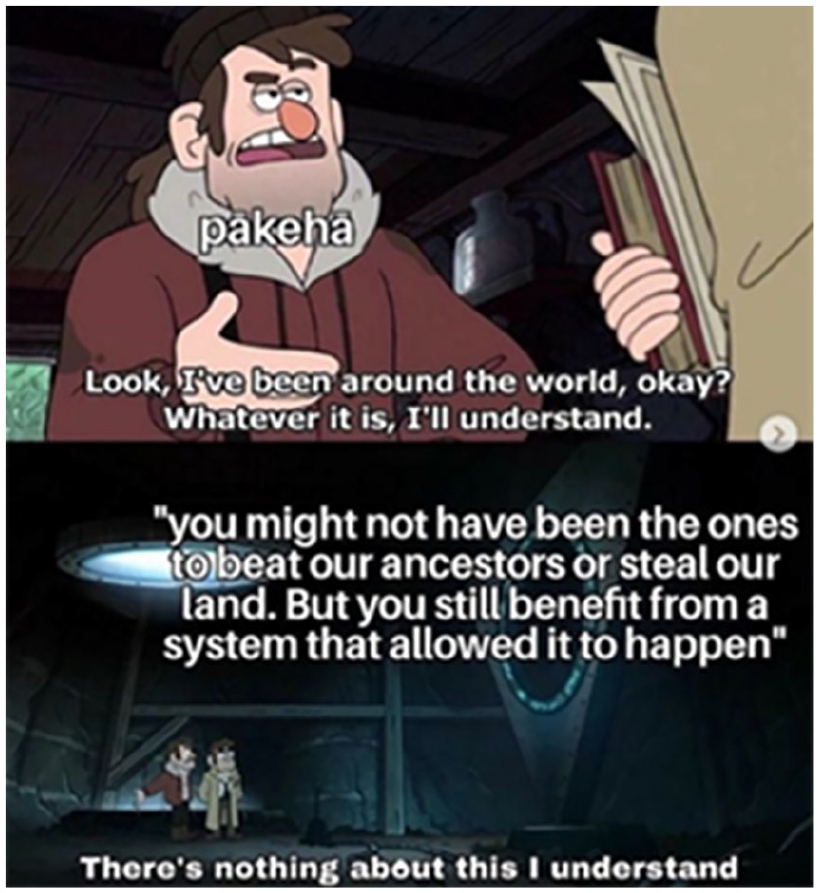
“A Cheeky Midday Thought” (Ngāti Half Caste, 2019d).
A similar approach is taken in the meme in Figure 3, which uses a combination of ridicule and infantilization in its depiction of Pākehā expecting Māori to “explain their [Pākehā] privilege” (Ngāti Half Caste, 2019c). Privilege here refers to “the multitude of ways in which people who are identified as ‘white’ enjoy countless, often unrecognized advantages in their daily lives” (Gillborn, 2006, p. 319). As shown in Figure 2, the modes of facial expression, pose, size, and character choice are essential to the meaning of the meme. The character’s furrowed eyebrows, blankly staring eyes, terse line of mouth, and slumped shoulders convey “effortful ignorance” about race (Williams, 2020, p. 4), but this contrasts with their instantiation as a small cartoon monster standing in a childhood bedroom, lending them an air of stubborn toddlerhood. The behavior referenced may be dangerous, but the Pākehā individual engaging in it looks infantile and foolish. The caption to the meme states “in short you look dumb [as written in original work] af” (Ngāti Half Caste, 2019c).
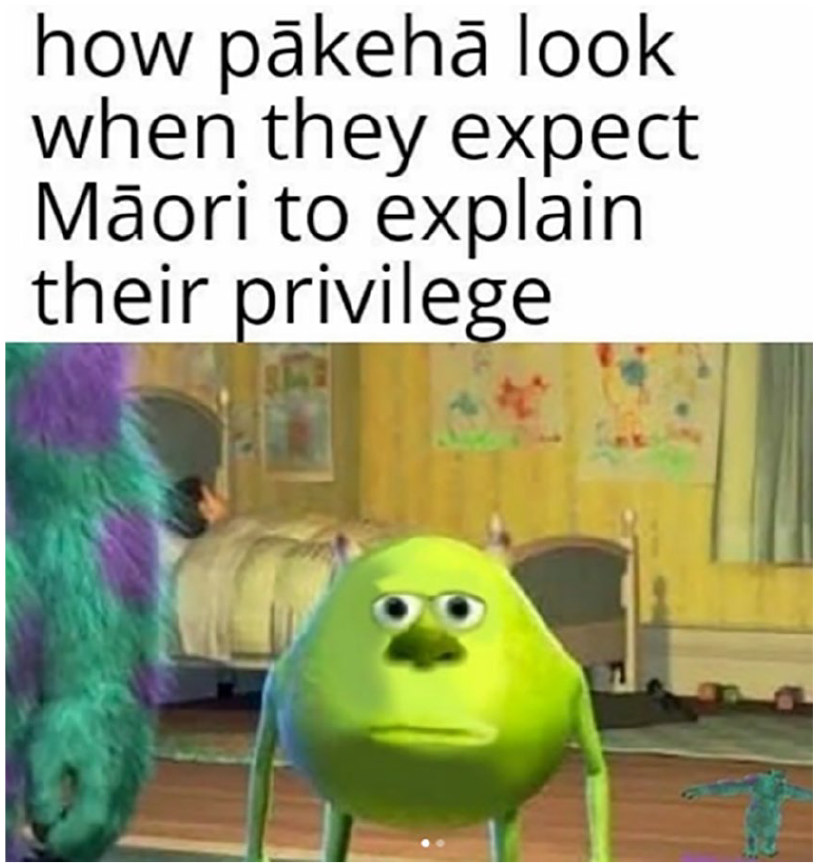
“In short you look dumb [as written in original work] af” (Ngāti Half Caste, 2019c).
A counterpoint to the erasure of Māori experience is Pākehā appropriating elements of this experience for their own benefit. One group of memes depicts Pākehā attempts to claim indigeneity as a means of justifying their presence in Aotearoa. One such meme juxtaposes the text “White people explaining how they’re Indigenous” with the image of a wild-eyed cigarette-smoking character from a television crime drama gesticulating at disparate pieces of data on a police noticeboard connected with a web of red thread (Ngāti Half Caste, 2019f). This visual metaphor conveys the mental gymnastics involved in Pākehā making this argument. A related meme includes the following caption: “Pākehā want to claim they’re Indigenous when it suits their narrative yet refuse to help fix the climate they helped create and have pushed upon tangata whenua” (Ngāti Half Caste, 2019g). Another group of memes reference cultural appropriation of Māori artistic products, as in Figure 4, where an obsequiously bowing SpongeBob SquarePants reacts to a perceived criticism of cultural appropriation with the comment “iM sAvInG mAoRi ArT” (Ngāti Half Caste, 2020b). The non-standard capitalization of this text uses the mode of font to convey a pleading and self-congratulatory tone on the character’s part, underlining their self-serving actions. Further memes depict Pākehā attempting to temper their privilege with acts of linguistic tokenism. These show Pākehā engaging in superficial appreciation of te reo Māori, while hesitating to interrogate their place in the bicultural landscape or engage in acts of anti-racism. In Figure 5, the character is informed that simply ending their emails with the common te reo Māori sign-off “ngā mihi [regards]” does not absolve them from being racist (Ngāti Half Caste, 2019e). The character responds by recoiling theatrically with a hand outstretched in defense, their wide-eyed terror magnified by the low angle and close-up. The character is an animated plush version of Pikachu from the Japanese video game franchise Pokémon and this character choice is not incidental. The contrast between the allegation of racism and the cuteness of Pikachu emphasizes the character’s vulnerability to critique, suggesting an appeal to sympathy from the viewer. Meanwhile, the melodrama of their response to light criticism frames this reaction as pitiful.
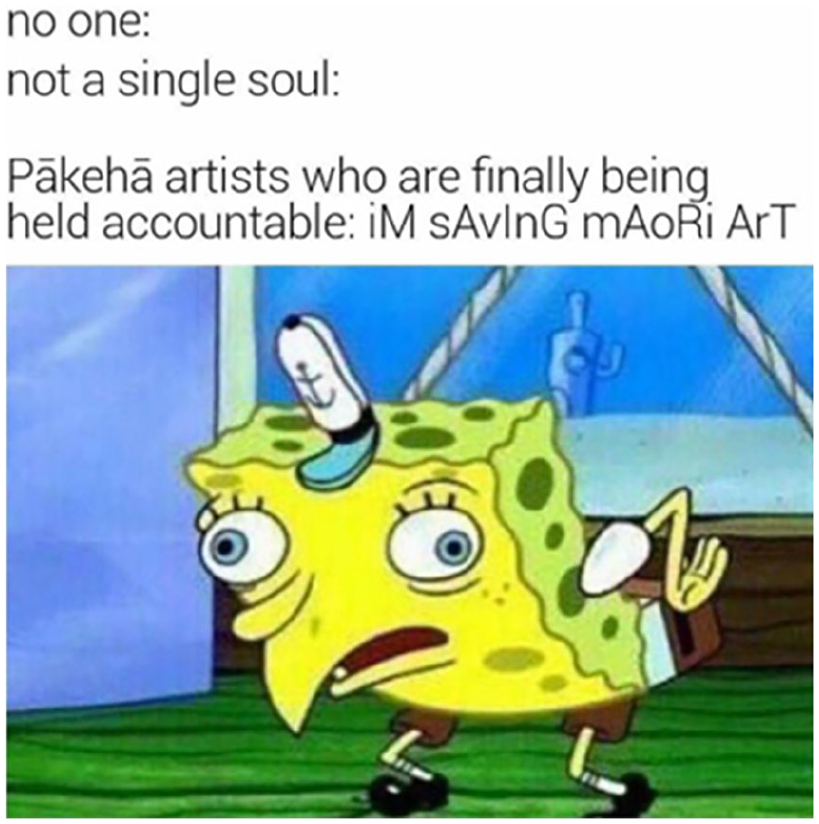
“@koaukaputamai You asked and I delivered cuz” (Ngāti Half Caste, 2020b).
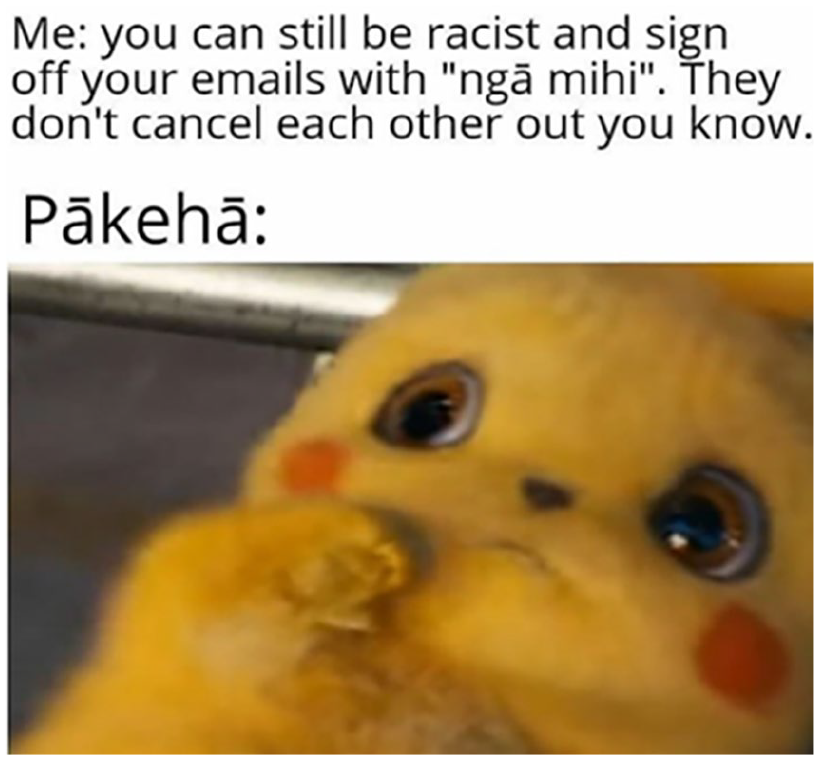
“It can be like that sometimes” (Ngāti Half Caste, 2019e).
This connects to a further theme of Pākehā fragility, in which Pākehā are parodied through exaggerations of their surprise, fear and hurt feelings when confronted with race-based issues. As Williams argues, such white tears are not straightforward emotional reactions, but rather weaponized to combat racial discomfort, including when “White individuals are forced to confront their own White guilt” (Williams, 2020, p. 9). There is a gendered element to these memes, several of which feature images of White women looking angry, terrified or teary, alongside text reading “Pākehā after you tell them they’ve mispronounced your name again” (Māori // salish memez, 2019b) or “Pākehā when you ask them to honour te tiriti” (Ngāti Half Caste, 2019b). Women’s names are also peppered through the captions and comments on the memes, including: Jan, Helen, Susan, Sharon, Deb, Barbara, Karen, Karyn, Brenda, Tracey, Annabel, and Elizabeth. Williams (2020) found a similar strategy deployed by Black creators, whose memes ridiculed White women using the monikers Karen and Becky. These names functioned as shorthand for the effects of White privilege on Black individuals who experience surveillance while performing everyday activities “living while Black” (Williams, 2020, p. 2). This theme recurs in our data in the category of Pākehā surveillance, which references the problematization and surveillance of Māori. One meme reproduces an image of a voracious-looking Gollum from the Lord of the Rings alongside the text “Pākehā you barely know waiting for any excuse to tell you their brother is a cop,” to which a commenter reacted with “F[**]n Karen” (Māori // salish memez, 2019b). As in Williams’ study, these memes “circulate a countercultural logic that highlights the ludicrousness of the constant surveillance and criminalization of Black bodies” (Williams, 2020, p. 7).
The memes described above use several discursive strategies to convey their points about the colonizing behaviors of some Pākehā, including satire, contradiction, ridicule, infantilization, metaphor, contrast, and parody. These strategies are furthered via creative combinations of modes, both the verbal text and font and the visual color, size, facial expression, pose, dress, and character choice. Taken together, they comprise a not-to-do list for non-Māori, with a focus on Pākehā. Calling out these harmful behaviors via humor serves a boundary-marking function for Māori, creating distance from the perpetrators, providing a safe environment for sharing lived experiences of colonization, and setting out Māori expectations for non-Māori behavior. This promotes in-group solidarity and provides tension relief, evident in the amused responses. But while the main target audience may be Māori, a secondary audience is non-Māori, for whom this not-to-do-list is potentially instructive. Given Pākehā fragility, these memes could be viewed as threatening by some: this is where humor comes into its own, softening the message and making a conversation about decolonization more approachable. Williams (2020) asserts that the humor in Black memes allows “difficult dialogues about race and racism” (p. 11), noting that laughter has a protective function for Black individuals when discussing the painful effects of racism. This protective function can also apply in a bicultural setting, if non-Māori are willing to listen. The humor in both Black and decolonial Māori memes thus functions beyond a joke, as Yoon (2016) claims. If humor doubly assuages the painful experiences of racism and lubricates the friction that comes with sharing those experiences, productive conversations can ensue.
Solidarity-building humor: supporting the decolonizing actions of Māori
The 72 solidarity-building memes reference Māori engagement in acts of decolonization. The themes in this category included: ethnic humor (30), trauma and resistance (24), and intersectionality (18).
Memes on the theme of ethnic humor involve references to te ao Māori (Māori worldview) and Māori social concepts and practices, including kotahitanga, whanaungatanga, whakapapa, tino rangatiratanga, and use of te reo Māori. Within this category, marae (Māori meeting ground) humor predominates. The marae is a central cultural hub, where Māori have retained tikanga (cultural practices) and te reo Māori. The memes use self-deprecating humor about forgetting actions to haka (ceremonial dance), stolen shoes outside the wharenui (meeting house), teasing and respecting kaumātua (elders), shirking dishes duty, snoring uncles, waiata (song), and talking through whaikōrero (formal speeches). The memes utilize te reo Māori, alongside the English kinship terms, including nanny, aunty, cousin, cuz, and bub, all commonly adopted by Māori to refer to whānau members.
The meme in Figure 6 is an example of gentle teasing, parodying kaumātua engaging in the common marae practice of waiata. The pursed lips of these stones are generally used to convey discomfort or awkwardness. With the addition of the text “how the kaumātua look when they’re all trying to hit the low note of doom,” the meme is remixed to depict the characters straining to reach the low notes as they sing (Ngāti Half Caste, 2020a). This affectionate teasing of kaumātua shifts in further memes to reference caring for them on the marae. The meme in Figure 7 expresses the relationship of rangatahi toward respected kaumātua, who are often tended to through acts of service. The Baby Yoda character is an infantilized version of the original Yoda—a respected and wise elder in the Star Wars franchise. This rangatahi Yoda, wearing a cozy cloak and bathed in soft light, is depicted in the marae context of wharekai (dining area), serving tea to kaumātua. This demonstrates how Māori broadly feel toward their elders: treating them with respect and care and desiring to emulate them and fulfill their expectations.
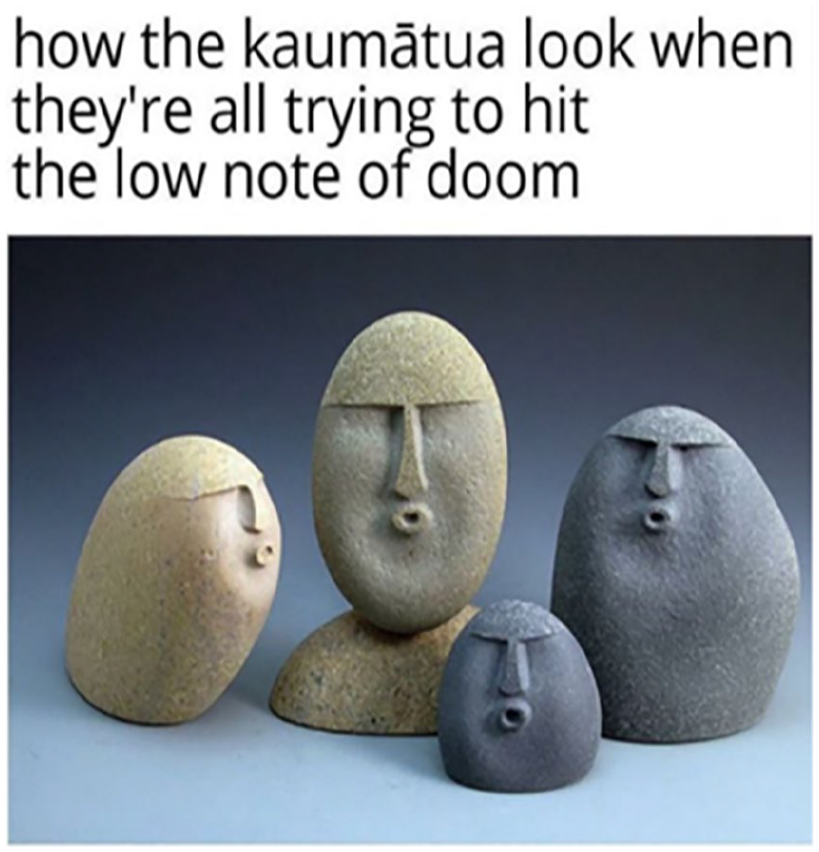
“Aue koro you been working on that vibrato?” (Ngāti Half Caste, 2020a).
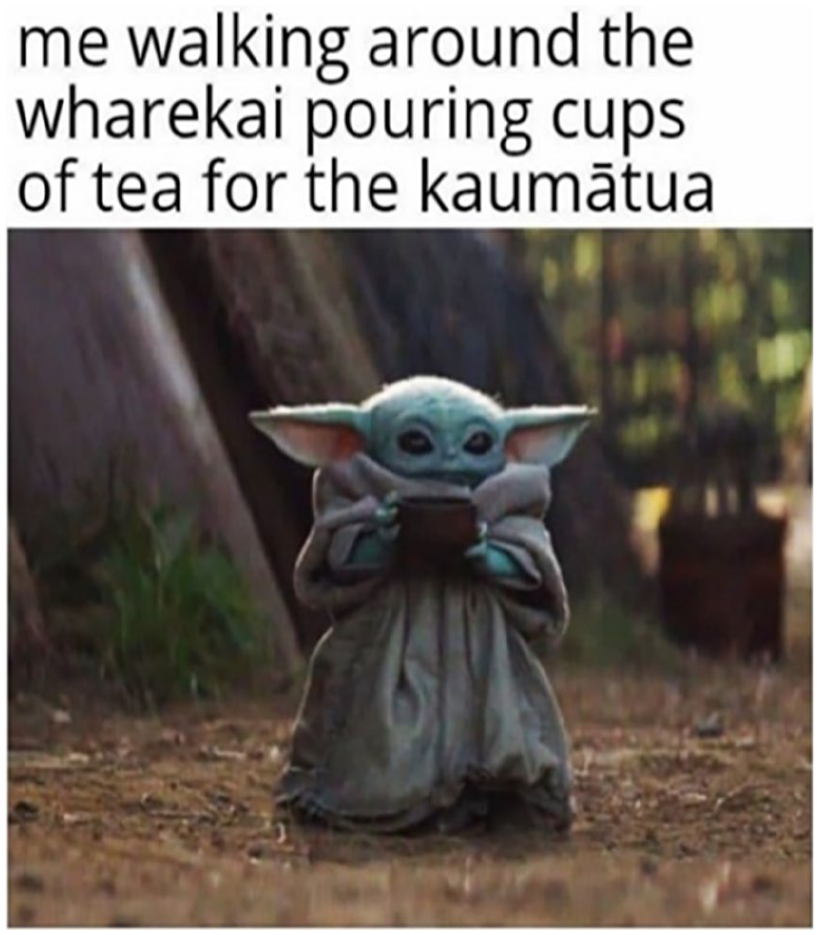
“No koro nan said no sugar for you because you have diabetes” (Ngāti Half Caste, 2019a).
We initially considered the group of ethnic humor memes to be distinct from the critical memes we found, referring as they do to aspects of traditional everyday Māori life. We came to see them as providing an essential counterpoint to the critical memes, however.
Interspersed between memes calling out racist Pākehā behaviors and mindsets—particularly on the @ngāti_half_caste account—these ethnic humor memes are intimately connected to the overall decolonial project via building e-whanaungatanga, defined by Waitoa et al. (2015) as “virtual spaces and networks where Indigenous like minds can interact and the seed of a kaupapa (topic) can be planted, nurtured and realized” (p. 54). With their connotations of childhood, connectededness and community, they serve a protective function: highlighting kotahitanga, softening the emotional impact of the more hard-hitting memes, and fortifying for the struggle by providing a reminder of collective cultural strength.
The second group of memes, trauma and resistance, employs familiar tactics of incongruity: blending a cute character and the ugly truth of ongoing trauma as a reality for Māori. The meme in Figure 8 features text fully in te reo Māori – “ōku tūpuna” (my ancestors) and “ahau” (me) (Māori // salish memez, 2019a). The template Cat and Cat Cake portrays an orange and white cat standing next to a cake modeled after the cat, representing a pale imitation. For rangatahi urbanized by colonization, the feeling that one is not Māori enough and not living up to the mana (dignity) of one’s ancestors is commonplace: the trauma of colonization includes their culture lost over generations. The creator’s caption “not sure about my reo but i did it all by myself” underscores their uncertainty about the use of their native language (Māori // salish memez, 2019a). Yet, the fact that the meme text is entirely in te reo is an act of decolonization in itself, and the cuteness of the cake, in all its imperfection, softens the message, suggesting that it is okay to not be a perfect replica as long as you are trying.
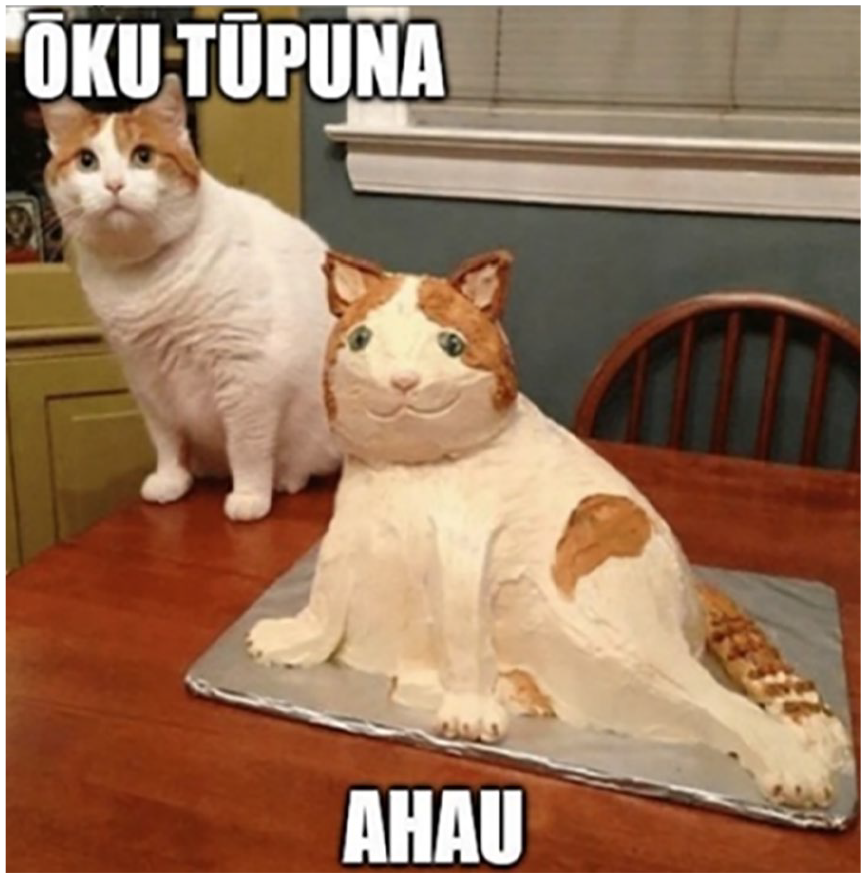
“Worried i have accidentally stolen this format . . .” (Māori // salish memez, 2019a).
The complexities of intergenerational trauma are palpable in the meme in Figure 9, which depicts a choice between two options, the car swerving dramatically from one lane to another suggesting an impulsive decision made without sufficient forethought. In this case, the car diverges from a straightforward route to decolonization: “learning traditional practices at a wānanga [Māori tertiary institution]” in favor of reaffirming colonial structures: “getting another degree from a sh[**]ty Pākehā university” (Māori // salish memez, 2019d). This meme represents the lure of finding value within the Pākehā system rather than within the Māori system. The creator uses contradiction to draw attention to their message: the incongruity between the protagonist’s statement that they are “finally ready to decolonise” themselves and their action to the contrary (Māori // salish memez, 2019d). The self-deprecating humor says something about the pressures on Māori to assimilate to dominant Pākehā systems, while experiencing feelings of cultural failure as a result, and may serve as a coping mechanism to release tension.
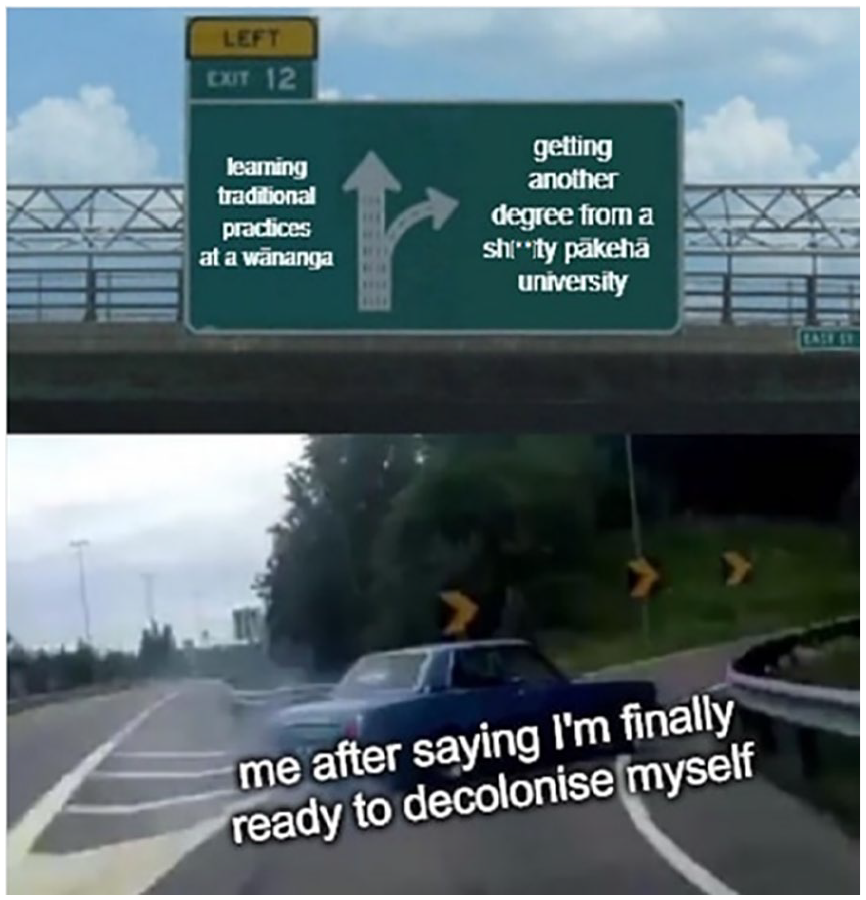
“I’m applying for an MA bb” (Māori // salish memez, 2019d).
This group of memes is best viewed as a spectrum, with some leaning more toward trauma and others resistance. In the meme in Figure 10, trauma is present in the creator’s recognition of the violence experienced by their ancestors whose hair was “forcibly cut by colonisers,” but the emphasis is on defiance (Māori // salish memez, 2019c). The character’s response is to grow their hair to cover their entire body, an act personified by the character “It” from the movie The Addams Family (1991). This discursive strategy of exaggeration emphasizes the strength of Māori commitment to tino rangatiratanga. The trauma and resistance memes thus offer a counter-narrative to dominant depictions of Māori as merely victims: in describing how society is arranged to alienate Māori from their traditional practices, they also foreground Māori resilience and autonomy.
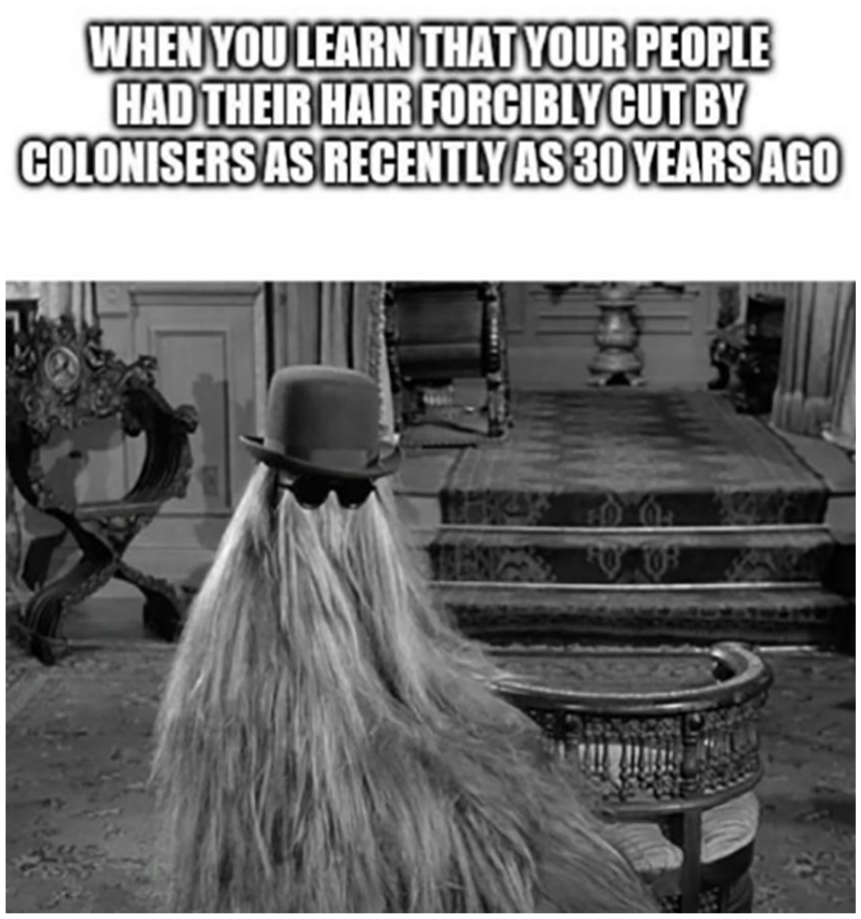
“Long hair don’t care” (Māori // salish memez, 2019c).
A third group of memes on the theme of intersectionality use critical humor to address sub-groups of Māori for their roles in furthering colonization through benefiting from its structures. In particular, the meme creators target tāne Māori (Māori men). The meme in Figure 11 returns to the strategy of incongruity, juxtaposing a cute character with sharp critique. The template is part of the Kermit The Frog series of memes, which typically portray disapproval at questionable social behaviors. The four panel scene pictures Kermit waiting or engaging in activities requiring time and patience: fishing, sitting on a rock, leaning against a column, and looking out a window at the rain. The text—“me waiting for Māori men to get on the decolonisation waka (canoe) and stop using their indigeneity purely for profit”—suggests that non-tāne Māori are waiting for tāne Māori to join the common cause, and Kermit’s poses reinforce the idea that they are not doing so fast enough (MeanMaoriMemes, 2019b). Another meme in this category utilizes a Diet Coke can image labeled “Diet Decolonialism” to symbolize a diluted form of decolonization (MeanMaoriMemes, 2019c). This dilution occurs when tāne Māori abuse their privilege by benefiting from the convergence of patriarchal and capitalist powers with colonial power in ways that non-tāne Māori cannot. This meme account, @decolonialmememaori has a strongly intersectional stance (Crenshaw, 1989), exploring the complexities of navigating the effects of colonization as they intersect with other forms of identity-based oppression, from a distinctly mana wāhine (Māori feminist) perspective (Mikahere-Hall, 2017; Pihama, 2001, 2020). Such memes critique the decolonial movement from within, which is a necessary part of decolonial action.

“U no who u r . . .” (MeanMaoriMemes, 2019c).
As with the memes addressing Pākehā behaviors, those focusing on Māori use several discursive strategies to convey their points about decolonization, including contradiction, exaggeration, metaphor, incongruity, imitation, localization, infantilization, self-deprecation, and parody. These are furthered via creative combinations of modes, including text, facial expression, pose, hairstyle, objects, and character choice. We have argued that the memes focusing on Pākehā were mostly boundary-marking, with solidarity-building flow-on effects for Māori, in terms of sharing common experiences of racism. The memes focusing on Māori are mainly solidarity-building, representing sites to nurture Māori identity and belonging, but boundary-marking surfaces in these memes too, as the wāhine rangatahi meme creators remind other Māori of their responsibilities in advancing the decolonial movement in ways that will benefit everyone. These memes highlight the challenges and messiness of the activity of decolonization, among Māori as well as non-Māori.
Conclusion
This article has examined the contemporary phenomenon of decolonial Māori memes, created by young urban Māori to advance the project of decolonizing Aotearoa. We have shown how the creators use a range of creative discursive strategies and modes to convey messages about the colonizing behaviors of some Pākehā and the decolonizing behaviors of Māori. The strategies identified include satire, contradiction, ridicule, infantilization, metaphor, contrast, parody, exaggeration, incongruity, imitation, localization, and self-deprecation. These are furthered via creative combinations of modes, incorporating both verbal and visual expressions, including text, color, size, facial expression, pose, dress, character choice, hairstyle and objects. The two functions of boundary-marking and solidarity-building are intimately connected, as decolonization is a process involving both Māori and non-Māori actions. The memes therefore provide a potential decolonization roadmap— a strategy to set out the obligations for both Māori and non-Māori, and the apparent lightheartedness of the memes may facilitate difficult conversations about race relations. This discursive genre allows rangatahi enmeshed in meme culture to adopt the ongoing struggle for past, present and future generations, who have fought and will fight to resist the racism and erasure of Māoritanga resulting from colonization. The resulting e-whanaungatanga has the potential to empower Māori in their communities on and offline, working to decolonize themselves and others. The memes coincide with a political climate demanding mainstream attention to anti-racism and decolonization via hashtag movements. This presents an opportunity for these memes to flourish. While the aim of this research was to highlight the memes’ potential to decolonize, further research may reveal if this potential is realized, by focusing on the memes’ dissemination within communities and the extent to which they provide a discursive boost to decolonial action.
Footnotes
Acknowledgements
The authors acknowledge Charlotte Muru-Lanning’s article in the Spinoff, which prompted them to investigate these memes. They thank Leanne Young and Joris de Bres for their assistance in supporting this project’s conception and reviewing the early stages of the manuscript.
Authors’ note
Ko Taranaki tōku maunga
Ko Tokomaru tōku waka
Ko Waiwhetū tōku awa
Ko Waiwhetū tōku marae
Ko Ngāti Puketapu tōku hapū
Ko Te Ātiawa tōku iwi
Ko Leanne rāua ko Chris ōku mātua
Ko Ia tōku ingoa
Declaration of conflicting interests
The authors declared no potential conflicts of interest with respect to the research, authorship, and publication of this article.
Funding
The authors received no financial support for the research, authorship, and publication of this article.

Glossary
ahau me
Aotearoa New Zealand
haka ceremonial dance
kaumātua elders
kaupapa topic
Kaupapa Māori philosophy and practice of Māori people
kia tūpato being cautious
kotahitanga solidarity
mana dignity
mana wāhine Māori feminist
Māoritanga Māori identity
marae Māori meeting ground
ngā mihi regards
ōku tūpuna my ancestors
Oranga Tamariki The Ministry for Children
Pākehā New Zealander with European ancestry
rangatahi Māori young people
takatāpui Māori queer people
tāne Māori Māori men
te ao Māori Māori worldview
te reo Māori the Māori language
tikanga cultural practices
tino rangatiratanga self-determination
wāhine women
waiata song
waka canoe
wānanga Māori tertiary institution
whaikōrero formal speeches
whakapapa ancestry
whānau family
whanaungatanga relationship-building
wharekai dining area
wharenui meeting house