




Abstract
This article examines references to tikanga Māori (Māori (the Indigenous Peoples of New Zealand) values) by New Zealand political parties. The article grounds itself in some of the wider debates relating to the incorporation and application of tikanga, Māori values, across New Zealand in both legal and political contexts, with particular review of legislative references. An analysis of New Zealand political party policies and constitutions from the 2020 General election showed that over half of the political parties who campaigned made some reference to tikanga, but there was great variation in how tikanga was interpreted. This article assesses some of the opportunities and complexities of New Zealand political party engagement with tikanga Māori.
Introduction
This article examines the use of tikanga Māori (Māori (the Indigenous Peoples of New Zealand) values) by New Zealand political parties, with attention paid to the 2020 General election. While tikanga, Māori values, exists as the basis for kaupapa Māori politics, Māori-centred politics, it has largely been excluded from theories and practices pertaining to British-informed politics. Tikanga form the basis for the first and longest enduring political systems and structures in Aotearoa. Varying between iwi (tribes), hapū (sub-tribes) and whānau (families), political interactions can be understood through the tikanga, which guide the ways in which decisions are made. Who is involved, what is being discussed, why it is being discussed, where and how decisions are made can all be guided through tikanga. As an all emcompassing system, tikanga covers vastly more than politics and is a fluid and flexible set of ideas that can inform all parts of life (Mead, 2016). However, for the purposes of this article, tikanga is viewed in relation to how it is situated within a Crown-derived political organistion—political parties. New Zealand political parties seek to represent the needs of society and ascertain what the best course action is for maintaining or improving the livelihoods of New Zealand citizens. Policies and constitutions form the underpinning values for how political parties seek to advocate for their constituents. In effect, these are the core promises that political parties make to uphold and, therefore, should be evident in the actions and advocacy that are centred on party lines. Within New Zealand, varying levels of reference to tikanga Māori were evident in the 2020 election, which leads to important questions regarding the growing movements towards consitutional transformation. This article examines some of the opportunities and complexities surrounding engagement by political parties with tikanga Māori by assesing some of the broader debates around tikanga within traditionally non-Māori spaces.
Context
Tikanga form the basis of Māori political theory and practice and is the basis for the first form of politics in Aotearoa (Te One, 2021). Despite the longevity of Māori politics and indeed the continuation and development of tikanga in Aotearoa, tikanga has been largely excluded from British-informed structures. Indeed from the outset of colonisation, British-informed Government in Aotearoa did not simply exclude tikanga from political discussion, but activily sought to stifle any other political values system that did not align with the Crown’s colonial goals of complete political dominance (Smith, 2021). The Westminster system, an inherited political system devised in and for British politics has largely dominated the ways in which New Zealand’s central government has developed. The politics that occur at the state level is set by those rules inherited and forcibly applied following the signing of te Tiriti o Waitangi (the Treaty of Waitangi, distinct from the English text of the same name) in 1840, and have since that time set the scene for political practice to be measured against. Indeed, the voting system, the legal system, the way politicians are expected to behave, are all set to some extent within those rules and institutions that came from Britain in the 1840s. Political parties are too inherited and evolved from this early imported system and all that it stands for, and although political perspectives vary across the political spectrum, there is an expectation that the way politics occurs fits within that status quo. Although political parties in New Zealand did not establish until the 1890s, they were developed as part of British-informed colonial strutures, and as a result serve the interests of British-informed governance.
Within Māori political environments, tikanga remains a key system through which Māori make decisions. For example, discussions held on marae (tribal meeting house) or those shaped by certain practices such as karakia (prayer), waiata (song), all represent the normalcy of tikanga as politics. Discussions that begin and end with karakia demonstrate the importance of tikanga such as manaaki (caring), wairuatanga (spirtualism), whanaungatanga (relationships), all which encompass ideas and practices to guide the way decisions are made and the way people engage during those discussions (Mead, 2016). These type of processes are also becoming increasingly more common outside of Māori environments. Nationally, there is a growing understanding and acceptance of te reo Māori (the Māori language), te Tiriti o Waitangi and tikanga. It has become commonplace for Māori ceremonial practices such as pōwhiri (welcoming ceremonies) to be included within parliamentary events, as well as a range of references to tikanga within the policies across government. As a result, understanding how tikanga Māori fits into Crown institutions has long been of interest throughout academic fields. Māori legal academics for example have been interested in and advocating for a more nuanced legal system, in which tikanga is recognised as law in New Zealand courts, see for example 2021 Borrin Foundation Study. Slow progress towards this has been made, and the likelihood of further adaptations is high given some recent high profile cases, see for example Ellis v R, 2022. In a similar way, environmental initiatives and organisations have also shown increasing openness to tikanga Māori as laws have changed to include reference to central tikanga like kaitiakitanga (guardianship) in the Resource Management Act 1991 (RMA), but also groups and organisations seeking more suitable frameworks for protecting the environment with issues of climate change becoming more iminent. Bargh and Tapsell (2021) for example have proposed a “tika(nga) based transition] transition” (p. 1) in which they argue that any transition to a zero carbon economy should include significant interogation of questions pertaining to tikanga Māori. Elsewhere there has been a signficant increase in the use of te reo Māori names in both the public and private sector such as the Reserve Bank of New Zealand—Te Putea Matua. Some Māori advocates have supported the growing trend and argue that a greater uptake of te reo Māori is indicative of greater acknowledgement of te ao Māori (the Māori world) (Kelly, 2022). Concern still exists over whether applying Māori names to traditional non-Māori institutions also means that Māori will be included in structural decision-making. Others have argued that the use of te reo Māori by non-Māori institutions, falsely marks an institution as being underpinned by Māori philosophies (Mika, 2022).
These concerns regarding te reo māori are also applicable to the use of tikanga. Reference to tikanga through numerous public and private policies is also trending, and the use of tikanga as influencing constitutional frameworks is becoming more and more common. While many of these efforts come hand-in-hand with movements towards rangatiratanga (Māori self-determination, it remains that the inclusion of tikanga, te reo Māori and Te Tiriti o Waitangi needs to be done in a way that is not simply about including aspects of te Ao Māori, but centring Māori values as a sustainable source of theory and practice.
Tikanga and legislation
Activity in New Zealand’s legal system has bought to the fore some of the practical and philosophical concerns regarding how tikanga may operate within a colonially designed institution and provides some of the most extensive examples of how tikanga might sit alongside Crown-derived concepts. Although there are distinctions between tikanga as law and political party engagement with tikanga, the same broader considerations apply and so are reviewed here.
The doctrine of parliamentary supremacy means parliament is not required to consider tikanga Māori before passing legislation (Toki, 2018). However, due to the increasing recognition of the importance of both Te Tiriti o Waitangi to Aotearoa and the validity of tikanga as law, in recent times, there has been an increase in legislation that includes references to tikanga Māori or tikanga principles. Incorporating tikanga into legislation is the main avenue at present that central government actors engage with tikanga.
Tikanga have been incorporated into a range of acts over the past 30 years. When tikanga are mentioned in various statutes, the term is often not fully defined and generally refers to concepts such as culture and custom (Toki, 2018). For example, the Education Act 1989 mentions tikanga Māori when describing the characteristics of a wānanga (place of higher learning) and defines tikanga Māori as Māori custom (Mead, 2016). The RMA is viewed as the first genuine attempt to import tikanga in a holistic way into any category of the general law (Williams, 2013). The RMA defines tikanga Māori as Māori customary values and practices, with kaitiakitanga being defined as the exercise of guardianship (Mead, 2016). It includes tikanga principles such as kaitiakitanga, wāhi tapu (sacred sites) and mana whenua (local authority). However, the RMA has been criticised for failing to mention mauri, an incredibly important concept in te Ao Māori (Durie, 1998). Another significant Act that mentions tikanga is the Te Ture Whenua Māori Act 1993, also known as the Māori Land Act 1993. This Act includes important concepts such as ahi kā (home fires) and kaitiaki, which it defined as guardian, alongside tikanga Māori, again, defined as Māori customary values and practices (Mead, 2016).
Post 2000, there has been a further increase in legislation incorporating tikanga, perhaps indicating central government’s increased willingness to engage in this area. Section 3 of the Fiordland (Te Moana o Atawhenua) Marine Management Act 2005 references the tikanga principle of kaitiakitanga (Potaka, 2011). The updated Coroners Act 2006 attempted to address issues specifically pertaining to tikanga and post-mortem procedures, especially with regards to the handling of tūpāpaku (corpses) (Selket et al., 2015). Schedule 2 of the Central North Island Forests Land Collective Settlement Act 2008 mentions the tikanga principle of whanaungatanga (Potaka, 2011). Tikanga and tikanga principles such as mana and kaitiakitanga are also found in treaty settlement legislation (Jones, 2016). Tikanga are also mentioned in a range of acts as a relevant consideration in decision-making (Toki, 2018).
Te Awa Tupua (Whanganui River Claims Settlement) Act 2017 involved an innovative incorporation of tikanga compliant ways of caring for the river (Te Aho, 2018). Despite much praise, some critics are wary and state that the granting of a legal personhood to the awa may not in fact result in a wider acceptance and recognition of tikanga Māori (Charpleix, 2018). However, to many, this Act feels like a step towards meaningful engagement with tikanga.
Significantly, the Law Commission’s 2013 review of the legal framework for burial and cremation states the importance of tikanga Māori in central government practices, and provides that tikanga must be taken into account when forming policy, defining tikanga as Māori customary law (Mead, 2016). This affirms the growing importance of tikanga to central government and indicates that it is well past time that political parties must be engaging with tikanga.
Political parties and tikanga
Thus far, research into the engagement of political parties with tikanga Māori has largely been focused on Te Pāti Māori (the Māori Party) or individual Māori politicians. A number of individual Māori politicians have stated the importance of tikanga in parliament; for example, in the 1996 election, John Delamare stated that he was hoping Māori MPs could work together by introducing tikanga Māori and demonstrating models for collective decision-making (Durie, 1998). Tariana Turia has also stressed the importance of promoting tikanga Māori in parliament (Humpage, 2017). Te Pāti Māori has been engaging with tikanga Māori since its inception. Co-founder Tariana Turia stated that the tikanga Māori nature of Te Pāti Māori is an essential part of the justification for its existence (Humpage, 2017). The founders of Te Pāti Māori crafted their constitution to effectively incorporate relevant tikanga Māori throughout and have selected tikanga, which they deemed most relevant (Jones, 2013). An example from Te Pāti Māori constitution is the use of the tikanga principle manaakitanga. The Party defines manaakitanga as: behaviour that acknowledges the mana of others as having equal or greater importance than one’s own, through the expression of aroha, hospitality, generosity and mutual respect. (Jones, 2013, pp. 179–180)
The constitution then goes on to set out how the Party can go about expressing manaakitanga, before listing tikanga of Te Pāti Māori derived from the principle of manaakitanga. This principle has informed how Te Pāti Māori Members of Parliament conduct themselves, such as through not performing personal attacks in parliament. Tikanga informs both political policy and the political actors’ actions (Jones, 2013). Te Pāti Māori engagement with tikanga has not been limited to their constitution and policies. The Party has influenced the expression of tikanga within the substance of policy and legislation, for example, with Whānau Ora (a Māori health initiative; literally, healthy families) (Potaka, 2011). This involved taking a more holistic approach to helping families (Humpage, 2017).
Analysis
There are a range of debates around the use of tikanga within Crown law and policy that sheds light on the opportunities and complexities surrounding political parties and tikanga. On one hand, there is recognition that the inclusion of tikanga within Crown institutions may be a step towards greater recognition of rangatiratanga (Māori self-determination) by the Crown. On the other hand, other scholars such as Mikaere (2013) have been concerned about the misuse and possible dilution of tikanga in a Crown political system. Mead (2016) holds that the use of tikanga by central government, such as by including tikanga and tikanga principles within legislation is evidence of an overall increase in support and awareness of tikanga Māori in Aotearoa. This is seen as positive and highly important for the future of Aotearoa (Mead, 2016). Other academics hold that the use of tikanga by central government through legislation supports the idea of a bicultural jurisprudence in Aotearoa, due to the incorporation of Māori customary law as part of statutes (Durie, 1998). Jones (2016) sees this as a valuable adaptation to the social and political circumstances of Aotearoa today. This is because the incorporation of tikanga and tikanga principles within central government is one way of expressing rangatiratanga and simultaneously recognising the regulatory powers of the state (Jones, 2016). By adopting tikanga, it is believed that this will help shift the values and processes of central government, which could result in beneficial outcomes for Māori through policy changes that more embody Te Tiriti o Waitangi (McMeeking et al., 2018).
One main critique of the government’s engagement with tikanga Māori is the effectiveness of its incorporation. This is because the places where tikanga and tikanga principles are utilised within statutes is often in the symbolic rather than in the operative sections (Jones, 2016). An additional issue is that often where tikanga is mentioned in legislation it is only one factor to be considered among many (Toki, 2018). This undermines the effectiveness of incorporating tikanga as it can be dismissed with other factors being deemed as more relevant considerations.
Another complication is that most of the people interpreting policies and legislation are not sufficiently educated on tikanga and may not have a suitably informed approach to engage effectively (Joseph & Bennion, 2003). Some feel that this poses a threat to tikanga. Jackson (2007) argues that when political parties and central government use tikanga Māori, this is setting tikanga into a foreign environment, away from whakapapa (genealogy), where it could be harmed, thereby making Māori unsafe (Jackson, 2007). A major criticism of the increasing incorporation of tikanga within central government is that this may undermine tikanga by subverting it within and below Crown legal structures. This is as the law of the Crown will take precedence over tikanga when consistency with criteria such as international obligations is required (Charpleix, 2018). An example of how tikanga Māori is subverted by being incorporated into Western political structures comes through from scholars such as Mikaere (2013). She argues that through the Crown’s attempts to engage with tikanga, they are falling far short of what is required and are in fact subverting the power of tikanga Māori. Her argument rests within a context of relationships between tangata whenua (people of the land) and manuhiri (guests) where she argues that engagement by the Crown with tikanga enables manuhiri to dictate the terms of relationship building (Mikaere, 2013). This means that while incorporating tikanga may appear as progressive moves from central government, the risk of tokenistic inclusion is high. Mikaere’s argument is based on the position that incorporating tikanga within the Western political framework is a wholly separate idea from recognising tikanga as the supreme law of Aotearoa (Mikaere, 2013). Mikaere posits that the incorporation of tikanga within Western legal and political frameworks should be viewed as the “maintenance of crown domination” through “reducing tikanga to a near empty shell” with the Crown ultimately being able to pick and choose which tikanga are relevant and which fit into the already established system (Mikaere, 2013, pp. 162–163). These ideas are supported by Jackson (1995) who states that tikanga is only found to be acceptable by central government where it does not threaten the Crown’s control and power (Jackson, 1995 in Charpleix, 2018). Mikaere argues that when political parties are encouraged to form policies and legislation that integrate tikanga Māori, this contributes further to the undermining of tikanga than would happen within the existing monocultural system. In this way, the incorporation of tikanga in central government is more easily able to disguise its transgressions against Māori. This aids in legitimising the Crown’s actions, through the tokenisation of Māori words and symbols (Mikaere, 2013). Following this line of thinking, this means that the more central government engages with and uses tikanga Māori, the greater the danger of tikanga being colonised instead of a “healthy expression of tino rangatiratanga” (Jones, 2016, p. 25).
Another major concern with political parties and the Crown engaging with tikanga is that its use is often to suit specific needs, rather than appropriately following tikanga as an overarching values system. For example, guidelines created after consulting with Māori on genetic engineering were changed by the government so that tikanga only pertained to Indigenous plants and animals (Joseph & Bennion, 2003). Other examples include the incorporation of the concept of tupuna (ancestors) rights, which was then changed to mean the opposite of what was intended by the Māori activists who had coined the term (Jackson, 2007). In acts such as the RMA, the definition provided of tikanga and principles such as kaitiakitanga are translated in a way that does not accord with full Māori understandings (Durie, 1998).
Toki (2018) argues that these mistranslations are to be expected, as the Crown takes tikanga such as kaitiakitanga out of context (Toki, 2018). Sometimes these mistranslations appear deliberate, as with the use of mana, which is never translated as sovereignty when referring to power held by Māori (Jones, 2016). Some see the solution to this problem is to not translate the words, but this also comes with a risk. It may allow a more authentic meaning, but it can result in Māori and central government interpreting the wording very differently, which then results in a lack of giving proper expression to Māori control (Jones, 2016).
While these arguments as set out above are nuanced and not always presented as being directly for or against the use of tikanga by the Crown, they do indicate that it is vital that conversations are transparent around the use of tikanga within Crown systems and that there are both opportunities and complexities within this ever-changing and evolving environment. To draw some of these considerations to a different context, we now reflect on the use of tikanga within political party structures with the 2020 election as a case study.
The 2020 election: political party case study
We began this research by asking how tikanga was understood by political parties in the 2020 election. This question was developed after considering the growing recognition of tikanga in legal studies, and courts, coupled with greater attention being paid nationally to te reo Māori, te Tiriti o Waitangi and tikanga Māori as presented earlier. Given this attention, we were interested to see how political parties were responding to this, and as potential leaders and policy makers, whether or not tikanga featured in their constitutions and policies. As the makers of government and national decision-making, reference to tikanga could mean that first, political parties thought that voters wanted to see greater use of tikanga Māori central leadership, and second that political parties believe that tikanga are useful governing values in Aotearoa. The debates outlined above informed the lens through which this research was undertaken. While there are a range of opportunities and complexities that have been discussed by various scholars and Māori experts, the fact remains that political parties are already engaging with tikanga in various ways, and that as it currently stands, there are no limitations nor guidelines regarding how political parties reference tikanga in their policies and constitutions. As such, understanding what the landscape looks like, provides important insights into another area within which tikanga is being used.
As a preliminary study, we focused on the 2020 election and all parties who ran for election, whether successful or not. We focussed on references made in the constitutions, which we considered important as the key values that political parties comit to act, and form the basis for the overarching political values that voters can expect from a party. We also analysed party policies and how tikanga was referenced in relation to the different stances that political parties were advocating for. This study does not analyse how tikanga influences the actions of elected parties, but forms a basis from which research of this type could occur. We also only intend for this to be an overview of tikanga; therefore, the methods used were searching through published constitutions and policies on political party websites.
We found that in the 2020 election, 9 out of 17 (53%) parties who stood for election made some reference to tikanga in their constitutions or policies and of those who were elected to parliament, four out of five made some reference to tikanga in their policies and or constitution. The data collected came from policies available following the November 2020 election and Table 1 provides a brief summary of the type of reference to give an indication of the extent of engagement.
Political party policies and constitutions referencing tikanga Māori (Māori (the Indigenous peoples of New Zealand) values) in 2020.
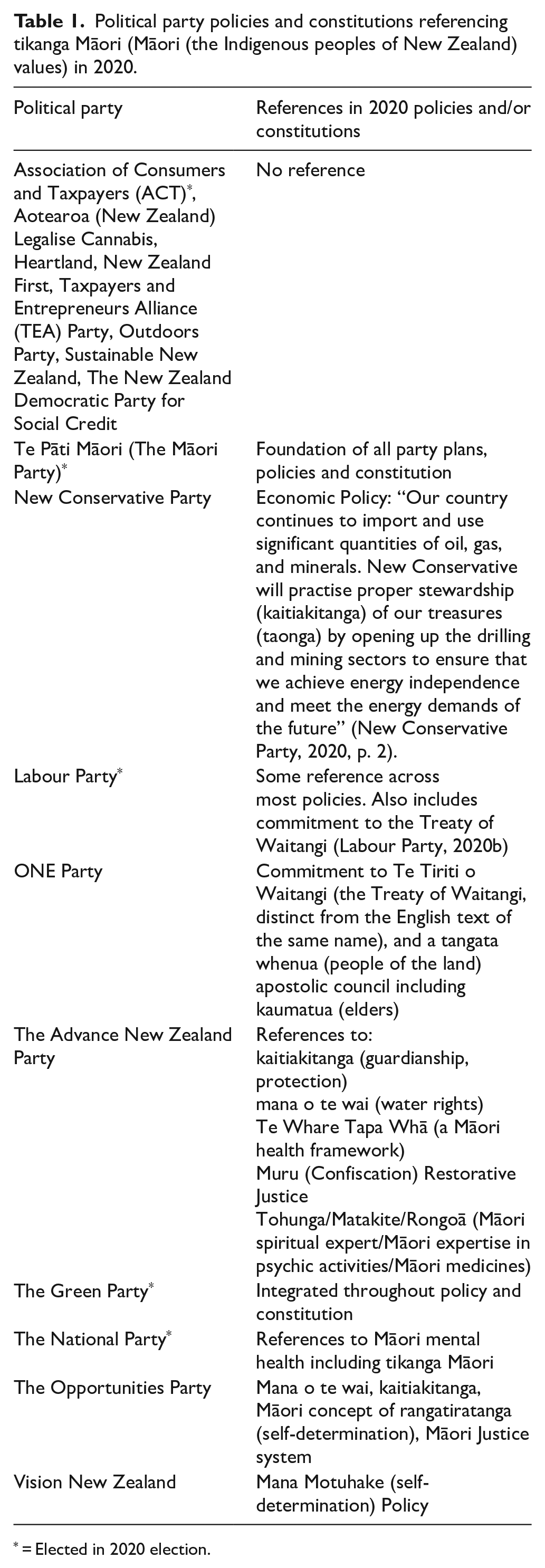
= Elected in 2020 election.
Political party references to tikanga
There is broad reference to the ways that tikanga were referenced by political parties, which illustrates some of the points and concerns that are outlined above. Te Pāti Māori was perhaps unsurprisingly the only party to have tikanga at the centre of it’s constitutional framework. For example, the growth of the party is described as: Growing from within the kaupapa (Māori principles) are our tikanga, like the trees that spring from Papatūānuku (Earth Mother). The tikanga are the policies, practices and organisational structures of the Party that are aligned to and consistent with the foundation kaupapa, and will benefit not only Māori but all those people who lay claim to this country as their homeland. (Te Pāti Māori, 2020, p. 1)
A number of tikanga are selected and described in relation to party practice and policy development. For example, kaitiakitanga is described as “the spiritual and cultural guardianship of Te Ao Mārama (Māori creation narratives), a responsibility derived from whakapapa” (Te Pāti Māori, 2020, p. 1). This definition locates tikanga and kaitiakitanga within a Māori worldview, with Te Ao Mārama, and whakapapa referring to a system of genealogy, which links Māori to our ancestors, our descendants, our gods and the environment.
In contrast to these references the concerns that tikanga can be utilised to serve a purpose, which may not align with rangatiratanga, are also apparent. The most obvious example that we found was the one reference made by the New Conservative Party’s Economic policy in which the interpretation of kaitiakitanga and taonga (tangible and intangible treasures) could be protected through mining and drilling land. As the essence of kaitiakitanga and taonga includes the protection sustainablity of the environment, such an interpretation sits at odds with more generally accepted definitions of those concepts.
The Labour Party (2020a), who currently sits in government had numerous references to tikanga throughout policies, and aligned with their Labour Manifesto 2020. Interestingly, while the manifesto includes specific tikanga, these are offset by English terms and political ideologies. For example, one such point is laid out and described as follows: FREEDOM RANGATIRATANGA Freedom is about both the right to fully participate in society and to exercise choice about how we live our lives. Labour recognises that people can only exercise true freedom when they can participate fully in a society that supports strong personal, social, and economic rights for everyone. (Labour Party, 2020a, p. 4)
The reference in effect interprets rangatiratanga through a societal approach while failing to acknowledge the specificity of rangatiratanga as a wholly Māori cause for self-determination that has often sat at odds with the Crown’s claims of freedom that have centred Crown sovereignty over rangatiratanga.
The Green Party (2020) has extensive references to tikanga that make up the base of much of their policy positions, for example, their Climate Change Policy noted that “Our response to climate change should be founded upon the tikanga (values) and matauranga (knowledge) of tangata whenua” and their position on constitutional transformation states that Māori should “have adequate resources to enable them to engage in their own tikanga process for determining constitutional issues” (p. 1).
Finally, the unsuccessful Vision NZ party stated in their Mana Motuhake Policy that “there has been an inability for Māori politicians to successfully work through a colonial and unsuitable system, where tikanga Māori cannot be expressed, and Māori interests must be placed second to Government agendas” (Vision NZ Party, 2020, p. 2). But go on to state that one of their policy goals is to “Whakamana Hapū (uplift sub-tribes) (that) allows the modern innovation of community living with ancient Tikanga Māori concept of Marae/Village living” (p.2). The statement while seeking to take tikanga into account also suggests that tikanga is stagnant or relegated to ancient times, which sits at odds to some of the wider understandings of tikanga as operating as a fluid and flexible set of values that are robust precisely because they are able to adapt to different times and circumstance.
While just a few examples drawn from political party constitutions and policies, the breadth of use and interpretation is wide and speaks to some of the debate that was outlined above. In particular, from these references it is clear that not all references to tikanga are in line with promoting rangatiratanga, and begs the question regarding who these parties are accountable to when tikanga is referenced as a policy position. A number of issues can be drawn from these examples.
First, tikanga are interpreted by different parties in different ways. While this in itself is not necessarily a negative thing, as tikanga is an adaptable system, it is not clear as to whether parties’ perceptions of tikanga are drawn from Māori experts, other than Te Pāti Māori.
Second, and related to the first point, tikanga is an all-encompassing system that can inform political activity. However, as a political philosophy, tikanga must be understood as the starting point for decision-making as opposed to something that can be scattered throughout secondary actions.
Third, perhaps one the challenges in applying tikanga to a political party structure is that tikanga does not align directly with left and right politics which underpin many of the policy decisions made by political parties. As such, trying to shape tikanga to fit into preconceived political positions, can dilute the essence of tikanga as a political philosophy in its own right.
Conclusion
To conclude, this research has shown that there is some diversity in the ways that political parties in the 2020 election engaged with tikanga. While on one hand, this engagement may demonstrate part of the slow progress towards constitutional transformation that centres te Ao Māori rather than excludes it, on the other hand, the diversity of interpretation and the dilution of tikanga as a complete system in itself is cause for concern. While Aotearoa New Zealand’s political system must continue to decolonise and indigenise, this research adds some small discussion to the debates. The opportunities and complexities are vast and changing rapidly. It is vital that assessment of tikanga use by the Crown and political parties remain, to ensure that rangatiratanga remains the central measuring stick. While further analysis is needed, the case study shows that tikanga is already on the radar of a diverse range of political parties, and therefore if this trend continues then it is important that systems for accountability are developed.
Footnotes
Acknowledgements
We acknowledge support from Te Herenga Waka—Victoria University of Wellington in providing a summer scholarship to support this research.
Authors’ note
Declaration of conflicting interests
The authors declared no potential conflicts of interest with respect to the research, authorship and publication of this article.
Funding
The authors disclosed receipt of the following financial support for the research, authorship and publication of this article: Te Herenga Waka—Victoria University of Wellington Summer Scholarship.

Glossary
ahi kā long burning fires of occupation, continuous occupation
Aotearoa New Zealand
aroha love, compassion
hapū sub-tribe
iwi tribe
kaitiaki guardian, caregiver, keeper
kaitiakitanga the exercise of guardianship; guardianship, trusteeship, stewardship
karakia prayer, blessing
kaumātua elders
kaupapa topic, agenda, purpose
kaupapa Māori Māori principles; Māori centred
mana prestige, authority, control
mana motuhake self-government, autonomy
mana o te wai water rights
mana whenua local people with power from the land
manaakitanga caring
manuhiri guests
Māori the Indigenous Peoples of New Zealand
marae tribal meeting house
matakite Māori expertise in psychic activities
mātauranga knowledge
mauri life force
muru confiscation
Papatūānuku Mother Earth
pōwhiri welcoming ceremony
rangatiratanga Māori sovereignty; self-determination
rongoā Māori medicines
tangata whenua people of the land
taonga tangible and intangible treasures
te ao Māori the Māori world
Te Pūtea Matua The Reserve Bank of New Zealand
te reo Māori the Māori language
Te Tiriti o Waitangi the Treaty of Waitangi, distinct from the English text of the same name
Te Whare Tapa Whā a Māori (Indigenous Peoples of New Zealand) health framework
tika correct
tikanga; tikanga Māori Māori values
tohunga Māori spiritual expert
tūpāpaku corpses
tupuna ancestors
wāhi tapu sacred sites
waiata songs
wairuatanga spiritualism
wānanga place of higher learning
whakamana hapū uplift sub-tribes
whakapapa genealogy
whānau family
Whānau Ora a Māori health initiative; literally, healthy families
whanaungatanga relationships