



Abstract
The qualitative analysis of farmers’ use of Indigenous knowledge on climate change adaptation across farming systems and agroecological zones of Sierra Leone was conducted using a combination of interpretive phenomenological analysis, Focus Group Discussions, and participant observation, which was analyzed with a qualitative interpretative approach. Farmers respond to climate change through the use of wind and cloud patterns, animal and bird behavior, moon shape, and position of the sun to predict changes in temperature, intensity, drying up of rivers, and frequency of rainfall, as well as the incidence of pests and diseases. Other Indigenous knowledge used by farmers were rotational grazing, migration, crop-livestock integration, and the use of manure for composting with herbal and biological treatment for disease management. The study recommended that in the current context of climate change, the promotion of adaptation strategies should explore the interdependency of different knowledge systems and knowledge hybridity in agriculture.
Introduction
In Sierra Leone, the agricultural sector is dominated by two-thirds of the population, featuring small-scale and resource-poor production activities and predominantly dependent on the use of women’s labor force (Government of Sierra Leone [GoSL], 2019). Farmers often depend on external development agencies for their supply of inputs and other support services such as seeds (GoSL, 2019). The government of Sierra Leone and foreign donors have put a lot of effort into transforming agriculture with the view of ensuring food security and improving the livelihoods of smallholder farmers from subsistence level to middle-income earners (GoSL, 2018). Successive governments have made efforts to diversify the country’s economy by designing and implementing programs that focus on agricultural development despite the strains on the socioeconomic situation in the country (GoSL, 2019).
The country is delineated into agricultural belts called agroecological zones, based on the agroclimatic and socio-agro-cultural factors that are closely related to the farming system practiced by farmers. Consequently, farmers naturally align themselves with the dominant farming system practiced, which is also reflective of the prevailing agroecological zone. Although agriculture is the engine of Sierra Leone’s economy, climate change has been a threat making agriculture highly vulnerable to natural hazards. The International Institute for Environment and Development (IIED, 2020) reported high incidences of floods, sea rises, mudslides, and landslides on an escalating trail in the past decade, exerting enormous pressure on their ability to cope with the effects and impacts of climate change often depicted as adaptive capacity. Similarly, GoSL (2018) reported that there has been a high incidence of strong winds, thunderstorms, landslides, heat waves, floods, and seasonal drought experienced by Sierra Leoneans and that climate change-induced extreme weather events remain major factors for re-occurring socio-natural hazards.
Farmers’ livelihoods are continuously impacted due to the potential and the ability of a system, region, or community to cope with the effects and impacts of climate change-adaptive capacity, highly variable and unpredictable climatic elements, thereby adversely affecting food crop production and household food security, especially in rural areas (Kangah & Boaten Agyenim, 2022; Kom et al., 2022). There is thus the need for production techniques to be adaptable to risks such as anticipating change and planting new crops. Adaptation strategies are integral components of climate-smart agriculture and have been widely promoted to strengthen livelihoods and food security, through the improvement of the use of natural resources and technologies along the value chain (Batchelor & Schnetzer, 2018). Over the past 10 years, climate-smart agriculture has been promoted as a composite method for sustainability of productivity, incomes, adaptive capacity, and resilience to climate-related shocks, to achieve a reduction of greenhouse gas emissions and increase carbon sinks, either individually or collectively (Fawzy et al., 2020).
While the incidence of climate change is quite evident, the uncertainty regarding the pace, and extent, of responsiveness to the impacts on agriculture among smallholder farmers is low. The implementation of climate-smart agriculture faces significant challenges, as adoption has been poor over the years (Yiridomoh et al., 2022). The slow adoption of improved resilience practices among farmers has been linked to barriers such as low capacity, poor access to technologies, information, credit, and institutional support (Cordingley et al., 2015; Mapfumo et al., 2013); incidences of pests and diseases (Antwi-Agyei et al., 2021); scientific models not being cost-effective among the Indigenous farmers to offsetting climate risks for the local communities (Kom et al., 2022); practices have been beyond the reach of farmers (Zougmoré et al., 2018); non-contextualization of practices within the beliefs, and values of farmers (Dumenu & Obeng, 2016); and the inability of farmers to pay for improved climate information (Ouédraogo et al., 2018). Salite and Poskitt (2019) reported that in Mozambique, cultural beliefs and collective responses indirectly influence adaptation strategies; however cultural beliefs determine the timing and order of implementation after farmers have first implemented collective responses, due to solidarity in their communities. Farmers’ livelihoods remain precarious under climate change and variability due to the low adoption of these practices (Ogunyiola et al., 2022). Jellason et al. (2021) stated that overcoming the barriers to the adoption of climate-smart practices will promote food security and the resilience of farmers to climate change (Kpadonou et al., 2017).
Farmers respond to climate variability through traditional techniques often referred to as Indigenous knowledge. They do this by changing their sequence of cropping, planting dates, crop diversification, use of crop residues, and conservation of soil moisture (Shikwambana & Malaza, 2022, pp. 435–449). According to the Food and Agriculture Organization of the United Nations (FAO) (2004), Indigenous knowledge “has a close association with “tribal groups” and the “original inhabitants of an area,” while traditional knowledge represents “rural, isolated, static and not interacting with other knowledge systems,” and local knowledge is “community knowledge of people who may or may not be Indigenous people and whose knowledge may have various sources” (p. 5). Indigenous knowledge is collectively owned and includes the mental inventories of the characteristics of weather elements, animal breeds, local plants, crop and tree species, and belief systems that enhance the livelihood of the people and protection of the environment (Audefroy & Sánchez, 2017). The International Panel on Climate Change (2022) stated that Indigenous knowledge has communal ownership based on mental inventories of weather, animals, and plants within the belief systems that are operational in livelihoods and environmental protection activities. Indigenous knowledge has been the foundation of adaptation practices to climate change by farmers (Mazibuko & Chitja, 2021), and a vital source of local-level climate change adaptation strategies (Muchaku et al., 2023), which is continuously treasured due to the inadequacy of scientific knowledge to deal alone with complex global climate crisis (Finucane, 2009) and thus the need for partnership across diverse knowledge systems (Orlove et al., 2023).
There is a widespread reliance by farmers on Indigenous knowledge for seasonal forecasts and a strong link with the implementation of climate adaptation actions (Zvobgo et al., 2023). Indigenous knowledge involves techniques of adaptation and mitigation used by farmers and society in a local environment when creating unique context-based farming practices and food culture (Filho et al., 2023). Farming communities rely on Indigenous knowledge to anticipate and respond to climatic variability (Donkor & Mearns, 2022) and assist in making informed decisions for climate-resilient and low-emission agriculture (Chaudhary et al., 2022). Dasgupta et al. (2023) observed that Indigenous knowledge and practices are deployed at various stages of farming, from the identification of farm sites to harvesting and the performance of traditional thanksgiving services.
Several Indigenous practices related to climate-resilient agriculture include the observance of the flowering of coffee and blooming of peach trees as an indication of the onset of rains (Aich et al., 2022; Chaudhary et al., 2022; Mapfumo et al., 2016; Varah & Varah, 2022); soil classification for improved crop production and crop yield (Osbahr & Allan, 2003); observations of cuckoo birds migration, Mopane trees leaf-sprouting, and Nimbus clouds for Indigenous knowledge forecasts (Zvobgo et al., 2023). Soropa et al. (2015) reported that the majority of farmers used Indigenous Knowledge System (IKS) weather indicators such as wild fruits, trees, worms, and wind for predicting seasonal quality in addition to meteorological forecasts. Zvobgo et al. (2023) noted that a great proportion of farmers used Indigenous knowledge of weather and climate forecasts, and relied solely on Indigenous knowledge forecasts for climate adaptation decision-making. Practices such as agroforestry, intercropping of cereals, tubers, and legumes, diversification, and mixed farming have been used to optimize food crop production under climate change (Ogunyiola et al., 2022). Farmers’ continuous preference for traditional over climate-smart practices is due to their inability to obtain credit, improved seeds, farm implements, and weather information services, among other climate-smart practices (Dumenu & Obeng, 2016); location or type of agroecological zone, and slope (Nguru & Mwongera, 2021); levels of perceptions of climatic risks and traditional values, beliefs, knowledge, and experiences (Morton et al., 2017); and level of access to improved farm services and practices, farming experience, and geographical location are other factors (Anang, 2022).
The theoretical framework for this study includes climate change and climate variability theory, and technology adoption model. The climate change and variability theory states that the incidence of climate change is uncertain and that climate change indicators vary from location to location (Abbass et al., 2022; Nsubuga & Rautenbach, 2018), with different impacts and response mechanisms that are available within the socio-cultural milieu of the incidences of variability (Fawzy et al., 2020). The technology acceptance model postulates that an individual’s adoption of technology is influenced by perceived usefulness and perceived ease of use of the technology. Ray (2023) noted that a strong and significant correlation exists among knowledge systems, social practices, and outcomes. Perceived usefulness is the users’ subjective likelihood to improve on their actions toward the use of technology, while perceived ease of use is the degree to which potential users expect the technology to be effortless (Davis, 1989); thus the factors that influence the adoption of technology are the ease of use, technology’s utility, and social influence (Abdu-Raheem & Worth, 2011; Hailu et al., 2021). The continuous use of Indigenous knowledge in responding to climate change stresses the need to understand the application and the factors underlying the usage, particularly among farmers. This study was guided by the following research questions:
Are farmers aware of the incidences of climate change?
How do farmers use Indigenous knowledge to respond to climate change?
What are the constraints farmers face in the application of Indigenous knowledge?
Methodology
Study area
The study covered seven districts including Kailahun, Bo, Bonthe, Moyamba, Kambia, Koinadugu, and Western Rural District, across the five administrative provinces, namely Eastern, Southern, Northern, Northeastern, and Western Areas of Sierra Leone (Figure 1).
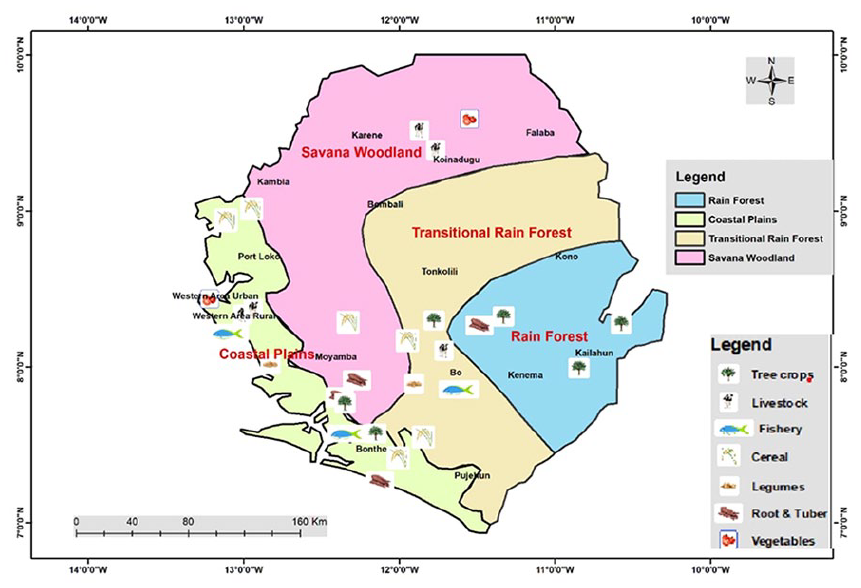
Map of Sierra Leone showing framing systems and agroecological zones (Source, ICT Njala University).
Smallholder farmers across the different agroecological zones and practicing various farming systems in Sierra Leone constituted the study population. Sierra Leone was stratified into agroecological zones and each zone covered the government administration. Districts that are predominantly reflective of the agroecological zones were purposively selected. To generate a sampling frame, the researchers obtained prior house listings conducted by the Ministry of Agriculture for the selected districts. This study combined interpretive phenomenological analysis with Focus Group Discussions and participant observation. The interpretative phenomenological approach helps to analyze how respondents view their “world as it is experienced” in particular contexts and at particular times in terms of the subject of inquiry (Willig, 2013, p. 7) and describe the experience of climate as observed naturally over space and time (Howard, 2013). Fay Cyr and Sagoonick (2024) applied interpretive phenomenological analysis among fish farmers. Interpretive phenomenological analysis describes, understands, and interprets a phenomenon (Tuohy et al., 2013); it “explores the inner experience unexamined in everyday life” (Bush et al., 2019, p. 2); seeks the core of the lived experience sought (Frechette et al., 2020); and discovers the examples of the inherent structure of meaning, through which complex understanding of experience is built (Bush et al., 2019). Participatory phenomenology is a fundamental research tool for social understanding of embodied experience, which taps into lived experiences and guides research questions for social understanding (Olaniyan & Govender, 2023). Sithole (2020) applied qualitative interpretative research design to explore the phenomenological underpinnings of various IKS-related phenomena and links to food security and environmental management. Kemkes and Akerman (2019) found that through interpretive phenomenological analysis, participants were able to narrate their understanding of the failures of collective actions and the uncertainties surrounding the magnitude and timing of localized effects of climate change. Olaniyan and Govender (2023) combined focus group discussions with in-depth interviews and participant observations to describe the response to climate change by root and tuber farmers in Nigeria. The combination of focus group data collection and interpretive phenomenology has utility in many types of studies, such as those that highlight the use of Indigenous knowledge in response to climate change. Focus groups were used as a data collection method to allow representations of multiple perspectives, and to derive key information from the consensus or discrepancies between focus group members (Leech & Onwuegbuzie, 2007).
Data collection
For the qualitative data collection, Focus Group Discussions and participants’ observations were carried out from each of the agroecological zones. The Focus Group Discussions reflected the demographic compositions of the population in the study. Creole language was used in the facilitation of Focus Group Discussions within the vicinity of their farm enterprises with adult and youth farmers. This study used the focus group discussion technique to gather information from lead farmers drawn from various farmer groups, farmer-based organizations, community-based organizations, and farmer cooperatives and conducted 23 focus group discussions of farmers comprising 6 to 8 youth and adult farmers per group representing each of the farming activities within a farming system in a district across the four agroecology of Sierra Leone. Every participant was encouraged and allowed to speak not more than three times to avoid dominance and all discussions were recorded.
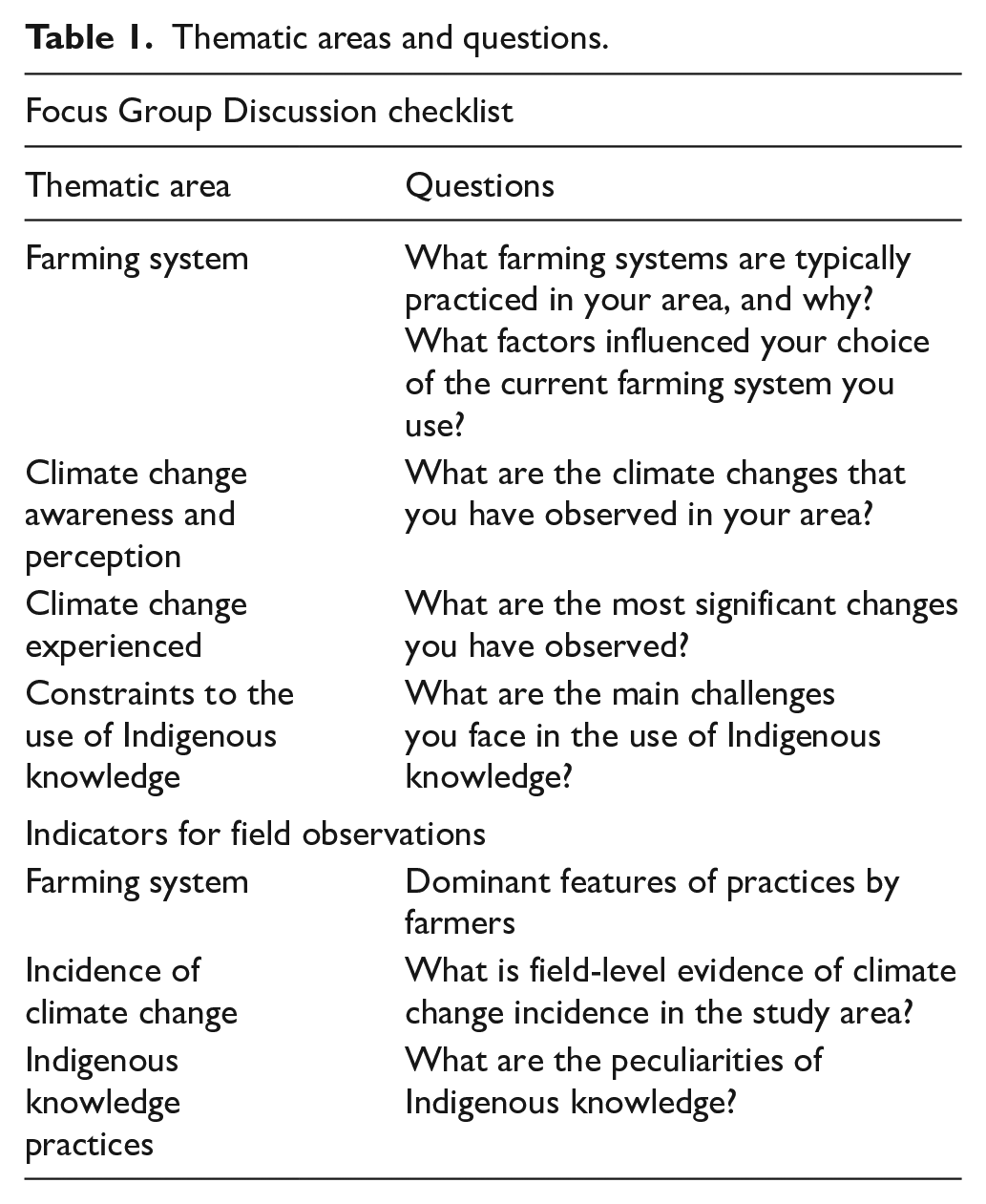
The field observation method was adopted by the researchers as a supportive or supplementary technique to collect data that may complement the data obtained from the focus group discussion and participant observation. The researcher thought that the observation method would provide additional information that could not be easily captured by the other methods used. This method was less structured. However, the researcher highlighted key areas of interest as the observation guide was prepared and focused mainly on the evidence of climate change, farming systems practiced, and climate-smart agricultural practices. The guide was also flexible enough to observe any other aspect or phenomenon that was relevant to the study. The checklist of the Focus Group Discussion and Indicators for Field Observations is presented in Table 1.
Thematic areas and questions.
The ethics approval was granted by the committee of the School of Agriculture, Njala University, Sierra Leone. Smallholder farmers who participated in this study signed an informed consent form signifying their understanding of the purpose of the study and their voluntary participation.
Data analysis
The study explored farmers’ views and experiences on climate change based on the following research questions: Are farmers aware of the incidences of climate change? How do farmers use Indigenous knowledge to respond to climate change? What are the constraints farmers face in the application of Indigenous knowledge? The qualitative interpretative approach, which constitutes data recording, transcription, categorization, summarization, and interpretation of contents, was used to analyze qualitative data such as Focus Group Discussions. This approach aims to understand the meaning and how social phenomena are constructed by actors (Aukes et al., 2020; Yanow, 2016).
Results
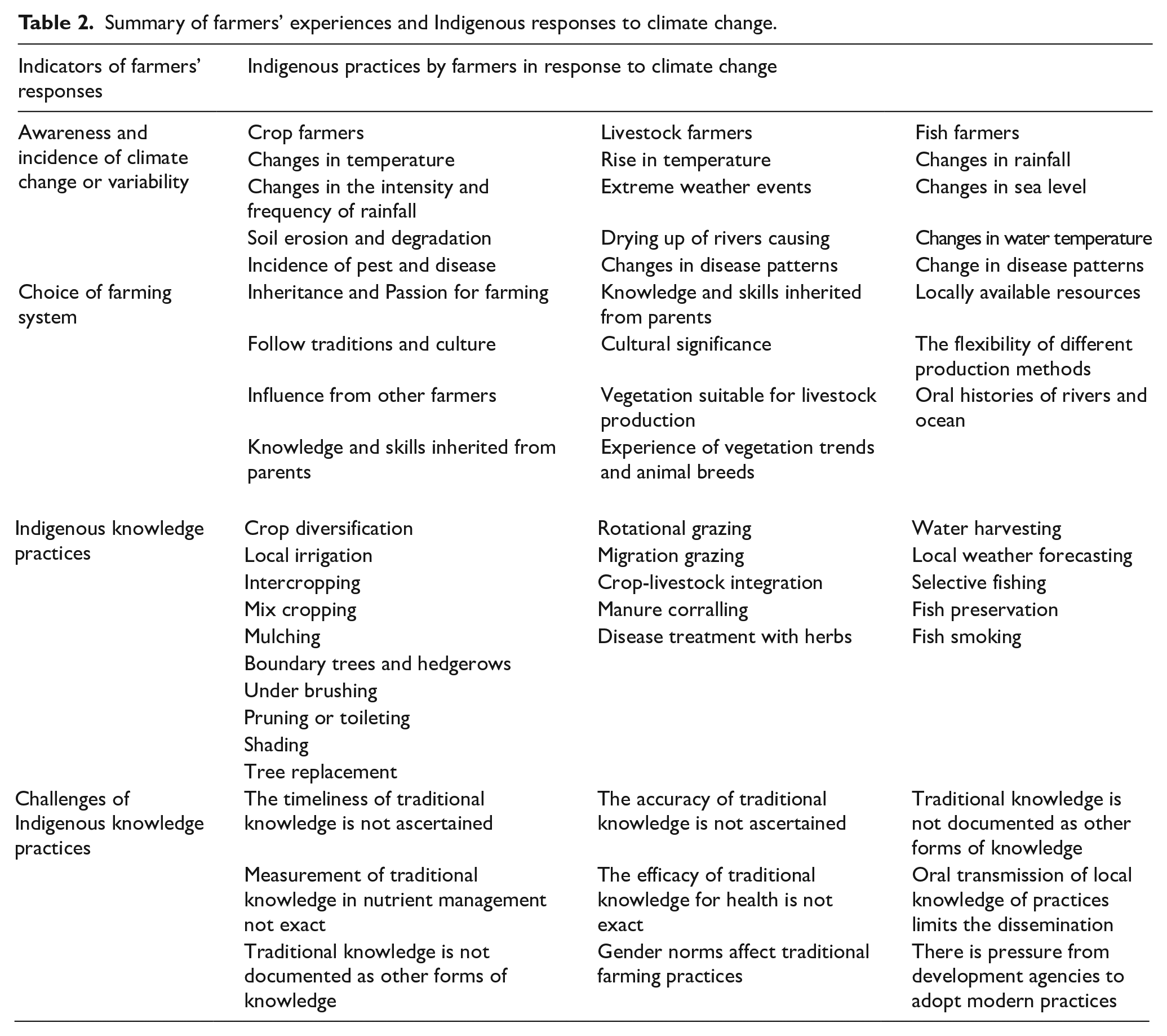
The findings of this study include direct quotes to support the categories where necessary and Table 2 was presented to summarize the overall constructions of climate-smart agriculture phenomena among farmers, across farming systems and agroecological zones of Sierra Leone.
Summary of farmers’ experiences and Indigenous responses to climate change.
Research question 1: Are farmers aware of the incidences of climate change?
Interviewer: Are you aware of the incidences of climate change?
A young lady vegetable farmer in Ogun Farm, Western Rural District: I have been cultivating vegetables for the past 20 years. I feed, clothe, and send my children to school from the proceeds of this vegetable production. But in recent times, I have experienced unpredictable rainfall that resulted in the shift in farming seasons and calendar, the emergence of pests and diseases, and poor harvest/low yield, and all of these affect the quantity and quality of produce we get. I no longer get enough money from my gardens to take care of our families.
An adult lady vegetable farmer in Kabala, Koinadugu District: We rely on rainfall and rivers as our main sources of water supply to carry out our vegetable production. But for the past years, we have seen the rivers drying, for a long period beyond normal times, frequent occurrence of drought, shifts in seasonal patterns that resulted in the interruption of the farming calendar, frequent crop pests and disease outbreaks, and crop failure.
A young fish farmer in Tonbo, Western Rural District: Appearance of new seaweed species, shifting in seasonal patterns, frequent wind/sea breeze, frequent rains, bad weather condition, disruption of fish habitat, rise in sea/ocean levels were all evidence of climate change incidence affecting our fishing activities.
Interviewer: What are farmers’ experiences of climate change?
A rice farmer in Kambia: For the past years, I have experienced unpredictable rainfall prior to the start of the growing season, that have affected the farming calendar and also the emergence of new diseases and pests such as fall armyworm. Sometimes we experience intensive sunshine when we should be expecting rain. These things happen as a result of climate change.
A rice farmer in Bonthe: I am quite aware of high and long periods of rainfall, flooding, soil erosion, and land degradation that have negative effects on my rice production in this community.
A lead rice farmer in Bonthe: I first learned about climate change from a meeting organized by the Ministry of Agriculture staff pointing out some examples of its occurrence in our community already. And later from radio discussions and other NGOs [Non-governmental organisation] in our community. I personally noticed it during the late or sometimes early onset of the rains than the normal period of April to May.
Research question 2: How do farmers use Indigenous knowledge to respond to climate change?
Interviewer: How do farmers respond to climate change?
An elderly tree crop farmer in Kailahun: I intercropped my cocoa plantation with pineapple, banana trees, walnut, forest trees and oil palm. The banana sucker will provide moisture to the young cocoa during the dries. The pineapple is used as food during brushing time. I get timber from the walnut tree and make an income while waiting for my cocoa to start producing. I planted my oil palm crop to diversify my income sources.
A young male livestock farmer in Koinadugu: I move my cattle every 3 to 6 months from one location to the other in search of feed and water. During the dry season, I move to lowland areas for green grasses and water for my cattle, and during the rains, I move to highland areas. I treat my cattle with herbs (Lemon grass—Cymbopogon citratus for antiseptic, fevers, nervous and gastrointestinal disorders, and Yumbuyambei [African peach]- Nauclea latifolia [used] as anti-helminthic) when they are sick and report to the vet when the need arises. I also protect my cattle especially the calf from harsh weather conditions, predators and thieves by fencing and erecting cattle shed.
A groundnut farmer in Bo: I get information on farming activities mainly by radio and extension workers from the ministry of agriculture and NGOs. We also share information among ourselves through mobile phones and other experienced farmers.
A young woman fish pond farmer in Tonkolili: I have a passion for fish pond farming. It is a lucrative enterprise but I don’t have the required skills and support to improve on my production. I need good information and training on best pond practices, feed preparation, water management, feeding techniques, pond maintenance, and fish handling. With the little knowledge I have, I have tried all my best but I could not get a good harvest due to the external inflow of water that would let the fishes escape.
Interviewer: How did you choose your farming system?
A rice farmer in Bo: My father and my forefathers used to cultivate rice and I therefore inherited rice farming practices from my father. So, I cultivate rice to feed my family, to sell and attend to my family’s needs, and for cultural purposes as well.
A young cassava farmer in Moyamba narrated: I have been cultivating cassava for a long time now because the crop can withstand the long period of drought, and there is the market, there is land, and the soil is also good. If I don’t have enough money to buy rice, my family and I can survive on cassava until I raise enough money to buy rice.
Research question 3: What are the constraints farmers face in the application of Indigenous knowledge?
Interviewer: What are the constraints imposed by climate change?
The chairperson of the livestock Farmer Association in Koinadugu: Difficulties to get feed for my cattle, especially during the dries, high cost of treatment from vets, unpredictable (bad) weather conditions, persistent conflict with crop farmers and thieves were major challenges I encounter every time.
The lead fisherman in Bonthe: During normal times I look up in the sky and read the weather and I will know whether it’s okay for me to go to sea or not. But now the weather is so unpredictable. I often notice changes in the weather condition—the sea gets rough, the weather becomes dark and we often experience poor visibility at sea that results in poor catch, and we could even lose our way for days.
Discussion
Table 2 provides the summary of farmers’ experiences and Indigenous responses to climate change as extracted from the focus group discussions and field observations, and are organized on the basis of the research questions.
Research question 1: Are farmers aware of the incidences of climate change?
Crop farmers indicated that they are aware of incidences of climate change through their observation of changes in temperature, intensity, and frequency of rainfall, as well as the incidence of pests and diseases. Livestock farmers stated that their observation of climate change is affirmed through the drying up of rivers, increase in temperature, extreme weather events, and changes in disease patterns, while fish farmers indicated changes in rainfall, sea level, water temperature, and disease patterns. These are very noticeable since farmers are practicing rainfed agriculture and depend on the onset of rain for the commencement of agricultural activities. According to Sesay and Kallon (2022), livestock farmers affirm that they are aware of climate change indicators due to increasing heat waves, humidity, veterinary expenditures, and decreasing rainfall, feeds, and water. Olaniyan and Govender (2023) reported that changes in rainfall patterns, intensity, and distributions were a part of the climate change experiences of farmers in Kwara State, Nigeria. Across the three categories of farmers, it was independently observed that the prominent experience of climate change is change is rainfall, its distribution, intensity, and predictability. The responses of farmers agree with the previous studies of Vilakazi et al. (2019), who reported that farmers observed reduced rainfalls, and increased temperatures, and used wind and cloud patterns, animal and bird behavior, moon shape, and position of the sun to predict the weather. Another prominent experience of farmers about awareness of climate change is the incidences of pests and diseases. This the farmers noted to be occurring and coinciding with the periods of unpredictable rainfall distribution and intensity. The farming community uses Indigenous-based plant protection measures, such as splashing liquids made of cow urine to control fungi and use different seed selection methods (Melash et al., 2023). The occurrences of pest and disease infestation associated with increasing temperature as a result of low rainfall have heightened the apprehensiveness of farmers about the sustainability of agricultural livelihoods. Previous studies have reported increased temperature with the resultant effects of pest and disease infestation because of changes in rainfall patterns. Autio et al. (2021) noted that farmers observed pest infestations, human–wildlife conflicts, and strong winds causing erosion and structural breakages. Urama and Ozor (2011) reported high incidences of diseases, weed infestations, soil infertility, floods, and droughts among farmers in Sierra Leone.
Research question 2: How do farmers use Indigenous knowledge to respond to climate change?
The response to climate change by crop farmers was situated within the Indigenous knowledge pool as they have learned and socialized with over the years within the community. The Indigenous practices deployed are crop diversification, intercropping, mix cropping, mulching, boundary trees and hedgerows, and under brushing—which is weeding, pruning and toileting, shading, and tree replacement. These practices align with the changing sequence of cropping and farm enterprises over time and space. Another practice involves the use of crop residues and grasses to serve as soil cover to help preserve soil moisture and through pruning reduce the rate of water loss by plants, particularly tree crops. Sesay and Kallon (2022) found that adaptation strategies among livestock farmers in Sierra Leone include herd size reduction, vaccination, and migration. Many farmers relied on Indigenous knowledge in their farming practices and drought risk reduction (Muyambo et al., 2017). Boundary trees and hedgerows, and under brushing help to improve nutrient management and tree replacement for the improved ecosystem functioning of trees. Ogunyiola et al. (2022) listed intercropping of cereals, tubers, and legumes, diversification, and mixed farming as Indigenous knowledge practices used by farmers to optimize food crop production under climate change. Ansah and Siaw (2022) revealed that specific Indigenous adaptation strategies applied by farmers include planting resistant varieties, early-yielding varieties, planting more trees, cover crops, and using irrigation practices.
The livestock farmers practiced rotational grazing, migration grazing, crop–livestock integration, use of manure for composting with herbal and biological treatment, and management of diseases. Getyengana et al. (2023) found that livestock farmers use transhumance—the seasonal movement of livestock between lowland pastures and dry regions to cope with water shortage challenges, while others use rituals in pleading for rain, and rainmaking ceremonies are carried out in conjunction with cultural prohibitions. According to Urama and Ozor (2011), farmers in Sierra Leone use prayers, the use of early maturing crops, the cultivation of wetlands and river valleys, and increased use of fertilizers, and seeds, as adaptive mechanisms to cope with the effects of climate change. Water harvesting, local weather forecasting, selective fishing, and fish preservation through traditional smoking are practices found among fish farmers (Table 2).
In responding to climate change, farmers applied the Indigenous knowledge of the farming system, which is a decision-making unit comprising the farm household, cropping, and livestock system that transforms land and labor into useful products that can be consumed or sold (Fresco & Westphal, 1988). Crop farmers reported that the choice of farming system was based on the inheritance and passion for farming, following traditions, and culture, influence from other farmers, and knowledge and skills inherited from parents. Hambati (2021) observed that farmers use Indigenous knowledge in land classification and traditional tools and tilling methods and the culturally in-built knowledge on land resources management that was historically accumulated. The World Food Programme (WFP, 2022) reported that the most used Indigenous knowledge indicator in seasonal climate forecasting was plants, followed by atmospheric and astrological signs and animal behavior. Farmers apply the use of Indigenous knowledge in management practices, early warning, and risk and disaster management (Nyadzi et al., 2021) and vary Indigenous knowledge application with the natural features of the growing location and cropping system, including the rainfall pattern, soil fertility status, crop, and weed type (Melash et al., 2023).
Similarly, livestock farmers enumerated the choice of farming system to be based on Indigenous livestock knowledge and skills inherited from parents, cultural significance, the suitability of vegetation for livestock production, and the experience of vegetation trends and animal breeds. On the same plain, fish farmers chose farming systems due to locally available resources, the flexibility of different production methods, and the oral histories of rivers and oceans from parents (Table 2). The WFP (2022) stated that plants, animals, birds and insects, astrological signs, atmospheric concepts, and spiritual premonitions are broad types of Indigenous knowledge indicators used in climate forecasting. Sherpa (2023) stated that Indigenous peoples had observed changes in seasonality. Cheteni and Umejesi (2023) observed that many farmers expressed familiarity with sustainable farming practices, and implemented these practices to boost yields.
Research question 3: What are the constraints farmers face in the application of Indigenous knowledge?
The constraints to the use of Indigenous knowledge as adduced by crop farmers are that the timeliness of traditional knowledge is not ascertained, the measurement of traditional knowledge in nutrient management is not exact, and traditional knowledge is not documented by crop farmers; while livestock farmers listed that the accuracy of traditional knowledge is not ascertained, the efficacy of traditional knowledge for health is not exact, and nor are gender norms and traditional farming practices. The fish farmers itemized constraints such as traditional knowledge not being documented, oral transmission of local knowledge, and pressure from development agencies to adopt modern practices (Table 2). The responses of the farmers agree with the findings of Dhoke et al. (2021). Karki et al. (2017) stated that the use of Indigenous knowledge to adapt to climate change is constrained because of uncertain and non-context and location-specific variability of climatic elements. Indigenous knowledge is ceasing to be feasible because of the changing landscape, modernization, rural–urban migration, and shifting religious beliefs (Nyadzi et al., 2021). According to Escott et al. (2015), constraints to the use of Indigenous knowledge for climate change adaptation are levels of socioeconomic status, capacity, engagement, participation, knowledge, and policy. The sources of Indigenous knowledge about changes in the environment were focused on observed changes in weather phenomena, changes in trees flowering, shedding of leaves, and behavior of certain birds, amphibians, insects, and arthropods animal species (Ansah & Siaw, 2022). Olaniyan and Govender (2023) concluded that Nigerian root and tuber farmers deploy the use of Indigenous knowledge in responding to climate change to sustain their production due to adverse weather conditions. Nyadzi et al. (2021) suggest the need for proper documentation, storage, and more inquiry into the complexity of Indigenous knowledge to overcome constraints of accessibility and dissemination.
Implications of the findings
The observations and lessons from the use of Indigenous knowledge on climate change adaptation across farming systems and agroecological zones of Sierra Leone imply that it is important to incorporate Indigenous knowledge into the modern technologies and practices promoted against climate change. This will help to remove many barriers to the adoption of Indigenous practices and enhance Indigenous knowledge to function as a basis of innovation because it is culturally accepted and environmentally adaptive. The current context of climate change and the promotion of adaptation strategies should explore the complementarity of different knowledge systems and knowledge hybridity in agriculture, climate science, and biodiversity conservation because of the complexity of the global climate crisis and the prevailing local land use systems and traditional beliefs. The findings also have implications for ensuring that the involvement of local people, their perceptions, and insights are objectively incorporated in knowledge co-creation and co-designing of actionable climate-smart practices.
Conclusion
Farmers across farming systems and agroecological zones in Sierra Leone have been using traditional and Indigenous knowledge practices to keep afloat in the face of threats from climate change. This they do primarily for household food security and marketing the surplus to generate income and ensure sustainable livelihoods. The study concluded that farmers across farming systems and agroecological zones in Sierra Leone have been deploying Indigenous knowledge to respond to the existential threat of climate change despite the low endowment and resources. The Indigenous-based climate-smart adaptation has bridged the gap between high- and low-resource farmers. It will therefore be a sustainable springboard for the effective adoption of Indigenous knowledge practices if these practices are contextualized on the basis of prevalent and corresponding Indigenous knowledge of such phenomena.
Footnotes
Acknowledgements
The authors acknowledge the cooperation and participation of the farmers for providing enlightenment and experiences of their climate-responsive practices across the farming systems and agroecological zones of Sierra Leone.
Authors’ note
Declaration of conflicting interests
The authors declared no potential conflicts of interest with respect to the research, authorship, and publication of this article.
Funding
The authors received no financial support for the research, authorship, and publication of this article.

Glossary
Yumbuyambei African peach, Nauclea latifolia, used as an anti-helminthic