




Abstract
Although emerging research on families of color explores internalized oppression and resistance, there is a gap in the literature on these phenomena’s incidence among Kanaka ̒Ōiwi (Native Hawaiian) ̒ohana (families) and the Lāhui (Hawaiian people, nation). Furthermore, scholars have yet to contextualize internalized oppression and resistance as huikau (confusion) and kū̒ē (to oppose, protest, resist), respectively. This conceptual article thus addresses this research gap while interweaving metaphors from Black feminist and Indigenous literature. This article provides a historical analysis of how internalized oppression and huikau came to afflict Kanaka ̒Ōiwi (Native Hawaiians) and conceptualizes the potentiality for kū̒ē at the ̒ohana dimension to generate a widespread disruption of huikau in communities and the Lāhui for collective social change. This conceptualization is offered as a culturally responsive intervention for educators, social workers, and health practitioners who engage with Kanaka ̒Ōiwi ̒ohana.
Toni Morrison’s seminal novel The Bluest Eye (1970) provides a powerful metaphor to conceptualize how oppression is internalized. The notion that healthy, promising seeds could be planted in “unyielding” soil that “kills of its own volition” (Morrison, 1970, p. 206) parallels the way that dominant US society systematically punishes those who do not fit White, colonial, Christian, heteronormative, patriarchal, capitalist norms (hooks, 1994). Moreover, the narrator Claudia MacTeer’s subsequent guilt and interpersonal conflict with her sister Frieda over their seeds’ inability to sprout suggest deficit-oriented mindsets socialize victims into believing they are at fault for their inequitable realities rather than the hegemonic systems in which they live. Simultaneously, Morrison’s naturalistic metaphor contrasts the imagery of planting seeds of change that can withstand toxic soil described in Noelani Goodyear-Kaʻōpua’s book The Seeds We Planted: Portraits of a Native Hawaiian Charter School (2013). To this end, The Bluest Eye and Goodyear-Kaʻōpua’s work on educational resistance to colonial schooling models form the foundation of this article’s proposed conceptual framework, which theorizes Indigenous ways of knowing and being as an antithesis of coloniality and resistance as an antidote to internalized oppression.
While there is a developing canon of scholarship on Native Hawaiian resistance in political and educational sectors (Goodyear-Kaʻōpua, 2013; Osorio, 2017; Saffery, 2019; Silva, 2004), there is very little to no literature on internalized oppression’s incidence among Kanaka ʻŌiwi (Native Hawaiians) and the Lāhui (Hawaiian people, nation). Indeed, there is no scholarship that explicitly pairs the two phenomena and aims to theorize how resistance can be harnessed to challenge internalized oppression at interpersonal and institutional levels. Though Salzman and Laenui (2014, p. 84) name “internalized negative self-evaluations and dehumanizations” as phenomena experienced by Pacific Island Peoples, they neither focus specifically on Kanaka ʻŌiwi nor examine additional forms of oppression according to sex, gender, or class. Similarly, Poupart’s (2003) work on internalized oppression among American Indians offers a historical trauma framework to analyze the multigenerational transmission of the phenomenon within families and communities, but this too, does not capture fully the Kanaka ʻŌiwi context. Therefore, this article seeks to extend these early inquiries into the experiences of Indigenous Peoples with internalized oppression through a historical analysis of the development of foreign oppression in Hawai‘i and a conceptualization of the relationships between and among family, community, and wider society with regard to the transmission of internalized oppression and resistance.
Until recently, internalized oppression had yet to be named in Kanaka ʻŌiwi public discourse. In 2023, Colin Kippen, the interim chief executive officer for the Office of Hawaiian Affairs published an editorial in a Hawaiian-serving newspaper in response to the devastating Lahaina and Kula fires in early August in which he asserts that Kanaka ʻŌiwi follow the “playbook for internalized oppression” to appease the oppressor (para. 13). By suppressing Indigenous voices that seek to hold the settler state accountable for protecting Hawaiian lands from further exploitation, Kippen (2023) believes Kanaka ʻŌiwi “pretend [they] have not been colonized” (para. 15). This article thus heeds Kippen’s bold call to engage in uncomfortable conversations like those involving the naming of internalized oppression as a phenomenon that threatens Kanaka ʻŌiwi ways of knowing and being. However, rather than attending only to the harm that is currently perpetuated in homes and schools, this article uplifts the everyday forms of resistance that Kanaka ʻŌiwi enact, too.
In this article, naturalistic imagery and Paulo Freire’s (1970) three-stage problem-posing methodology—identify a problem, analyze its root causes, and propose a solution (Solórzano, 1989)—are interwoven to examine why and how internalized oppression came to afflict the Lāhui. First, this article names and defines a deleterious phenomenon that afflicts Kanaka ʻŌiwi using the parallel between harmful soil and dominant US society. Second, it contextualizes the theorized causes of the phenomenon by presenting historical evidence of Hawai‘i’s colonization to illustrate how it evolved among Kanaka ʻŌiwi and continues to impact ʻohana (families), the precious seeds of the Lāhui. Third, the article introduces a Kanaka ʻŌiwi-centered conceptual framework that identifies resistance as a solution to challenge internalized oppression. It concludes by outlining how these revelations about the seeds planted may provide guidance for educators, social workers, and health practitioners looking to actualize a collective vision of social change within the Lāhui.
Exposing US society’s unyielding nature by naming and defining internalized oppression
Our understanding of the history and legacy of supremacy and dominance in the USA continues to expand through critical scholarship (Solórzano & Pérez Huber, 2020; Wilkerson, 2020) on interpersonal, institutional, and systemic forms of oppression, defined as “the systematic use of power or authority to treat others unjustly” (García Coll et al., 1996, p. 1900). In light of growing intergroup and intragroup discontent at local and national levels (Qasim, 2020; Solórzano & Pérez Huber, 2020), more scholars have turned their attention to internalized oppression, the conscious and unconscious acceptance of intersecting social hierarchies that reinforce and reproduce negative intragroup and intergroup relations, such as discrimination, stereotypes, stigmas, and prejudice (David, 2014). Through groundbreaking interdisciplinary work on the lived experiences of racial and ethnic minorities, women, non-binary, queer, transgender, and religious minority groups across the USA, it is possible to assert that intersecting hierarchies are being internalized and performed today. Consequently, when contemplating the unyielding nature of US soil for Kanaka ʻŌiwi, we can point to the circulation of dominant beliefs from naturalized hierarchies that prescribe inferior status along multiple social categories as well as our acceptance of those hierarchies. Indeed, the problem with the soil in which we have been encouraged to plant our seeds is that it teaches us to hate ourselves and to find any means necessary to avoid the bottom rung of the social ladder (Bell, 1992; Malcolm, 1962).
In this sense, the metaphorical soil of US society is contaminated by internalized oppression, a detrimental phenomenon that entails a learned process of socialization into intersecting hierarchies, a state of psychological and spiritual marginalization, and subsequent actions that justify and maintain the broken system (Williams, 2012). This trifold conceptualization of internalized oppression is enacted through discourse, defined as the “use of language along with other multimodal resources (e.g., facial expression, gazes, gesture, body movements, artifacts, and the material settings) to accomplish actions, negotiate identities, and construct ideologies” (Waring, 2018, p. 8). For marginalized peoples, everyday exposure to dominant US society’s messages in homes, schools, workplaces, and media culture alters their attitudes, beliefs, and values, leading to verbal and non-verbal behaviors that may reflect internalized oppression (Solórzano & Pérez Huber, 2020). For that reason, this phenomenon likely remains pervasive because it is widely communicated in everyday discourse.
Contrary to majoritarian logic, internalized oppression is not a monolithic experience. Like racism and sexism, it is a dynamic condition encompassing intersecting manifestations that evolve across time, place, and space (Solórzano & Pérez Huber, 2020). In this way, internalized oppression is truly insidious. It adapts to different social contexts, producing and reproducing negative outcomes for those who hold social identities that are perceived as subordinate.
For years, internalized oppression has been overlooked as an interpersonal issue stemming from “bad experiences” with individuals (Bonilla-Silva, 2022, p. 119). For example, in the aftermath of the September 11 attacks, a Muslim teen’s negative self-concept may be mischaracterized as cognitive dissonance over her religious identity rather than an internalization of repeated Islamophobic messaging by classmates and media culture. Another example, a working-class, first-generation college student’s perception of her undocumented peers as “aliens” is labeled as an excusable moment of nativism instead of a violent act due to socialization into dominant xenophobic social beliefs (Solórzano & Pérez Huber, 2020, p. 62). However, whether through personal observation or exposure to ecological theories of human development (Bronfenbrenner, 1994), one can easily imagine a reality where individual attitudes and feelings of self-hatred and competition are shared among families and communities.
Table 1 identifies (a) common social categories in contemporary US society, (b) corresponding manifestations of internalized oppression that result from group differences according to these categories, (c) examples of marginalized social identities, (d) various adverse sociocultural and sociopolitical outcomes for subordinate groups in US society, and (e) examples of negative outcomes in Hawaiʻi’s educational context. This table thus demonstrates internalized oppression’s ability to spread beyond individual psyches and seep into the very fabric of policies and laws that dictate mainstream ways of knowing and being. Since it is primarily used to name various manifestations of internalized oppression and link them to different outcomes, Table 1 does not accurately capture the nuances of holding multiple subordinate identities. Rather, it is a starting point for future Kanaka ʻŌiwi-centered theorizations of oppression, which intersectionality scholars argue is cumulative and able to transcend manmade boundaries of social categorization (Crenshaw, 1991; Pak, 2023). Therefore, while it is certain that Kanaka ʻŌiwi students who are hard of hearing may internalize negative messaging that contrasts those received by Kanaka ʻŌiwi women or queer Hawaiians, this is beyond the scope of the table but firmly recognized by this article.
Intersecting manifestations and outcomes of internalized oppression (Adapted from David & Derthick, 2018).
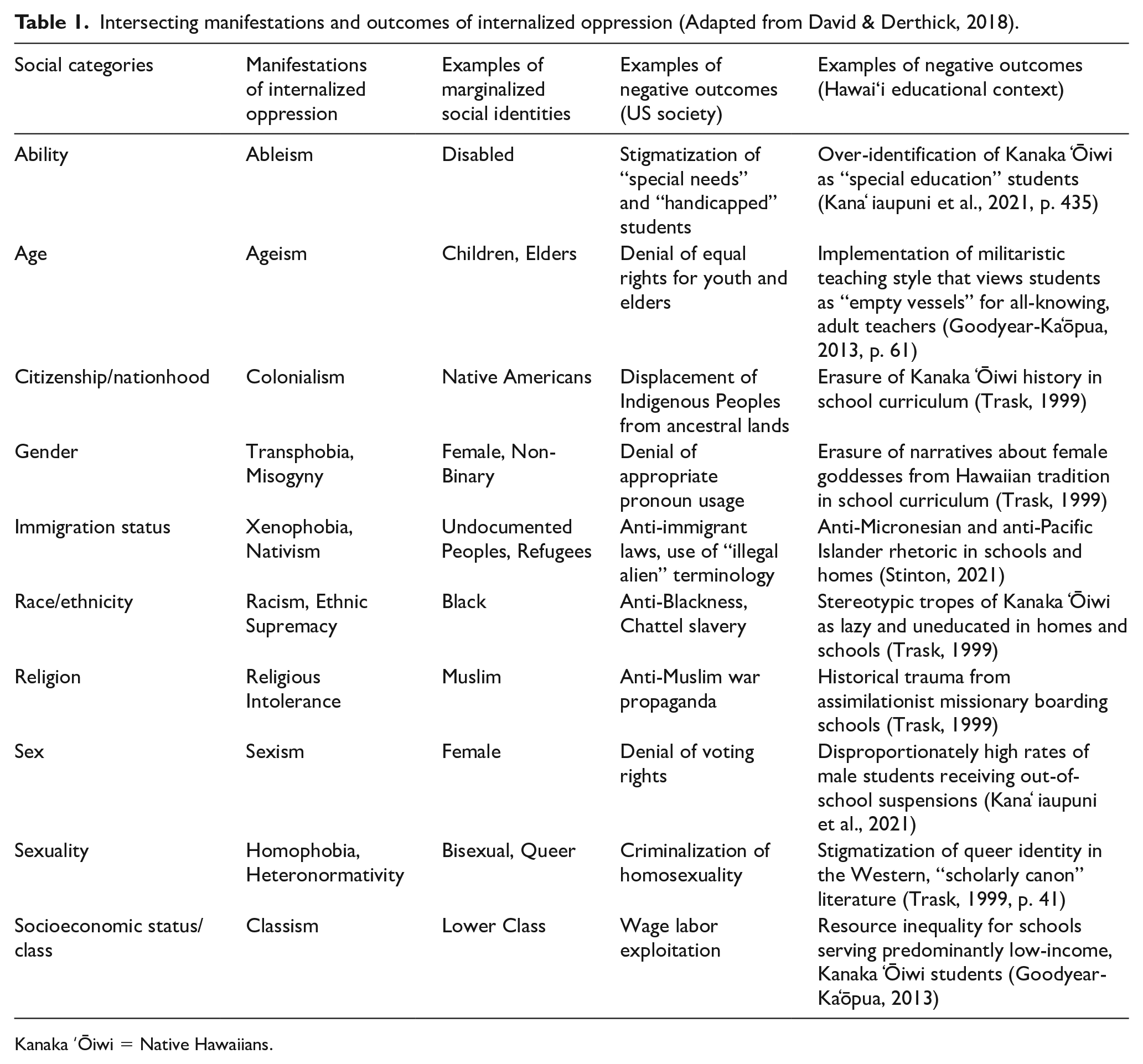
Kanaka ʻŌiwi = Native Hawaiians.
Consequently, internalized oppression persists because it disguises itself as healthy soil to the unsuspecting eye. It insists that the USA is a land full of equal opportunity and meritocracy (Dunbar-Ortiz, 2021) by purposefully upholding settler colonialism, a structural project that eliminates and replaces Indigenous histories and cultures (Wolfe, 2006). It persuades us to see the world as post-racism and post-sexism even though we are living during a time when Civil Rights legislation is being overturned or intentionally ignored. As its manifestations intersect and accumulate over time, internalized oppression continues to produce devastating psychological and physiological consequences, including lower educational and career aspirations, higher levels of hopelessness and stress, and earlier deaths among those with subordinate social identities (David et al., 2019). In effect, internalized oppression violently harms people.
Uncovering the origins of Hawai‘i’s unyielding nature by historicizing and contextualizing internalized oppression
In Ralph Ellison’s novel Invisible Man (1952), the Black American male protagonist faces an identity crisis that he links to chattel slavery in the USA. Here, Ellison demonstrates the importance of analyzing history to contextualize the modern problem of internalized racism among the Black American community. In this section, a historical analysis is similarly applied to identify the ideological root causes of internalized oppression in Hawai‘i. Beginning with the assumption that Kanaka ʻŌiwi did not experience foreign oppression in pre-contact civilization (Trask, 1999) and moving chronologically from Western settlement, this section exposes oppressive discourse about Kanaka ʻŌiwi to understand how the seeds for internalized oppression were sown in Hawai‘i. Through this analysis, it is evident that the phenomenon is an outcome of the introduction of settler colonialism and White supremacy, defined as a social, psychological, and cultural lie that positions Whiteness as the unobtainable goal for People of Color (Coates, 2017), in the islands.
Shortly after Captain Cook’s arrival in 1778, numerous aspects of pre-contact Indigenous civilization drastically changed due to the influx of British-American settlers, the spread of new illnesses, and the dismantling of the Kapu (Pre-colonial Native Hawaiian religious system) (Malo, 1951). For the first time in Hawaiian history, Kanaka ʻŌiwi were made to feel like second-class citizens in their lands (Trask, 1999). In personal journals, Cook and his companions describe Native Hawaiians as heathens and “poor wretched/unhappy beings,” shaping early perceptions about Pacific Islanders as less civilized than White, Christian citizens (Ellis, 1784, pp. 75–76). Similarly, in his account of pre-modern life in Hawai‘i, William Ellis (1833), a British missionary, condemned Pele, a revered goddess of volcanoes and fire, in favor of the Christian deity Jehovah and called those who prayed to Pele “idolatrous and wicked” (p. 310). In essence, this extended contact between Kanaka ʻŌiwi and predominantly White, Christian men brought White supremacy and settler colonialism to Hawai‘i and introduced toxins into the soil.
Consequently, a belief in the perceived inferiority of Kanaka ʻŌiwi and the superiority of the colonizers began to circulate. While the settler population steadily increased between 1778 and 1823, the Kanaka ʻŌiwi population declined by up to 80% during the same period due to a lack of immunity to foreign diseases such as smallpox and syphilis (Kashay, 2008). As Kanaka ʻŌiwi became conflicted over the power of their gods to protect them, missionaries capitalized on these fears, repeatedly attacking their ways of life as barbarous and sinful (Kalākaua, 1888). Many Kanaka ʻŌiwi converted to Christianity and learned how to read and write in English and Hawaiian, gaining favor among the settlers (Malo, 1951); however, in the eyes of the colonizers, Kanaka ʻŌiwi could not attain their elevated status. This ideology is evident in the writings of Nathaniel Emerson, a physician known for translating an account of pre-contact life in Hawai‘i by David Malo, a Kanaka ʻŌiwi historian (Lyon, 2011). In the introduction to Malo’s (1951) Hawaiian Antiquities (Moʻolelo Hawaiʻi), Emerson writes, “As a writer David Malo was handicapped not only by the character and limitations of the language which was his organ of literary expression, but also by the rawness of his experience in the use of the pen” (p. 14). Emerson goes on to note that Hawaiian speech contains “evolutionary weaknesses,” communicating a belief in the language’s subordinate status to English (Malo, 1951, p. 14).
This perceived dominance of Western culture created negative political and cultural outcomes for Kanaka ʻŌiwi. In 1893, Protestant missionaries and US businessmen used gunboat diplomacy to seize political power from the Hawaiian monarchy, which they decried as illegitimate and primitive (Iyall Smith, 2006). Three years later, members of this White, male government banned vernacular instruction in a bid to weaponize education and advance imperial goals (Snyder-Frey, 2013). As a result, this systematic push to colonize Hawai‘i “resulted in the suppression and near extinction” of Hawaiian ways of knowing and being (Lucas, 2000, p. 145). In 1959, the colonial government declared Hawai‘i a state, deepening the harm to the Lāhui, which continued to experience aggressive assimilationist tactics. By the late 20th century, fewer than 50 Native children spoke Hawaiian (McCarty & Nicholas, 2014; Silva, 2004). In effect, Kanaka ʻŌiwi became an involuntary minority in their ancestral homelands.
As Osorio (2017) asserts, to understand how Hawai‘i became unyielding for Kanaka ʻŌiwi, we must look to this dark history as a source of modern physical, spiritual, and psychological oppression. Inspired by Solórzano and Pérez Huber’s (2020) “abridged history of racism in the United States” (p. 26), which quantifies the periods of legalized enslavement, Jim Crow segregation, and modern re-segregation in US society, Figure 1 depicts the legacy of White supremacy and colonialism in Hawai‘i to identify them as the ideological root causes of contemporary internalized oppression. By dividing the 245 years since contact into 3 periods and quantifying each as a percentage of time that Kanaka ʻŌiwi spent navigating life in an ever-changing Hawai‘i, Figure 1 is also used to theorize the impact of different policies and practices that the US government implemented to justify and enact its cultural genocide of Indigenous Peoples (Trask, 1999).
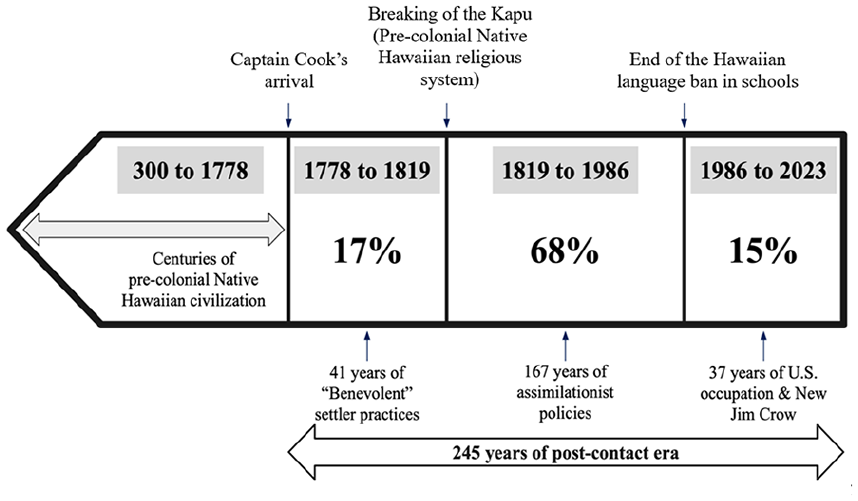
An abridged history of White supremacy and settler colonialism in Hawai‘i (Adapted from Solórzano & Pérez Huber, 2020).
Although pre-colonial civilization constitutes the longest period in Hawaiian history, the post-contact era represents the ongoing legacy of historical trauma. From 1778 to 1819, the early settlers adopted “benevolent” practices to infiltrate Kanaka ʻŌiwi families and communities under the guise of scholarly inquiry about an exotic people (Dunbar-Ortiz, 2014, p. 11) and a savior complex burdened by a call to save their “immoral” characters (Ellis, 1833, p. 33). American missionaries preyed upon Kanaka ʻŌiwi children and their close-knit family network systems, converting young boys through a religious schooling system that called on Kanaka ʻŌiwi to abandon their cultural ties to family and the land (Arista, 2019). This 41-year period thus represents the initial planting of the seeds of perceived subordinance by the settlers.
Between the breaking of the Kapu in 1819 and the overturn of the Hawaiian language ban in 1986, Kanaka ʻŌiwi spent 167 years navigating antagonistic assimilationist policies similar to those striving to “kill the Indian, save the man” in the North American tribal context (Dunbar-Ortiz, 2014, p. 151). This corresponds to 68% of the post-contact period spent encountering overtly prejudiced messages about their people and culture. Western missionaries and scientists told them their creation stories were myths and their deities were false (Fornander, 1919). Formal educators believed they “lacked the physical and mental vigor for advanced work,” (Dyke, 1909, p. 424) resulting in separate compulsory schools for Kanaka ʻŌiwi designed to assimilate them through “identity-alteration methodologies” that included the renaming of Kanaka ʻŌiwi children and youth with Protestant Christian, English names (Newland, 2022, p. 7). Subsequently, during this period, seven federal residential boarding schools with militarized pedagogical practices were established across Hawai‘i to separate Kanaka ʻŌiwi students from their families and forcibly strip them of their Indigenous heritage. By quantifying this assimilationist period, the story of how internalized oppression came to contaminate Hawai‘i’s soil becomes clear. For Kanaka ʻŌiwi, 167 years of being immersed in overt discourse about perceived mental, physical, and spiritual deficiencies certainly yielded psychological responses that influenced how they felt about themselves and others (Poupart, 2003).
Today, Kanaka ʻŌiwi live in an ongoing period of US occupation characterized by displacement and erasure. Although English and Hawaiian are both official languages in Hawaiʻi, English is the primary language used for government, diplomacy, and business in state affairs, perpetuating the legacy of foreign dominance (Lucas, 2000). While Hawai‘i experienced its own Civil Rights era during the late 20th century, many of the “progressive” social changes across institutions have since reverted to their discriminatory ways (Bonilla-Silva, 2022, p. 22). Aptly named the New Jim Crow by scholars, this current period is demarcated by de facto stratification bolstered by the remnants of legal separation and fatalist beliefs in the permanence of our hierarchical realities (Bell, 1992; Solórzano & Pérez Huber, 2020). Even though this 37-year period constitutes the shortest amount of time in the post-contact era, it greatly impacts contemporary Kanaka ʻŌiwi, the involuntary inheritors of historical trauma.
The State of Hawai‘i is thus unyielding for Kanaka ʻŌiwi individuals, families, and communities because they pose a threat to settler claims to territory and power. However, the state no longer needs to rely on formal, de jure policies to accomplish its goals. Internalized oppression can re-direct blame and silence opposition (Kippen, 2023). As Memmi (1965) contends, once the colonized adopts the colonizer’s “values, he similarly adopts his own condemnation. To free himself, at least/so he believes, he agrees to destroy himself” (pp. 165–166). To this end, as long as White supremacy and settler colonialism exist, modern Kanaka ʻŌiwi will be born into a world with tainted soil.
Theorizing a Kanaka ̒Ōiwi-centered conceptual framework for internalized oppression and resistance
Needless to say, the effects of living in an unyielding society are manifold for Kanaka ʻŌiwi today. Since Western contact, Hawai‘i experienced a surge in development and subsequent demand for an elaborate tourist industry, resulting in cultural exploitation and the ongoing displacement of Kanaka ʻŌiwi from their homes due to inflating housing prices and costs of living (Kanaʻiaupuni et al., 2021). This negative reality is also evident in the disparate outcomes for Native Hawaiians across multiple social institutions in Hawai‘i, including achievement gaps in K-12 education and disproportionately high incarceration and arrest rates compared with other major ethnic groups in Hawai‘i like Japanese and Filipino residents. Similarly, the state of the Lāhui’s health and wellness is an area of concern, with increasing attention on higher rates of mental health illnesses, cancer incidence, and obesity cases. As theorized, pervasive and intersecting social hierarchies continue to shape the ability for Kanaka ʻŌiwi to navigate Hawai‘i’s economic, education, health care, and political systems.
In this section, contemporary examples of internalized oppression are presented before a Native Hawaiian-centered conceptual framework is offered to contextualize internalized oppression and resistance among Kanaka ʻŌiwi. Through the incorporation of Hawaiian language terminology and lived experiences of Kanaka ʻŌiwi youth and critical Hawaiian scholars, a nuanced portrait of internalized oppression and resistance within the Lāhui emerges, reflecting a need for culturally responsive frameworks for practitioners and future empirical studies on the phenomena’s impact on contemporary Kanaka ʻŌiwi ʻohana.
One particularly distressing consequence of the legacy of settler colonialism and White supremacy in Hawai‘i is the internalization of deficit-based messages that frame “Native Hawaiians as part of a problem and as something broken in need of fixing” (Aluli Meyer, 2004, p. 86). In an essay for a senior English class, one Kanaka ʻŌiwi student questions where the Hawaiian race lost “such intellect” due to higher unemployment rates and lower college completion rates when compared with their non-Native peers (Jenkins, 2017, para. 3). Though the essay identifies the brilliance that exists within the Lāhui, it also labels Kanaka ʻŌiwi youth as “lost,” “blinded,” and “culturally dead” (para. 2). This perspective is similar to that of another student, who misattributes the experiences of Kanaka ʻŌiwi peers experiencing housing insecurities as a drug abuse issue (Tsutsumi, 2020, p. 16). Perhaps most disheartening is the overarching theme in a memoir about a Kanaka ʻŌiwi boy from a rural part of Oʻahu who achieved personal success by becoming a doctor: the idea that such “success” is Kanaka ʻŌiwi exceptionalism, not the status quo (McKinney & Puana, 2014).
In addition to this harmful view of self, deficit-based messages of other groups have been internalized and reinforced through dominant social discourse. Studies on the educational experiences of Filipino and Black youth in Hawai‘i identify Kanaka ʻŌiwi students as the perpetrators of ethnic stereotypes and slurs (Labrador, 2018; Viernes, 2014). In Lois-Ann Yamanaka’s (1997) semi-autobiographical children’s novel Wild Meat and the Bully Burgers, the protagonist Lovey Nariyoshi, a Japanese girl from Hilo, is verbally attacked by Kanaka ʻŌiwi peers who use racial slurs from the Internment era. Recently, many Kanaka ʻŌiwi supported Honolulu police officers who shot and killed Iremamber Sykap, a 16-year-old Micronesian boy caught driving a stolen car in 2021, blaming the teenager for failing to assimilate and his culture for leading him to criminal behavior (Stinton, 2021). This rhetoric that criticizes Micronesian culture is evident in comments by readers on an online post following Sykap’s death and the subsequent public debate on police involvement, some of which label Pacific Islanders as “deficient” (Hofschneider, 2021, “Comments” section, “Kandyman” comment, para. 5) and lacking in “cultural intelligence to do well in a western society” (Hofschneider, 2021, “Comments” section, “basic_citizen” comment, para. 7).
Among these disconcerting examples of negative intragroup and intergroup relations, one common thread is the attention to the significance of one’s family. The student perspectives on the “poor” choices of Kanaka ʻŌiwi youth assert that the Lāhui’s educational and social issues stem from communities (Tsutsumi, 2020, p. 16). The Kanaka ʻŌiwi doctor’s success is framed as a “rags-to-riches” story despite his upbringing in a household where the children “all sucked in school” (McKinney & Puana, 2014, p. 52). Even Lovey recognizes the effect that her family has upon her when her teacher reprimands her for speaking Pidgin—Hawai‘i Creole English, admitting, “the sound, the sound from my mouth, if I let it rip right out the lips, my words will always come out like home” (Yamanaka, 1997, p. 13). Home, as the commenters on online articles about Sykap’s murder note, is where important beliefs, attitudes, values, and behaviors are taught and learned.
While unyielding soil may have seeped into our families, nutrients continuously combat these toxins. In an op-ed, a Kanaka ʻŌiwi college student, recalls a conversation with her grandma about their Hawaiian identity and her disapproval of her Hawaiian studies major (Sarsona, 2021). Although her grandma voiced her support of US imperialism in Hawai‘i, the student recognized the remarks “came from generations of being told that our language and our practices were wrong” (para. 4). However, she did not hesitate to share her love for Hawaiian language with her. Years later, the student’s grandmother opened herself back up to the language and asked more questions about community protests and events at her institution. It was then that she recognized that she and her grandma learned and unlearned “what it means to be Hawaiian” (para. 5). This family moʻolelo (story) thus conveys the power of resistance, defined as a mode of discourse that critiques domination and hierarchy and “provides theoretical opportunities for self-reflection and struggle in the interest of social and self-emancipation,” (Giroux, 1983, p. 290) and demonstrates how widespread social change begins with families.
Although this article is situated within a broader history of inquiry about internalized oppression and resistance, it establishes contextual boundaries by introducing a conceptual framework grounded in Kanaka ʻŌiwi ways of knowing and being. In truth, existing scholarship fails to consider the possibility of dissonance between Indigenous and non-Indigenous definitions of internalized oppression, so this framework reflects an intentional move to respect the terms that Kanaka ʻŌiwi scholars have used to understand their contemporary lives. Therefore, in the following two sections, internalized oppression and resistance are operationalized as huikau (confusion) and kūʻē (to oppose, protest, resist), respectively.
Internalized oppression as huikau
A social psychological perspective that attends to boundaries in group membership recognizes that “being Hawaiian is ultimately about not wishing to be anything else” (Osorio, 2006, p. 23). While this conclusion seems intuitive, it does not account for the cumulative consequences of holding identities that are simultaneously politicized, racialized, and socialized today. For Osorio (2006), differences in beliefs and understandings over what it means to be Kanaka ʻŌiwi as opposed to US American are best characterized as huikau.
Huikau is an appropriate term to contextualize the phenomenon of internalized oppression in the Kanaka ʻŌiwi context because it similarly describes a learned process, state, and action. Through their immersion in intersecting social hierarchies, Kanaka ʻŌiwi are socialized to “believe they [have] no right to live and work on the land” (Osorio, 2006, p. 21). They submit to colonial scripts of how to be Kanaka ʻŌiwi based solely on ancestry or cultural and linguistic authenticity (Snyder-Frey, 2013). As a result, Kanaka ʻŌiwi may enact huikau by making choices that uphold Western knowledge systems instead of our own. Although it is problematic to dichotomize “being Hawaiian” as right or wrong (Osorio, 2006, p. 23), some individuals and families possess a strong sense of belonging to and affiliation with Native Hawaiians but are unwilling to recognize or unaware of systems of oppression in which they are immersed (McCubbin, 2003; Salzman & Laenui, 2014). For that reason, Kanaka ʻŌiwi in a state of huikau may self-identify as Hawaiian and articulate discourse that perpetuates negative relations with Hawaiians and other groups (Kawano, 2023).
Like internalized oppression, huikau has been linked to settler colonialism and White supremacy. Sumida (2011) argues that huikau is the result of historical trauma due to the suppression of Hawaiian language, Hawaiian culture, and identity. In her study on elementary students attending a culture-based school, she names colonial classrooms as spaces where huikau is formed because children are encouraged to sever their connections to mind, body, and spirit. Similarly, Silva (2004) suggests that huikau among Kanaka ʻŌiwi began to spread by the mid-19th century due to the introduction of colonial capitalism across the islands. As foreigners began displacing Hawaiians and seizing land, Indigenous perceptions about morality and justice began reflecting Western interpretations, causing confusion over what it means to live according to the principles of pono (balance, fair, proper) and kuleana (responsibility, right).
Furthermore, huikau among contemporary Kanaka ʻŌiwi is connected to ʻohana (family) and everyday discourse. In her family moʻolelo, Sarsona (2021) includes her grandmother’s positive view of imperialism through the belief that US colonialism is better than colonization by other foreign nations like Japan. In another editorial, a pastor working at a Native Hawaiian-serving institution was quoted during a chapel service, saying “Hawaiian culture is a part of me. But Christianity defines me” (Deenik, 2020, para 3). Though these Kanaka ʻŌiwi are proud of being Native Hawaiian, they also identify as US American and Christian due to their familial and educational upbringing. This rhetoric reflects internalized colonialism and subsequently huikau through the belief that long-term imperialism benefits the health and well-being of Indigenous Peoples.
These examples raise an important justification for the use of huikau over internalized oppression when referring to the Lāhui specifically. That a Native Hawaiian can simultaneously be a self-identifying Kanaka ʻŌiwi who is proud of his heritage and a supporter of settler colonialism is clear evidence of confusion. This is a predictable outcome of “more than 100 years of American-centric, assimilatory education that has aimed to change the way we live and see ourselves in relation to our land, our history, and our country” (Goodyear-Kaʻōpua et al., 2008, p. 156). Thus, salient Native Hawaiian identities may develop among contemporary Kanaka ʻŌiwi, but due to the pervasive nature of settler colonialism and White supremacy, they are affected by psychological confusion over the social worth of that identity and the commensurability of assimilation with cultural genocide (Chopra, 2021; Dunbar-Ortiz, 2014). While an internalized oppression framework may label a student’s proud self-identification as Kanaka ʻŌiwi as an adaptive response to maintain ingroup pride in the face of settler colonialism (Chopra, 2021; Williams, 2012), huikau is better suited to recognize the dissonance between identity-related beliefs and actions. Furthermore, it is culturally responsive to the language that may be spoken in Kanaka ʻŌiwi communities and cognizant of the methodological harm that can be invoked when injecting academic talk on “oppression” into everyday discourse with Indigenous Peoples (Tuck, 2009, p. 413). For these reasons, when discussing manifestations of internalized oppression that are specific to the Kanaka ʻŌiwi context, huikau is used moving forward.
Resistance as kū̒ē
Even though Hawai‘i has transformed into an unyielding place with pervasive social hierarchies that have become naturalized and internalized among individuals and families in the Lāhui, Kanaka ʻŌiwi have always been resilient and resisting. From public protests against the illegal overthrow and US annexation to verbal references to the contiguous USA as the “continent” and not the mainland, (Trask, 1999, p. 15) resistance is a complex term that encompasses a wide spectrum of cultural, philosophical, and spiritual thoughts and actions that may be politicized and socialized. In critical Hawaiian literature, resistance has been linked to notions of survivance (Saffery, 2019), cultural resilience (Cristobal, 2018), political resurgence (Goodyear-Kaʻōpua, 2018), educational sovereignty (Goodyear-Kaʻōpua, 2013), and praxis, defined as “a sense of agency via reflection and the continuous application of insights” (Trinidad, 2011, p. 188). Lived experiences similarly reveal multiple definitions of resistance according to divergent interpretations of what it means to be Hawaiian and to live as Hawaiians (Osorio, 2001). Therefore, I propose to use kūʻē in place of resistance to capture these nuanced understandings and behaviors.
Kūʻē is a historically significant term to characterize resistance because of its association with the 1897 Anti-Annexation petitions that sought to protect the Hawaiian Kingdom from the US government (Osorio, 2017; Silva, 2004). It has also been associated with the Hawaiian Renaissance movement of the 1970s, which notably involved mass resistance against foreign development and military occupation, as well as protests in the early 2000s for the inclusion of Hawaiian curricula and pedagogy in K-12 and higher education institutions (Goodyear-Kaʻōpua, 2013). Kūʻē recognizes purposeful action for public causes is the result of increased awareness about the nature of oppression, what Freire (1970) and other critical pedagogues (hooks, 1994; Solórzano, 1989) and social psychologists (Chopra, 2021) refer to as a critical consciousness. For Kanaka ʻŌiwi, a capacity to kūʻē may develop through ancestral wisdom. In response to a question on whether or not Hawaiian language should be added to official state reports and plaques at the Capitol in Honolulu, Ifit Hoppe-Cruz, then a high-school sophomore who participated in a televised student panel, said: I will be satisfied when the values, the values of the Hawaiian language are used in the government. . . . All of these different things, all of these issues that we’re facing right now, the climate crisis, patriarchy, you know all of this can be countered through, not necessarily a return, but a revitalization, as some people are saying, of Hawaiian . . . ʻike kūpuna [ancestral knowledge] and ʻike Hawaiʻi [Hawaiian knowledge], and, you know, just aloha [love]. (Up-late ʻŌpio Panel: Legislative Edition, 2021, 1:13:17)
Through this student’s words, it is evident that ancient wisdoms can be harnessed to name settler colonialism and White supremacy, expose the US education system as “a site of contention,” and guide the formation of kūʻē (Chang, 2016, p. 249). By learning about Hawai‘i’s history, Kanaka ʻŌiwi may come to “recognize our own enslavement to the dominant cultures of colonial masters” and “free ourselves from the straight jacket of viewing the world” from a settler perspective (Helu-Thaman, 1991, p. 18).
Like activism and praxis, kūʻē takes multiple forms. Kanaka ʻŌiwi engage in a psychological form of kūʻē by viewing oppression as separate from themselves and refusing to articulate discriminatory language that targets ingroups and outgroups (Banks & Stephens, 2018). Cultural, social, and political forms of kūʻē are enacted through the privileging of critical philosophies (Allen et al., 2001; Hughes, 2016) and Kanaka ʻŌiwi knowledge principles (Saffery, 2019; Trinidad, 2011) in homes and schools. Although people may only think of kūʻē, activism, and praxis in highly politicized, nationalist, and public contexts, they also take spiritual forms and occur in private settings. Thus, Kanaka ʻŌiwi may hold beliefs, attitudes, and values that reflect kūʻē and articulate them through personal forms of discourse like journaling (Kaufka, 2009).
While huikau is the result of miseducation into intersecting social hierarchies, kūʻē is an outcome of learning to reject those hierarchies. Unless we are taught to externalize oppression and to recognize individual differences among ingroups and outgroups, we allow society to govern our perceptions about the world before we see or experience them for ourselves (Lippmann, 1922). Therefore, the relationship between identity and education plays a key role in the development of kūʻē. As K-12 students observe familial behaviors that challenge oppression, they may interpret these actions and learn to “combat systemic, domestic, and personal” prejudices “in developmentally appropriate ways” (Anderson & Stevenson, 2019, p. 65).
To this end, huikau and kūʻē are conceptualized as mutually opposing but not mutually exclusive constructs. They produce different outcomes for Kanaka ʻŌiwi but take similar forms. Given the numerous manifestations of internalized oppression and the pervasive nature of intersecting hierarchies in Hawai‘i’s society, it is possible for Hawaiians to kūʻē publicly while deconstructing huikau privately. While many Kanaka ʻŌiwi kūʻē today, it is also likely that huikau remains embedded in their everyday lives.
Applying the conceptual framework and creating a vision for social change through kū̒ē and ‘ohana
In response to advice from community elders on the importance of healing the ʻohana before pursuing broader change across communities and the Lāhui (Kawai‘ae‘a et al., 2018), this final section offers a family-centered vision for social change as a potential solution to widespread huikau. In Kanaka ʻŌiwi tradition, the ʻohana is placed at the center of culturally responsive ecological models that argue a healthy Hawaiian identity is achieved through sustainable relationships with ʻohana, community, nation, and ʻāina (land), illuminating a proposed trajectory for social change through interconnections among ʻohana and communities (Kūkulu Kumuhana Planning Committee, 2017; McCubbin & Marsella, 2009; McGregor et al., 2003). These models follow Indigenous ways of defining family through kinship networks that transcend heteropatriarchal, colonial notions of “blood” relations, thereby recognizing “not just our immediate relations, but also those who show up and reciprocate love, respect, and are responsible for one another” (San Pedro, 2021, p. 192). Therefore, it is a culturally responsive decision to ideate a family-centered vision of social change because they represent the building block of Native Hawaiian society (Kanaʻiaupuni, 2004). Moreover, it follows that the familial relationship that Kanaka ʻŌiwi have to ʻāina ensures that a healthy and thriving nation will love, care, and protect their ancestral homeland for future generations.
Even though contemporary ‘ohana are more diverse ideologically and politically than those of the pre-contact period (Paglinawan et al., 2020), Native Hawaiian families often guide the process of learning what it means to be Hawaiian (Cristobal, 2018). Accordingly, individual Kanaka ʻŌiwi identities are intimately connected to those of their ʻohana. Indeed, for Kanaka ʻŌiwi students, the likelihood of Hawaiian identification increases with a greater connection to and support from ʻohana (Crabbe, 2002; Kanaʻiaupuni, 2004). Similarly, a critical race psychological perspective names families as key contributors to the development of identity-conscious schemas, which may lead to the labeling of certain identities as privileged and superior over others (Salter & Adams, 2013) as well as the reproduction of naturalized social hierarchies of age, class, gender, race and ethnicity (Collins, 1998).
Despite the ongoing impact of cultural assimilation and the disintegration of interdependent, subsistent family units from pre-contact civilization (Trask, 1999), Kanaka ʻŌiwi families may hold the key to collective social change and the uprooting of unyielding soil. Native Hawaiian epistemologies support this assumption by viewing families as the center of individual well-being and the “future of Hawaiian people and our culture” (Paglinawan et al., 2020, p. 16). Consequently, it is possible that everyday enactments of kūʻē by Kanaka ʻŌiwi youth not only reflect those of their close family members but also demonstrate the capacity for family beliefs, attitudes, and practices to extend to community members and eventually, the Lāhui. This revelation about the mana (ancestral, spiritual power) of Native Hawaiian ʻohana to transform society is perhaps the most endearing message of Goodyear-Kaʻōpua’s (2013) The Seeds We Planted. The historic creation of Hawaiian-focused charter schools at the turn of the 21st century reflected the collective capacity for Kanaka ʻŌiwi families and communities to mobilize and kūʻē for their right to equitable, culturally responsive schooling. This reality was also evident during the Lāhui’s 2019 mobilization atop Maunakea, a sacred mountain on Hawai‘i Island, against the planned construction of a 30-m telescope. Though Native Hawaiian families from Honokaʻa, a rural community on the Northeast side of Hawai‘i Island, spearheaded initial protests as early as 2012, the movement spread across communities on Hawai‘i Island before turning into a multigenerational, interisland, national, and global event that united Indigenous peoples and allies toward a common goal for social and environmental justice.
To this end, a future is envisioned in which manifestations of kūʻē are more common than those indicative of huikau using the ancestral metaphor of a Kanaka ʻŌiwi family as a kalo (taro) plant. In Figure 2, the ʻohana is represented as a single kalo plant nested within a loʻi kalo (taro patch). These kalo share resources and nutrients to grow collectively, paralleling the interdependent relations that Kanaka ʻŌiwi families have with one another according to cultural, geographical, and generational connections (McDowell et al., 2005). When various loʻi kalo are viewed through a collective lens, they form a loʻi kalo farm, which represents the Lāhui and its genealogical connection to ʻāina. Through this conceptualization, the intertwined nature of ʻohana explicates how they shape and are shaped by communities. In this way, the ʻohana is a microcosm of the Lāhui. Discourses that reflect huikau and kūʻē among ʻohana are likely to circulate across families and communities. Furthermore, potential disruptions to such discourse in families via kūʻē may generate widespread social change against huikau. It is thus imperative for educators and practitioners working with Native Hawaiian families not only to recognize symptoms of huikau in everyday discourse but also to contribute to the growing movement of critical consciousness-building efforts that empower Kanaka ʻŌiwi to name the root causes of their oppression and enact their capacity for kūʻē so that our collective vision for a more equitable, culturally responsive future becomes our present reality.
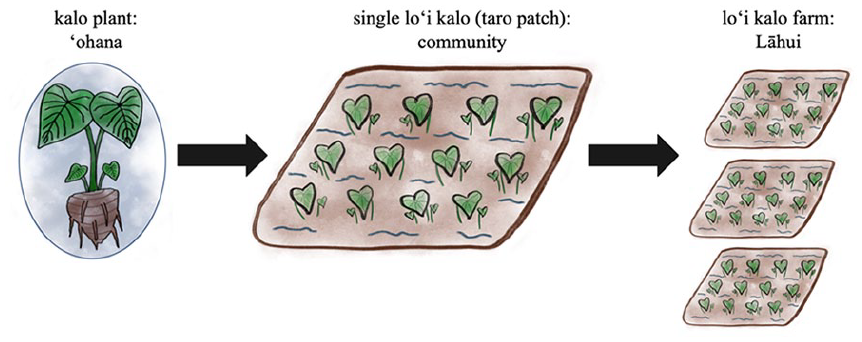
A Kanaka ̒Oiwi theoretical perspective of ̒ohana, community and Lāhui.
Conclusion
In this article, huikau was theorized and contextualized within the Lāhui and a conceptualization of kūʻē was provided as a possible solution to challenge huikau among Kanaka ʻŌiwi. Moreover, the role that the Native Hawaiian family may play in generating widespread social change in the Lāhui was uplifted to parallel calls to action as Indigenous scholars like Poupart (2003), who recognizes “we must struggle to understand violence as a form of genocide that we recreate within our families and communities as we are now oppressors unto ourselves” (p. 95). Collectively, this article represents the foundation of a moʻolelo that counters the protagonist’s fatalistic conclusion in Morrison’s The Bluest Eye (1970). Even though Claudia comes to realize she “did not plant the seeds too deeply,” she laments that “it doesn’t matter. It’s too late” (Morrison, 1970, p. 206). We must reject that thinking and imagine a future created by and for us using the knowledge and tools that our ancestors have already gifted us. These are the true seeds that we must water and protect. As long as Kanaka ʻŌiwi speak up and speak back to the hostile earth, the seeds we planted will grow. It is not too late for us to unlearn the hate we have internalized if we are willing and able to learn.
Footnotes
Acknowledgements
I acknowledge my grandmother Laura Kauakahekili Kealoha Tauʻa (née Hokoana) for inspiring this article through her complex experiences with huikau and kūʻē. I carry you with me as I continue learning and unlearning. I also acknowledge Daniel Solórzano, Lali McCubbin, Ananda Marin, and Robert Teranishi. Mahalo piha.
Author’s note
Declaration of conflicting interests
The author declared no potential conflicts of interest with respect to the research, authorship, and publication of this article.
Funding
The author received no financial support for the research, authorship, and publication of this article.

Glossary
ʻāina land
aloha love
huikau confusion
ʻike kūpuna ancestral wisdom
ʻike Hawai‘i Hawaiian wisdom
kalo taro
Kanaka ʻŌiwi Native Hawaiian, Native Hawaiians
Kapu Pre-colonial Native Hawaiian religious system
kūʻē to oppose, protest, resist
kuleana responsibility, right
Lāhui Hawaiian people, nation
loʻi kalo taro patch
mana ancestral, spiritual power
moʻolelo story
ʻohana families, family
ʻōpio youth
pono balance, fair, proper