



Abstract
This article shares findings from evaluating a mentoring programme for Aboriginal youth on Yorta Yorta (an Aboriginal Tribal nation, north-eastern Victoria and Southern New South Wales, Australia) Country. This work is positioned in First Nations worldviews that are relational and require deep listening to youth, mentors, Elders, Country, and Ancestors. Applying a qualitative participatory action research design, methods involved attending camps on Country and research Yarning Circles. The findings demonstrate that Aboriginal mentoring programmes need to be led in their delivery and evaluation by First Nations peoples. This ensures that the programmes are culturally embedded in First Nations worldviews and that important interpretations of meanings are not overlooked. On Country experiences are a place for healing and learning. Country is a stakeholder in Aboriginal mentoring programmes. A trusting mentoring relationship creates a space where youth become part of an Aboriginal community, and where they feel strong in their identity.
Introduction
Positioning of the study
The authors pay tribute and respect to Country and First Nations peoples. The article was written on unceded Aboriginal land. We use the word Aboriginal to reflect a broader perspective; in Australia, many Nations and Communities have different traditions, cultures, languages, and lived experiences (Bennett & Gates, 2019). When we refer to Aboriginal peoples, we refer to the First Peoples of what is now called Australia and acknowledge the homogeneous notions of identity. Relational worldviews inform our research, we exist as and through our relationships with Aboriginal youth, Elders, mentors, the Knowledges that participate in this research, and with Yorta Yorta (an Aboriginal tribal nation, north-eastern Victoria and Southern New South Wales, Australia) Country (Barlo et al., 2021). To support our relational accountability (Steinhauer, 2002), we will introduce ourselves: Dr Mishel McMahon (A1) is an Aboriginal researcher and Yorta Yorta woman, Michael Chisholm (A2) is a Gamilaraay (an Aboriginal nation located in the north-western plains of New South Wales, Australia) and Yuin (an Aboriginal nation from the South Coast of New South Wales, Australia) man, Dr Werner Vogels (A3) is a White man from the Southern Netherlands, and Dr Corina Modderman (A4) is a White woman from the Northern Netherlands, both living in Australia. Aldara Yenara (Leading the Way; the name of a youth mentoring programme) in Yorta Yorta language, is a proudly owned Aboriginal Corporation. The authors of the article comprise social work scholars as the first and last authors. The second author, employed in First Nations secondary student services, and the third author, a psychologist, are both affiliated with La Trobe University and employed during the project as researchers. All four authors are critical of practice and research that continue to centre Western narratives about Aboriginal youth well-being. Initially, the last author received an invitation from the state government to lead this study. However, First Nations experiences lie beyond her, and third author, experiential understandings. Taking a critical standpoint and practicing cultural humility allowed the Dutch authors to engage with counter-colonial practices (Modderman et al., 2023). Dr Modderman and Dr Vogels acknowledge that they will always struggle to see beyond their Eurocentric lens.
The article uses First Nations use of English, and the following definitions of Country, Community, and Ancestors are those of the first author. Country, On Country, or the Bush, spelt in capitals includes the land, the seas, the waterways, the skies, animals, plants, rocks, the stars, and elements such as the wind and fire. Community, spelt with a capital refers to Aboriginal and Torres Strait Islander collective identities within their communities. Ancestors, spelt with a capital refers to Aboriginal and Torres Strait Islander Community members who have passed away, recently or many years ago, and may also be used to describe the spirit world.
This article presents findings emerging from the Aldara Yenara youth mentoring programme evaluation. This Aboriginal Corporation is focused on culturally appropriate healing. The evaluation by the La Trobe University in Shepparton was undertaken to understand the benefits of Aboriginal youth mentoring practices. Yorta Yorta Country is an area within regional Australia surrounding the junction of the Goulburn and Murray Rivers in present-day north-eastern Victoria and southern New South Wales. The programme is for all Aboriginal youth, regardless of their Nations, and they attend six cultural mentoring sessions and one On Country 3-day camp. The programme is funded through the state government department and young people are referred by statutory services, not-for-profit support programmes, or Community members.
Background
Mentoring has been used as an Aboriginal teaching process for thousands of years, and this learning process continues today. Collective group mentoring aligns with Aboriginal tradition, values, and beliefs. This practice involves developing trusting relationships that bring the youth together with Aboriginal mentors and Elders who offer guidance, support, and encouragement (Klinck et al., 2005; Youth Affairs Council Victoria, 2022). Aboriginal youth have the right to their culture and to an Aboriginal childhood (Black et al., 2023; McMahon et al., 2023). Transformational mentoring experiences enable youth to see themselves as positive contributors and cultural custodians, with mentors and Elders guiding the way to learning, sharing, and passing on culture (Black et al., 2023; McMahon et al., 2023). However, the available literature on mentoring Aboriginal youth is predominantly not Aboriginal-led and demonstrates limited understandings from First Nations perspectives. First Nations concepts for Aboriginal youth mentoring are frequently constructed using Western discourses with Western meanings (McMahon et al., 2023). For example, the relationship with Country may not be well understood in Western-informed mentoring programmes for Aboriginal youth. The available research shows a limited understanding of the complexities of collective identities and kinship (McMahon et al., 2023). As a result, mainstream mentoring models, as in the White Western dominant paradigm, may fail to offer the nuanced benefits that occur when Aboriginal youth hold a relationship to Country for their well-being.
A central tenet of First Nations relational worldviews is that all entities, including animals, the elements, Country, seasons, humans, the spirit world, Ancestors, and waterways, participate in a web-like relationship of oneness. Consequently, a sense of belonging to the whole lifeworld is a key element within Aboriginal worldviews (McMahon, 2017; Townsend & McMahon, 2021). Well-being informed by Aboriginal worldviews involves the individual’s physical, emotional, social, and cultural well-being within their collective community. This is strongly tied to Aboriginal peoples’ connection to Country and culture (Schaepe et al., 2017; Yap & Yu, 2016). Aboriginal mentoring programmes emphasise the growth of a strong cultural identity and the mental health, wellness, and healing of Aboriginal youth. Cultural identity can be defined as the knowledge of, and engagement with, belonging to aspects of Aboriginal culture, and philosophical ways of knowing, being, and doing (Snowshoe et al., 2017). Although the occurrence of group mentoring for Aboriginal youth is evident and frequently empowers and engages Aboriginal youth to be strong, healthy, and proud (Crooks et al., 2017; McMahon et al., 2023; Youth Affairs Council Victoria, 2022), there is limited understanding of the components which contribute to a positive mentoring experience for Aboriginal youth, conceptualised through First Nations-led practice and research. This article aims to understand and respect the contribution of Aboriginal knowledges to mentoring practices. This includes Aboriginal perspectives and processes for health and well-being that emerge as a unique discipline from First Nations Communities.
Methodology
This study is firmly anchored to the roots of First Nations worldviews, informed by Aboriginal ways of knowing, being, and doing (Barlo et al., 2021; Martin & Mirraboopa, 2003). Aboriginal researchers, mentors, Elders, and youth engaged in this research process draw upon their distinct ways of knowing, being, and engaging with Country to gather, reflect, share, and discuss culturally responsive youth mentoring practices (Martin & Mirraboopa, 2003; Rigney, 1999). First Nations research needs to be transformative; positive change must occur; Aboriginal Communities must gain a net benefit from all research (Bennett & Morse, 2023).
A qualitative participatory action research design enabled an emergent and iterative data collection and analysis process that aligns with culturally responsive research led by Aboriginal peoples (Mertens, 2008). Aboriginal knowledge systems support participatory practices that strengthen the well-being of culture and Community (Dudgeon et al., 2020). The study included two phases; a scoping literature review guided the study’s first phase that found that existing youth mentoring literature is dominated by Western understandings and perceptions (McMahon et al., 2023). The article presented here reports on the study’s second phase, including On Country reflections and Yarning Circles. Purposive sampling involved inviting Aboriginal youth, mentors, and Elders; working together through a collaborative process of planning, action, evaluation, and reflection to address the research question; and to better understand Aboriginal mentoring practices (Table 1). Data collection involved researchers (A1, A2, A3, A4) participating in two mentoring camps On Country followed by two Yarning Circles. One for Aldara Yenara staff and Elders and one for young people separately.
Who is involved with the programme evaluation?.
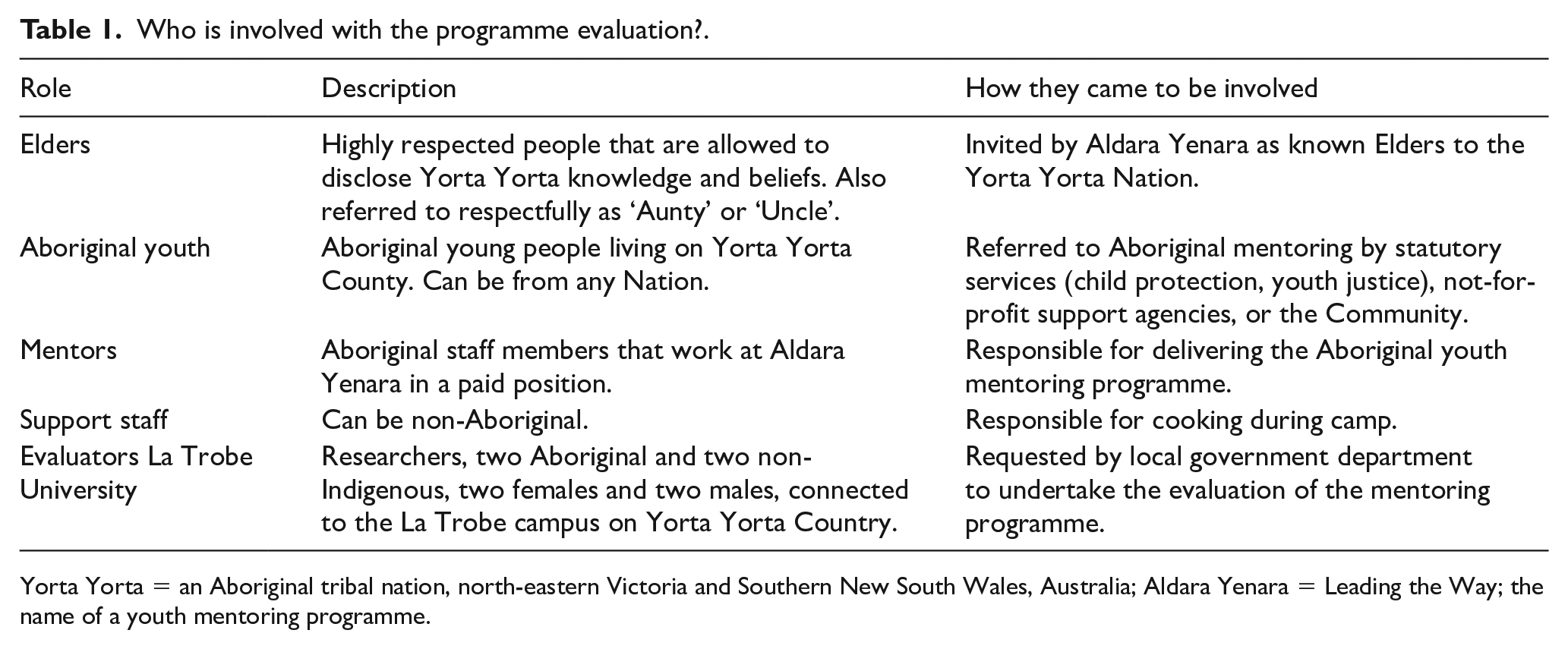
Yorta Yorta = an Aboriginal tribal nation, north-eastern Victoria and Southern New South Wales, Australia; Aldara Yenara = Leading the Way; the name of a youth mentoring programme.
Being On Country
At the girls’ camp, female researchers A1 and A4 joined five girls, four mentors, and two Elders. At the boys’ camp, male researchers A2 and A3 were present, in addition to six boys, four mentors, and one Elder. The location of the camp has significant cultural meaning to Yorta Yorta people. Staff, Elders, mentees, and their carers were informed about the research via information leaflets and in-person discussions before attending. Consent was discussed and signed by all staff, Elders, and mentees attending the camp; carers signed consent before the youth attended camp.
A notebook was used to record handwritten thoughts and experiences in a non-invasive manner to ensure the experience for mentees, mentors, and Elders were not affected and to optimise immersion and participation of the researchers during On Country camp activities. Reflections were not recorded in front of camp attendees; thoughts were written down a few days after camp. No identifiable information was recorded or described. During the activities, the researchers talked with Elders, youth, and mentors present at the camp and during the activities, for example, fishing and possum spotlighting. Researchers’ reflections were shared with youth and Elders in the evening during a Yarn around the fire. Researchers were absent in culturally restricted activities and sacred information about Aboriginal cultural mentoring was not shared with non-Indigenous researchers. A written report with reflections from all four researchers was shared with Aldara Yenara staff after the camp experience.
Yarning Circles
Two distinct Yarning Circles were held following the camp. One Yarn had six staff and two Elders, and one Yarn had 11 young people. As mentioned above, consent was discussed and signed with all involved, and carers/guardians gave consent before the young person participated, including permission to audio record the Yarning session. The Yarning methodology utilised here is grounded in Australian Indigenous ways of knowing, being, and doing (Kennedy et al., 2022; Martin & Mirraboopa, 2003). Yarning is a way of sharing knowledge structured by principles and protocols (Barlo et al., 2021; Kennedy et al., 2022; Terare & Rawsthorne, 2020). The Yarning Circle was led by an Aboriginal researcher (A1). Yarning has been identified as a rigorous and credible Indigenous cultural form of conversation, a way to share stories and explore narratives to gather information (Atkinson et al., 2021; Bessarab & Ng’andu, 2010). To answer the research question, to better understand and respect Aboriginal youth mentoring practices, Yarning, in addition to being On Country with young people, Elders and mentors, was found to be most suitable for gathering information through participants’ stories related to the research topic. The Yarn took place in a relaxed and interactive environment, next to being purposeful with a defined beginning and end. Each Yarn took about 2 hr (Bessarab & Ng’andu, 2010). Each of the Yarning Circles included an Acknowledgement of Country, cultural introductions, voicing respect to Elders during conversations, humour, careful consideration of body language, and prompt questions used by researchers to position Aldara Yenara staff and Elders as experts for the research topic. Food was offered during the discussions.
Data analysis
All field data—On Country camp reflections and Yarning Circles—were analysed using a type of analysis strong for First Nations-led research; Thematic Discourse Analysis (TDA) (Alejandro & Zhao, 2023), which includes thematic analysis techniques (Braun & Clarke, 2014; Graneheim & Lundman, 2004) with careful attention and inclusion of emergent First Nations discourses. As part of the thematic coding process, the analyst (A1) reviewed words and meanings attached to phrases, as well as the use of language in transcripts of the Yarning Circles, including how these patterns in language revealed underlying First Nations concepts and values derived from First Nations epistemologies (Mayr & Machin, 2012). Discourse analysis needs to move from deconstructive activities, such as revealing power imbalances, racism, and subjugated knowledges, to emancipatory activities, such as re-revealing First Nations ways of knowing, to enable positive social change (Martin, 2004). Findings from TDA hold increased cultural capital for programmes in First Nations Communities because of the careful positioning of re-revealed First Nations discourses completed during the data analysis stage (Bartlett, 2012).
Coding was led by a First Nations researcher (A1) and shared in writing and conversations with a non-Indigenous researcher (A4). The process of deep listening and taking time between coding initiated a pathway where emergent First Nations discourses became a song that weaved through the date set. This process of deep listening and time acknowledged individual positions of participants and enabled new insights and knowledge about mentoring, informed by meaningful and culturally respectful relationships (Bennett et al., 2011; Modderman et al., 2021).
Most Western-led research concludes once the data analysis is complete or the participants receive the findings report. Then, research discussions are prepared for publication. To position First Nations-led decision-making as a central tenet throughout the research process, drafts were continually sent back for feedback to all researchers and staff at Aldara Yenara after analysis, ensuring careful attention to the use of language and First Nations principles to centre the strong voice of Aboriginal participants. Shared authorship and reflective conversations were integral throughout the research process and created findings relevant for the First Nations Communities (Kennedy et al., 2022; Modderman et al., 2021). Because of the small community and the involvement of a limited number of people, the authors assigned pseudonyms to the staff, young people, and Elders mentioned in the findings. A two-page resource summarising the findings has been developed for the First Nations Community involved in the study to address reciprocity and tangible research benefits.
This study received ethics approval from the Australian Institute of Aboriginal and Torres Strait Islander Studies on October 25, 2021 (EO265-20210701). La Trobe University Research Governance Authorisation was granted for the project on November 1, 2022.
Findings
Six themes from the Aboriginal-led discursive TDA emerged from camp participation On Country and the Yarning Circles: (1) culturally restorative On Country healing, (2) family and community integrated model, (3) the importance of understanding Aboriginal communication and language, (4) the influence of mentoring on developing a strong cultural identity, (5) Aboriginal youth leadership, and (6) important elements for programme design.
For ease of presentation, each theme will be discussed separately; however, they may operate concurrently, in varying order and iteratively rather than sequentially.
Culturally restorative On Country healing
Being On Country emerged as a key element of healing during the mentoring programme. Elders and mentors repeatedly referred to the Bush as an important stakeholder, equally important as their role in mentoring. Youth explained that the Bush changed their mindset, improved their well-being, and was seen as medicine for their healing. Country also strengthened their connection to Ancestors and served as a mentor and family: Going camping is honestly one of the biggest releases of my stress. I feel that connection when I’m out in the Bush. Mental more than anything. That’s what needs healing. That does it. The Bush. That is such a powerful thing. (Tom, male, 15 years old)
This embodied experience of the Bush also held collective outcomes. Youth developed a new community with one another while attending camps On Country. Findings reveal a heightened sense of identity by youth as they experienced that the Bush felt like home. Youth and mentors both reported this phenomenon, healing through culture and being in the Bush. Elder created healing On Country through leading Yarns and Ceremonies with the young people: You take them out the streets, their street mind, and the roughness of the streets and that. Get them out in Bush, they’re running around like beautiful little kids. You become the person you want to be out in the Bush. (Aunt Sue, Elder, female)
Mentors and Elders also took youth to a local Aboriginal community cemetery, a special place for young people and adults alike. This created an opportunity to visit well-known Ancestors, such as Aboriginal activist Uncle William Cooper. Young people felt pride; they were Aboriginal people, they were warriors learning about their Ancestors. Elders explained that this experience increased youth’s understanding about the leadership their Ancestors demonstrated and invited youth to craft a vision for their future and who they want to become. Mentors supported this experience and shared their own stories of leadership and how Ancestors inspired their own leadership journey: When she got onto Country and she just felt like she could be herself, that is I think that’s your DNA just . . . resonating with home. These kids are learning this and they’re going, oh my gosh, these people before us have done what they have done. We need to continue and be that next legacy and follow their footsteps of going, okay, I’m proud of who I am. (Anita, mentor, female)
Positive discourse such as referring to self as a warrior enabled youth to hold a more positive outlook for their future, healed by their relationship to Country, Bush, peers, mentors, and Elders.
Family and community integrated model
Mentors and Elders raised the need for Aboriginal youth mentoring to integrate the participation of family members and members from the community. In doing so, strength-based cultural conversations could extend to the family home: From the moment you wake up to the moment you go to sleep, you are part of the community. If those kids need it or the family need some additional support, we need to show that we’re there for them. (Bob, mentor, male)
Mentors indicated that extending the programme to families and the wider community would support youth and enable strong cultural conversations to bring healing to family spaces. Family members were also seen as holding valuable cultural knowledge for the young person’s healing journey and information regarding the youth’s Ancestors and relations. An ideal mentor programme design would include the young person’s family through a two-way relationship: What’s happening now with the young kids and what we’re doing with them, taking them back On Country and healing them inside, because they’re troubled at school. To me trouble stems back home in the house as well and they’re taking it to school. That’s where with Aldara’s program where they’re taken to Bush, the parents need to be involved to connect and heal with them. (Danny, mentor, male)
Equally, mentors expressed the requirement to include community networks or key workers within the mentoring programme. For example, Aboriginal liaison staff within the education system, justice workers, health workers, housing staff, police, and staff from government departments: Then we’ve also got to think about how we can then support these kids outside of the camps, because it’s—as much as, yes, taking these kids On Country, it’s then supporting them at home as well, because we can’t have them On Country all the time. Then having the supports within the family units and the wider community units. (Karli, mentor, female)
Mentors frequently experienced that Aboriginal youth navigate these community-based networks alone. They felt a need to assist youth in navigating these systems and inform services about the current progress the youth is achieving through the mentoring programme. A family and community-integrated, holistic partnership model emerged as an important aspect of programme design: Not everyone is on the same page of support for these young people. You need to include both youth and family support workers, education support workers and Aboriginal liaison officers within the police, we need to connect to these programmes. (Lesley, mentor, female)
Aboriginal communication and language
Elders and mentors used Aboriginal ways of talking with mentees during camp, which led to high levels of young people’s engagement. Local Aboriginal language, or use of English with Aboriginal meanings attached, was frequently observed and integrated into the daily programme. For example, humour, storytelling, teasing, silence, modelling, or Yarning during an activity were used instead of directly telling a young person what to do: A lot of Mob are storytellers. That’s how we are. Just love to yarn, love to pass—that’s how we passed on the information for generations. (Uncle Larry, Elder, male)
One of the Elders described this communication style as gentle talking, essential for building trust and rapport. Alongside gentle talk was the practice of non-hierarchical relationship between the mentors and youth on camp. This communication style meant that mentors and Elders were required to demonstrate professional self-disclosure and a degree of vulnerability to youth involved in the programme. Deep listening, or listening to intuition, being observant of animals or Country, listening to Elders allowed mentors and Elders to discuss their culture and their families in two-way conversations with youth. This enabled strong mutual trust and young people were encouraged to step up into responsibility roles when ready. This style of communication was undertaken in a natural way, such as during bus rides, a Yarn around the fire, or when walking On Country, imagining how Ancestors would have walked the land. Communication and language also included the urgent necessity for youth mentoring to drop all deficit language or labelling, all youth were positioned as leaders: Changing that language from young at-risk offenders to young Aboriginal leaders, we are warriors, not gangster. (Uncle Larry, Elder, male)
Strong cultural identity
Mentoring programmes that understand cultural relationships between people, between people and Country, and between people and their Ancestors, emerged as an important finding during Yarning Circles and being on camp. Understanding that through a relational worldview, everyone or everything is in a relationship to everything, or interconnectedness. These relationships hold stories, knowledge, and responsibilities and were held and discussed by mentors and Elders. They demonstrated or role-modelled what enables an Aboriginal person to feel strong, and their sense of identity or belonging to culture and Country: It was honestly the most invigorating thing to see that he went from not knowing anything to now he is welcoming his own child onto his own Country. That child’s going to grow up in a way that we didn’t, because we did the work because of what we’re doing here. (Bob, mentor, male)
Mentors’ ability to understand and grow a young person’s cultural identity sat at the heart of mentoring and emerged discursively during Yarning Circles and being On Country: I have all this history. I’ve learnt my family tree. I know who my Ancestors are. I know exactly where I come from. That’s helped me realise who I am. Then I can then pass this information on to my friends who don’t know as much, because I was in their shoes once. To me it’s really big on the self-identity. I feel like I’m a part of my family. I feel like I’m a part of a family of Aboriginal people, because we are one big family. (Lisa, female, 16 years old)
Youth reported the relationship between learning their cultural connections, their healing experience, and their self-pride. They explained that their strong cultural identity became their anchor as they navigated challenges, giving them hope and a new positive mindset for their future: It’s going from I don’t think I’m worth—I don’t know who I am. I don’t think I’m worth anything. I’m not going to bother about my health. To I am strong. I am full of pride. I have an identity. I’m going to put in the effort for that I can stand up, be strong in who I am and teach the next generation. It’s that flow on. Like all of us have said, having that identity of who they are and then teaching the next generations, our culture’s going to live on forever. (Karli, mentor, female)
Aboriginal youth leadership
Youth engaged with Aboriginal mentoring learned respect for themselves, their Country, and their Communities. This positionality informed language and processes within the programmes and how youth are encouraged to understand their histories, culture, and responsibilities. Young people were encouraged to step up into leadership in any capacity they demonstrated to be ready for. This link between mentoring and leadership existed, regardless of the young person’s current lived experience. Mentees within the programme may have been involved in the justice system, child protection, experiencing homelessness, or struggling with substance abuse or mental health issues. These context factors did not prevent mentees from being positioned from a strength-based Aboriginal understanding, which is that all young people are Aboriginal future leaders: They’re learning to respect themselves, our youth become leaders, they choose their journey and are the narrator of their own storyline. (Danny, mentor, male)
In the programme, mentees were encouraged to hold their own agency, self-efficacy, speak up with their own unique cultural voice, and begin to experience community roles and responsibilities: When we get back to camp, they know the responsibilities is on the Elders, show the respects of the Elders, look after the little ones, make sure everything’s right with the little ones. They start to give guidance to the younger ones. They take a role, a very significant role. Stepping up to what is expected of you. (Lesley, mentor, female)
Programme design
Components of best practices for programme design became apparent during Yarns and camps. Participants said that mentors need to be Aboriginal people. There are communication skill sets and cultural knowledge that only Aboriginal people hold or should hold. Even if an Aboriginal person is still learning aspects of their identity, under the guidance of Elders and Aboriginal leaders, this cohort was experienced to demonstrate higher capability than non-Aboriginal mentors. However, non-Aboriginal staff, for example, the cook, filled important roles within the programme under the supervision of Aboriginal colleagues: You need an Aboriginal person to teach. (Aunt Sue, Elder, female)
Funding stability and adequate resourcing emerged as components of best practice; requirements of Aboriginal youth mentoring need to be understood and supported. Mentors indicated that programmes need to be holistic to build the required levels of trust within the mentor–mentee relationships. This means mentors should have the capacity and required partnerships to discuss education, housing, mental health, and physical health issues with youth, and not sideline these discussions to be picked up or not picked up by other services: They [government department responsible for child protection] wanted us to deliver to 50 children, so that would mean one visit On Country for every child that was in the programme. It’s not enough. We want them to come back three times, four times. It’s disrespectful for everybody involved to think that this (mentoring) is going to be a one-off. (Karli, mentor, female)
The presence of Elders emerged as a pivotal part of Aboriginal youth mentoring. Mentors and Elders expressed that programme design also needs to demonstrate an understanding of Aboriginal ways of knowing, being, and doing. This includes Aboriginal definitions of Family, Country, Ancestors, Community, and Healing, plus other terms, especially Aboriginal terms specific to each area: We can’t put the Aboriginal model of learning over this model that we live in. We have to grow the Aboriginal model within this system, you’re fitting that round peg in that square hole. The concept of learning and lifestyle for Aboriginal people is completely different from this numbers-driven model. (Terry, mentor, male)
Discussion
Mentoring On Country
For some youth who attend an Aboriginal mentoring programme, it is the first time they experience strong Aboriginal people talking about places where Ancestors gathered and are still present in spirit. Aboriginal mentors and Elders keep culture alive and identity strong (Black et al., 2023). A trusting mentoring relationship ignites healing, a space where young people are a part of a community where they feel strong in who they are. Country and the Bush is a place for healing, Country is mentoring youth equally as Elders and mentors (McMahon, 2017; McMahon et al., 2023). The findings show that only Aboriginal mentors can lead this work as they have communication skills and cultural knowledge that Aboriginal people hold and should hold.
Strong cultural and community identity
A strong cultural identity is pivotal to a young Aboriginal person’s well-being and mental health (Yap & Yu, 2016). Mentoring creates an emerging awareness about extensive family support systems. Belonging as an Aboriginal person to this broad definition of family then becomes their identity. Emerging from this finding is the need for Aboriginal youth mentoring programmes to integrate family members. Enabling strength-based cultural conversations that are repeated in the family home and include cultural input from a youth’s family members. In doing so, cultural learnings from the programme are discussed in each young person’s family spaces. Family members can then also share their valuable insights as they may also be on a similar healing journey. It is crucial that Aboriginal youth mentoring programmes are holistic, inclusive, supportive, and respectful to the young person’s family.
Current mentoring programmes are informed by Aboriginal men and women’s businesses in programme design; however, deeper thinking and Aboriginal-led community conversations are required to be inclusive towards young LGBTQIA+ Aboriginal young people (Bennett & Gates, 2019). Mentoring programmes need to include the general understanding that not all activities or initiatives of a programme will be unisex. Gender is personal and, for some, non-binary. Going forward, funders or programme designers need to enable co-design with Aboriginal community members. In doing so, hopefully, engagement with Aboriginal youth is not lost due to the community deciding a programme is not culturally safe.
Strengths-based interdisciplinary collaborations and communication
Interdisciplinary strength-based conversations with agencies and services, for example, police, child protection, education, and health, that youth navigate during the mentoring programme also need to be embedded as a process within the programme. Programme design that includes family members and service providers enables sharing and celebrating a young person’s positive experiences. The relationship between the youth mentoring programme, the youth’s family, and the youth’s broader context requires two-way communication. In the current context of Australian service delivery, Aboriginal ways of learning may not fit easily within mainstream siloed case management approaches (McMahon, 2017; McMahon et al., 2023). As a result, Aboriginal mentoring programmes must somehow grow within an incompatible and disjointed system.
Findings show that communication and language in youth mentoring programmes need to move away from deficit language common in the dominant White Western paradigm. An example is the use of at-risk youth. This term is at odds with Aboriginal strength-based positionality for healing. There is a requirement for Aboriginal conceptual ideas, or intellectual sovereignty in programme design, such as cultural perspectives for men and women’s business or terms used to identify different age groups. Programme design may also include First Nations concepts or terms such as equality, respect, interconnectedness, collective healing, balance, deep listening, self-agency, and gentle communication styles. Using Aboriginal language or Aboriginal use of English in mentoring programmes has the benefit that it enables the continuity of cultural concepts, connection, and high engagement with the programme.
Youth leadership occurs on a continuum
Emerging from the findings is that mentoring young Aboriginal people is not a one-off On Country event; culture is ongoing and growing strong Aboriginal leaders requires ongoing secure funding and resourcing. Youth attending mentoring programmes are never discussed as young people at risk. They are walking out strong in who they are; strong in their identity and strong in their culture. They are the leaders of the future. As youth transition towards leadership, they in turn provide mentoring to younger participants of the programme. This cyclical component of Aboriginal youth mentoring was evident in this study and held its own set of benefits as younger mentees responded positively to modelling and conversations with older mentees.
The findings emphasise the role of On Country experiences in fostering healing and learning among all involved: mentees, mentors, and Elders, with Country being considered a stakeholder in Aboriginal mentoring programmes, reflected in Figure 1. Aboriginal mentors are uniquely equipped to lead this work, possessing essential communication skills and cultural knowledge rooted in their distinct cultural consciousness. Their lived experiences and understanding of systemic injustices enable them to effectively relate to others, bridging gaps between Indigenous and non-Indigenous perspectives. Ancestral memories and relationship with the spirit world further enriches Aboriginal mentors’ leadership in offering a holistic approach to guidance and healing for young people. There is a need for securely funded, culturally informed, and community-led and engaged mentoring programmes for Aboriginal youth, with a strong emphasis on First Nations worldviews, perspectives, processes, language, and values.
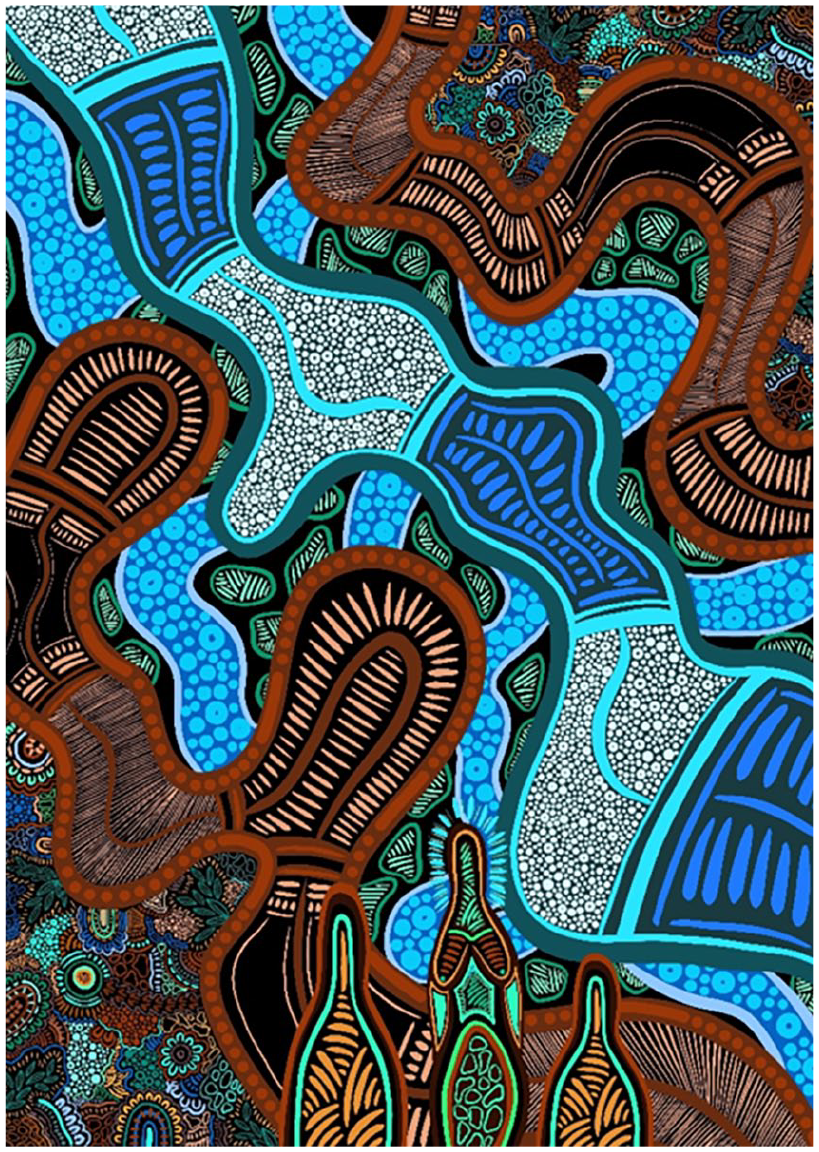
Woka (2022) (by First Nations artist Alkina Edwards).
Conclusion
Aboriginal youth mentoring programmes create healing that ripples through the young person’s life; the findings here urge these ripples to extend to families, Community, and service systems. For some youth attending the Aldara Yenara mentoring programme, it is the first time they experience strong and proud Aboriginal people. Young people attending mentoring programmes learn positive stories about their Ancestors and connect with their Elders and Communities. Mentoring enables youth to grow into their innate cultural self, First Nations leaders who pass cultural teachings onto the next generations. Youth attending Aboriginal mentoring gain strong cultural pride and identity, strengthened through interactions underpinned by Aboriginal language, knowledges, and communication styles with mentors and Elders. Country and the Bush are medicine for Aboriginal youth and contribute to healing, as each youth experiences a place to belong. First Nations principles of communication need to inform the design and processes of a mentoring framework, to enable each young person’s pathway to leadership, instead of reaffirming Western deficit perspectives. Finally, Aboriginal mentoring is not a one-off event held On Country; culture is ongoing, and growing strong Aboriginal leaders needs long-term secure funding and resourcing. It requires many stakeholders to do things differently than what current Western mentoring models incorporate. As a way of being, mentoring is a continuing Aboriginal method for raising strong Aboriginal youth within a collective and relational identity, and which is thousands of years old.
Footnotes
Acknowledgements
The authors thank the young people who proudly demonstrated their cultures and shared their experiences during Yarns around the fire. They pay their respects to Aunt and Uncle, leading the way for Aboriginal youth on Yorta Yorta Country by sharing their wisdom. They thank Aldara Yenara, the mentors, for letting them participate and proudly sharing their cultures and commitment to youth. They also thank Tanya Garling, Victorian Department of Families, Fairness and Housing, for her guidance and support.
Authors’ note
Declaration of conflicting interests
The authors declared no potential conflicts of interest with respect to the research, authorship, and publication of this article.
Funding
The authors disclosed receipt of the following financial support for the research, authorship, and publication of this article: Aldara Yenara.

Glossary
Aldara Yenara Leading the Way; the name of a youth mentoring programme
Gamilaraay an Aboriginal nation located in the north-western plains of New South Wales, Australia
Yorta Yorta an Aboriginal tribal nation, north eastern Victoria and Southern New South Wales, Australia
Yuin an Aboriginal nation from the South Coast of New South Wales, Australia