



Abstract
Colonization is understood as a determinant of health for Indigenous people globally. Understanding colonization through a lens of historical trauma offers new insights into the field of Aboriginal young peoples’ health and wellbeing. Grounded in the Indigenous research paradigm, this study conducted interviews with 15 Aboriginal young people living on Gamilaroi Country, New South Wales, Australia. Three stories are presented to explain how Aboriginal young people understand their resilience, strength and resistance as an integral component of historical trauma. Aboriginal young people identified the need to connect and to continue to draw strength from their ancestors and to be cognizant of the hope and strengths they have as Aboriginal people and describe how this strength can ensure Aboriginal culture is sustained for generations to come.
Keywords
Introduction
We as a team of Aboriginal and non-Aboriginal researchers are focused on amplifying the voices of Aboriginal young people and their experiences of historical trauma and resilience in the field of historical trauma inquiry. Historical trauma inquiry offers valuable insights in the field of health research by taking into consideration contemporary and historical collective traumas experienced by Indigenous people globally (Mohatt et al., 2014). Historical trauma is conceptualized as collective complex trauma inflected on groups of people who share a specific group identity and affiliation (Evans-Campbell, 2008). Within Australia, limited studies have been conducted on the inquiry of historical trauma, even more so where Aboriginal young people are concerned (Smallwood et al., 2021). Aboriginal young peoples’ health and wellbeing is a well-documented concern in Australia (Smallwood et al., 2022; Williamson et al., 2010, 2016), including the experience of high rates of ongoing transmission of trauma, cycles of poverty, abuse and racism (Paradies, 2016). Despite limited research pertaining to Aboriginal young peoples’ perspectives of historical trauma, significant advancement in research has occurred more recently with Aboriginal young people regarding their social and emotional wellbeing (SEWB) and the importance of cultural connections (Murrup-Stewart et al., 2021; Smallwood et al., 2023) and young peoples’ engagement with cultural strengthening programs (Black et al., 2023). See Text 1 regarding terminology used throughout this paper.
Text 1. Note on Terminology.
Throughout this text the words Indigenous and Aboriginal people are used interchangeably depending on the context of the population being addressed. Aboriginal and Torres Strait Islander people are the First Nations people of the continent we now know as Australia. Respectfully, while acknowledging the 500 different distinct Nations and clans’ groups, the preferred term when discussing Aboriginal and Torres Strait Islander people is ‘Aboriginal people’. When referring to International First Nations populations, ‘Indigenous people’ will be used. Further this research originated within the Gamilaroi nation, an Aboriginal nation located in the north-western plains of New South Wales, Australia. The Gamilaroi nation has three distinct language dialects; however, the language dialect used throughout this text is Gamilaraay.
Aboriginal SEWB in the context of health is about the recognition of the many facets of connection that influence and interact beyond the absence of ill health (Black et al., 2023). These include connection to body, mind, emotions, family, kinship, community, spirituality, Country and culture (Black et al., 2023). Aboriginal young peoples’ engagement with health prevention and gaining an education is closely tied to their experiences of racism (Black et al., 2023). Importantly, Aboriginal SEWB literature recognizes the importance of understanding colonization and how it is understood from contemporary and historical experiences (Gee et al., 2014). This includes not just understanding how the individual experiences these connections, but across the collective levels including their families and communities (Evans-Campbell, 2008; Gee et al., 2014). Murrup-Stewart et al. (2021) identified that connection to culture is inextricably linked to how Aboriginal young people recover from colonization and its influences on wellbeing through relationship, connection and disconnection as an essential understanding. Smallwood et al. (2023) further identified how a young persons’ wellbeing and resilience is linked to the experience of belonging, showing strength, maintaining positivity and recognizing and navigating risk.
Importantly in this field of inquiry is the recognition of the ongoing resilience within Indigenous communities globally and how ‘despite colonial interference, Indigenous knowledge and cultures have endured’ (Thomas et al., 2016, p. 2). Resilience has been framed and understood in varying ways across the social sciences and health, this includes the example of a person bouncing back or bending without breaking during stress or trauma (Thomas et al., 2016). The value of interrogating resilience from an Indigenous lens provides opportunity to factor in other ways of knowing and how this repositions the individual within their social, political, environment and historical context (Kirmayer et al., 2011). Kirmayer et al. (2011) defined Indigenous resilience as shared commonalties that include an individual’s ability to regulate emotion, adaption and change through relationship with living/nonliving beings and the connection to self. Additionally, resilience can be seen through the revisioning of collective histories to valorize collective identity and engagement with language and culture that has been found to heal individuals and generations collectively (Kirmayer et al., 2011). Lastly, resilience has further been identified through how Indigenous communities build collective and individual agency through political activism, empowerment, reconciliation and self-determination; importantly, agency is closely linked to the understanding and recovery from colonization in the context of health (Kirmayer et al., 2011; Stearne et al., 2022).
Significantly, work within this space, relating to historical trauma and resilience has not only contributed to wider understanding of trauma in the colonial context (Evans-Campbell, 2008) but has offered pathways forward to highlight the importance of decolonizing trauma theory (Visser, 2015). Trauma theories are historically founded in western belief systems and methodologies and are limited by the lack of recognition of colonization and the process of trauma over generations (Visser, 2015). Advancement in decolonizing trauma theories requires an understanding of the legacy of colonial violence and traumas associated through a shift in paradigm (Visser, 2015). This shift involves rethinking of trauma as a collective, spatial and material experience, which transforms previous perspectives of trauma being individual, temporal and linguistic to an understanding that considers diverse historical and cultural contexts more broadly (Visser, 2015). Paradies (2016) importantly highlighted the benefit of decolonization and the positive impact on an Indigenous community in Canada, through Indigenous-led health control and governance and its impact on decolonization, endurance and recovery within a community. Importantly, in the field of trauma and decolonization, further inquiry into this space benefits from an openness towards other ways of knowing, particularly from the context of Aboriginal ways of knowing, being and doing (Martin & Mirraboopa, 2003), in order to transform, heal and decolonize trauma-informed practices (Visser, 2015). Given the significant gap in research associated with historical trauma for Aboriginal young people in Australia, we illuminate the stories of young people in this study to provide meaningful insights to the field of trauma-informed policies and practices in health.
Aim for Article
The purpose of this article is to amplify the voices of Aboriginal young people who participated in a research study that aimed to understand historical trauma from their perspectives, including how they understand resilience, both collectively and individually.
The intended research question for this article was:
How do Aboriginal young people recognize collective or individual resilience to help overcome the impact of historical trauma?
Methodology and Methods
Methodology
Positioned in the Indigenous research paradigm, this research study has been informed through Gamilaroi ways of knowing, being and doing; a process of ongoing critical reflection of the first authors’ positioning within the community of focus, and the cultural and ethical responsibilities held as part of relational approaches to research (Kovach, 2021; Martin & Mirraboopa, 2003; Wilson, 2008). This relationality has been informed by the notion that research is a ceremony as explicated by Wilson (2008). Wilson (2008) originally described research as being an act of ceremony that is sacred which honours the fact that research for Aboriginal people is relational and highly dependent on relationships engaged with respect, relevance, responsibility and reciprocity (Archibald, 2008). Foundational to this premise is the need to ensure the privileging of Aboriginal voices within research and how the act of listening and amplifying voice is guided by the re-telling of stories both from cultural and ethical standpoints (Rigney, 2003). Rigney (2003) thus called for Aboriginal researchers to act within political integrity to ensure protocols of research are guided by the promotion of Aboriginal worldviews, experiences, knowledges and cultural ways of knowing.
In addition to being guided by the Indigenous research paradigm, the methodology used in this study has been informed by the principles of Indigenous Story Work (Archibald, 2008), aligning with the context of sense-making that heals and transforms communities (Kovach, 2021). Story, from the position of resilience, has a communal and collective dimension, that forms ways to engage with identities collectively and individually and that values culture for meaning-making, including the creative process to develop solutions for new challenges that may arise (Ramirez & Hammack, 2014). Thus, StoryWork practices are guided by the notions of placed-based meaning, which Benham (2007) describes as story being reliant on relatedness to place, space and time throughout the project. To place this story within and on Country, Country informs the axiological and epistemological ways of knowing and informs ongoing accountabilities and responsibilities behind the research intent and purpose (Hughes & Barlo, 2021; Rigney, 1999). Being conducted on the Country and nation of the Gamilaroi Calala people, the research project was gifted a Gamilaraay word, winanga-li. This word means to listen, to hear, to know and to remember (Munro et al., 2019). It is a practice that is culturally embedded in place; a process that honours deep listening and reflection; a constant reminder to ensure the researchers listened, heard, knew and remembered the stories of the young people who participated in this project (Atkinson, 2002). Winanga-li further offered opportunity for a process of ongoing reflexivity; that is, remaining reflective and accountable to the young people and their stories, spirit and healing, which is later discussed in the data analysis section (Nicholls, 2009; Rigney, 1999; West et al., 2012).
Human Ethics Approvals
Ethical approval was sought from both the University of Technology Sydney (REF: ETH20-5373) and the Aboriginal Health and Medical Research Council (AHMRC) (REF: 1813/21). Ethical approval did not seek the collection of demographic data such as age or gender. Participants nominated a pseudonym for their data and were also asked during the yarn if they had any gender preferences and if their chosen pseudonym was reflective of the young persons’ gender at the time of the interview. Participation in the interviews was voluntary. All participants consented to participate by signing a consent form after an explanation about the project by the researcher. At the time of consent, participants were informed that they had the right to withdraw at any time and were given options regarding follow-up support.
Data Collection
Data collection occurred during the COVID-19 pandemic in the period between January 2020 and December 2020. After ethical variation, data collection occurred via zoom and telephone to ensure data collection was not delayed due to uncertain periods of lockdowns. Aboriginal young people chose their preferred location for the interview and prior to consenting to the interview, they had an opportunity to ask questions regarding the project and express any concerns and to discuss these if required.
Employing a yarning method of data collection, key questions were developed with the research team and appropriately guided by the Cultural Research Advisory Committee members (Carlin et al., 2019). Yarning is a method of data collection commonly employed in research with and by Aboriginal people (Bessarab & Ng’andu, 2010). Yarning is a form of communication and there are informal and formal elements of the yarn that include social, research and supportive components (Bessarab & Ng’andu, 2010; Hughes & Barlo, 2021). The social component is how the participants and researchers connect and develop rapport before launching into the research collection objectives. The research component is derivative from the objectives of the study and is often guided by key questions or yarning topics related to the field of inquiry, and lastly the supportive component is where the researcher may need to offer emotional support during the yarn if the participant(s) is distressed (Bessarab & Ng’andu, 2010). Yarning more broadly is often referred to by Aboriginal people across Australia as a form storytelling and through this yarning, transfer of knowledge is shared between each other (Barlo et al., 2020). As we have used yarning and Indigenous StoryWork in our approach to research with Aboriginal young people, we have presented the research findings in a story format below. During the yarn to explore resilience and historical trauma, one of the questions asked was ‘Can you tell me how Aboriginal people in this community have overcome the impacts of historical trauma related to colonisation?’ After this question was asked, the researcher allowed the participant to respond, listening carefully for any follow-up questions to gather more insights on the topic. Yarns were recorded with permission and sent for transcription to an external provider. Over the period of data collection, field notes were collated and used to aid in the process of analysis and often this would be through use of poetics or art-based techniques that later informed the cycles of analysis by the first author. Using a process of member checking, results were presented to community, and they were given the opportunity to reflect, question and interrogate the findings. This process of member checking is a commonly employed approach used with participants and communities as part of Indigenous-led research (Kovach, 2021).
Data Analysis
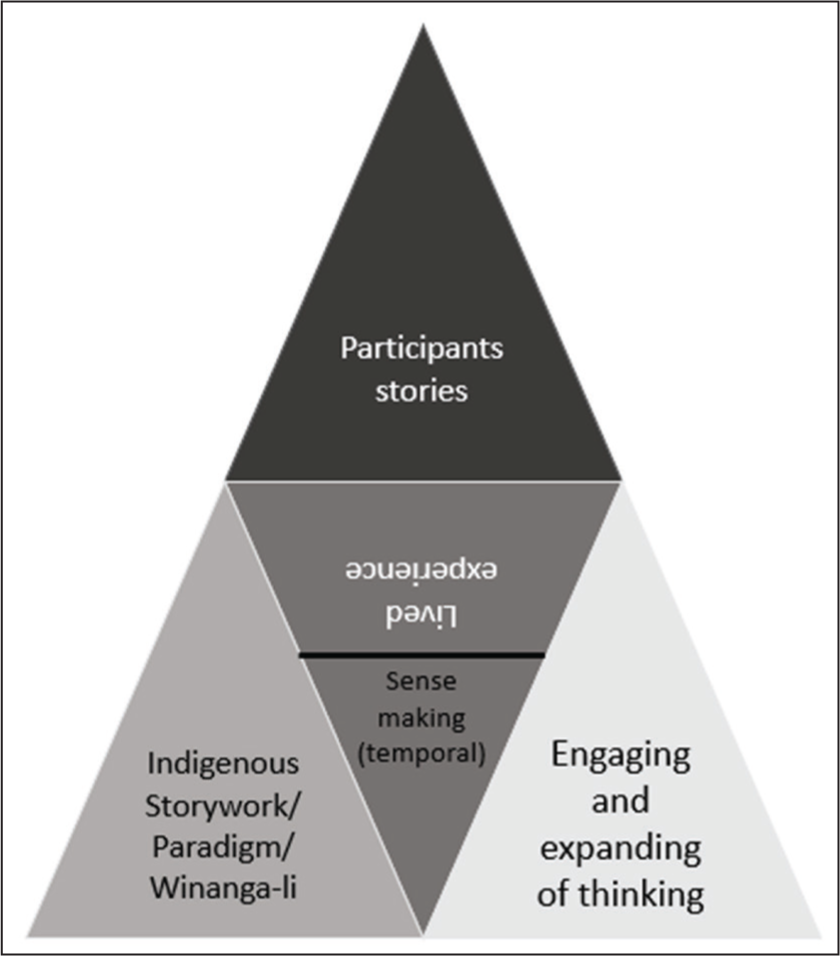
Data analysis was achieved through deep listening guided by the practice of winanga-li, where the first author immersed herself in the audio and written transcripts of the young people’s stories by listening and reading repeatedly. The transcripts were then coded using NVIVO v12. Using a bricolage approach of reflective thematic analysis (Braun & Clarke, 2006; Byrne, 2022), the stories were re-engaged using the same initial process of immersion. Coding was achieved through using abductive analysis, that was a process of sense-making through an interpretative process of reflection, through organization, labelling, challenging, writing up and contemplating ideas through reflection, the axiological needs (cultural and ethical) and how this made sense in the wider field of inquiry (Earl Rinehart, 2021). As the Ph.D. student was inherently informed from her Gamilaroi lived experience, further ongoing critical reflection was used to inform the temporal sense-making of the study. Critical reflection of lived experiences has been informed by West et al. (2012) where Aboriginal researchers living in their communities of research hold ongoing obligations to the research and beyond, including the acknowledgement of the relationship Aboriginal people have to community, Country and culture. This process of analysis is displayed in Figure 1. The design of the diagram reflects an ongoing engagement with the core aspects of sense-making informed by the participants’ stories, the lived experience of a Gamilaroi woman, a culturally informed method of deep listening (winanga-li and StoryWork), and wider engagement with the field of Aboriginal young peoples’ health and resilience. The ‘lived experience’ text is displayed inverted, as it was a reflexive tool, to build sense-making by ongoing critical engagement with the young peoples’ voices and stories through their lived experience.
Aboriginal Young People
Out of the 15 Aboriginal young people who participated in the study, the majority were from the rural location in the Gamilaroi Nation and identified as an Aboriginal person from this Nation. The inclusion of participants from outside the Gamilaroi nation occurred due to snowballing sampling which occurred when a young person shared information about the study with another young person.
Participants were aged between 18 and 23 years. As part of participation in the study, the Aboriginal young people were invited to have an ongoing relationship with the study which included ongoing confidential updates on progress and dissemination of results. Participants also consented to having their transcript returned to them to check and provided an opportunity for them to remove, expand or clarify what was said in the yarn.
Findings
Quotes from the Aboriginal young people in this study are included below in the following three stories. Resilience was expressed from the following sub-themes as part of the data analysis outcomes, these include: Blackifying Western institutions, sharing our histories, coming from resistance and resilience, obligation to the future, pushing for change, finding our culture, individual and community-led solutions and Aboriginal young people seeing themselves in the Australian narrative.
Story One: Acknowledging Ancestral Strength
Within the story of acknowledging ancestral strength, Aboriginal young people in this study understand and acknowledge they come from a long line of resistance and resilience generationally. Young people in this study hold the stories of their grandparents and ancestors at the centre of their healing. By doing so, they can draw on the strength of their ancestors to heal and move forward towards thriving. For James, he recognized the sacrifices made by his ancestors to ensure that his generation and the future generations were afforded the opportunities that his ancestors originally fought for. James expressed this in the following quote:
I mean, it’s everything that our ancestors went through and it’s everything that our great-grandparents went through. It’s everything our grandparents went through. It’s everything our parents went through. They all had it tough, but each generation it was made a little better. The last generation worked so hard to pay it forward to us and so back in the sixties, it was horrible for Aboriginal people and the generation before that. They were all pushed to the fringes of town … they were denied their right as human beings. We were treated like animals. You fast-forward only two generations … like, we’re doing it. Every day we’re doing it. (James)
Some of the young people in this study further conveyed how they draw on the strength of their ancestors and how this gives them the ability to honour their great feats over unimaginable adversity. Resistance is expressed by acknowledging that some of the political figures in Australia are continuing to silence the traumas of the past and re-telling these stories to the wider population. Marcia articulated:
I guess. It’s like we’re still here. May be like recently Scott Morrison was talking about how slavery didn’t exist in Australia, and we all know that there were unpaid workers, and looking at their stories and how they got through those times shows strength, I think. They got through that period and kept pushing on. (Marcia)
This show of strength, despite what has been shared widely, profoundly positions the young people in this study and reflects how they are able to draw on ancestral strength as part of acknowledging the past. Mary shared that she wanted to be part of change for her people, and by doing so honouring her great-grandfather and what he started in the fight for human rights at time prior to the 1967 Referendum. Mary added ‘I completely agree. We are a big part. My great grandfather fought for our rights and fought for our human rights and to be equal in this world and yet we still aren’t, so we’re going to continue that fight’ (Mary).
As part of sharing this history, she expressed the need for these stories to be heard, to be told and to be passed generationally to ensure everyone recognizes what Aboriginal people have been through; including what this means as having a collective identity with other Aboriginal people to continue the fight for change. Mary further added:
We’re going to go back and we’re going to tell our kids about all the people that we went to uni with, we’re going to talk about all the Indigenous kids that were there, we’re going to talk about all the things that we made sure we did to make sure we had a better future. We’re going to tell our stories and tell our grandparents, our great grandparents about our people. But yeah, we do have our own stories to write, and we will tell them. (Mary)
For Essie to connect to her ancestral strength, she highlighted the importance of storytelling and the ability this practice has with dealing difficult subjects such as trauma. This includes how she believes the importance of this sharing is integral to healing and the prevention of transmitting trauma generationally. Essie added:
Well, Indigenous people have always been storytellers. We’ve always told stories through word of mouth and I really think that has carried on even if people don’t really believe it. Indigenous people have been the best storytellers I’ve ever listened to. So, they will also bring up these stories. It’s like we will never forget what happened and it’s a good thing and a bad thing at the same time, I think, because if people forget about it, it’s like, well, the trauma doesn’t really pass on. But if we remember it, we can fight for what happened to us and how it hurt but it’s going to be passed on through generations upon—until it’s fixed. (Essie)
Marcia further added that she does not hope for Australia to get better, or hope for things to change because of inactivity, instead, she draws strength from looking back on the achievements of Aboriginal people collectively and individually as her motivation to push for a better future. Marcia added:
Instead, I look back and I’m like okay, they set up the tent embassy, look at all the achievements we’ve had. That’s where I draw strength from. I think people looking at those around them and leaning on those around them created strength, and we come from a strong breed. (Marcia)
Story Two: Empowering Our Collective Identities
Within the story of empowering our collective identities, young people shared how they continue to recognize the potential futures of Aboriginal people and the continued strength of their culture. For some young people in this study, they recognize the power of their cultural identities collectively to empower others to have a voice and to speak the truth. For other young people in this study, changing the present is about accessing higher education and employment to break cycles of poverty and welfare dependence. Finally, for some of the young people in this study, it is about accessing culture, through connecting to community and peers.
Truth telling was identified as a pertinent theme for the young people in this study. During data collection, there was a period of distress experienced on the global stage, as result of the tragic murder of George Floyd, the reignition of the Black Lives Matter movement was triggered globally, which motivated young people in this study to share their stories about what truth telling means to them in their communities. Brooke alluded to this time in the following quote:
A lot more of our people are standing up especially now and having that strength to say I’m Indigenous and I’m here. Like yes, we’ve had so many of these setbacks and stuff like that but they’re really kind of speaking out now and it really shows. (Brooke)
Mary added:
Especially with everything that’s going on over in America. They’re sitting there saying, oh, well, we didn’t have all this, we don’t have police brutality and all this kind of stuff, and it’s like, look in our own backyards. Our own Prime Minister won’t even recognise that we had a violent history. What is that saying about Australia’s future? (Mary)
This notion of speaking your truth was particularly important for Marcia when she reflected on the history of her Aboriginal identity and the act of sharing her truth about her disrupted family history and the uncertainty of not knowing her heritage clearly. For many contemporary Aboriginal people, colonization has caused a substantial disconnection, where many people and families are unable to trace their bloodlines and ancestry. For Marcia, sharing the truth of this trauma is articulated in the following quote and how it impacted her wellbeing:
‘But, when you speak your truth, even if it’s not the story that everyone accepts, or expects, that’s better for your wellbeing’. Marcia expands further to explain about the hope she has for peers and the work she does to empower others to speak their truth and acknowledge their ancestry; ‘people will just accept that and be like okay, that’s your story and not you…. People are just like yeah, that’s your story and you still fit within our community.’ (Marcia)
Like Marcia, James shared his story around what it meant for him to embrace his bloodline and acknowledge the strength of his Aboriginal heritage, ‘We are part of the oldest living culture on earth. Like Mungo Man, that’s my relative. That’s my bloodline. That’s my ancestor. You know? That’s the oldest living person ever found here on this continent … we’re a part of something bigger’. James, in his story, expressed that for him to realize his ancestral strength he needed to go overseas to understand the importance of his connection to a larger collective identity. Further, James identified for himself how this experience meant that he was part of ‘something that’s bigger than anything on this planet’, an important part of his healing.
Contextualizing this experience of James going outside of Australia to embrace his heritage is expressed as an ongoing issue for some of the young people in this study. As a result of colonization, young people in this study recognize the impact of wider Australia having certain beliefs about Aboriginal people, that includes Aboriginal identity being seen in negative ways, such as ingrained beliefs and stereotypes that Aboriginal people are the problem. The stories of the young people in this study resist this idea of being the problem, instead, they present the solutions needed for change.
For Pearl, these stories of colonization being hidden and silenced, motivated her towards teaching and being part of the educational shift required towards truth telling in wider communities. Pearl, in the following quote exemplified how for her, this means learning in a system with peers that do not recognize the impact of colonization and how she wants to be part of the shift for her community:
But I know that I’m in uni with a whole bunch of other teachers that do not see eye-to-eye with me, which is problematic for our education system, where all our students have to grow up. We know for them, for most of their lives—early lives. They’re just teaching mathematics and English, and then they go home. It’s just like, no, you can do so much more than that. You don’t have to keep the cycle going. So, that’s kind of how I’m doing my part, and I think maybe some programs in that to teach teachers…. So, I think maybe teaching programs as well, and even just programs within schools that … promotes cultural knowledge as well. (Pearl)
For Mary, when she accessed higher education, it opened her mind to what it means to be Aboriginal. Part of this learning process was that she not only became aware of colonization and its impact on Aboriginal people, but that she realized the importance of getting an education, and how communities are breaking cycles and doing it for themselves, their families and communities:
Being here is a completely different aspect. We’re learning how to do that. Coming to university, it’s most of the reasons why Indigenous people are here, to better their communities and to change them…. We’re going to make our own—we’re going to sit there and educate our kids about how we walked these marches and how we were there, and we protested, and we went to university to better ourselves and better our communities. We did all these things to make sure that all our people had a better future, that we were equal. (Mary)
James also reflected on the importance of Aboriginal people accessing education and opportunities surrounded by culture, where he believes Aboriginal people are breaking down barriers and participating in the workforce, for the betterment of their communities. Highlighting that Aboriginal people are getting educated, doing decolonial work, and reviving culture and language. James added, ‘We’re living the way—learning the ways of our old people. We’re doing it every day. I’m so proud of all our mob for going and doing it.’
For Rachel, she recognizes the need for culture to be accessed by Aboriginal young people and for others to accept and understand why culture is important for young people and their healing. Rachel added:
People my age want to get that culture back. They see like no, that’s [explicit]. Why should I be judged on that? That’s so ridiculous. I see a lot of young people coming together and reaching out, proud to be Aboriginal or proud to have family that is Aboriginal. (Rachel)
Brooke further highlights how Elders are integral to the young people reclaiming their strength through accessing culture, language and art. Brooke added:
yeah, learning language like a lot of Indigenous people now are learning their language and reclaiming that strength. Elders passing on traditional art ways. A lot of people and a lot of Indigenous girls and boys are really getting back into traditional art. I think that’s a good show of like unity and strength. (Brooke)
Marcia further added that for her going to university meant she was able to connect and find a community of Aboriginal people. That gave her the opportunity to share and yarn with other Aboriginal people about their histories, identity journeys and belonging. Marcia articulated,
I can’t imagine the support I would have gotten before having community…. Even though you draw on ancestral strength … my family really wants to be part of that and really wants to know more about our whole space and to connect the dots.
Marcia highlighted that, no matter how far-reaching her community is, it is not only important for her own healing, but for her family as well. Marcia further added:
I suppose I can provide that strength to the people around me, too, that I’ve met from all over Australia who have their bits and pieces, and we all sort of lean on each other in different ways…. Through the trauma, we’ve managed to create community around that, too, which isn’t—like it started and that’s how it is but I mean at least we can be united in the hurt, and I think we can understand each other a bit better. (Marcia)
Story Three: Changing Futures for Everyone
Within the story of Changing futures for everyone, Aboriginal young people in this study identified two important steps towards reconciliation and healing for their futures. The first step identified by the young people in the study was for the wider Australian community to recognize the hurt, trauma and loss caused by colonization. The second step is for Aboriginal young people and people more broadly to make a commitment to improve everyone’s future, which includes truth telling, embedding of culture, acceptance and accountability in communities. For Anita ‘it’s showing everybody that Aboriginal people can succeed, and we are just too deadly; we don’t just say it to hear ourselves talk’.
The young people in this study identified that there needs to be a wider conversation with Aboriginal people and non-Aboriginal people about colonization and the subsequent contemporary impact of colonization. Marcia articulated this need for change in the following quote:
This begins from the I think creating opportunities [for Aboriginal people], but also it would be great if non-Indigenous Australians recognised us. Indigenous Australia in things like the curriculum, and just (fair) representation…. I don’t want future generations to keep having to push and relearn to, you know, to get to the end of school and then be like everything I learned didn’t include me and now I have to relearn, and now it’s my responsibility to teach my kids, but the kids they sit next to in school aren’t going to know. I don’t want another generation of that to happen. I want for our young people to see themselves. (Marcia)
Faith expressed how she believed the trauma of colonization has continued due to some of the wider communities not recognizing the true impact of colonization. Including how it continues to impact Aboriginal people historically, politically, socially, physically and emotionally. Faith described this in the following quote:
The biggest thing that is dragging on the trauma is the negligence and the ignorance of the—just the wider—our community that—our national community, our state community. I just think there is ignorance and negligence, and education is the greatest way of being able to overcome it because the more we’re talking about it. Yeah, it’s hard to talk about it but it’s a conversation that we’ve got to have. It’s our history for everyone. (Faith)
As part of this advocating for change, James identified the need for people to hold each other accountable, like drawing on our strengths, and overall, everyone being accountable and self-aware of the changes needed in community. James’ quote confirmed this, including the need to celebrate success:
Well, we must hold each other accountable. We’ve got to keep doing that. We’ve got to hold each other accountable for the good stuff and we celebrate that, but also with the bad stuff, we’ve got to keep it honest with each other and create that self-awareness and—you know? I think everything we’ve just talked about; we’re doing it. Education is such a big part that empowerment and coming back to culture, but, yeah, it’s about keeping those goals in our vision and keeping each other accountable. (James)
For Michelle, when asked about resilience and strength of young people, she reflected on the work that her mother does in community for health promotion. Highlighting the importance of her mother working in community as a positive step towards improving health and putting yourself out there despite not seeking formal identification as an Aboriginal person in community. Michelle added:
She got out there. She’d get involved in the community. She doesn’t care that she doesn’t have proof of who she is [being an Aboriginal person], she still gets involved and tries to make a better community…. She travels around doing work for it. She’s trying to encourage positivity and raise awareness of health…. I just think it’s something that helps in a way. (Michelle)
For Pearl her passion and desire to complete her degree was focused on changing the lives of all the young people she teaches. To ensure they not only receive the standard curriculum, but further how each student has their own identity and they too, are part of the solution towards change:
Well, I’m in teaching, because I want to help this situation. I think teachers—it’s compulsory to go to school, so teachers have a big, big job in shaping these children’s lives … it’s not just about teaching English and numeracy, it’s about empowering these students and finding … being more educated on the true history and the true impact of intergenerational trauma … getting pedagogy … that includes community, includes partnerships, reciprocal relationships, empowering students’ identity, no matter what culture or diverse background they come from, because … that kind of starts the change, as well, within our young people. (Pearl)
Essie explained that for community to change and for better futures for everyone, there needs to be ways to have difficult conversations about trauma, loss and pain, including how this can be done from different, creative methods and standpoints:
So, talking about ways to fix issues. Because everyone is different. I could be like, oh yeah, I feel like education is the best. The next person would be like, oh I have very harsh feeling about education. I hated it. I never wanted to do it. It’s like, okay. Well, what’s best for you? People are like, well, I go through more arts ways. I know—dancers and stuff. (Essie)
For James, to help with healing his community, he felt that ‘Having safe spaces to yarn … men’s circles, women’s circles, yarning circles, just community get-togethers, having the good people around you, and I think on a grand scale having that leadership’ (James). Pertinently, James raises the importance of young people having Elders and leaders to look towards as role models, to aide in the creation of having safe spaces to yarn and understand the complexity of re-shifting trauma, breaking cycles and imagining better futures.
Discussion
Aboriginal young people in this study define resilience in the context of historical trauma, as a collective experience. They remember their ancestors and the strength and resistance they needed to confront injustices of the time and how those strengths have carried forward and influenced their futures. Importantly, the young people in this study recognize the importance of connection to their culture, personal identities and their communities as integral components to their resilience. This resilience is expressed as a collective, generational experience of strength, healing, and change.
Using a lens of historical trauma to define resilience, this study identified the broader need for wider recognition of Aboriginal people, and the experience of colonization that continues to cause trauma today (Mohatt et al., 2014). This is evident from the young peoples’ stories, particularly when they witness people in powerful positions denying opportunity for truth-telling and recognition of traumas associated with colonization. This important finding adds to the wider conversation occurring in Australia today. In 2023, Australia will vote for a referendum to permit an ‘Aboriginal voice’ to parliament. A body of people, that will be representative of the many diverse nations and clans’ groups located across this continent that will provide advice on matters relating to Aboriginal people to the governing party. 1 This referendum is one of the three recommendations out of the ‘Uluru Statement from the Heart’ (The Uluru Statement, 2023). The other two recommendations call for truth telling and treaty. Importantly, Aboriginal young people in this study understand the importance of truth telling and the arrangement required for Aboriginal people to have control and self-determination over their futures. The young people in this study want to see change, and are not willing to sit back and wait, but instead push for change for a better future for all.
Explicit in the young people’s stories in this study, despite present- and past-day narratives of colonization, is their continued show of strength and resilience. This is evidenced by the findings of this article, where the young people in this study, despite their stories of navigating traumas, articulate their continued strength and the obligations they hold for their futures. They articulate actions that include accessing education, engaging in their communities, creating communities of acceptance, resisting racism and speaking their own truth about their histories and the truth of colonization. They have identified how they perceive resilience as a way forward for the Aboriginal people through connecting and reconnecting to culture, language and communities. Further, they outline the importance of having the freedom to access culture in ways that affirm their own identities, connections and sense of belongingness; a key commonality expressed as pivotal to the Indigenous resilience literature (Kirmayer et al., 2011).
Culture and language are a continued and well-documented source of resilience for Aboriginal people (Salmon et al., 2018; Smallwood et al., 2022). Aboriginal young people in this study want to be able to access culture in a way that is meaningful to them. Colonial practices of intentionally removing children, broken kinship structures, lost connections to community and Country, and most importantly, young people removed from their families and culture must be recognized and resolved (Menzies, 2019). As a result of these colonial practices, languages and cultural practices have been lost. Emerging in the space of historical trauma is the importance of Aboriginal people and communities reconnecting to culture, understanding historical traumatic events and understanding how understanding these opportunities offers space for healing and restoring Aboriginal peoples’ cultural practices, identities and sense of belonging.
This article’s findings amplify the current need for reflective and accountable policy, practice and research to consider the impact of colonization as a historical and contemporary indicator of health and wellbeing. In these spaces of change, we must find ways to listen and hear what Aboriginal young people require to be self-determining individuals, who are part of wider collective group who are seeking such recognition and change. We recommend further engagement with Indigenous-led research to create space to listen and hear what Aboriginal young people envision for their futures.
Conclusion
Engaging with Indigenous ways of knowing, being and doing showcases critical issues in the fields of resilience and historical trauma inquiry. The young people in this study recognize the importance of acknowledging our past, to ensure we heal our present traumas, while recognizing the potential for all our futures. Researchers interested in resilience as a field of inquiry need holistic approaches when engaging with Aboriginal young people to amplify their voices and their insights on colonization as an integral component to health and wellbeing. This article adds to the important literature emerging around young peoples’ health and wellbeing and the importance of connection to culture that includes our past and our future.
Footnotes
Acknowledgements
We would like to first acknowledge the Country of where the project is located on, the lands of the Gamilaroi people. We extend this respect to acknowledge ancestors, past, present and future. We further would like to acknowledge the young people who shared their time and knowledge for this study, as well as the many Aboriginal community members and critical friends who have been part of this work and its development.
Author Contributions
Conceptualization, RS, KU and DJ; methodology, RS, VS; software, RS; formal analysis, RS and DJ; writing—original draft preparation, RS; writing—review and editing, RS, KU, DJ, VS and CW, visualization, RS; funding acquisition, RS, KU, DJ. All authors have read and agreed to the published version of the manuscript.
Data Availability Statement
The data presented in this study are available on request from the corresponding author.
Declaration of Conflicting Interests
The authors declared no potential conflicts of interest with respect to the research, authorship and/or publication of this article.
Funding
The study was funded by an ARC Indigenous Discovery grant (IN170100008). Reakeeta Smallwood received an Australian Postgraduate Research Scholarship and a University of Technology Sydney Jumbunna Postgraduate Research Scholarship.
Institutional Review Board Statement
The study was conducted in accordance with the Australian Code for Responsible Conduct of Research and has been approved by the University of Technology Sydney Research Ethics Committee (ETH20-5373) and the Aboriginal Health and Medical Research Ethics Committee (1813/21). Informed consent was obtained from all people involved in the study. Written informed consent has been obtained from the participants to publish this article.