




Abstract
Telling stories can be an empowering exercise, providing important insights into the values and priorities of the storytellers. This article shares stories told during a participatory scenario planning process among Inuit, an Indigenous People of northern Canada, Greenland, and Alaska, USA. This research takes place in Nunatsiavut, a land claim area in Labrador, Canada, to explore how visions provide insights into postcolonial futures for the fishing industry. Beginning in 2019, a group of fisheries stakeholders and managers came together to create a visioning process that would help them to develop consensus around priorities for the industry. Facilitated by university researchers, Inuit in the commercial fishing industry participated in an iterative data-collection process that involved interviews and a workshop. This article shares what was found during the scenario-planning process and position stories of the future within the context of Indigenous sovereignty.
Keywords
Introduction
Stories are a powerful tool to create meaning by ordering and making sense of the world. Participatory scenario planning is a tool that is used to support groups of people in developing a story, not about what is or has been but about what is possible in the future. Telling stories about the future can help groups to imagine new, possible worlds (McDowell, 2019), and stories can also help disparate groups of people to find agreement and build trust (Datta, 2018). In these ways, storytelling can be an empowering exercise, one that can support groups in articulating the futures they want. The stories about desirable futures that are shared through this process can also provide important insights into the values and priorities of the storytellers.
Between 2020 and 2022, a group of Inuit (an Indigenous People of northern Canada, Greenland, and Alaska, USA) organizations chose to undergo a process to build a story about an ideal future. This group was made up of stakeholders in the commercial fishing industry in Nunatsiavut, a land claim in northern Labrador, Canada. Over the course of 3 years, using an iterative participatory scenario planning process, the group sought to imagine the future of fisheries in the region, asking “what would a future determined by Labrador Inuit look like for the commercial fishing industry?.” Facilitated by visiting university researchers, this group developed a vision for the future that is based on group consensus.
The resulting story is a vision of Nunatsiavut holding far greater influence and investment in the industry than it does today. Commercial fisheries are a socially and economically important industry for the region, and the outcomes of management have weighty implications for the wellbeing of the communities (Snook et al., 2022). This vision demonstrates the ways that fisheries are interwoven with Nunatsiavut’s way of life and has implications for their rights and responsibilities.
In this article, we share the outcomes of the visioning project and discuss how the final vision is bound up with a particular conceptualization of Inuit sovereignty. This group sees greater ownership and control over fisheries as an essential next step in building their capacity to thrive. In this vision, we imagine how Labrador Inuit Knowledge and values can be folded into fisheries governance to support Nunatsiavut to achieve success according to its own cultural heritage. The participatory scenario planning process has furnished the Nunatsiavut fishing industry with an empowering story for their future that can also provide us with a deeper understanding of how a sovereign Inuit land claim might contribute to governance in the future.
Positionality and fisheries visioning project
The concept for the Fisheries Visioning Project was developed by the Torngat Joint Fisheries Board, the Nunatsiavut Government, and the Torngat Fish Producers Cooperative (Torngat Co-op). These three groups recognized that the commercial fishing industry of northern Labrador was struggling because management was organized around species-specific decision-making and short-term planning. They wanted an opportunity to think more holistically about the fisheries to build a more sustainable future. The three groups came together as partners, hereafter referred to collectively as the partners, to form the Fisheries Visioning Project and connected with visiting university researchers to help facilitate the project.
This article is written by representatives from each of these partner organizations and the academic partners who facilitated the scenario planning process for the group. The Nunatsiavut-based partners collectively own the data for this project. In addition to developing the research questions, they advised on research design, participated in each stage of data collection, verified the interim results, and provided feedback and editing help on communication materials. The academic partners helped design the research methods, collected data, conducted preliminary analysis, and drafted communication materials. Detailed information about how partners contributed at each stage is available in the study by Cadman, Snook, Gilbride, et al. (2023).
Nunatsiavut fisheries
Nunatsiavut is a land claim area based in northern Labrador, in what is currently known as Canada. The land claim was negotiated by the Labrador Inuit Association, a representative group that was created in the 1970s for negotiating the Labrador Inuit Land Claim Agreement (LILCA) and was dissolved upon the ratification of the final agreement in 2005. Nunatsiavut is comprised of the five communities of Nain, Hopedale, Makkovik, Postville, and Rigolet (Figure 1). Inuit and their predecessors have lived on the north coast of Labrador for thousands of years and have been involved in the commercial fishing industry for hundreds. In fact, first contact between Europeans and Inuit was the advent of Basque whaling vessels entering the region in the 1760s. Since that time, Labrador Inuit have participated in many commercial fisheries, including everything from seal and walrus harvesting to salt cod, char, and salmon fisheries and to the present-day shellfish and groundfish industries (Mills et al., 2018). Currently, there are five fisheries operating in the region: Snow crab (Chionoecetes opilio), Northern shrimp (Pandalus borealis), Greenland halibut (Reinhardtius hippoglossoides), Arctic char (Salvelinus alpinus), and Icelandic scallop (Chlamys islandica). For many people in Nunatsiavut, the industry has strong ties to their history, livelihoods, and identity (Snook et al., 2022).
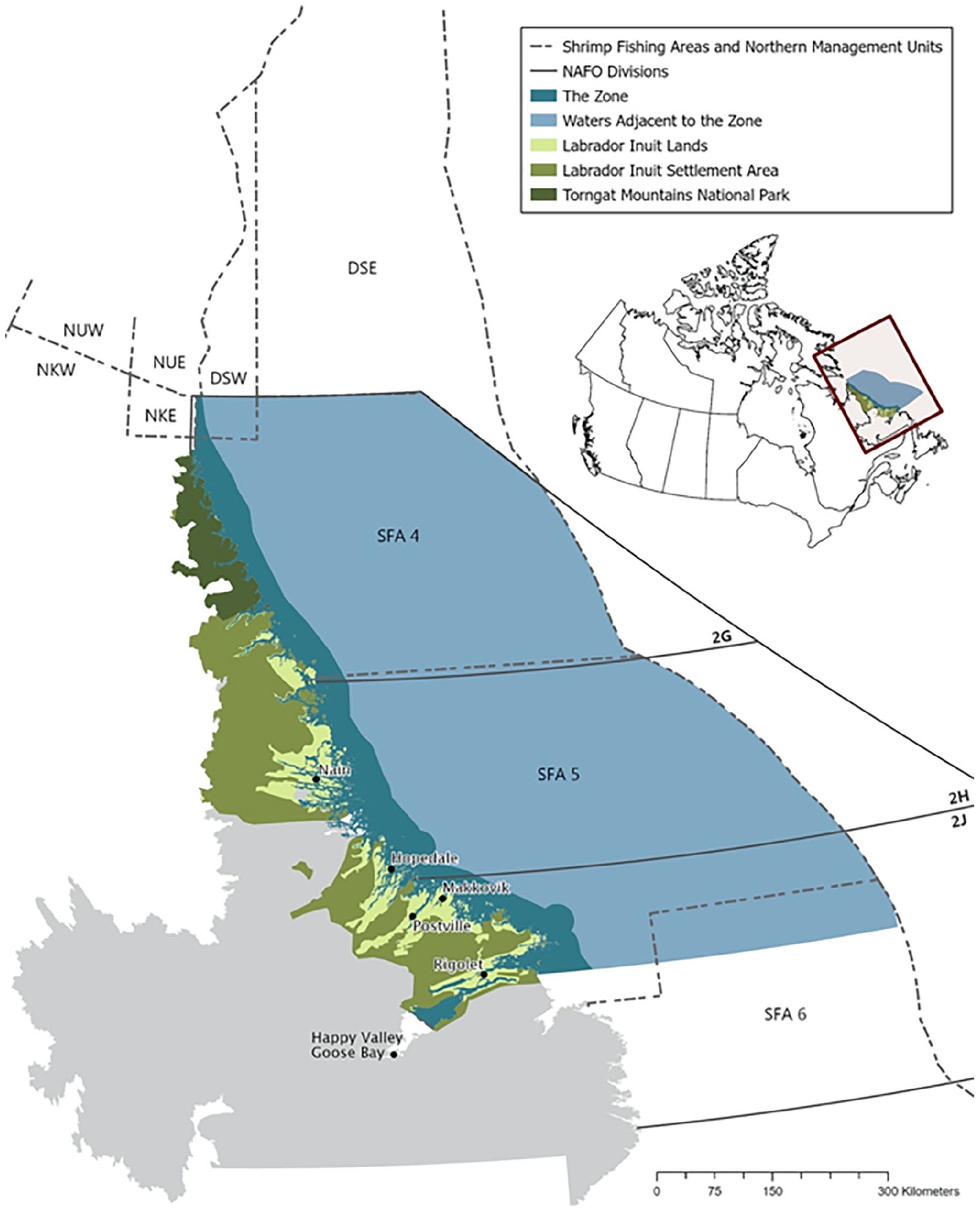
Map of Nunatsiavut showing the five communities of Nain, Hopedale, Makkovik, Postville, and Rigolet, as well as North American Fisheries Organization fishing divisions and Shrimp Fishing Areas that show where Nunatsiavut-based fishing enterprises operate (Cadman, Snook, Broomfield, et al., 2023).
The LILCA established the Nunatsiavut Government, which manages a number of communal commercial licences for the region. Quota from the licences is distributed to land claim beneficiaries who are qualified to harvest it. These beneficiaries are referred to as designates, and they manage enterprises to fish the quota. Some of these designates are able to afford their own vessels, but many are not (Foley et al., 2018). The LILCA also established the Torngat Joint Fisheries Board, which is the fisheries co-management board for the region, housed under the Torngat Secretariat. The Board comprises appointees from the federal, provincial, and Nunatsiavut governments. Their role, according to the LILCA, is “the conservation of species or stocks” and the “management of fisheries in the Labrador Inuit Settlement Area [LISA]” (Labrador Inuit Land Claims Agreement Act, 2005, 3.11). They conduct research and provide recommendations to the minister of Fisheries and Oceans Canada (DFO) on these topics. Shrimp is processed outside of the region, largely at a plant in Charlottetown, Newfoundland and Labrador, but Nunatsiavut has processing plants in Makkovik and Nain that have the capability to process turbot, Snow crab, and Arctic char. These processing plants are run by the Torngat Co-op. The Torngat Co-op also owns offshore shrimp licences, which they lease to southern fishing enterprises to help fund their processing operations.
Indigenous sovereignty
In this article, we position these visions of the future within the context of Indigenous sovereignty, in pursuit of a Labrador Inuit definition of fisheries sovereignty. The concept of Indigenous sovereignty has been an important one in Indigenous scholarship for decades, entangled with conversations on governance and law (Borrows, 2015; Coates, 2015), writing and research (Carroll et al., 2019; Lyons, 2000; Tuck & Fine, 2007), history and storytelling (Bodkin-Andrews et al., 2016), and resource use and governance (Grey & Kuokkanen, 2020; Prosper et al., 2011). Indigenous sovereignty has no one quintessential definition, it is bound up with its particular context, with the lands and the culture that envisage it (Moreton-Robinson, 2020; Snelgrove et al., 2014). We therefore use this section to outline what we mean by the concept of Indigenous sovereignty and show how it intersects with fisheries.
The term sovereignty has not been without controversy. Kanien’kehá: ka (People of the Chert; an Indigenous People of southeastern Canada and northern New York State, USA; otherwise known as Mohawk) scholar Taiaiake Alfred aligned the word sovereignty with a settler colonial ideal based on dominance, coercion, and homogeneity (Alfred, 2002). It has also been argued that basing an Indigenous governance paradigm on a European concept would erode and pervert Indigenous Knowledge systems (Barker, 2005). It is possible, however, to remove the concept from its Western political and legal mooring, to Indigenize the term for the benefit of Indigenous Peoples. The term sovereignty is then understood by grounding it “within Indigenous people’s struggles for autonomy, self-sufficiency, and self-determination rather than within assertions of domination, control, and authority over ancestral homelands” (Coté, 2016, p. 9).
In general, there are two schools of thought in approaching Indigenous sovereignty. These revolve around the question of recognition (Bodwitch et al., 2022; Van der Porten, 2012). Namely, can Indigenous Peoples really be considered sovereign if they require the acknowledgement and legitimization of the state? The dichotomy here is that Indigenous Peoples can generally pursue sovereignty either with an outward turn, by appealing to legal courts for their rights to be recognized, or by looking inwards, nurturing and protecting their own legal orders and governance systems (Stark & Stark, 2018).
The concept of moving beyond the politics of recognition requires understanding that Indigenous Knowledge systems are complex. This means that each Indigenous tribe carries their own social, legal, and economic institutions that guide the way that their communities and societies operate (Whyte, 2018). Deborah McGregor (2004) demonstrates that Indigenous Knowledges contain their own laws, morals, and ethics that guide individual and community behaviour. Each knowledge system contains within itself the capacity to govern communities. These systems are sometimes not as formalized or recorded in the same way as Western governance systems are and instead revolve around rules, norms, and lifeways that are taught to each generation (Mistry & Berardi, 2016; Tengö et al., 2017). In this framing, sovereignty beyond the politics of recognition only occurs where Indigenous Peoples employ their own knowledge systems as the basis for governance. In some places, Indigenous Peoples have experimented with implementing this concept by developing guidance based on their own lifeways. Notably, in Nunavut, a territory in Inuit Nunangat, Inuit use the term Inuit Qaujimajatuqangit (IQ; that which Inuit have always known to be true) to articulate an epistemological worldview used in the territory (Tagalik, 2015; Tester & Irniq, 2008). IQ is defined as encompassing “all aspects of traditional Inuit culture including values, world view, language, social organization, knowledge, life skills, perceptions and expectations” (Wenzel, 2004, p. 240). It is a knowledge system that includes spiritual and physical knowledge without distinction (Tester & Irniq, 2008). Based on this definition, Nunavummiut have created explicit guidance on how Inuit societal values should guide management processes (Government of Nunavut, n.d.). While Inuit in Labrador share much of their culture, language, and history with Inuit in Nunavut, it is important to recognize that Labrador Inuit Knowledge is unique to Nunatsiavut, embedded in a geographically, historically, and linguistically distinct region. To date, the Nunatsiavut Government has not articulated any analogous guidance on how Labrador Inuit Knowledge might be implemented in policy.
In accessing the Canadian legal system to negotiate and establish a land claim agreement, Labrador Inuit chose to pursue their sovereignty through an outward approach. Commercial fisheries were written directly into the LILCA, making it the first comprehensive land claim agreement in Canada to explicitly consider commercial fisheries (Andersen, 2009). This is an indication of how important commercial fisheries are to a Labrador Inuit way of life. Despite centering the discussion of fisheries rights through the land claim process, many managers and fishers have expressed frustration that they remain largely on the outside of decision-making processes (Foley et al., 2017; Kourantidou et al., 2021; Snook et al., 2022). Fisheries management remains couched in Western science and valuations, with the benefits leeching out of communities and spreading to southern Canada. As an important dimension of social, cultural, and economic wellbeing for Nunatsiavut, commercial fisheries are potentially an important industry for nurturing Labrador Inuit Knowledge and values, contributing to the overall sovereignty of Nunatsiavut (Cadman, Snook, Gilbride, et al., 2023).
Regarding sovereignty, the celebrated Mississippi Ojibwe (a group of Native American people whose tribal band office is located in northern Minnesota, USA) of Leech Lake and Mdewakanton Dakota (a Native American tribe located southwest of Minneapolis and Saint Paul, USA) of Lower Sioux (Native American tribes from the Great Plains of Canada and USA) scholar Scott Richard Lyons (2000) wrote: Our claims to sovereignty . . . are nothing less that our attempt to survive and flourish as a people. Sovereignty is the guiding story in our pursuit of self-determination, the general strategy by which we aim to best recover our self-respect. For indigenous people everywhere, sovereignty is an ideal principle, the beacon by which we seek the paths to agency and power and community renewal. (p. 449)
We take this imagery of a beacon to heart and see the discussion of sovereignty as an exercise in building strength and resilience for Indigenous people. As we develop a vision of fisheries sovereignty in this article, we position the process and the outcome as part of a broader conversation on sovereignty for Labrador Inuit. In reporting on the visioning process and its outcomes, we hope to show how this project can be a motivating process—a step towards articulating what sovereignty would look like for Nunatsiavut from the perspective of a particular industry.
Methods
The methods employed for this research were decided through a series of meetings between the project partners in 2019. In early meetings, the partners discussed goals for the project and agreed that what was needed was an explicit, shared, and long-term vision for the future. Considering the desire for open discussion and consensus, as well as the need for articulating a desirable vision of the future, participatory scenario planning was identified as an appropriate framework for the research (Cadman, Snook, Broomfield, et al., 2023). Scenario planning is a group of methods for engaging in the consideration of potential or possible futures (Oteros-Rozas et al., 2015). Participatory scenario planning is a subset of these processes that focuses on facilitating future conversations with resource users, stakeholders, and communities (Flynn et al., 2018). We employ an iterative approach, building each phase on the findings of the last. In each phase, the findings were presented to the participants to allow them to comment on the directional flow of the research and to allow them an opportunity to evaluate their own answers in the light of the group’s general interests (Fletcher & Marchildon, 2014; Stoll et al., 2023). This process allowed us to locate the areas where stakeholders held similar views about the priorities and values underpinning the industry and where potentially inflammatory topics might hinder the research.
The methods described in this text were approved by the Nunatsiavut Government Research Advisory Committee (NGRAC-20006002) and the Dalhousie University Research Ethics Board (#2022-6271). Data were collected in three phases (Figure 2). This approach was used to create a dialogue among participants, to identify points of consensus, and build a vision collectively. First, 28 individuals who work in the commercial fishery were interviewed. Interviews took place in the summer and fall of 2021, in person in Makkovik, Nain, and Happy Valley-Goose Bay and over the phone or on Zoom for individuals located elsewhere. Participants included partner organizations, fishers, and community leaders. Semi-structured interviews were conducted to establish a baseline of how fisheries stakeholders understand the current fishery. Participants were asked to identify the strengths, weaknesses, opportunities, and threats they experience in Nunatsiavut’s commercial fishing industry. Transcripts of these interviews were analyzed using NVivo to identify all potential opportunities shared by participants. These opportunities were then analyzed inductively and grouped thematically into a comprehensive list, which were used to guide the second phase of the research.
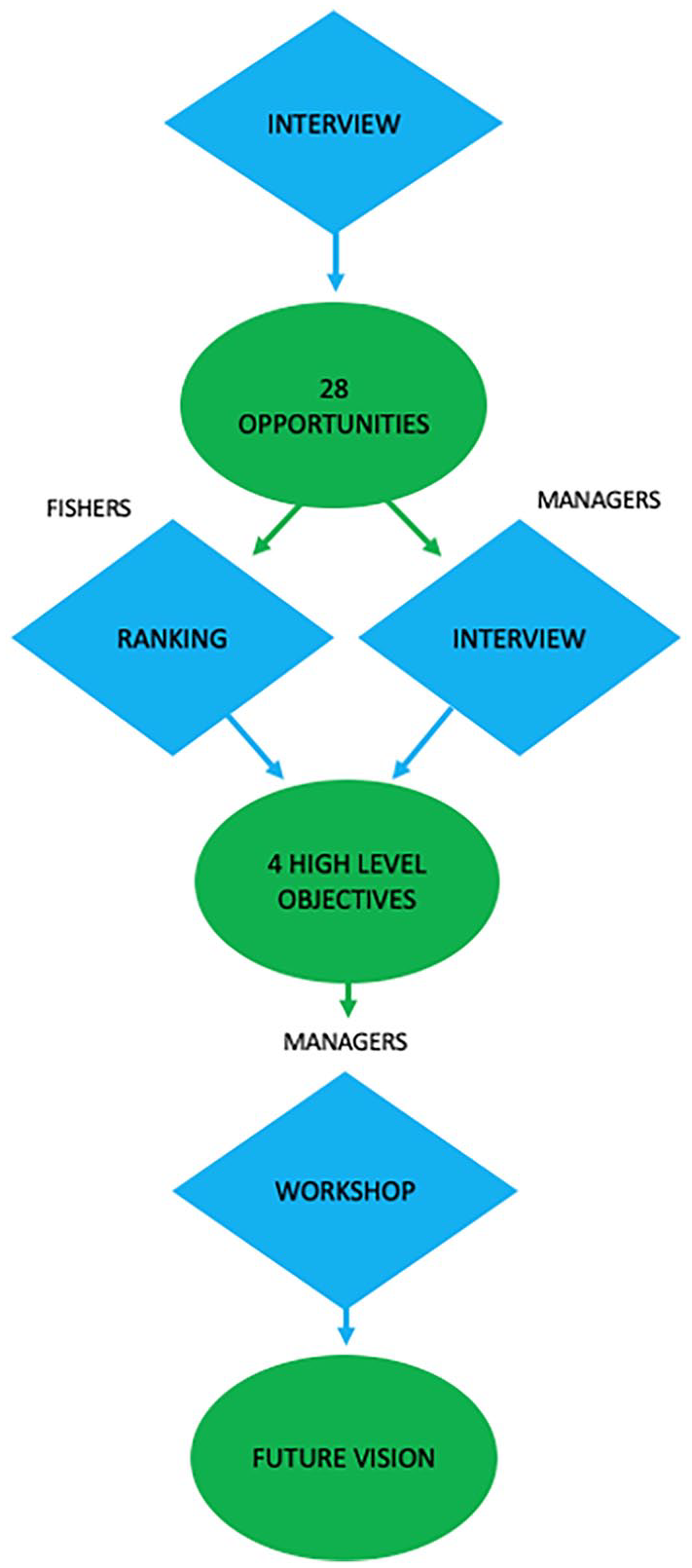
Flowchart of the participatory scenario planning method used for the fisheries visioning project.
Second, this list of opportunities was used to prompt another round of interviews, this time with a smaller group of participants. Interviews were conducted with the partner organizations (n = 10) between February and April 2022. Participants were presented with the list of opportunities and asked to rank them in order of their importance. The objective of these interviews was to provide insights into where the partner organizations might agree about priorities for the future of the industry, as well as to identify any sensitive or controversial topics that could derail the dialogue. Participants ranked the opportunities and discussed their choices with the interviewer. These interviews were transcribed and analyzed using inductive thematic coding in NVivo to find the topics that partner organizations generally agreed were priorities for the future of the fishing industry. The same list of opportunities was presented to a group of fishers (n = 12), who chose their top and bottom five priorities, and provided further feedback on their priorities, values, and concerns. Notes were taken during these conversations. Four high-level objectives were identified in the analysis, which were used to guide the final phase of the research.
For the final phase of the research, a three-day workshop was held in Happy Valley-Goose Bay in December 2022. Present at the workshop were eight individuals from the partner organizations: two from the Nunatsiavut Government, one from the Torngat Co-op, and five from the Torngat Joint Fisheries Board. Audio recordings were taken of the whole workshop, and facilitators also took notes during discussions. On the first day, participants shared stories about the history of the fishery, focusing on moments that they characterized as “successes” and “failures.” The group discussed what made those stories positive or negative. The facilitator recorded all the characteristics that the group thought were important for a successful fishery. On the second day, participants were put into four breakout groups of two people. Each group was assigned one of the high-level objectives identified in the second phase of the Visioning project. Breakout groups were asked to use the prompt to tell a story about an idealized fishery 50 years in the future that is being managed for one high-level objective using this prompt: “The year is 2072, and fisheries are being managed for [name of high-level objective].” Facilitators sat with each group and used prompts to help the groups think in detail about their ideal fishery. In addition to the prompting questions, groups were provided with cue cards that listed the characteristics of a successful fishery from day 1 to help elicit ideas. Breakout groups then came back together and discussed their stories, considering where the stories overlapped, where trade-offs might occur between futures, and what priorities the overall group had for a single ideal future. On the third day, a rough, synthesized vision containing all four futures was presented to the group. The group discussed the synthesized vision and provided feedback and adjustments. The day was closed with an evaluation session on the entire visioning process. The final, synthesized vision was presented to a large group of stakeholders, including fishers and managers, at the Annual Fisheries Workshop held in Happy Valley-Goose Bay in December 2022 for final comments and feedback.
Following the completion of the workshop, audio recordings were transcribed and notes from all facilitators assembled. Data were analyzed to provide additional details to the synthesized vision. Inuk (a person of Inuit descent) artist Jessica Winters was also given access to these visions and created artwork based on what stood out to her, which helped us to visualize the future in new ways for communicating the results of this work.
Results
Analysis of the second round of interviews produced four high-level objectives shared by all the partner organizations: environmental sustainability for the industry, cultural wellbeing for Nunatsiavut communities, political autonomy for Nunatsiavut, and economic success for the fishers. In the workshop, participants were asked to imagine futures based on these four objectives. In the following sections, we share the individual futures they imagined and then the synthesized vision, inspired by all four objectives, that the group developed collaboratively.
Individual visions
Vision 1: The year is 2072, and the Nunatsiavut fishing industry is being managed for sustainable harvests: In 2072, to help minimize fishing pressure in the Labrador Sea, there is a mix of inshore fisheries, executed by small and mid-sized boats run by Nunatsiavut beneficiaries, and offshore fisheries where fish are harvested by a large trawler with onboard processing ability that is owned jointly by the Nunatsiavut Government, the Nunatsiavut Group of Companies, and the Torngat Co-op. Fishing capacity is driven by Nunatsiavut-based enterprises, and Nunatsiavut is able to harvest all of its own quota. Fishers can pursue multiple species throughout the year, decreasing reliance on one or two commercial species, and supporting resilience through an ecosystem-based approach to management. In this future fishery, management is driven by stewardship and care for the waters adjacent to Nunatsiavut. Under this management paradigm, subsistence fisheries are prioritized over commercial harvests. Species including Arctic char, Atlantic cod, and Atlantic salmon are protected for the people of Nunatsiavut to continue traditional harvesting at sustainable levels before any commercial harvesting can occur. To support this, Inuit and non-Inuit conduct science both in the inshore and the offshore to support good decision-making. Additionally, a Fisher Association exists that supports fishers to advocate for themselves, to have their voices heard in decision-making, and to report on their observations on the water.
Vision 2: The year is 2072, and the Nunatsiavut fishing industry is being managed for cultural wellbeing: In 2072, there is a focus on returning benefits from the fishery to Nunatsiavut beneficiaries, so that they may enjoy a long-lasting social and cultural connection to the fishing industry. The focus of this management regime concerns employment. All inshore vessels fishing in waters adjacent to Nunatsiavut are owned and run by Labrador Inuit, and offshore vessels fishing Nunatsiavut-owned quota employ beneficiaries as well. Processing of all the fish caught in waters adjacent to Nunatsiavut are processed in processing plants located within Nunatsiavut through the Torngat Co-op. Finally, there is an observer program run out of the region to support region-specific monitoring, and hires Knowledge holders to ensure that Inuit Knowledge is used to frame onboard monitoring. Beyond the benefits seen from employment, the future industry will make sure that the fisheries will contribute to community growth and wellbeing. The Nunatsiavut Government will fund the community freezers to buy and distribute fish to increase food sovereignty and connection to marine species across the region. Revenues from communal licenses can also fund better infrastructure in the communities, such as services and roads.
Vision 3: The year is 2072, and the Nunatsiavut fishing industry is being managed for Labrador Inuit autonomy: In 2072, the fisheries are an important tool for advancing sovereignty and independence in Nunatsiavut. Fishers are able to own their own vessels because they have a guaranteed access to quota for many years, allowing them to operate independently. Processing is done within the region so that Nunatsiavut beneficiaries control the production and distribution of fish caught in the adjacent region. In this new paradigm, the Nunatsiavut Government has access to all new and existing marine species both within with LISA and adjacent to the LISA, and they work to lobby DFO when new opportunities arise. Inside the LISA, and adjacent to the LISA, the Torngat Joint Fisheries Board holds decision-making authority, without veto power being held by a federal government minister, so that the power is truly shared among the three governments.
Vision 4: The year is 2072, and the Nunatsiavut fishing industry is being managed for economic development: By the year 2072, 100% of the resources adjacent to Nunatsiavut is controlled by Nunatsiavut beneficiaries. In this new regime, beneficiaries can pursue multiple species throughout the year, and the Nunatsiavut Government is given access to expand into new and emerging fisheries when they arise. Because they have control over fish harvested within Nunatsiavut waters, fishers and processors are able to make a good wage, supported by a strong industry. Having gained control over the fisheries, Nunatsiavut is able to reinvest the economic benefits into community development. Revenues from the industry are redirected into supporting the communities through new infrastructural projects and education. In order to sustain the subsistence char fishery for the communities, the commercial char fishery has evolved into a tourism industry with a catch and release program, which supports training and travel for beneficiaries to learn about char harvesting while earning a wage.
Synthesized vision
The breakout groups came back together to share their visions. Figure 3 depicts the synthesized vision that emerged from the workshop. When they started talking, they realized that they all agreed that their visions all depended on Nunatsiavut holding far greater authority over their adjacent resources than they currently do. A synthesized version of the future containing elements of all four breakout group visions was collaboratively built from the points that followed in the discussion. We also share artwork by Inuk artist Jessica Winters, who created illustrations based on the visions. Jessica Winter’s art brings these stories to life, told through her own understanding of the visions. Jessica Winters read the stories and chose elements that she found particularly important to represent, and thus, her work has a hand in how we come to understand the significance of the vision(s).
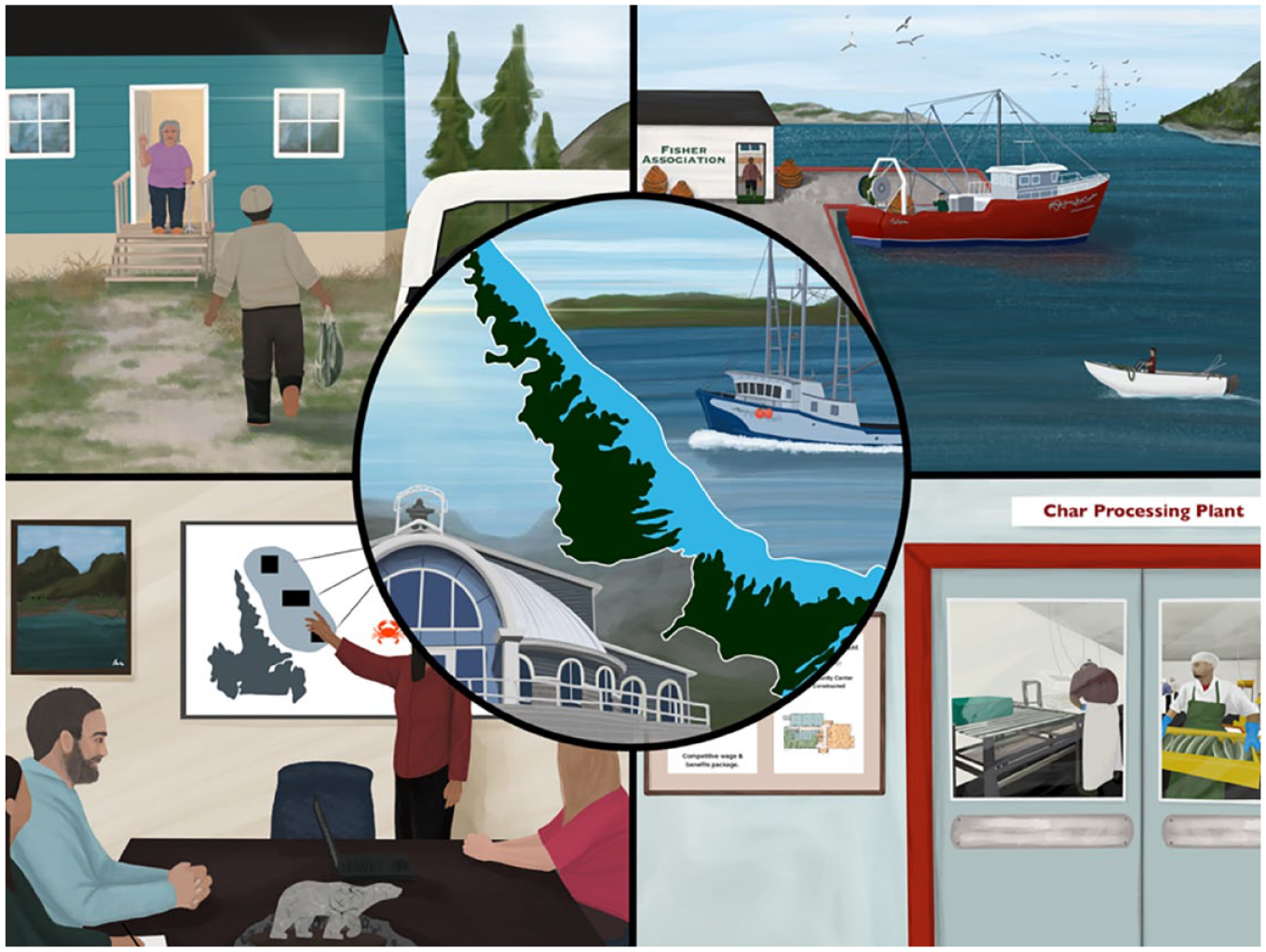
A synthesized vision for the future of commercial fisheries in Nunatsiavut shows all four individual visions brought together, overlaid with an image of Nunatsiavut itself, depicting the final vision developed by partners during the final discussion of the workshop (Illustration by Jessica Winters).
In 2072, in an ideal world, Nunatsiavut would have 100% access to all marine resources inside and adjacent to the LISA and operate a mix of inshore and offshore fishing that is owned and run by Nunatsiavut-based organizations. The Torngat Joint Fisheries Board, as a co-management body, would need to have control over decision-making. Everything else in the vision of the commercial fisheries hinges on this core concept of sovereignty for Nunatsiavut.
Importantly, this management paradigm values Inuit Knowledge and local fisher knowledge alongside Western science, and all relevant data to help make decisions will be collected from within the area adjacent to Nunatsiavut. In support of that goal, there is a fisher association providing advice on quotas, safety, and observations on the water. There is also an emphasis placed on protecting species for subsistence fishing before commercial fisheries, ensuring that communities always have enough wild food. The Nunatsiavut Government can help further food sovereignty by supplying the community freezers with catch from the Nunatsiavut fishing fleet.
The outcomes of gaining control over the adjacent fisheries will have huge impacts for community development. Fishers will be independent, stable, and bringing in a good income from the vessels that they own and manage themselves. Processing plants operate within the region, they are safe, and they recruit employment from the communities. Revenue from the fisheries is reinvested into the communities, with a priority on fisheries infrastructure, including docks and ship storage.
Discussion
Here, we discuss some of the implications of these results and reflect on the significance of this project for the future of the Nunatsiavut fishing industry. We identify three overarching themes that form the basis of the workshop participants’ vision for the future. By framing these future visions within the literature on Indigenous sovereignty, these themes can be understood as the three pillars for Nunatsiavut’s future fishing industry.
We had never had the opportunity to sit together and discuss, in depth, the issues facing the fishing industry and the hopes we had for its future, and we approached the task of openly discussing desirable futures with enthusiasm. In closing comments of the workshop, many expressed how motivating the discussion had been—one noted that they enjoyed “basing the vision on the future without the constraints of the past” (Anonymized Nunatsiavut Government participant). Another noted that they wanted to take on “a go forward approach—Immediately!” (Anonymized Torngat Joint Fisheries Board participant) based on the workshop discussions. The workshop was seen as a positive, strength-building exercise for the group. The resulting vision of the fisheries is built on three pillars: access to marine resources, shared control over management decisions, and values-based governance. We describe these three pillars and discuss their significance for Inuit sovereignty.
Access
First, the partners agreed that they would need access to 100% of the quota within the LISA and in the area adjacent to Nunatsiavut. This includes access to existing commercial fisheries and all potential future fisheries. During the workshop, participants discussed the importance of access to fishing quota for the continuation of the fisheries. Participants saw it as essential, and as a member of the Torngat Coop (anonymized) called it, “principle number one,” adjacent quotas should be under the control of Nunatsiavut. From a board member: Certainly the objective . . . would be that the Indigenous population owns the resource, manages the resource for their own benefit . . . So in 50 years . . . anything that swims off the coast of Labrador that is caught should be under the control and for the benefit of the folks in Nunatsiavut. (anonymized)
The question of access to adjacent quotas is an important one for Nunatsiavut. Access to Northern shrimp, in particular, has long been a source of contention between Nunatsiavut entities and the federal government. Shrimp fishing areas 4 and 5 are 100% and 97% in and adjacent to Nunatsiavut, respectively, but the Nunatsiavut Government only has access to approximately 10% of the quota in each area. It is suggested that a history of inequitable policies like DFO’s Last in, first out policy, as well as disregard for the spirit of the land claim agreement, have prevented Nunatsiavut from developing a strong industry (Snook et al., 2018; Torngat Joint Fisheries Board, 2022). Over the years, both the Torngat Joint Fisheries Board and Nunatsiavut Government ministers for Lands and Natural Resources have unsuccessfully advocated for Nunatsiavut to be given significantly more access to shrimp quotas in and adjacent to the LISA (CBC News, 2020; Torngat Joint Fisheries Board, 2022).
The debate around access to quota reflects a much broader ongoing debate about the nature and extent of Inuit rights. Canada has long insisted that Indigenous identity and rights are closely tied to very specific territories and traditional activities. Framed this way, it is possible to argue that modern activities like commercial fishing are not traditional enough to be considered part of Indigenous rights. For example, commercial fishing requires access to modern technology and brings fishers further out to sea than their ancestors would have fished. But it is worth noting that settler colonial states benefit greatly from controlling and restricting Indigenous identities, particularly when it comes to natural resource extraction that occurs on the lands they occupy (Procter, 2016). When defined by Inuit themselves and not by the Canadian government, Inuit identity and rights are grounded in relationships and responsibilities to family, community, and the land and are not defined by the continuation of certain activities, technologies, or species (Tagalik, 2015; Tester & Irniq, 2008). Thus, commercial fishing does not have to be at odds with Inuit life and in fact can play a role in supporting culture and wellbeing (Cadman, Snook, Gilbride, et al., 2023; Snook et al., 2022) in the present day, whether or not its role in the past is clearly recorded. Equally important, Labrador Inuit need income to access housing, healthcare, and food security. Bennett et al. (2018) point out that Canada’s rights of access over marine resources is based on the principle of adjacency, why should the same not be true for Indigenous nations and land claim areas?
To address this imbalance, Canadian fisheries managers should consider redistributing existing fishing quotas in the zones adjacent to Nunatsiavut to the Nunatsiavut Government. However, this requires more than a change in regulation: Under a Canadian management paradigm, there is an assumption that access to fisheries is analogous to extraction (Bernauer & Roth, 2021). The concept of access articulated in this vision is more akin to ownership—100% access would give Nunatsiavut the ability to decide how many fish could be removed from the population. This would require the Canadian Government to acknowledge a different understanding of what access entails in the marine space.
When the participants identified access as a primary pillar for sovereignty, they are bringing to the forefront these conversations on the nature of Inuit rights. Fisheries do not have to be at odds with Labrador Inuit culture, in fact fishers and managers see the commercial fishing industry as an important way of caring for community. Gaining access to quota in the waters adjacent to Nunatsiavut is seen as essential for supporting livelihoods and wellbeing for Labrador Inuit communities.
Management
Second, the partners decided that the Torngat Joint Fisheries Board, as the tripartite co-management board for the region, should have decision-making authority over the management of fisheries from within the LISA. When asked to imagine an ideal future for Nunatsiavut fisheries, workshop participants saw co-management as central to its success, and this is reflected in their vision to have the board holding decision-making authority about management and conservation in the LISA. As one breakout group in the workshop put it, the structure would “move from a recommendations board to actually having decisions that couldn’t be overturned by politics. The Board would have the full final authority, so it couldn’t keep getting rejected” (Breakout Group 2).
The role of the co-management board was much discussed throughout the visioning process. The co-management board was established under the LILCA in 2005 to generate recommendations for the minister of DFO on the conservation and management of fisheries in the LISA. Made up of three appointees from Nunatsiavut, two from the federal government and one from the province of Newfoundland and Labrador, the co-management board’s major role is not to act as representatives from those bodies but to work together to assess and advise on science and policy matters in ways that uphold the land claim agreement (Cadman et al., 2022; White, 2020). Despite this mandate, the federal minister maintains veto control over all decision-making, limiting the normative power the board is able to wield over fisheries management in the region.
Although the board has evolved over the years to become more strategic in its activities and gain more indirect influence over policy-making, this lack of formalized power remains frustrating for many. During an interview, one participant pointed out: The role of the board has improved considerably over the past couple of years, but there’s still an obliviousness . . . a total ignoring of us. We send letters and they don’t respond, you get contrary about it, and they’ll say “oh, we read that and took it into account.” I find it to be incredible. (participant PN06)
The relative power that co-management offers for Indigenous people is debated in the literature (Grey & Kuokkanen, 2020; King, 2015; White, 2020), and yet, it is notable that the group chose to maintain this cooperative management structure over something that would give a Nunatsiavut-based organization complete control over fisheries in the region. In line with the management system created through the land claim agreement, participants saw an advantage to maintaining a collaborative management organization that included insights from provincial and federal appointees, as well as those from Nunatsiavut to lead fisheries in the region. It indicates that the group sees value in sharing power among the three states. The management structure outlined here would require the Canadian Government to set aside its usual hierarchical structure for decision-making and relinquish ultimate control over management decisions. Regional fisheries management would be presided over by a collaborative co-management board that would be required to achieve consensus from appointees of all three governments—provincial, federal, and land claim. The board has been shown to be a leader in eliciting participation from resource users and conducting regionally specific scientific research to contribute to decision-making (Cadman et al., 2022). This change would advance the board’s authority to bring that work to bear on fisheries decision-making.
Inuit knowledge
The final pillar supporting this future vision of Nunatsiavut’s commercial fisheries concerns grounding fisheries governance in Inuit Knowledge and values. Participants felt that respect for and integration of Inuit Knowledge and way of life was an important aspect of running a fishery for the benefit of Labrador Inuit. Current fisheries governance within the LISA, as with the rest of Canada, is directed by the Canadian federal government according to Western, settler colonial ideals and cultural expectations (Alessa et al., 2010; McMillan & Prosper, 2016; Silver et al., 2022; Thornton & Hebert, 2015; Todd, 2018). Participants felt that a connection to Labrador Inuit lands was important to understand how fisheries should be governed to benefit the region.
For Indigenous Peoples, sovereignty is bound up with the land and waters to which it pertains and with the requirement of cultural continuity (Snelgrove et al., 2014). There is no sovereignty that does not account for Labrador Inuit culture and Knowledge. The synthesized final vision pays attention to Labrador Inuit values, norms, customs, and land use both in terms what is put into decision-making and what the group saw as the outputs.
One important input that was identified in the visioning process was the inclusion of Inuit Knowledge in the science informing decision-making in the fishery. Participants discussed the need for more regionally specific science and inclusion of Inuit Knowledge in assessments. One breakout group suggested that the future vision should include an observer programme staffed by Labrador Inuit so that their knowledge could inform data collection. Another suggested that a Fisher Association should be established to support fishers in sharing their observations on the water for improved management. During the final day of the workshop, when presented with a rough draft of the final vision, the group gave the feedback that this should be the top listed bullet point: “Inuit Knowledge and local fisher knowledge is part of the science being collected” (Visioning Workshop). One participant said “there’s got to be a little more weight put into the traditional knowledge . . . it’s still there with offshore shrimp, or crab or anything else. I think it should be the most important thing” (participant PN01).
The other participants agreed, which sparked a discussion about the best term for this knowledge system that is not completely about fisheries or ecology more generally, nor is it completely historical. The group talked about how their knowledge connects to modern fisheries like crab and shrimp, the physical environment and changes to the climate, and a more holistic understanding of the marine environment adjacent to Nunatsiavut. The group concluded that Inuit Knowledge would be the best term to capture this understanding (Figure 4).
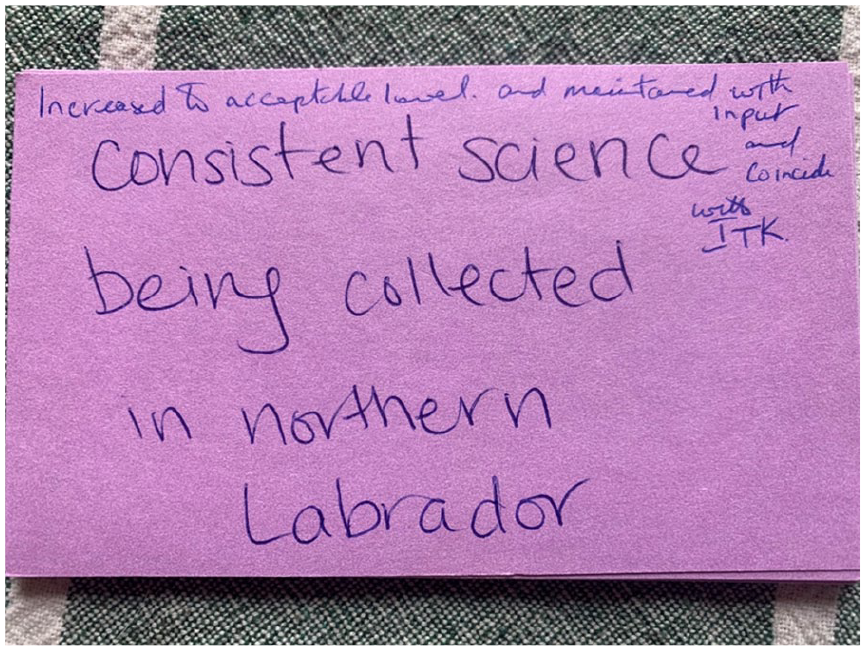
A photograph of a prompt card from the workshop that states: “consistent science being collected in northern Labrador.” A participant has added additional text to the card: “Increased to acceptable level, and maintained with input and coincide with ITK [Indigenous Traditional Knowledge]” (Photo by Rachael Cadman).
Participants saw increased inclusion of and respect for Inuit Knowledge as essential for producing the outcomes they wanted for their communities. One board member noted that “food security is part of our identity and history” (participant PN04), speaking to the ways that Inuit communities see it as essential to share their resources. This became incorporated into the final vision through the maintenance of community freezer programmes. During the final discussion, the participants noted the importance of “maintaining our culture and connection to land” through the fisheries. Two breakout groups noted that by gaining more control over fisheries governance they would be able to implement policies that promote better stewardship—including less invasive gear types.
The group saw the future of fisheries to be embedded within an Inuit Knowledge system, guided by their own cultural values and world view. This extends the vision beyond general control over management mechanisms and outcomes and into an interest in governance (Grey & Kuokkanen, 2020). In this context, we define the word governance in line with Kooiman (2003). The governance of natural resources is distinct from management because it refers to the connections between everyday decision-making and the broader social and cultural context in which those decisions are made. No governance system is a blank slate. It is always wrapped up in the cultural norms and values of the people that created it. When Whyte (2018) wrote that Indigenous Knowledges have “governance value” (p. 63), he was referring to the fact that Indigenous Knowledges are their own paradigms for understanding and interpreting the world, guiding decision-making, and connecting to land (Latulippe & Klenk, 2020). In Canada, fisheries governance is embedded in the settler colonial state, guided by a certain set of values and norms (Silver et al., 2022; Todd, 2018). The interest of the workshop participants in aligning the inputs and outputs of commercial fisheries with their own values and knowledge system implies an interest in getting involved with governance at a systemic level, beyond they currently could be said to have control over. To accomplish this, Labrador Inuit might look to the articulation of IQ in Nunavut governance. Nunavut has articulated guiding principles and values that are now embedded in policy, research, and decision-making processes to ensure that a Nunavummiut ethic steers governance (Ferrazzi et al., 2018; Wenzel, 2004). Nunatsiavut may wish to develop a similar system to guide management in accordance with their own knowledge system.
Contextualizing sovereignty for Labrador Inuit commercial fisheries
This idealized vision for the future of fisheries provides some insight into Nunatsiavut’s current approach to sovereignty. The definition of sovereignty emerging from the vision is framed around the ongoing work of Labrador Inuit for representational self-determination over Nunatsiavut lands and waters. We understand that there are many sovereignties existing with Indigenous Peoples across the world, and so we scope this investigation into sovereignty to Labrador Inuit fisheries, acknowledging that other sectors, peoples, and obligations will change how sovereignty is understood. By centering this research on the future of commercial fisheries for Labrador Inuit, we provide insights into one small piece of a large and complex puzzle for Indigenous sovereignty.
The question of recognition is central to the conversation of Indigenous sovereignty. Van der Porten (2012), drawing on work by Coulthard (2007), locates this problem in the Canadian context. In order for an Indigenous nation or people to achieve self-determination, they must ask the federal government to recognize their claim, reinforcing the power imbalance between the two parties. In this framing, Indigenous people cannot rely on the state to provide true sovereignty and must turn inward to protect and nurture its own legal, political, and governing orders as a way of achieving sovereignty.
But the legal structures implemented by the state continue to shape Indigenous lives and rights in real time. The future vision developed through this process does not break away from the issue of recognition politics. There is an understanding among the partners that addressing the current legal framing is necessary to move towards greater sovereignty. The three pillars emerging from the discussion all require that the Federal Government grant extended rights or privileges to Nunatsiavut. The success of this future depends on the government acquiescing. But the individuals involved in this process are very familiar with the political context of Nunatsiavut. This analysis came from a specific time and place, from a group of people who work within and are affected by the everyday decision-making concerns of commercial fisheries and more generally colonial fisheries management. This vision of sovereign fisheries is embedded in the social, political, and legal realities facing Nunatsiavut fisheries stakeholders.
The extent to which Labrador Inuit have authority over fisheries is grounded in a land claim agreement, which was negotiated and signed by both the Labrador Inuit Association and the federal government of Canada. Several of the institutions responsible for fisheries governance in Nunatsiavut were created through that agreement—in particular, the Nunatsiavut Government and the Torngat Joint Fisheries Board. Capacity to support, evolve, or expand fisheries in the region relies on these groups. Our understanding of sovereignty does not occur out of space and time, it is grounded in the legal and political realities that Nunatsiavut lives with, and thus, we would argue that whatever articulation of sovereignty we develop through this research must acknowledge recognition from the state.
Importantly, however, this vision does not invalidate the significance of grounding this definition of sovereignty within a Labrador Inuit Knowledge system. The research question, the methods used, and the interpretation of the results are motivated by a desire for the revitalization and rejuvenation of a Labrador Inuit governance system according to their own knowledge system, values, and priorities and for the continuation of Labrador Inuit culture. It thus displays some of the characteristics of both an “outward” and an “inward” turn for achieving sovereignty.
Increasingly, Indigenous scholars are suggesting that land claim agreements, under their current iteration, may not offer adequate solutions for Indigenous sovereignty to thrive in the Canadian context (Inutiq, 2022; King, 2015; Snook et al., 2022). The vision presented in this article moves Labrador Inuit treaty rights and responsibilities beyond what is described in the LILCA. Labrador Inuit management and governance has grown significantly since the land claim was ratified in 2005, and it may be that what they can do for themselves (administratively) surpasses what was imagined by the negotiators. While in a normative sense, Labrador Inuit beneficiaries maintain the same level of legal authority, their capacity has grown dramatically over the last 15 years, and this vision indicates that they may be ready to assume new roles and responsibilities in their traditional territories. This raises an important question: Is the current land claim agreement robust and resilient enough to adapt to an evolving Inuit territory?
The goal posts are shifting for what Indigenous self-determination might look like in the coming decades. Canadian co-management arrangements have not sufficiently contended with how context, knowledge, and culture affect their ability to meaningfully share power. If Canada truly intends to reconcile with Indigenous Peoples, it needs co-management arrangements that empower Indigenous Peoples as equal partners, which requires parity between Indigenous and Western knowledge systems. It may be that a more generous interpretation of the land claim agreement on the part of the federal government, in line with the “spirit of the agreement” (Snook et al., 2018, p. 68), would be enough to help Nunatsiavut achieve its vision. But this would require the Canadian government to give up some of their authority voluntarily. More likely, this vision could only be achieved with Nunatsiavut and Canada back at the negotiation table. This vision helps bring into focus shifting definitions of Inuit sovereignty and raises questions about the usefulness of a static land claim agreement. It may be necessary to evaluate our understandings of land claim agreements as one step in a longer process towards the sovereignty of Indigenous people.
One note written in a facilitator’s book from the final visioning workshop reads “incremental change isn’t the way—or is it?” (anonymized facilitator). Perhaps by reconceiving of sovereignty as a process, as well as a beacon to aim for, we can see the ways that Labrador Inuit are working for a future guided by their own governance system.
Conclusion
The Fisheries Visioning Project produced a story for the future of Labrador Inuit commercial fisheries that advances their interests in the access, management, and governance of fisheries adjacent to their traditional territory. This story provided us with an opportunity to examine how Labrador Inuit fisheries stakeholders understand the commercial fisheries as bound up with Labrador Inuit culture and wellbeing. In so doing, we identified three pillars that support their vision of the future and provide some insights into how this future vision fits into a conceptualization of sovereignty.
On its own, a vision like the one in this research cannot be emancipatory. Significant systems-level changes would be required to carry out the vision put forward in this exercise, which seems unlikely to happen within our lifetimes. But the vision may act as a beacon for what might be possible given Labrador Inuit control of the resources off their shore. It remains a step on a longer journey towards sovereignty.
Footnotes
Acknowledgements
The authors acknowledge the participants in this study with thanks, particularly to all project partners who gave time and creative energy to keep this project moving through the COVID-19 pandemic. Additional thanks to the staff of the Torngat Wildlife Plants and Fisheries Secretariat, especially Aaron Dale, Shawn Rivoire, and Beverley White for their support. This work was done on the lands of Nunatsiavut, traditional territory of Labrador Inuit. The map was prepared for the authors by Shawn Rivoire (Happy Valley-Goose Bay, Labrador).
Authors’ note
Declaration of conflicting interests
The authors declared no potential conflicts of interest with respect to the research, authorship and publication of this article.
Funding
The authors disclosed receipt of the following financial support for the research, authorship and publication of this article: This study was supported by a Canada First Research Excellence Fund grant through the Ocean Frontier Institute. RC acknowledges support from a Social Sciences and Humanities Research Council (SSHRC) doctoral award.

Glossary
Inuit an Indigenous People of northern Canada, Greenland, and Alaska, USA
Inuit Qaujimajatuqangit that which Inuit have always known to be true
Inuk a Person of Inuit descent
Kanien’kehá: ka: People of the Chert; an Indigenous People of southeastern Canada and northern New York State, USA; otherwise known as Mohawk
Mdewakanton Dakota a Native American tribe located southwest of Minneapolis and Saint Paul, USA
Mississippi Ojibwe a Native American people whose tribal band office is located in northern Minnesota, USA
Sioux Native American tribes from the Great Plains of Canada and USA