




Abstract
This article explores the potential of TikTok videos as a method of relational engagement for Indigenous artists. The concept of relationality is the foundation of Indigenous artistic practices, through which Indigenous art is representative of an ongoing process of knowledge sharing and connection rather than a final product. Within this process, art is given meaning through the extensive relationships that inform its stories and symbolism such as the artist’s connections, ancestral knowledges, and both Indigenous and non-Indigenous audiences. The ways that Indigenous artists share their art on platforms such as TikTok play a key role in the Indigenous art process. Using data produced through content analysis of three TikTok videos, this article highlights the various ways that Indigenous artists use TikTok videos and its functions as a means of sharing knowledge, locating their identities, and maintaining extensive relationalities with themselves, community, Country, and ancestors.
Introduction
With the rapid development and prevalence of digital technologies and online networks, social media platforms have become powerful tools for connection, activism, and knowledge sharing. The popularity of different social media platforms over the past decade has ushered in new ways to communicate with others on an interpersonal, intercultural, and global scale. With the rise in popularity of platforms such as TikTok, Instagram, and Snapchat in recent years, audio-visual communications and engagements have become a staple in online and offline people’s lives globally, particularly for Indigenous Peoples. This article focuses primarily on TikTok over Instagram and Snapchat due to TikTok’s broader audience and creative potential.
There are three main social media platforms that include videos, which are Facebook, Instagram, and TikTok. In this article, I focus on TikTok as it provides a more flexible and autonomous format for users to create and engage with content they are interested in (Karpova & Borymska, 2022). TikTok (2020) is an online platform, usually the main destination for short-form videos. TikTok algorithmically generates a video feed based on the user’s interests and interactions (Karizat et al., 2021) such as likes, comments, shares, and follows.
Unlike Instagram and Facebook, TikTok provides a more flexible and autonomous format for users to create and engage with content they are interested in (Karpova & Borymska, 2022). With countless video-making features at users’ disposal—such as video-editing interface, default and custom filters, voiceover, text-to-speech narration, background music or sounds, duets, and stitches (Geyser, 2022)—TikTok’s features allow users to creatively and efficiently contribute to social, cultural, and political discourses globally. Each of these in-app features plays a part in TikTok’s algorithmic process, particularly how these features are used in relation to the video’s content—or subject matter—and how audiences are engaging with this content. TikTok’s algorithmic process also applies to keywords in video captions, the types of hashtags used—such as #Indigitok, #LGBTQI+, and even the video creator’s physical traits such as their weight, skin colour, and ability (Karizat et al., 2021). While a comprehensive discussion of social media algorithms as systems of violence against marginalised peoples are beyond the scope of this article—it is important noting that Indigenous TikTok users navigate a unique space of engagements and institutional violence that result from the colonial history of so-called Australia and global politics more broadly (Carlson, 2020). Current research demonstrates that online spaces, including social media and apps, are sites of complex and nuanced interactions for Indigenous Peoples. Aboriginal scholars such as Carlson (2020, 2021a, 2021b), Farrell (2021), and Kennedy (2018) have made extensive contributions to research on Indigenous Peoples’ interactions with digital technologies and online spaces. Social media platforms can be sources of empowerment, connection, and activism for Indigenous Peoples, while also functioning as sites of online and offline colonial violence (Coe, 2022). Indigenous social media users—both those who openly identify as Indigenous and those who “look” Indigenous (Carlson & Kennedy, 2021, p. 2)—experience consistent abuse and harassment based on their Aboriginality, especially if they exist at the intersections of multiple marginalised identities based on sex, gender, sexuality, class, and so forth (Farrell, 2021). Indigenous social media users are constantly forced to “prove” and explain their Aboriginal identities to settler audiences (Carlson, 2021, p. 14), whose understandings of Indigenous Peoples are limited to racialised “inferiority” or “criminal” stereotypes (Carlson & Kennedy, 2021, p. 9).
Because of the heightened exposure to racial and anti-Indigenous abuse, many Indigenous social media users engage in self-censorship or self-policing of their identity to avoid or reduce racialised violence online (Carlson, 2021; Carlson & Frazer, 2020). Examples of self-policing for Indigenous Peoples online include not identifying as Indigenous on social media platforms, setting your profile as “private,” avoiding engagement with “drama” or discussions on Indigenous issues, and “keeping an eye” on family or younger mob (Carlson & Frazer, 2020, pp. 5–6). The need to censor ourselves, our communities, and our individual and collective identity as Indigenous Peoples forms a complex space of interactions and expressions which impact Indigenous communities both online and offline.
This article explores how Indigenous artists utilise short video-based content to share knowledge and contribute to the relational art process. The article first introduces the features, engagements, and complexities of TikTok in both a general sense and with particular focus on Indigenous Peoples. Following this, an overview on relationality as a living practice and as a theoretical framework are provided. These contextualise an in-depth examination of Indigenous art as a relational process. Then the article analyses the video posts of various Indigenous artists on TikTok by exploring the cultural knowledges within their work, and the audio and visual functions they use to communicate knowledge and engage relationally. These findings provide a glimpse into the ways that Indigenous Peoples utilise emerging technologies to create and maintain cultural connections—while also highlighting how TikTok plays an important role in both the Indigenous artistic process and the continuation of Indigenous relationalities. This article is informed by my position as an Indigenous artist and frequent TikTok user.
Positionality
It is important that I acknowledge my position within this research by honouring the social, cultural, and relational contexts that inform my thinking (Martin & Mirraboopa, 2003). I am a queer, non-binary, Wiradjuri (Aboriginal Peoples of central New South Wales [NSW], Australia) person that was born and raised on Darkinjung Country in eastern NSW, Australia. I am related to the Riley and Ferguson families from the Dubbo and Darlington Point areas, respectively. My experience and knowledge as a Wiradjuri artist is informed by my relations to my Uncle Mick Huddleston, whose cultural name is Gararroongoo—a Ngardi (Aboriginal Peoples of the Northern Territory and Western Australia, Australia) man from the Roper River region of East Arnhem Land, Aunty Karen Lee, whose cultural name is Mungarrja—a Wiradjuri woman from the Western Sydney area in eastern NSW, and Aunty Linda Huddleston, whose cultural name is Nungjingi—a Wiradjuri and Ngardi woman from Katoomba in eastern NSW. My cultural knowledge is also informed by my upbringing and connections to community on Darkinjung Country, and my continual connections to my immediate and extended families from both Wiradjuri and Ngardi Country.
I must also note my position as an openly Indigenous queer person who actively uses TikTok. My knowledge of TikTok is informed by my continual usage of the app since its rise in popularity in 2019, through which I have observed and experienced the developments of Indigenous, LGBTQIA+, Indigenous LGBTQIA+, and Indigenous art-related content on the app. My position as an Indigenous artist and a frequent TikTok user grants me an informed perspective on this research matter.
Methods
I draw on and ground this research in relationality through the research of significant Indigenous scholars such as Kwaymullina and Kwaymullina & Kwaymullina (2010, 2014), Rey (2019), and Graham (1999, 2014), who actively engage with the concept and practice of relationality. The term relationality describes the foundational worldview within many Australian Aboriginal language groups that recognises the physical, emotional, and spiritual interconnectedness of humans, animals, Country, time, space, and spirits. Within the complex, interwoven relationships that we all possess with everything, everywhere, and “everywhen” (Stanner, 1979, as cited in Rey, 2019, p. 48), there is a foundation of reciprocity that recognises the responsibilities we have to all kin, including humans, non-humans, and more-than-humans to maintain and care for Country. We as Indigenous Peoples are defined and known by our complex relationships to others, particularly our engagements with Country (Graham, 1999). The ways in which we relate and interact with each other are informed by our cultural histories which are intertwined with our ancestors and Country. Our cultural histories are the living memories of our ancestors. The interactions that our ancestors had with each other, Country, and spacetime are interwoven in the ancestral web of the Dreaming.
The Dreaming is a living web of ancestral memories that exist within us, Country, animals, plants, space, and time. The ancestral memories of the creator spirits and our ancestors—the human descendants who coexisted with Country—are the foundation that informs our understanding of, and reciprocal relationships with, the world around us. These ancestral knowledges have been passed down to us through oral storytelling, ceremony, and everyday engagements with Country and other lifeforms. Our ancestral stories contextualise the geographical and cultural history of Country (Saunders, 2022), such as how the creator spirits formed the lands, how our ancestors cared for Country and our kin, and how other non-human and more-than-human lifeforms engage with Country and each other (Kwaymullina & Kwaymullina, 2014). We keep these stories alive by following the Lore or Law of Country.
Aboriginal Lore are the practices that maintain the reciprocal relationships that all living beings have with one another (Kwaymullina & Kwaymullina, 2014). Our Lore comes from the interactions our ancestors and the ancestral spirits had with Country that have been passed down to us since time immemorial. The purpose of Lore is to lay out the framework on how to interact with and sustain Country alongside the other non-human and more-than-human beings alongside us (Kwaymullina & Kwaymullina, 2010). Lore teaches us how to protect and nurture Country and how to engage with each other and our non-human and more-than-human kin—which are also interwoven with how we interact with Country. Lore also tells us how to live well, how to strengthen the relationships between us and the non-human and more-than-human beings around us, and how to heal and support ourselves and our communities (Dudgeon & Bray, 2019). Country gives us our Lore, and we learn from and pass down this Lore through ceremony, oral storytelling, dance, and art.
The foundation of relationality is the intricate and ongoing web of relationships that is directly informed by—and given meaning by—Country (Tynan, 2021). One of the many ways in which Aboriginal People sustain and communicate their relationships and Dreaming knowledges is through the practice of art. For many Aboriginal People, art is both a process of (re)connection to our culture and communities, and a method of storytelling that weaves together the artist’s identity, experiences, cultural knowledges, and kinship and community ties into a visual story (Cameron, 2010).
Relationality as a theoretical framework
A core understanding of relationality permits an informed analysis of Indigenous Peoples’ online engagements on TikTok. Indigenous artists are utilising TikTok as a means of relational engagement by sharing their works, connecting to other Indigenous Peoples both nationally and globally, and sharing stories and knowledges through TikTok videos. Relationality forms the foundations of all Indigenous ways of knowing, being, doing, and relating, which is prevalent in Indigenous relational practices such as oral storytelling, art, dance, and ceremony, playing significant roles in the continuation of our culture and histories (Rey, 2019). The current emergence of social media technologies initiates a realm of possibilities for mob to engage relationally within the online and offline space. I argue that these relational practices of oral storytelling, visual arts, dance, and other forms of cultural storytelling can be conducted through digital platforms just as effectively as in-person engagements.
Digital technologies such as social media, FaceTime, Zoom, and many others can be utilised within our relational engagements in situations where in-person engagement is not possible—an example being during peak of the COVID-19 pandemic in 2020 to 2021. In this situation—and similar circumstances—digital communication platforms became important tools of human interaction, especially for mob who are more at-risk of infection, long-term illness, and community transmission due to a multitude of political, social, and historical factors (Dudgeon et al., 2021). The restrictions of in-person contact, and long-distance travel meant that many Indigenous Peoples turned to digital technologies, particularly social media platforms, to maintain relational connections to family, culture, and Country (Holt & Worrell, 2021). Even outside of the context of COVID-19, communication technologies are accessible tools that assist in the maintenance of interpersonal relationships by providing mob of all ages and locations with direct audio-visual communication irrespective of geographical distance. This direct communication is especially important for mob—both historically and currently—who have been forcibly displaced from their Country, cultures, and connections through ongoing colonial violence.
Aboriginal art as a knowledge transfer process
The role of art within Indigenous cultures is one that weaves together ancestral knowledge with everyday practices as a method of maintaining strong relations with our communities, Country, and other non-human and more-than-human beings. Alongside oral storytelling, ceremony, and other relational practices, Aboriginal art as both an artistic process and a finished creative work is a form of knowledge sharing that communicates Dreaming knowledges, stories associated with the artist’s Country, and a multitude of other forms of knowledge that are culturally significant to the artist and their communities. Aboriginal art is a visual depiction of histories and relationalities throughout time, with Country as both the foundation and the canvas (Neale & Kelly, 2020). While being a vital source of community identity, kinship, life skills, and cultural knowledge (Cameron, 2010), Aboriginal art processes represent a visual interweaving of Country as a living and fluid space, and the artists’ utilisation of cultural knowledge, relationalities, and memories within the artistic process (Rey, 2019).
A common notion held by settler audiences that Aboriginal art—much like other forms of Western art—can be understood and critiqued based on its finished result, which opposes Indigenous ways of knowledge sharing. Aboriginal art—or what many settlers understand to be Aboriginal art—extends beyond just an artwork on a canvas and is a purposeful act within the relational process. This process is an ongoing story that is directly informed by the artist themselves, their ancestral and community knowledges and relationalities, their Country or Countries of connection, their community’s ancestral knowledges, the viewer’s own cultural, community and ancestral knowledges and connections, Country, and the non-human and more-than-human beings that are connected to each party in this process.
To explain the artistic process as a relational act, I provide an overview of an Aboriginal artistic process. This is informed by my own personal and familial connections. The stages involved in this artistic process are not linear. Each stage of this process informs the other, regardless of the order they take place within the artists’ journey. Within each stage is an ongoing process that informs and is informed by our identities, cultural knowledges, communities, Country, and our relationalities more broadly. Each stage in this process can happen concurrently, which provides an alternative route to the artworks’ sharing of knowledge and art process overall. Each of the stages in the following explanation plays a significant role in how meaning, knowledge, and relationalities are expressed and defined through Aboriginal art.
The first stage of the art-making process involves a mediation of the artist’s knowledge (Neale & Kelly, 2020). Regardless of the knowledge origin—such as an artist’s ancestors, communities, Elders, Country, or by non-human or more-than-human presences—the action of remembrance and reengagement with cultural knowledge informs the visualisation and exploration of the artwork and creation. Reengagement with cultural knowledge can involve visiting sacred sites or areas of personal connection for inspiration, such as rock art sites. Reengaging with community stories and knowledges through rock art allows the artist to be guided by the emotional and spiritual responses that can be felt by being present within sacred sites (Taçon, 2019).
In the second stage of the art-making journey, the artist or artists begin the physical creation of the artwork by culminating their personal, ancestral, and community knowledges. Using their preferred medium—such as acrylic paint, raw ochre, textiles, a carving knife, digital tools, and so forth—and their preferred surface—such as paper, canvas, fabric, sand, the human body, animal skin, and a multitude of others—artists can use these physical tools and mediums to create a visual story. The action of creating a visual story on a physical surface puts us in deeper connection with ourselves, our ancestors, Country, and everything, everywhere, everywhen around us (Stanner, 1979, as cited in Rey, 2019).
While also remembering the knowledge from the first stage that came from our extensive relationalities, we are also feeling and embodying these knowledges both on behalf of our ancestors and on behalf of ourselves in our physical bodies. We feel these stories, knowledges, and emotions during this process. The physical, emotional, and relational action of creating art teaches us ancestral knowledges and provides an avenue for us to heal—both as individuals and as a collective across time (Cameron, 2010). Within each brush stroke, woven thread, and movement of a finger is a culmination of ancestral knowledges, individual experiences, and mutual love for our extensive relationalities—which communicates a timeless, visual story. As Indigenous Peoples, especially us who experience intersectional abuses such as misogyny, queerphobia, transphobia, classism, ableism, or xenophobia (Carlson & Day, 2021), our art is a relational expression of our cultural knowledges, love for community, and resistance against the settler colonial regime (Barnes, 2023). This stage in the art process is the practice of embodying knowledge and weaving that knowledge with the mixed emotions of love and rage from ourselves, our ancestors, and Country.
The third stage involves the oral, textual, or performative explanation of the artwork’s meaning and story from the artists to their communities and other Indigenous Peoples of close connection. This stage is characterised by the artists’ oral explanation of the artwork, its meaning, the culturally relevant symbolism, the creation process, and the stories and knowledges that informed the artwork and the artists’ visualisation. The artists’ explanation of the artwork is told to their respective community members, Elders, and any other Indigenous Person that is interwoven with these communities, through which this explanation opens up an intimate space of conversation, remembrance, and discussion. This intimate space—similar to a yarning circle—includes Elders and community members discussing the stories and knowledges that are being depicted in the artwork and remember and embody the feelings that might be associated with these. The intimacy of this space also initiates the dialogue to any misrepresentations or breaks of cultural protocol that might have been done by the artist. For example, if an artist were to use symbolism from another community without their permission, or if an artist depicted a Dreaming story that did not align with their communities’ Lore, the artists and community members could share and discuss their perspectives in an open dialogue that includes knowledge sharing, interpersonal connection, and a teaching of morals for everyone involved. This stage of the artistic process is important as it embodies the ways that Indigenous Peoples have shared knowledge and maintained relationships with each other and Country since time immemorial, which is through oral storytelling (Rey, 2019).
Oral storying—both historically and in the current day—is a vital method of meaning-making, communicating, imagining, and relating for many Indigenous Peoples. Even within our everyday interactions with each other, the ways that we observe, listen, care, connect, and relate to each other within our conversations are forms of oral storytelling that underpin our relationalities (Rey, 2019). Although being physically present within the conversation is an important contribution to the intimacy of the speaking space, communication—including phone calls, video calls, social media, and other technologies—are equally valid and necessary methods of storytelling. These are discussed later in this article. The conversational and interpersonal engagements I’ve outlined in this stage can also happen in the second stage during the creation of the physical artwork. Having conversations with the artist or artists while they paint or listening to the stories that the artist or artists plan on depicting in the artwork grants each participant a more informed and refined understanding of the artwork’s relational storying and strengthens the connection between the artist and the listener (Cameron, 2010).
The fourth stage is less-so a methodical stage in the process, but a result of the widespread sharing of the particular artwork. Whether it is shared globally, nationally, or within community, this stage is where the viewer plays a role in the relationalities of the art process. Different from the previous stage, this stage includes the created artwork being observed, understood, and engaged with by audiences outside of the artists’ communities and close relations. In addition, the artist or artists themselves are not physically present alongside the artwork to provide an oral explanation of the artwork’s stories and relationalities—which can cause disconnect between the artist, artwork, community, and the Indigenous or non-Indigenous observer. A common situation where this stage would be reflected would be an Aboriginal artwork that is displayed in an art gallery, where the physical artwork is presented with only a written explanation of the artwork’s story and meaning. The absence of the interpersonal and relational engagements that come with in-person storyings means that a foundational part of the artwork’s stories, meanings, and relationalities are missing.
However, the importance of this stage comes from the audience’s engagement to the artwork without the artist there communicating the stories and relationalities of the artwork. What the audience understands, infers, and takes away from the visual and textual stories of an artwork—whether Indigenous or non-Indigenous—is informed by their personal experiences, identities, upbringings, and a myriad of other factors. For Aboriginal art in particular, what the audience understands of the artwork and what they do with that interpreted knowledge is interwoven with the extensive relationalities of the artwork itself, the artist or artists, and Country. For example, if a non-Indigenous observer engages with an artwork from a Wiradjuri artist that depicts a Murray River turtle searching for snails and water plants to eat, the observer could infer that the Murray River turtle has relational ties to Wiradjuri stories and Country, while also inferring that the turtle plays a vital role in the Murray River’s ecosystem. Through inferences such as these, the observer—now with an increased understanding of Wiradjuri Country, relationalities, and artistic practices—is better able to share this knowledge with others, while also reflecting on this knowledge to change the ways they engage with turtles, river ecosystems, Wiradjuri knowledges, Country, and Aboriginal art more broadly. Although just an example, this scenario represents a real and ongoing dynamic that reflects the relational nature of the world, and more specifically Aboriginal art.
To better understand the relational artistic process, it could help to imagine each stage in the process as the physical act of taking a step when we walk. By undergoing this creative journey, we are walking with ourselves, our knowledges, and our extensive relationalities. We are not walking to a final destination in this journey, instead we are using walking as a method of connection and immersion on a physical, emotional, and spiritual level. When we have no destination, it does not matter where our steps take us—just that we had the time to experience the journey with ourselves, our knowledges, and our relationalities. The steps we take through this process can happen at any time, anywhere, in any order, and with a varied amount of time between each step. Whether it takes us a few hours or even a few lifetimes to take the next step, the artwork that we create—both in its physical presence and the relational process that created it—will weave itself into the relational web of knowledge that is accessible across time and place.
Each stage of the Aboriginal art process is reflective of the different methods of relationality that form the basis of Indigenous lifeways that have been maintained since time immemorial. With the advancement of technologies and settler colonialism’s ongoing attempts of Indigenous erasure (Carlson, 2021; Day, 2021; Haebich, 2015), mob are utilising social media technologies to maintain and assert Indigenous knowledges and relationalities. The remainder of this article will examine how the four stages of the Aboriginal artistic process are reflected in different TikToks by Indigenous users.
Discussion
This TikTok features Kaytetye (Aboriginal Peoples of central Northern Territory, Australia) artist Louise Numina Napanangka during the painting process (Figure 1). As she paints, Louise explains her relationalities and the meaning of the medicine leaves symbols throughout her work, going on to explain the healing properties of these leaves. The TikTok is demonstrative of the second stage in the Aboriginal artistic process that is defined by the physical creation—in this case, painting—of the artwork to express some form of knowledge. The video utilises a variety of TikTok’s features such as voice over, transitions, and various hashtags such as #aboriginalart, #art, and #oddlysatisfying to increase the likelihood of appearing on both Indigenous and non-Indigenous People’s For You Pages (FYP).
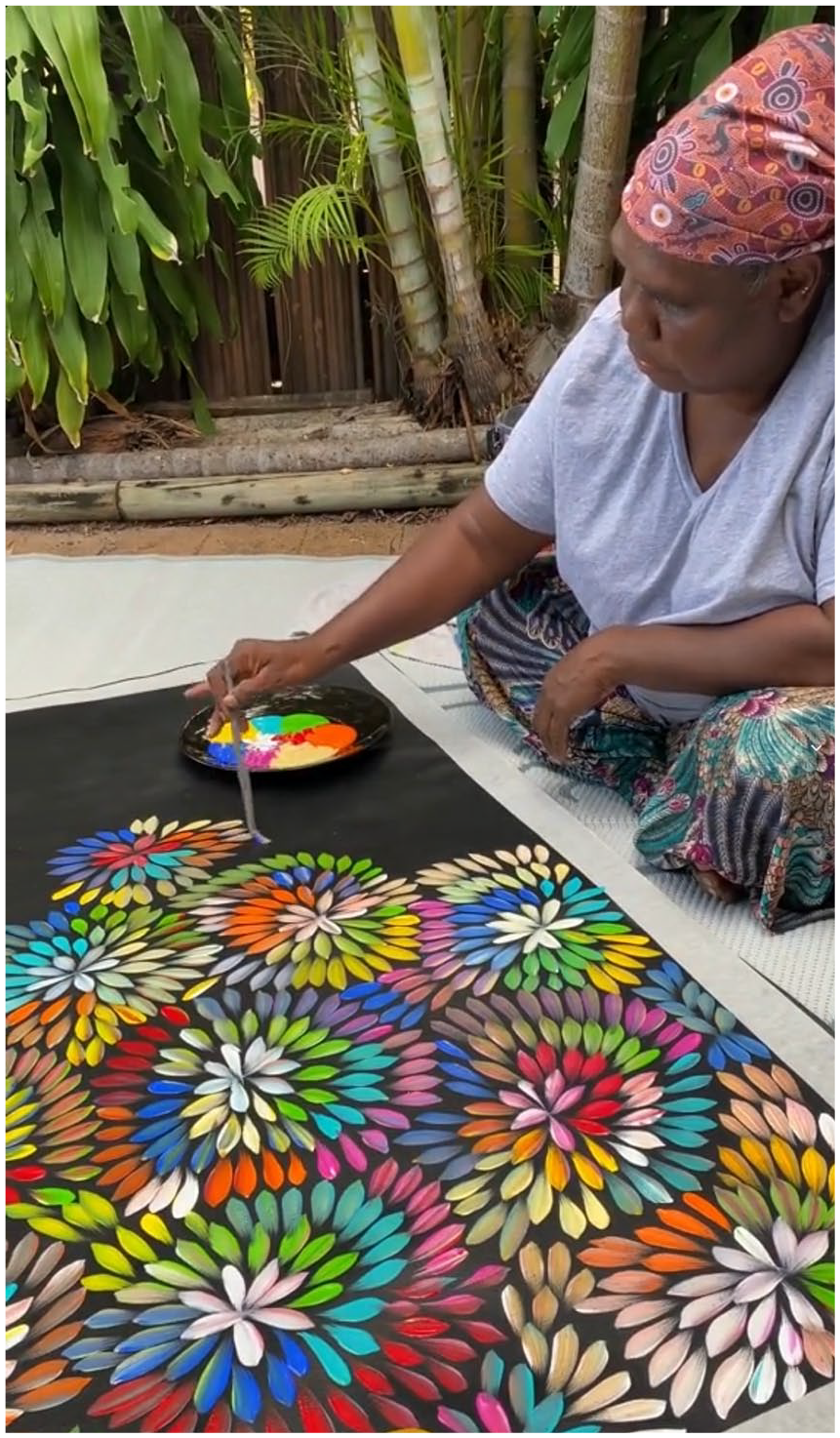
Kaytetye (Aboriginal Peoples of central Northern Territory, Australia) artist Louise Numina Napanangka during the painting process (Photo by Dylan Barnes).
The combination of Louise’s in-person explanation and her narration over the painting footage is a form of relational storytelling that uses TikTok as the medium to facilitate connections and transfer knowledge. In this case, the video footage captures Louise’s painting process in real time, while the narration and intermittent video shots of Louise’s explanations allow for knowledge to be shared both visually and orally. While the audience—or viewer—of the TikTok video cannot be physically present with Louise themself, the conversational nature of the video and the intimate space that is fostered through the sharing of cultural knowledge helps to bridge the gap between the audience and the artist. In addition, the depiction of Louise laughing with her children and the person filming at the beginning of the video further bridges the artist versus online audience divide by creating a more casual and intimate online space, particularly for Indigenous audiences (Huggins, 1987, as cited in Duncan, 2014). Although the intricacies of Indigenous humour online are beyond the scope of this article, humour plays an active role in fostering and maintaining relational connections for Indigenous Peoples (Duncan, 2014).
Featuring Dalabon (Aboriginal Peoples of the Northern Territory, Australia) artist Manuel Pamkal, this TikTok features Manuel as he paints a crocodile on a yidaki (didgeridoo) and shares his childhood memories of collecting crocodile eggs (Figure 2). The TikTok primarily uses various hashtags such as #aboriginaltiktok and #aussie to boost engagement with both Indigenous and non-Indigenous TikTok users. Manuel’s storytelling provides context for the overall painting while also demonstrating how an artist’s stories give meaning to the created art. Manuel’s reflection helps to strengthen the relationship between the storyteller and the listener while also allowing the storyteller to engage with, reflect, and embody their own memories, which are intertwined with those of our ancestors (Geia et al., 2013). In addition, Manuel’s personal reflection communicates relational knowledges such as how the blooming of yellow flowers on kapok trees means the beginning of the crocodile egg season, and how freshwater crocodiles will only attack humans when a human gets too close to its eggs. These relational knowledges that are shared through the conversation between Manuel and the cameraperson create an intimate space for connection where the viewers can learn these knowledges within the intimate, digital learning space. In this case, the cameraperson’s position within the conversation with Manuel allows the viewer to be present within the conversation in the camera-person’s place. This video demonstrates how digital conversations can be practised and interwoven with the relational process through TikTok’s audio-visual functions.
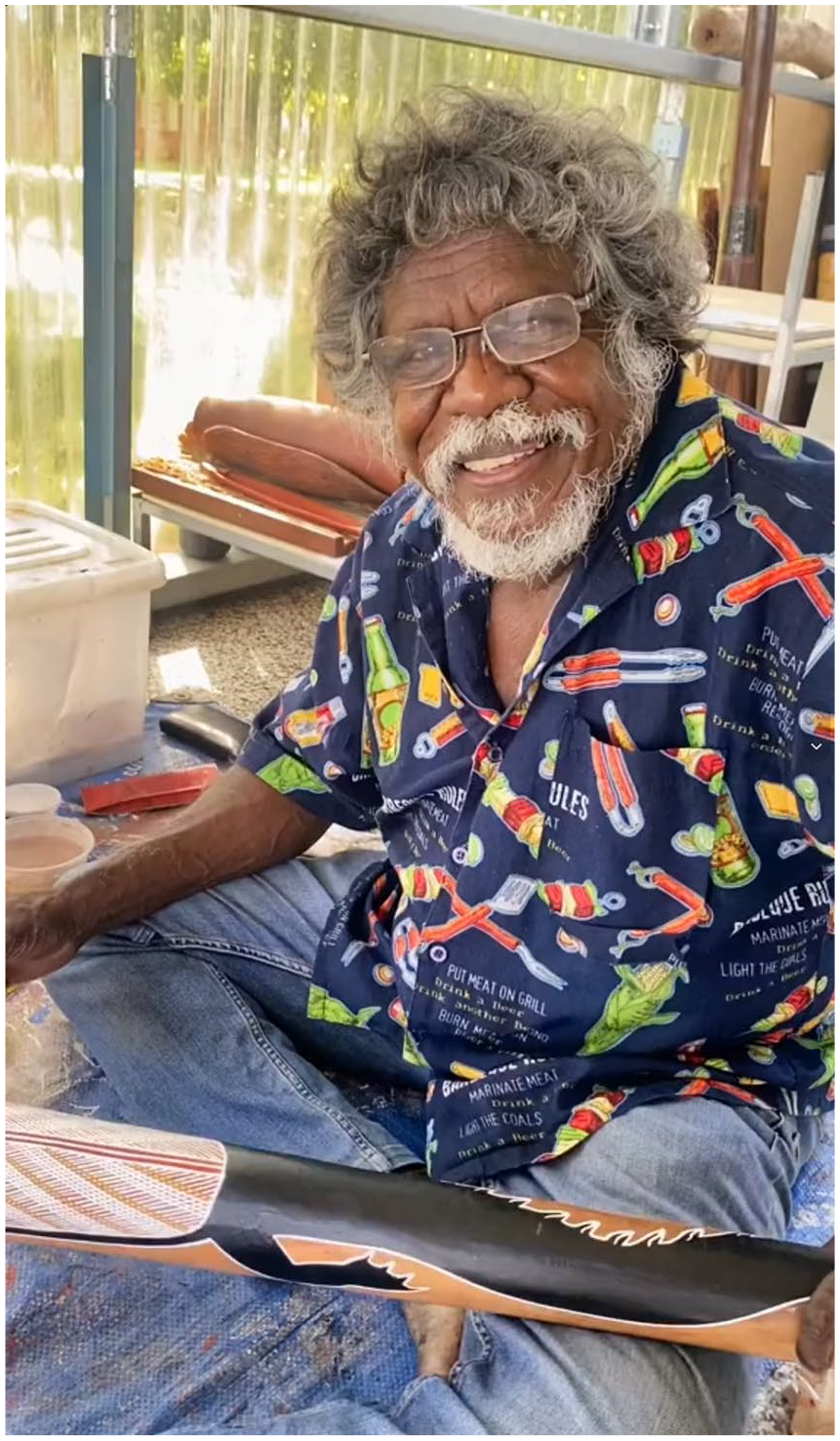
Dalabon (Aboriginal Peoples of the Northern Territory, Australia) artist Manuel Pamkal during the painting process (Photo by Dylan Barnes).
This TikTok features Bibbulmun (Aboriginal Peoples of southwestern Western Australia, Australia), Noongar (Aboriginal Peoples of southwestern Western Australia), and Chilean artist Jay Van Nus (2023) painting a mural using various TikTok functions—such as video editing, trending sounds, hashtags such as #art, #aboriginalart, and #aboriginaltiktok, and text-to-speech voiceover—to create a captivating video for various audiences (Figure 3). Jay uses the text-to-speech function and subtitles to explain the symbolism and the stories within the artwork, particularly why they used these symbols to convey a specific story. Using these functions in addition to the painting process footage, Jay is able to visually and orally communicate cultural knowledges simultaneously, which is reflective of the second stage of the Aboriginal art process. As TikTok users cannot be physically present with the artist while they are creating the artwork, the TikTok video becomes the medium through which the artist can yarn with the audience and tell their stories.
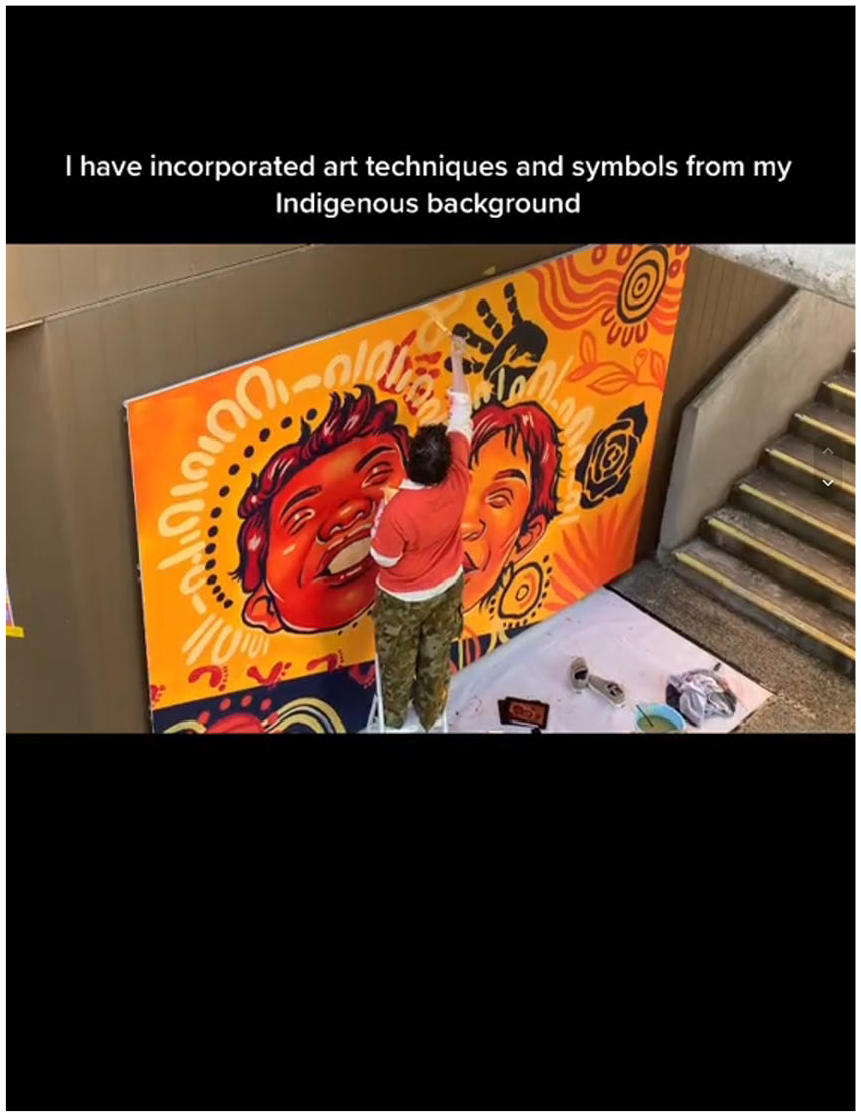
Bibbulmun (Aboriginal Peoples of southwestern Western Australia, Australia), Noongar (Aboriginal Peoples of southwestern Western Australia, Australia), and Chilean artist Jay Van Nus during the painting process (Photo by Dylan Barnes).
In addition, Jay’s text-to-speech explanation of why they expressed certain symbols and stories to convey a specific message is reflective of the fourth stage of the relational art process. Characterised by the understandings, reflections, and actions of broader audiences after engaging with an artwork, Jay’s explanation facilitates further connections where the viewer can imagine themselves and their experiences within the artwork’s stories. Even when both the artist and the viewer are not physically present in the storytelling or discussion of the artwork, Jay’s text-to-speech explanation bridges the gap between the audience—both Indigenous and non-Indigenous—and the extensive relational knowledges within the artwork.
Each of the previously discussed TikToks highlights the various methods and expressions of Indigenous artists that are reflective of the relational artistic process. The TikToks featuring artists Manuel Pamkal (TopDidj, 2022) and Louise Napanangka (Bluethumb Art Gallery, 2022) express relational storying and knowledge sharing through both an informal conversation between the cameraperson and the artist, and video snippets of each artist painting. Alternatively, the TikTok by @jaykulbardi (Nus, 2023) expresses these relationalities and knowledges through text-to-speech narration over video snippets of Jay in the painting process. Although slightly different methods of knowledge sharing and storytelling, both conversational and text-to-speech communications on TikTok are living and ongoing conversations that are interwoven within the online archives of knowledges and engagements.
As TikToks can be viewed, engaged with, and saved at any time regardless of the post date, all forms of content such as videos, comments, and other interactions on TikTok become ongoing or living conversations that anyone can view and contribute to. The concept of living conversations online acknowledges that all content that exists on the internet, including content that has been deleted (Önal, 2019), can be engaged with in an almost eternal dialogue. Carlson (2021) applies Nakata’s (2007) concept of the Cultural Interface to highlight the complex and intersecting ideas, relationships, dialogues, and engagements that Indigenous Peoples are situated within in the online space. These intersecting dialogues and engagements are further complicated over time with changing societal values and political discourses, particularly settler–colonial dialogues that centre Indigenous Peoples or the Indigenous position (Carlson, 2021). Although the complexities of online Indigenous–settler relations are beyond the scope of this discussion, the concept of an ongoing or living conversation in the online space provokes a unique perspective on the expansiveness of the relational artistic process.
An online, living conversation in relation to Indigenous Peoples and knowledges is situated within the fourth stage of the relational art process. TikToks such as the three discussed previously exist within the global landscape of online content, engagements, and discourses that are freely accessible to any and all audiences. Each TikTok embodies and shares a form of relational knowledge by utilising TikTok’s expansive digital platform. For these TikToks to reach a local and global audience means that the relational engagement between Country and artist, artist and community, art and artist, and art and audience is expanded and complicated. What an audience—either Indigenous or non-Indigenous—can infer, understand, or engage with from an Aboriginal art-related TikTok is interwoven with the living conversations that precede, inform, and define it. For as long as the TikTok video exists or did exist, the ideas, dialogue, and engagements that arose from the video are interwoven into the living conversations of Indigenous Peoples, the Indigenous position, Indigenous art, and Indigenous cultural knowledges more broadly.
Each of the previously discussed TikToks demonstrates the expansiveness and fluidity of the relational artistic process through the medium of audio-visual content and social media platforms. Each TikTok utilises different app features such as hashtags and trending sounds to utilise TikTok’s algorithm and increase their visibility on viewers,’ especially mobs,’ FYP. Considering the biases that TikTok’s algorithm has towards particular marginalised groups (Karizat et al., 2021), Indigenous content creators are forced to take advantage of the algorithm in order to increase their viewership. Although the shared knowledge or content of the previously discussed TikToks is not affected by algorithmic biases, the decreased viewership on these videos impedes on the fourth stage of the relational artistic process. As the fourth stage focuses on the engagements of a broader audience, these algorithmic biases actively limit the potential that these TikToks have to connect, teach, and engage with both Indigenous and non-Indigenous audiences. There is opportunity for further research into the impact that TikTok or other social media algorithms have on Indigenous users and content creators. To this extent, there is potential for further analysis into how various social media algorithms can complicate how Indigenous Peoples and knowledges are perceived, understood, and engaged with on a local or global scale.
Conclusion
The relationalities of Indigenous artists online are spaces of complex engagement that ultimately play a key role in the Indigenous artistic process. While this article focuses primarily on Aboriginal artists on TikTok, these examples demonstrate the usefulness of relationality as a framework to better understand the interconnectedness of Indigenous Peoples’ digital engagements and the Indigenous artistic process. This research contributes to the field of Indigenous subjectivities and online engagements as explored by Carlson (2020, 2021). There is potential for further research on Indigenous LGBTQIA+SB (lesbian, gay, bisexual, transgender, queer, intersex, asexual or aromantic, Sistergirl or Sistagirl, and Brotherboy or Brothaboy) relationalities in both online and offline spaces, through the current and future works of Day (2019, 2021), Farrell (2017, 2021), O’Sullivan (2021a, 2021b), Sullivan and Day (2019), and Coe (2022).
This article has highlighted the ways in which Indigenous artists are using TikTok as a method of knowledge sharing and relational engagement. The examination of TikTok as a social media platform and a space of complexities for Indigenous Peoples, along with the comprehensive explanation of the theoretical and cultural contexts of relationality provided foundational knowledge to better understand Indigenous digital relationalities. This was explored through an extensive discussion of the relationalities within the Indigenous art process, through which was provided a relevant framework to analyse how Indigenous artists share knowledge and engage relationally through TikTok. In closing, digital technologies such as TikTok are an ever-changing space of meanings, subjectivities, and relationalities that can be potential sites of resistance and (re)connection for Indigenous Peoples. Alongside this, the emergence of research related to relationality and Indigenous creative practices creates a realm of possibilities for future research into Indigenous digital creativities. It is abundantly clear that Indigenous relationalities are expansive and fluid systems that can be incorporated into the daily lives of Indigenous Peoples, regardless of the medium.
Footnotes
Acknowledgements
We acknowledge and pay our respects to Ngurra and the traditional custodians of Dharug Country—the Wallumattagal clan—who continue to care for and protect the lands that this article was written on. We extend our respects to all Elders both past and present who share, embody, and preserve the knowledges of our ancestors. We also acknowledge the ancestors and custodians of the Wiradjuri, Ngardi, and Darkinjung nations that have informed our own cultural identity, relationships, and artistic practice.
Author’s note
Declaration of conflicting interests
The author declared no potential conflicts of interest with respect to the research, authorship, and publication of this article.
Funding
The author received no financial support for the research, authorship, and publication of this article.

Glossary
Bibbulmun Aboriginal Peoples of southwestern Western Australia, Australia
Dalabon Aboriginal Peoples of the Northern Territory, Australia
Kaytetye Aboriginal Peoples of central Northern Territory, Australia
Ngardi Aboriginal Peoples of the Northern Territory and Western Australia, Australia
Noongar Aboriginal Peoples of southwestern Western Australia
Wiradjuri Aboriginal Peoples of central New South Wales, Australia
yidaki didgeridoo