



Abstract
Connection to culture in Australian First Peoples children is an important social determinant of health in child development and wellbeing. The current study draws upon the collective knowledge of Australian First Peoples Elders and community leaders to collaboratively develop the first theoretical conceptualisation of connection to culture in Australian First Peoples children. Through participatory action research, we integrated both Western and Indigenist methodologies. One-on-one qualitative narrative interviews were conducted with six Australian First Peoples Elders and community leaders. Their knowledge was summarised through a process of Western thematic analysis and Indigenist arts-based participatory analysis to identify core concepts and mechanisms of connection to culture in First Peoples children. The outcome was a theory of connection to culture in Australian First Peoples children. By better understanding how children connect to culture, we can better support children in connecting to culture, targeting an important factor of health and wellbeing.
Introduction
Connection to culture is an integral aspect of Australian First Peoples ways of being, knowing, and doing. For Australian First Peoples children, it can be a source of strength and resilience (Gee et al., 2014). It encompasses all aspects of a child’s life (Bamblett & Lewis, 2006), building the foundations of a child’s values, beliefs, and understandings of who they are in the world. First Peoples Elders, community leaders, and knowledge holders in Australia know the benefits of culture on their peoples and that culture is essential for health, wellbeing, and child development. Scientific discourse on this topic is limited, but research has found engagement in cultural activities to be a protective factor. For example, it enhanced family functioning (Lohoar et al., 2014), it protected youth from suicide (Berry et al., 2010; Burgess et al., 2009; Gibson et al., 2021), and it was considered central to healthy child development in First Peoples from Western Australia (Scrine et al., 2020). Public schools that engaged children in learning traditional First Peoples languages found that this strengthened students’ development of cultural identity, pride, and self-worth, which increased their engagement in learning (Korff, 2019; Purdie et al., 2008). Furthermore, there is a convergence of evidence to show that children who are removed from their First Peoples culture have poor developmental and psychosocial outcomes (Australian Human Rights Commission, 1997; Cunneen & Libesman, 2000; Turnbull-Roberts et al., 2022).
Despite Elders’ knowledge and scientific research concurring that connection to culture is an important social determinant of health, development, and wellbeing for Australian First Peoples children, there continues to be an inherent colonial nature to Western medicine and health delivery in Australia. This is a major barrier to improving First Peoples health (Sherwood & Edwards, 2006). Weaving connection to culture and cultural health and wellbeing into healthcare for Australian First Peoples begins the process of addressing current and historical inequities in Australian health systems. Addressing inequity in Australian healthcare systems is challenging because factors that are important for First Peoples health and wellbeing, such as connection to culture, have not been historically valued by Western health systems. To create a shared understanding, we must find ways to translate First Peoples’ ways of being, knowing, and doing into a medium that can be understood and embraced by the Western health systems that exist throughout Australia (Sherwood & Edwards, 2006; Taylor & Guerin, 2014). Few theoretical conceptualisations of cultural connectedness within Australian First Peoples have been published in the scientific literature. The current study is the first to qualitatively distil the experiences and learnings from community Elders, who are treasured and rare cultural icons and knowledge holders, to co-construct a developmental theory of connection to culture in Australian First Peoples children. Central to this theory is an innovative approach to integrating Indigenous methodologies with qualitative scientific rigour to progress our understanding of the mechanisms of connection to culture in Australian First Peoples children.
It must be noted that cultural connectedness, as it is used here, is not intended to represent a person’s Aboriginality or Indigeneity, but rather be a conceptualisation of how children engage and connect to their own First Peoples culture. Racist and inhumane policies and practices in Australia shaped an entire generation of First Peoples, the stolen generation (Australian Human Rights Commission, 1997). The physical, social, and emotional traumas from these policies not only impacted the stolen generation but have been passed on through intergenerational trauma. With the loss of family and community came the loss of language, culture, land, and knowledge, which, along with the trauma of their experience, has not only impacted the lives of the stolen generation but those of their children, grandchildren, and future generations. One of the largest, long-lasting effects of colonisation in Australia has been the loss of language and social, cultural, and spiritual practices. Therefore, it is acknowledged that due to the past and ongoing impacts of colonisation, the extent to which one may be connected to their own First Peoples culture varies greatly across individuals. This study aims to focus on the preservation of culture, emphasising the ways that children are connected, the knowledges that have survived to be passed down, and the ways children may be able to further develop and grow their connection to their culture.
Existing Australian frameworks of connection to culture have focused on where connection to culture fits within the ecological system of an individual and not on the essence of “what is connection?” (Kingsley et al., 2013; Krakouer et al., 2018). A North American study proposed a framework for Indigenous connectedness (Ullrich, 2019) providing a holistic perspective on child wellbeing and Indigenous connectedness. The framework is not focused on connection to culture specifically but does explore important aspects of it. Ullrich’s (2019) framework was developed through a comprehensive literature review of concepts and mechanisms of Indigenous wellbeing pertaining to First Peoples populations from Canada, the USA, Australia, and New Zealand. The framework proposes five core concepts of Indigenous connectedness. These are environmental, community, family, intergenerational, and spiritual connectedness and key mechanisms of connectedness found withing these concepts. Ullrich then later expanded upon her theory in her doctoral dissertation (Ullrich, 2020) by interviewing Alaska Native knowledge bearers who were foster-care alumni, relative carers, or foster parents. This updated theory also focussed on Indigenous wellbeing and connectedness but with an accompanying framework of Indigenous disconnectedness within an Alaskan Native context. Due to its general conceptualisation of Indigenous connectedness rather than a focused North American conceptualisation, Ullrich’s (2019) general theory on Indigenous connectedness was used as a reference point for the current study. The current study expanded upon the work of Ullrich (2019) by co-designing directly with Australian First Peoples Elders and cultural leaders. This was necessary to honour the differences in cultural connection that exist across First Peoples within and across countries.
Co-designing with Elders and community leaders through participatory action research and qualitatively documenting their knowledge was integral to ensuring the most accurate information was included within the conceptualisation (Baum et al., 2006). Elders were chosen as participants because they are the treasured and rare custodians of their culture’s knowledge and Lore; they have permission to disclose knowledge and beliefs. Without Elders’ input and guidance, one may risk engaging in culturally unsafe research. Furthermore, many First Peoples knowledges are embedded within oral traditions, held only by Elders, with much knowledge inaccessible in written records. Narrative analysis was used to understand First People Elders’ and community leaders’ perspectives on connection to culture from their knowledge repository and their own personal experience (Clandinin, 2013). The Indigenous methodology of representing the data through art was an important component in ensuring cultural knowledges were accurately translated in a culturally acceptable manner (Hammond et al., 2018). This was also inspired by Ullrich’s (2019) use of artistic motif within her theory, from North American Inupiaq’s (a group of North American Indigenous peoples from north-western Alaska, USA) and Yup’ik’s (a group of North American Indigenous peoples from south-western and south-central Alaska, USA) tools, jewellery, and artwork.
Developing a comprehensive theoretical conceptualisation of how children connect to their First Peoples culture may provide healthcare professionals with the understanding and knowledge necessary to better support First Peoples children. A greater understanding and knowledge of the specific mechanisms of culture could then aid healthcare professionals with engaging in culturally safe practices (Brascoupé & Waters, 2009). A theory may also help give First Peoples children guidance around opportunities to rebuild strong cultural connections, enhance resilience, and potentially improve developmental outcomes. This is particularly important for those children who continue to experience the effects of displacement policies and cultural dispossession (Currie et al., 2019).
Method
Inspired by Ullrich (2019), the current study utilised participatory action research to integrate both Western and Indigenist methodologies. It was led by an individual from the Wiradjuri (a group of Australian Indigenous peoples from central New South Wales) Nation and co-designed with Elders, community members, First Peoples academics, and non-Indigenous academics with First Peoples research experience. Ethics were informed by the Australian Institute of Aboriginal and Torres Strait Islander Studies (AIATSIS, 2020) code of ethics for Aboriginal and Torres Strait Islander research and received ethics approval from the Griffith University Human Research Ethics committee (GU Ref No: 2020/941).
Participants
Australian First Peoples culture dates back over +60,000 years, making it one of the oldest living and continuing cultures today (Malaspinas et al., 2016). Australian First Peoples culture is preserved and passed down through oral traditions by important knowledge holders and leaders. Of these knowledge holders, Elders are considered the most senior. An Elder’s knowledge on cultural matters is both invaluable and unparalleled, and to work in collaboration with an Elder on this project is a necessity, but to work with multiple Elders on this project is incomparable. The current study is the result of a collaboration with six Australian First Peoples Elders and community leaders who are recognised as such by their community. The collective knowledge of these participants was extraordinarily rich, and the depth of their knowledge is profound.
A chain sampling technique was used to recruit participants, with initial participants recruited through prior established relationships the authors have with local Elders and community leaders on the Gold Coast and in Mt. Isa. Participants consisted of three male and three female Elders and community leaders from the following mobs: Alyawarre (a group of Australian Indigenous peoples from the Northern Territory), Eastern Arrernte (a group of Australian Indigenous peoples from central Australia), Eastern Aranda (a group of Australian Indigenous peoples from central Australia), Kalkadoon (a group of Australian Indigenous peoples from west Queensland), Kombumerri (a group of Australian Indigenous peoples from south-east Queensland), Minjungbal (a group of Australian Indigenous peoples from northern New South Wales), Ngugi (a group of Australian Indigenous peoples from south-east Queensland), Wakka Wakka (a group of Australian Indigenous peoples from south-east Queensland), Warluwarra (a group of Australian Indigenous peoples from west Queensland), and Yugambeh (a group of Australian Indigenous peoples from south-east Queensland).
Measures
A narrative interview was used to collect data. This involved an unstructured interview style that allowed the researcher and participant flexibility in collaboratively formulating what is said and how things are said during the interviews (Lavrakas, 2008). This provided a high level of control to participants over how their narrative was presented. Some interview prompts were used, such as “In your own words, define cultural connectedness in First Peoples children,” “Can you tell me a story of how you connected to culture as a child?,” and “What aspects of culture do children engage and connect to?”; however, interviews were not bound by these questions alone.
Procedure
Informed consent to participate was obtained. One-on-one narrative interviews were conducted face-to-face, over videoconferencing, or via telephone by a First Peoples researcher. With participants’ permission, the interviews were either audio-recorded with the dialogue transcribed to text or completed with note taking for two Elders. All participants were informed of their right to withdraw from the project at any time.
Data analysis
The transcribed data were interpreted using an inductive thematic analysis (Braun & Clarke, 2006), whereby categories, patterns, and themes from transcribed interviews were identified and extracted using NVivo 12. The lead author, who conducted the interviews and transcribed the data, generated initial codes, and searched for themes. Text frequency searches were also used to support the emergence of themes. Ullrich’s (2019) model was also consulted to compare emergent themes. The second and last author reviewed the data and extracted themes, with discrepancies resolved through discussion. Themes were then presented to participants and remaining co-authors and discussed until agreement was achieved. The arts-based participatory analysis was conducted by the lead author who artistically interpreted the themes using traditional Wiradjuri art symbols. This involved translating emergent key themes into cultural symbols familiar to the author’s own Wiradjuri culture. Initially, interpretations were sketched digitally and then painted using ochre. This design was presented to participants for comment and then finalised.
Results
The qualitative thematic analysis found one superordinate theme of Lore and Dreaming, which then had two subordinate themes of connection to country and connection to kin. The two subordinate themes were not mutually exclusive with three factors emerging in the intersection of the two: knowing where you come from, knowing your values, and expression of knowledge. These are presented in Figure 1 and were named mechanisms of culture.
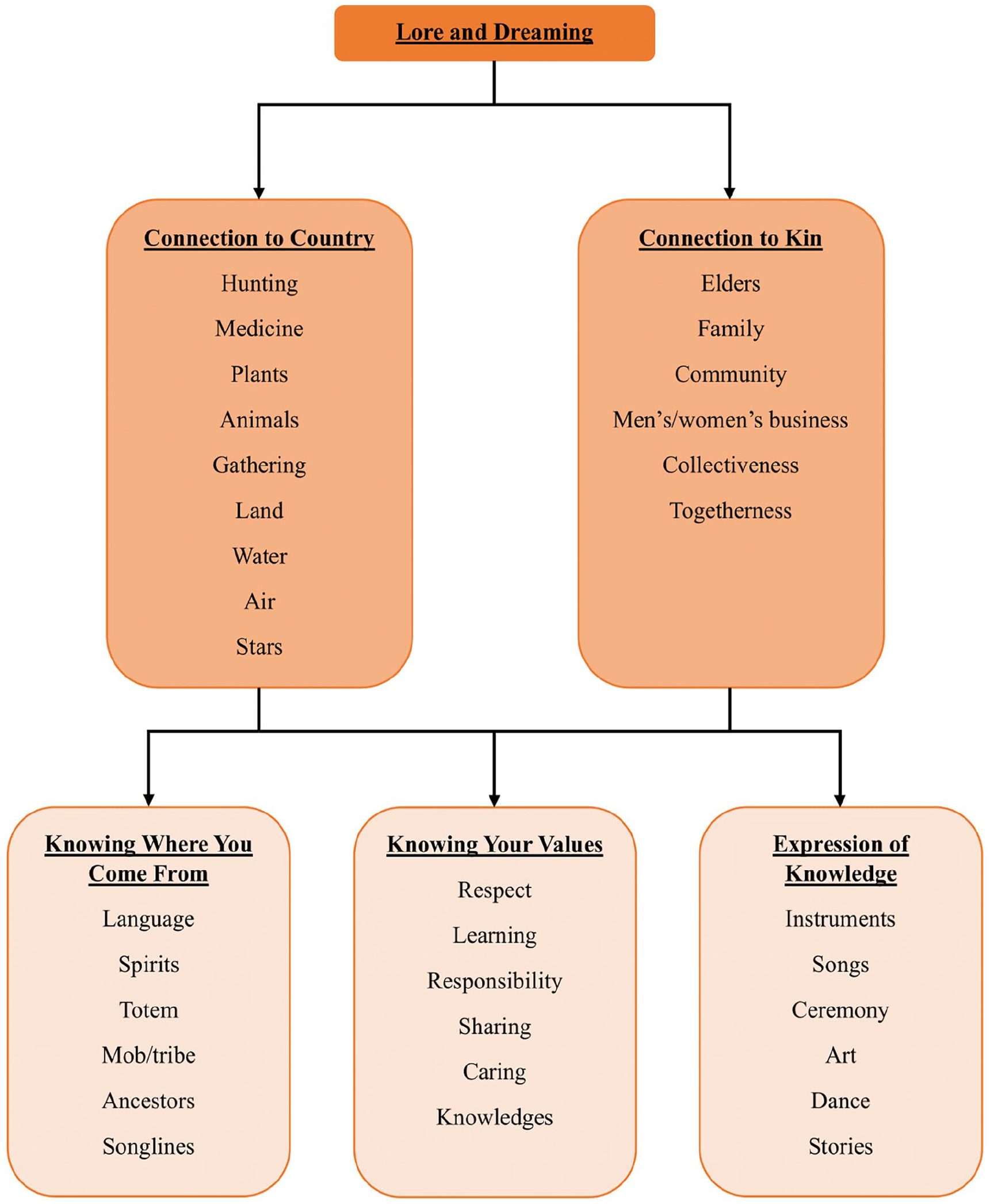
Mechanisms of culture.
Lore and dreaming
The superordinate theme was Lore and Dreaming. This first represented the Lore of First Peoples culture. Different to the Western concept of law, Lore was explained as the customs and stories that were upheld by and passed down from Elders to the wider First Peoples community. Second, it represented the Dreaming, also known as the Dreamtime, which was described as a concept that was difficult to explain in written or even spoken word. The Dreaming has been simplified by Western audiences as a concept that encompasses the creationist stories of the land and times of the past; however, the Elders described the Dreaming as something that transcend the Western concept of time. It is not bound to the past, present, or future, it is simply a state of existence that First Peoples live in. It was also reported to be a spiritual representation of the flora and fauna around us, the land, the water, and the sky and the spirits that guide us. It was described as an embodiment of spirituality and the collective knowledge of First Peoples that makes up our ways of being, knowing, and doing. Dreaming and Lore were seen as interconnected concepts, as Dreaming was a part of Lore that was shared and passed down, and Lore was a part of Dreaming, which contained important Lore in its stories.
During the interviews, Lore and Dreaming were common themes when discussing children’s connection to culture and was easily established as the theme that encompassed connection to culture the best, as culture could only be connected through Lore and the Dreaming. One Elder said: they engage with things you do with the Lore and the culture like there is a tree there and they’ll say “well what’s that for?” “well that’s where you get your boomerangs that’s where you get this.” . . . then they connect, they’ll go and they’ll want to do it themselves. Or a medicine tree they’ll ask you about that then they’ll wanna make that medicine from that tree, then they’ll know themselves, they can take you back and say “nanna got that bush off that and this is the medicine you make.” (Elder 1, female)
This quote highlighted the process of how a child connects to culture. Children connected through the Lore they learned from their Elders. They used this Lore to connect to both the country and to their kin. It was also a great example of how continuity of culture, an aspect of knowing where you come from, was upheld through this process with children learning, an aspect of knowing your values, and then implementing culture, an aspect of expression of knowledge.
Lore and Dreaming were the overarching concept of connection to culture, and within this was connection to country and connection to kin. One Elder stated, “It’s about connection to country and connection to kin, they’re the essence of Aboriginal culture” (Elder 2, male). Although these two concepts—connection to country and connection to kin—were seen as separate from Lore and Dreaming, they were not independent from it. According to the Elders, it was impossible to truly understand the concepts of connection to culture and connection to kin outside of its context within the Lore and the Dreaming, hence Lore and Dreaming was a superordinate theme.
Connection to country
The first subordinate theme of connection to culture was connection to country. This theme encompassed the manner in which a child connected to and interacted with the space around them, this included hunting, medicine, plants, animals, gathering, land, water, air, and stars. Culturally connected children were reported to have a symbiotic relationship with country, whereby they took care of the land and the land took care of them. As one Elder stated, You can always tell somebody [a child] who is connected because they’ll walk on country, they’ll see things, they’ll sort things out; other kids will just walk and they’ll look at things and its different . . . you’ll know that they’re connected to country because they’re looking at what’s on land and how the country is going to supply them with all that information. (Elder 1, female)
These ideals were supported by another Elder who described culturally connected children as “being able to walk down the riverbank and know how to get back home. Using the stars [for directions] and knowing the Dreaming” (Elder 3, male).
Multiple participants discussed the importance of hunting and living off the land. One Elder intonated that “it [living off the land] was about respecting mother nature” (Elder 2, male). Regarding hunting, Elders spoke of the importance of only “taking what you need” and to use all parts of the animal hunted so that there was no waste and their sacrifice was respected. Multiple Elders discussed different hunting traditions, specific to different mobs, whereby people would pay respects to country before hunting or fishing—this was done to thank the land for providing for them and allowing them to live off of her. Multiple Elders also shared stories of engaging in hunting and or gathering practices as children themselves, and they reminisced on their connection with their parents and Elders who taught them to respect the land and how that would lead to the land respecting and providing for them. Other themes were centred around medicine, particularly about knowing how to identify or find medicine on country; plants, particularly about knowing the importance and uses of plants; animals, particularly around knowing and respecting the animals; gathering, particularly around knowing where to find important foods or materials; land, particularly around respect and knowledge about land; water, particularly around respect and knowledge about water; air, particularly around respect and knowledge about the air and sky; and stars, particularly around knowledge of important stars and Dreaming. These themes were all considered important aspects of connection to country by the Elders.
Connection to kin
The second subordinate theme of connection to culture was connection to kin. This theme encompassed the way a child connected to and interacted with their family, community, and ancestors. This included the mechanisms of Elders, family, community, men’s and women’s business, collectiveness, and togetherness. When discussing the roles of the Elders, including their Elders when they were a child, one Elder stated “everybody had to be treated special, especially, especially the Elders, they were the top one because we know that’s where our history came first from those older people and they were respected by the younger people” (Elder 1, female). Elders explained how they played a special role in the life of children, and one Elder spoke about the intergenerational space whereby Elders would often circumvent the parents and guardians of the child and would directly connect to the child themselves. “Elders will say . . . ‘that’s your parent, but you can talk to me’ in that nice comfortable intergenerational space” (Elder 4, female). This showed how Elders had direct connections and roles in a child’s life—they did not replace the parent, and did not undermine the role of the parent, but rather served as an additional guide and confidant to the child. Another major theme highlighted by an Elder was the importance of collectivist values and how that formed the basis of First Peoples ethics and systems of thought.
It’s not about individualist style of life . . . it [ethics and Aboriginal systems of thought] forms Aboriginal culture and raised the foundations for organising principles that govern the social and political structure, decision making and conflict management systems—developed over immense time, forming the basis of sovereignty. (Elder 2, male)
Elders highlighted that First Peoples children were brought up in a collectivist culture that instilled the importance of country and kin. Other themes were centred around family, particularly about being connected to family; community, particularly about being involved and connected to the community; men’s and women’s business, particularly around knowing about and respecting it; and togetherness, particularly around coming together as family and community. These themes were all considered important aspects of connection to kin by the Elders.
Knowing where you come from
The first of the three factors in the intersection of connection to country and connection to kin was knowing where you come from. It consisted of mechanisms that were applicable to both connection to country and connection to kin. These included language, spirits, totem, mob or tribe, ancestors, and songlines—Aboriginal walking routes that crossed the country, linking important sites and locations. One Elder said, “Well for me [as a child] I lived it [culture]—I ate culture for supper breakfast and dinner . . . we was connected from day dot one” (Elder 1, female). It was expanded that many First Peoples children are brought up surrounded by their culture and are connected to culture from birth; however, this was not always been the case for all First Peoples children. Elders discussed how due to the ongoing impact of colonisation, a child’s caregiver(s) may not have had the knowledge or supports to ensure their child was brought up within their First Peoples culture. For example, one Elder quoted their own Elders on connecting to culture, “The Elders will say ‘We weren’t allowed to speak [in language] or the children would be taken away’” (Elder 5, male). Historically, culture and knowledge was not allowed to be shared, and much was lost. As such, the revitalisation of language, culture, and knowledges was seen as an important aspect of a child’s cultural development, and this was considered by Elders to be fundamentally a part of knowing where they came from.
One Elder expressed the difference between knowing and engaging with their culture and connecting with their culture.
definitely there was a conscious moment [of recognising being connected to culture], but it was when I was a teenager . . . whilst I grew up having these knowledges . . . it was in high school that I had that “connected moment,” whereas everything else [before adolescence] was being taught and engaged with until then. (Elder 4, female)
This highlighted the developmental progression of connection. Where children might have had knowledge and engaged with culture, at some stage, possibly around adolescence, a person connected with culture, although this age might differ across individuals. This Elder also highlighted how this level of connection might not happen for some individuals. Children could fundamentally know that they were Aboriginal and or Torres Strait Islander and be engaged with their culture but may lack the deeper level of connection between culture and their identity. Other themes were centred around the knowledge of and connection to spirits, totems, mobs, tribes, ancestors, and songlines. These themes were all considered important aspects of knowing where you come from by the Elders.
Knowing your values
Knowing your values covered the mechanisms of respect, learning, responsibility, sharing, caring, and knowledges. Respect was a theme emphasised by all Elders, whether that was respect for kin or respect for the land. One Elder highlighted that respect went beyond a value to abide by but was a way of being, knowing, and doing for First Peoples as a whole. They reported that children needed to “know your [the child’s] ways of doing things are in a proper way, in a respectful way” (Elder 6, female). Other themes were centred around learning, particularly about culture from the Elders and knowledge holders; responsibility, particularly the responsibility to country and kin; sharing, particularly around sharing with others and not being greedy; caring, particularly around caring for country and kin; and knowledges, particularly around learning and preserving cultural knowledges. Many of these values were seen as major themes in the Dreaming stories taught to children and were present in the stories shared by the Elders. These stories centred around the Elders being taught as children to only take what they needed from country, to share what they had with kin, to listen to and respect their own Elders, and their responsibility as First Peoples to country and to kin.
Expression of knowledge
Expression of knowledge consisted of the mechanisms of instruments, song, ceremony, art, dance, and stories. These knowledges were typically expressed through art and dance; however, one Elder highlighted that, at an institutional level, First Peoples knowledge expression tended to be limited to artistic mediums.
We really push this notion of art . . . they [a government funded program in schools] hand out cardboard or hardwood boomerang templates and the kids paint them with a few dots and a few lines . . . and it is a great misinterpretation that that’s an art movement out of the middle of Australia . . . I see the misinterpretation and generalisation of what Aboriginal culture is, into a smashing/merging dot artwork or didgeridoo [a wooden dronepipe developed by pre-colonial Indigenous peoples of Northern Australia]. (Elder 4, female)
Multiple Elders noted that the confinement of First Peoples knowledges and culture to art, dance, and instruments was a disservice to the great diversity and richness that made up First Peoples culture across Australia. Art, dance, and instruments were found to be critical and important, but it was equally important to acknowledge ceremony, stories, and song as mediums of expression of knowledge. Elders expressed how songs, stories, and ceremonies were used to teach children about the world they lived in, and these stories were often based in scientific knowledge, for example, biology of different plants and animals, chemistry of bush medicines, and geography of different landscapes. They were also typically seen by Elders as a mode of connecting to the Lore and Dreaming of the particular mob of the child. One Elder emphasised the importance of song and, in particular, songs taught in their language. This Elder told a story of a young child being reconnected to their culture, as well as learning about their family history, through language and songs that the child had been taught. It was also noted that for ceremony, some children may not be old enough to engage in it themselves, nevertherless they can still be present and involved in these practices when age appropriate, and this could be seen as an important way a child connected to their culture.
Connection to culture theory
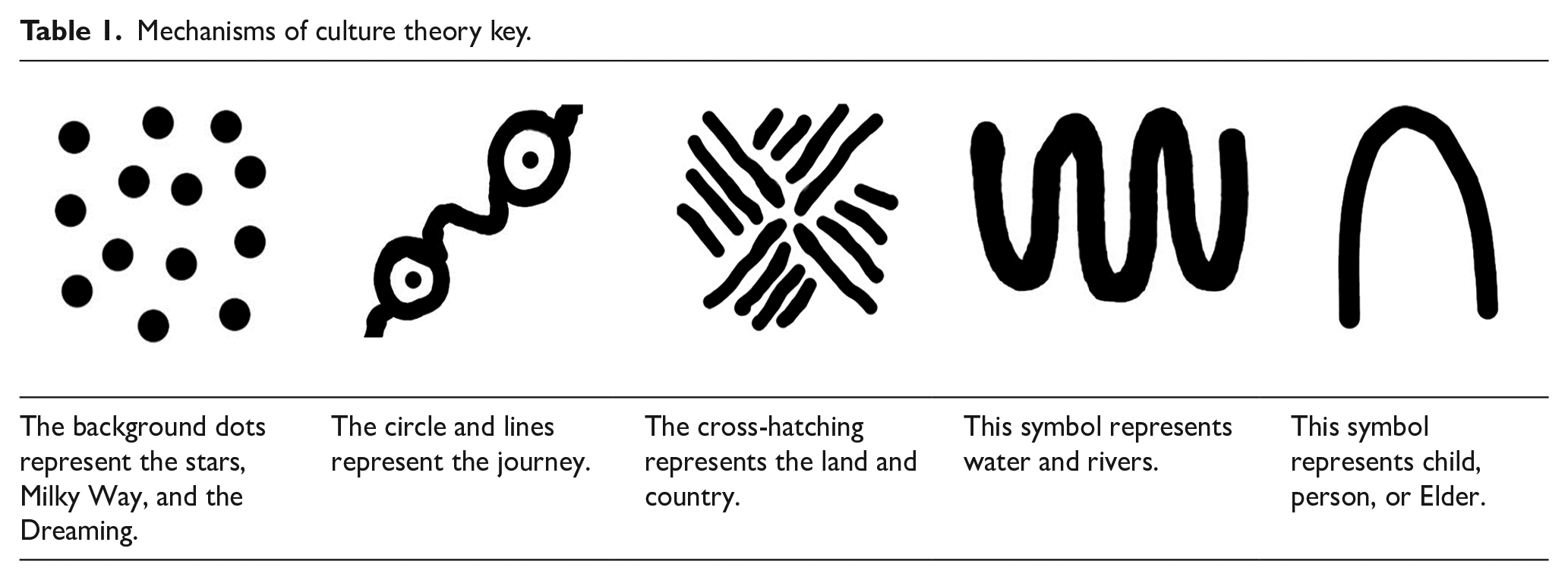
Figure 2 presents an artistic conceptualisation of connection to culture based on the data. The theory was interpretated by Wiradjuri woman and the first author. The background to the theory was the stars and the Milky Way, which represented the Dreaming and Lore that encompassed culture. The circle was then bordered by the symbol for journey, representing the journey that children were on to connect to and engage with culture. Connection to country was shown through the cross-hatching, representing land, and the squiggly lines, representing water. Connection to kin was shown through the upside-down U symbol, which represented Elders and the child. The Elders, such as grandparents, parents, and other kin, surrounded the child and supported the child as they explored and connected to country. Table 1 is a key of the symbols in Figure 2.
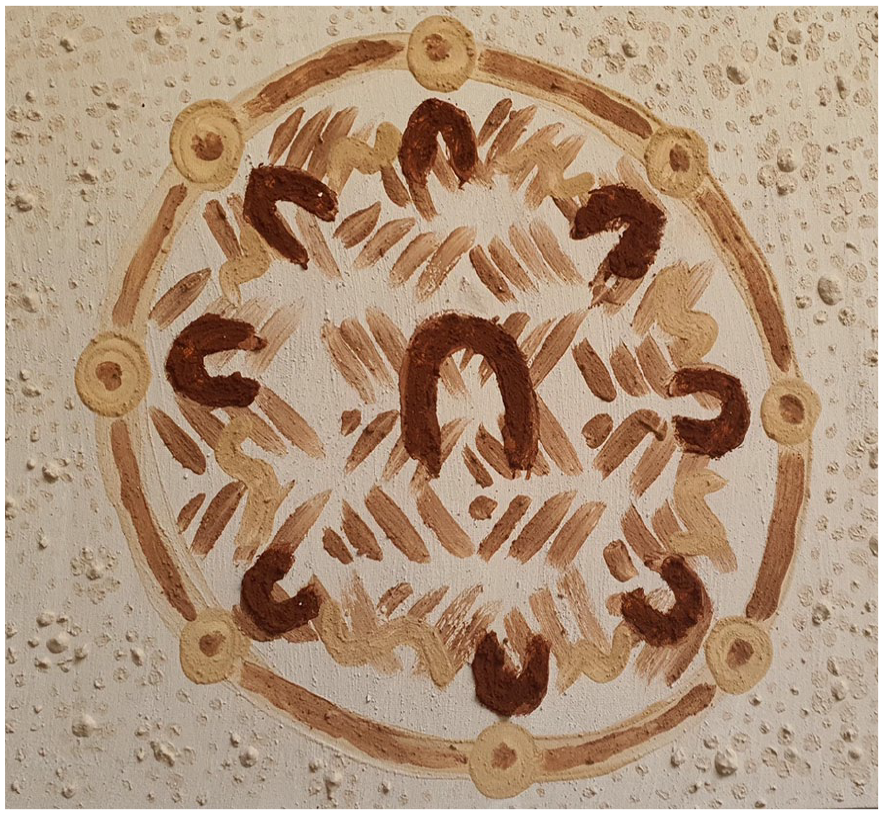
Artistic conceptualisation of connection to culture (Artwork and photo by Leah Henderson).
Mechanisms of culture theory key.





Discussion
The aim of the current study was to collaboratively co-design the first conceptualisation of cultural connectedness in Australian First Peoples children with First Peoples Elders and community leaders. Previous literature had yet to conceptualise cultural connectedness in an Australian First Peoples population. A notable aspect of the current study was the collaboration with First Peoples Elders and community leaders, as well as the use of both Western and Indigenist methodologies in the development and conceptualisation of the theory.
The conceptualisation of connection to culture in Australian First Peoples children was presented in two forms: (a) the mechanisms of culture were presented in themes, and (b) the theory was summarised in a painted artistic interpretation. The mechanisms of culture depicted the superordinate theme of Lore and Dreaming, then the two subordinate themes of connection to country and connection to kin, which encompassed the three themes of knowing where you come from, knowing your values, and expression of knowledge. One main purpose of presenting the conceptualisation of connection to culture in two forms was to ensure the conceptualisation could be disseminated in a manner which Western and Indigenous audiences could both digest. Presenting a theory using exclusively Indigenist iconography would have created a barrier to understanding the theory for Western audiences who may not be familiar with Indigenist knowledges. Conjunctly, a theory that is presented using purely Western structures and symbology would have created a barrier to understanding the theory for Indigenous audiences who may not be familiar with Western knowledges. This does not mean that the mechanisms of culture and the connection to culture theory should be considered two separate theories, but rather that they are two parts of a whole. These two parts together, build the bridge between Western and Indigenist knowledges, creating a synergy which allows a truly holistic understanding of connection to culture in Australian First Peoples children to be formed.
The current study has drawn from Ullrich’s (2019) Indigenous Connectedness theory. As a result, the current theory shares similarities with Ullrich’s framework. An aspect of the current methodology inspired by Ullrich was the application of art and First Peoples symbology within the theory. Ullrich’s use of Inupiaq and Yup’ik tools, jewellery, and artwork represented Indigenous wellbeing in a holistic way, and this concept was similarly applied to the current study with Wiradjuri symbols used to represent connection to culture in a holistic way. Similarities were also seen in the results of the current study, specifically in comparable emergent themes, mechanisms, and concepts. For example, Ullrich’s framework places god, creator, and universe–all encompassing as the backdrop to everything, but although not a direct comparison, Lore and Dreaming emerged as the backdrop to the current theory with similar concepts of creation stories, spiritual power, and overarching connectedness shared between the two. Similar to the current theory’s themes of connection to country and kin, Ullrich’s five themes, including connectedness, environmental, community, family, intergenerational, and spiritual connectedness, were heavily interconnected. Likewise, the themes in the current theory shared interconnections and were rarely mutually exclusive. Comparable concepts can similarly be seen between the current theory’s themes and Ullrich’s mechanisms, such as the shared ideas of togetherness, language, art, and Elders being present in both theories.
The current study presented key differences from Ullrich (2019). Ullrich’s core concept of Indigenous connectedness was defined differently from the current study’s core concept of connection to culture. For example, Ullrich’s theory focused on child wellbeing and the important areas of connection in a child’s life (Ullrich, 2019). In contrast, the current theory focused on how a child specifically connects to their culture. This also produced two theories with different applications. Ullrich (2019) theory helped to foster a general understanding on how children were connected and how that impacted wellbeing, and the current theory helped to understand how a child specifically connected to their culture and the mechanisms involved in connection to culture. Further differences existed in the methodology. Ullrich’s (2019) initial theory was developed from a comprehensive literature review, whereas the current study’s methodology ensured the lived experience of Elders was honoured, as Elder’s knowledge has not often been captured in scientific literature. This was a key difference in how the current theory originated, although Ullrich’s (2020) updated theory took a similar direction and incorporated Elders’ views. Finally, differences between the two could be seen in the structure of each theory. Notably, the structure of the current theory is proposed in two forms, a hierarchical structure and a holistic structure, whereas Ullrich’s is a proposed systematic structure, whereby the child is the focal point, situated within varying degrees of connectedness to greater factors. These similarities and differences together demonstrate both the uniqueness of the current study and the commonalities it holds with other international theories.
Limitations
The lack of written theories on connection to culture in First Peoples children worldwide was a limitation. Furthermore, there were no Australian theories to build upon. As such, there was no way to determine how this theory aligned with other First Peoples theories of connection to culture. It must also be recognised that the theoretical conceptualisation was developed specifically with Eastern Australian, Goori (a self-identifying term typically used by Aboriginal people from northern New South Wales coastal regions), Murri (a self-identifying term typically used by Aboriginal people from Queensland and north-west New South Wales), and Koori (a self-identifying term typically used by Aboriginal people from parts of New South Wales and Victoria) Aboriginal Peoples. As such, the application of the theory must be used with the knowledge that it may not be applicable to all Australian First Peoples. A direction for future research could be to explore how the theory applies to other Australian First Peoples and how it could be adapted. Another potential limitation of the current theory is the great overlap between connection to country and connection to kin. Western academic theories typically aim for mutually exclusive factors with limited overlap between concepts; however, in the case of connection to culture, these concepts were intertwined. This is a limitation in a Western academic sense as it will make distinguishing between concepts difficult, for example, through quantitative data analysis. However, this is not a limitation from an Indigenist point of view as it authentically represents the true connectedness of the concepts in real-life applications.
Implications, future research, and conclusion
Having a theoretical conceptualisation of cultural connectedness in Australian First Peoples children could help foster a sense of belonging, community, and understanding. The current study is the first to translate First Peoples knowledge into an academic conceptualisation of cultural connectedness in Australian First Peoples children. This conceptualisation will have implications for targeted health interventions and the social determinants of health in First Peoples children. In particular, the theory will assist those supporting First Peoples children in thinking more critically, divergently, and holistically about First Peoples child development and the importance of connection to culture for developmental outcomes. For example, it could help support non-Indigenous adults in understanding the specific mechanisms of how children develop and connect to their First Peoples culture, which in turn will help them identify the aspects of cultural connection that benefit child development. The theory could also aid researchers in having a better understanding of the mechanisms important for First Peoples children to connect with culture. The current theory could be used to develop a measure of child’s cultural health, which would be useful in helping to understand areas they may need extra support from community Elders and in providing evidence that improved connection is related to better health outcomes.
Future research should explore systematically interviewing Elders from a wider range of communities and nation groups to better explore generalisability of the theory across different groups. Furthermore, investigation into connection to culture in older age groups such as adolescents and adults could be beneficial for better understanding the mechanisms specific to how these groups connect to culture and how connection changes over time. Research could also explore how related factors to connection such as social connectedness, spirituality, self-determination, and wellbeing interact with connection to culture and in turn impact health outcomes.
In conclusion, the current study has proposed the first theory of connection to culture in Australian First Peoples children. The theory has quantified traditional knowledges from Elders and translated it into Western academic literature. This theory allows these important knowledges to be seen, heard, and understood in the Western spaces, which deal with and include First Peoples children. This is an important step towards addressing current and historical inequities in First Peoples health, enhancing First Peoples wellbeing, improving health outcomes, and setting up First Peoples children to flourish.
Footnotes
Acknowledgements
Indigenous knowledges and teachings are the result of the contributions of generations of Elders and Knowledge Keepers across +60,000 years of culture. We acknowledge the contributions of Elders and Knowledge Keepers both past and present whose rich teachings we were entrusted with in this study. We acknowledge that these knowledges are not owned by any one person and thank the Elders and Knowledge Keepers who imparted us with the knowledges of their community, their ancestors, and their peoples.
Authors’ note
Declaration of conflicting interests
The authors declared no potential conflicts of interest with respect to the research, authorship, and publication of this article.
Funding
The authors received no financial support for the research, authorship, and publication of this article.

Glossary
Alyawarre a group of Australian Indigenous peoples from the Northern Territory
Goori a self-identifying term typically used by Aboriginal people from northern New South Wales coastal regions
Inupiaq a group of North American Indigenous peoples from north-western Alaska, USA
Kalkadoon a group of Australian Indigenous peoples from west Queensland
Kombumerri a group of Australian Indigenous peoples from south-east Queensland
Koori a self-identifying term typically used by Aboriginal people from parts of New South Wales and Victoria
Minjungbal a group of Australian Indigenous peoples from northern New South Wales
Murri a self-identifying term typically used by Aboriginal people from Queensland and north-west New South Wales
Ngugi a group of Australian Indigenous peoples from south-east Queensland
Wakka Wakka a group of Australian Indigenous peoples from south-east Queensland
Warluwarra a group of Australian Indigenous peoples from west Queensland
Wiradjuri a group of Australian Indigenous peoples from central New South Wales
Yugambeh a group of Australian Indigenous peoples from south-east Queensland
Yup’ik a group of North American Indigenous peoples from south-western and south-central Alaska, USA