




Abstract
Historically, research partnerships between Indigenous communities and academic institutions were often harmful for communities; wise ways of achieving more balanced and just relationships are emerging. This project focuses on the research partnership between Grandmother’s Bay and the University of Saskatchewan with the objectives of providing knowledge on initiating Indigenous community-based research and maintaining good relationships between collaborators. One-on-one interviews were conducted with participants and analysed using etuaptmumk (two-eyed seeing), a thematic analysis approach. These themes indicated that research partnerships must proceed through relationships of trust that provide meaningful results and benefit to the community; that traditional approaches, culture, and intergenerational knowledge sharing are key to the research; effective communication and the Indigenous language are encouraged where possible; and ownership, creative design, and dissemination of the research belong to community. This project is the beginning of an ongoing relationship between Grandmother’s Bay and University of Saskatchewan.
Introduction
There is a long and storied history of power imbalances, exploitation, and appropriation within community–university relationships when it comes to research involving Indigenous peoples in Canada. This has been evident primarily in the pattern of research being done on people and communities rather than being done in collaboration with them (Jull et al., 2020). These partnerships must be relationships of trust which incorporate cultural values and ways of knowing and doing that promote reciprocity and reconciliation (Lavallée, 2009). This study will focus on the emerging community–university research partnership between the University of Saskatchewan (USask) and the northern Saskatchewan Woodland Cree (a North American Indigenous people, one of Canada’s largest First Nations) community of Grandmother’s Bay (GMB), one of a group of 19 reserve communities which make up the Lac La Ronge Indian Band (LLRIB).
Statistics show that First Nation communities across Canada consistently score lower on the Canadian Community Well-being (CWB) index than non-Indigenous communities—an average of 19.1 points lower in 2016—with First Nation communities in Saskatchewan having among the lowest CWB scores in the country. Moreover, in 2016, GMB was significantly below the provincial and national averages for overall CWB scores for First Nations—44.0 compared to 51.0 and 58.4, respectively—and below provincial averages in three of the four individual components which comprise the CWB index (Figure 1) (Government of Canada, 2019). GMB community members and USask recognize the need for community-based research to address these disparities, but wish to ensure that research is conducted “in a good way” (Ball & Janyst, 2008).
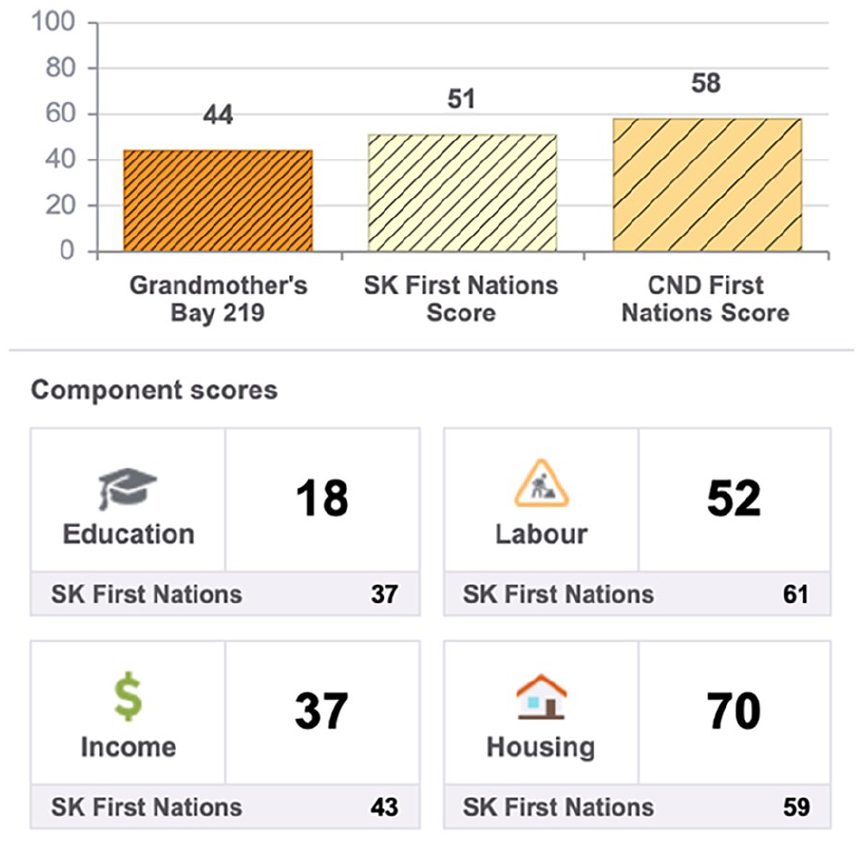
2016 Community Well-Being score (Government of Canada, 2019).
Many Indigenous communities view westernized approaches, methodology, and perspectives as harmful, exploitive, and serving the needs of researchers and academics, while not providing tangible benefits for the communities (Hayman et al., 2015). Community-based research needs a decolonizing process, informed and guided by Indigenous community perspectives, to be implemented in community–university research partnerships (Simonds & Christopher, 2013).
This study aims to demonstrate that an emerging framework for community–university research partnerships with Indigenous communities must advance through mutual respect and trust. The proposed framework will identify and address community needs as well as ensure research findings benefit Indigenous communities. Partnerships of trust were previously established with GMB through the connectedness of Indigenous members attached to the Pewaseskwan (the sky is starting to clear) research team, and councillors and community leaders from LLRIB, which includes the embedded community of GMB. Accordingly, when a funding opportunity arose, the Pewaseskwan leads, who are Indigenous researchers at USask, reached out to these GMB connections—band councillors and leaders of GMB—to apply with Pewaseskwan to co-develop this project. After the funding was received, band councillors and community leads of LLRIB and GMB reached out to the GMB community to facilitate and provide connections which proceeded respectfully according to the community’s cultural practices. By appropriate engagement with community leadership, and following their guidance, the community project was successfully launched in an atmosphere of respect and trust.
Research methods
Community-based participatory research (CBPR) is a methodological approach that is becoming quite common when conducting research with Indigenous communities. Previous research in the USA (LaVeaux & Christopher, 2009) has identified key principles in CBPR, including:
Recognizes community as a unit of identity.
Builds on strengths and resources of the community.
Facilitates collaborative partnerships in all phases of the research.
Integrates knowledge and action for mutual benefit of all partners.
Promotes a co-learning and empowering process that attends to social inequalities.
Involves a cyclical and iterative process.
Addresses health from both positive and ecological perspectives.
Disseminates findings and knowledge gained to all partners.
In addition, a previous Canadian study (Gaudet, 2018) established an Indigenous research methodology named keeoukaywin (the visiting way) which presents a decolonizing process focused primarily on linking land-based teachings and methods to the concept of milo pimatisiwin (the good life). Where keeoukaywin differs critically from the notion of relationship building seen in the principles of CBPR methodologies is that it trusts in a process with unforeseen or unscripted outcomes. This is counter to the western approach which focuses more on problems and how to arrive at better solutions or outcomes (Gaudet, 2018).
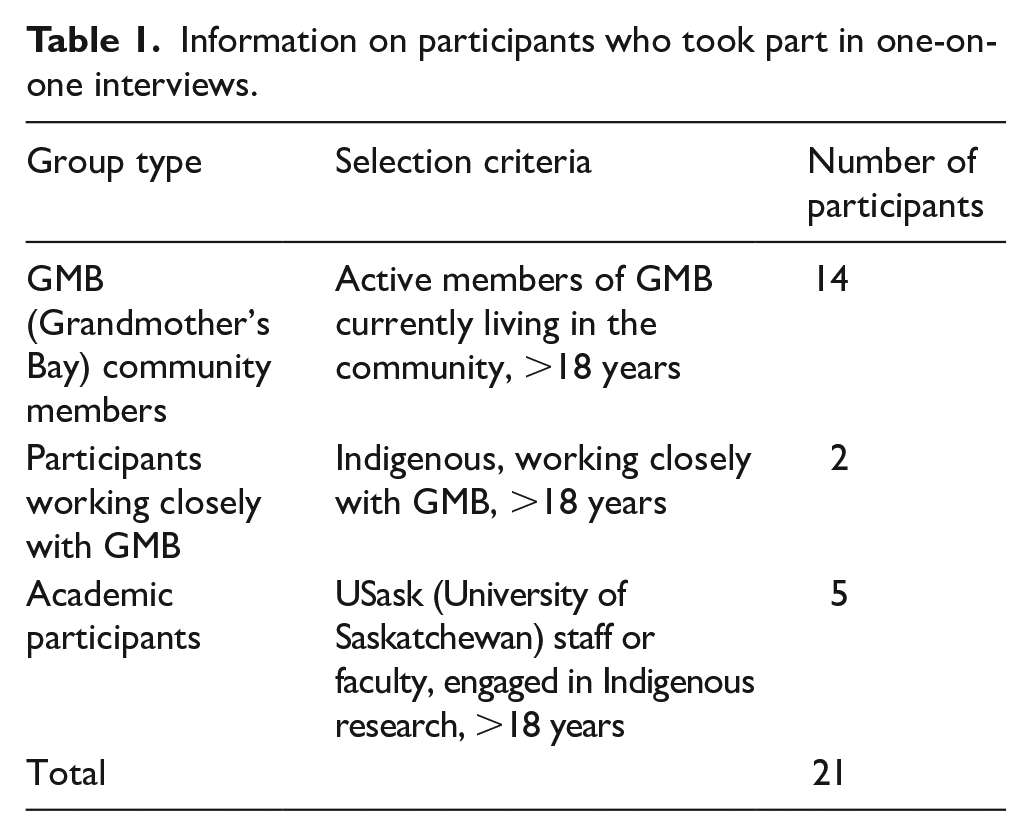
This study aims to determine whether principles such as these are highly valued in the relationship between USask and GMB and whether new principles may emerge which are unique to this particular partnership. To better understand how GMB and USask can work together in a good way, we recruited a diverse group of participants including GMB community members, those who work with GMB, and USask faculty and staff who conduct Indigenous research. This research adheres with GMB’s community protocols, First Nations concepts of Indigenous data sovereignty—ownerships, control, access, and possession—as well as ethical standards under the Tri-Council Policy Statement TCPS2—Module A9—Research Involving Indigenous Peoples and USask Behavioural Research Ethics Board. Once behavioural ethics approval was obtained from the USask Behavioural Research Ethics Board—Beh-REB # 2717—21 one-on-one interviews were conducted with participants including 14 community members from GMB, 2 members of other First Nations working closely with GMB, and 5 academic staff from USask (Table 1).
Information on participants who took part in one-on-one interviews.
Fourteen community members were recruited through word-of-mouth and posters advertising the research study in the community, and representative from Pewaseskwan visited the community subsequently to conduct the interviews in person. A Community Navigator from LLRIB helped us connect with participants at the Isaiah Roberts Memorial Culture Camp. This important meeting place is an annual culture camp in which the community participates in traditional practices on the land, eats traditional foods, and spends time in fellowship learning and sharing their culture and traditions.
The GMB community participants were selected if they were registered members of the community and currently residing there. Qualitative interviews were all conducted at the culture camp with several interviews spoken and recorded in Cree (the language spoken by Cree). There was a community interpreter who translated the words back to the researcher. Participant consent was obtained using physical versions of a secure web-based forms used for other interviewees, which were stored securely by the research team following data collection.
In addition to community participants, two members of other Saskatchewan First Nations who are regular collaborators with GMB were recruited to provide an additional perspective to the project. Given their close relationships with GMB, they were aware of some of the community’s needs and desires and could speak to them.
Four USask faculty and one staff member were recruited by email. They were required to be active at USask and previously or presently engaged in Indigenous community research projects. One participant self-identified as being Indigenous. Consent for academic participants and community members working closely with GMB was obtained via a secure web-based form. Interviews were conducted using Webex, a video conferencing software.
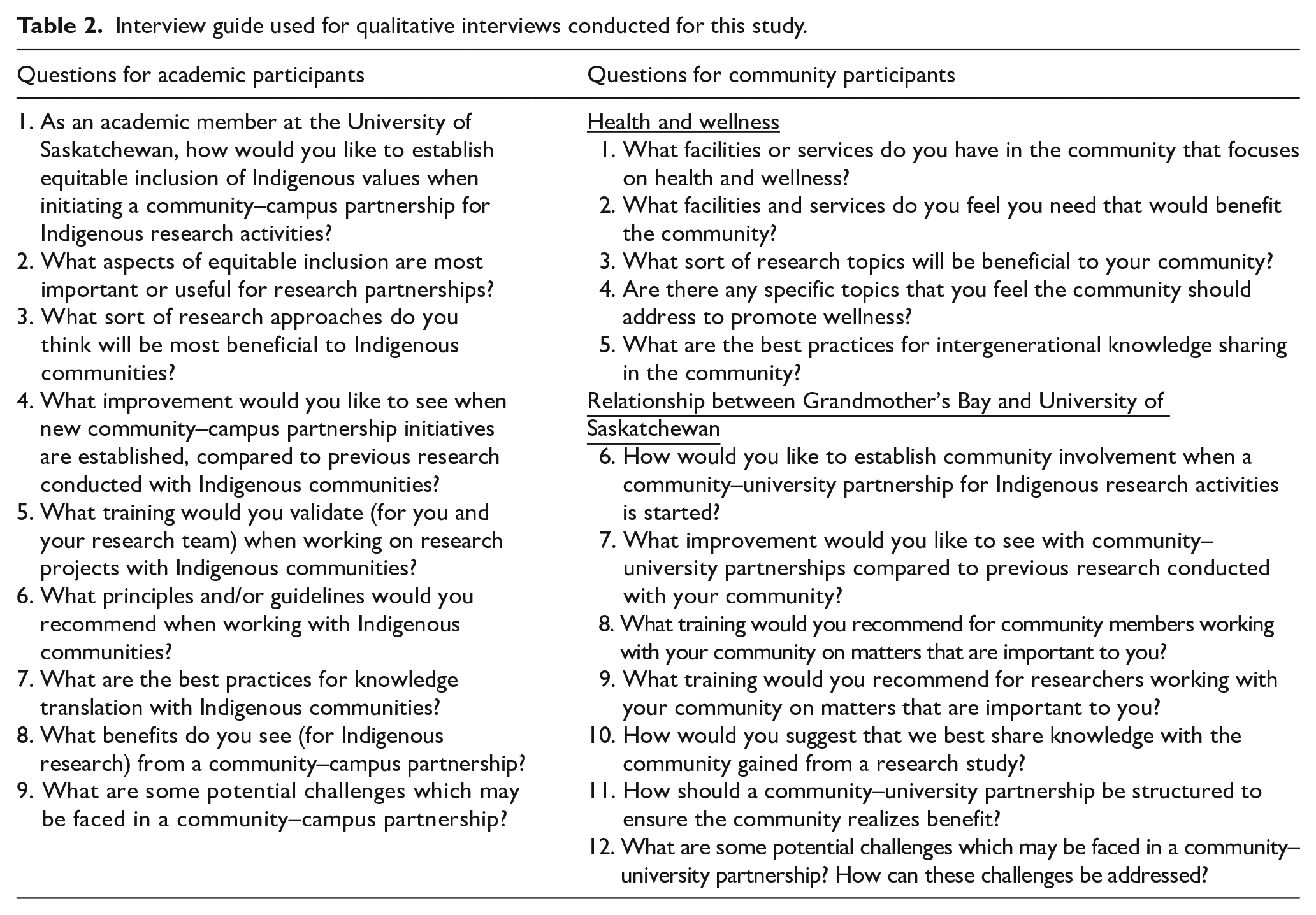
Qualitative data were gathered through one-on-one interviews following the interview guide shown in Table 2. Participants readily engaged in these interviews and expressed excitement at the prospect of a positive relationship between the community and the university. Interviews were recorded and transcribed with participants de-identified for qualitative data analysis using thematic analysis. After transcribing and de-identifying of the interviews, thematic analysis was conducted using etuaptmumk, which emphasizes Indigenous health constructs, interwoven with relevant western best practices (Martin, 2012).
Interview guide used for qualitative interviews conducted for this study.
The project used etuaptmumk as the approach to analysis. This is a method developed by Mi’kmaw (a First Nations people primarily Indigenous to Canada’s Atlantic Provinces) Elder Albert Marshall, which emphasizes learning to see from one eye with the strengths of Indigenous knowledges and ways of knowing, and from the other eye with the strengths of western knowledges and ways of knowing, and to using both these eyes together, for the benefit of all. (Bartlett et al., 2012, p. 335)
This process included a involving a research member who is of Indigenous ancestry—with lived experience and knowledge of Indigenous ways of knowing and doing—to validate themes that entwine cultural connectivity, land-based activity, and incorporate Indigenous knowledge, when conducting qualitative data analysis. The research team followed a pre-established qualitative analysis approach which integrated Indigenous ways of knowing to ensure the community’s voices guided the whole project (Kiger & Varpio, 2020). This included interviews, transcription, generation of initial codes and themes, and grouping similar codes and themes into categories. Several overarching themes were generated from this analysis and used to interpret the data, with supporting quotes from participants (Chun Tie et al., 2019; Westbrook, 1994; Yi, 2018).
Protocol
Following GMB’s traditional protocols, participants were offered tobacco at the start of their interviews and received a cash honorarium for their stories and time. Elders within that same group were also gifted a blanket (Figure 2) from the Silver Wolf Trading Post, Saskatoon’s only Indigenous owned and operated trading post. In following the community protocol of gift-giving, academic staff and faculty were presented with dreamcatchers and Indigenous art cards (Figure 3). The research team gifted the community a painting by a local First Nation artist to thank them for their collaboration and welcoming the team into the community (Figure 4).
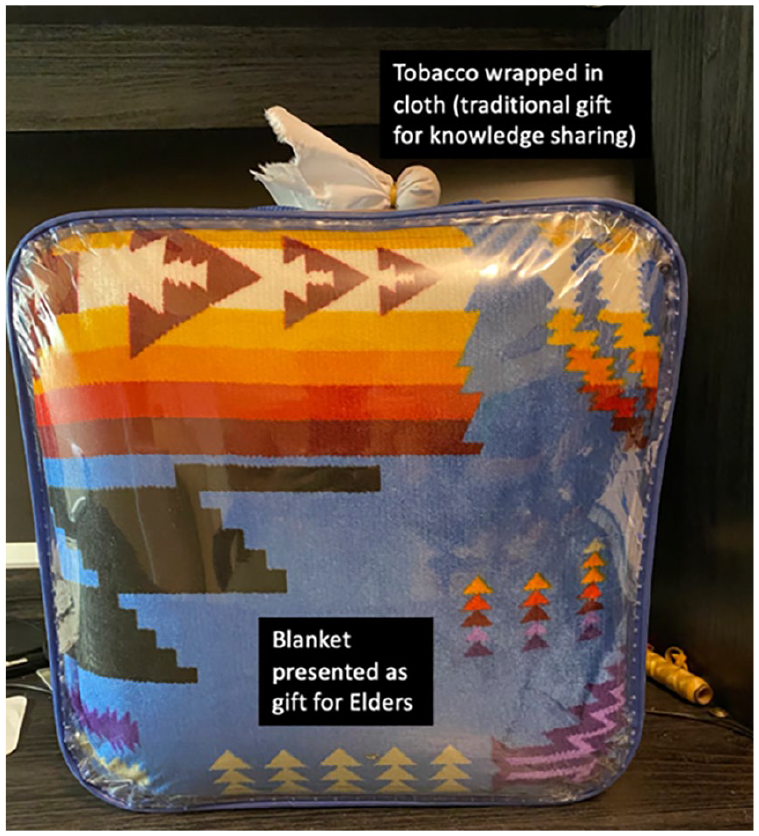
Gifts provided to Grandmother’s Bay community members (photo by Adrian Teare).
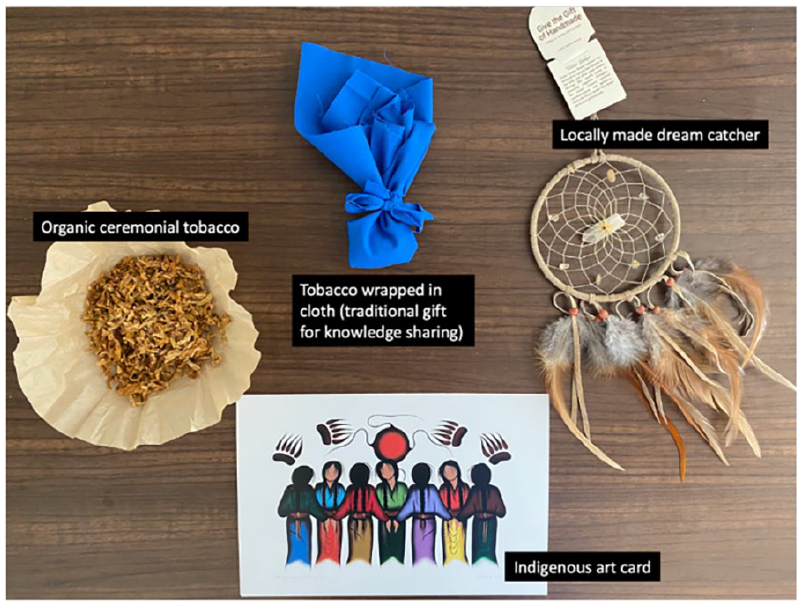
Gifts provided to academic participants (photo by Adrian Teare).
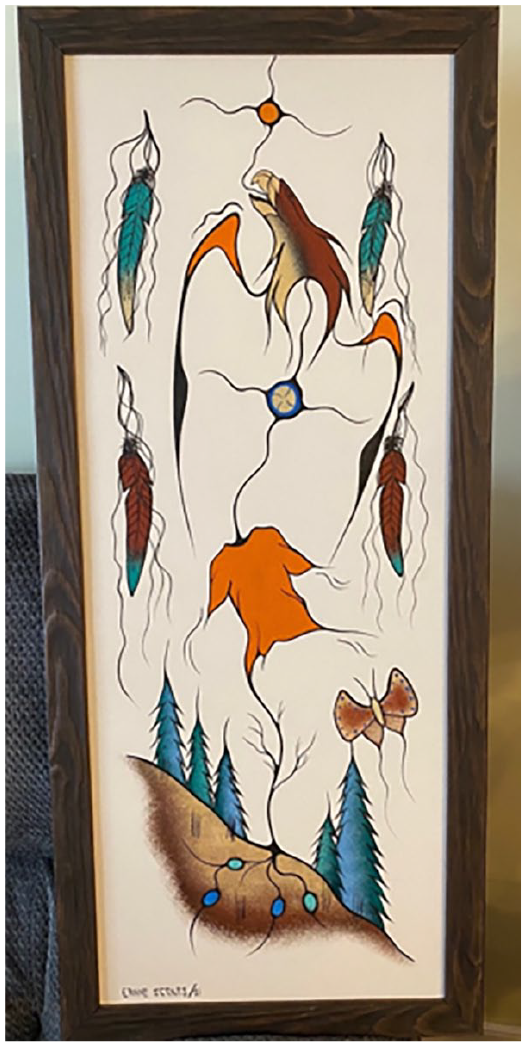
Gift provided to the community of Grandmother’s Bay by the Pewaseskwan (the sky is starting to clear) research team (acrylic on paper by Ernie Scoles; photo by Adrian Teare).
Results
Once themes from the interview transcripts were identified, supporting quotes from participants were taken from the transcripts. The GMB community member quotes used were reviewed and approved by the quoted individuals and the community approved the results. Quotes from participants who did not sign transcript releases were not used.
The overarching themes identified from interviews with participants included:
Relationships of trust with meaningful results and benefit.
Traditions, culture, and intergenerational knowledge.
Effective communication and language.
Ownership, creative design, and dissemination.
Relationships of trust with meaningful results and benefit
Building community relationships of trust
Many community members who were interviewed noted that building relationships of trust is key to community–university research partnerships. Due to Covid-19 restrictions in 2020 and 2021, the Pewaseskwan team and GMB community members corresponded online for a year before the researchers set foot in the community and met community members in person. While communicating online was not ideal, it was the start of the longitudinal relationship building between the community and university. Communication preceding data collection creates a relationship and relationality between the researchers and the community members involved in the research and indicates your interest in them as individuals and not merely as data source; you are doing research with them, not on them. For example, Get to know the people a little bit first of all. Get to know a little bit about their culture. And don’t learn from over there looking at them, you know, sit down with them; have coffee with them and just get in there. And do the stuff they’re doing a little bit; don’t be aloof and you know stand in the background over here. (GMB11, male, GMB community member)
Relationship building is especially important with Indigenous communities because of the extensive history of abuse and mistreatment through research and academic institutions. As one community member participant said, It will take baby steps in order to have their trust. Because over the years that trust has been broken and so we need to make those little tiny steps to be able to build that trust and then, with our people, trust is earned. (GMB9, female, GMB community member)
It takes work to build trust with communities, but this trust can be earned by developing good relationships over time. Research must be done at the community’s pace as they are the ones leading the research. This was further supported by the following quote from one of the academic participants: I’ve been approaching that research through the principles of the “Four Rs” that Kirkness & Barnhardt have talked about, so: respect, reciprocity, relevance, responsibility. And then over-riding all of that is relationship. And I think the only way to try to find a space for any kind of equitable inclusion in our setting is to bring those as part of the conversation and be mindful of each of those but over-riding that is, before you can come and really talk business and stuff, is just get to know each other and start to build a relationship. (GMB2, female, academic participant)
Foremost, relationships of trust which respect and incorporate the culture, traditions, and language of the community will need to be established before beginning research. There should also be good communication between the researchers and the community throughout and beyond the course of any research. The process of engaging in community research must be co-led, whereby the community retains ownership of all the data that are collected. It is essential to both the researcher and the community to clearly identify what is going to be researched beforehand to avoid any confusion when it is time to collect the data.
Building research partnerships of trust
Historically, research partnerships between academic institutions and Indigenous communities have been oppressive and provided little benefit to communities being researched. According to faculty working on Indigenous issues, “Relationship building is the key, first, because I don’t think there will be any understanding of values from a community perspective unless that relationship is built first” (GMB4, female, academic participant). Open dialogue between community and university is one of the first steps that should be taken “from the beginning” (GMB1, female, academic participant) when creating spaces for research.
Capacity strengthening is also key to moving forward with research relationships. It is vital that we ensure that the community has the capacity to carry out the research before beginning community-based research in First Nation or Métis (an Indigenous people of Canada primarily of mixed First Nations and European ancestry) communities. For example, There needs to be some more time for capacity building, and that can be for research, research management, program management, that could be in terms of economics, administrating funding and even just . . . some of the skills sometimes that you need to collect data . . . learning an Excel program, transcripts analysis, so on. And then we can also learn too . . . maybe if a transcript is read, maybe a community might have another way of reading that transcript and analyzing it or thinking about what was said and how to present it, other than our ways of doing things. (GMB4, female, academic participant)
First Nations are self-determining. Relationships should be focused on supporting the exercising of this self-determination. In the context of research, this entails support to engage in all aspects as fully and meaningfully as communities deem appropriate. If communities determine the need for additional capacity, academic institutes could assist in developing the tools and training needed for them to move forward independently. By supporting communities to strengthen capacity, the university researchers can then transition into more of a supportive and learner role while the community partners are the true project leaders.
The quote below highlights the importance of approaching Indigenous community-based research from a standpoint of reconciliation and working towards building and maintaining trust-based research partnerships.
We know there’s been a longstanding history of research not done in the right way, not carried out in respectful way. Indigenous communities have felt violated and rightly so. So it’s . . . a great opportunity again, in commitment to the TRC [Truth and Reconciliation Commission], TRC principles and . . . particularly in reconciliation and our commitment to that, it’s a good opportunity to pave the way, or start paving the way, in a good way, for research collaborations and partnerships . . . led by Indigenous community members or in collaboration with Indigenous community members. (GMB1, female, academic participant)
In other instances, it is pre-existing relationships with community that lead to research opportunities—such as this project with GMB. This study has found that strong research partnerships are founded on good relationships and open dialogue between researchers and community members.
The foundation of community-based research is forming research partnerships of trust to ensure everything proceeds in a good way, and there are good processes available when it does not. These relationships should be established early and maintained beyond the research ending. It has been suggested that researchers should be “in the community for 12 to 18 months before they can even ask the question [referring to a research question]” (GMB5, female, academic participant). Relationship building can take months, if not years and should be well established before beginning research; however, few funding sources support this, and often they do not provide compensation to community for their time and expertise. The existing research paradigm conceptualizes and funds research as a clearly delineated process, rather than encompassing the work that must precede and follow a particular project.
Consequently, researchers and community members often work on their own time to establish trust and rapport so that projects can proceed with a mutually beneficial partnership. This is ultimately not sustainable for many communities and researchers as the communities have their own matters to attend to which take precedent over the research timelines, and many researchers do not have the availability or capacity to continue to invest this significant amount of personal time. According to one participant working with Indigenous communities, You know we can sit down as a department; as a department we can really define what we’re looking for . . . you got to find ways of how you can work with communities. MOUs [Memoranda of Understanding] define that for you: how you want to exchange information, how you want to work together. (GMB7, male, participant working closely with GMB)
It is crucial that the community leads all parts of the research process. Communities should be involved from the initial formation of the research questions and topics through to the final knowledge mobilization of the results. Community-based researchers can take the “nothing about us, without us” approach when working in communities to involve community every step of the way (Charlton, 1998). The following quote illustrates this: We’re equal partners in a process . . . they [the community] actually identify the questions and then we [the researchers] look at how best to do those and answer those questions together. And they are part of the data collection; they are part of looking at the questionnaires; they receive their data back before it goes anywhere else so that we actually interpret it together . . . they’re involved with the poster presentation, oral presentations and if we’re publishing papers, they too are writing aspects of the papers to they are authors on it. (GMB5, female, academic participant)
Consequently, making and upholding these agreements and understandings is foundational to maintaining trust in the relationship and should always be a high priority for community-based researchers. One participant described it as, Asking people what they want or what they want to be, even studied on or whatever, would be great. Just getting that involvement from the community level. (GMB3, male, participant working closely with GMB)
This approach puts the research in the community’s hands and allows them to dictate what direction it should take based on their needs, established through thorough consultation with them. Accordingly, There has to be community consensus; a community forum talking to all age levels right from children to old people. There has to be community consensus of what they want to learn. (GMB7, male, participant working closely with GMB)
Producing meaningful results
Another common theme addressed by the community was the need for meaningful results from research. This entails addressing the specific needs presented by the community and providing tangible benefits that can be achieved through the research. The following quote indicates the importance of knowing the community you are working with to ensure that the research is generated at the community level. For example, Ask the community members what they really need at this time because if we can’t get the information from the community members on what the needs are, then how can we be able to identify the needs that are actually needed for the certain area of where the crisis is? (GMB9, female, GMB community member)
One way to make the research more meaningful and beneficial at the community level is to ensure that community follow-up occurs soon after data are transcribed and coded to confirm accuracy of those who were interviewed. Follow-up was identified during the interviews in the following way: I think there should be follow-up like—you’re gonna record all this information and you’re gonna come up with a report. But look lets also come up with some suggested ways of implementing some of the things that are pointed out there . . . . Let’s identify some actionable items and who’s gonna do it. And let’s not just write about it and then kind of shelf it. Let’s work towards it . . . . Get out the actionable items: Who does it? What is it going to require to achieve some of the things that are identified? (GMB11, male, GMB community member)
Traditions, culture, and intergenerational knowledge
Researchers who enter the community should not only learn about the community members but learn their traditions and protocols by engaging with their traditional culture. It is essential to take time to get to know the people and their culture before coming to conclusions on what would be best for the community. Accordingly, If they want to help the community, they should live it first; know the people and know the traditions of the people. Instead of trying to come in and solve what’s wrong they should be coming in to try to get involved; see how they can integrate themselves into the community, to the communities. (GMB10, male, GMB community member)
This illustrates the importance of traditional culture and Indigenous ways of knowing and doing as priority in the research process.
Many community members said they are beginning to lose their culture as people are not engaging in traditional activities as much as they used to. It was stressed that engaging in traditional culture is not only the responsibility of the researcher, but it is also a responsibility of the community to ensure that all community members embrace their culture and traditions before they are no longer practised. One participant stated, Our community’s fairly strong in culture . . . . But what’s unfortunate is here we are. These [culture camps] happen [for a week], maybe three times a year. They happen; they’re compartmentalized and then we . . . forget about them. As before, when I was young, that was the way of life; there was no choice; that’s the way we lived. We lived at what you see here . . . the smoke racks, the meat, the fish and the outdoor cooking; that was the way of life, by the lake, in a tent. Now it’s a special occasion. And I’m . . . concerned about that . . . are we gonna be able to sustain those, our culture, our old ways, if we only do it on special occasions like that? (GMB11, male, GMB community member)
According to community members and Elders, passing on traditional knowledge and culture to the younger generation is a vital part of keeping their culture alive and ensuring young people can carry this knowledge forward to future generations. Elders are concerned their way of life will not be sustained as future generations become more dependent on and adapted to colonial systems which provide expedited ways of doing things, which often come at less cost to the individual and greater cost to the world around them. They want to see their culture and traditions stay in the community as a way of life rather than becoming something community members do for special occasions.
This is what we teach here, is passing on our knowledge . . . we try to get these knowledge keepers and we try to change them all the time so when we have a culture camp so they can teach the younger generation what they know. So their knowledge is passed on to them, to the kids. (GMB12, male, GMB community member)
Many participants shared their concerns about the younger generation. There are not enough programmes or resources for youth engagement, so they are seeing more young people lose touch with their culture and get into trouble. One participant stated, What I would suggest is that it’s mainly with the kids. Like there’s too many, too many of this stuff going around and you know, they break things and they do this other stuff that they shouldn’t be doing . . . . They should really have a building like this to get the kids in and show them, yeah and try and talk more Cree, their own language and do things like going out and doing things like fishing and snaring; stuff like that for kids to do and so they stay out of trouble. (GMB19, female, GMB community member)
Indigenous ways of knowing and doing must be prioritized in the community-based research process when working with Indigenous communities. As one participant said, I think number one is cultural guidance and ceremony as you did to open this; I think that’s absolutely essential and that’s the first thing that has to happen with our Elders and/or knowledge keepers . . . I’d put ceremony as number one, connecting, whether it’s to the land, each other, the animals or spirit, Creator; that all has to happen. (GMB6, female, academic participant)
It is important to defer to the Indigenous community members on the traditions and customs involved in their approach to research so it is conducted in a good way.
Clearly, a strong relationship and a good grasp of the community’s traditional culture are vital when engaging in community–university research partnerships. By getting to know the community and people with whom they collaborate, researchers can better understand the culture and how it fits into the current context to inform community-based research and ensure these partnerships to proceed in a good way. Researchers must also put loss of culture or regaining of culture into context; when we see communities grappling with the way things were done in the past, it could be that they are relearning their culture at the same time we are asking them for answers about it.
Effective communication and language
One aspect of effective communication mentioned several times was the potential language barriers when fluent Cree speakers have little or no understanding of the English language. The Cree language remains the mother tongue for many in the community of GMB despite colonizing forces such as the Residential School system and systemic policies attempted to assimilate their first language and replace it with the English and French languages. It is vital that we encourage the use of the Cree language foremost and accommodate this with translators who can effectively capture the essence of the words and meaning that are being spoken.
Well, there’s always that language barrier. And then there’s the illiteracy; there’s a lot of illiteracy out there . . . . Simple terms would be best . . . And then you ask, “Did everybody understand that?” And if there’s hesitation, then you know that they didn’t understand and then you just make it simpler as possible. (GMB9, female, GMB community member)
As researchers, we must understand that many Elders whose first language is Cree do not read written English, as their language was historically passed down through generations orally as opposed to the written word. Effective communication cannot be had if people do not understand what is being asked and this creates opportunities for community members to be taken advantage of or to agree to things they do not fully understand. Effective communication in community includes avoiding jargon and using lay language. As one community member said, I think sometimes we need to look at the language we use, like even the word research. Is there a simpler word that could replace research . . . maybe could have said, “Hey look, this guy wants some information; how they could work with us for a healthier community” or something . . . when you start using the word research . . . connotations you know . . . . Use simpler language and that is not intimidating. (GMB11, male, GMB community member)
Indigenous languages are critical for both data gathering and the dissemination of results. Language barriers and English being the dominant language of research and of colonization for much of Canada likely present challenges. People may struggle to express themselves in interviews and understand the results of the research, as illustrated in the following quote: When it comes to some of our Elders and our older population, their first language isn’t necessarily gonna be English. So they might not be able to say things exactly how they feel, properly in English . . . so there could be that little bit of disconnect there when it comes to a language barrier and just in general. (GMB3, male, participant working closely with GMB)
It is critically important that those being interviewed for research fully understand what is being asked of them and how the knowledge they share will be used in the context of the project. Language barriers are yet another way that research has been colonizing and as such has excluded non-English speakers. It is vital to have the ability to present information and ask questions in languages people understand so they can contribute to the project in an informed and meaningful way.
Whomever you’re working with in any community as long as they’re Cree speakers, Dene speakers, or any other language that you work with, so they can simply define that information to the members so they understand what the research is about. (GMB7, male, participant working closely with GMB)
The use of translators in predominately Cree-speaking communities is an important aspect that should be included in the planning stages of any community based research. Researchers who become familiar with the communities they are visiting will know whether they will need a translator. As one participant asked about language said, You’d want the Elders involved because they’re the ones, the knowledge keepers in the community. And some of them, their first language is Cree . . . . So having a translator or having a translator from the community to work with you from beginning to end on any projects so that you have a better understanding . . . . Things that are said in Cree are lost in translation when you translate to English . . . . So . . . having a good translator. . .that can connect with the people and ask them questions in Cree and get answers in Cree and then provide that translation for you. (GMB16, female, community member)
The community must be actively involved in any research that takes place in GMB from study design to knowledge translation of final results. Communication between researchers and community must be culturally appropriate and well understood before researchers enter the community. Community members stress that research and its results are more effective when conducted in the language community members understand best and when cultural protocols and ceremonies are respected.
Researchers should engage in robust communications that support community truly engaging in and directing research, as this would help better define and achieve collaborative research goals and methods. One participant stated, Rather than just going to the person that they’re wanting to interview, have them explain first on why they are there and then the reason for the study, because a lot of people are quite shy and they get offended easily . . . they need to be looked at as equals rather than looking below them that they’re less than who they are because they are more, there’s more to them than people assume . . . if they can be treated as equals the relationship can improve from that. (GMB9, female, GMB community member)
Ownership, creative design, and dissemination of projects
Data sovereignty
Indigenous data sovereignty is one more way Indigenous communities can protect and maintain control of their data. Indigenous data sovereignty “refers to the right of Indigenous peoples to control data from and about their communities and lands, articulating both individual and collective rights to data access and to privacy” (Rainie et al., 2019). Consequently, it is imperative for the community to have sovereignty over the research data, as they own the knowledge and should benefit from the study results. This is detailed by the following quote: Another big thing for us is making sure that our information and our data is ultimately, obviously shared with us first, before it’s put out. And then we’re well informed and kind of in the loop on where our information, where our data is going . . . we want to make sure that our data’s not being shared in any like, derogatory means or being sent out to places around the world, we don’t know it’s going and people are learning about us that we don’t even, that we’re not even informed on. (GMB3, male, participant working closely with GMB)
At Pewaseskwan, we are currently in the process, with Canadian Institutes of Health Research funding, to develop a digital archive centre where Indigenous communities in Saskatchewan can upload their data into a safe and secure server. The communities will control who has access to or use of these data. Researchers who wish to access the data will have to get approval from the corresponding community. As a result, in respecting the community’s data sovereignty, the community can best direct the researchers on how to disseminate the results in the most beneficial, meaningful way for the community.
Data may mean different things to different stakeholders. In Indigenous community-based research, the priority should be for the research to yield results that the community finds meaningful and useful. For example, In terms of understanding what the data or the results mean . . . . I think the community needs to be involved in translating those results into a knowledge mobilization product that is meaningful for them. Because, as academics, we have things that are meaningful for us, in terms of our promotion and tenure and so on, but we might not also understand and see what . . . is best for the community on how to translate that information and mobilize it elsewhere. (GMB4, female, academic participant)
Collaborative research design
Collaborative research design was significant throughout the research process. The community must be involved in all stages of research and researchers must be willing to collaborate with them on all important decisions pertaining to the research. This includes consulting the community regarding potential research topics, developing the research questions in partnership with the community, and engaging in a data analysis and review process which is centred on the community and allows them to direct the final results of the project.
I think probably the best thing would be, you know, for everything to be compiled and then for you to go and kind of ask permission from those individuals that you’ve asked or study participants that ‘this is what I’ve gathered from our interview, and is this ok with you?’ And kind of go through almost an editing process . . . . [Make] sure that once you publish something or once you want something published . . . you go to that person that you asked and make sure that that’s ok and make sure this is what they’ve actually said. (GMB3, male, participant working closely with GMB)
Dissemination
The final important aspect is engaging in discussion with the community about data analysis and how and with whom the results will be shared. This invites them to be part of the editing and mobilization process, upholding their ownership of the work. The following quote details the value of engaging in this process, both in English and community’s language: After you do your write-up, and then you show it to us. Show it to us first, and then have another consent form, so it’s saying that it’s ok. Cause a lot of times you get the wording wrong, right? . . . And it could be offensive in some parts. Then maybe some stuff needs to not be put in there or needs to be added on or in a different way. (GMB12, male, GMB community member)
Community review process
After the initial draft of the article was completed, a member of the research team visited GMB on July 18–19, 2022 to engage in a community review process. A cultural celebration was occurring, which meant everybody would be gathering at the school or at the culture camp. She was invited to attend both gatherings. Everybody was happy and interested to know who she was, so the community liaison spent time introducing her to community members and explaining why she was there. She was able to connect quite quickly with many of the participants at the school so they could review their transcripts and the draft of the article. She was also invited to the culture camp for lunch to see who else might be there that needed to sign transcript release forms. We obtained transcript release consent from 13 of 16 participants which authorized use of the transcript by the research team and stated that participants had reviewed the complete transcript of their personal interview and had been provided with the opportunity to add, alter, and delete information from the transcript as appropriate.
Discussion
This project was the first step in what has the potential to be a positive long-term relationship between USask and GMB. It gathered insight on engaging in a community–university research partnership in a good way which provides meaningful benefit to the community. Quality of research has traditionally been defined using colonial standards of what constitutes good research, which often discredits and excludes Indigenous peoples and their ways of knowing and doing (Denzin et al., 2008). This has left a painful and traumatic legacy with Indigenous communities, as summarized by the following quote: “The word itself, ‘research,’ is probably one of the dirtiest words in the Indigenous world’s vocabulary” (Smith, 2021, p. 1).
This has the potential to improve relationships between USask and GMB, and work towards reconciliation. It has been documented in the literature that Indigenous data sets are able to provide more accurate information on Indigenous peoples (Braun et al., 2014). With community members being research partners instead of research subjects, we hope to achieve results which more accurately address the community’s needs and continue to work towards reconciliation in research. In addition, community partners can engage to provide Indigenous health and wellness needs, which in turn contributes ways to integrate favourable recommendations and new health system policies through university academics.
Several themes identified in this study are consistent with those found in the literature. Various studies emphasize the development of trust with the community through building good relationships and communicating well, which further validates our findings (Ball & Janyst, 2008; Christopher et al., 2008; Colquhoun et al., 2013; Rasmus, 2014; Smithers Graeme, 2014).
In addition, several studies pointed to the importance of actively engaging community in the research process and incorporating traditional Indigenous cultural practices and approaches (Ball & Janyst, 2008; Hyett et al., 2018; Martin, 2012; Simonds & Christopher, 2013; Thomas et al., 2011). Finally, the importance of research yielding meaningful results which lead to action and knowledge being shared in a meaningful way is in several studies (Ball & Janyst, 2008; Hayman et al., 2015; Hyett et al., 2018; Jull et al., 2020; Snow et al., 2016). The high prevalence of these themes in the literature indicates that our findings are consistent with the peer-reviewed standards for engaging in community research in a good way.
A theme which appears less frequently in the literature but was found to be crucial in this study was conducting research in the community’s language. A few other studies indicated the value of using Indigenous language in the research and knowledge translation processes, though this theme was less common than others in the literature (Colquhoun et al., 2013; Jull et al., 2020; Keane et al., 2017). This study will add to the body of knowledge on the importance of the use of Indigenous languages in community-based research.
Conclusion
The interviews conducted revealed that community–university research partnerships must proceed through relationships of trust and must address the following themes outlined by GMB community members: (a) relationships of trust with meaningful results and benefit to the community; (b) traditions, culture, and intergenerational knowledge are key to the research; (c) effective communication and language; and (d) ownership, creative design, and dissemination belong to the community.
This project was the first step in an ongoing relationship between GMB and USask and provides guidelines for how to engage in future research in a good way. Much of the relationship moving forward will involve abiding by the community’s research principles which have previously been outlined in the literature; however, this project generated new knowledge which specifically pertains to the partnership between GMB and USask, which will aid in the continued development of this relationship is outlined by the following principles:
Relationship building with meaningful results and benefits. Appropriate engagement with community leadership, and following their guidance, enables the successful launch of the project in an atmosphere of respect and trust.
Interviews should always be conducted in the mother tongue when requested by the community—this would also be made known during the relationship building phase as to the extent of Cree speakers who will be part of the study. It would then be up to the researcher to accommodate for community translators so that the meaning is not lost in translation from Cree to English. According to fluent speakers, Cree is a much more expressive language than English and their words should not be limited to what it would mean in English because sometimes there is no English word that would justify the Cree meaning.
All knowledge translation pieces should be provided in both English and Cree and the community must approve both versions before either is disseminated.
A community-based research associate should be hired for future projects when doing research in the community. The Community Research Associate can help to provide translation, act as a liaison between the community and university, and can help to strengthen capacity within the community so that members can be more active participants in the research process.
The youth should be a primary focus for community-based programming and funding, and future research should provide meaningful results to help the community access youth programmes and services.
Good community-guided research can greatly benefit community and it is our hope that we will continue benefit GMB through our research for years to come.
Footnotes
Acknowledgements
The authors and Pewaseskwan (the Indigenous Wellness Research Group) as a whole acknowledge and are grateful to the community members of Grandmother’s Bay, community Elders, Community Navigator: Leonard Roberts, Councillor for GMB Gerald McKenzie, and Chief Tammy Cook-Searson of the Lac La Ronge Indian Band. We were welcomed into the community, well fed, and made to feel at home while we were in Grandmother’s Bay. We are most grateful to the community members who were interviewed and who graciously shared their time, traditional knowledge, and stories with us.
Authors’ note
Declaration of conflicting interests
The authors declared no potential conflicts of interest with respect to the research, authorship, and publication of this article.
Funding
The authors disclosed receipt of the following financial support for the research, authorship, and publication of this article: Canadian Institutes of Health Research (437759).

Glossary
Cree a North American Indigenous people, one of Canada’s largest First Nations; the language spoken by Cree
keeoukaywin the visiting way
milo pimatisiwin the good life
pewaseskwan the sky is starting to clear
etuaptmumk two-eyed seeing
Métis an Indigenous people of Canada primarily of mixed First Nations and European ancestry
Mi’kmaw a First Nations people primarily Indigenous to Canada’s Atlantic Provinces