




Abstract
The magnitude of water-induced disasters is projected to increase in the coming decades. Yet, there is a substantial gap in the understanding of how local knowledge and Indigenous knowledge are employed to respond to climate change water-induced disasters. We examine this gap through a meta-review of literature published between 2014 and 2019 yielding 39 scholarly papers. The meta-review indicates that the literature highlights that marginalized people are facing multiple risks that threaten their ability to produce enough food for consumption, secure water for irrigation, live in sustainable communities, and maintain their health and well-being. Responses are largely incremental, autonomous adjustments, such as livelihood diversification, flood-proofing homes, and soil moisture conservation. Our findings show that there is a clear need to more closely attend to the processes by which local knowledge and Indigenous knowledge can be meaningfully integrated into adaptation to move toward transformative change for long-term climate resilience.
Keywords
Introduction
Indigenous communities and international scientific assemblies, including the Intergovernmental Panel on Climate Change (IPCC), have emphasized the importance of including local knowledge (LK) and Indigenous knowledge (IK) in climate change adaptation planning (David-Chavez & Gavin, 2018; IPCC, 2022). Local knowledge and IK can drive locally led adaptation responses; thus, they are important sources of place-based evidence of climate change that need to be integrated in western scientific assessments (Castán Broto et al., 2019; Tengö et al., 2014). However, these calls remain largely unanswered and evidence on LK and IK-led adaptation limited (Li et al., 2021), particularly as it relates to water-induced disasters (WIDs) (Caretta & Morgan, 2021).
The intensity and frequency of WIDs are projected to continue to increase with climate change (IPCC, 2021). Water-induced disasters disproportionately affect the lives and livelihoods of impoverished, resource-dependent communities across the globe (Greve et al., 2018). In the Global South, many historically marginalized communities rely on subsistence agriculture, which is particularly prone to the risks and negative consequences of WIDs (Oppenheimer & Anttila-Hughes, 2016). While marginalized groups, including Indigenous peoples, the poor, women, and children, are often the most affected by WIDs (Savo et al., 2016), they typically have the least say in how climate-change impacts and risks should be tackled (Leonard, 2021). Moreover, there remains a need to better understand if locally led adaption, which can include IK and LK, is a pathway to overcoming the barriers presented by local micropolitics and power imbalances (Rahman et al., 2023).
Exploring the dynamics of adaptation to WIDs is necessary to understand the effectiveness of adaptation strategies. How adaptation strategies operate in practice, whether strategies are successful and, importantly, who defines success, differs between sectors and regions (Singh et al., 2021). Financial, technological, governance, and cultural constraints hamper adaptation to changing climates (Castells-Quintana et al., 2018). Community-led adaptation can be ripe with exclusions, hierarchies, and oppression. Nonetheless, adjustments to day-to-day life are already being taken, particularly in the Global South (Ensor et al., 2019). Yet, there is a substantial gap in the understanding of how LK and IK are used to design and implement adaptation responses to climate change (Savo et al., 2016). Accordingly, exploring the knowledge drivers of locally led adaptation is fundamental to understand how risk reduction, equitability, and inclusivity can be achieved (Rahman et al., 2023). Therefore, in this article, we aim to better understand how LK and IK are employed to respond to climate-related WIDs.
The article is organized as follows. We start by explaining the underlying concepts that guided our ontological and epistemological approach to a LK- and IK-mediated understanding of climate change adaptation. We then outline the meta-review methodology employed and present our results. This is followed by a discussion of the findings and recommendations for greater inclusion of LK and IK in climate change adaptation.
Conceptual foundations
In this section, we outline the concepts that ground our examination of existing evidence of LK- and IK-led adaptation strategies to WIDs. We first present widely held definitions of LK and IK and then discuss how these different ontologies intersect in the literature with climate change adaptation.
UNESCO (2021, paras. 1–3) broadly defines LK and IK as, Local and indigenous knowledge refers to the understandings, skills and philosophies developed by societies with long histories of interaction with their natural surroundings. For rural and indigenous peoples, local knowledge informs decision-making about fundamental aspects of day-to-day life. This knowledge is integral to a cultural complex that also encompasses language, systems of classification, resource use practices, social interactions, ritual and spirituality. These unique ways of knowing are important facets of the world’s cultural diversity, and provide a foundation for locally-appropriate sustainable development.
Indigenous and local ways of knowing are situated and relational. Local knowledge and IK emerge from relationships between people and environments, integrating “cultural, economic, religious and pragmatic dimensions” (Hill et al., 2020, p. 10). Thus, LK and IK are dynamic systems, that is, adaptable and unbounded practices that are maintained, altered, and transmitted orally and through routines, for example, written forms of communication, digital and not, and that constantly interact with other forms of knowledge (Tengö et al., 2014). Local knowledge and IK have long been considered subaltern to western scientific knowledge, and engagement with LK or IK by western scientists is typically extractive in nature, as the communities who produce this knowledge are left out of decision-making processes (David-Chavez & Gavin, 2018).
While IK and LK are often conflated, the terms are not interchangeable. Unlike LK, IK refers to place-based ontologies of Indigenous Peoples, which are grounded in complex sets of beliefs and practices shaped by cosmologies or cosmovisions that animate the world and give it meaning (Burgos-Ayala et al., 2020). More specifically, an adaptation approach is only truly IK-led if it centers an epistemic Indigenous community; otherwise, it is merely being informed by IK (Kovach, 2021). The plural term Indigenous knowledges is used to reference the many “systems of monitoring, recording, communicating, and learning about the relationships among humans, nonhuman plants and animals, and ecosystems that are required for any society to survive and flourish in particular ecosystems which are subject to perturbations of various kinds” (Whyte, 2017, p. 157), each “with their own language, protocols, ethics, ontology, and epistemologies” (Battiste & Henderson, 2021, p. ii). Indigenous knowledges are vibrant, changing, and intergenerational, formed through context, history-specific and place-based social institutions, and practices within Indigenous communities (Muir et al., 2010). Indigenous knowledges encompass language, values, rituals, social interactions, and resource-use practices (Nakashima et al., 2018).
Local knowledge does not necessarily carry these meanings. The frequent conflation of LK and IK reflects a broader inconsistency in the use of these and other terms, including traditional knowledge and traditional ecological knowledge (IPCC, 2019). Inconsistent assessment by the IPCC and gaps in author expertise have led to a “regionally heterogenous and thematically generic” coverage in climate adaptation literature (Petzold et al., 2020, p. 1). Accordingly, the IPCC has further specified that LK is, “what non-Indigenous communities, both rural and urban, use on a daily and lifelong basis,” a type of knowledge recognized as “multi-generational, embedded in community practices and cultures, and adaptive to changing conditions” (IPCC, 2019, p. 3). Local knowledge is informed by place-based observation and responses (Nakashima et al., 2018).
In recent years, efforts to document how Indigenous peoples and local actors observe, project, and respond to anthropogenic climate change have expanded (Caretta & Morgan, 2021; Mustonen et al., 2021; Wilson et al., 2022). In part, these efforts stem from awareness that Indigenous peoples and certain local communities increasingly face a disproportionately higher risk of suffering from the deleterious effects of climate change (IPCC, 2019). Climate change directly stymies the ability of Indigenous peoples and local communities to sustain their livelihoods and well-being, as their livelihoods are often natural resource dependent and rooted in systemic inequalities, which further limits their ability to protect these resources (Li et al., 2021).
Given the disproportional negative effects of climate change on Indigenous and other communities, LK and IK have critical roles to play in evaluating and responding to the impact of climate change globally (IPCC, 2019). This standpoint is crucial to understand how climate-related adaptation, that is, “the process of adjustment to actual or expected climate and its effects” (IPCC, 2018, p. 542), is mediated, planned, and implemented through LK- and IK-related ontologies. Indigenous populations and local communities should be directly involved in the development of adaptation policies and practices (IPCC, 2019). Ideally, the employment of LK and IK in adaptation can facilitate the creation of protection for ecosystems, species, and members of human societies who are particularly vulnerable. However, unprecedented changes may render forms of LK and IK that were previously effective unsuitable or ineffective. For instance, it has been found that growing uncertainty and unpredictably related to shifts in the rainy season and warmer weather can impair farmers’ LK and IK, and small farmers may prioritize short-term solutions addressing their urgent needs over long-term institutional-building activities to mitigate the effects of climate change (Popovici et al., 2021).
Methodology
In this meta-review, we focus on water-related adaptations to climate change. A water-related adaptation refers to a response undertaken if either the risk was water-related or the actual adaptation intervention was water-related. Following the IPCC (2018), risk is defined as a combination of hazard, exposure, and vulnerability. Water-related hazards include droughts, floods, the melting of the cryosphere, and groundwater depletion, which pose risks when these intersect with existing levels of vulnerability and exposure.
The data for the study were derived from a more comprehensive meta-review of current adaptation responses in the water sector carried out for the IPCC 6th Assessment Report Working Group II (IPCC WGII) Chapter on Water (Caretta et al., 2022; Mukherji et al., 2021). The meta-review relied on a database comprised of 1682 scholarly papers published in Anglophone peer-review journals from the Global Adaptation Mapping Initiative (GAMI) database (Berrang-Ford et al., 2021) and 137 papers from the IPCC WGII Water Chapter (Caretta et al., 2022). To date, GAMI is considered the gold standard of adaptation meta-review as it has been extensively used for the IPCC WGII 2022 Assessment Report and no other study has been equally comprehensive and exhaustive in its analysis of existing literature. Twenty-eight experts in the field of adaptation coded the papers for approximately 100 variables (Mukherji et al., 2021). Excluding those studies that did not assess outcomes from the adaption effort (hereafter “effectiveness”), either quantitatively or qualitatively, resulted in a database of 359 peer-reviewed papers published in or after 2014. We selected the 74 papers from this database that examine effectiveness of adaptation responses to WIDs, particularly floods, droughts, and extreme rainfall events. We narrowed the selection further to the papers in which LK or IK led the adaptation response (Figure 1). This yielded a total of 39 papers. Papers were coded through the online SysREV platform by two or more coders to ensure interceding reliability. Data were analyzed using Excel, R (R Core Team), and Stata software (Mukherji et al., 2021).
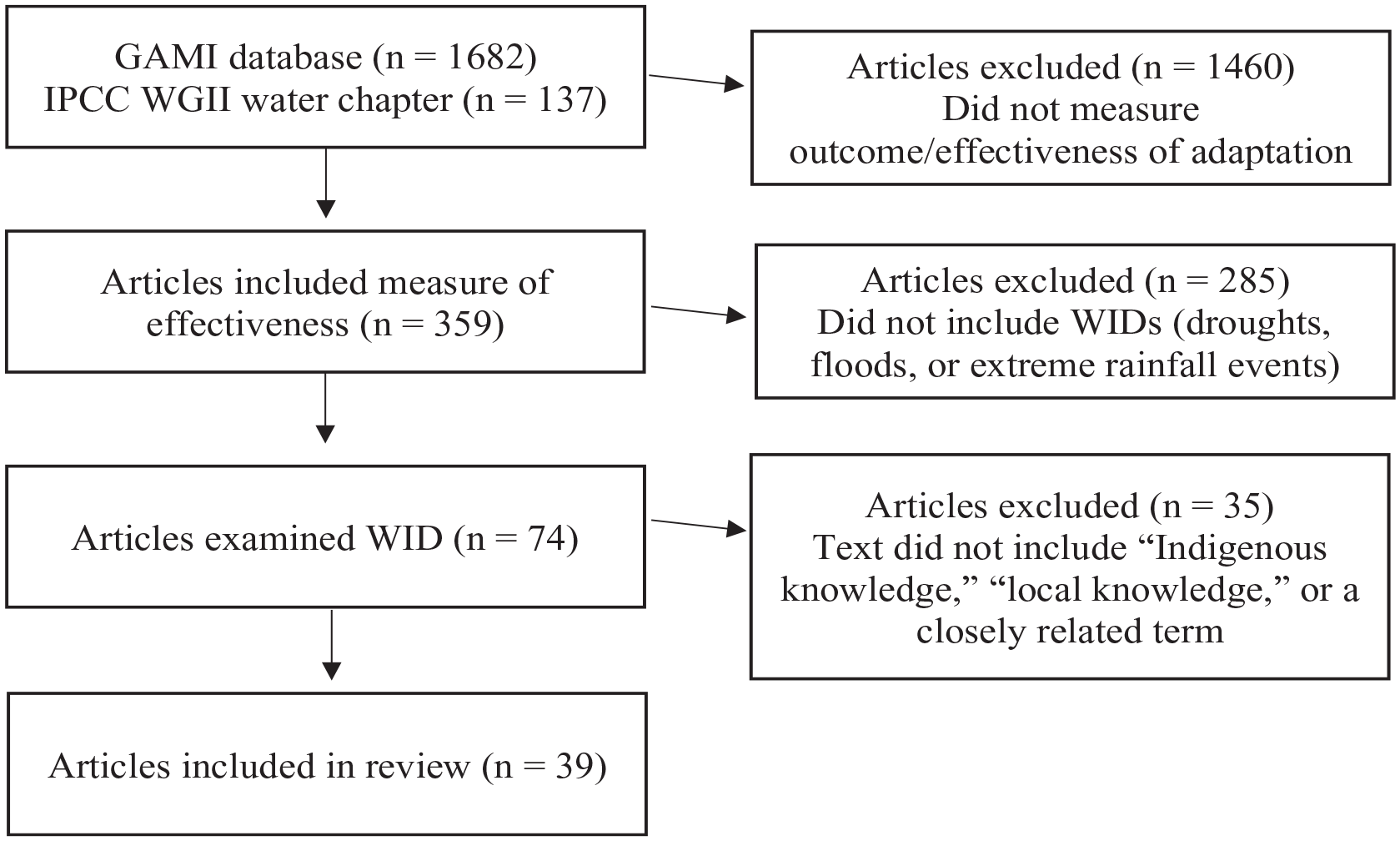
Flowchart of selection process of articles reviewed.
We evaluated the 39 papers to address the following questions:
How did the authors define LK or IK?
Where did the study take place?
What is the water-induced climate change hazard?
What are the vulnerabilities to the hazard?
What is the adaptation responses? What type of response, such as flood risk reduction, livelihood diversification, cropping system change, and traditional IK practice, is it?
Who initiated the response?
Was the adaptation effective in reducing risk?
Results
Definitions and terminology
While many of the studies used the term LK or IK, other studies referred to adaptation responses guided by terms such as local culture (Ha’apio et al., 2019; Sari & Prayoga, 2018) or local perceptions (Ling et al., 2015). Some authors acknowledged co-production of knowledge. Tran and Rodela (2019, p. 19) wrote, “In this study, farmers’ adaptive knowledge that refers to experiential and experimental knowledge is accumulated through the long-term processes of interacting with local environments (e.g., living with floods) and with other social actors (e.g., extension officials).” Petzold (2018, p. 104) wrote, Local knowledge, here, refers not only to traditional knowledge but also to knowledge and skills brought in by newcomers. Local knowledge is dynamic. While traditional knowledge refers to land management practices or disaster recovery mechanisms, “new” local knowledge offers the potential to integrate new skills and ideas to the management of environmental changes, e.g., through linking social capital.
Few of the studies defined the degree of local or Indigenous engagement in an adaptation project. Eleven of the studies referred to LK or IK interchangeably, which added to the challenge of determining which knowledge was used for development of the adaptation approach. Several studies described the community as Indigenous but did not provide insight into the type of knowledge used to guide an adaptation response. In this section, we use IK only when the adaptation response was clearly defined in the case study as IK.
The studies were geographically limited. Seventeen of the 39 case studies were carried out in Asia and 11 in Africa, 5 in North America, 3 in Europe, 2 in Australasia, and 1 each in Central and South America and Small Island States. At the country level, 7 of the 39 studies were in Bangladesh; 4 took place in Vietnam, and 3 studies were in the USA. There were two each in Canada, Indonesia, Solomon Islands, and South Africa. Other countries only had one study per country.
Hazards
Water-induced hazards refer to the physical hazards that motivate adaptation in these studies. They can be single events, conditions over time, or a combination of events (Lavell et al., 2012). Eighty percent of the studies involved multiple hazards. In Asia, flooding was an important driver of adaptation responses in 16 of the case studies. For example, in Bangladesh, storm surges from typhoons damaged homes in small coastal Indigenous communities (Rahman et al., 2019), severe riverbank erosion damaged homes in Indigenous communities (Ferdous et al., 2019), and flash floods led to landslides and soil erosion in forest-dependent Indigenous communities (Rahman & Alam, 2016). In the Philippines, flooding from cyclones destroyed crops in an Indigenous community (Bacud, 2018), and in Vietnam, intense flooding inundated rice fields in a lowland Indigenous community (Thi Hoa Sen & Bond, 2017). Several other studies in Asia documented adaptation responses to flooding from typhoons and cyclones in non-Indigenous communities (Ayeb-Karlsson et al., 2016; Ling et al., 2015).
In Africa, hazards included changes in seasonal precipitation, drought, extreme precipitation, riverine flooding, and extreme heat. For example, in Burkina Faso and South Africa, droughts led to IK-led adaptation responses (Apraku et al., 2018; Etongo et al., 2015). In western Africa, periods of drought, combined with increases in extreme precipitation and temperature increases, led to an array of LK-led adaptation responses (Choko et al., 2019).
Exposure and vulnerability
Disaster risk is the intersection of a hazard, vulnerability, and exposure, which is the presence of people in a place that could be adversely affected (Lavell et al., 2012). Ninety percent of the studies involved more than one aspect of vulnerability and exposure. Vulnerable livelihoods, primarily agriculture- or fisheries-based, prompted adaptations in 77% of the cases. Not being able to produce enough food for sustenance motivated responses in 49% of the papers. Damage to infrastructure, including roads, bridges, buildings, and other assets, drove adaptation actions in 41% of the studies. One-third of the studies involved extreme poverty, and one-fifth were responses to loss of life.
Adaptation strategies
Thirty-two of the studies documented more than one type of response. Table 1 lists adaptation responses in the 39 papers.
Summary of adaptation and the corresponding risk reduction in the 39 papers in the meta-review.
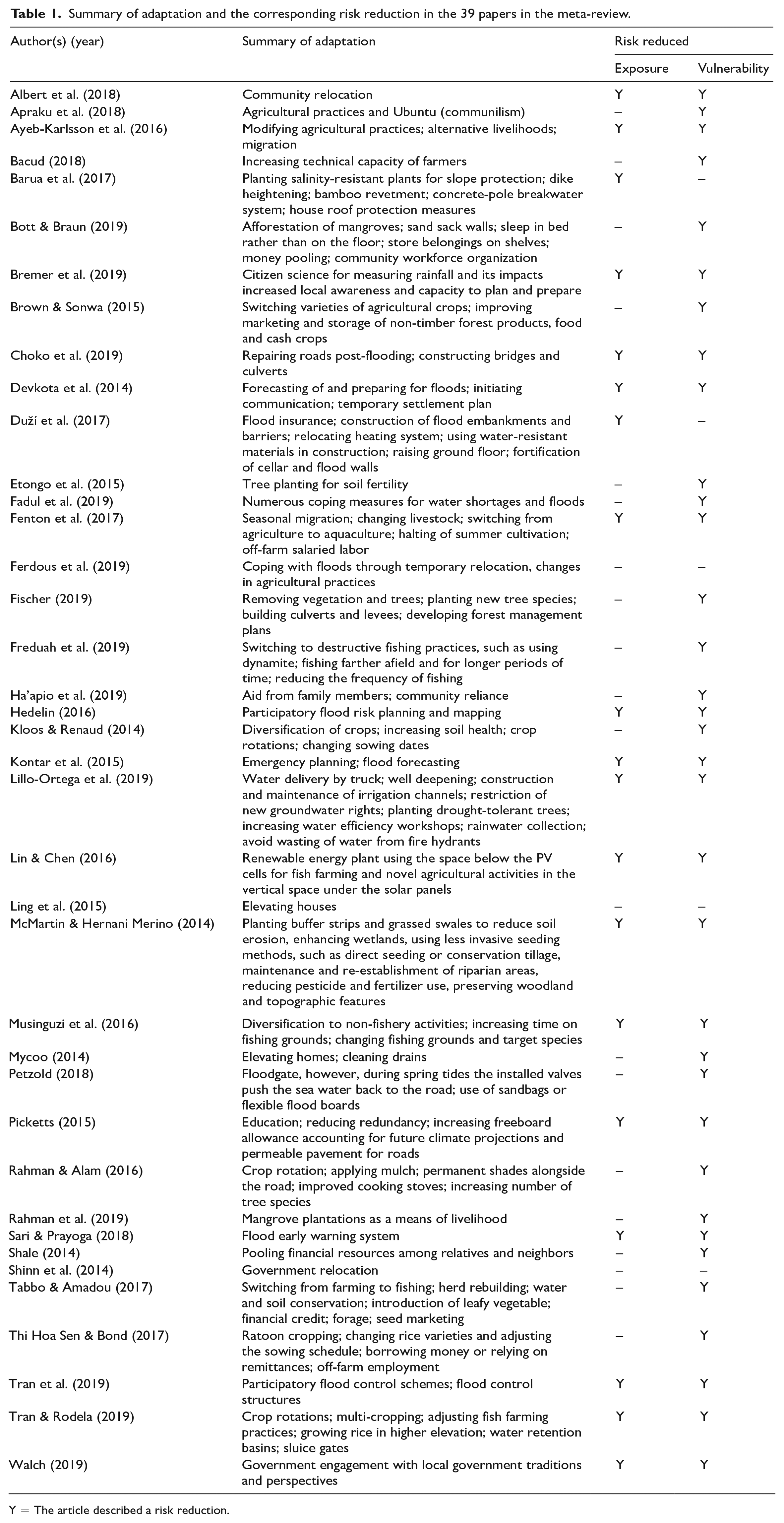
Y = The article described a risk reduction.
Indigenous or multigenerational practices were implemented in 10 of the studies, which clearly spelled out the role of IK in the adaptation process. For example, in South Africa, homes were built in an Indigenous rondavel (a circular hut with a thatched, conical roof) style to reduce wind damage, regulate interior temperature, and facilitate roof drainage, and traditional practices of preserving grains and seeds and composting manure allowed farmers to sustain crops during periods of irregular rainfall (Apraku et al., 2018). In Bangladesh, a forest-dependent Indigenous community applied leaf litter to maintain soil moisture for crops (Rahman & Alam, 2016). In the Solomon Islands, wantok (a social cooperation system) improved resilience (Ha’apio et al., 2019). In Vietnam, farmers made an autonomous switch to regenerative rice production (Thi Hoa Sen & Bond, 2017). Other studies highlighted multigenerational practices. In Bangladesh, a traditional method of tying roofs to the ground prevented roofs from being blown away during cyclones (Barua et al., 2017). In Sudan, a farming community used a centuries-old practice of spate irrigation in response to erratic rainfall (Fadul et al., 2019).
Adaptation initiators
Incremental collective action occurred in 18 studies, although the connection to LK or IK is not described. For example, in South Africa, Indigenous farmers responded to drought by collectively leasing livestock to neighboring, less drought-stricken regions (Apraku et al., 2018). In Bangladesh, Indigenous community members protected their homes from storm surge by placing geotextiles on the banks of ponds (Rahman et al., 2019). In Niger, when crop yields decreased, farmers learned from local fishers how to fish for both sustenance and income (Tabbo & Amadou, 2017). In Nepal, strong social and cultural ties enabled individuals to use informal community networks to communicate with, check up on, and assist others after floods (Devkota et al., 2014).
Nine papers described collective action that was driven by outside actors who introduced new technology, methods, or funding. In Indonesia, international organizations worked with local government and citizens to design a flash flood warning system (Sari & Prayoga, 2018). In Nepal, Indigenous flood forecasting was incorporated into emergency preparation (Devkota et al., 2014). In Bangladesh, international, national, and local institutions restored mangroves for flood protection (Rahman et al., 2019). In the Philippines, the local government and an Indigenous community built irrigation canals and trained farmers in new seedling propagation and biofertilizer application techniques (Bacud, 2018). In Bangladesh, researchers from Norway and the USA trained citizen scientists to improve flood forecasts (Bremer et al., 2019). However, when a project is led by outside experts, it is unclear whether this type of response enhances either LK or IK or implicates the forcing of western knowledge onto the community.
Eleven studies described autonomous or individual migration or off-farm diversification, such as seasonal migration (Ayeb-Karlsson et al., 2016; Thi Hoa Sen & Bond, 2017) and switching from agriculture to aquaculture (Fenton et al., 2017). In eight studies, individuals or households changed cropping patterns or cropping system. For example, in Benin, farmers increased growing of organic cotton, as they faced loss of other crops due to the difficulty of timing fertilizer application when rainfall became less frequent and more erratic (Kloos & Renaud, 2014). Individuals in seven studies implemented water and soil moisture conservation, such as no till practices (McMartin & Hernani Merino, 2014). Other flood protection measures included practical approaches such as applying water-resistant finishes to buildings in the Czech Republic (Duží et al., 2017) and elevating houses in Vietnam (Ling et al., 2015).
Risk reduction
One of the criteria for inclusion in this meta-review was that the paper included an evaluation, either quantitative or qualitative, of effectiveness of the adaption response to a WID. We determined risk reduction as effective if either exposure or vulnerability was reduced. Three of the papers concluded that the adaptation did not reduce risk. Overall, 87% reduced vulnerability and 49% exposure. For example, in Bangladesh, mangrove restoration reduced exposure to floods (Rahman et al., 2019), and in western Africa, drainage ponds and tree planting reduced vulnerability to changes in precipitation (Choko et al., 2019). Rahman and Alam (2016) found that land cover changes reduced food insecurity and improved community resilience but did not protect livelihoods, nor did it address gender or other social issues. In addition, risk reduction in one dimension may increase risk in another. In Uganda, facing declining fisheries, some fishers switched to grazing livestock on the shoreline, which polluted the water (Musinguzi et al., 2016). In the Solomon Islands and Alaska, migration reduced exposure, but fractured communities (Albert et al., 2018). Also, in Bangladesh, migration led to living in urban slums or incurring loss of assets after multiple relocations (Ayeb-Karlsson et al., 2016).
Concluding discussion
The increasing scholarly and policy focus toward locally led adaptation is grounded in the understanding that adaptation can be more effective if driven by LK and IK (Rahman et al., 2023; Westoby et al., 2021). The aim of this study was to examine existing evidence on LK- and IK-led adaptation in the context of climate-related WIDs, the most prominent and common manifestation of climate change, through a meta-review of scholarly works published between 2014 and 2019.
This meta-review shows that existing evidence on LK- and IK-led adaptation to WIDs in papers that measured effectiveness amounts to 39 papers, primarily from Asia and Africa. This skewed geographical distribution is indicative of a major research gap in the Global North where Indigenous populations are also present and adapting to climate change (Whyte, 2014). The most common hazards discussed were flooding, extreme precipitation, and irregular rainfall patterns. While the responses were largely behavioral, such as livelihood diversification, or technological, such as flood-proofing homes, institutional and ecosystem-based responses were also carried out. Importantly, most of the responses were reactive and led by communities facing multiple risks. This is not surprising given the nature of LK and IK, which are based on experiential, context-based, and situated knowledge often shaped iteratively through long-term lived experiences. These responses primarily aimed to produce enough food for consumption, secure water for irrigation, live in sustainable communities, and improve health and well-being of community members.
Our work corroborates other recent systematic reviews, which show that most climate change adaptation responses are incremental behavioral adjustments that provide short-term relief when what is actually needed is transformation change (Berrang-Ford et al., 2021; Eriksen et al., 2021). Local knowledge-led and IK-led adaptation will lead to a reduction in climate change impacts because it will be culturally and ecologically justifiable and feasible for a community (Rahman et al., 2023). Integrating these knowledges is fundamental as adapting to increasingly severe impacts due to climate change may require transformative changes, that is, novel, integrative approaches bringing about fundamental changes that are implemented quickly and large scale or across sectors (Berrang-Ford et al., 2021).
Measures such as altering farming practices or creating flood barriers provide short-term protection and might give a false sense of security, possibly increasing long-term risks and failing to address future problems (Eriksen et al., 2021). Unlike Eriksen et al. (2021), who analyzed 34 papers from the adaptation literature focused on internationally funded activities, few of the papers in our study involved top-down directives and external funding. We argue that this speaks to the fact that international funders have yet to recognize the value of LK and IK as sources of sustainable, historically proven, and potentially effective adaptation responses. In fact, similar to Eriksen et al. (2021), our results point to the continuing marginalization of Indigenous peoples and local communities when only minor adjustments driven by external actors are taken in response to climate change and vulnerability. Our findings also resonate with Berrang-Ford et al.’s (2021) review of 1,682 papers, which found that much of the existing literature documents responses that are reactive, implemented in under a year, autonomous, and do not involve regional coordination. However, as Shaffril et al. (2020) concluded in their review of 25 studies of adaptation of Indigenous Pacific Asia peoples, cohesive planning and social support are critical for climate change adaptation.
There are no universal metrics for success of locally led adaptation because of the context-dependence of effectiveness (Rahman et al., 2023; Singh et al., 2021). Therefore, it remains challenging to decipher from the academic literature if and how an adaptation approach reduces exposure or vulnerability. Indeed, in our meta-review, when studies report reduction in exposure or risk thanks to LK- or IK-led adaptation responses, they do not examine what led to this reduction. Fischer (2019), for instance, documented changes in forest management practices among farmers in the mid-western USA to adapt to droughts as an example of engaging with solutions informed by what is described in the paper as LK. However, in the absence of a discussion of structural inequities, such as land rights of Indigenous communities and the role of IK in shaping the human–ecosystem interactions, these solutions do not answer critical questions related to risk reduction. Moreover, effectiveness in one dimension does not necessarily indicate overall effectiveness, particularly, in relation to Indigenous-led adaptation strategies: who has the authority to define effectiveness? We argue that measures of effectiveness shaped by western ontologies are not appropriate to determine whether Indigenous and locally led adaptation are successful as they are grounded on an alternative cosmovision. Our study adds to the nascent debate around this issue (Singh et al., 2021) and hopes to generate scholarly interest in continuing on this avenue.
We find that claims to engage with adaptation led by LK and IK is often marred by several conceptual issues, which may ultimately hinder attempts to develop a robust understanding of the roles that LK or IK can play in climate change adaptation. These issues stem largely from a tendency to reify and essentialize LK and IK as static variables, rather than approaching knowledge formation as dynamic and ongoing processes of learning and exchange. In fact, while there are increasing academic calls for western science to integrate LK and IK (Castán Broto et al., 2019; Tengö et al., 2014), our meta-review shows that some authors appear to take the meaning of LK and IK for granted and thus deploy the terms in vaguely. We included academic peer-reviewed papers of studies that were led or informed by IK and LK fully realizing the differences between these concepts. However, given the dearth of such analysis, this review is to be considered a first step which we hope will encourage more thoughtful use of terminology by academics in the future. We see little attention to how knowledge is situated (Haraway, 1988) in contexts shaped by power dynamics, gender, age, and other forms of difference. The homogenization of LK and IK entails neglect of historical and political economic processes that condition knowledge and its expressions, such as colonialism or neoliberal capitalism (Hunt, 2013; Sultana, 2021; Tormos-Aponte, 2021). These conceptual simplifications assert once again the dominance of western knowledge over different ontologies by writing on behalf of Indigenous communities or trying to interpret their adaptation approaches without invitation (Wilson et al., 2022). We argue that a more respectful and integrated scholarly engagement with LK and IK and the communities that produce and maintain these knowledge types is needed to cultivate equitable adaptation responses to WIDs.
The majority of the literature does not give justice to the resourcefulness of local communities and Indigenous peoples that, as our meta-review shows, are mostly autonomous and independent in their adaptation strategies. Integrating LK and IK with broader regional and long-term adaptation responses requires an understanding of process-based factors that lead to risk reduction. Practical experience from the implementation of projects on adaptation suggests that there is an inherent power imbalance between local communities, local civil society organizations, international NGOs, state, multilateral, and private sector actors. This imbalance stems from the relative importance placed on western positivistic knowledge and the primacy given to technological solutions that lead to short-term improvements in income indicators. For example, Kontar et al. (2015) provide a case study of Alaska’s successful River Watch Program, noting that the program’s success derives from its “long-lasting, open, and reciprocal communication with flood prone communities, as well as local emergency management and tribal officials” (p. 13). While the case study mentions that “community leaders” are often taken on river flyovers to get a “local perspective and knowledge of the situation” (Kontar et al., 2015, p. 16), it does not specify how this reduces risk. All too often, studies that consider LK or IK seem to recite blanket invocations of the need for open, inclusive dialogue with local communities and Indigenous peoples without discussing the details of how this can be achieved in practice. However, where IK is consistently integrated with western scientific knowledge, several benefits in terms of detection, attribution, and action are gained and ensure more appropriate and effective response to long-term climate change impacts (van Bavel et al., 2020). Our meta-review shows the need to pursue this path more coherently, as LK- and IK-led adaptation is a reality that should no longer be ignored or dismissed as irreconcilable with other types of knowledge.
In agreement with recent work on LK and IK in climate change adaptation (Chambers et al., 2021; Schipper et al., 2021), we argue that there is a clear need for scholars and practitioners to better articulate what is meant by LK or IK in their research and practice and to more closely attend to the processes by which these knowledges can be meaningfully integrated into adaptation efforts, also by following Indigenous research protocols (Wilson et al., 2022). If this suggestion is to be taken seriously, however, it will inevitably entail greater attention to meaning-making, power, and the politics of knowledge within and beyond the academy. Importantly, attaining this level of critical analysis will require equal weight being given to different ontologies, greater cross-disciplinary collaboration, and more extensive involvement of critical perspectives from the social science and humanities in climate science.
Footnotes
Acknowledgements
We acknowledge all the other colleagues involved in the wider meta-review under the leadership of Aditi Mukherji. We are thankful to the entire Global Adaptation Mapping Initiative (GAMI) team, led by Dr Lea Berrang-Ford for providing us the database (articles) for the meta-analysis, which were then coded for assessing the effectiveness of water-related adaptation responses.
Authors’ note
Declaration of conflicting interests
The authors declared no potential conflicts of interest with respect to the research, authorship, and publication of this article.
Funding
The authors received no financial support for the research, authorship, and publication of this article.

Glossary
rondavel a circular hut with a thatched, conical roof
Tok Pisin language
wantok a social cooperation system
Zulu language
ubuntu communalism