




Abstract
Contentions centering on rights claims on behalf of Métis, an Indigenous group descended from a distinct bicultural political nation in central Canada, continue within the traditional territory of the Syilx, a group Indigenous to the Okanagan Valley, British Columbia, Canada. This article revisits earlier work arguing that Métis in Kelowna pre-1900s were mostly absorbed into Syilx community, having no traditional territory within this region. Inclusion took place through marriage and common-law partnerships, but also through social and familial networks formed out of kin connections. Accounting for oral histories, genealogical records, and cultural inheritance and identity practices, Syilx philosophies of inheritance and Métis practices of relationality and matrilocality are cause for the McDougall family’s integration into Syilx communities, despite Canadian Government policies that dictated otherwise. Through decolonization and unlearning, this work acknowledges how colonial interference created and continues to reinforce divisions among First Nations and Métis peoples.
Introduction
The history of the city of Kelowna in British Columbia’s southern interior region that is commonly shared and accepted by the general public reflects a colonial narrative that stifles other perspectives: a settler story that is romanticized and whitewashed, failing to account for the diverse experiences of past community members including those of colonialism and racism. According to Simpson (2011), typical of such narratives include descriptions of “western exploration” (p. 14) beginning with the Okanagan Fur Brigade Trail in the early 1800s, established by Scotsmen David Stuart and David Thompson, followed by Father Pandosy’s Catholic mission founded in 1859, gold discovery, “and, finally, settlers” (p. 30). This approach is particularly problematic as it both “suggests that nobody was there” while “subtly depoliticiz[ing] the process whereby white people came to dominate First Nations territory” (Perry, 2001, p. 7), and fails to acknowledge the sexual, marital, and consequently familial relationships between incoming settlers and primarily local Indigenous women (Barman, 1996). Jeannette Armstrong, who is Syilx, a group Indigenous to the Okanagan Valley, British Columbia, Canada, “few Syilx Okanagan [an alternative term to describe Syilx people]voices exist to counterbalance the overwhelming number of settler voices recounting those times” (Armstrong, 2021, p. 1).
It is crucial that the stories of the Syilx peoples be told alongside the classic pioneer historical narrative recalled by settlers. Prior to the introduction of the fur trade, Syilx peoples were living within the Okanagan and Similkameen watersheds, both in Canada and across the border in the USA (Wagner, 2008). As Syilx historian Shirley Louis (2002) explains, “before contact the Okanagan people existed as one in a number of matrilineal groups of Salish [language spoken by the Salish—Indigenous peoples of the American and Canadian Pacific Northwest] speaking people of the Western plateau” (p. 10). The Syilx economy included a complex system of hunting, fishing, gathering, food processing, and trading that was organized by kin-group. Semi-permanent winter village sites were established as centres for storage, with less permanent sites established nearer to important resources (Thompson, 1994). In the 1700s, horses were introduced into the Okanagan region and became key to the Syilx economy as an important means of transport and trade. From initial contact until 1905 and beyond, the effects of increasing colonization and an increasingly racist attitude towards Indigenous people devastated Syilx communities. The formation of reserves and a forced capitalist regime, in addition to restricted access to key resources, prevented Syilx peoples from maintaining their traditional harvesting practices. Once promised by James Douglas that they would be treated fairly under the law, Syilx peoples were often treated as second-class citizens, being denied basic rights, such as the right to vote and to purchase crown land (Thompson, 1994). Syilx traditional and ancestral territories remain unceded, unconquered and unsold, yet continue to be occupied by settlers (Okanagan Nation Alliance, n.d.).
When I wrote my master’s thesis in 2012, I concluded that there was a historic Métis, an Indigenous group descended from a distinct bicultural political nation in central Canada, community in existence in the Okanagan and by extension that Métis claims to Powley rights in this territory were justifiable (Legault, 2012). One of the gifts of remaining in academia is revisiting earlier ideas, as perspectives and hypotheses change over time through access to new knowledge. With exposure to new knowledge, further connected to Métis histories and ways of being, and through conversations with Syilx friends and colleagues, including Dr. Jeannette Armstrong, I have revised my earlier research to contend that historical Métis—in especially the Kelowna region pre-1900s—were, for the most part, absorbed into Syilx community. For the focus of this research, I revisit the subject of my master’s thesis: the McDougall family, to explore how and why this occurred historically, and explain why it is important today.
My mistake in conducting my initial review of the McDougall family history was mine alone and stems from drawing conclusions solely on material remains, houses built by John McDougall and his sons, and genealogical records, without taking into account historical collectivity. As Métis scholar Brenda MacDougall explains, such approaches are flawed, as “traditional genealogical methods actually divorce historical people from their cultural context, their collective existence, and, therefore, the worldview or philosophical outlook of their people” (Macdougall, 2014, p. 34). By ignoring the cultural context, the philosophies of the Syilx people with whom the McDougalls were deeply connected and the compatibilities between Syilx and Métis matrilineality, the significance of Syilx relational practices was overlooked.
Background: the McDougall family
The history of the McDougall family has been (re)constructed to a great extent by those who have interpreted their presence in the Okanagan Valley, be it historical societies, museums, descendants, or historical first-person accounts. Because of the oral nature of Indigenous culture, historical records typically describe only part of the story, which is largely from a Euro-Canadian perspective. A survey of the McDougall family historical documents, including local histories and first-person accounts written by both Indigenous and non-Indigenous authors, unearthed a number of key resources. Louis’ works were particularly valuable as she includes oral histories concerning past women told by Syilx Elders and McDougall descendants that are rich in details of past activities and social relationships in the Okanagan (Louis, 1996, 2002). There is no record of firsthand documents written by John McDougall, so his personal history and genealogy is re-constructed through the few documents in which he and his family were mentioned, including primary sources such as birth, baptismal, marriage, death, military enlistment, census records, the stories told about him, and the buildings that he constructed that can be found throughout the Okanagan Valley (Legault, 2015; Louis, 1996).
Jean Baptiste McDougall, known locally as John or Johnny, was born in 1827 at Fort Garry, present-day Winnipeg, to a Scottish father Duncan McDougall and Métis mother Helene Wenzel, or Wensell (Louis, 1996; Sloan, 2013). His father and mother’s father were both employed in the fur trade by the Hudson’s Bay Company. John came west to British Columbia at a young age while working as a guide for Donald Smith (Louis, 1996). Until 1854, he worked as a labourer and canoe man, traversing the Okanagan Valley with pack trains. In the early 1860s, John McDougall pre-empted 160 acres in the Okanagan Mission, building a small trading post. While working in the fur trade at Fort Kamloops, John engaged in a country marriage to a woman of Secwépemc and Syilx ancestry named Emelie, or Amelie or Melie, Topa, with whom he had a lasting relationship (Barman, 1996). John McDougall was instrumental to the early pioneer community of Kelowna and held considerable status on account of his role as a Hudson’s Bay Company store owner, but also because of his role as a builder. John McDougall was relatively wealthy due to his discoveries of gold in the Similkameen Forks River, which he attributed to a prophetic dream from God (Gellatly, 1983). He was known as a devoutly religious man who was dedicated to the local Catholic Mission de L’Immaculée Conception (1859–1906), known later as Father Pandosy Mission (Louis, 1996). John was particularly knowledgeable of the local landscape as a result of his many years working in the area and reportedly “mixed well with his neighbours” (Louis, 1996, p. 9). He and his family started off living near the Mission, but sold his land at Guisachan to the wealthy British Aberdeen Family around 1891 and later moved to the west side of Lake Okanagan (Louis, 1996). Together, John and Emelie had 10 sons and, with following Emelie’s death, John had 2 daughters with another Syilx woman named Julie, with whom he had limited contact (Louis, 1996). The genealogy of second and third generations of John McDougall’s family illustrates the complexity of the McDougall family’s social and familial networks and the extent to which they were present in the Okanagan (Tables 1 and 2).
Children of John McDougall.
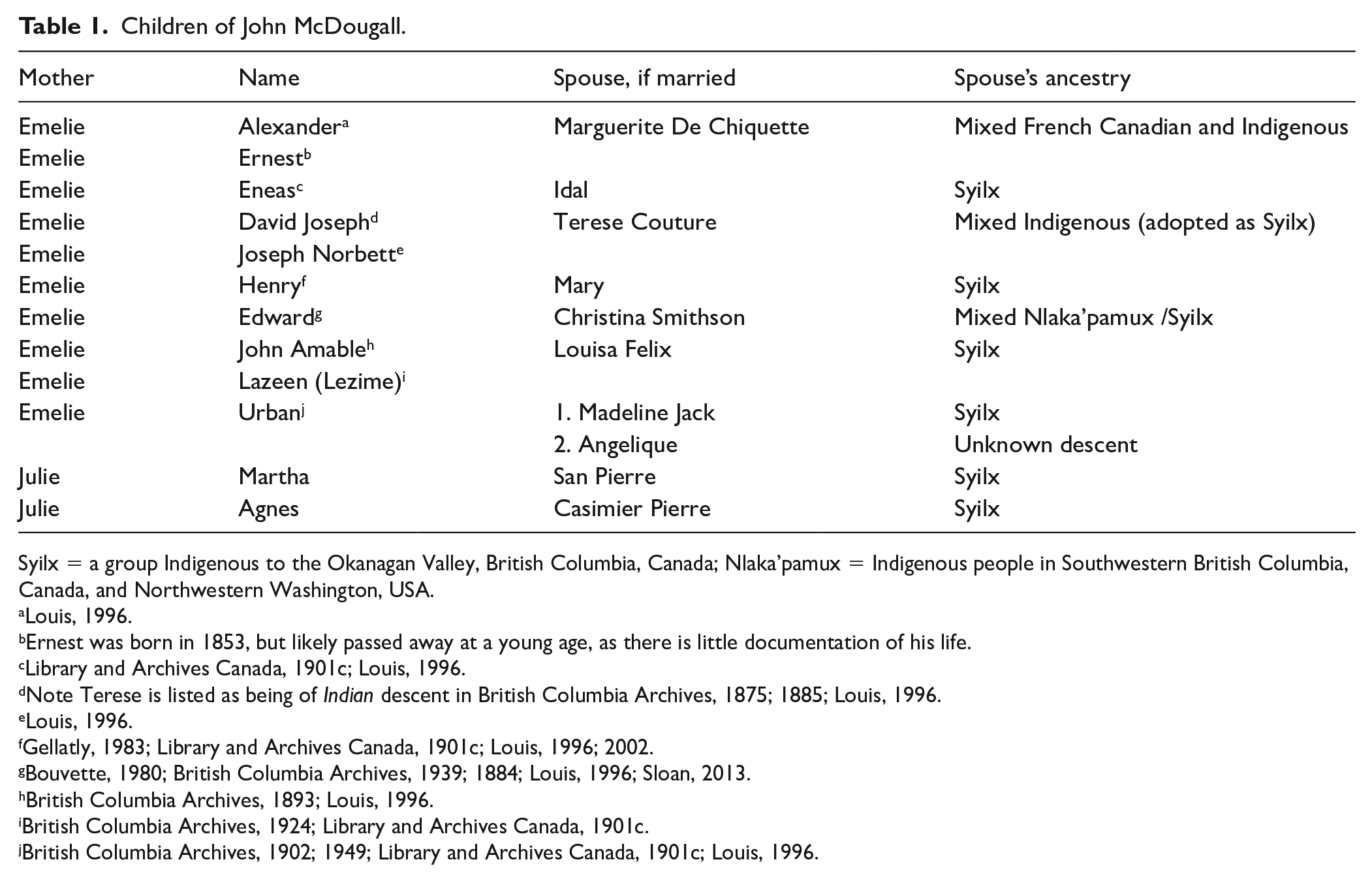
Syilx = a group Indigenous to the Okanagan Valley, British Columbia, Canada; Nlaka’pamux = Indigenous people in Southwestern British Columbia, Canada, and Northwestern Washington, USA.
Ernest was born in 1853, but likely passed away at a young age, as there is little documentation of his life.
Note Terese is listed as being of Indian descent in British Columbia Archives, 1875; 1885; Louis, 1996.
Third-generation marriages within the Okanagan Valley.
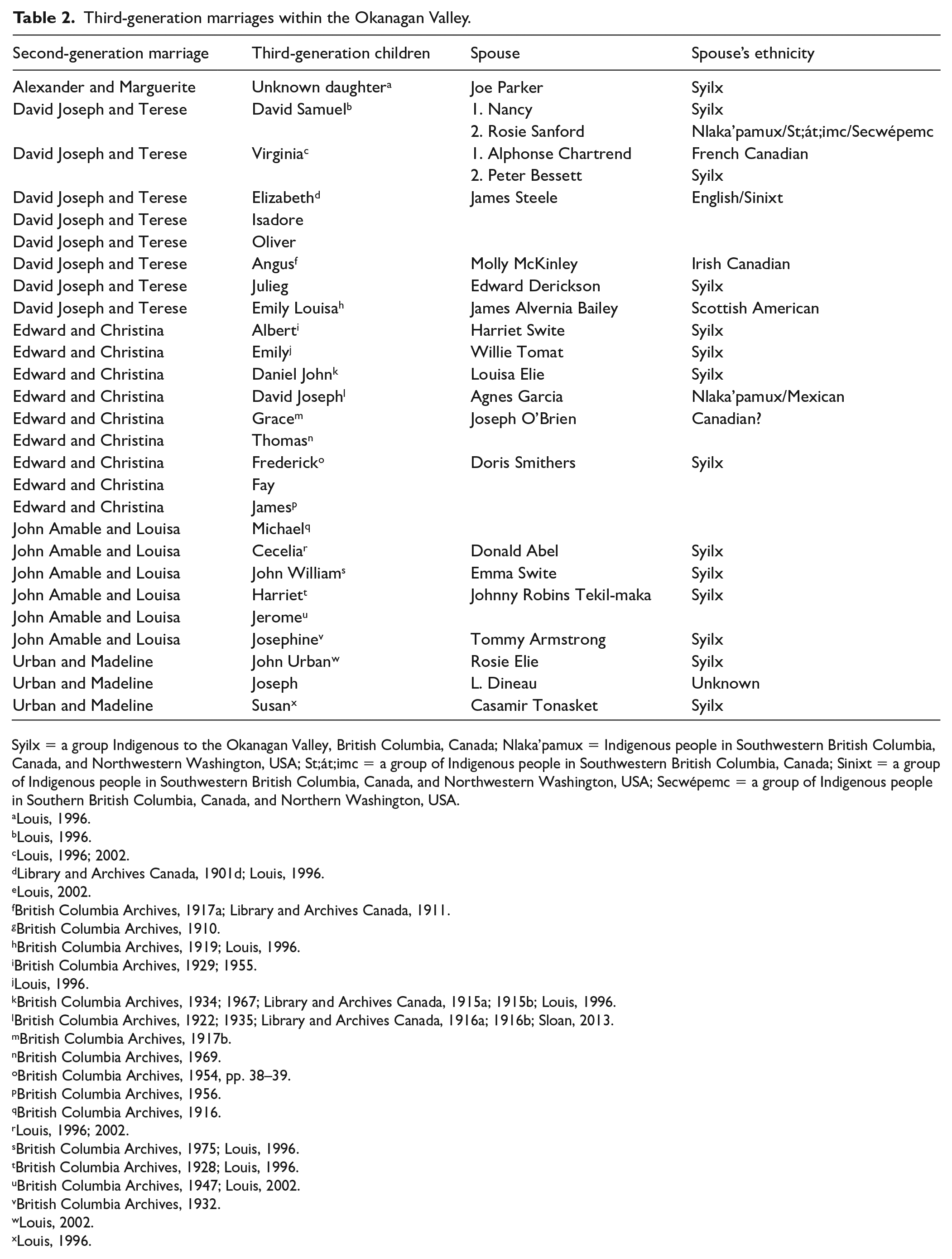
Syilx = a group Indigenous to the Okanagan Valley, British Columbia, Canada; Nlaka’pamux = Indigenous people in Southwestern British Columbia, Canada, and Northwestern Washington, USA; St;át;imc = a group of Indigenous people in Southwestern British Columbia, Canada; Sinixt = a group of Indigenous people in Southwestern British Columbia, Canada, and Northwestern Washington, USA; Secwépemc = a group of Indigenous people in Southern British Columbia, Canada, and Northern Washington, USA.
British Columbia Archives, 1954, pp. 38–39.
British Columbia Archives, 1947; Louis, 2002.
While John and Emelie McDougall’s sons Lezime, Ernest, and Joseph Norbett never married, sons Eneas, Henry, John Amable, and Urban each married Syilx women and sons Alexander, David Joseph, and Edward each married women of mixed ancestry, who may have also have been of Syilx ancestry. John’s daughters with Julie, Martha, and Agnes both married Syilx men.
By the second generation, David McDougall and his wife Terese Couture, a woman of mixed Indigenous ancestry, but adopted by a Syilx family, are noted as being fluent speakers of French, English, and Nsyilxcen, the Interior Salish language of the Syilx peoples, which likely resulted from their social and familial relationships with speakers of each language (Louis, 1996). They had eight children, three of whom married Syilx partners: David, Virginia, and Julie, two of whom remained single and three married settler partners: Virginia, Emily Louisa, and Angus. David and Terese’s home was known to be a lively place, where the “local townspeople at Winfield and native people” would stop by to play music, dance, and hear stories of the past (Louis, 1996, p. 28). David McDougall, like his father John, was well known for his storytelling abilities and is noted by his descendants as carrying oral traditions through the telling of detailed coyote stories (Louis, 1996). Stories about snklip (coyote—who is often a trickster figure in Syilx culture) are of particular significance to Syilx people, as explained by Syilx scholar Bill Cohen (1998): The relationship to the land through Coyote’s [as written in original work] teachings is central to the Okanagan culture, language, and the stories and mythology or [cep-captikwl (stories which guide Syilx ways of knowing and being through demonstrating laws, traditions, values, traditional governing structures, alongside informing relationality ith land and culture)]. Respect for the land and all the beings put here by the creator was expressed through the language and [cep-]Captikwl [as written in original work], and practiced through the culture in ceremonies and everyday life activities. (p. iv)
Cep-captikwl, also known as captikwl, are further described by Cohen (2010) as “the Okanagan traditional story system which expresses cumulative knowledge, the living record of what it means to be Sqilxw/Okanagan [an alternative term to describe Syilx people]” (p. xiv).
Edward McDougall and Christina Smithson had 10 children, 3 of whom married Syilx partners: Albert, Daniel John, and Emily; 2 remained single: Thomas and James; 1 married a woman of nearly by Nlaka’pamux (Indigenous people in North America, whose traditional territory is located in Southwestern British Columbia, Canada, and Northwestern Washington, USA) and Mexican descent: David Joseph, and daughter Grace married a settler. John Amable McDougall and wife Louisa Felix had five children, two never married: Michael and Jerome, and the other three children: Cecilia, John William, and Harriet each married Syilx partners. Urban McDougall, with wife Madeline Jack, had one son, John Urban, who also married a Syilx woman.
John McDougall had no contact with his two daughters, Martha and Agnes, as upon their mother Julie’s death, John wanted his daughters to be educated at boarding school, which their grandparents outright refused (Louis, 1996). Martha married Syilx San Pierre and had six children, whereas Agnes married Syilx Casimier Pierre and had three children. Their children also married into Syilx families (Louis, 1996). The vast majority of third generation of McDougalls also demonstrate a marital preference for Syilx partners. Similar to other Métis peoples living in British Columbia’s central interior, the marital choices of the McDougall sons as well as those of their children “echoed those of parents and grandparents”, as they “partnered with others of similar backgrounds and understandings where they were most likely to find social acceptance” (Evans et al., 2012, p. 338).
Most of the second generations of McDougalls remained in the Okanagan Valley, with sons Eneas, Henry, John Amable, and Lezime living together as adults. With the exception of Edward and Christina McDougall’s children Albert, David Joseph, James, and Grace, who lived in the Nicola Valley, the majority of the third generation of McDougalls also remained in the Okanagan (Louis, 1996). For the McDougalls, it appears that the increasing immigration of settlers into the Okanagan pressured them to leave the recently urbanized areas of the Mission (areas within contemporary Kelowna), Guisachan, and Benvoulin to primarily the Duck Lake and Westbank Indian Reserves. Here, the sons of John McDougall and their children could continue the activities with which they were most familiar, mainly hunting, guiding, and trapping. Social and familial networks were formed out of kin connections, work and school relationships, geographic proximity, and religious affiliation. Moving closer to their Syilx families ensured security during a time of economic insecurity and providing them with an ongoing sense of belonging.
Discussion: being and becoming Syilx
In the early years of Euro-Canadian land development in the Okanagan, Syilx, and settler communities often overlapped, as the majority of settlers in what is now known as Kelowna engaged in relationships with Indigenous women (Barman, 1996). During this period, Syilx women stood “between two worlds, the expanding frontier world of the settler and the shrinking Indigenous world of the Syilx Okanagan people” (Armstrong, 2021, p. 1). The 1901 Census recorded several families as being of mixed First Nation and Métis ancestry living throughout the Okanagan, including the Berard, Bouvette, Brent, Dickson, Garcia, Houghton, Kruger, Lawrence, McDougall, McIntosh, McIntyre, McLean, Richter, Shuckey, Shuttleworth, Steele, and Tronson families (Library and Archives Canada, 1901a, 1901b, 1901d, 1901e, 1901f, 1901g, 1901h, 1901i). First Nation and Métis peoples worked and lived among each other, as sons engaged in similar types of employment. As Armstrong explains, a number of men working for fur trading companies such as the North West Company and the Hudson’s Bay Company who were Métis or settlers from Europe had children with Syilx women, and their descendants continued to live as Syilx people, as per the Syilx cultural ethic. She explains as follows: The Okanagan Syilx had and have a cultural ethic that persons who marry a Syilx person and has children is one of us through their children and in every way to be included—and where it was possible—to insure their children to have full culture and rights as Syilx. Those who marry and have children (even by common-law) are one of us because they are related to us, their children are us, they are not viewed as outsider. Many names, such as Pierre, Peone, Marchand, Bonneau, Mcleod, McLean, Louie, Louis (both are shortened versions of Groslouis) are descendants of those who came with the HBC [Hudson’s Bay Company] and North West Company, as guides, and builders of the Forts. Some descendants of course have different last names.. . .There continue to be many intermarriages with M[é]tis men and women in our communities, I have never heard anyone refer to them in any way other than as our people. (J. Armstrong, personal communication, March 14, 2021)
As Louis (2002) explains, matrilineal practices were essential to preserving and passing on Syilx/Okanagan culture: Family life is still central to the preservation of Okanagan culture. The People established a well-structured existence of matrilineal family life that included immediate and extended family, distant relatives and close associations. These ties to one another, and to their Nation, created a strong sense of family and community identity. And being that the family usually resided with the mother’s family, their children experienced strong maternal ties. (p. 10)
Matrilineal practices were also articulated through oral histories, as Dave Parker (1987) a McDougall descendant explains, “My grandfather was a half breed: his mother was an Indian. If the men married into the Indians, then they became Indians” (as cited in Cox, 2013, p. 38). The genealogical and residency patterns described above, taken with continued Syilx philosophies of inheritance described by Jeannette Armstrong above and Syilx matrilineal practices indicate that the descendants of intermarriages between Métis and Syilx prior to and post-1900 effectively became Syilx, a practice that is incidentally consistent with Métis matrilocal patterns. In her study of 19th-century Métis in Île à la Crosse, Saskatchewan, Macdougall (2006) reconstructed genealogies through the cross-referencing of scrip, fur trade, and census records to reveal the ways in which wahkootowin, a Cree (group of Indigenous people in central to southeastern Canada) principle of relating that informs the social structure of family networks as follows: The women Indigenous to the region became the centrifugal force incorporating successive waves of outsider males who carried with them the surnames that came to mark northwestern Saskatchewan communities and identified the families locally and patronymically. Aboriginal women—Cree, Dene [a group of Indigenous people in central to northwestern Canada ] and then Métis—grounded their families in their homelands, creating for them a sense of belonging to the territory through a regionally defined matrilocal residency pattern and, therefore, female-centred family networks. (p. 445)
Consequently, the relationship that Métis people had to the land was defined by that of the women born of that land (Macdougall, 2010). Macdougall (2006) describes the ways in which worldviews of First Nation women trickled down into the lives of their Métis descendants to produce “a system of social obligation and mutual responsibility between related individuals—between members of a family—as the foundational relationship within communities” (p. 434).
Though there has been extensive discussion of historical identity shifting along binaries of either “white or Indian” among historic Métis (Barman, 1991, p. 171), there has been little analysis of the mechanisms that encouraged shifts towards First Nations relatives belonging to local territories (Weinstein, 2008). Métis lawyer Jean Teillet’s (2019) history of the Métis centred in the historical North-West documents the ways in which repeated oppressive forces, including the Selkirk settlers, the Hudson’s Bay Company, the Orange Lodge, and the Canadian Government, all acted against the Métis, but rather than eliminate them as planned, had the effect of only further crystallizing their sense of collective identity and nationhood. It could be argued that Métis moving into the Okanagan were so few in numbers in comparison with the North-West and thus were perceived to be less of a threat to colonial bodies, so were not necessitated to collectivize in opposition. In the Okanagan instance, the clear compatibilities between Syilx philosophies of cultural inheritance and Métis practices of wahkootowin and matrilocality resulted in a distinct shift within the McDougall family towards becoming Syilx, despite assimilationist laws and policies that dictated the opposite should occur (Legault, 2022).
Discrimination on the basis of gender has been woven into Canada’s Indian policy since at least 1869 (Gehl, 2000). Canada’s early definition of Indianness, in the Act for the Better Protection of the Lands and Property of Indians in Lower Canada, 1850, included the following: All persons of Indian blood, reputed to belong to the particular Body or Tribe of Indians interested in such lands, and their descendants . . . . All persons intermarried with any such Indians and residing amongst them, and the descendants of all such persons . . . . All persons residing among such Indians whose parents on either side were or are Indians of such Body or Tribe. (Para. v)
By such a definition, many mixed-blood peoples, such as those who were termed by others or self-identified as half-breeds or Métis, would have then been considered Indians. This definition became more restrictive with the Lands and Enfranchisement Act, 1869, which required registered Indians to have a minimum of one-fourth blood quantum (Lawrence, 2004). The Indian Act 1876, simply replaced blood quantum with the principle of patrilineal descent, which created membership restrictions against women who married non-Indians, and their children, thus rendering legal status to patrilineal affiliation (Fiske, 1995). Married women took on the socio-legal status of their husbands and were required to leave their natal band upon marriage to a non-Indian man or an Indian man from another band. The enforcement of this Act should have severed relationships between the McDougalls and their Syilx kin beginning with John McDougall’s marriage to Emelie Topa and continuing among their many sons, but this was not the case. Many of John McDougall’s sons maintained strong relationships to the relatives and the lands of their wives and mother, an expectation consistent with the principles of relational obligations inherent in wahkootowin.
The strength of such philosophies and relational obligation is demonstrated by John McDougall’s son Lazeen, or Lezime, being honoured by members of the Okanagan Indian Band and having been offered land in exchange for his employment as a carpenter building houses for Syilx Ethel Jack, chief Pierre Louis, and Willie Marchand. He never accepted the land, as he “had a bit of the McDougall wandering spirit” (Louis, 1996, p. 36). Legally, this would not have been allowed in accordance with the Indian Act, but clearly this didn’t deter Syilx peoples, as the second and third generations of McDougalls demonstrate a pattern of residence centralized near or on Indian Reserves in the Okanagan. Louis (2002) and archival records titled Protests of Indian Act from Okanagan Indians (1952) both describe examples of McDougall descendants living on reserve lands. This runs contrary to provisions in the Indian Act which should have resulted in their removal. However, Louis (2002) also describes a 1913 Royal Commission inquiring about halfbreeds living on reserves, which resulted in the removal of David and Terese McDougall from the Duck Lake Indian Reserve.
Oral testimonies in Louis’ collection of Syilx genealogies and stories titled Q’Sapi (2002) describe a number of McDougall family descendants as being Syilx, but do not explicitly indicate their Indian status, though it can often be inferred by their presence on Indian reserves. One oral story of Syilx Ned Louis (2002) describing his father Pierre Louis, elected chief in 1932 as being strategic in any circumvention of the Indian Act 1876, stated the following: Dad never went completely by the book. He used to tell us guys don’t go deep into the Indian Act, just go around the edges. That way we will still be within the law and if you use only the edge then we can have both the provincial and federal law. We will always be protected. But, if you go deep into the Indian Act we’ll get locked in. That’s why we have to write all the newborns’ names and the families once a year. We have to stay ahead of the government and keep our own records. (p. 166)
Though it is not clear how such record-keeping effected band lists and the Indian Register, there was clear resistance to the legally forced divisions and Indian Act 1876, classifications of who is and isn’t Syilx. This in itself is a testament to the resilience of Syilx cultural philosophies of matrilineal relationality and cultural inheritance in the face of systemic colonial violence.
Revisiting the Okanagan
As mentioned already, the reversal of my position on the McDougall family results from continued learning from Syilx peoples including scholars and experiences within the Okanagan region. It is through this witnessing, both through interviews conducted with local Métis people in my PhD research (Legault, 2016), and through witnessing the experiences of community members, that I have become aware of the neocolonial nature of Métis claims to Syilx territories. For instance, as a Métis person who has lived in Kelowna for over a decade, I am well aware of the fallout of the local Willison case, where a Métis harvester Greg Willison attempted to claim Métis harvesting rights in Falkland, within Syilx territory (R. v. Willison, 2005; B.C.J. No 924.; B.C.J. No. 1505, 2006). With this case, in 2006, the British Columbia Provincial Court applied the Powley Test based on the R. v. Powley (2003) decision criteria, which continues to be the most widely used official definition of Métis. This was done to determine whether there was a distinctive Métis community in this specific region prior to “effective [colonial] control” and whether hunting was a traditional practice of such a community (Teillet, 1999, p. 53). While the Provincial Court judge concluded that the accused Mr. Willison had a proven Aboriginal right to hunt, the British Columbia’s Supreme Court appeal overturned the judgement on the basis that within the trial evidence “there was no historical or contemporary Métis community in the relevant region” (Peach, 2013, p. 289).
The impacts of these legal proceedings were felt everywhere, from Indigenous advocates working in the local school divisions to Métis social workers sitting on Indigenous child welfare committees (Legault, 2016). Without a doubt, Métis claims were considered to be an affront to Syilx nationhood and the authority of the Okanagan Nation Alliance. This tension continues today and has most recently been reinforced through Métis Nation British Columbia’s intervention in R. v Desautel (2021), claiming that “the Kootenay region for the Métis Nation British Columbia (MNBC) is a core traditional territory,” despite the region “falling squarely within Syilx/Okanagan Nation Territory” (Mussell, 2020, p. 2).
With regret, I now realize that in my previous work, I too was reproducing colonial patterns of glossing over or silencing Indigenous histories, and for that I am sorry. When I completed my master’s thesis in 2012 examining the historical structures built by Métis fur trader John McDougall in the central Okanagan (Legault, 2012), I agreed with MNBC’s position, and that put forward by the defendant in the Willison case, that there could have been a historical Métis community in the Okanagan prior to “effective control” (Teillet, 1999, p. 53). I reached this conclusion primarily through the study of vernacular architecture, in the form of houses built by John McDougall and his sons which demonstrated a continuation of Métis architectural practices, which have been previously documented in Saskatchewan (Burley et al., 1992). These remains speak to the work of men, and entirely omit the women married to and descended from John McDougall, predominantly Syilx women. This analysis ignored Syilx philosophies of cultural inheritance and their innate compatibilities with Métis matrilocal practices. If viewed through this new lens, it is difficult to conceive of a historical Métis community within Syilx Okanagan territory. Nevertheless, there are undoubtedly descendants of the McDougall family who identify today as Métis, are active Métis Elders and whose families may have identified as Métis historically. That, I cannot question, nor is my intent to make any judgements on how descendants of the McDougall family today may identify, as legal identity categorization through the Indian Act undoubtedly severed future generations of McDougalls from their Syilx kin.
Conclusion: relational reflections
My own engagement with decolonization has involved an unlearning and questioning of colonial approaches as the status quo, and a relearning of the ways in which colonial interference created and reinforced, and continues to reinforce divisions among Indigenous peoples, in particular, First Nations and Métis peoples.
The historical attention paid to racial difference between Métis and First Nations has been overemphasized and disregards their shared cultural characteristics, most notably kinship practices (Hancock, 2021). Métis legal scholar Paul Chartrand (2007) describes how relations between the Métis and First Nations had historically close relations and similar cultural practices in the historic national homeland, due to shared territory: “the land gives you your culture, so as we shared the land, so we also shared some of our ways of life” (p. 5). Historically, political alliances between Indigenous groups were solidified through kinship bonds and reinforced by ceremonies. In some cases, Métis were heavily intermarried into many First Nation bands, which Plains Cree scholar Rob Innes describes as being multicultural in nature. Innes’ (2003) description of the permeability of pre- and post-reserve bands and early advocacy on behalf of First Nations to include Métis peoples in treaties counteracts dominant narratives, which he defines as “racist fiction” that “benefitted the government’s aim to undermine Indigenous rights, primarily Indigenous land rights” and which continues to position Métis and First Nations tensions as being rooted in racial and cultural differences (p. 109). Furthermore, as Métis scholar Adam Gaudry (2014) explains, historical Métis political thought depended on the concepts of wahkootowin as well as kaa-tipeyimishoyaahk, a Cree term translating to self-governing. Embodied in these concepts are the notions of collective self-sufficiency, freedom, and cooperation (Hayter, 2017). Andersen (2021) describes such “diplomatic relationality” as being central to Métis peoplehood, countering dominant understandings of Indigenous peoples as ethnic, racial, or special interest groups (p. 34). Elsewhere, I have described the ways in which inter-Indigenous relations were disrupted through colonial attempts to “divide and conquer” through policies and laws that physically and metaphorically disrupted relations to kin and traditional territory (Legault, 2022, p. 44), but others have also described these impacts as extending to trading and political alliances (Teillet, 2019).
Increasingly Indigenous groups are pitted against one another in judicial proceedings where groups that are simply using the only means available to them to address long-standing rights abuses take positions that advance their claim but set back the claims of others (Voth, 2018). While political battles between Indigenous peoples and the Canadian state that play out in the courts highlight obvious Indigenous-settler state conflicts, what is less obvious is how these legal battles set different Indigenous groups against one another (Voth, 2018). The emphasis on single ownership and the indivisibility of land remains at the crux of these issues and a direct contradiction to both Syilx and Métis perceptions of the land as relation and borrowed from future generations (Armstrong, 2006; Ghostkeeper, 2007). As the Métis population in British Columbia grows and Métis organizations within British Columbia’s experience a new influx in federal support, it is more important than ever that Métis organizations are equipped to engage in inter-Indigenous relations with First Nations in British Columbia. It is critical that Métis peoples understand nation-to-nation relations as extending beyond the state to other Indigenous nations (Lightfoot & MacDonald, 2017).
In past community-based research I was asked to refrain from presenting an overtly critical analysis that could be internally divisive for Métis communities (Legault, 2016). This is not my intention with this work. Instead, my intention is to attend to Indigenous philosophies of relationality and our interconnectedness (Starblanket & Stark, 2018). My aim is to be accountable to the First Nations peoples who are already here and to engage in allyship, rather than replicating colonizing behaviours that effectively erase First Nations peoples by ignoring their existence since time immemorial. Yes, contemporary Métis are Indigenous and may also be kin to local Indigenous peoples on whose land we live, but we are often also settlers, despite the ways in which we may have made our way onto these territories, whether through historical diaspora caused by encroaching colonial settlement, or through willful relocation for employment, or through following previous waves of Métis relatives. It is essential that as Métis, we disrupt the binary of colonizer and colonized and see ourselves as both Indigenous and settler and hopefully, ally and kin within our interconnected web of relations.
Footnotes
Acknowledgements
The author expresses profound gratitude and recognition to the Syilx Peoples, upon whose ancestral lands the author lives and works as an uninvited guest. They have cared for these lands since time immemorial, and the author is deeply privileged that they grant her the opportunity to document their shared histories. The author acknowledges Dr Jeannette Armstrong for her mentorship, patience, and generosity in sharing Syilx teachings. Without her guidance and support, this work would not be possible. The author thanks Drs. Mike Evans, Jean Barman, and Diana French who supported the author’s original master’s research, and those who have contributed to the thinking that followed as it relates to building inter-Indigenous relations between First Nations and Métis Peoples, including Dr Peter Hutchinson and Zach Romano, among many others. The author offers thanks to the funders who have made this work possible, with a special acknowledgement of the Rupertsland Centre for Métis Research for their commitment to advancing Métis scholarship and supporting Métis scholars. The author’s gratitude extends to the diligent efforts of students Denica Bleau and Sam Grinnell, who played integral roles in refining this text and bringing it to its present published form. Finally, the author acknowledges the members of her Métis community and her living relatives for their unwavering support throughout her academic journey as well as her ancestors, for illuminating the path forward.
Author’s note
Declaration of conflicting interests
The author declared no potential conflicts of interest with respect to the research, authorship, and publication of this article.
Funding
The author disclosed receipt of the following financial support for the research, authorship, and publication of this article: Rupertsland Centre for Metis Research Fellowship and University of British Columbia’s Hampton New Faculty Grant.

Glossary
captikwl; cep-captikwl stories which guide Syilx ways of knowing and being through demonstrating laws, traditions, values, traditional governing structures, alongside informing relationality with land and culture
Cree a group of Indigenous people in central to southeastern Canada
Dene a group of Indigenous people in central to northwestern Canada
kaa-tipeyimishoyaahk self-governing
Métis an Indigenous group descended from a distinct bicultural political nation in central Canada
Nlaka’pamux Indigenous people in Southwestern British Columbia, Canada, and Northwestern Washington, USA
Nsyilxcen the Interior Salish language of the Syilx Peoples
Salish language spoken by the Salish—Indigenous peoples of the American and Canadian Pacific Northwest
Secwépemc a group of Indigenous people in Southern British Columbia, Canada, and Northern Washington, USA
Sinixt a group of Indigenous people in Southwestern British Columbia, Canada, and Northwestern Washington, USA
snklip coyote—who is often a trickster figure in Syilx culture
Sqilxw/Okanagan an alternative term to describe Syilx people
St;át;imc a group of Indigenous people in Southwestern British Columbia, Canada
Syilx a group Indigenous to the Okanagan Valley, British Columbia, Canada
wahkootowin a Cree principle of relating that informs the social structure of family networks