



Abstract
Indigenous peoples have strong social and cultural values, ordered social control and cohesive social systems rooted in their Indigenous knowledge of the universe in general and their locals in particular. The research assesses the Indigenous knowledge of the community in natural resource conservation practice and their perception toward natural resource. A socio-philosophical insight was employed to the analysis. The result showed that Me’en (Indigenous people of southwest Ethiopia) Community has a deep knowledge and practice of natural resource conservation in general and for soil and wildlife in particular. The study reveals the community practice contours, tracing, mulching, ridges, shifting cultivation, crop rotation, and area closure. The communities also have the knowledge to identify fertile lands by physical observation such as by its color and texture and touching. They practice a sustainable concept of utilization, but in terms of philosophical orientation, they fall in both biocentrism and anthropocentric orientation.
Background of the study
Indigenous peoples have strong social and cultural values, ordered social control and cohesive social systems rooted in their Indigenous knowledge of the universe in general and their locals in particular. They have normative and well thought-out behavior in their relations with and adaptation to the wider ecological niche hitherto established in their worldview. However, it could be argued that the emergence of modern world systems and the impact of globalization have much contributed in reversing the long-established cultural traditions and underpinned philosophical principles of live and existence. As one effect of globalization, there is “an exogenously induced and internalized sense of inadequacy in Africa, and endowed with the mission of devaluation or annihilation of African creativity, agency and value systems” (Nyamnjoh, 2004, pp. 161–184).
The emergences of imperialist ideology and colonial domination imposed upon Indigenous people have needless to say brought about massive changes in the philosophy and worldview that have been maintained for generations. To say it another way, the introduction of exogenous culture into these people has changed their life in many aspects. Concerning this, Workineh Kelbessa (2005) of Adiss Ababa University says “African . . . in the name of ‘development’ ‘democracy’ and ‘human rights’ simply dissolve and become Western. The irony is that; many of these ‘scholars’ did not take the time to critically study indigenous environmental knowledge.” Kelbessa also stated that there is similar effect in the Oromo (Indigenous people of Oromia, Ethiopia and northern Kenya) community of Ethiopia.
In general, Kelbessa (2005) tried to state how young people and new generation in Africa have been alienated from their culture through the influences of globalization: missionaries, modern schooling and the mass media. Metaphysically, there are multidimensional array of Indigenous human to nature conceptions (Kelbessa, 2005). There are claims, discourses and reasons embedded within a life of any society. Among them, “the view of nature as separate from humans and as open to human utilization” (Kelbessa, 2010, p. 89). A conception that integrates humans within nature, and humans having a kinship with nature, so that nature and society are not truly separate (Cooper et al., 2016). “The Oromo ethnic group believes that Waaqa [Creator] and lafa [Earth] are inseparable” (Kelbessa, 1995, p. 69). These points are based on metaphysical reasons, claims, conceptions and values of man to nature and environment.
Scholars like Strang (2004) commented that environmental problems are serious problems of the globe as caused by diverse human activities. Human beings culturally deal with their environments that have either positive or negative impacts upon the environmental components. As human beings are socially organized and oriented by means of particular cultures, they have contact with and influence upon the land, climate, animal species, plants, and other humans in their environments and these in turn have reciprocal impacts. For that matter, Robinson asserts that environmental problem represents problems of social organization, communication, and socialization. According to him, our understanding of environmental issues as primary social construction offers insight into how these issues are created, maintained, and resolved. Community-level interaction is an interesting social space from which to witness environmental understanding. Similarly, Strang (2004) suggests that failing to engage with local communities could carry a high social and ecological price ticket. The irony is the roles of Indigenous communities in natural resource management have owed no or little emphasis by modern conservationists and governments almost throughout the world (Lalonde, 1991).
Environmental ethics concerns human beings’ ethical relationship with the natural environment, a philosophical concern of what is and how ought to be the widespread human interact with their environment. Scholars on the area of Indigenous knowledge like Kelbessa (1995) and Wiredu (1996) underscore that, in a given society, there are epistemological basis and embedded knowledge about their practices, value systems, systems of production and consumption, institutions, relationships, and rituals which are related to the context and environment they are in.
Further literature reveal that different communities have their own particular orientation or adaptation to the wider environment institutionalized in the culture of the group, particularly in its technology, which includes established knowledge of plants and animals, weather and minerals, as well as tools and techniques of extracting food, clothing, and shelter. One can see more in Kelbessa (1995). World Bank in its report also affirms that for Indigenous peoples, management of biodiversity is not isolated, compartmentalized concept, but an integral part of their lives (Sobrevila, 2008). In spite of this, the role and importance of Indigenous peoples in biodiversity conservation are considered as the “often forgotten partners” (Sobrevila, 2008, p. 12). As the community-level interaction is the best social space from which to witness environmental problems, the study of how they view and define the cosmic order is an option-less option in an effort to revive and set the actual management strategy, and for the assessment of the cause of environmental problems.
In academia, the environmental and natural resource management issue is best discussed and illustrated in three socio-philosophical arguments: anthropocentric, biocentric, ecocentric and Deep Ecology. The pioneer of Anthropocentric, also known as human centered, argues that human beings are the highest of all creatures and existence and thus the center of the universe (Huiying, 2004). The genesis of this notion dates back to Aristotle’s discourse which maintains that animals existed for the sake of and benefit of humans (Brennan & Lo, 2008). Scholars like Charles Lyell, a leading American geologist, and George, an American paleontologist, stated that fish and domestic animals existed only to provide food to benefit man. A divergent orientation to the Anthropocentric is a Biocentric (life-centered) which stress on the value of human and non-human life. Its premise is embedded on the notion that all living things have intrinsic and worth command admiration and respect from humans. That is, life is good per se, inspiring, and deserves reverence (Geevarghese, 2005). According to the proponents of the perspective, if humans need to develop an attitude of respect to nature, they need to consider the wildlife in the natural ecosystem as possessing an inherent value. A third perspective on the arena of environmental and natural resource management is a synergism of the above, that is, a Deep Ecology which holds the notion that satisfying Anthropocentric and Biocentric is difficult, where practicing the former is devastating and converting to Biocentric overnight is impossible especially in the contemporary world (Wapner & Matthew, 2009). The premise of this perspective lays on that acknowledging intrinsic value in all nature’s beings which both anthropocentric and Biocentric individually recognize and allowing consumption what the environment offers to fulfill basic needs (MacKinnon, 2007). This article will be guided by this theoretical orientation, Deep Ecology, and highlights communities’ ecological and environmental management knowledge in light with that.
It has been a public agendum that since the genesis civilization, knowledge, as well as modernism originated from the west and eventually flourished to the east. In other words, knowledge acquisition is embedded only in the modern system of education, which principally embodies the western philosophy of education. Whereas, paradoxically, the western world with its sophisticated technology couldn’t cope up with the austere challenges of the centuries like climate change, environmental degradation, inter and intra-group conflicts, extremists’ attacks, and so on (Radcliffe et al., 1995).
Africa has ample Indigenous knowledge that, if documented and practiced, could contribute sustainable natural resource management for instance Bio-pesticide in Nigeria a case of neem product to tackle locust attack (Radcliffe et al., 1995). Soil regeneration in Rwanda (Sands, 1987) water harvesting system in the Sahel region, a Mossi farmers’ in Berkinafaso construct, rock bunds and stone terraces, the Dogan of Mali constructs a basin system in their field which help rehabilitation degraded barren and crusted soil (Reij et al., 1988).
Ethiopia, which is the land of more than 86 ethnic groups, has enumerable Indigenous knowledge ranging from medical surgery to natural resource management. According to Indigenous knowledge system (IKS) report of Ethiopia in 2002, medical, surgery, ethno-veterinary in afar, family planning in Surma, technical knowledge of shifting cultivation in Benshagul-Gumuz, Conso natural Terracing, and craftwork in Northwest Shwa are some of the Indigenous knowledge sparked in the country.
Traditional knowledge found in Me’en (Indigenous people of southwest Ethiopia) could contribute to the overwhelming issue of natural resource degradation, human–nature relation, and best practice to tackle it. Southwest Ethiopia, where Me’en ethnic group is situated, has rich natural resources and ample conservation practice, but up to date there is no research conducted. Documenting such knowledge at regional and local levels could contribute to the policy makers to consult the community when sustainable development endeavors are ensuing. Theory and its practical implication shows some discrepancies where the fast growing population and increasing demand for scarce natural resources make it difficult to implement sustainable natural resource management. Indigenous knowledge which fosters suitable and convenient natural resource management is a solution which all development agents and scientists should consider. A systematic study, documentation, and propagation of such Indigenous knowledge are a solution to the problem. This study will fill the gap by revealing the natural resource management of Me’en community.
General objective of the study
The general objective of the study is to assess the Indigenous knowledge, practice, and perception of the Indigenous people toward natural resource conservation, specifically on soil and wildlife, in the study area.
Specific objective of the study
The specific objective of the study is to investigate the Indigenous knowledge of the community to ward soil and wildlife, to identify the Indigenous people’s main practices in soil and wildlife conservation, and to examine the perception of the Indigenous people toward the cosmos and cosmic order in the study area.
Methodology of the study
Mixed-methods research design was selected for this study because of a number of reasons. Among the different types of mixed-methods research approaches, this study used concurrent triangulation approach by giving equal weight for both the quantitative and qualitative methods.
Study population
The population of this research project is all members of the community Me’en ethnic group found in South-West Omo Zone. According to the Center of Statistical Agency, the total population of the zone is 219,550.
Sample size and sampling procedure
A simple random sampling was used to select the participants of the research because of the homogeneity, and there is little known about the population and also it is the best method to give equal chance of being selected as a respondent.
Sample size determination for the quantitative data
The sample size was determined using Cochran (1963, p. 75) for large population proportion of the distribution of the target population with the following assumption of 95% significance level (Z = 1.96) and 5% margin of error (M = 0.05)

where N = sample size required, P = an estimate of the prevalence rate, M2 = the margin of sampling error tolerated, and Z = the standard normal variable at 95% confidence interval.
For the qualitative part of the study
The research conducted three focus group discussions (FGD) with experts, community leaders, and representatives. To achieve the purpose, three Kebeles were selected purposively. Each FGD contains an average of eight participants. In this case, a total of 72 with an average of 8 participants in each group participated, which gave a total of 9 FGD groups from 3 Kebeles. Ten participants were taken for the in-depth interview. To select participants for the qualitative part of the study, a non-probability sampling technique of purposive and snowball sampling was utilized. The study used purposive sampling to select Kebeles with good practice of natural resource and snowball sampling to get individuals from the community with deep knowledge of nature, natural resource, and wildlife.
Data collection tools
In-depth interviews were designed and held with clan and spiritual leaders, experts, and community members to describe social and cultural basis of Indigenous knowledge and practice of the community in conservation natural resource. In this case, guiding questions were developed and used. All the in-depth interviews were tape-recorded and transcribed using verbatim method.
Focus group discussions were held with above identified groups. Three FGDs were held in each of the ethnic group. In this case, the number of participants in each FGD was 8. All of the FGD was tape-recorded and transcribed in a verbatim way.
Observations were made in the identified research areas. This method was used to observe natural resources physically and to crosscheck with data collected through other tools.
Data analysis and presentation
After the quantitative data were collected, using questionnaires, descriptive method of data analysis was used, that is, data obtained from quantitative was presented using tables and percentage. The first step of analysis was data cleaning and management. Each questionnaire was checked for problems like response sets, inappropriate responses, no response, and illegible respondents. The responses were tallied and interpreted analyzed following the steps suggested by Creswell and Tashakkori (2007), which was thematic analysis. After data collection, the qualitative data was organized based on their thematic types identified from in-depth interviews, FGDs, key informant interviews, and field observations. Then, the data were transcribed verbatim, in Amharic language. Next, the data were translated into the English language. After that, the data were read thoroughly to have some insight into the general picture of the situation. Then, coding was done. Significant quotes will be highlighted and codes were created by grouping similar ideas together. Codes with similar nature were also further grouped together into categories. These categories finally help to identify fewer themes and patterns. Then, themes and patterns were presented in a discussion format. Eventually, these results were interpreted in relation to theories, other research findings, and researchers’ personal reflection.
Ethical consideration
In this research, the researcher was made sure that the ethics of the profession and study participants are protected. Accordingly, the following important points were given attention: informed consent at different levels; anonymity of participants; confidentiality of information given by participants; and avoidance of possible harm to participants as a result of participating in the study. Permission and consent to conduct the study and to collect data was sought at different levels from different parties. The first was from Mizan-Tepi University, which reviewed the proposal of this study for approval. The second level of permission was gained from each kebele. And, finally, each individual participant was asked for his or her informed consent or assent.
The nature and purpose of the study was explained at all levels of permission before consent is secured. In addition, the issue of anonymity and confidentiality was assured for all participants. In this case, participants were assured that the researchers would never use any identifiable information for out of research purpose. To do so, participants were not asked to write or tell their names in the questionnaire or in the interview and FGDs. In addition, pseudonyms and code numbers were used to present results of the study. Furthermore, the researchers were assured participants that the finding of this study was used only for academic and professional purpose. Participants were also told that they could withdraw from the study anytime if they want.
Study area
Me’en are found in Southwest Ethiopia regional state specifically in the present-day West Omo Zone, which is known for its multi-ethnic diversity consisting of four ethnic groups, namely Me’en, Dizzi, Surma, and Zilmamo (Zerihun, 2009). The Me’en people dwell mainly in three wordas (counties), Me’en Shasha, Me’en Goldya, and Guraferda, which are located 720 km from the capital city, Addis Ababa. The total land mass of Me’en is estimated about 150,400 hectares, of which 56% of the area is temperate climatic condition and the rest arid condition. The highland of Me’en and its surrounding plains have been always attractive for various settlers who are depending on crop production and animal husbandry. The natural resource and strategic geographic location for cattle breeding had attracted the people nearby regions (Peter & John, 1998). Topographically, Me’en is characterized by mountains, dissected plateaus, and gorges. It is also endowed with considerable number of rivers, dens, natural forests, fertile soils, and diver wild animals, with annual rain fall varying from 1,200 mm up to 2,000 mm. Economically, in contemporary period, mixed farming is the basic economic mainstay of the people, where their livelihood depends on both livestock and crop farming. Along some of the rivers, there are attractive and beautiful dens, natural forests, and wild animals. Linguistically, Me’en language is classified under Nilo-Saharan language super family. Currently, the majority of the Me’en are predominantly traditional believers in Tumma (the Sky god), and since the fall of the Dreg Regime in Ethiopia, some part of the population has begun to believe in protestantism (Nuguse, 2013).
Geographic location of the study
Figure 1 shows the geographic location and administrative borders of the study area as taken from Bench Maji Zone administrative office. The map is from 2009, before Bench Maji was restructured as West Omo and Bench Sheko zones.
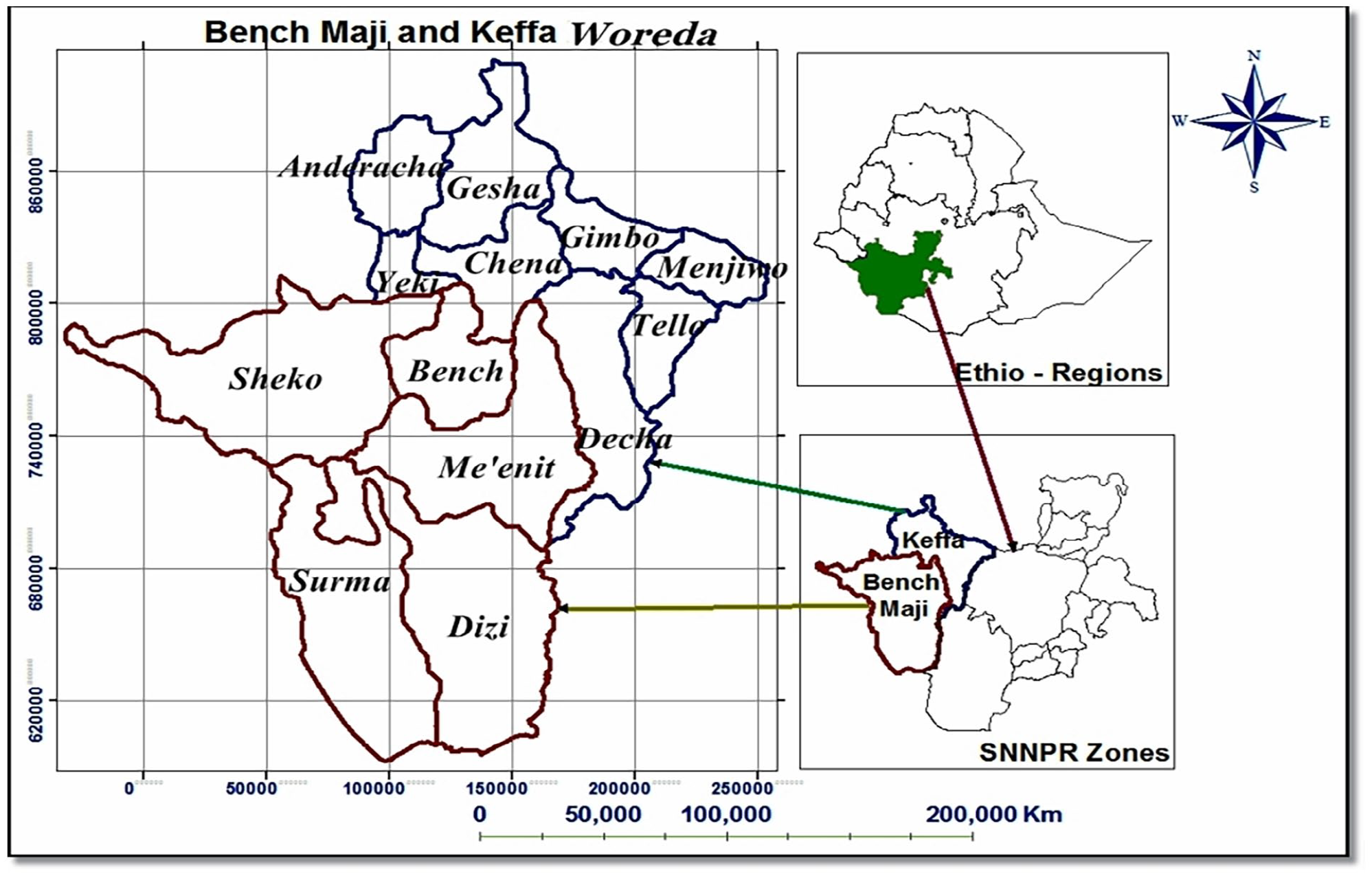
Bench Maji Zone in 2009 (used with permission of the Bench Maji Zone Administrative Office).
Result and finding
Soil conservation knowledge and practice of Me’en
According to the participants of the study, Me’en has a rich Indigenous knowledge about soil fertility and has different conservation mechanism. When the Me’en plow and sow their farms, they make a karmiya erken (terrace made from weeds). The local people practice this for centuries. The practice has dual benefits. First, it protects soil erosion, and the humus of the weeds serves as nutrients and organic fertilizers to the soil. This will help increase soil fertility and productivity. The Me’en ethnic group practices this with the understanding of soil conservation. Their practice is knowledge based and it helps improve soil fertility and protects soil erosion.
The in-depth interview with the elders and key informant reveals that Me’en ethnic communities have a unique knowledge of identifying soil type by physical observation. Some members of the community identify the soil by its color and attribute it to the level of fertility more or less matched with the scientific knowledge. Not only they identify the color of the soil by observing, but they know which kind of crop is more productive or effective in that color type of soil. At this level, the most important issue is their ability to identify and associate the color of the soil with the type of crop it suits and its coincidences with the scientific knowledge.
The key informants and discussants also reveal that Me’en people have knowledge about how to plant in a line or row and at the same time they dig in a round 60 cm by 60 cm hole to plant kudit (a false banana), bananas, and other valuable plants around their backyard. Their understanding to soil conservation could be best explained by a 65-year-old interviewee. He said,
Planting in a contour line protects soil erosion and the big hole dug around the plant helps to preserve moisture and rotten the leaves that are dropped from the branch of the tree. By doing this, we get better product from the plant. (Bekele, male, 65 years of age)
An expert from agricultural and natural resource confirms the practice of Me’en people as exactly in line with advisable scientific way of planting seeds and conserving trees.
According to the participants of the research, the local people highly practiced shifting cultivation they clear one area which they assume to be fertile and burn it. They use it once or twice and then they move to another area to do the same. Here, one may argue that shifting cultivation has its own disadvantage to the ecosystem, yet the important point is their knowledge of identifying the productive land. They do not do it because they get free land. Rather, they do it based on the knowledge rooted for centuries about their environment. According to the participants of the in-depth interview and key informants, the local communities carefully identify a fertile land based on their own criteria. They select based on soil color, soil fines, trees that are grown in the area, and the sound it gives when one steps on it. For instance, one in-depth interviewee narrates the situation as follows:
We didn’t simply clear and burn a bush just because of its nearness and availability. We look carefully on the trees and bushes that are grow. We touch and see the texture of the soil its color. We also walk around and identify it. When we walk around, if the soil is noisy, it is not fertile, and if it doesn’t, it is fertile because the sound comes from the texture that the soil has. (Adane, male, 50 years of age)
Again, the people have a unique practice of ritual ceremony connected to soil fertility that is conducted before the season of sowing. Any member of the community who plows and sows before this ritual ceremony will be cursed and thus will get little harvest in the end. A 67-year-old in-depth interviewee explains the matter in the following way:
After we clear and prepare the land, all members of the community gather in the field. We prepare a beverage locally known as borde alcoholic beverage. Before anybody drinks, we splash and pure it to the farm land. As a result, the owners of that land remain unaffected from any diseases, and the land becomes fertile and gives good product. There is a clear distinction between those who observe this ritual and those who do not in terms of health, production and satisfaction. (Werkinesh, female, 67 years of age)
The community of Me’en has unique and typical way of keeping soil fertility and erosion. According to the participants of the study, Me’en use fast growing plant like golit (castor bean). This kind of plant grows very fast and dies fast. It has big leaves, and these leaves are used as organic fertilizer to the farm land. They also deliberately plant dompoch (Vernonia amygdalina), which has a short flowering period and is useful for conserving soil fertility. After it flowers, they cut a bunch of dompoch flowers and bind it in a place with high wind flows. Through the process of wind dispersion, the flower disperses its seed in the field and regenerates itself very quickly. This process helps protect soil erosion and at the same time after it dries it adds soil fertility. This is done every 3 years of cultivation. This practice is also unique to Me’en ethnic group.
The study also reveals that the local communities have the practice of planting trees for the purpose of protecting soil erosion. According to the participants, they plant the trees in their farm land in an equal interval. This can explain their practice emanates from their deep knowledge of the nature. According to the participants, some of the plants they normatively plant in their own surrounding area are oshoch (Cordia africana), zogit (Mallettia feruginea), dompoch, and golit.
Based on the result and finding from the key informants and FGD discussants, Me’en people have sound knowledge and practice of forest protection mechanism. The local communities have their own way of protecting. Forests in Me’en are under the control of mirata (spiritual leaders) who are responsible for the safety of the forest. These scared forests, and thick forests, such as Mashaye Forest, are owned and protected by a reputable elder and local leader by organizing their fellows. Anybody who cuts a tree from these places is believed that he will face with wrath from supposed supernatural force and his line of generation will be cursed. As a result, he may die and his family may face severe diseases. Most crypts of those known people and spiritual leaders are done in the thick forests and are untouchable.
Furthermore, the result of the finding from key informants and FGD discussant shows that the local communities have their own way of controlling and protecting plant pests and diseases. A 50-year-old FGD discussant explains the process this way:
After we [sow] our seeds and start to grow especially maize locally known as wayida we follow and look each individual crop in the field while we are inspecting. When we see any crop affected and attacked by pest, we create mosil, a fire creating mechanism in their own knowledge which made of oshoch tree. After we create a fire, we collect each affected plant and burn it. Through this mechanism, we protect our crop field from further incidence of diseases. (Mulu, male, 50 years of age)
The research also reveals that there is conflict between the local people and the experts in the application and utilization of inorganic fertilizer. It is not the conflict between these parties but the insight from the Indigenous people on the sustainability and other consequences of inorganic fertilizers is important. This conflict and resistance to use inorganic fertilizer is found in all ethnic groups. The argument from the Indigenous people could be seen from two perspectives, one from the sustainability of soil fertility and quality of the product and second from health perspective. A 60-year-old participant narrates the issue as follows:
We have our own way of keeping land fertility; however, the government forces as to use this chemical. The experts, without telling us the result, they made us dependent to the products of inorganic fertilizer. We found it harmful both to the soil and our health. The water we use to drink got polluted and is bringing some unintended diseases. Not once we use it to the soil the soil permanently become barren. It is very difficult for the soil to recover and bear any product if you stop using it. (Getu, male, 60 years of age)
Likewise, one FGD discussant stated that
When the experts tell us only the good results, we use it inorganic fertilizer. However, we found the fruit even tasteless. The water streams are polluted. Our bees died in the water streams; this is all the consequences of it. That’s why we resist using the so-called new technology. (Bahru, 30 years of age)
Resistance to technology shows their deep understanding and connection with nature and their genuine concern to sustainability of soil fertility. The result also shows that almost all ethnic groups use soil for aesthetic, artistic, and utensil purpose. They, for example, decorate their homes and body using soil. Their homes are beautified by the different types of colors produced from natural soil. They have the ability to identify the type of soil used for utensils and beautification.
Wildlife conservation practice of Me’en
The finding uncovered that Me’en community do understand the importance of wildlife and have respect for them. The result found from FGD discussants, key informants, and in-depth interviewees shows that the community cares about wildlife for basic survival. According to the participants, Me’en community protects forests because they know that it is a shelter for the wildlife. They have a controlling mechanism if any member of the community kills any wildlife for any purpose without permission especially in optimum harvest seasons. This means that the wild lives are kept in the forest as a food safety net for the community. According to the in-depth interview made with elders, the communities have a structure that allows hunting wildlife for food purpose during drought season. This was best explained by a 65-year-old participant explanation:
We protect the forest because our survival depends on the wildlife and forest is their home. If we destroy their home, how can we find the benefit from them? If anyone kills wildlife during a good harvest season, we have a controlling mechanism in that the elders gather and call a court. We call the offender and punish him both materially and in cash. The punishment is based on the extent and severity of the deeds. It ranges from one to three oxen and cash. (Derbe, male 65 years of age)
Again, the community protects plants for their medical purpose. According to a 45-year-old discussant, they protect and conserve wildlife and use them for medicine and in some cases for making clothes and shoes. According to the participants of in-depth interview, the animals that are used for medicine purpose are mainly wu’e (hyena) and kala’e (rabbit). Me’en community uses the hair of wu’e to protect plant diseases particularly for the kudit plant. They burn the hair of the wu’e and according to their beliefs the smoke heals the diseases found in the plant. Kala’e is also used to treat wounds. If someone gets wounded, they cover the wound with kale’e skin and it heals in a short period of time. The community developed such culture through centuries by own way of conserving and managing wildlife. Here, while using the wildlife, they think also their continuity because they help them to survive during emergency times like drought and other natural calamities. This indicates that the connection of the community with wildlife is a matter of survival. In other words, they conserve and care wildlife because they get their basic needs like food and clothes.
According to the in-depth interview participants and FGD discussants, designated family lines have a spiritual connection with wildlife. The participants reveal that there are designated people who command live in harmony with kanach (monkeys), toba (pigs), and gushor (lions). These individuals have a spiritual knowledge that is inherited from their ancestor to enable them communicate with the wild animals. This type of knowledge is transferred genealogically. This could best be understood from a quote by a 70-year-old participant:
In our community there are a line of family that has knowledge to communicate with animals like monkey, pigs and lions. They acquire this kind of knowledge from their forefathers. Apart from this family line, one cannot practice it. A man who has the ability to command monkeys have the authority to call the monkeys and command them either for bad or for good. The same is true for the man of pig and lions. For instance if a man of monkey want to his field kept from any damage from outsider he command the monkey to keep his field and if also he want them to destroy someone’s field he command them to destroy and they accomplish it. The same is for man of pigs and lions. (Kurju, male, 70 years of age)
According to these study participants, Oshak (a clan from Me’en community who have a special relationship with monkeys) members are the ones who command kanach. Despite the effect of globalization and other external factors that affect the local knowledge, there are still people who have spiritual connection with wild animals in Chat Kebele in Me’en Goldya. What is significant here is that not the spirituality of the process and magic that the individuals perform, but the practice contributes to the conservation of wildlife through generation. The communities in this area live in harmony with wildlife.
Me’en ethnic group also have a psychological connection with wildlife. Me’en envisions wild animals as predictors. They predict the season that comes whether it is national politics and local social and economic affairs based on the diversity and availability of wildlife. For instance, participants reveal, if plenty animals like kanach and wilchi (colobus monkey) are available around their home and everywhere, they easily project that the coming season is good in terms of harvest and health. Not only that, if animals like lion and tiger appear in Chat Town, the local people think a sudden political or governmental change at a national level will happen. According to participants of the study, members of the community believe it is dangerous and risky to exhibit or even internally have a feeling of anger in front of them. The community believes that wild animals, particularly lion and tiger, have the ability to sense and identify such kind of feeling.
This finding shows how the communities interact with and benefit from wildlife. The study also reveals that the conservation practice with the wildlife emanates from the deep Economic, spiritual, and psychological connection they create through long period of time.
Perception of the community toward cosmos and cosmic order
The study also focused on assessment on the perception and knowledge of the community. Three hundred eighty-four respondents participated in the study and the questionnaire was distributed randomly. This section discusses and analyzes both the quantitative and qualitative data concurrently. Table 1 shows the perception of respondents toward cosmos and cosmic order.
Perceptions of respondents toward cosmos and cosmic order using a 5-scale Likert-type measurement.
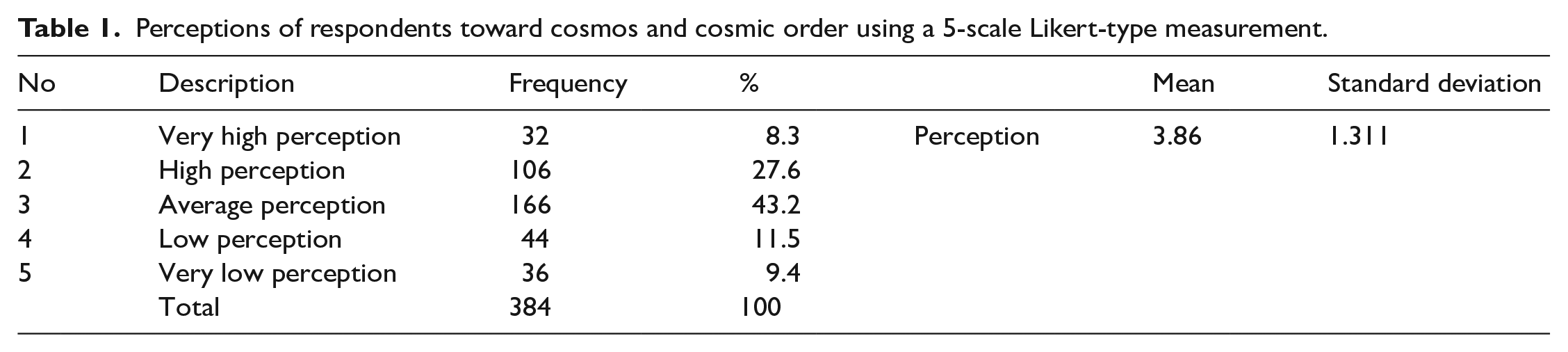
Table 1 shows that 32 (8.3%), 106 (27.6%), and 166 (43.2%) of the respondents have very high, high, and average or moderate perception, respectively, toward nature, cosmic order, and natural resource particularly toward soil and wildlife. The mean and standard deviation are 3.86 and 1.311, respectively. This statistical result coincides with finding from discussant in the FGD and interview participants of Me’en, ethnic group.
They reveal that nature is a gift from God and need to be protected. The participants also assert the cosmos and all in it is a gift from God and He is the only one who controls it. Not only control it, but also gives a stewardship responsibility to human being. Thus, the participants frequently assert nature and natural resources need to be utilized properly and conserved to the next generation and each member of the community has a responsibility in maintaining and conserving nature and natural resource conservation. Table 1 also shows 44 out of 384 which is 11.5% and 36 out of 384 which is (9.4%) of the respondents have low and very low perception, respectively, about nature, cosmos, and natural resource. The finding from in-depth interviews, especially youngsters and experts, uncovers that some community members have hostile interaction and exploitative behavior toward natural resource. They assert that this is a gift from nature to human being and we should exploit them to our maximum potential. They kill animals for prestige and commercial purpose. These contribute to the low status of forest, wildlife in the area. Table 2 shows knowledge of respondents toward natural resource conservation.
Knowledge of respondents toward natural resource conservation.
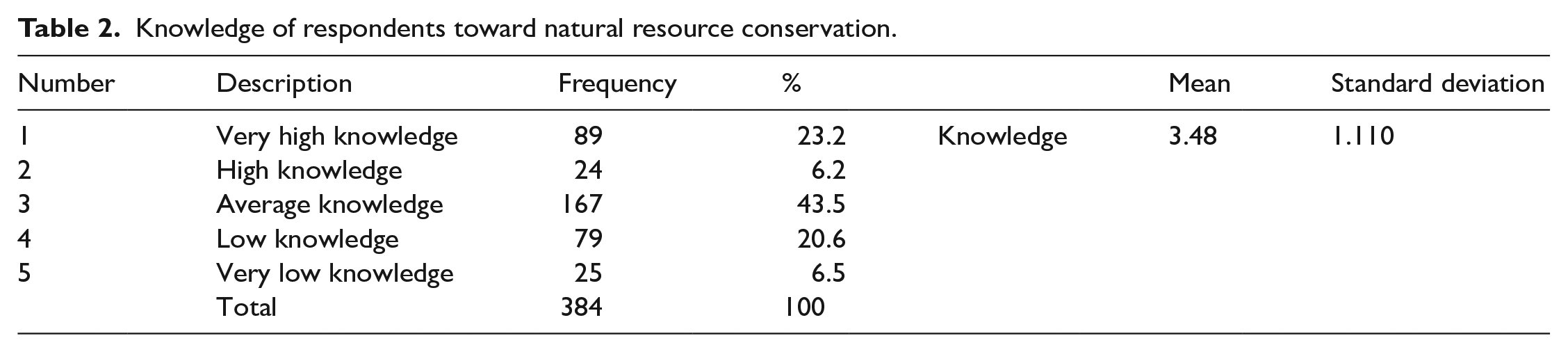
Table 2 shows that 89 (23.2%), 24 (6.2%), and 167 (43.5%) cumulatively 280 out of 384 (72.9%) of the respondents have very high, high, and average or moderate knowledge, respectively, toward nature, cosmic order, and natural resource particularly toward soil and wildlife. The table also shows that the mean and standard deviation of the respondents are 3.48 and 1.110, respectively. FGD and in-depth interview result also reveals that nature and natural resource are important facets of day-to-day life. The participants also assert that natural resource and soil and wildlife in particular need to be conserved. This understanding leads them to use different kinds of conservation mechanisms like shifting cultivation, contour planting, mulching, crop rotation, tracing, and others. Thus, the participants assert conservation practices to nature and natural resources like soil and wildlife for their benefit. The above table also shows that 79 out of 384 (20.6%) and 25 out of 384 (6.5%) of the respondents have low and very low knowledge, respectively, about nature, cosmos, and natural resource. The finding from expert and key informant shows that some community members have low knowledge and awareness about wildlife and soil conservation. The participants also reveal even if they know due to different circumstances like scarcity of available land for farming and others, some community members act carelessly and exploit natural resources.
Discussion
Based on metaphysical foundations and reasons, there is sense of “harmony between man and nature” (MacKinnon, 2007, p. 1). According to the finding of the research, their sense of “harmony between man and nature” is generated from the assumption that their survival seriously depends on nature. Therefore, it does rise to a degree of rationality for their survival. The harmony of man with nature is conceived as natural, essential, and characteristic to their culture (MacKinnon, 2007).
Some traditional moral values pay attention to human relations and do not realize that nature is the source of human life while people consider nature as the object freely to be obtained and used. Inversely, the Indigenous knowledge of the people assumes human to establish a correct view of nature, learn to respect, imitate, and protect nature, and get along amiably and peacefully with the nature. It is considered that their life is in equal interdependency with the natural environment (Naess, 1990). This view is prominent in the communities where the research is conducted.
There is a criticism from axiological foundations and a reason to the culture of industrial civilization was characterized by human conquest of nature (Young, 1995). Literature also reveals that there was agricultural civilization known as yellow civilization before the industrial civilization (Braudel, 1992). The Indigenous culture and knowledge that the people of the study area have is and live by is a culture of conservation. It exhibits a harmonious coexistence, sustainable survival quest, practical rationality, and virtuous circle with the environment. It can be said a green culture they value their environments for its aesthetical and ethical values. They want just to have that green environment with the root reasons are intellectual richness and value system of their culture. That is why we call it green culture (Ogiemwonyi et al., 2020).
Ethical foundations and reasons have a notion that natural environment is self-regulating object with robust fecundity that can generate basic things to its entire creatures including man. However, wise system of use, relation, and sustainability is important considering scarcity and unfriendly manners. Actions affecting these stable points of environment are subject to ethical considerations and evaluations. The following are some of the ethical foundations and reasons we found as part of Indigenous knowledge on the conservation practice and management of natural resource specifically related to wild animals and soil in the study areas. First, there is a kind of individual and collective sense of virtue ethics. Individuals seem to scorn unauthorized use, preventable damage and pollution of natural resources as something unworthy, something inappropriate not only to the character of the doer, but to the self-respect of the environment and the society of which he is a member. Second, there is sense of having responsibility to use it and maintain it for future generations. The nature and honor of possessing the earth and its natural resources, as respondents claimed, entails the responsibility of maintaining it in the better for their use and their future generations. That is not only to maintain to immediate posterity but also to maintain it to the long future with great deal of responsibility. Leopold, in his Earth Ethic, construes this as long anthropocentrism. Third, there is sense of Kantian deontological orientation to concede and respect intrinsic value of natural environment. It is possible that individuals respect soil and animals not only as immediate beneficiaries from them but as a moral agent and as a member of that community. They value and respect all things as part of the natural environment and its parts. Fourth, there is an agent-relative deontological obligation in which a particular agent takes or refrains from taking some action. The agent-relative obligation does not necessarily give anyone else a reason to support that action. Because it is agent-relative, the member is a relative agent to his environment as a member of that community. Each member, for example, is commonly thought to have such special obligations to his or her environment; the obligations may or may not be shared by anyone else from other community. The question of the obligations is with one’s dictate, it is not determined by whether others do so. Likewise, an agent-relative obligation, an agent-relative permission is permission for some members to use or add value, even though others may not be permitted to aid that agent in the doing of their permitted action. Each member is commonly thought to be obligated to protect and maintain his own environment even at the cost of not having more material benefits. That agent-centered orientations and agent-relative reasons on which they are based not only enjoin each of them to do or not to do certain things; they also instruct individual members to treat their environment and its parts in a certain way because they have sense of belongingness. They have claims like that is ours because that is mine.
Among the above four ethical reasons and foundations, similar points like the first three are more or less stated in Leopold’s Earth Ethic. It is safe to summarize that the ethical reasons and foundations are dominated by non-anthropocentric or holistic orientations. It can be represented by this Aldo Leopold’s (1949) claim: “A thing is right when it tends to preserve the integrity, stability, and beauty of the biotic community. It is wrong when it tends otherwise” (p. 224). These ethical foundations founded by this research defy the understanding of Immanuel Kant as stated by Kelbessa (2010), “Kant believed that the non-European peoples are devoid of ethical principles, and lack adequate self-consciousness and rational will” (p. 28). But with recent external and internal influences interventions, this Indigenous culture and knowledge is being blown away.
The ethnic groups have world view that incorporates both anthropocentric and non-anthropocentric attitudes toward wild animals which have had different effects on their practices. The concerns for animals are stated in various forms by the respondents of this research. When they stated anthropocentric attitudes toward wildlife, that is animals, they believe that humans can use wildlife to satisfy their desires irrespective of any consequences if they are edible animals according to their culture. It is similar to the western mainstream belief that state humans are metaphysically special and can use wildlife to satisfy their desires for instance (Aquinas, 1964, 1975).
On the other hand, when the respondents state non-anthropocentric attitudes toward wildlife, that is animals, they believe that humans usage and treatment of wildlife need to be rational and one that respect natural harmony. They appreciate the goodness of creation in all its diversity. They show real and balanced concern for all wild lives. This goes with the ideas of some writers, such as John Ray, Linnaeus, and William Paley, who implicitly rejected the belief that everything was made for humankind and the metaphysically superiority of man. Thus, both anthropocentric and non-anthropocentric attitudes are mutually entertained in the society. However, they clearly understand the natural balance, natural mutual interdependency of nature as a whole. Literature on the area points out that there are two ways or systems of valuing something. Namely, they are intrinsic and extrinsic values. Kelbessa (2010), for example, paraphrased ideas of Korsgaard that “the value a thing has in itself is intrinsic goodness, whereas the value a thing gets from some other source is extrinsic goodness” (p. 180). So it is important to discuss both ways of valuing in relation to the findings of the study area.
The ethnic groups have system of value that incorporates both intrinsic and extrinsic values toward natural environment and their specific elements which have had different effects on their practices.
Respondents said that there are valuable certain elements in the natural environment, that is, certain wild animals, for that they are useful. From their expression, it does seem certain elements, that is, certain wild animals, have instrumental values. However, it is not a very adequate theory to describe their real relation with and the value they give to the environment. The natural environment is source of memories of their predecessor generations, amusement, and it is part of their life. They value the natural environment as if it is part of their life, as sacred, as something owe respect. In this regard, the assigned value to the natural environment is holistic and intrinsic. But the holistic and intrinsic values of the natural environment do not deter them from using certain elements of natural environment, that is, some selected wild animals which have specific instrumental values. Thus, the people mixing extrinsic and intrinsic values with regard to the natural environment and neither extrinsic nor intrinsic values are dominant attitudes.
Based on the Kantian theory of goodness, according to Korsgaard (1983), there are two distinctions in goodness that are quite separate, namely the distinction between things valued for their own sake and things valued for the sake of something else—between ends and means, or final and instrumental goods. And the distinction between things which have their value in themselves and things which derive their value from some other source: intrinsically good things versus extrinsically good things. The distinction between intrinsic and extrinsic goodness refers to the value of a thing either because of its nature or because of something else. “To say that something is intrinsically good,” she says, “is to say that it has goodness in itself” but it does not mean that it is “valued for its own sake” (Korsgaard, 1983, p. 170).
Similar research also stated that farmers have good knowledge of soil conservation. For instance, Yeshambel Mulat (2013) identifies Konso (Indigenous people of South Omo Zone, Ethiopia) farmers have well-known and UNESCO-registered tracing practice. Farmers of Konso also perceived that fertile soil held more erodible character than infertile due to soil texture and particles size. This Indigenous knowledge of the farmers is most closely associated with the scientific finding. Farmers have good experience and knowledge that leguminous plants such as beans, peas, and chickpeas have good capacity in maintaining and retaining the soil fertility of the land (Mulat, 2013). This finding coincides and gives in-depth insight that Indigenous communities of Southwest Ethiopia and Ethiopia in general have sound knowledge toward natural resource conservation.
A case study in central Africa shows similar techniques of soil wildlife and forest conservation knowledge and practices. The study conducted by Eyong (2007) reveals that Indigenous communities of central Africa have long practice and knowledge of shifting cultivation, ridges, sacred forests, culture of food taboos, knowledge of forest and its resources, and Indigenous early warning systems which is similar to the finding of these Me’en ethnic group of south west Ethiopia.
Documenting the IKS and integrating it is important for the global development assistance in general and Africa and Ethiopia in particular. State and concerned bodies, in assisting developmental activities, including local participation, capacity building, and sustainable resource management, can be enhanced in a cost-effective manner if collaborative approaches which understand the IKS at stake.
The synergism of both socio-philosophical perspectives that is anthropocentric and biocentric is crucial for the contemporary world to keep the environmental equilibrium. This approach is reflected in the Deep Ecology which tries to reconcile the two. Me’en community as mentioned above practice a sustainable environmental natural resource management. Hence, documenting and propagating such practices is of much importance as it help the developmental agents, policy makers, researchers, and other concerned bodies to use the body of knowledge and practice when drafting and implementing their policies.
Conclusion
The research assessed Indigenous knowledge of Me’en community in southwest Ethiopia. Based on the inquiry of the study, Me’en community has a deep knowledge and practice of natural resource in general and about soil and wildlife in particular. The study reveals the community practice contours, tracing, mulching, ridges, shifting cultivation, crop rotation, and area closure. The communities also have knowledge needed to identify fertile lands by physical observation such as by its color and texture and touching. They have good knowledge and perception toward nature cosmos and cosmic order and natural resource. Me’en community also has a strong psychological connection with the wildlife. The Me’en community uses the availability of wildlife to predict the future. They forecast the coming season based on the number and availability of wildlife around them. Not only this, the community also forecasts the political situation. For instance, if lion and tiger appear in the village and enter to the town on a day time, the Me’en community believed that some sudden political revolution will take place or any structural or governmental change will happen at a national level. They practice a sustainable concept of utilization, but in terms of philosophical orientation, they fall in both biocentrism and anthropocentric orientation. Looking at the general practice and knowledge of the Indigenous people in Benchi-Maji Me’en, the community, in most cases, has an eco-friendly practice and utilization of natural resource. Most of the practices and knowledges found in this study are in line with the scientific knowledge and are worth for implementation. The community’s world view and conceptions of nature and natural resource is in line with the concept of sustainable development.
Recommendations
Based on the findings and results of the study, the following recommendations are forwarded for best solution and intervention to the issue at hand.
Socio-economic valuation of Indigenous knowledge
Valuation means acknowledging IKS function and utility. They have socio-cultural and ecological values, usually measured and monitored with the use of indicators of their contribution to ecosystem integrity and resilience and regenerative capacities. Therefore, this has to be maintained with great care. This could be done with coordinated and systematic planning with stakeholders and concerned body like science and higher education minister, Mizan-Tepi University, Local community, and zonal administration.
Revitalization of Indigenous coping mechanisms
The most important thing toward revitalizing Indigenous coping mechanisms in the study area involves genuine commitment of local, national, regional, and international initiatives to an objective scientific enquiry by an interdisciplinary team. The overarching goal should be to systematically document IKS with an active involvement of Indigenous people. In this regard, though very much contested, oral tradition remains the best tool for recollecting past memories, genealogies, and Indigenous practices.
Integrating Indigenous knowledge with scientific knowledge
The current finding of the research shows that knowledge that the community used for century in most cases are in agreement with current scientific knowledge. Most of the techniques are eco-friendly. However, despite their advantage and rich knowledge, they are not well documented and used in harmony with the current scientific knowledge. Thus, if a lasting solution to the puzzles of global warming and sustainable agenda of the 21st century is to be addressed, a holistic approach of integrating, promoting, and utilization of Indigenous knowledge mainstreaming must be adhered by governments, and non-governmental organizations and scientific arena.
Realization of Indigenous knowledge
All higher education in Ethiopia must realize the indispensable importance of Indigenous knowledge in the socio-economic, political, and cultural life of the community, the nation, and the globe at the broader level. Thus, their center of excellence must be based on the available Indigenous knowledge of all spheres. Their research and community service should direct such valuable knowledge stemmed in the Indigenous people to protect, document, and implement them. Researchers should focus on conducting research of any kind of valuable Indigenous knowledge of the community. It is important to have incentive and recognition to individuals and organizations of outstanding performance on Indigenous activities in realization of Indigenous knowledge.
Integrated and concerted intervention needed
A study conducted by Kelbessa (2010) and this research reveals that there are challenges of degradation of environment and natural resources. For instance, among the main challenges are population growth, over cultivation, plowing down slopes, clearance of forests to make way for agriculture, house construction, firewood gathering, sawmills, coffee plantations and human settlements of various sorts, logging, and charcoal making. These challenges existed in different degrees in the study area. The importance of such common challenges made clear and helps to urge concerned body to consider and tackle the environmental degradation with a holistic solution to the problem existed in different regions of the area.
Footnotes
Acknowledgements
First and foremost, I thank Mizan-Tepi University for funding this research work. Second, my gratitude goes to study participants who were involved in this study. I also express my heartfelt gratitude to the six ethnic groups of Bench Sheko and West Omo zones for facilitating data collection processes and for their unreserved effort and genuine information during data collection process.
Author’s note
Declaration of conflicting interests
The author declared no potential conflicts of interest with respect to the research, authorship, and publication of this article.
Funding
The author received no financial support for the research, authorship, and publication of this article.

Glossary
borde an alcoholic beverage
dompoch Vernonia amygdalina
golit castor bean
gushor lion
kanach monkey
kala’e rabbit
karmya erken Indigenous way of making trace in Me’en community by using weeds from the farm
kudit a false banana
mirata spiritual leaders
mosil a fire mechanism
oshoch Cordia africana
toba pig
Tumma the sky god
wayida maize
wilchi colobus monkey
wu’e hyena
zogit Millettia ferruginea
Lafa Earth
Waaqa Creator
qolla arid climatic condition
weyna dega temperate climatic condition
wordas counties, county
Dizzi Indigenous people of West Omo Zone, southwest Ethiopia
Konso Indigenous people of South Omo Zone, Ethiopia
Me’en Indigenous people of southwest Ethiopia
Oromo Indigenous people of Oromia, Ethiopia and northern Kenya
Oshak a clan from Me’en community who have a special relationship with monkeys
Surma Indigenous people of West Omo Zone, southwest Ethiopia
Zilmamo Indigenous people of West Omo Zone, southwest Ethiopia