




Abstract
Indigenous people are considering how to safeguard their natural resources, culture and knowledge against illegal, inappropriate or unauthorised use. Such protection is needed to maintain the integrity of Indigenous relationship to and control over such resources, while allowing for potential benefits from such resources to support tribal social and economic development. Using the case study of taramea (Aciphylla aurea), a sub-alpine speargrass, traditionally used to make fragrance by Ngāi Tahu (a large tribe from the South Island, New Zealand), we assess potential approaches to protection, ranging from national and international intellectual property approaches such as trademarking, copyright and patenting to extra-legal approaches such as supply chain auditing, blockchain, biocultural trademarks and biocultural labels. From this assessment, we evaluate approaches’ usefulness against a range of Indigenous and market-oriented attributes. We find that while each approach has advantages and disadvantages, no one method is superior, so we recommend a mix of approaches.
Keywords
Introduction
Many Indigenous groups are worried about the illegal, inappropriate or unauthorised use of their natural resources, culture and knowledge. There are long-standing grievances, especially around bioprospecting and biopiracy, whereby pharmaceutical and other organisations have hunted for valuable biological resources and the requisite knowledge to harness them commercially. Such knowledge, in the form of physical samples and the raw data associated with them, frequently reside in bio-banks and databases outside the location from which they were collected. Hence, not only do Indigenous peoples fail to receive financial benefit from the commercialisation of biological resources, but the traditional cultural knowledge associated with the resource frequently goes unrecognised as well.
However, increasingly Indigenous people themselves wish to derive benefit from their resources while protecting these against illegal, inappropriate or unauthorised use. One example is Ngāi Tahu, a large tribe from the South Island, New Zealand. Ngāi Tahu has legal acknowledgement of its “cultural, spiritual, historic, and traditional association” (Ngāi Tahu Settlement Claims Act 1998, s. 288) with a biological plant or taonga (treasured property) called taramea (Aciphylla aurea), a sub-alpine speargrass species, and the “rangatiratanga [exercise of chiefly authority, control, power] and mana [prestige, authority, influence] over the lands within its boundaries” on which taramea grows (Ngāi Tahu Settlement Claims Act 1998, s. 6.7). The resin of taramea was used traditionally to make both a fragrance and a perfume. These were highly prized by Māori (Indigenous people of New Zealand) tribes and traded widely across the country (Dobson-Waitere et al., 2022).
Recently, one of the tribe’s regional authorities, Kāti Huirapa Rūnaka ki Puketeraki (Puketeraki), has revived the Ngāi Tahu tradition of perfume making from taramea, trading under the brand-name MEA. This has required understanding the mechanisms that enhance and maintain Ngāi Tahu’s enduring association with taramea, while also allowing for potential social and economic benefit as Puketeraki develops taramea into a globally accessible market product. In light of such social and economic ambitions, this article assesses current legal and extra-legal mechanisms that Puketeraki might deploy to reinforce mana and rangatiratanga to safeguard and enhance kaitiakitanga (safeguarding obligations) over taramea.
The assessment is part of ongoing research that Puketeraki and some of the authors have instigated to support the global development of MEA. In New Zealand, a number of taonga species have received commercialisation attention, in particular, mānuka (Leptospermum scoparium; a flowering tree) (Strong, 2022). It is also easy to find online oils, fragrances or perfumes that incorporate taonga species ingredients such as mamaku (Cyathea medullaris; the black fern tree), harakeke (Phormium tenax; New Zealand flax), pohutakawa (Metrosiederos excelsa; a coastal myrtle tree) or kōwhai (Sophora sp; a small woody legume tree) (New Zealand Native Oils, n.d.). Puketeraki is, to the authors’ knowledge, the only example in New Zealand of a tribal attempt to commercialise taramea as a perfume. Given not only Ngāi Tahu’s legislative acknowledgement but also its kaitiakitanga obligations, decisions about how best to commercialise taramea need careful consideration.
First, we provide a global context of what occurs when taonga like taramea are exploited by pharmaceutical and cosmetics industries, considering issues of bioprospecting and biopiracy. We then consider how Indigenous people have sought to address these issues, examining international Intellectual Property (IP) regimes and the extent to which they offer Indigenous people protections over their tangible and intangible properties. We next provide a brief overview of New Zealand’s legal protection pathways in light of findings around Māori claims to and kaitiakitanga over taonga. We then identify and explore how legitimacy can be created through legal and extra-legal approaches, each with advantages and disadvantages. Our article concludes with a discussion of our approach and how legitimacy over taonga, in both legal and extra-legal senses, can be implemented to provide a proactive and effective means for Ngāi Tahu and Puketeraki to assert and protect an ongoing association with taramea while allowing for economic development.
Bioprospecting and biopiracy
Bioprospecting and biopiracy are closely related concepts. Bioprospecting is generically defined as “the examination of biological resources for features of commercial value” (Kam, 2005, p. 387). However, Mooney (as cited in Robinson, 2012, p. 77), coiner of the term biopiracy, believes “[w]hatever the will and wishes of those involved, there is no ‘bioprospecting.’ There is only biopiracy.” Sanchez (2012, p. 146) defines biopiracy as “the theft of traditional knowledge and genetic resources without just compensation.” Others such as Fredriksson (2017) and Efferth et al. (2019) believe that biopiracy also concerns Indigenous resources and the use of IP rights to immorally monopolise those resources. While the difference between the two terms is sometimes framed as solely legal, the complexities of international law and the significant questions regarding rights to own life or knowledge relating to nature mean there are as many moral and ethical factors as legal ones. One person’s bioprospecting is another’s biopiracy, and while some forms of bioprospecting can be considered more lawful, moral and ethical than others, this is not a well-demarcated distinction. Matters of legitimacy, that is, who has the right to claim a particular biologically based resource and derive benefits from it, come to the fore in these distinctions, as we discuss more fully below.
Both bioprospecting and biopiracy have been critiqued as a form of neocolonialism (Kam, 2005; Martin & Vermeylen, 2005). In the modern era, the “exploitation of nature and Third World territories by colonial powers has been replaced by similar forms of exploitation at the hands of multinational corporations driven by shareholder value in a neoliberal economic arena” (Efferth et al., 2019, p. 321). Many factors can complicate the issue, such as multiple traditional knowledge holders across several countries sharing the same genetic resources, biological resources mutating or migrating, and unclear distinctions between what are considered general and specific forms of knowledge. Still, from an Indigenous perspective, the scales of justice have long tipped towards giving validity to accusations of neocolonialism.
There have been several prominent cases of biopiracy. In 1994, a US multinational patented neem tree seed extract which was used in their antifungal spray, Neemex (Chen, 2006). However, the neem plant has been used in an array of medical uses across the Indian subcontinent for millennia. After years of protest, the patent was overturned in 2000 for its lack of novelty or an innovative step. Other cases have included attempts to patent Ojibwe wild rice, Mexican maize, and Hawaiian taro (McGonigle, 2016). A more recent case involving the Institute for Development Research in France involved an accusation of biopiracy for patenting an anti-malaria drug without acknowledging the French Guianan Indigenous community’s traditional medicinal knowledge (Pain, 2016).
There have also been cases involving cosmetics and perfume companies. The American cosmetics company Mary Kay sought a patent for the Kakadu plum, which is a bush food rich in vitamin C traditionally used by Australian Aboriginal people on long hunting trips (Robinson, 2010). In New Zealand, the ß-triketones of the mānuka plant are considered highly valuable and are used in a range of commercial applications including essential oils, nutraceuticals, and cosmetics (Strong, 2021). For several decades, French fashion house Yves St. Laurent used ilang-ilang (Cananga odorata; a tropical flowering tree) flowers from the Philippines in a fragrance. Then, in 1998, “Yves St. Laurent stopped importing ilang-ilang from the Philippines, put up its own plantations in Africa and secured a patent for its perfume formula based on the native Filipino species” (Sanchez, 2012, p. 152). Across all these cases, traditional knowledge holders were usurped, unacknowledged or denied. It has only been through more recent and intensive research, protest and legal action that patents involving biopiracy have not been upheld. However, biopiracy and bioprospecting are ongoing risks, with many countries lacking approaches towards or sufficient consistency in protecting traditional Indigenous biocultural knowledge (Robinson & Raven, 2017).
Given these historic and ongoing examples, Te Rūnanga o Ngāi Tahu (governance body of Ngāi Tahu) (Te Rūnanga) and Puketeraki need to be aware of the issues that Indigenous people have and continue to face in relation to the exploitation of their biocultural heritage and resources. The next sections outline some key legal approaches to these issues in international and domestic law, their strengths and weaknesses and what these offer in terms of protection of kaitiakitanga obligations.
Scents, bioprospecting, the law and profitability
The key international law concerning the use and commercial exploitation of biological and genetic resources, including bioprospecting, is the United Nations Convention on Biological Diversity (UNCBD). The UNCBD was developed in response to increasing threats to biodiversity in the second half of the twentieth century, including a boom in patent applications related to biological life and corresponding threats to Indigenous economic and cultural livelihoods. Its preamble recognises the close and traditional dependence of many indigenous and local communities embodying traditional lifestyles on biological resources, and the desirability of sharing equitably benefits arising from the use of traditional knowledge, innovations and practices relevant to the conservation of biological diversity and the sustainable use of its components (UNCBD, 1992, p. 1).
The objective of the UNCBD is “the conservation of biological diversity, the sustainable use of its components and the fair and equitable sharing of the benefits (including with Indigenous peoples) arising out of the utilization of genetic resources” (UNCBD, 1992, p. 2). The UNCBD recognises states have sovereign rights to exploit biological resources within their jurisdiction (article 3) but places a number of obligations on party states to develop national strategies, plans, or programmes for the conservation and sustainable use of biological diversity (article 6). Two directives in the UNCBD are especially relevant here.
First, article 8(j) requires states to respect, preserve and maintain knowledge, innovations and practices of Indigenous and local communities embodying traditional lifestyles relevant for the conservation and sustainable use of biological diversity and promote their wider application with the approval and involvement of the holders of such knowledge, innovations and practices and encourage the equitable sharing of the benefits arising from the utilization of such knowledge, innovations and practices (UNCBD, 1992, p. 6).
Second, article 10(c) requires states to “protect and encourage customary use of biological resources in accordance with traditional cultural practices that are compatible with conservation or sustainable use requirements” (UNCBD, 1992, p. 8).
Under the UNCBD, bioprospecting efforts that draw on traditional uses of biological resources and result in successful commercial ventures should assure protection for and benefit sharing with the “indigenous or local populations whose knowledge contributes to biologically engineered products” (Greene, 2004, p. 213). This “[r]equires signatories to protect and promote the rights of communities, farmers and indigenous peoples vis-á-vis their biological resources and knowledge systems” (GAIA/GRAIN, 1998, “Basic obligations of the CBD” section, para. 4). The international community has given much attention to the practical implications of access and benefit sharing (ABS) requirements for Indigenous peoples, a matter addressed by an optional protocol to the UNCBD signed at the Nagoya conference in 2010. A particularly relevant directive of the Nagoya Protocol instructs parties to take measures to ensure that traditional knowledge associated with genetic resources that is held by indigenous and local communities is accessed with the prior and informed consent or approval and involvement of these Indigenous and local communities, and that mutually agreed terms have been established (Nagoya Protocol on Access and Benefit-Sharing, 2010, article 7).
The ABS arrangements detailed in the Nagoya Protocol have been lauded as a mechanism for ensuring the economic benefits of the exploitation of biological and genetic resources flow back to Indigenous communities (Wynberg & Laird, 2013). However, the reality is that monetary benefits—such as royalties and milestone payments—have not been truly realised, with few cases reported of royalties being distributed to Indigenous communities (Neimark & Vermeylen, 2017). Moreover, in some jurisdictions, such as Brazil with its mega-diversity of potential biocultural materials, the royalties have been set at such a low level (0.1%) that ABS can be viewed as a way of absolving companies and consumers of ethical and legal impropriety (Wynberg & Laird, 2013). Access and benefit sharing are also hampered by the decision not to include monitoring of patent offices, leaving it a reactive rather than proactive measure (Robinson, 2012).
However, what has been created is a potential mechanism for business partnerships between Indigenous peoples and corporations. There are instances where ABS has become a formalised expectation of nations with significant traditional ecological knowledge, such as the 2022 Pacific Access and Benefit-sharing (ABS) Implementation Guidelines (Secretariat of the Pacific Regional Environment Programme [SPREP], 2022) and the 2019 Rooibos Benefit Sharing Agreement (Schroeder et al., 2020) The latter, signed with the Khoi-San Council, representing the Indigenous Khoikhoi and San people of South Africa, is the first comprehensive, industry-wide benefit sharing agreement (Schroeder et al., 2020). There are also cosmetics companies that have entered into benefit-sharing arrangements with local tribal groups. French perfume company Aïny Savoirs Des Peuple re-contracts every three years with the organisation representing the Indigenous Achuar tribal community of the Peruvian-Ecuador Amazon region, agreeing both to not register patents against any of the genetic knowledge from the area’s plants and to pay 4% of total income to the community (Gardetti & Torres, 2013).
A growing number of international law scholars consider the Nagoya Protocol, ABS, and requirements for free, prior and informed consent part of customary international law, binding on all states in the United Nations system (Gilbert, 2018). Within the European Union, which adopted the Nagoya Protocol in 2014, researchers in some countries can face fines of up to €810,000 and imprisonment for not performing due diligence regarding the sources of genetic materials (V. O. Patents & Trademarks, 2019). Moreover, the Zero Draft of the Post-2020 Global Biodiversity Framework “sets out an ambitious plan to implement broad-based action to bring about a transformation in society’s relationship with biodiversity and to ensure that, by 2050, the shared vision of living in harmony with nature is fulfilled” (UNCBD, 2020, p. 6). The Zero Draft includes several yet-to-be-quantified action targets, including target 11 to “[e]nsure that benefits from the utilization of genetic resources, and related traditional knowledge, are shared fairly and equitably, resulting by 2030 in an [X] increase in benefits” (UNCBD, 2020, p. 9). Should it proceed as expected, it will give further direction to UNCBD parties, including New Zealand, to take quantifiable measures to protect Indigenous knowledge, rights and benefit-sharing, alongside developing international law around Indigenous developmental and biocultural rights (Gilbert, 2018).
Having ascertained the key international approaches, we now turn to the specifics of New Zealand IP law to assess capability to maintain kaitiakitanga over taonga species like taramea.
Te Tiriti o Waitangi and taonga species protection in New Zealand
Te Tiriti o Waitangi (Te Tiriti) or the Treaty of Waitangi, signed in 1840 by the consul for the British Crown and some Māori chiefs, including Ngāi Tahu, is considered to be a key New Zealand constitutional document (Ministry of Justice, 2023). Consisting of three key clauses, it guaranteed Māori tino rangatiratanga (sovereignty) over their lands and taonga but gave kāwanatanga (governance) rights to the British Crown. However, in the years that followed, Ngāi Tahu, like many other tribal groups, lost authority over its territories, including areas where taramea was harvested. Despite protests and claims over the intervening years, it was not until 1998 that Ngāi Tahu’s grievances were redressed in the Ngāi Tahu Settlement Claims Act 1998. This was due to the setting up of the Waitangi Tribunal, a permanent commission of enquiry to investigate and make recommendations on claims brought by Māori relating to actions or omissions of the Crown, in the period largely since 1840. The settlement, among other things, acknowledged Ngāi Tahu’s “cultural, spiritual, historic, and traditional association” (Ngāi Tahu Settlement Claims Act 1998, s. 288) with its taonga species and “rangatiratanga and mana over the South Island lands within its boundaries” in which taramea grows (Ngāi Tahu Settlement Claims Act 1998, s. 6.7). The legal entity created to receive the settlement, Te Rūnanga, is charged with aiding the social, cultural and economic development of the tribe. Te Rūnanga consists of 18 regional hapū (clan)-based governance structures known as papatipu rūnaka.
Recently, Puketeraki, aided and supported by Te Rūnanga, launched a range of taramea-based perfumes, under the brand name MEA. Puketeraki aims to revive and share the “sustainably hand-harvested taramea” Ngāi Tahu cultural practice of perfume making with the world, “weaving a thread in the story of [Ngāi Tahu] an innovative and resourceful people” and its long and special relationship with taramea (MEA, n.d., paras. 1–3). However, having only recently regained access and the capacity to revitalise the taramea tradition, Puketeraki and Te Rūnanga had to consider how to protect the association with rangatiratanga and mana over taramea as it becomes a commercial product, including against unsanctioned or unacknowledged uses of traditional knowledge. Of necessity, this has required consideration of options available under New Zealand’s IP laws.
In New Zealand, there are several issues surrounding legal protection and property rights generally, and IP specifically. While not a party to the Nagoya Protocol, New Zealand is a party to the UNCBD, and the Department of Conservation is the principal Crown agency concerned with its implementation. A recent Supreme Court case confirmed that Māori must have pre-eminence when accessing resources in Department of Conservation-held lands that have potential economic benefit (Brankin, 2019). For Ngāi Tahu, this asserts to some extent rangatiratanga given that taramea is most often gathered on Conservation-held lands.
Other issues remain to be settled, however. New Zealand has a significant background in discussing Māori IP rights, beginning in 1991 with the WAI262 claim to the Waitangi Tribunal that sought recognition of Māori tribal authority and rights over native plants, animal species and associated taonga. In 1993, the Mataatua Declaration, issued at the First International Conference on the Cultural and Intellectual Property Rights of Indigenous Peoples, stated that “Indigenous Peoples of the world have the right to self-determination and in exercising that right must be recognised as the exclusive owners of their cultural and intellectual property” (United Nations Commission on Human Rights, 1993, p. 2). Twenty years after the lodging of the WAI262 claim, however, a 2011 Tribunal report determined that Māori do not have substantive proprietary rights in genetic and biological resources. Rather, the Tribunal focused its recommendations on procedural rights, providing for kaitiaki (guardian) relationships with taonga in requirements for various government agencies to consult with Māori, including in the patent process. Thus, Māori have the right to be acknowledged as kaitiaki (guardians), to have a reasonable degree of control over their mātauranga Māori (Māori traditional knowledge and culture), and to have some form of recognition of their kaitiaki interest (Jones, 2012).
The WAI262 recommendations are weak in comparison to Western property rights, and the recommendations have not translated into concrete policies or regulations with regard to Māori ownership rights. Despite the report’s completion in 2011, public engagement only occurred in 2019. While the Crown is still consolidating its response to the WAI262 claim (Te Puni Kōkiri, 2022), the exploitation of genetic and biological resources continues to be governed by current New Zealand IP laws.
The framing, assumptions, and content of New Zealand’s IP laws were inherited from England and shaped by global forces, and thus inadequately recognise or provide for Māori authority or rights in natural resources (Calhoun, 2018). IP law in New Zealand involves a system of copyrights, patents and trademarks, wherein property ownership rights are assigned to IP users for certain periods of time—a framework which has “been challenged as providing insufficient protection for mātauranga Māori and taonga species” (Sterling et al., 2021, p. 7). Sterling et al. (2021, p. 7) explain that while New Zealand’s IP laws have been amended in recent years to provide greater protection for mātauranga Māori, “they can only be actioned if the user is attempting to apply for IP protection in the first place.”
The failings of New Zealand’s IP law when it comes to Māori are unsurprising. As a member of the World Trade Organization, New Zealand’s IP law framework must comply with the obligations set out in the Trade-Related Aspects of Intellectual Property Rights (TRIPS) agreement, and as such, is heavily slanted towards facilitating global free trade (Arewa, 2004). Māori have long been concerned with IP law’s inability to protect traditional culture, knowledge and natural resources. Sterling et al. (2021) argue that the UNCBD and other international treaties provide a better-aligned regime than international and domestic IP law. There are fundamental disconnects between TRIPS and both the UNCBD and Māori collective understanding of property rights, raising issues of legitimacy and who owns the right to exploit and benefit from a resource. This is exemplified in TRIPS “Article 27.3(b) on biodiversity [which gives] . . . global jurisdiction to private individual property [emphasis added]” (GAIA/GRAIN, 1998, “4.2 The CBD and TRIPs embody conflicting systems of rights” section, para. 3). The CBD takes a contrasting approach to biological IP. GAIA/GRAIN (1998) explain that: [M]ember states of the CBD and TRIPs agreements face an inescapable problem. Both treaties are legally binding for signatories, but their obligations pull countries in completely different directions. It is likely that a country which in all good faith seeks to implement community rights, and does so through a CBD-framed policy, could find itself in serious contravention of the TRIPs Agreement. (“4.3 The CBD and TRIPS are conflicting obligations” section, paras. 1–2)
The legitimacy of TRIPS has been questioned numerous times both on its ability for Indigenous people to participate in and be included in TRIPS processes, as well as its substantive outcomes (Goel, 2008). Legitimacy, in its legal sense, has therefore become a barrier to ensuring Indigenous relationships to and benefits from its biological resources and properties. Before exploring matters of legitimacy more fully and how Puketeraki might use extra-legal tools that enhance mana and rangatiratanga through asserting kaitiaki relationships, we briefly outline the most salient IP options at this time available under New Zealand law. We note that these are being reviewed at the current time (Te Puni Kōkiri, 2022).
The Trade Marks Act 2002 sets out the process for protecting rights through registering a trade mark for a sign, with a stated purpose including “to address Māori concerns relating to the registration of trademarks that contain a Māori sign, including imagery and text” (Trade Marks Act 2002, s. 3). The Act is silent regarding the protection of Māori IP by trademark, and assumes that the appointment of an advisory committee determine whether a potential trade mark “derivative of a Māori sign, including text and imagery, is, or is likely to be, offensive to Māori” will discharge the Crown’s obligations under the Treaty of Waitangi (Trade Marks Act 2002, s 178). It has been possible since 2002 to trademark smells as the Act’s definition of “sign” includes “smell” (Trade Marks Act 2002, s. 5); however, to date, there have only been four applications for smells filed, all of which have failed (Griffiths, 2018).
The Intellectual Property Office of New Zealand has two requirements:
The smell is not an inherent or natural characteristic of the goods or services. For this reason, perfumes and air fresheners are unlikely to be distinctive as their scent is essential to their practical function; and
The smell is not common in trade. For example, you couldn’t register the smell of coconut for tanning products or the smell of lemon for cleaning products as these smells are often used by others in the industry (Griffiths, 2018).
While it may be difficult for Ngāi Tahu to trademark the taramea scent because it is “a natural characteristic of the goods” (Griffiths, 2018, para. 5), the product name MEA and any associated symbols are subject to trademark protection, which could reduce the potential for others to benefit commercially from Ngāi Tahu connections to the plant. To date, this is the only IP mechanism that Puketeraki has selected. The word taramea itself would face trademarking hurdles, as evidenced in a recent ruling wherein New Zealand mānuka honey producers lost a trademark battle with Australian producers (Taunton, 2022).
Copyright, provided for in the Copyright Act 1994, is a property right that is automatically enjoyed by the creator of “literary, dramatic, musical, or artistic works; sound recordings; films; communication works; and typographical arrangements of published editions,” but the work must be “original” to be protected by copyright (Copyright Act 1994, s. 14). No one has ever applied to copyright a scent or fragrance in New Zealand (Samoylov, 2021). There have been several cases in Europe that, despite initial success, ultimately failed to provide copyright protection for fragrances (Cronin, 2015). However, copyright could apply to other Te Rūnanga creations related to taramea, such as stories, songs, artwork or symbols.
The process of obtaining patents is provided for in the Patents Act 2013. The Act’s purposes include addressing “Māori concerns relating to the granting of patents for inventions derived from indigenous plants and animals or from Māori traditional knowledge” (Patents Act 2013, s. 3); however, similar to the Trade Marks Act, the Act assumes that this objective is discharged through a weak procedural requirement for the appointment of a Māori advisory committee (Patents Act 2013, ss. 225–228). The Committee can advise the Commissioner for Patents whether the commercial exploitation of an invention derived from Māori traditional knowledge is “likely to be contrary to Māori values,” but this advice is not binding (Patents Act 2013, s. 227). For Ngāi Tahu to successfully obtain a patent for taramea, the scent would need to be blended with other scents to make it an invention, and this formulation would have to be made public. Traditionally, taramea was a key ingredient and current formulations are sold as perfumes using mixed scents. However, an “invention must be useful to be patentable,” and fragrances are generally marketed as luxury goods (Cronin, 2015, p. 274). Consequently, few perfumes have been patented (Cronin, 2015). WAI262 introduced the idea of being kaitiaki of the mātauranga involved in a product’s development; however, Indigenous concepts have not yet been incorporated into patent law.
To sum up this section from a Ngāi Tahu perspective, Ngāi Tahu has the right to be acknowledged as kaitiaki and have a degree of control over the mātauranga of taramea, but there is no proprietary ownership. IP law provides some protections, with trademarking of brands and copyrighting of mātauranga (traditional narratives) about taramea providing the most easily accessible routes. Trademarking or patenting of scents would be far more burdensome to achieve and likely to fail.
We now return to the issue of legitimacy as a key construct from a market perspective. How, in a global and commercial environment, might Puketeraki employ additional tools that reinforce its mana, rangatiratanga and ongoing kaitiakanga over taramea? To answer this question, we explore how legitimacy can be reinforced through socially constructed and technical means.
Protecting and enhancing legitimacy, provenance, authenticity
Legitimacy can be defined as “a generalized perception or assumption that the actions of an entity are desirable, proper, or appropriate within some socially constructed system of norms, values, beliefs, and definitions” (Suchman as cited in Cashore, 2017, p. 515). Legitimacy is subjective, based on collective perception, and it can incorporate moral and ethical dimensions in addition to the legal. In the past, legitimacy, in the sense of legally enforceable rules to allow or prevent certain actions such as IP laws, has been state-enforced. However, a broader sense of legitimacy, which connects norms and values to practices (Behringer & Feindt, 2019), has increasingly shifted to private actors (Cashore, 2017). Moreover, “something can become legitimate through a ‘coproduced’ bundle of processes, including scientific validation, recognition in policy-making and government, practical testing against experiences, and verification by civil society actors” (Montenegro de Wit & Iles, 2016, p. 2). To the latter, we should add Indigenous entities, who are in many cases de facto or de jure nations. These socially constructed views of legitimacy provide an entry point into considering extra-legal tools to protect Indigenous cultural and biomaterial resources circulating in global consumer markets. Such tools rely on provenance to create authenticity and legitimacy beyond State sanctions.
Provenance has a long history, with nascent tracing schemes in the 1930s emerging because of desires to assert the provenance of high-quality, location-specific products like champagne (Norton et al., 2014). While often “conflated with place [it] has a much wider meaning,” with provenance having a “spatial dimension (its place of origin), a social dimension (its methods of production and distribution), and a cultural dimension (its perceived qualities and reputation)” (Morgan et al., 2008, p. 4). In other words, provenance can be said to be socially constructed (Beverland & Farrelly, 2010; Grayson & Martinec, 2004). From a market value perspective, the social and cultural dimensions of provenance have become increasingly salient with a shift towards authenticity (Gilmore & Pine, 2007). As Gilmore and Pine (2007, p. 1) explain: “People increasingly see the world in terms of real and fake, and want to buy something real from someone genuine, not a fake from some phony.”
Provenance and authenticity strongly overlap in providing qualities desired by consumers in their products, qualities that, as we discuss in the next section, can be verified through technical means. However, from an Indigenous perspective, provenance as a consumer-oriented attribute carries risk. This is because attributes such as Indigenous or Māori can be co-opted as short-hand projections of others’ desires for authenticity. Interest in products like taramea is not limited to useful physical attributes such as scent but also the Indigenous allure surrounding the product. In their analysis of the cosmetics industry for the Secretariat of the UNCBD, Wynberg and Laird (2013, p. 16) explain, “[t]raditional knowledge associated with genetic resources is of particular interest to the cosmetics sector which uses the ‘story’ of products and ingredients as an important marketing tool.” Aïny Savoirs Des Peuple, noted above for its agreement with the Achuar community, uses these Indigenous credentials in its marketing approach.
Another example is in the tourism industry, where Indigenous people’s “otherness” can become tropes of an “interpreted, pseudo-authentic way of life” (Morgan & Prichard, 1998, as cited in Bott, 2018, p. 6). Such desire for both provenance and authenticity may be manifestations of the same underlying set of issues: the growing isolation and abstraction people feel in an increasingly complex modern world (Kipnis, 2008). In this light, Indigenous culture seems to belong to “Nature’s domain of things,” tying Indigenous people to “a pure category of nature” (Vamanu, 2018, pp. 12–13). In turn, this can hinder Indigenous development when Indigenous realities fail to conform to others’ constructs of purity, authenticity or nature. Indigenous cultural forms can become commoditised, diminishing Indigenous people’s own aspirations to develop their tangible and intangible assets. Hence, there are many products freely available that are marketed as Indigenous but are not produced by, for or with the approval of tribal groups. A recent investigation of Australian Aboriginal-style souvenirs found that two-thirds were fake, with a consequent loss of millions of dollars to Aboriginal and Torres Strait people, given that about 60% of international visitor spending was on such products (Allam, 2022). While selling such souvenirs is legal, Indigenous people view such activities as illegitimate.
Extra-legal approaches to protecting and enhancing Indigenous provenance, authenticity and legitimacy
As we have shown, recourse to legal methods can go only so far. Asserting and assuring provenance through the technical encryption of the kaitiaki relationship to a taonga and any consequent information, data or product that may derive from it, may be ways to enhance tribal rangatiratanga and mana. From a global consumer perspective, such technical encryption, along with Indigenous-framed global actions, may help to assure the authenticity and legitimacy of a product like MEA.
In the next section, we outline four extra-legal tools and approaches, some of which are specifically aimed at addressing the issues we have noted in the previous sections.
Supply chain auditing
Recent decades have seen global supply chains grow in scale, complexity and distance. There has consequently been an explosion in food scares, counterfeiting, greenwashing, and other deceptive and dangerous production and marketing techniques (Kipnis, 2008). Increasingly, consumers demand to know where and who their products come from and how they were produced (Coff et al., 2008; Kipnis, 2008; Sharma et al., 2021). Consumers are more savvy, discerning and demanding, not only wanting safe and functional goods and services, but to create experiences and connections.
Traceability schemes, with their “ability to identify and trace the history, distribution, location and application of products, parts and materials” (Norton et al., 2014, p. 6), are record-keeping systems that trace product flows through all production stages. Such systems are reliant on increasing flows of information (Coff et al., 2008; Norton et al., 2014), hence the merger of supply chain traceability with auditing. Audits are “traditionally technical instruments that claim to provide systematic and independent evaluations of an enterprise’s data, records, finances, operations and performances to assess the validity and reliability of the information provided, and to check an organisation’s systems for internal control” (Shore & Wright, 2015, p. 24)—traceability and auditing overlap in providing mechanisms for recording, reporting, connecting and verifying.
Increasingly sophisticated methods of traceability and auditing have developed alongside computing and networking technology. Tracing has gone from paper records to barcodes, quick reference codes, radio frequency identification tags, and, more recently, blockchain technology (Coff et al., 2008; Norton et al., 2014). Auditing has been empowered by growth in data collection, processing and machine learning, as well as complex and nuanced aggregation methods and indicator sets. There are different tracing and auditing granularities possible within a supply chain, with some systems providing a simple, high-level overview of the chain while others enable the identification of virtually every element (Coff et al., 2008). Traceability and auditing provide transparency, although this is highly variable. Original tracing focused more on internal management and risk mitigation, whereas over time, traceability has become increasingly consumer-oriented, with a greater focus on communicating and verifying not only tangible components of production but also intangible aspects, such as provenance and authenticity, therefore enhancing legitimacy.
Te Rūnanga already has experience of using a tracing scheme to protect its rights to pounamu (jade) that were vested in the tribe as part of a Treaty settlement with the Crown. Although the context is somewhat different—Te Rūnanga owns pounamu, whereas with taramea, there exists an enduring cultural connection but not ownership—the experience with pounamu shows that legal rights can only go so far. Before attaining rights to the resource, a substantial black market had emerged. While the Crown issued mining licences, illegal sourcing was ignored. To overcome the difficulties of enforcing a new property right, and after trying to assert ownership through conventional legal means, the tribe developed a verification system to authenticate pounamu sourced from its tribal areas. The traceability system uses codes to track commercially extracted pounamu from raw stone to finished product, enabling premium prices with average increases of between 30% and 50% (Barr & Reid, 2014).
Blockchain
Blockchains are a form of publicly distributed decentralised digital ledger, made up of an ever-growing list of encrypted records called blocks, which include information linking to previous blocks, thus forming a chain. “The robust, decentralized functionality of blockchains,” as Galvez et al. (2018, p. 222) explain, “is very attractive for use with global financial systems but can easily be expanded to contracts or operations such as tracking of the global supply chain.” Rogerson and Parry (2020) outline several case studies of blockchain use in supply chain management, including one developed by the viticulture industry to counteract fraudulent wines. As Biwas (2020, as cited in Rogerson & Parry, 2020) explains this end-to-end system: anyone in the supply chain can trace the origin, production and purchase history of each individual product . . . [and] can verify the provenance and authenticity of the purchased wine by inputting the product ID in the system. After receiving the product ID, the system first identifies the batch of wine and then traces back all transactions made by different entities in the supply chain for the corresponding item (p. 604).
Blockchain holds potential as a mechanism for provenance, authenticity, and legitimisation because of its high degree of transparency, traceability and security, which are engendered by its distributed, decentralised, and encrypted format (Galvez et al., 2018). Across numerous industries, blockchain is being deployed to communicate the provenance and authenticity of products, while at the same time, it is being deployed as a means of asserting rights, particularly over digital art (Rogerson & Parry, 2020). It could be argued that blockchain has a strong cultural resonance with Māori beliefs and practices, as it stores information in what can be viewed as whakapapa (genealogy)-like chains. Whakapapa refers to a concept of relationality which is fundamental to the Māori worldview. In fact, the “founder of Indigicoin, a Maori cryptocurrency, has explicitly claimed that ‘we [Indigenous people] were the original inventors of blockchain’ with songs and stories as the distributed, collective production of knowledge” (Jutel, 2021, p. 5).
However, there are several issues that need to be considered. The first is that it remains a relatively untried and untested tool for these purposes—though its use in cryptocurrencies is far more mature—and this poses an inherent risk of failure or compromise. Blockchain use in supply chains faces the problem that its transparency is only as good as the initial real-world data inputs that are recorded (Rogerson & Parry, 2020). Trust could quickly be lost in this technology through exposure to a significant scandal relating to data input fraud. This outcome is highly likely, as some believe that the “overwhelming majority of blockchain offerings to date . . . have been scams” (Jutel, 2021, p. 5). A second hurdle is expense, as, in part due to its relative newness and its technological requirements, “full-visibility blockchain solutions can be expensive, potentially limiting their use to lower-volume, higher-value goods” (Rogerson & Parry, 2020, p. 610). While taramea would fall into that low-volume, higher-value category, there is a risk that this technology is prohibitively expensive. Third, Jutel (2021, p. 2) argues that “blockchain represents a form of ‘platform imperialism’ that extends both the cultural and economic power of Silicon Valley and American geopolitical interests” and outlines how “blockchain undermines the developing world state’s ability to control its own resources.” Underlying the hype that promises equal access is the potential for blockchain to reinforce existing power discrepancies hidden behind a libertarian cloak (Jutel, 2021).
Biocultural trademark
The International Institute for Environment and Development (IIED), a research organisation that promotes sustainable development, has championed the development of a globally recognised labelling and certification mechanism for Indigenous biocultural products and services (IIED, 2019). Alongside the University of Leeds, the Peruvian Asociación ANDES (Association for Nature and Sustainable Development), an Indigenous food advocacy organisation founded in 1995, and the International Network of Mountain Indigenous Peoples, IIED has been exploring the development of a global biocultural labelling scheme. The proposed scheme would build on the experiences of an informal trademark developed by the Potato Park biocultural heritage territory in Peru, with benefit sharing and use of the trademark guided by Quechua (Indigenous people of Peruvian highlands) customary law. Likewise, Karen ethnic communities in Myanmar northern Thailand have developed branding for their local products, forming an informal network and developing a story to explain their forest stewardship and rotational farming methods.
In existing certification schemes such as Fairtrade, management and marketing costs are borne by companies to legitimate their supply chain compliance, as outlined above. Given that many Indigenous groups cannot find upfront resources for such management activities, what differentiates the proposed approach is that such activities would be outsourced to third-party organisations such as the Network of Mountain Indigenous Peoples. To scale up would require further global infrastructure, with suggestions that this be provided by organisations such as UNESCO or the Satoyama Initiative. For Puketeraki to take advantage of this approach would require more direct involvement with the proposers of the scheme at the international level.
Traditional knowledge and biocultural labels
Biocultural (BC) Labels and Notices are an emergent digital rights tool (Reijerkerk, 2020) to enhance Indigenous control of Indigenous genomic data stored in biomaterial databases (Anderson & Hudson, 2020). These Labels and Notices are a complement to Traditional Knowledge (TK) Labels and Notices that originated as a solution to issues of copyright, whereby ownership and control adheres to the collector of a resource such as a physical artefact, image or recording, rather than the Indigenous creator or subject.
Adapting the Creative Commons licencing approach, Jane Anderson and Kim Christen developed the Local Contexts hub (localcontexts.org/) in 2010 (Anderson & Christen, 2013), whereby Indigenous archival material is tagged as such in its metadata—the data about the data. Institutions might then append a notifying icon to an item, which, when accessed through the Local Contexts hub, indicates that such material requires further information, explanation or permission from the Indigenous group from which the material originated. Researchers hoping to use such materials should thus be made aware of any protocols prior to use. Working extensively with Indigenous tribal groups, Anderson and Christen also developed TK labels to make apparent the range of permissions required for material held tribally but accessible online (Hudson et al., 2021; Ruckstuhl, 2022). Some labels, for example, indicate that only tribal members should access, and perhaps only seasonally, while others indicate that the tribe is open to sharing or even commercialising the knowledge.
Extending upon these are BC Labels and Notices. Like TK labels, these allow primarily researchers and research organisations to understand and seek permission before accessing or utilising genetic information from an Indigenous source. The BC labels are a direct implementation of the Nagoya Protocol and address both ABS expectations and issues around disclosure and origins of genetic resources. Given the extensive flow of genetic sequencing in the world of big data, BC labels provide a persistent machine-readable connection between Indigenous communities and researchers that indicates the extent to which such data may be accessed (Liggins et al., 2021). While researchers have ascertained taramea’s phytochemical properties (Dobson-Waitere et al., 2022), at this point, genomic analysis has not been done. If such analysis were to be undertaken, then a BC label would be warranted. To date, few iwi (tribes) are using this approach, although Whakatōhea (a tribe of the eastern Bay of Plenty, North Island, New Zealand) is using TK labels for its digital cultural heritage (Whakatōhea Māori Trust Board, 2022).
Assessment of legal and extra-legal protective mechanisms
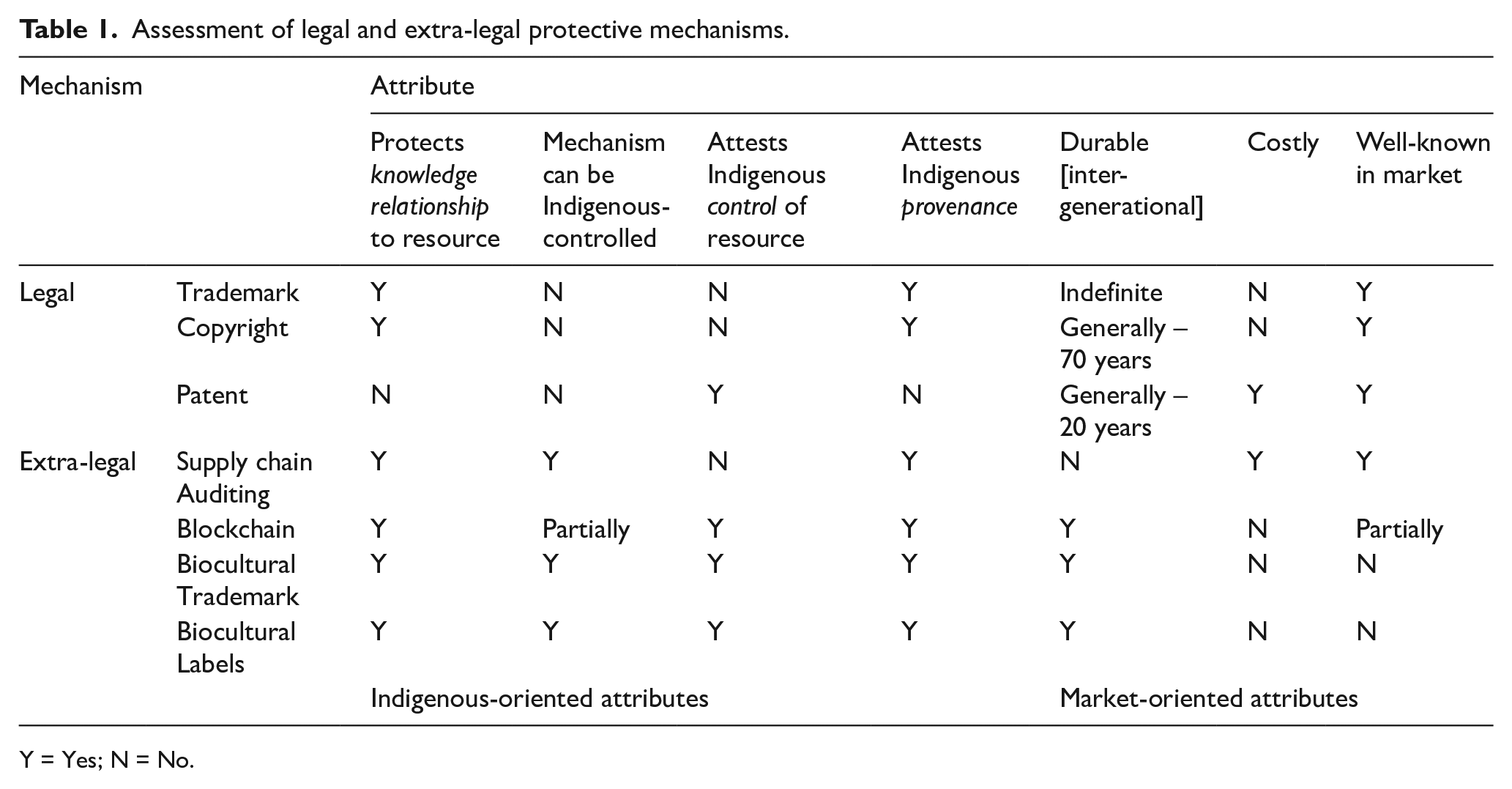
As Puketeraki aims to commercialise taramea while at the same time ensuring its kaitiakitanga relationship, we have assessed the legal and extra-legal mechanisms against a range of Indigenous and commercially oriented attributes. Table 1 sets forth how each legal and extra-legal solution performs with regard to issues of Indigenous ownership, provenance and authenticity. It also assesses market attributes that may affect Indigenous groups when accessing or selecting the mechanism, such as durability, cost and familiarity.
Assessment of legal and extra-legal protective mechanisms.
Y = Yes; N = No.
As our comparisons in Table 1 show, each mechanism has advantages and disadvantages. Legal protection options are available and well understood globally; however, they can be costly to acquire, expensive to defend and may not be durable. Given that Indigenous attachment to tangible and intangible resources is ad infinitum, this can be a disadvantage. Their attractiveness can also vary depending on an Indigenous group’s orientation and desire to assert commercial control. Some options, such as patents, confer ownership—an advantage—but do not protect Indigenous relationship to knowledge about the resource that may be captured in songs, oral histories or use.
Extra-legal options also provide opportunities. Supply chain auditing is a well-known mechanism, although it can be variable and expensive. Newer approaches such as blockchain and BC labels are permanent digital records of rights and relationships to a resource, as well as being relatively inexpensive, if one puts aside infrastructure requirements such as online access and third-party fees. However, apart from supply chain auditing, they are not fully tested from a market perspective, given their relative newness. Biocultural trademarks have an advantage over legal trademarks in that they are under Indigenous control, and like BC labels, create an enduring link to Indigenous provenance, and hence, authenticity and legitimacy. However, the movement is new, and its funding model is still unsure. The outsourcing of coordinating infrastructure to global third parties may also reduce desirability for some. Blockchain requires further exploration as while it has a powerful capacity to deliver provenance, authenticity and legitimacy, there are cultural alignments that need to be analysed.
The foregoing discussion demonstrates that there is no single ideal global or national market mechanism to protect the provenance of and kaitiaki relationship to a biocultural taonga such as taramea. So, what are Puketeraki’s options? We see a combination of three pathways:
From a legal perspective, trademarking of any subsequent brands and copyrighting of traditional narratives are attainable steps, although not without upfront and other potential costs.
Developing an auditing and traceability option might be feasible. This would build on experience already gained within the wider Te Rūnanga group through the development of a tracing scheme for conveying the provenance and authenticity of pounamu.
Application of TK and BC labels might be warranted. TK labels might be applied to narratives, stories, songs, images, research articles or other items that, while perhaps written or produced by others, indicate Ngāi Tahu’s enduring relationship the cultural knowledge and thereby acknowledge kaitiakitanga. Similarly, a BC notification might be applied to any scientific information, data or specimen material that resides in databases. Should such information be used in a secondary context, such as in combination with other novel attributes, the kaitiakitanga relationship to the specimen data would be on record. Although TK and BC labels are still novel, they are also relatively easy to attain, so they might have long-term value.
Conclusion
As Indigenous people increasingly seek to derive social, cultural and economic benefits from their tangible and intangible properties, protecting these against illegal, inappropriate or unauthorised use has come to the fore. While there is a trend towards greater legal protection for Indigenous peoples, both nationally and internationally, there are also forces pulling in the opposite direction; as the state has increasingly withdrawn from taking an active role in regulation, corporations have stepped into the vacuum. As our analysis shows, legal protections will never provide comprehensive protection and are still essentially reactive, generally requiring a transgression to activate and test the protection’s robustness.
This is why tribal groups such as Puketeraki and Te Rūnanga who are undertaking global commercialisation activities should consider extra-legal measures alongside legal protections. These measures not only deliver the perception of legitimate ownership but are also a powerful means of reaching out and connecting with consumers who are increasingly prepared to pay for authentic products. By employing a mix of legal and extra-legal mechanisms to communicate provenance and authenticity, Puketeraki and Te Rūnanga can reinforce mana and rangatiratanga and enhance kaitiakitanga over taramea as it circulates globally in narrative, data or commercial product.
Footnotes
Acknowledgements
The authors acknowledge the support of Pūketeraki Limited.
Authors’ note
Declaration of conflicting interests
The authors declared no potential conflicts of interest with respect to the research, authorship and publication of this article.
Funding
The authors disclosed receipt of the following financial support for the research, authorship and publication of this article: Ministry of Business, Innovation and Employment, Unlocking Export Prosperity LINX170; Our Land and Water National Science Challenge, Rewarding Sustainable Practices; and Science for Technological Innovation National Science Challenge, 2019-S1-CRS Building New Zealand’s Innovation Capacity.

Glossary
Aïny Savoirs Des Peuple French perfume company
Achuar Indigenous tribal community of the Peruvian-Ecuadorian Amazon region
Asociación ANDES Association for Nature and Sustainable Development.
hapū clan
harakeke Phormium tenax; New Zealand flax
ilang-ilang Cananga odorata; a tropical flowering tree
iwi tribes
kaitiaki guardian, guardians
kaitiakanga safeguarding obligations
Karen ethnic communities in Myanmar and Thailand
Kāti Huirapa Rūnaka ki Puketeraki; Puketeraki a regional tribal authority of Ngāi Tahu
kāwanatanga governance
Khoikhoi Indigenous tribal group of South Africa
kōwhai Sophora sp; a small woody legume tree
mamaku Cyathea medullaris; the black fern treeprestige,
mana authority, influence
mānuka Leptospermum scoparium; a flowering tree
Māori Indigenous people of New Zealand
mātauranga traditional knowledge
mātauranga Māori traditional Māori knowledge and culture
Ngāi Tahu a large South Island tribe
papatipu rūnaka Ngāi Tahu clan-based regional governance structures
pohutukawa Metrosiederos excelsa; a coastal myrtle tree
pounamu jade
Quechua Indigenous people of the Peruvian highlands
rangatiratanga exercise of chiefly authority, control, power
San Indigenous tribal group of South Africa
taonga treasured property
taramea Aciphylla aurea; a sub-alpine speargrass
Te Tiriti o Waitangi; Te Tiriti The Treaty of Waitangi
Te Rūnanga o Ngāi Tahu; Te Rūnanga governance body of Ngāi Tahu
whakapapa genealogy; a concept of relationality
Whakatōhea a tribe of the eastern Bay of Plenty, New Zealand