




Abstract
This article explores kapori, an Indigenous form of storytelling to investigate and report experiences, motivations, responses, and challenges of sorcery accusation–related violence (SARV) by the Yuri people, a tribal group from the Papua New Guinea highlands. SARV is attributed to the belief that some people use supernatural powers to cause illness, deaths, or misfortunes to a community and, therefore, become targets of violent accusations. We outline the rationale for incorporating kapori into SARV research and discuss the findings from a storytelling workshop with 14 participants representing 13 clans of Yuri. The findings suggest that key strategies for curbing SARV include building community capacity to respond to the challenges of SARV, addressing the physical and emotional scars of SARV, and valuing collective interventions to prevent SARV. The use of kapori in this research helped to diversify, expand, and circulate Yuri narratives about SARV to support prevention strategies.
Introduction
This article explains how an Indigenous storytelling approach was applied in the context of research undertaken to understand the responses to sorcery accusation–related violence (SARV) among the Yuri people, a tribal group from the Papua New Guinea (PNG) highlands. Contemporary SARV is a particular form of violence directed at another person because they are believed to possess supernatural powers to cause illness and deaths in a family or community (Forsyth & Eves, 2015). It has been difficult to address and requires multiple and coordinated approaches. This article discusses how kapori, storytelling in Yuri culture, was used to facilitate conversations among participants on motivations, experiences, and actions in response to SARV. Kapori is a word used by the Yuri people of the PNG highlands to describe their collective storytelling or conversation practice. Ka means word and pori means telling or sharing. Kapori means sharing a word about one’s experiences of the world. Indigenous in this discussion in encompassing the Yuri people who are among the many tribal groups in post-colonial PNG, whose own ways of knowing, storing, and disseminating knowledge came under stress as a result of colonisation. Despite PNG being an independent nation with most of its Indigenous people owning their land, aspects discussed in this article relating to identity, social change, and tribal affiliations are commonly shared across Indigenous groups globally. This article supports the application and expansion of Indigenous research methodologies within the context of the Yuri people of PNG.
Contemporary SARV is complex and widespread in PNG and many other countries around the world (Forsyth, 2016). National and international initiatives seek to address SARV but local knowledge of community responses is often missing from the discussions that inform these initiatives (Evenhuis, 2015). A human rights frame often guides international, national, and local SARV responses, including this research. This frame values and respects sorcery beliefs and practices that help people to build relationships and connect with the environment and the spiritual world but condemns those that link to all forms of cultural, spiritual, and human violence such as blaming others and using violence against them for causing illness, deaths, and misfortunes in the community (Forsyth & Eves, 2015).
The research reported here is important in the context of PNG because one of the priority areas under the PNG National SARV action plan is building response capacity at the community level (Forsyth & Eves, 2015). During a meeting of the Human Rights Council of the United Nations, it was also suggested that community responses can offer effective solutions to SARV (United Nations Human Rights Council, 2018). Contextual approaches to investigating and understanding community perspectives on SARV are needed to provide insights to different responses to curb SARV.
This research is informed by existing action research projects such as Yumi Sanap Strong (Let’s Stand Together), which highlighted that community-led initiatives are at the front line of responding to SARV providing contextualised solutions (Kauli & Thomas, 2020). Experiences from community-based organisations provide an understanding of the impact of SARV on communities to inform intervention programmes (Thomas et al., 2017). This work builds on foregrounding such local interpretations and narratives in understanding contemporary forms of violence associated with sorcery accusations through arts-based approaches in support of community-led initiatives (Kauli & Thomas, 2019; Thomas & Kauli, 2020).
The research was particularly concerned with using kapori to uncover and amplify local narratives that were being used to curb SARV and to generate context-specific knowledge about community responses to SARV that can help to inform local and national initiatives. This research documented the stories of sorcery and related violence of the Yuri people by integrating kapori and photovoice. This article contributes to local research approaches in PNG by showing how Indigenous storytelling approaches, such as kapori, can help to access this body of community-based knowledge of SARV and how it is applied in local contexts.
The lead author Witne is a Yuri man, with deep understanding of local cultural protocols and the benefit of local forms of storytelling. The co-authors Thomas, Kauli, and Spurgeon have extensively used storytelling and process drama techniques working with community-based groups to represent their perspectives. Thomas and Kauli worked with human rights defenders in PNG through the Yumi Sanap Strong project and represented their voices in addressing SARV through digital storytelling and filmmaking.
Kapori is an integral part of the Yuri culture. Witne grew up among the Yuri people, listening to kapori and experiencing accusations of sorcery related to intra-clan fights and explains, My mother told me that fighting and sorcery accusations related to fighting was a way of the Yuri people. After going to school and reading about SARV, I realised that my father never discussed SARV and why it occurred with my mother. Kapori about fighting and SARV was considered as men’s space in Yuri. I am a Yuri man who observed SARV too and curious to develop kapori of sorcery and disrupt secrecy of sorcery talk and develop mitigating strategies to prevent violence.
In 2013, following decades of tribal fighting among Yuri, the initiative Yuri Alaiku Kuikane Association (YAKA) was formed to disrupt legacies of all forms of violence through peace building and reconciliation. All the clans of the Yuri tribe united based on collective consciousness of destructive effects of intra-clan wars, weakening community cohesion, cultural destruction, denying access to socioeconomic, health, education, bridges, and roads (Witne, 2016). The new leadership embraced local circumstances and identified with YAKA, which symbolised Yuri, the spiritual founder of Yuri tribe and his son Alai. Alaiku means we belong to Alai or we are Alai’s children. The term kuikane means a renewed Yuri generation committed to peacebuilding and non-violent conflict resolution. YAKA provided a foundational platform to safely engage in storytelling and discussions related to sorcery accusations. Kapori about experiences of accusations of sorcery and violence, such as those generated through this research, was told by diverse group of community members, including women and youth who shared critical consideration of the motivations and challenges of addressing SARV. Our research shows that the new local narratives about SARV generated through the process of kapori and visually represented and amplified through photovoice have potential to increase conversations of responses to SARV and inspire people to (re)connect with the peacebuilding objectives of YAKA.
In this article, we first provide a background to Indigenous storytelling approaches and the importance of integrating local approaches of knowledge sharing into our research methodologies. The article then goes on to describe how kapori and photovoice were integrated to understand Yuri voices and perspectives on SARV, and simultaneously helped to amplify them. The article describes how kapori about experiences of sorcery accusations were co-created in a research process guided by mutual understanding and cultural sensitivity. The research process showed the strategies for curbing SARV most valued by participants including the need for building community capacity to respond to SARV, the need to help people overcome the physical and emotional damage of SARV, and the need to encourage and value collective responses to SARV.
Background
Indigenous approaches to storytelling
Indigenous approaches to storytelling have been used in contextual research in a range of settings including in PNG, to uncover local knowledge of a range of issues such as peacebuilding. Indigenous communities developed storytelling as a significant way of communicating, teaching, keeping practices and values alive. Storytelling embodies knowledge, culture, and lived experiences of people (Datta, 2018). For example, Iseke (2003) involved the Métis (mixed European and Indigenous ancestry and one of the three recognised Indigenous Peoples in Canada) elders in storytelling to understand the history of the people as well as the role of storytelling in sharing Indigenous knowledges of the past and present. The collaborative research revealed that there were different ways and times for stories. It was the storytellers who were aware of the stories and told them in specific and powerful ways.
Senehi (2002) discusses storytelling in the context of intergroup conflicts and peacebuilding more broadly. She highlights both destructive and constructive storytelling, exploring key concepts of knowledge, identity, socialisation, emotions, morality, time and memory, and geographic space. Senehi (2002) argues for the facilitation of cultural spaces and constructive storytelling where people faced with social upheaval and conflicts or in the aftermath of violence and tragedy can participate in building communities and inter-communal relationships characterized by shared power, mutual recognition, and awareness in order to work together to shape the future. (p. 57)
Many Indigenous groups have faced social and cultural conflicts as a result of colonisation. In the context of the Yuri of PNG, protracted tribal warfare pre- and post-colonisation has negatively impacted generations of people.
Sium and Ritskes (2013) stated that “Indigenous stories place Indigenous peoples at the centre of their research and its consequences” (p. 4). Stories are owned and told by Indigenous peoples, and they make meaning of stories based on their world view (Lewis, 2011). Accessing the stories require culturally acceptable ethical approaches such as engaging in conversations, building relationships, and mutually agreeing to the benefits of the research. Ethical values and practices of Indigenous storytelling have been used in conjunction with arts-based and visual research methods, where open dialogue, mutual respect, understanding, and privileging knowledge holders and co-creators of knowledge is foregrounded in the research process (Denzin et al., 2008). Following local protocols is important in the way stories are told and shared, as well as how they might be recorded and distributed more widely.
Across Melanesia, different terminologies are used for the act of involving others for the purpose of sharing stories depending on the context in which it occurs. Increasingly, these storytelling approaches are promoted as research methodologies such as talanoa in Fiji, Samoa and Tonga, and tok stori in Solomon Islands and PNG. In the Yuri language, the form of sharing a story is called kapori.
Pacific scholars in Fiji, Samoa, Tonga, and New Zealand use talanoa as a form of Indigenous storytelling in research to demonstrate that Pacific people and communities are diverse and unique and capable of using research methods that privileged and valued this diversity (Cammock et al., 2021; Suaalii-Sauni & Fulu-Aiolupotea, 2014; Tecun (Daniel Hernandez) et al., 2018; Vaka et al., 2016). Talanoa originated from traditional oratory culture, embodying relationships to people, place, land, environment, and the spiritual world. The protocols of talanoa embrace dressing, behaviour, and traditions guided by emotions, empathy, and respect which equalised relational barriers and tensions of age differences, rank, gender, religion, and other aspects of life (Tecun (Daniel Hernandez) et al., 2018). Vaioleti (2006) pointed out that Pacific peoples storied their issues, their realities, and aspirations. In this context, talanoa provides a face-to-face means to tell, inform, relate, and command, which resonate with stories and conversation practices of many Pacific communities. The research by Cammock et al. (2021) highlighted how talanoa embraced a sense of belonging and relationship with others, environment, space, and time. The values of belonging and relationship extended to promote well-being, safety, and meaning for people, which can be expressed through emotions, spirituality, physical, mental, and cultural elements. Talanoa helps to capture Pacific diversity, cultural values, research processes, and methods that are relevant for Pacific researchers (Vaioleti, 2006).
Indigenous peoples of Solomon Islands use tok stori, a particular form of expression among the Mala’ita people of Solomon Islands, based on lived experiences of the people. The experiences recounted in tok stori include particular ways in which people interpret and make meaning of their world and some people, mostly tribal elders, become custodians of collective knowledge and culture dictated specific protocols of when, how, and whom to share or impart knowledge to (Sanga & Reynolds, 2020). Nicholas et al. (2011) noted that people in many cultures lived storied lives and stories served as links to imagine complex issues and present opportunities to retell or rethink creatively.
A key feature of naming and adapting local processes to research methodologies is understanding how knowledge is created and shared and how existing processes embody ways of being in a place and community. Careful attention must be given to those processes that can promote collective knowledge, ethical engagement, and support community benefit. The experiences, motivations and challenges expressed in a kapori contain knowledge, skills, and abilities of Yuri people. Unreliable, street talk was regarded as ka’wai (gossip), which had potential to create tensions and violence. Therefore, in the Yuri culture, people treat kapori with care, separating it from ka’wai. Similarly, Sanga and Reynolds (2020) when discussing different types of knowledge in Mala’ita distinguish between public or private knowledge in consideration of access to knowledge, such as knowledge of sorcery used to maintain power and social control at the community level. Among the Yuri, the source of kapori was regarded as authentic, knowledgeable, and respected.
In particular, knowledge and discussions of sorcery are traditionally regulated within PNG’s cultural systems. For example, in pre-colonial Bougainville (Evenhuis, 2015) and Milne Bay Province (Lawrence, 2015), the knowledge of acquiring supernatural power, which was described as sorcery, was guarded, and transferred to others by performing specific rituals for the purpose of continuity of knowledge and enriching communal life. The Binandere people of Oro Province have different names and rituals for supernatural powers with local magical formulae, which include good and bad magic (Denoon & Lacey, 1981). The Yuri people have their own language, worldview, and ways of communicating with others and sustaining themselves. The diversity of PNG’s cultural practices, as well as the social and cultural changes taking place, present challenges in developing local research methodologies.
This is further problematised by the way contemporary SARV manifests. While sorcery beliefs for many in PNG are a way of finding an explanation for difficult circumstances including illness and deaths, targeted accusations of individuals as sorcerers or witches often have other underlying issues, such as access to land and resources (Kauli & Thomas, 2020). The way accusations are perpetuated often relies on narratives and stories or what might be considered gossip. In the context of Yuri, such narratives are ka’wai. While stories in this context can be harmful, this research carefully considers how kapori can be harnessed to create different and new narratives to increase peace and security in the community. Lewis (2011) argued that stories have a life through storytellers which must be carefully considered in different settings of storytelling. In the context of research about SARV, storytelling is an important means for listening to the voices of the survivors of violence. It is through stories that background information such as socioeconomic, religious, and cultural environments that shaped people’s mindset and attitude to certain violence, and community responses can be documented. This kind of local storytelling also provides an important means for generating new narratives that can counter and curb the propagation of SARV. Therefore, kapori of sorcery was designed as action research to actively disrupt legacies of sorcery ka’wai by involving men, women, youth, and community leaders to share their stories and experiences.
Methods
Facilitating kapori about sorcery accusations and violence
The overarching methodology for this research project was informed by Indigenous, visual, and action research approaches. The integration of these approaches ensured that relational and communal values were respected while providing opportunities for collective sharing and co-creation in support of community interests and benefits from the research within the Yuri context.
Indigenous storytelling helps to foreground the voices of people at the grassroots level in Melanesia and elsewhere and suggests these voices cannot be generalised or simplified into a singular or dominant narrative about SARV. This is because the specifics of sorcery beliefs, accusations, and the violence associated with accusations can vary significantly from place to place. Through kapori, this research was able to uncover details about the Yuri experience of SARV, because the processes and protocols of kapori—already known to research participants—are based on a special relationship of trust which is established between the teller and listener in the process of kapori. Bennett et al. (2019) explained that the photovoice method can be useful for Indigenous research, particularly valuing grassroots knowledge, and participation in solving community issues. In our case, the integration of kapori and photovoice in a 3-day workshop enabled participants to create kapori in audio-visual media to represent the complexities and multiple responses to SARV.
Kapori resonates with protocols of talanoa, bringing people together, respecting diverse views, and creating a safe space for expression (Tecun (Daniel Hernandez) et al., 2018) and the integration with photovoice, embraced principles of upholding relational values of mutual understanding, collaboration, participation, dialogue, and privileging local knowledge (Wang, 1999). Photovoice is characterised as action research as it involves closely working with participants “to identify the problem or the asset, critically discuss the roots of the situation, and develop strategies for improving the situation” (Wang, 1999, p. 190). Wang (1999) further highlights how photovoice as action research activates social support among community members. For McNiff (2013), action research is about “learning in and through action and reflection” (p. 24). Photovoice and storytelling were actions by participants which were shared in the group for further discussing and reflecting community solutions to SARV. Relational requirements of kapori were addressed throughout the fieldwork, from the way Witne entered the community, negotiated the recruitment of participants, and facilitated participants’ active involvement in the workshop, including creating a space that would support inclusive kapori practice.
Ethical clearance was given by the Queensland University of Technology and fieldwork was conducted from December 2019 to March 2020. It must be noted that we did not actively recruit perpetrators as research participants. The focus was on the recruitment of community members who were active in addressing SARV in the community. It is also important to note here that deep care was taken to recruit those with strong social networks in the community. Given the sensitivity of the research topic, we recruited participants who already had experience working and mediating tenuous relationships and demonstrated the ability to protect themselves and the community. This was further guided by the lead researcher’s local knowledge. The main workshop was held in the village of Irimaule where the community hall of the Yuri people is located.
The Yuri tribe comprises over 13 clans and many sub clans and villages, scattered along the plateaus and gullies on the southern part of Kubor Range in Gumine District of Simbu Province (Witne, 2016). Prior to the workshop, Witne walked to several villages to recruit 14 participants, made up of an equal number of men and women representing 13 clans. The youngest participants recruited through this process were 21 and the oldest was 55 years of age. Village court magistrates, community leaders, ordinary men, women, and young people were recruited to participate in the kapori workshop.
Participants were welcomed by a tribal elder and attended 3 days of SARV kapori workshop at the YAKA community hall. Participants were informed that they were recruited to share kapori about their experiences of SARV. Community protocols were followed and implemented with regards to the approval of the research and the ownership and benefit of this work to the community. This built on the peace agreement established through YAKA in 2013 that emphasised protection of people within the community and processes of dealing with issues of violence. Collective protocols around care and respect were established at the beginning of the workshop, and time was taken where needed to ensure support for the well-being of participants. Cultural implications, particularly negative repercussions to the participants for their kapori about SARV were considered. For example, we asked them to tell their own stories and avoid telling other people’s stories or calling names that may provoke anger and disturb the workshop. Participants were given the following questions to help guide the development of kapori: (1) Participants were asked to recall an experience in a sorcery accusation or related violence; (2) In the above situation, how did they react? (3) The participants were asked to reflect on why they acted in that way. (4) And finally, they were asked to recall some challenges and how they addressed them.
Each participant recalled an encounter and shared it in the kapori workshop with other participants. This followed kapori protocol where the listener learnt from a kapori and provided feedback or asked questions. The tellers reflected on the comments and strengthened stories and re-told them for recording. In the night, we listened to each of the recorded stories around the fireplace and asked questions and commented. The story owners listened to the comments and questions and decided to keep or adjust their stories. The final stories were recorded in the morning of Day 2 of the workshop.
After recording their kapori, participants were loaned cameras and supported with basic training to take photographs to represent their stories. They practised taking photographs in and around the workshop venue and showed some photos to other workshop participants and discussed why the photos represented their stories. The other participants commented on the photos. This reflective session inspired participants to take additional photos, so we walked to Omdara, a large village along the river. For this session, we agreed that participants take as many photos as they like and carefully chose three to six photos to present to other participants at the workshop. After everyone commented on the photos, participants chose a photo that best represented his or her kapori.
At the end of the third day, we concluded the workshop by taking a group photo, which was printed and laminated along with the photo each participant chose for their kapori, for each participant to take home with them. The village elder was invited to make his speech and officially end the workshop. The transcribed kapori and photos were used to create a photobook. Each participant agreed for their name to be used as author of their story, and those identifiable in any of the photographs provided their consent for publication of the photograph. Careful consideration was given to their representation in image and text, in the context of their community and beyond. Apart from the photobook being a record of the workshop and each participant’s story, it is intended to be distributed to churches, schools, universities, and other organisations addressing SARV in PNG.
Research participants came together at the conclusion of the kapori workshop to reflect upon the process and the narratives and images of SARV that had been generated through the workshop. The reflection session also followed kapori protocols, with each participant having the opportunity to speak about their SARV kapori and be heard and receive feedback from other participants around the fireplace in the community hall (Figure 1).
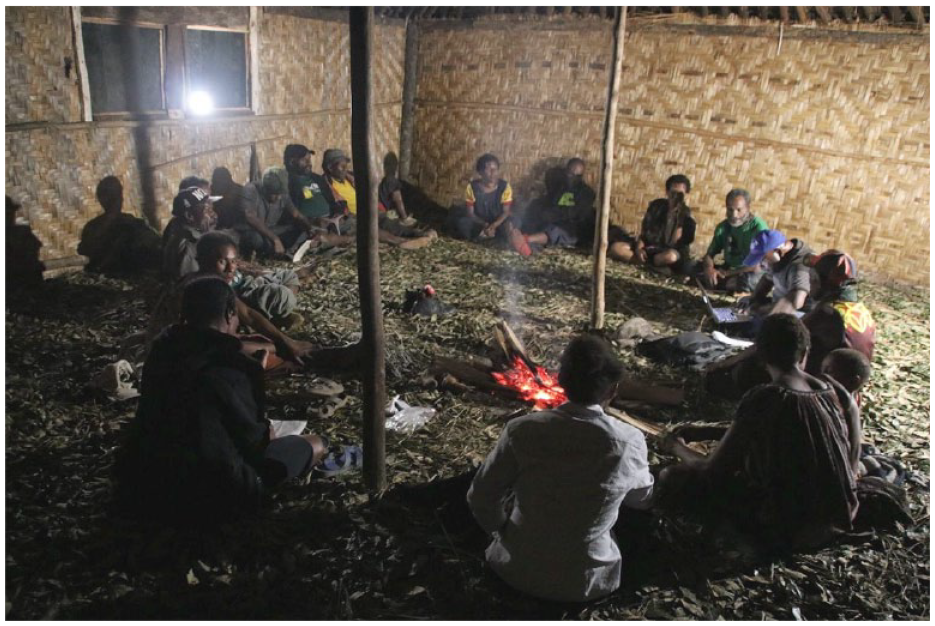
Kapori (storytelling) session at the community hall in Irimaule village (photo by Bomai Witne).
We share the common insights that surfaced from participants in the kapori sessions under the following themes: building community capacity for sharing experiences to curb SARV, helping to overcome the physical and emotional scars of SARV, and communicating the successes of collective responses to SARV.
Findings and discussion
Building community capacity for talking about the need to curb SARV
Every participant agreed to share kapori about SARV. A woman from the Ahngale clan stated her willingness to participate in the workshop and shared her kapori for the first time: I like living in my community. But, whenever a child got sick or a community member died, people in the community used to accuse me and my husband of using sorcery on them. I am not a sorcerer. And God above knows that. I am very happy to share my experience and worries in my own language. (Vero, female, 55 years old)
Accusations of sorcery might be traced to many generations and stigma is often felt and remembered for many generations. Some victims of SARV were vulnerable to repeated accusations and attack. In our research kapori stories around the fire recounted the painful and traumatic experiences. Ruth recounted the sadness she felt when her mother was accused of sorcery, My mother was accused of sorcery, and she left to stay with my big sister. My brother had a fight with accuser and chased him away from our village. Later my brother wanted to give a pig and asked the accuser to return to the village. I told my brother that when they called my mother a sorcerer, it meant I was a sorcerer too and did not support my brother and went to the garden to plant sweet potato but I was very sorry for my mother and returned home and I was asked to attend this workshop. I know there is a solution. (Female, 21 years old)
These victims and family members carry the burden of SARV together. The SARV kapori generated in this research also uncovered young men as those involved in violent accusations: A woman, I knew, whose house is next to mine, was dragged from her house by many young boys. I felt sad and walked behind her. They threw sticks at her, cut her with bush knives and exposed her body to the heat of a fire. (Augustina, female, 35 years old) My young nephew died. They said it was sorcery, young boys went with bush knives, guns, stones, sticks, and held two women and a man. They pulled them to a public space and beat them badly. (Julie, female, 21 years old)
These experiences are consistent with earlier research on SARV in PNG. Urame (2015) observed that there was growing unemployment and increasing number of youths being disenfranchised and resorted to different forms of violence including SARV. For example, young men who did not have community standing to talk or behave in certain ways in their culture were using bush knives and guns to threaten, torture, and kill people accused of sorcery (Rio et al., 2017). Lack of socioeconomic and cultural developments contributes to SARV. Therefore, addressing underlying causes of SARV is key to sustainable responses to SARV.
During the kapori session, young men also shared their experiences. For example, Michael Tolpari, a young male survivor (Figure 2) saw his mother killed and brother injured with a bush knife, recovering at the hospital. He lived with fear and stigma. He was angry at some point and wanted to fight back but thought of his young family who would be displaced and decided not to fight back. He expressed his daily emotional burden of SARV in the following terms: I saw that sorcery accusations increased and damaged many people. I thought of my wife and two children. I had land and property, so I remained calm. I did not want to displace my family. Many leaders and police in town knew our problem in ward 5. I was a young man, and they gave me a bad name. I reduced my time to walk in public spaces. I always thought the people talked about me as this sort of person. (Michael, male, 21 years old)
Some people from Michael’s clan felt sorry for him. They invited Michael to join the church social network and after 2013, Michael joined YAKA and settled in his own community with his wife and two children. Community mobilisation and responses to SARV as demonstrated through kapori are important in the context of PNG where many SARV incidents remained isolated from police and state law enforcement agencies.
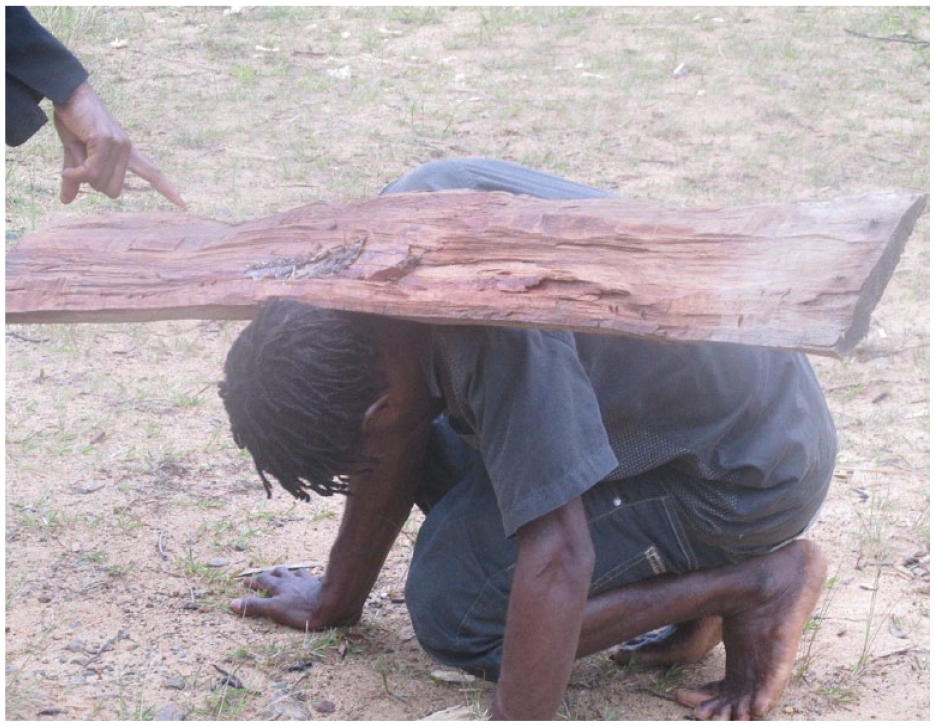
Michael Tolpari’s photograph in which he re-enacts his experiences of physical and emotional violence (Photo by Peter Laki).
For village court magistrates, for example, it has been difficult to interpret SARV in the context of law. Village court magistrates received training throughout the country, including Simbu province. Provisions from this training included training related to the amendments of the criminal code addressing SARV. However, given limited support from law enforcement, the peacebuilding activities by Yuri and the formation of YAKA as a tribal association signify a shift in addressing SARV at the community level, as demonstrated in participants’ kapori.
SARV challenged individuals, families, and communities to unite and rethink ways of addressing it. The YAKA movement provided a platform for change and held people accountable to a joint vision for peace. A woman participant, Rita Gilbert (Figure 3), shared how her husband was one of the lead persons in SARV and her actions and words at home and the impact of YAKA changed her husband from being a perpetrator to an advocate against SARV: “He told others that he used to accuse people of sorcery but changed and everyone should do the same” (Female, 29 years old).
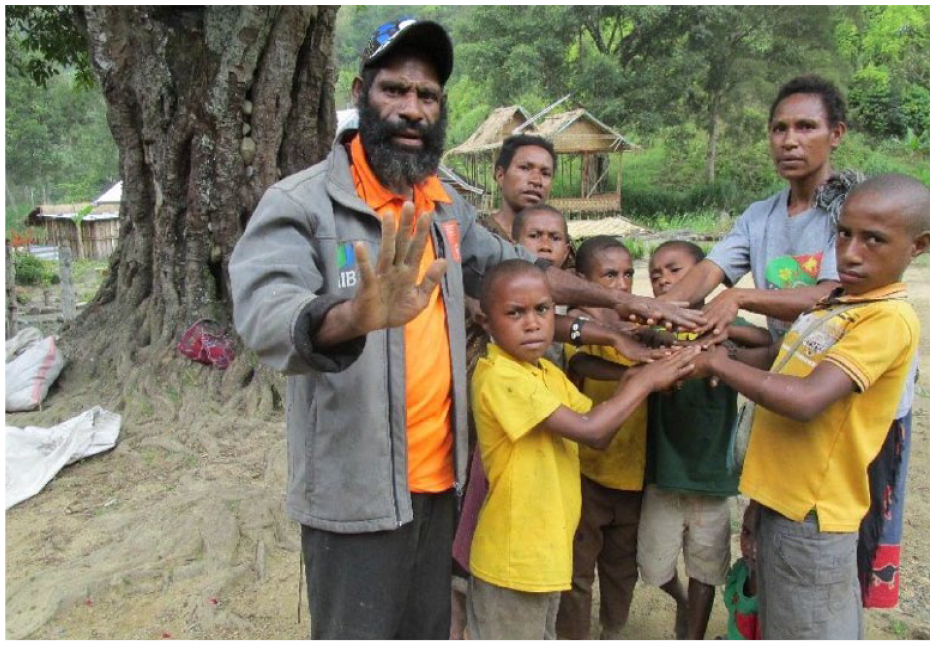
Rita Gilbert (second from right) standing with Michael Wari (first from left), and children from Omdara village, demonstrating unity to address sorcery accusation–related violence (photo by Julie Philip).
The lead researcher facilitated the workshop and the kapori process was discussed and developed with the participants, which was an important learning experience for participants that helped to build community capacity for talking about SARV. For example, participant Julie reflected, I want to express how I felt about my kapori and photo. During kapori, I felt bad because I never had opportunity to speak in public. I was not confident, and my talk was muddled. However, after three days of speaking, I felt confident to speak in public. This is a good thing I learnt and am so happy for it. (Female, 21 years old)
Figure 4 shows the image that Julie created and selected to illustrate her SARV kapori. She shared, “My picture showed that these things [bush knives, sticks and stones] were used for sorcery accusations so they can see it and avoid using these things again” (Julie, female, 21 years old). It was also evident in the way Julie voiced her reflection on the workshop that she felt good about the practice of kapori and the way it shaped her confidence.
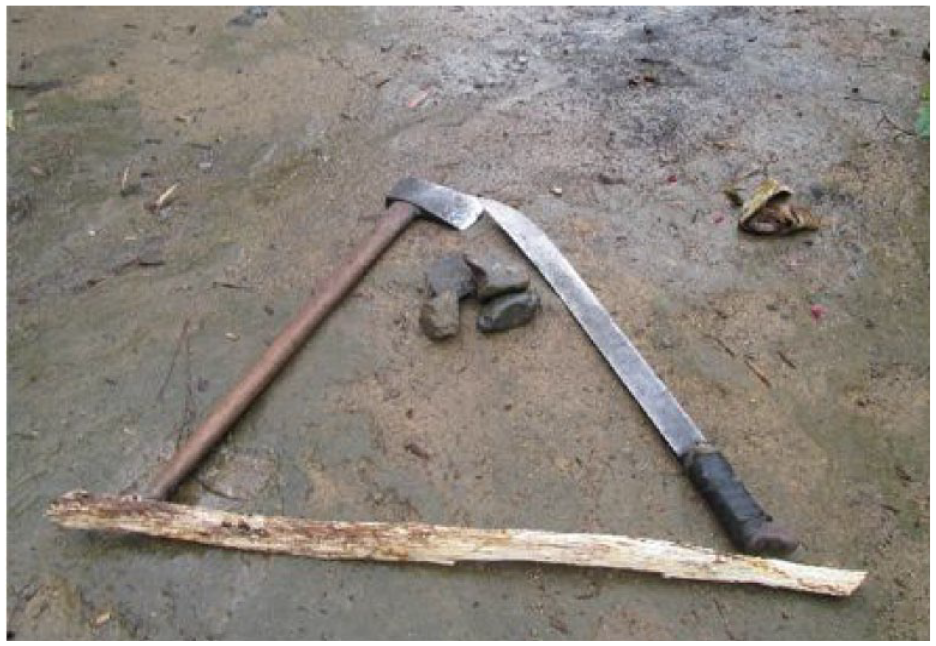
Objects used during violent sorcery accusations (photo by Julie Philip).
SARV violates cultural and human rights such as freedom of life, movement, expression, education, security and good life (Klug, 2015). However, what is egregious is the lack of space and opportunities for people, particularly young, women, and vulnerable people to have a voice on issues such as SARV that affect them, especially for cultural reasons including the narrow perspectives that have dominated SARV kapori. This research deliberately disrupted the dominant cultural SARV protocol to engage young, women and old people in SARV conversations to inspire change.
Overcoming physical and emotional scars of SARV
Research participants also found that the kapori sessions were helpful in addressing the physical and emotional scars of SARV. SARV physically scarred many participants and resulted in the deaths of close relatives. Other participants were accused, threatened, tortured, and injured. After listening to the stories, a man reflected: These were real stories of personal and family experiences. Some stories were very sad. I felt sad too. It was good we had an opportunity to share, and I felt both good and bad. The good thing was we spoke out. (Kale, male, 50 years old)
The diverse experiences shared through the kapori demonstrated that all the participants had kapori related to different aspects of sorcery accusations and violence. YAKA served as platform that served their collective strengths, responses, and hope for change. The sorcery kapori workshop allowed participants to articulate and expressed their empathy, fear, pain, insecurity, and longing for sustainable solutions to SARV and peace.
An integral part of the Pacific peoples’ demonstration of knowledge and skills of identifying problems and seeking solutions has been through storytelling. These have been documented through several processes such as talanoa (Vaioleti, 2006), tok stori (Sanga & Reynolds, 2020), and we add kapori to highlight how the Yuri people of PNG expressed personal experiences, motivations, and challenges of addressing SARV. Frequent reference was made to Yuri Alaiku (Yuri belonging to Alai) and YAKA as the unifying promise for peace: Before we made sorcery accusations and this started fights but in 2013, we changed. So now I tell our clan and our community “these sorcery accusations we used to talk about it in the past, but in 2013 our leaders of Yuri Alaiku stopped the violence related to sorcery accusations, so now we have to stop it and live peacefully.” (Peter, 45 years old)
Indigenous peoples of Melanesia are connected to each other, environment, and the spiritual world through unwritten laws and customs, which shaped their cosmology (Narokobi, 1989). Narokobi further expanded his ideals of Melanesian cosmology and relationships in terms of brotherhood, wantok (reciprocal relations of people sharing the same language, culture, or values), system, family cohesion, and interdependence (Narokobi, 1983). These ideals were also found among the people of Simbu through the boromai suara (one blood based on birth and kinship) social relationships guided by giving, sharing, and caring for one another in times of peace and war (Brown & Brookfield, 1959). However, sorcery beliefs and accusations were also common among one-blood relationships and determined movements of people when sorcery was believed to have caused misfortune to an individual or a family. SARV challenges Melanesian spirituality and cosmology of brotherhood and boromai suara. Yuri recognised the devastating effects of tribal fights and sorcery accusations. They drew on their collective identity of their spiritual leader Alai to form a collective peace movement, manifested through a pig killing ceremony and the bringing together of all 14 Yuri clans. Building on this movement and collective memory, our research process captured cultural narratives of the experiences of contemporary SARV. This generated new kapori about SARV that were shared and put into circulation. Collective storytelling can provide a space to deal with trauma safely and support cultural identity and belonging to support healing (Friskie, 2020). The Yuri narratives remind of local desires for peace and are aligned to national and global narratives of collective responses to address SARV that are anchored in human rights. Building critical community capacity to talk about, and share responses to SARV may prevent, cure stigma, and address many instances of SARV.
Conclusion
Communicating the success of a collective response to SARV
This is the first time in my life that I have participated in a workshop like this. We used cameras and shared our photos, we recorded our stories and voices yesterday, and today I am even happier. My story and my photo will be in our book for others to see, and I am very happy about that. (Peter, male, 50 years old)
Indigenous narrative methods such as kapori provide a way in which community perspectives can be accessed and considered as viable responses to SARV. They are culturally appropriate forms that are also effective ways to engage people in the frontline of dealing with SARV in a way that also positions these storytellers as voices of authority on SARV. While this research was facilitated by someone we might consider a cultural insider, researchers who come from outside the specific context would benefit from working closely with people from within the community as co-researchers. Key to applying an Indigenous research methodology such as Kapori is understanding and applying the particularity of place within the research approach, so that it responds to context and relationships. Here reflections from within by those involved and affected by the research are paramount.
This article demonstrates that the storytelling practice of kapori that is culturally specific to Yuri people of Simbu Province can be used to obtain unique community voices and perspectives on SARV experiences and SARV responses. Used in combination with photovoice, it was possible to put these SARV kapori into circulation in the communities in which they were produced and the larger national and international networks that are concerned with bringing SARV to an end. The integration of kapori with photovoice provided an opportunity to participants to creatively express their unique perspectives on the complexity of SARV experiences, including the physical scars, psychological trauma and emotional stigma, pain, and fear associated with SARV. This process of kapori with the integration of photography and the visual representation of their experiences and community fostered the transformative potential for the community of collaboration, participation, dialogue, and immersive experiences and shared understanding.
Kapori is an ethical and culturally relevant Yuri system of communication and disseminating information for many centuries. Therefore, the kapori reported here was used to understand local experiences and perceptions of SARV, as well as community responses. The power of kapori as the foundation for communication around the complexity, diverse views, and responses to SARV to change prevailing narratives, protect victims and develop intervention programmes for victims and perpetrators also demand disruption of some cultural protocols of kapori that hinder collective response to SARV. Such deliberate disruption and expanding space for more and inclusive participation in SARV kapori, create social change at the community level which will inform social actors such as the participants who will emphasise collective action to address SARV and achieve social change in contemporary communities. Through the research, Yuri participants were supported to share their knowledge of SARV and create visual materials to communicate this local knowledge to other Yuri, and to have these Yuri perspectives amplified in national and international debates.
Footnotes
Acknowledgements
The authors acknowledge and sincerely thank the members of the Yuri tribe who participated in the research.
Authors’ note
Declaration of conflicting interests
The authors declared no potential conflicts of interest with respect to the research, authorship, and publication of this article.
Funding
The authors disclosed receipt of the following financial support for the research, authorship, and publication of this article: B.D.W. received funding from the Australia Awards Scholarship Program in support of undertaking the research presented in this article.

Glossary
Alaithe son of Yuri whose children form different clans of Yuri
Ahngale a Yuri clan
alaiku we belong to Alai; we are Alai’s children
Binandere Indigenous people of Oro Province, Papua New Guinea
boromai suara one blood based on birth and kinship
ka word
ka’wai gossip
kapori storytelling in Yuri culture; sharing a word about one’s experiences of the world
kuikane renewed generation
Malaita Indigenous people of Solomon Islands
Métis mixed European and Indigenous ancestry and one of the three recognised Indigenous Peoples in Canada
pori telling or sharing
talanoa storytelling in Fiji, Samoa and Tonga
tok stori storytelling methodology in Solomon Islands and Papua New Guinea
wantok reciprocal relations of people sharing the same language, culture or values
Yuri tribal group from the Papua New Guinea Highlands; the spiritual founder of Yuri tribe
Yuri Alaiku Yuri belonging to Alai