




Abstract
Expanding social media research on the Pacific Digital Revolution, this article explores the significance of Papua New Guineans’ digital and visual articulations of Papua New Guinean identity through Instagram by analysing two public Papua New Guinean Instagram accounts, @archiveples and @taniabphoto. The research triangulates between Pacific, Indigenous, and Cultural studies, drawing on articulation theory and a multimodal thematic and visual cultural studies analysis. A Melanesian tok stori (storytelling) framework reveals how social media interactions fit within a culturally relevant Melanesian concept of storytelling and illustrates how social media has become a contemporary site for Pacific digital storytelling. This digital tok stori is a decolonsing digital wave of the Pacific artistic renaissance and reimagining emerging in 1970s post-independence art and literature. This research demonstrates how Papua New Guineans are subversively harnessing the tools and affordances of social media to counter reductive colonial narratives and mass media representations of Papua New Guineans.
Introduction
Rapid information and communications technology expansion in the Pacific is enabling younger generations of Pacific peoples to harness the tools of social media in decolonising ways that enable self-representation and subvert imposed, limiting, and racist colonialist narratives. Drawing on research of two Instagram accounts administered by Papua New Guineans, @archiveples and @taniabphoto, this article demonstrates how this self-representation, a form of visual digital media sovereignty (Ginsburg, 2018), is enabling a decolonising reimagining of Papua New Guinean identity. This is significant in a history of false and demeaning outsider-dominated representations and narratives of the Pacific. These representations take back the gaze that has distorted Indigenous peoples, and as a form of “cultural activism” they “‘talk back’ to structures of power” (Ginsburg, 2018, p. 31). Research on Pacific social media use has focused primarily on Facebook and Polynesian-centric conceptualisations. This research broadens the discussion by focusing on visual social media platforms and Melanesian concepts, and explores the significance of this digital phenomenon occurring throughout Papua New Guinea (PNG) and the greater Pacific.
I use Indigenous to refer to peoples with recent Indigenous ancestry and connection to land and acknowledge that Papua New Guineans, as with some other Pacific peoples, may not self-identify as Indigenous (Marrinacio, 2021). I use modern and modernity in a way that challenges the Eurocentrism embedded in the terms and recognises that “different communities, countries, and regions produce different modernisms at different times” (Hayward & Long, 2020, p. 9). The term Melanesia was born of colonial categorisation and mapping reflecting European discourses of race. In the tripartite division of the Pacific, Polynesia and Micronesia were named based on the geography of the islands, whereas Melanesia was named after the inhabitants skin colour, the “black islands” (Kabutaulaka, 2015, p. 112). As done in this research, Melanesians have since come to appropriate and refashion the imposed classification to foster a regional cultural identity, solidarity, and pride (Kabutaulaka, 2015; Narokobi, 1980).
This research focused on a month-long period of posts from Instagram accounts @archiveples and @taniabphoto, as well as supplementary articles and interviews. @archiveples, created by Samira Homerang and Lavau Nalu, curates posts featuring repurposed archival images of PNG from family photo albums, community submissions, and public archives. Providing a gendered lens to this research, professional photographer Tania Basiou, creator of @taniabphoto, curates posts of her portraiture photography of predominantly contemporary Papua New Guinean women. Building from a comprehensive literature review, a thematic analysis and cultural studies approach to visual analysis were applied to explore the questions of: how image-based social media tools are being harnessed to articulate contemporary Papua New Guinean identity; how Papua New Guinean identity is being articulated in these spaces; and what significance these articulations in this visual social media platform have.
Method
A tok stori approach
I ground and frame this research within Pacific Indigenous epistemology through tok stori, a Melanesian concept of storytelling. In Melanesian pidgin languages, tok stori translates to talk story. Kabini Sanga and Martyn Reynolds (2019, p. 12) describe tok stori as “a way of negotiating with the social world” and as “an everyday Melanesian discursive form of group communication that takes place when people interchange and exchange, creating a collective experience in which the development of relationships is both an accompaniment to, and a purpose of storying.” Tok stori is rooted in the Melanesian wantok (a relation based on common ties to land) system used to establish and acknowledge relationality between people based on place, from village to regional connections. Diverging from the dialogical nature of tok stori, yet grounded in tok stori’s underpinning values and principles of storying, relationality, and reciprocity, I adapt and employ a framework of tok stori to interpret, conceptualise, and recognise places of interaction and dialogue in the Pacific that extend beyond the oral form of storytelling. These include art, literature, film, photography, podcasts, and multimedia visual forms of social media.
I apply tok stori to understand image-based social media interactions as sites of culturally relevant digital storytelling, digital tok stori. Jenkins et al. (2017, p. 1061) describe “digital storytelling” as interactive stories generated via digital tools, and distributed and consumed on digital platforms. There exists a storyteller and a listening audience receiving in a space of engagement. Through a tok stori framework, digital storytelling occurs in an interactive digital space within online social networks—“virtual communities” (Rheingold, 1993, p. 3). These communities could be considered different levels of wantoks. Visual digital tok stori takes place by using social media functions to create content such as posts of images with captions and hashtags that are published and interacted with through comments, reposting, forwarding in messages, or by being viewed, absorbed, and made meaning of. Distinct from traditional mainstream media, the tools of visual social media platforms are being harnessed by Pacific peoples as bottom-up participatory technologies that enable self-representation (Waitoa et al., 2015; Yang et al., 2017). @archiveples describes the importance of visuals for connecting to our cultures: “it keeps history alive, it lets us speak with our ancestors” (Archive Ples, 2020a, para. 3). The tok stori occurring in the digital space extends beyond the present engagement between users to reach ancestors in the images. Applying a framework of tok stori highlights social media as a site for contemporary Indigenous digital storytelling—digital tok stori—where the past is engaged as new fluid realities are being storied.
A tok stori framework also supports my accountability, reflexivity, and reciprocity. There exist extended co-creators and participants to whom as a researcher I am accountable for remaining vigilant that their stories are respected, not distorted, and their humanity, well-being, and dignity are protected and uplifted. I acknowledge this is a story shaped by my experiences and positionality as a mixed-diasporic-displaced-Papua New Guinean-Bougainvillean-Canadian woman.
Methodology
In conceptualising contemporary Papua New Guinean identity including diasporic and urban migration experiences, I draw on a Native Pacific Cultural Studies approach (Diaz & Kauanui, 2001) that recognises the complexity and dynamic nature of Pacific identity, the mobility of Pacific peoples, and a sense of rootedness to place of origin. Employing Clifford’s (2001) articulation theory that understands the diverse, multifaceted, and fluid nature of identity—a complex of various moving parts that are articulated, disarticulated, and rearticulated, I discuss the complexity of Papua New Guinean identity that is articulated and disarticulated through Instagram. Cultural Studies and an Indigenous Pacific feminist lens lend a critical approach to the research. A decolonising (Tuhiwai-Smith, 2013) and reimagining approach (Wendt, 1976) critiques othered colonial misrepresentations, displaces deficit discourses, and reveals stories of resistance in the digital realm and era.
Thematic analysis and a cultural studies approach to visual analysis
Thematic analysis offered a systematic analysis of data and the development of unrestricted, distinct, and coherent themes to emerge informed by the research questions relevant to identity articulations (Braun & Clarke, 2012, p. 57). This was followed by a selection of images from each account to demonstrate key themes, and from which a more in-depth visual analysis informed by cultural studies was conducted. Articulation theory was an appropriate meaning-making approach that avoids the pitfalls and political dangers of objectifying, fetishising, and dissecting Indigenous peoples’ bodies, as has often occurred through historical imperialist discourse and academic research and writing (Teaiwa, 2017).
Lister and Wells’ (2001), and Rose’s (2016) approach to visual analysis is attentive to the power, structure, and context surrounding images. This method considers “where the image exists socially and physically [?]”; “why a consumer might be looking at the image [?]”; analyses “the context of production: how did the image get there?”; and helps to situate it among contextual information from the literature review (Pennington, 2017, p. 239). The visual analysis focused on “social conventions” such as signifying objects (Lister & Wells, 2001, p. 76); “conventional operations” such as gaze (Lister & Wells, 2001, p. 75); “site of production” such as who is taking the photo and why; “site of circulation”, which asks where the image is showcased and how that affects circulation; and the “site of audiencing”, which asks who is accessing and consuming the image (Rose, 2016, pp. 24–25).
Digital tok stori in context
Anchoring the significance of this digital phenomenon and articulated Papua New Guinean identities was a comprehensive literature review. Discourse on the stakes and limitations of representation has largely evolved to a nuanced understanding that media representations are often decontextualised and highly constructed by those in control of the device, editing, and distribution; they not only mirror but also produce reality while normalising dominant world views and “othering” those outside; while audiences to varying degrees negotiate and resist media representations (Fürsich, 2010, pp. 115–116). With cultural identity being inextricably linked to representation (Hereniko, 1999), Papua New Guinean scholar Regis Stella (2007) stressed representation, particularly in writing, as “important mechanisms through which society indoctrinates its members in its prevailing ideas, prejudices, and aspirations” (p. 206). Pacific identity has long been shaped by dominant racist European representations of the Pacific, primarily by fiction writers, explorers, missionaries, and anthropological accounts.
Producing insidious legacies of shame and inferiority, missionaries and colonisers characterised pre-colonial times as a time of darkness versus colonial contact as enlightenment (Wendt, 1976). The power of Christianisation and Western imperialism enabled colonialist narratives to wield significant power in normalising and facilitating colonised peoples to experience and internalise themselves as other and inferior (Hereniko, 1999). Fuelled by fear and White supremacy, strategies of infantilisation and sexualisation reinforced by legal discourses of contamination and segregation produced a collective image of PNG as savage, uncivilised, and infantile (Stella, 2007). The legacies of these colonialist tropes and discourse “had an extremely powerful, negative effect on the self-understanding of Papua New Guineans” and “the residue of this disempowerment has continued to haunt the national psyche” while contributing to misperceptions of Indigenous people that perpetuate and reinforce racist thinking (Stella, 2007, p. 208).
An enduring divisive colonial representation of the Pacific is that of Polynesians as innocent, light-skinned, and beautiful noble savages, contrasted with Melanesians as evil, Black, and inferior “ignoble-savages” (Hereniko, 1999; Kabutaulaka, 2015, p. 119). Negative and racist representations persist in political and popular discourses today and continue shaping outsider attitudes about PNG, such as Australian mass media coverage of PNG focused narrowly on crime and tragedy, lacking cultural sensitivity and nuance (Ginau & Papoutsaki, 2005). Also resulting is Polynesian racism against Melanesians, and colourism within Melanesians (Kabutaulaka, 2015).
Proclaimed by Albert Wendt (1976) as an “artistic renaissance” and “genuine decolonisation”, a Pacific reimagininging emerged in the 1970s to subvert colonial representations (p. 60). Pacific peoples used art and harnessed interventional technologies of writing and publishing to restore their humanity by taking control of their own cultural self-representation, no longer passive recipients of negative colonial representations (Stella, 2007). In providing more accessible and democratising avenues for self-representation, social media tools and platforms are facilitating a digital development of Pacific reimagining. Discussed as “reterritorialising social media”, Indigenous peoples are harnessing the affordances of social media to “intervene and reclaim digital and real-time space and representation” as resistance to colonialism, and to imagining new futures (Wilson et al., 2017, p. 3). Today, Pacific social media content is fostering cultural identity, and the building of transnational Indigenous community and networks over distances not otherwise possible (Titifanue et al., 2018; Waitoa et al., 2015).
The diversity and complexity of PNG underpins the value of social media self-representations of Papua New Guinean identity. Due to various influences of colonisation, urbanisation, and globalisation, contemporary Papua New Guinean identity is highly personalised, in constant negotiation, and dependent on context and the tension between personal experience and social expectation (McGavin, 2016). Central to Papua New Guinean identity and social relationship is ples (village, home), “a multivocal Tok Pisin [a Creole official language of PNG] term referring to a person’s place of Indigenous origin” (McGavin, 2016, p. 57). Papua New Guinean identity is extremely diverse due to the weight of ples-based identities within an amalgamated colony of extreme ethnolinguistic diversity. In rural PNG, people identify primarily around ples. Influenced by pan-ethnic concepts of wantokism and Melanesianism, a fluid and hybrid sense of national and regional identity is more common in urban areas with diverse ethnic peoples less regularly attached to ples (Hermes, 2014).
Papua New Guinean feminine identities are also notably shifting within the contexts of educated, employed, urban, transnational, and diasporic Papua New Guinean women articulating identities with modern and Western influences (Spark, 2014). Historically, notions of Papua New Guinean femininity have reflected conservative, sexist, nationalist agendas (Zimmer-Tamakoshi, 1993) and urban elite men have been the most influential in shaping national Papua New Guinean identity. While recognising that younger, urban, educated, economically privileged people accessing social media are not representative of all Papua New Guineans (Hermes, 2014) due to the digital divide (Titifanue et al., 2018), these groups are shaping cultural identity through their digital representations.
Findings and discussion
The Pacific and Papua New Guinean Instagram social mediascape
@archiveples and @taniabphoto exist within a broader Oceanian and Melanesian Instagram social mediascape subversively reimagining Pacific narratives through digital tok stori, such as @pasifikavisuals and @ourmelanesia. The Papua New Guinean Instagram social mediascape showcases “Indigenous developments” (Waitoa et al., 2015, p. 54) and “innovation” (Carlson & Dreher, 2018, p. 16). These include accounts showcasing Papua New Guinean identity and culture, public figures, businesses, social initiatives, podcasts, bloggers, and artists. @taniabphoto is part of a network of urban and transnational Papua New Guinean women on social media “shaping ideas about women and feminism in PNG” (Spark, 2020, p. 2). These include @hibiscus.three, @whoaskedher_, and @melaninhaus.
Site analyses of @archiveples
@archiveples, created by two transnational Papua New Guineans moving between PNG and other countries, presents the great diversity of Papua New Guineans in the decades surrounding PNG Independence in 1975. Posting submissions and archival photos, the project has adapted Instagram to curate a collaborative networked digital archive. The following themes articulating Papua New Guinean identity were identified from @archiveples’ posts.
The theme “Ceremony and Reciprocity” entails social and ceremonial practices that embody the Melanesian value of reciprocity, a significant aspect of maintaining social relations in the wantok system (Nanau, 2011). It is evident in images of events such as bride price ceremonies that promote a harmonious relationship between families. Overlapping with “Ceremony and Reciprocity”, “Art and Performance” is articulated in posts through images depicting cultural and artistic practices such as dance, ceremonial object making, and cultural stylings.
The theme “Everyday Life” encompasses nuanced and candid everyday moments and social life in PNG, from villages to urban settings. As many of these candid shots are submissions to @archiveples, the public collective archive offers self-representation and an insider Papua New Guinean perspective less likely to be captured by foreign photographers or in public archives. Moreover, submissions of urban centre images of Papua New Guineans in modern-styled clothing, automobiles, and city structures may speak to the more nuanced and less publicised images of PNG that Papua New Guineans are wanting to feature on this platform. These contrast to the reductive and anachronistic representations of Indigenous people, common to mass media platforms like National Geographic (Lutz & Collins, 1993), which have contributed to perceptions of Indigenous peoples and cultures as static, dying out or belonging to the past; or reductive foreign news representations (Ginau & Papoutsaki, 2005).
The theme of “Regional Diversity” is informed by an articulation of PNG as ethnically and geographically diverse. This theme is evident in the diverse images of Papua New Guineans and landscapes marked with geotags and location hashtags spanning the highlands, coastal, and island areas. This theme articulates the geographic diversity and ethnic multiculturalism that informs Papua New Guinean national identity (Hermes, 2014; Narokobi, 1980).
The theme “Foreign Influence & Syncretism” demonstrates the intersecting articulations of PNG with foreign influence and imposition, syncretism, and adaptations to processes of colonisation, Christianisation, and urbanisation that have contributed to the modernisation of PNG. Evident in posts are negotiations of difference and cultural rupture (Gegeo, 2001) that have impacted Papua New Guinean culture and identity through the aforementioned processes, resulting in varying degrees of adoption of and adaptation to imposed practices, values, ideology, and structures such as intensive commercial agriculture, resource extraction, and capitalism. These become articulated aspects of Papua New Guinean identity contributing to the postmodernity of PNG described by Clifford (2000) as a place complexly negotiating between the local, regional, national, and transnational within a context of fracture, imposition, and syncretism. Syncretism is articulated as Papua New Guineans adapt to impositions by merging them with elements of their own culture. Figure 1 rearticulates cultural practices like skin marking that were demonised and largely stopped due to Christianisation. This syncretic and adaptive postmodernity contrasts against the tired tropes of savagery and primitivism (Stella, 2007).
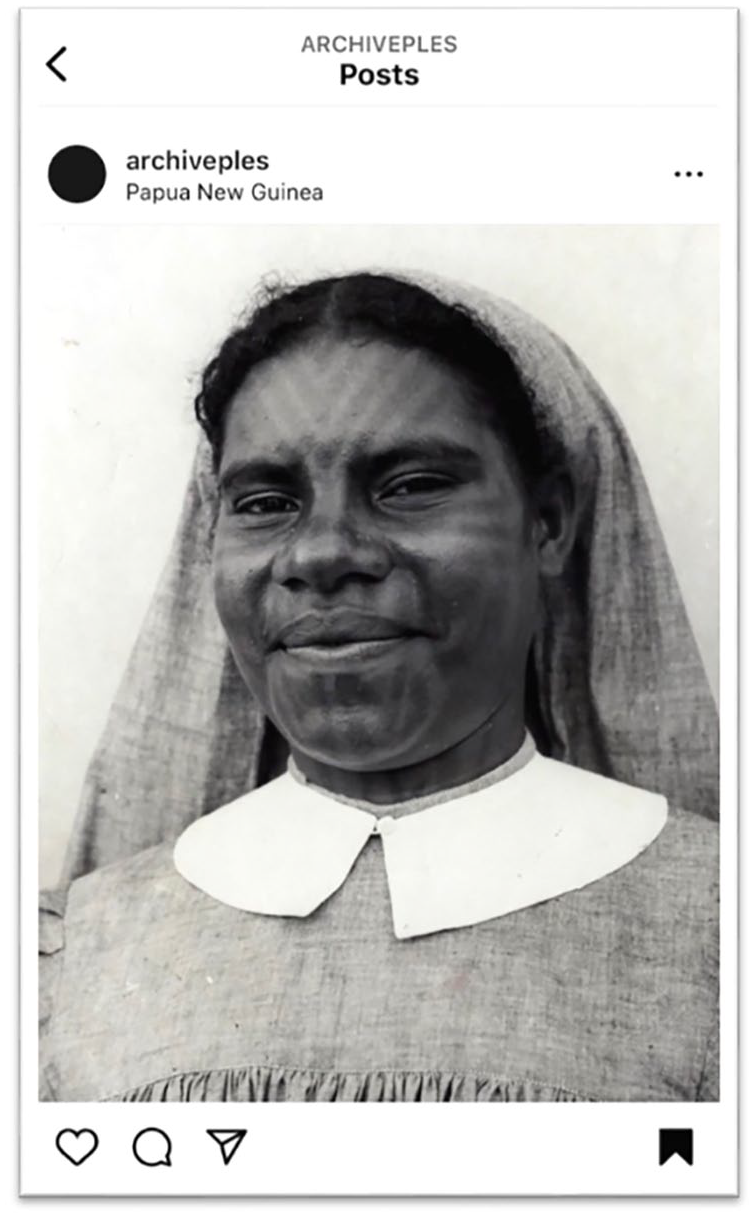
@archiveples Instagram post of Sister Anne-Marie Irere (Archive Ples, 2020b).
The theme “Significant Historical Events and People” is an articulation of Papua New Guinean identity that is expressed in posts of notable or pioneering persons such as Papua New Guinean foreign diplomats in Australian cities. Posts featuring Papua New Guineans in Australian locations in Western fashion allude to an “Indigenous cosmopolitanism” (Clifford, 2001, p. 476). They also disarticulate anachronistic representations of PNG by articulating a simultaneous mobility and rootedness to land (Clifford, 2001). The theme is also evident in posts of Papua New Guineans, termed fuzzy-wuzzy angels by foreign soldiers, using their knowledge of tropical terrain to aid Australian soldiers in winning World War II (Figure 2). This rarely seen position of power in relation to Australians contrasts with and disarticulates tropes of savagery and infantilism. Intervening in antiquated and reductive colonial narratives of PNG, @archiveples reclaims space and PNG’s narrative by harnessing the tools of social media to collectively self-represent and articulate a nuanced and diverse contemporary Papua New Guinean identity.
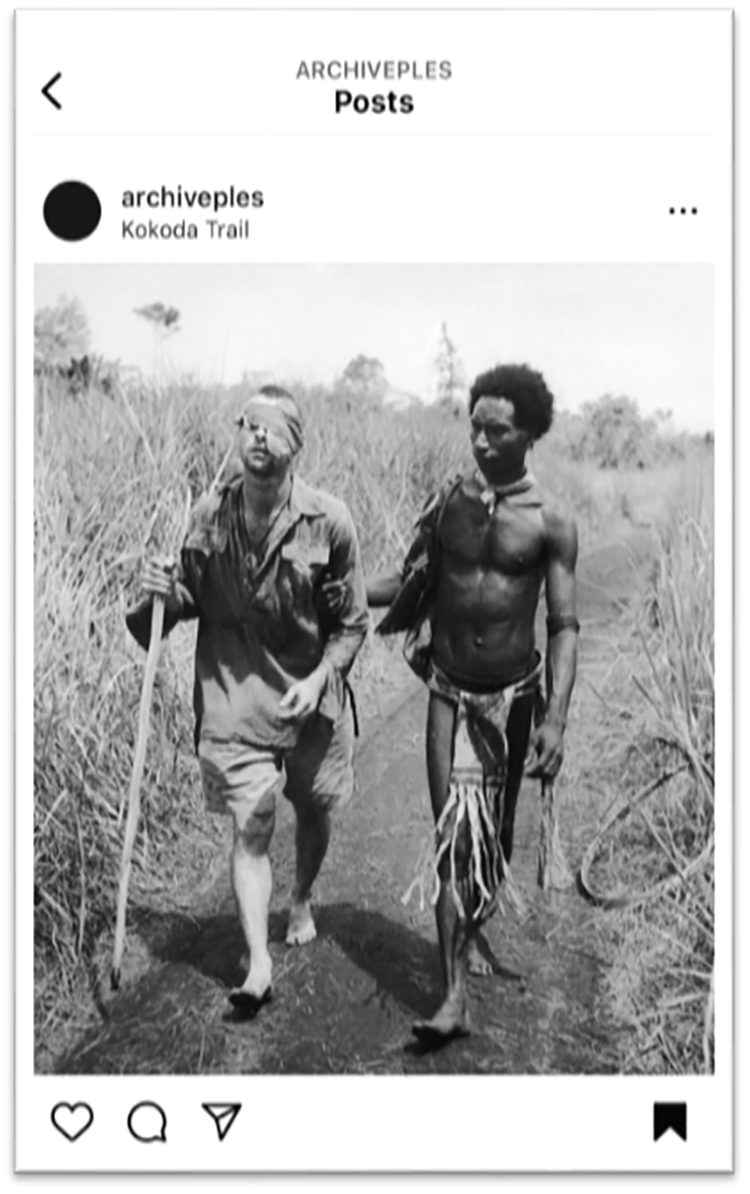
@archiveples Instagram post of World War II Archives (Archive Ples, 2020c).
Site analyses of @taniabphoto
@taniabphoto prioritises the visibility of Melanesian women with a focus on style and aesthetics. Part of an emerging contemporary feminine Papua New Guinean identity (Spark, 2014), @taniabphoto presents a female gendered lens of Papua New Guinean identity. The following themes articulating Papua New Guinean identity emerged from @taniabphoto’s posts.
As Western and Papua New Guinean style converge, a theme of “Contemporary Modern Papua New Guinean Style” is articulated in @taniabphoto’s featured aesthetic stylings. These include Papua New Guinean clothing designs and cultural stylings such as handwoven bags. @taniabphoto expresses and injects the contemporary and modern Papua New Guinean feminine aesthetic into the social mediascape through a visual digital tok stori with her virtual community of followers and potentially their networks. Similar to @archiveples, this contemporary style parallels the postmodern image of PNG. @taniabphoto disarticulates reductive and demeaning colonialist and conservative nationalist discourse and tropes of Papua New Guinean women as savage beasts of burden and jezebels (Zimmer-Tamakoshi, 1993), by showcasing nuanced images of Papua New Guinean women as professional, modern, and connected to cultural elements. Basiou (2016) states, “through my lens, our sense of cultural identity and rich tradition would meld with modern influences” (para. 29).
Figure 3 features author Rashmii Bell in Papua New Guinean designs standing face forward looking directly at eye level into the camera. Through aesthetic framing, gaze, and camera position, Basiou communicates a simultaneously gentle and strong feminine power. Bell gazing directly back contrasts with anachronistic images of Indigenous people taken by and for an outsider’s gaze.
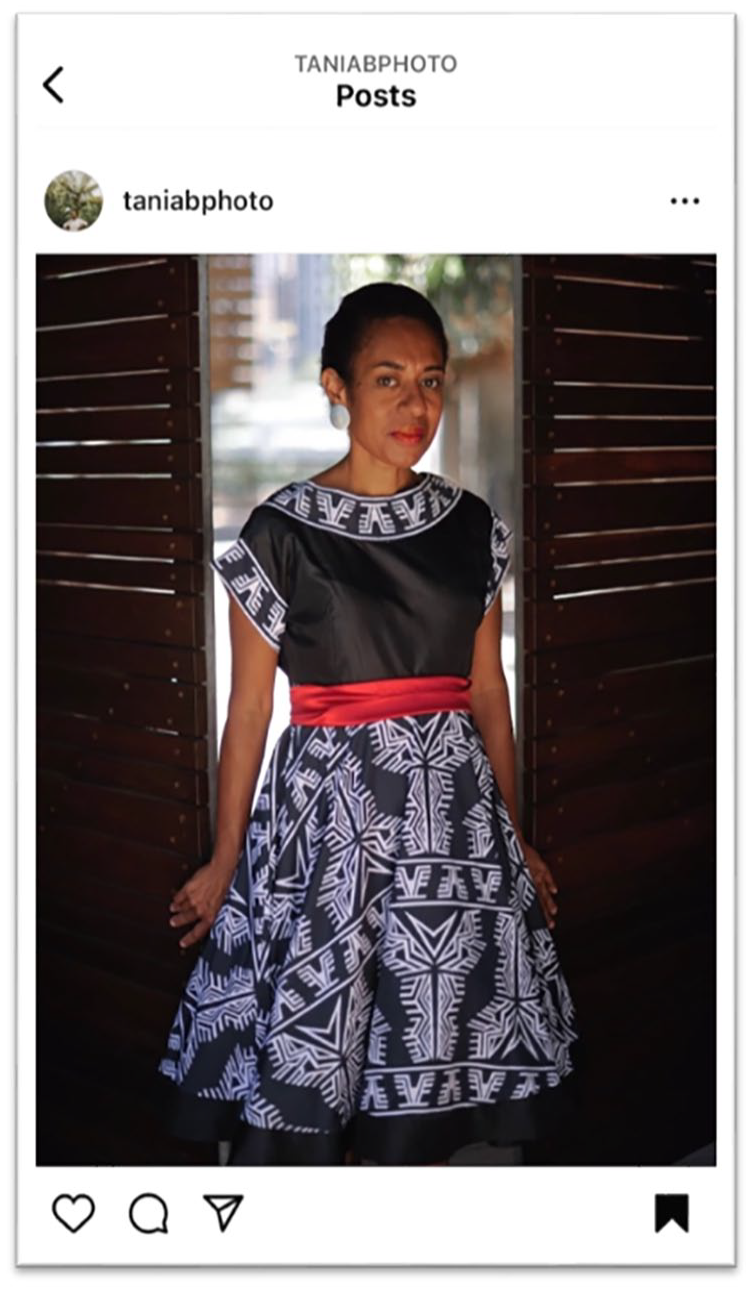
@taniabphoto Instagram post of Rashmii Bell (Taniabphoto, 2018a).
Similar to @archiveples’ articulations of Papua New Guinean identity as tied to significant Papua New Guineans and their achievements, @taniabphoto articulates a “Creative Professional” Papua New Guinean identity through posts and hashtags highlighting the works of Papua New Guinean writers, fashion designers, and her own photography. Figure 3 is accompanied by hashtags #womenwriters and #indigenouswriters. Posts of “Creative Professionals” disarticulate tropes of Papua New Guinean women as victims, as well as the hopeless dependency myths and paternalism that has shrouded PNG’s representation (Stella, 2007).
@taniabphoto’s images are imbued with significance when viewed against the legacies of patriarchal colonialism in the Pacific (Hall, 2009; Korare, 2002), and the misogyny and violence of conservative nationalist discourses (Zimmer-Tamakoshi, 1993). Teresia Teaiwa’s (2017) metaphor of the “articulated limb” (p. 5) represents the pain that can accompany disarticulating identities comprised of foreign parts. Disarticulating limiting notions of gendered identity and rearticulating different ones can be potentially dangerous, traumatic, and alienating (Spark, 2014), which is evident in Basiou’s (2016) description of navigating misogyny daily: “I was conscious of it in the way I picked an outfit for the day that didn’t show my femininity, so avoiding being the target of lewd remarks and sexual assault” (para. 15). Contrasting with potentially dangerous physical public spaces, Basiou (2016, para. 31) creates a safer space for feminist discourse, a feminine “freedom of self-expression” uplifting Papua New Guinean women and an emerging narrative of urban, educated, and employed Papua New Guinean women “as the most convincing symbols of change” (Spark, 2020, p. 1).
The theme “Setting” was also identified as @taniabphoto presents a variety of both urban and natural or rural settings similar to @archiveples. This presentation illustrates the variety of places in which Papua New Guineans exist and identify with, be that in village settings, urban areas, or international places. @taniabphoto occasionally geotags the Australian or Papua New Guinean locations of her photos, thereby demonstrating the transnational aspect of Papua New Guinean identity. The transnationality articulates an “Indigenous cosmopolitanism” (Clifford, 2000, p. 476). This dismantles and disarticulates essentialising anachronistic ideas of Papua New Guineans as being part of nature, stemming from imperialist discourses of savagery. This disarticulation is also apparent in the positioning of Papua New Guineans in modern contemporary stylings in contrasting natural or rural settings (Figure 4).
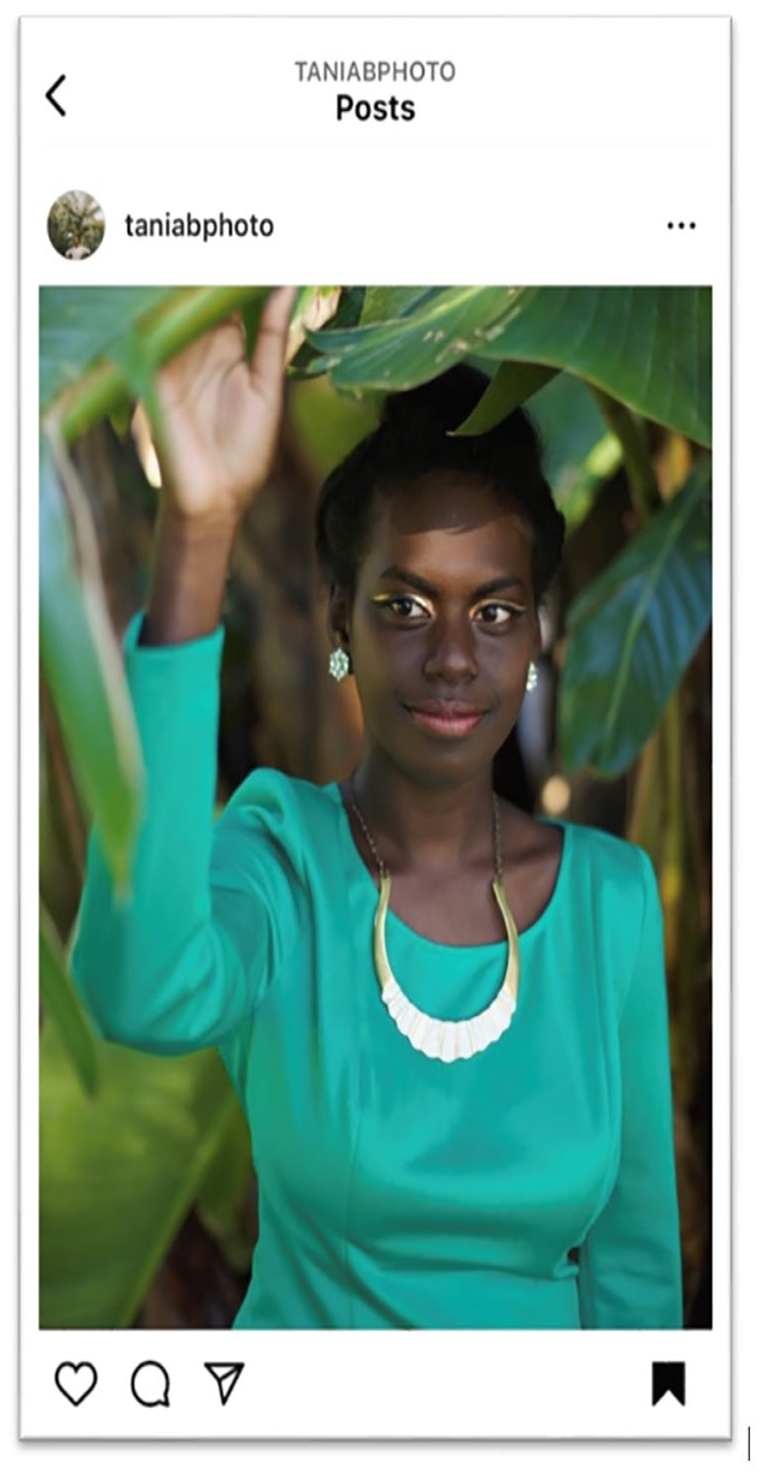
@taniabphoto Instagram post in natural setting (Taniabphoto, 2018b).
Articulating identity through hashtags
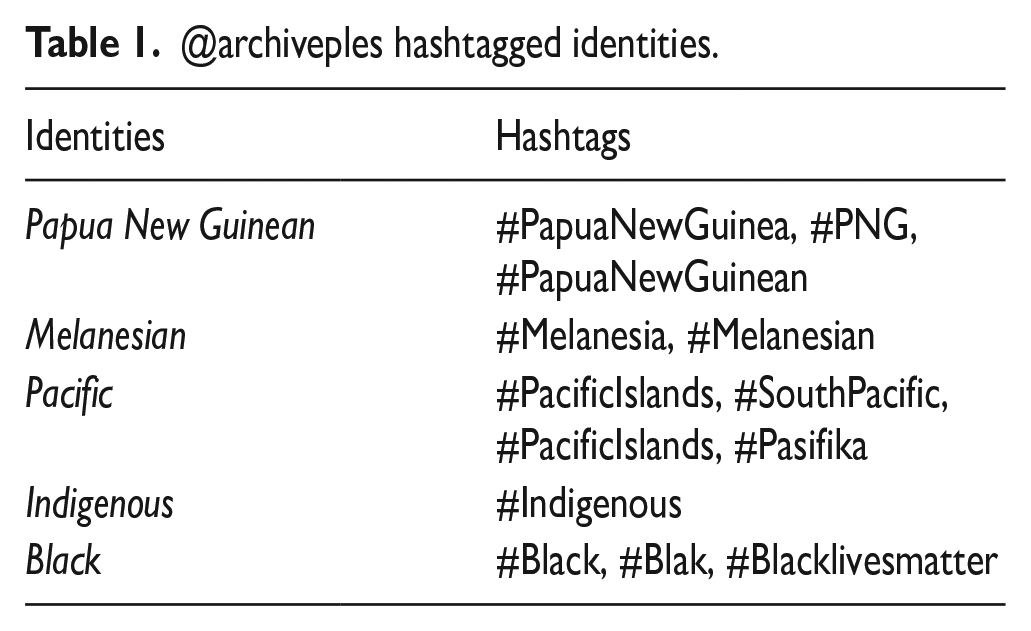
Hashtags are keywords prefixed with the hash symbol #, which are used as a tool to increase visibility, archive, categorise, and anchor posts in the vastness of the decentralised Internet, and connect communities associated with the hashtag. In my analysis of the researched accounts, hashtags carry the voice and perspective of the account administrators, and reflect articulated identities (Tables 1 and 2).
@archiveples hashtagged identities.
@taniabphoto hashtagged identities.
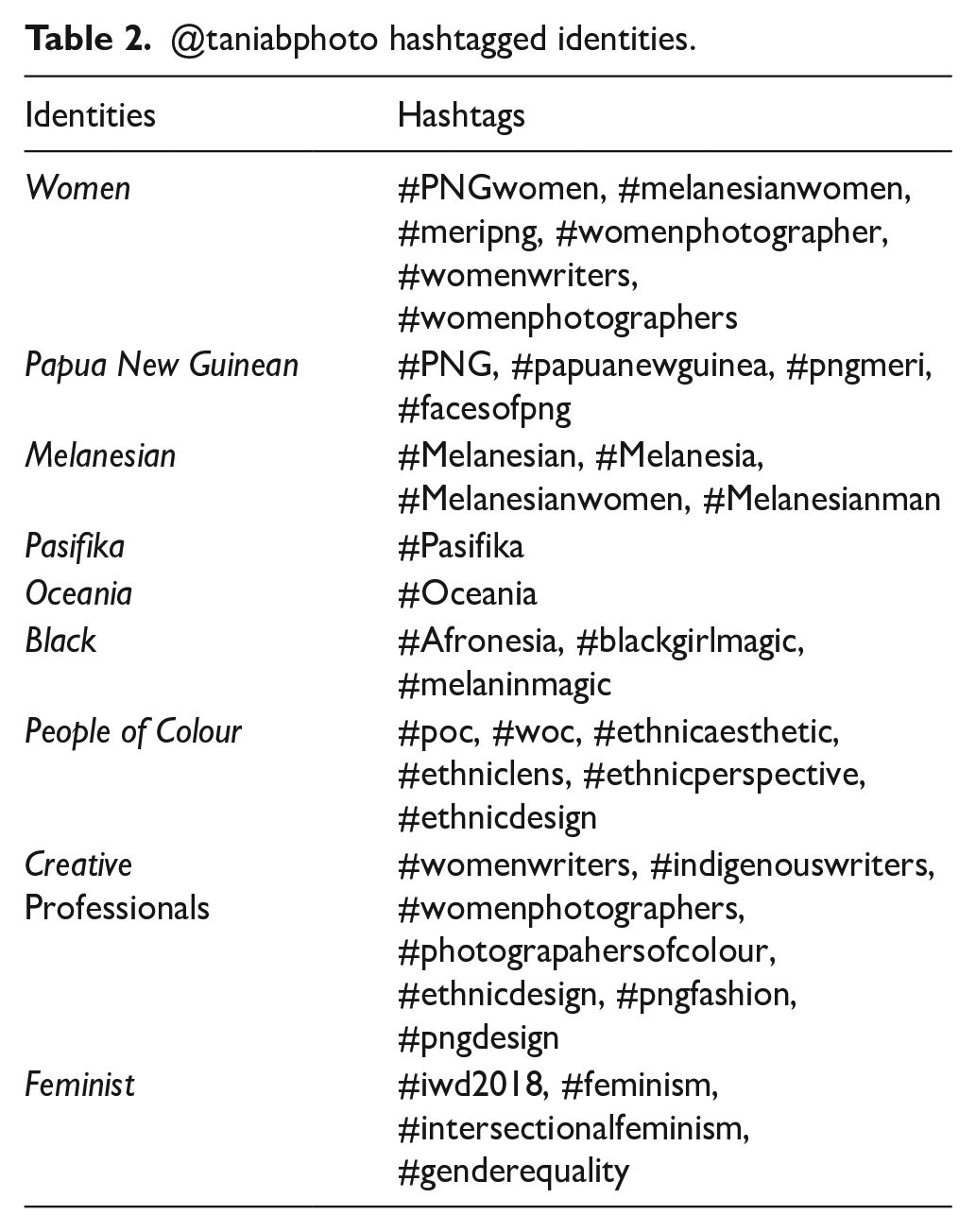
The hashtag #PapuaNewGuinea articulates national identity and indicates that the post content, including other hashtagged identities, are articulated aspects of Papua New Guinean identity. A variety of hashtags expressed represent an inclusive and expansive vision of imagined national, Melanesian, and Pacific community. These identities privilege “‘unity’ over differences” and celebrate Pacific heritage alongside other local identifications (Spark, 2014, p. 55). For example, @taniabphoto articulates through hashtag #Oceania that PNG is part of Epeli Hau’ofa’s (1994) reimagined boundless, unifying, and expanding regional identity of Oceania. Using the term Oceania refutes representations of the Pacific as small, scattered islands. The articulation #Pacific and #Pasifika proclaims PNG as part of the Pacific and disrupts and disarticulates the Polynesian-centric image of the Pacific instilled by colonialist discourse (Jolly, 2007). These articulations of identity are most common to educated, urban, transnational, and diasporic Papua New Guineans.
Although not indicative of Papua New Guinean identity, a theme stressing a “Papua New Guinean perspective” was evident through hashtags such as #ethnicperspective. This theme speaks to the intentions of self-representation and of taking back the gaze. In line with Frain’s (2016) discussion of activist uses of hashtags as identity-based forms of resistance, these hashtags can be seen as digital tools Papua New Guineans use to navigate colonial legacies and assert their identities.
The hashtagged identity #Melanesian proudly appropriates the colonialist categorical term which disarticulates colonial ideas of hierarchy within the Pacific and articulates PNG as part of a greater regional identity. Hashtags #Black and #Indigenous, overwhelmingly historically disparaged identities, further indicate an articulation of pride in these identities. Other hashtags #feminism, #intersectionalfeminism, and #genderequality articulate a feminist Papua New Guinean identity. The feminism expressed in the combination of @taniabphoto’s posts and article respond to the patriarchal oppression that Papua New Guinean women face from the complex layering of colonial and Indigenous patriarchy (Korare, 2002). These discussed themes of articulated Papua New Guinean identity inform the digital tok stori of Papua New Guinean identity taking place in the posts.
“Carving out a space” for tok stori
Writing and literature were harnessed by Papua New Guineans to “carve out” space and insert themselves into mainstream discourse (Stella, 2007, p. 163). Homerang similarly describes @archiveples as “carving out a space in the digital realm” for “wantoks” to visually self-represent and engage with (n.d., paras. 1, 7). This is especially pertinent to urban migrated and diasporic Pacific communities’ connection to cultural identity, community, and ples (McGavin, 2016). @archiveples intentionally creates space for engaging with colonial histories and legacies, and negotiating and connecting to both ples-based identities and a collective Papua New Guinean identity (Homerang, n.d.). Reflective of decolonisation, both accounts “name and claim their spaces,” enabling “a forum to determine how they are represented and how their knowledge and information is shared” (Waitoa et al., 2015, p. 54). Within these affordances, the digital divide, social selectivity, and filtering technologies remain limitations (Kaakinen et al., 2020).
@archiveples intends on “handing authorial control back to Papua New Guineans, giving the island back its right to weave its own narrative, and to decide on its own imagery” (Homerang, n.d., para. 8). Basiou (2016, para. 24) expresses the desire to “challenge what I had seen when growing up and to create what I wanted to see.” @archiveples counteracts historical representations demonising PNG by taking community submissions and repurposing archival imagery to curate their own posts celebrating PNG. @archiveples expresses wanting “Papua New Guineans around the world to feel pride in the richness of our culture, to feel a sense of unity in our diversity, and to feel empowered” (Archive Ples, 2020a, para. 3).
Basiou (2016) is engaged in self-validation through photographs that “evoke a sense of empowerment and inclusion” (para. 26) by prioritising the diversity of Papua New Guinean women, “from the naturally woolly and curly textures on her head to her unique shade of melanin” (para. 27). Basiou’s representation of Melanesian women challenges racist colonial hierarchy privileging the exoticised representation of Polynesian women against the depiction of Melanesian women as unattractive and victims (Jolly, 2007). @taniabphoto’s injection of an empowering feminine Papua New Guinean aesthetic into media counters limited nationalist discourses (Zimmer-Tamakoshi, 1993) and lacking mainstream media reflections, which Basiou (2016, para. 19) describes as contributing to “self-loathing” and “colourism”.
Conclusion
Reflecting a broader phenomenon in the Pacific, Papua New Guineans are harnessing the affordances of social media tools and spaces through a visual digital tok stori. The diversity of themes uncovered in both sites highlights the complex, multifaceted, and oscillating nature of contemporary Papua New Guinean identity, one rooted in culture and ples, while simultaneously routed, migratory, urban, transnational, and modern. These contemporary articulations disarticulate and subvert colonial tropes and discourses of savagery, primitivism, and infantilism channelled through mass media (Stella, 2007), while articulating Pacific identities oscillating between historical roots and contemporary post-independence politics and modernity. An emerging contemporary feminine Papua New Guinean identity is also articulated, which challenges and disarticulates misogyny and patriarchal notions of femininity. A tok stori framework validates an understanding of how structures and tools of social media supporting connection, collaboration, and sharing are appropriated and fit within Indigenous and Melanesian values of relationality, reciprocity, and storying.
This taking control of the gaze and collective reimagining through social media tools is a political, expanding, and increasingly accessible medium of representation for Pacific peoples that strive to restore humanity and reignite pride in cultural identity (Hereniko, 1999). Identities and connections are being forged in the changing modern world while referencing the past and creating new work that speaks to today’s young Pacific audiences. Digital tok stori is a digital wave of the decolonising and reimagining Pacific renaissance (Wendt, 1976). This flourishing reclamation of tools of representation to self-represent and re-construct Pacific identities and narratives heeds the calls to awaken to colonial legacies, to reimagine ourselves, and to no longer be caged in the ways we have been imagined for centuries by others (Hau’ofa, 1994). Hau’ofa’s (1994) call still travels into the digital media age, as younger generations of Pacific peoples act in digitally subversive and reimagining ways on the digital frontier of Pacific people’s world enlargement.
Footnotes
Acknowledgements
The author acknowledges Dr April Henderson for her supervision, and Samira Homerang, Lavau Nalu, and Tania Basiou for allowing this research on their work.
Author’s note
 and @digitaltokstori.
Declaration of conflicting interests
The author declared no potential conflicts of interest with respect to the research, authorship, and publication of this article.
Funding
The author received no financial support for the research, authorship, and publication of this article.
Glossary
Ples village, home, a person’s place of Indigenous origin
Tok Pisin a Creole official language of Papua New Guinea
tok stori storytelling; a Melanesian concept of storytelling; talk story
wantok a relation based on common ties to land