




Abstract
Disrupting forms of exclusion in higher education requires culturally sustaining practices. However, in some areas of higher education, the notion of culturally sustaining practice remains unexplored. The present study addresses this disparity by exploring the concept of culturally sustaining supervision in the specific case of Pasifika research students in mathematics education. In particular, this case study examines what a group of 22 Pasifika research students in mathematics education valued most about their respective supervisors. Using talanoa (respectful and free-flowing conversation and discussion) to gather data, three characteristics of supervisors that the participants valued most were identified via thematic analysis: (a) being available and accessible; (b) developing the student’s confidence; and (c) providing support beyond the thesis. The characteristics are discussed with respect to the Pacific concept of vā (relationships), which refers to the intricate relational and spatial realm in which connections among people exist and evolve.
Keywords
Introduction
Student populations in institutions of higher education are becoming more ethnically and culturally diverse (Morgan, 2013; Naepi et al., 2017). This growing diversity necessitates equitable access to quality education for all students, especially those from ethnic minority backgrounds, who have historically been underrepresented in higher education. In Aotearoa (New Zealand), one of the fastest growing ethnic minority groups is Pasifika peoples, who comprise a multiethnic group of Indigenous peoples from Pacific Island nations such as Tonga, Fiji, Samoa, Cook Islands, and Niue. While national education plans such as the Pacific education plans (Ministry of Education, 2012, 2020) and university strategic plans (Massey University, 2020; University of Auckland, 2021; University of Canterbury, 2019) have established clear commitments to developing and supporting Pasifika participation and achievement in higher education, studies show that such commitments to Pasifika are rarely fulfilled (Naepi et al., 2017, 2020; Nanai et al., 2017). Pasifika peoples have traditionally been, and continue to be, underrepresented in, and excluded from, New Zealand universities as a result of, among other things, university practices and policies that perpetuate neocolonial and Eurocentric perspectives (Carter et al., 2018; Naepi et al., 2017, 2020).
Disrupting the cycle of Pasifika underrepresentation and exclusion in higher education requires culturally responsive pedagogy and practices (Paris, 2012) that recognize and utilize Pasifika students’ cultural values and perspectives in all aspects of teaching and learning. The present study is premised on the findings of recent case studies which highlight the possibility of achieving equitable educational outcomes for Pasifika learners through culturally responsive school practices, pedagogy, and policies (Hunter et al., 2016; Reynolds, 2016; Si’ilata et al., 2018). A much smaller body of research, at the tertiary level, shows that culturally responsive and sustaining practices, which assetize Pasifika students’ cultural capital, have the potential to achieve equitable outcomes for Pasifika students (Carter et al., 2018; Nanai et al., 2017). However, one aspect within this small body of research that needs more attention is that pertaining to Pasifika postgraduate research students. Furthermore, in my field of mathematics education, studies on the experiences of Pasifika research students, or any group of ethnic minority research students for that matter, are virtually non-existent, thus indicating a gap in the literature. Yet, it is a field, like many others, that continually declares a need to become more culturally responsive in light of the growing cultural and ethnic diversity of its students. The aforementioned gap in the literature is problematic because it can be argued that graduate research programs represent and provide access to the highest of levels of learning in mathematics education.
Thus, the present case study aims to make a small contribution toward bridging this gap in the literature by exploring the concept of culturally sustaining supervision for Pasifika students. More specifically, the study examines what a cohort of 22 past and present Pasifika research students in mathematics education valued most about their respective supervisors, who according to the literature, play a critical role in the experiences of research students (Lee, 2008). Exploring these supervisor characteristics is a part of figuring out what culturally sustaining supervision practices might look like in mathematics education. Through talanoa (respectful and free-flowing conversation and discussion), three characteristics that our student cohort valued most are identified, discussed with respect to the existing literature, and analyzed with respect to the Pacific concept of vā, which refers to relationships, and more specifically, the intricate relational and spatial realm in which connections among people exist and evolve (Anae, 2010; Ka’ili, 2008; Thaman, 2008).
Positionality
Given the critical nature of the research topic, I acknowledge three particular positions that influenced how I conducted this research (Cohen et al., 2017). First, I am of Tongan and Fijian descent, and born and raised in Tonga. Although I have not lived in Tonga for over 18 years, I stay in close connection with immediate and extended families, which means that Tongan traditions and ways of being have remained an integral part of my identity. Second, I am an early career lecturer and researcher in mathematics education. A significant part of my teaching and research in mathematics education relates to Pasifika education. Over my relatively short academic experience, I have become aware of many structural inequities that exist and hinder the development of students from marginalized communities both within, and beyond, Aotearoa. Finally, I am a supervisor for doctoral and master’s students in mathematics and Pasifika education.
Background literature and theoretical underpinnings
Literature concerning Pasifika research students in mathematics education is virtually non-existent. As such, I begin this section with a brief review of the wider literature on postgraduate research supervision. Then, I review the small body of literature pertaining to Pasifika research student supervision in areas other than mathematics education. Finally, I describe the theoretical lenses of culturally sustaining pedagogy (CSP) and vā that guide the present study.
Postgraduate research supervision
While a few studies (Boaler, 2003; Nardi, 2015) have focused on postgraduate students in mathematics education, their focus was not on supervision, but rather the nature of postgraduate programs in mathematics education, more generally. Beyond mathematics education, case studies have explored the graduate student–supervisor relationship in different contexts. For instance, based on interviews with supervisors from various disciplines, Lee (2008) conceptualized doctoral supervision as consisting of five parts: functional, which relates to project management; enculturation, which involves encouraging students to become members of the disciplinary community; critical thinking, which involves encouraging students to analyze their own work; emancipation, which involves encouraging self-reflection and self-development in students; and quality relationship, which involves inspiring students and making them feel that they are cared for.
Several studies (Dysthe et al., 2006) have argued that given the extremely significant influence that supervisors have on graduate student outcomes, it would be beneficial to have multiple supervisors because the responsibility may be too much for a single person. As such, Dysthe et al. (2006) proposed an alternative three-component supervision model for a Master’s of Education degree: (a) supervision groups, consisting of two supervisors and all their research students; (b) student colloquia, consisting of the research students without their supervisors; and (c) individual supervision, consisting of the main supervisor and the student.
Exploring the issue of whether doctoral programs were adequately preparing students for various academic workplaces, Austin (2002) proposed several suggestions for addressing this issue. While the suggestions applied to aspects beyond the student–supervisor relationship, a couple of suggestions are pertinent to the present study. First, Austin (2002) suggests that students be given many opportunities to learn about the different aspects of academic work. Second, supervisors should encourage students to engage in ongoing systematic self-reflection on their values and goals in relation to future desired professions, and to develop their own competence, place, and sense of belonging within these desired professions.
From the field of professional psychology, Mori et al. (2009) found that international graduate students were more satisfied with their supervisors when they engaged in discussions about culture. The study claimed that international students valued supervisors who were able “to discuss cultural issues such as cultural difference based on their country of origin and create a positive environment for dialogue” (Mori et al., 2009, p. 15). Mori et al.’s (2009) findings align with those of other studies regarding the importance of supervisors’ cultural sensitivity and responsiveness (Inman, 2006; Nilsson & Dodds, 2006).
Pasifika research students and their supervisors
The small body of literature pertaining to the relationships between Pasifika research students and their supervisors highlights the need for supervision practices that respect and build on students’ cultural values and perspectives. For instance, a large study by Carter et al. (2018) explored supervisors’ (n = 226) and doctoral students’ (n = 80) perceptions about aspects of the doctoral experience. This study discussed how drawing on Indigenous perspectives can enhance research supervision practices of Pasifika students. In particular, the study found that supervisor–student relationships benefit from an understanding of vā, which was viewed as the interconnectedness of people, time, and space. The study further suggested that supervisors should draw on “students’ heritages, looking for culturally-appropriate pedagogies and protocols, as these would inspire the heart of human relationship-building” (Carter et al., 2018, p. 284).
Possibilities for enhancing the academic achievement of Tongan students at university were examined in a study by Kalavite (2010). Some of the participants were currently enrolled or had completed a research degree. Participants shared their views on the perceived socio-cultural aspects influencing their academic achievement. Reflecting on their experiences, the participants expressed how academic success can be achieved when all parties involved had a mutual understanding and respect for and within New Zealand and Tongan academic cultures. Hence, for the student–supervisor relationship, Kalavite (2010) suggests establishing a relationship that is flexible and allows students to move fluidly between the two cultures, in this case, Tongan and European. This involves supervisors being understanding, showing interest in students’ well-being, and helping students navigate academia. Above all, Kalavite (2010) posits that supervisors must understand the centrality of vā in their students’ lives.
Exploring the challenges faced by an Indigenous researcher in academia, Fa’avae (2019) discussed efforts to validate traditional cultural knowledge and practice amidst the “unresolved and competing demands between . . . disciplinary knowledge bases and Indigenous knowledge” (p. 14). Reflecting on his experience as a doctoral student of Tongan descent, Fa’avae (2019) highlighted: (a) the importance of tauhi vā (sustaining and nurturing the relationship) between himself and his supervisors and (b) the benefits of having supervisors that were experts in the Tongan language and culture. Fa’avae’s (2019) argument aligns with that of Carter et al. (2018), which acknowledges the importance of supervisors being appreciative of the wealth of Pasifika scholarship and advocating for perspectives that might resonate with their students’ worldviews and ways of being.
Culturally sustaining pedagogy and tauhi vā
The notion of culturally sustaining supervision explored in the present study draws inspiration from CSP, which according to Paris (2012) seeks “to sustain linguistic, literate, and cultural pluralism as part of the democratic project of schooling” (p. 93). Reynolds (2019) asserts, [CSP] involves challenges to historically justified practices of narrow cultural origins through alternative actions which take account of the histories and experiences of students. Accurate knowledge of students, the replacement of deficit perspectives, the valuing of culture and difference as essential aspects of humanity, and the forging of contextual pedagogical connections with students. (p. 24)
Note, some of the suggestions provided by the studies briefly reviewed in the previous two subsections emphasize the importance of cultural responsiveness and sensitivity in research supervision. Such suggestions align with the conceptions of CSP promoted above by Paris (2012) and Reynolds (2019). Building on the aforementioned suggestions and their links to CSP, the goal of the present study is to shed some light on what culturally sustaining supervision practices might look like for Pasifika research students in mathematics education. With this goal in mind, I searched the literature for a lens through which I could effectively examine supervision practices in relation to Pasifika students. This search led me to the concept of tauhi vā, which can be understood as sustaining and nurturing relationships (Ka’ili, 2008).
As alluded to in the previous section, researchers have argued that understanding the significance of vā is essential for understanding issues related to Pasifika peoples (Anae, 2010; Ka’ili, 2008; Thaman, 2008). The concept stems from the notion that Pasifika cultures are communal: resources are shared, and nurturing relationships is important as a matter of sustaining cultural identity. The foremost goal of tauhi vā is not to accumulate individual gains but rather to sustain reciprocal connections among people. While the term vā is often translated as relationship, this translation has been deemed problematic by some. For instance, Poltorak (2007) claims that equating vā with relationship incorrectly positions vā as something independent of context, reflecting a “latent ideology of the nature and representation of relationship” (p. 12). Furthermore, Giles et al. (2012, as cited in Reynolds, 2016) suggested that student–teacher relationships can be conceived in terms of a continuum. On one end, lies an interpersonal space concerning matters relating to things that happen strictly between the teacher and the student. Giles et al. (2012, as cited in Reynolds, 2016) argues that the relationship is objectified to a point where efficiency and achievement are considered paramount. In this space, the tangible is all that matters, thus overlooking “the underlying relational conditions for achievement which are less tangible, and more difficult to quantify in terms of efficiency” (Reynolds, 2016, p. 193). On the other end of the continuum, lies a more holistic relationship that extends beyond the student–teacher dyad and includes the wider community. It is this latter form of relationship that is more closely related to vā, and consequently more relevant in reference to Pasifika peoples. Under this conceptualization of relationships, Giles et al. (2012, as cited in Reynolds, 2016) suggest that it is not the “functionality of the [relational] space but an inherent quality of connectedness, based on common humanity, which comes to the fore” (p. 196).
Methodology
The data for the present study were collected as part of a research project exploring the experiences of Pasifika research students in mathematics education. The project had two main goals with separate data collection phases: (a) to identify the characteristics of their supervisors that the participants valued most and (b) to identify barriers that the participants experienced during their time as research students. Owing to limitations of space, I report only on the work pertaining to the first goal of the project. In the ensuing subsections, I begin by describing the talanoa methodology (Vaioleti, 2006) and how it was used in this study. Then, I give an overview of the research participants, before describing the data analysis procedures.
Talanoa methodology and data collection procedures
Talanoa translates to ordinary conversation: “Tala means to inform, tell, relate, and command, as well as to ask or apply. Noa means of any kind, ordinary, nothing in particular” (Vaioleti, 2006, p. 23). Talanoa was purposefully chosen to guide the data collection for the present study because as Vaioleti explained, this sort of ordinary conversation is more appropriate than western methodologies for conducting research with Pasifika participants as it affords the opportunity for “people [to] story their issues, their realities, and aspirations. It allows for more mo’oni (pure, real, authentic) information to be available for Pacific research than data derived from other research methods” (Vaioleti, 2006, p. 1).
Data were collected in two stages. First, a questionnaire (Figure 1) was emailed to the participants (n = 22). Giving the questionnaire to the participants prior to the talanoa allowed the participants to familiarize themselves with the questions and have sufficient time to think about their responses. Then, a 60-min one-on-one talanoa session was conducted in-person with each participant (n = 19) who was willing to participate in a talanoa. The questionnaire was written in English only, rather than in each participant’s native language, because English was the only common language that each participant and I could both communicate in fluently. The talanoa sessions were also carried out in English for the same reason. Prior to each talanoa session, I sent an email to the participant introducing myself, the study, and my expectations of the talanoa. In this email, I positioned the talanoa as a sharing of stories about particular experiences, rather than as a question-and-answer session. Moreover, I highlighted my own lived experience as a Pasifika research student in mathematics education to further establish connections between myself and the participant, and to emphasize that the participants would be sharing their stories with someone who could relate to some, if not all, their experiences. Participants were invited to ask any clarification questions they had and were informed that they did not have to share anything that they were not comfortable sharing.
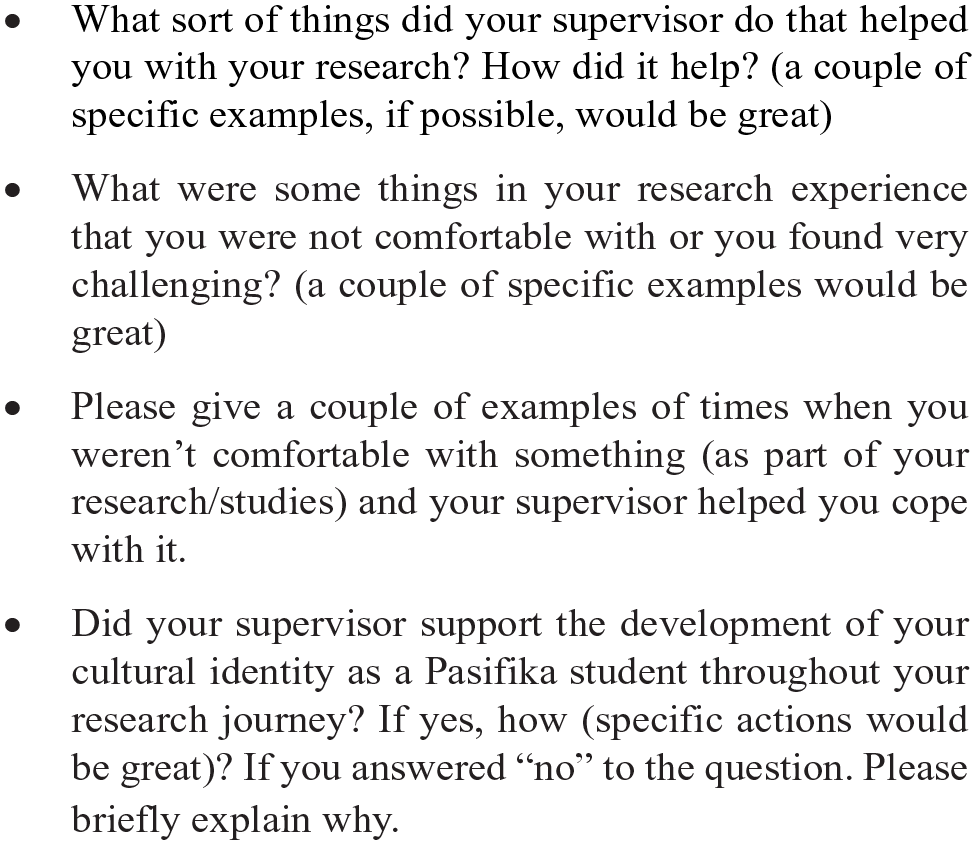
Main questions for the talanoa sessions.
Each talanoa session took place at a location of the participant’s choosing, in which they were comfortable but still upholding confidentiality requirements. Each talanoa session was audio-recorded. In these sessions, the participants elaborated on their responses given in the questionnaire and shared further experiences, allowing for the researcher to ask follow-up questions that elicited more insight into their experiences. Among other follow-up questions, the researcher asked the participants to discuss at least three characteristics that they valued most about their supervisors during their research experience.
Participants
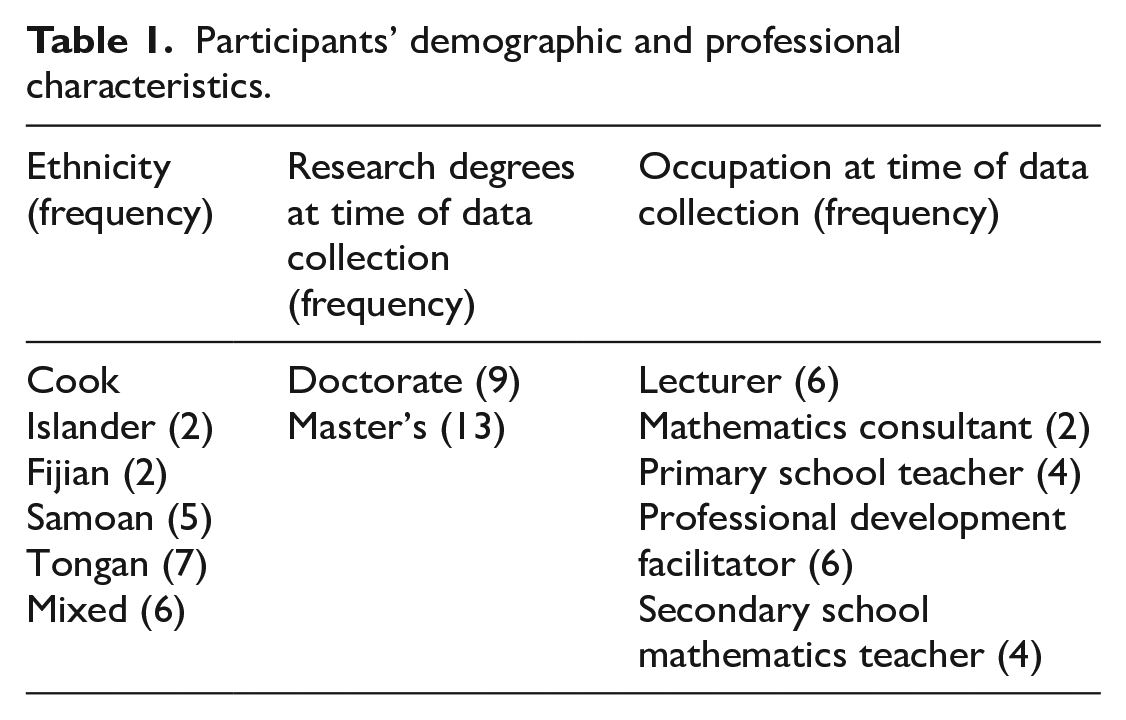
All participants (n = 22) were recruited through purposive snowball sampling (Cohen et al., 2017). I contacted colleagues, faculty, staff, and students associated with mathematics departments in schools and universities across New Zealand, and through them made connections to other prospective participants from overseas. Two criteria were required of participants: they had to be of Pasifika descent and either completed, or were currently enrolled, in a postgraduate research degree in mathematics education. A summary of the participants’ demographic and professional characteristics is presented in Table 1.
Participants’ demographic and professional characteristics.
Data analysis
The overarching approach used to analyze the data was thematic analysis (Cohen et al., 2017). The first of stage of the analysis took place during the talanoa sessions, in which I took written notes of points at which the participants spoke about their respective supervisors and the characteristics they valued. During the talanoa, I also made notes of things that I recalled hearing in previous interviews; and through this, I began identifying common themes across the different talanoa sessions. After all the talanoa sessions were complete, I listened to the recordings and used the notes to sensitize myself to the nuances of each specific talanoa. The field notes helped with reimmersing myself in the talanoa. This was important because after 19 talanoa sessions, it was difficult to remember particular differences between what each person had said, and the contexts surrounding those differences. Specifically, these notes helped realign myself with the minutiae of that specific talanoa. More generally, these notes supported me with my attempt to link the talanoa sessions together in terms of understanding the participants’ collective perspective about their supervisors and their research experiences.
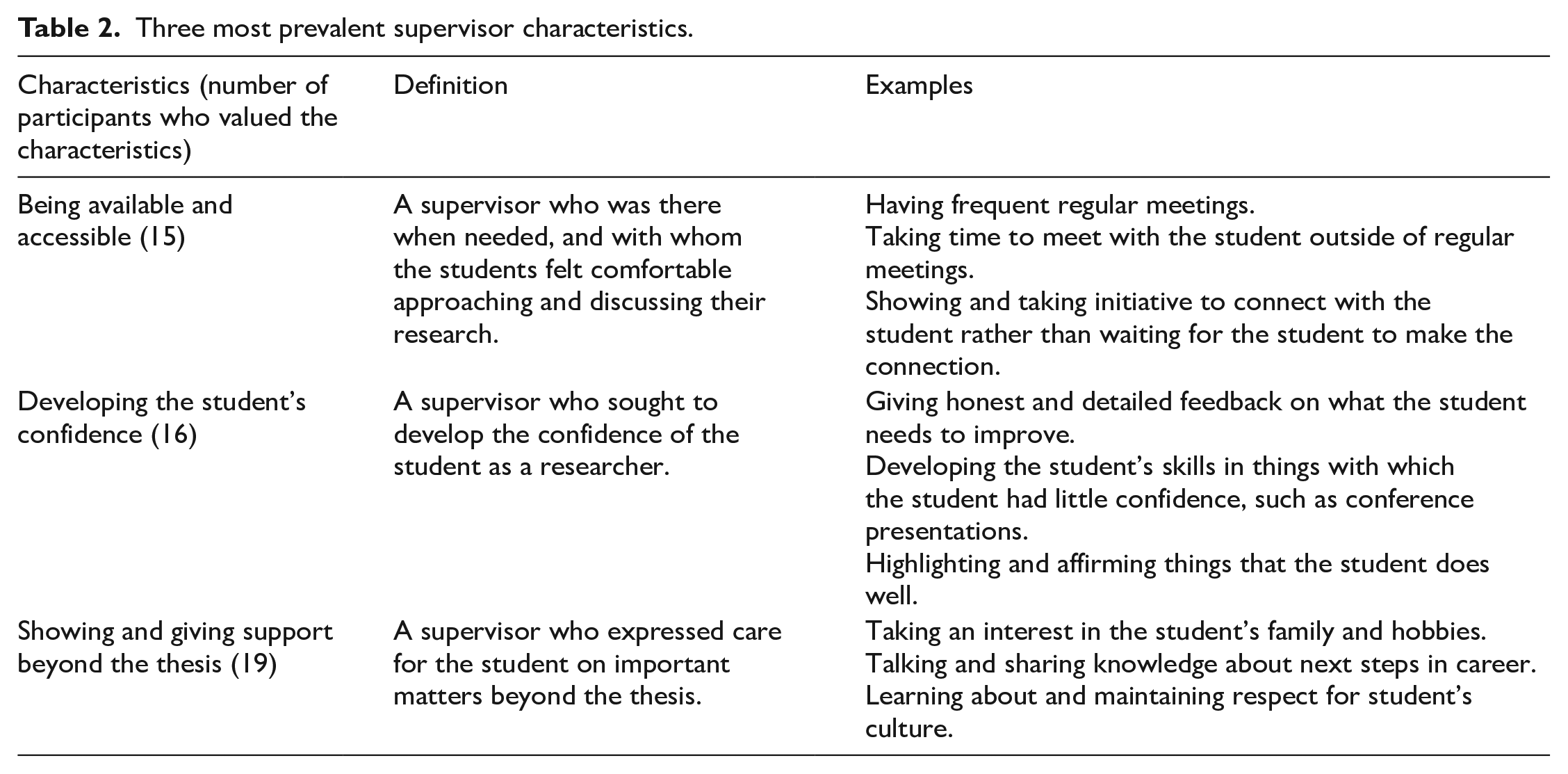
Once the talanoa sessions were transcribed they were uploaded to NVivo. This stage of the analysis took place with the help of three research assistants. The four of us individually read each transcript multiple times, together with the notes I had taken in each session. While reading, we also independently recorded a list of recurring themes that we identified during the sessions. We then met several times to discuss the common themes that we had noticed. These discussions resulted in the generation of our initial set of codes to sort and organize the data on NVivo. This code-generation process occurred in both an inductive manner and a deductive manner—codes were developed from the interview data and research literature (Cohen et al., 2017). Furthermore, the data were coded independently by all four of us and then crosschecked. Throughout the coding process, the research team met frequently to discuss progress and, for instances where there were contradictions or inconsistencies between coders, a discussion was undertaken to reach a consensus. After completing the coding, the final stage of the analysis involved identifying and explicating the most prevalent supervisor characteristics that the participants talked about during the talanoa sessions. Table 2 contains the three most prevalent supervisor characteristics, corresponding to the characteristics mentioned by at least 75% of the 19 participants.
Three most prevalent supervisor characteristics.
Findings and discussion
In this section, I present the three supervisor characteristics that the students valued most, evidenced by selected excerpts from the talanoa sessions. I also discuss these three characteristics with respect to the concept of vā and the wider literature.
Being available and accessible
Fifteen participants expressed their appreciation for supervisor availability. Some responses were They were always available and accessible. I could stop by their office anytime I wanted to talk about my research, and when I was stuck. (Mele, 35) She was pretty much there and ready to talk to me about research when I had questions about things I was stuck on . . . and I had lots and lots of questions because I was stuck a lot! (Sio, 46)
The importance of supervisor availability has been acknowledged in past research (Carter et al., 2018; Lee, 2008). In the responses above, one notices how availability is linked to the idea of being stuck. Being stuck while doing research is a common phenomenon, so having a supervisor who is available goes a long way in helping students cope with the state of being stuck (Dysthe et al., 2006; Lovitts, 2007). Note that both the responses above may give one the impression of students expecting their supervisors to be available literally anytime. However, as a co-participant in the talanoa, and from my knowledge of the participants and their expectations, I did not get this impression. Instead, I interpret being available anytime as the supervisor’s willingness to find some time, not always immediately, to meet with the student to discuss the student’s questions.
In addition, supervisor accessibility is critical. Accessibility differs from availability because while supervisors may be available in that they are free to talk to students, they may not be accessible to students, in the sense that students feel comfortable talking to them. This element of accessibility is evident in the following responses: I felt I was in a safe space whenever I was talking with her about my lack of understanding. She didn’t look down on me, she didn’t patronize me. There was little power dynamic there, like “do this because I know more than you.” She made it clear that we both had had a lot of knowledge to share with each other. (Mana, 35) Because I had built up a professional relationship with one of my supervisors it helps [as written in original transcript] me feel more comfortable to ask questions when I was unsure. And there were many times that I was [unsure]. I had a lecturer who was running [an] online course [at the same time] and I found it very hard to connect with [her] online and did not feel like she understood my concerns. (Nat, 41)
These responses suggest that accessibility is important because it gives students confidence to talk to their supervisors about things that they did not understand in their research. Such confidence cannot be overstated, because it is often not easy for students to admit that they do not understand something, especially at the research level where there is an expectation to know everything (Woolston, 2019).
Supervisor accessibility is also essential for tauhi vā between student and supervisor. Tauhi vā requires a great degree of openness and accessibility among people (Kalavite, 2010). However, it is not unusual for Pasifika students to be reticent in the educational settings (Hunter et al., 2016) and thus may hesitate to open up fully to their supervisors. One way in which to help students move past this reticence is for supervisors to express a sense of openness, so that the students might begin to perceive the learning environment as one in which they can be open—“a safe space” (Mana, 35). Carter et al. (2018, p. 54) claim that while “many supervisors understand that relationship-building is key to working successfully with students [they] may not understand that they can build effective relationships with Pasifika students by reframing their usual practice as maintaining and nurturing va.” They also argue that values such as compassion, humility, reciprocity, and respect are key to nurturing the student–supervisor vā. Furthermore, Kalavite (2010) suggests that accessibility can come in the form of supervisors expressing an openness and willingness toward being challenged by students.
Some participants also spoke of how their supervisors encouraged them to embrace their cultural backgrounds, thus further enhancing their supervisors’ accessibility: He encouraged me to draw on my culture when I was doing research . . . and I never felt that I had to be a Pākehā [a New Zealander of European descent] around him, which is something that I felt a lot of whenever I was in school. I felt I could completely be myself around him, and he made me feel okay about that. (Bill, 36) She always tried to make sure that she wasn’t doing anything that was against my culture. She was eager to learn. She asked me to explain to her many things about my culture. The other things [as written in original transcript] is she encouraged me to use Pasifika perspectives and methodologies for my research, which was inspiring because, I mean you hardly see that in maths ed! The participants of my study were mostly Pasifika students. . . . She said that I was the expert, and that I knew more about the students than she did. (Vosa, 45)
These responses align with Thaman (2008), who claimed that encouraging students to embrace their cultural values in education “results in mutually beneficial collaboration between Indigenous and non-Indigenous peoples, and improves their treatment of each other as equals” (as cited in Fonua, 2018, p. 11). This is particularly relevant in the context of this study since the majority of Pasifika students’ supervisors are non-Pasifika.
Developing the student’s confidence
Sixteen participants spoke about the importance of having a supervisor who helped them develop their confidence as researchers, as evident in the responses below: Presenting to academics and maths teachers at seminars and conferences always makes me uncomfortable. My supervisors would make me do a practice run with them or at a small local seminar. Sometimes in my presentations, I sometimes think that what I present is boring and not useful. My supervisors always reminds [as written in original transcript] me how so many people in the audience have never heard of my research and what I present is important. So my supervisors helped with growing my confidence in . . . I’ve become more comfortable presenting my research. (Ema, 37) For my Master’s, my supervisor helped me cope with not feeling like I had a voice to tell my stories and experiences. He helped me overcome this by constant reassurance, pointing out a different point of view in situations and praising me for things that he appreciated. (Mira, 41)
The confidence referred to in the responses above helped students with alleviating issues pertaining to the unfamiliarity of the research journey (Lee, 2008). Confidence in doing something is closely associated with familiarity and past success in doing that thing. Thus, unfamiliar territories, such as the research journey for many students tend to undermine their confidence (Dysthe et al., 2006; Lee, 2008; Medley-Rath & Morgan, 2022). For many of the students in our study, as evident in the responses above, confidence was achieved in terms of being able to talk about their work—more generally, having a voice—within different aspects of the research space. For Pasifika learners, the significance of having a voice in academic spaces cannot be underestimated. Two points from the literature can shed further light on why having a voice is paramount to Pasifika success in education, and why it is important for educators to support the development of Pasifika student voice.
First, across Pasifika cultures the right to speak in certain spaces is reserved for people with a certain status such as elders, authority figures, and so forth. As a sign of respect, people who do not have this status remain silent unless they are asked to speak (Hang, 2011). In academic spaces, Pasifika students tend to assume the role of people who do not have the authority to speak and think that their job is to listen and not talk (Hunter et al., 2016). From the perspective of tauhi vā, Pasifika reticence in academic spaces can be understood as an expression of respect. As Thaman (2008) explains, Implied in the notion of nurturing vaa [relationships] is knowledge and understanding of the relationships among people or groups that are involved as well as mutual respect and responsibilities for keeping vaa intact. It follows therefore that the value of vaa lelei [good relationships] underlies the complex and often unwritten codes of conduct and appropriate behaviour. (p. 465)
Second, Pasifika peoples have historically had to deal with various forms of exclusion (Naepi et al., 2017, 2020) resulting in, among other things, a limited sense of belonging in spaces of higher education, which in turn results in not having a voice. The challenge lies in acknowledging that Pasifika students have the authority to speak. Research shows that Pasifika students can thrive in academic spaces and will talk more if they realize that they have the authority to speak, especially when that realization is encouraged by those whom students perceive as people with the authority to speak (Hunter et al., 2016). Encouraging the development of the student’s confidence to tell their stories, and to share their work in the academic space can be perceived as an attempt to empower Pasifika students and to bring forth their usually excluded voices.
The majority of participants who valued their supervisors’ acts of confidence building also spoke about how their supervisors’ high expectations and critical feedback were particularly crucial in their development as confident researchers: My supervisor pushed me out of my comfort zone. It made me nervous sometimes but it was good I reckon because I was able to perform at a high level, I think [laughs]. He raised his expectations, which helped me perform at a high level, and that made me more and more confident in myself. Sometimes those expectations were hard to live up to, but in the long run it made me have high expectations for myself. (Koni, 40) I think his critique was always something hard for me most times but I think I have become better at being critical in certain areas of teaching and education because of the approach he had with me. I have had a few opportunities lately where I have been invited to panel meetings, critical discussions, and leadership meetings where I have combined the learning of his critical approach coupled with my personality to deliver opinions and presentations in a way that is informative and thought provoking. (Kesa, 42)
Koni’s response above aligns with an abundance of research that emphasizes the importance of having high expectations for Pasifika students (Carter et al., 2018; Nanai et al., 2017). By having high expectations of their students, supervisors convey the message to the students that they believe in their ability to produce excellent work. Kesa’s response points to how critical feedback can be beneficial for students’ development, specifically in terms of developing their own critical thinking and voice. Critical feedback reflects high expectations (Lee, 2008). However, it is important to note that while high expectations and critical feedback may be important in supervision, it is equally important that such expectations and feedback are expressed in ways that do not damage the vā between the supervisor and the student. Mila-Schaaf and Hudson (2009) explain, As a matter of preference, connections are made and conflict minimised out of concern for the relationship and a desire for harmony and symmetry within the engagement. This may not be straightforward or an easy course of action. Interactions produce untidiness which needs to be acknowledged and dealt with positively. Keeping the vā in a good state requires constant attention. (p. 17)
As such, supervisors’ expectations and critical feedback must be promoted in a respectful and culturally appropriate manner. Furthermore, it may be worth considering in future research the role of accessibility in relation to how Pasifika students respond to critical feedback. For instance, would Pasifika students be more accepting of critical feedback from supervisors they deem accessible?
Providing support beyond the thesis
Out of all the supervisor characteristics valued by the participants, the one that they seemed to regard as most valuable was the support they received from their supervisors beyond work immediately related to completing their thesis. This characteristic is twofold. First, as evident in the two excerpts below, the participants appreciated supervisors giving them advice for their current or prospective careers: He always pushed me to relate it to my maths teaching . . . maths classes. . . . Because my thing is teaching maths, not researching in maths education. . . . So when he got me to reflect about my class and my teaching, that made me feel like my research was really informing my future teaching practice. (Pita, 56) During my PhD I was really fortunate to have opportunities to publish with my supervisors and other colleagues. I think this was quite handy because I got valuable experience going through this process and steps for getting research published. You know? Getting back reviews, feeling really meh about the reviews [laughs], but then you are learning how to respond to the reviews as well. It was very very useful, because now . . . as a researcher now, I am really confident about publishing. (Rena, 37)
The responses above reflect a shared understanding that writing the thesis is only a small part of students’ educational and professional development. It is important to note that the participants had different career trajectories and aspirations, which were not all research focused. Past studies have sought to raise awareness among supervisors that not all students enrolled in a research degree aspire to pursue an academic research career. Furthermore, these studies show discrepancies between the preparation of graduate students and the realities of both academic work and the wider labor market (Austin, 2002). These studies highlight a need for supervisors, and research programs more generally, to provide opportunities for students to develop skills and knowledge relevant for their career aspirations, academic or otherwise.
The second dimension of this characteristic is the willingness of supervisors to support students with non-work and non-academic related matters: My supervisor was always willing to talk to me about things in my life like my kids and my family. It made me feel like they knew there was way more to my life than just the thesis. So, I didn’t feel like I had to suppress those things and just focus on my studies. You know, everything is connected whether you like it or not, things outside of work and your studies is [as written in original transcript] going to impact your work and studies. Talking about them with my supervisor helped me a lot. (Tui, 38) I have lots of responsibilities outside of my academics . . . social, cultural duties . . . obligations. My supervisor supported me by making sure that I wasn’t sacrificing any of those responsibilities to just focus on the thesis. I mean, yes, you have to make some sacrifices here and there but there are some really important responsibilities with my family, and like church, that if I had to choose, I could not give up even [if] it means withdrawing from my studies. But fortunately, my supervisor was always . . . he always tried hard to make sure that I didn’t have to choose between these important things. He made sure that I was able to find balance. (Motu, 52)
The aspect of supervision alluded to in the responses above is critical (Carter et al., 2018; Mori et al., 2009; Nilsson & Dodds, 2006), and its importance cannot be overstated from a Pasifika perspective. In terms of tauhi vā, this characteristic can be perceived as part of an attempt to establish a more holistic student–supervisor relationship revolving not merely around the thesis, but rather around two people. Such a holistic relationship emphasizes “a genuine concern for students by nurturing their wholeness as an act of community . . . [and] an inherent quality of connectedness, based on common humanity, comes to the fore” (Reynolds, 2016, p. 193). Moreover, Carter et al. (2016) assert that supervisors of Pasifika students “need to understand where the student comes from, as well as showing an interest in their family background, family members and family dynamics” (p. 54). This aspect of supervision is even more important when considered in the light of discussions around Pasifika success. Researchers argue that for Pasifika students there is a need to consider success holistically with respect to the multiple worlds within which the students operate (Matapo & Baice, 2020; Si’ilata et al., 2018). For Pasifika peoples, academic success is perceived “as the fruit of a collective effort, in which Pacific students are supported heavily by peers, families and communities” (Matapo & Baice, 2020, p. 31).
Concluding remarks: holistic approaches to research supervision in mathematics education grounded in tauhi vā
Motivated by the need for culturally sustaining supervision practices in mathematics education research, this case study examined what a group of 22 past and present Pasifika research students valued most about their supervisors. Three main characteristics of supervisors were identified from the analysis of the data: being available and accessible to students, developing students’ confidence as researchers, and providing support for students beyond the thesis. The study used the concept of tauhi vā to position these characteristics as part of culturally sustaining supervision practices for supervisors of Pasifika students in mathematics education.
By and large, the findings of the present study align with those of past similar studies outside of mathematics education. Numerous studies (Carter et al., 2018; Mori et al., 2009; Nilsson & Dodds, 2006) have stressed the importance of supervisors’ cultural responsiveness through a willingness to discuss cultural differences and establishing an environment for positive dialogue. Furthermore, some of the characteristics identified in the present study align with various dimensions of Lee’s (2008) conceptualization of doctoral supervision. For example, developing the student’s confidence relates to Lee’s (2008) dimensions of enculturation and critical thinking, while supporting the student beyond the thesis relates to the dimension of quality relationships. Furthermore, studies (Austin, 2002; Lee, 2008) have advocated for the inclusion of systematic and developmentally organized opportunities for students to learn about the many aspects of faculty work—a suggestion that aligns with the present study’s finding about how students valued their supervisors’ willingness to discuss future work and study opportunities beyond the thesis. Overall, while the present study’s findings in terms of the three supervisor characteristics are not novel, the study contributes to the literature by proposing the significance of these characteristics within the specific context of Pasifika research students in mathematics education.
In sum, the supervisor characteristics that the participants in this study valued most are those that were “[expressions] of a genuine concern for students by nurturing their wholeness as an act of community” (Reynolds, 2016, p. 193). These characteristics constitute part of a holistic approach to supervision, grounded in the understanding that students’ success depends on networks of connectedness at various levels extending far beyond the institution. Nurturing the vā at these different levels is paramount to Pasifika student success. It is also important to acknowledge Reynolds’ (2016) argument that embedding tauhi vā in the complex system of education: involves a disturbance of existing power relations, the removal of the school or the teacher [or the supervisor] as the dominant and unquestioned centre of power, and effective intercultural communication. . . . An understanding of vā has the potential to transform the flow of power since it poses a challenge to the legitimacy of otherwise invisible “natural” ideological positions. (p. 199)
Furthermore, disrupting and transforming the existing flow of power will require ongoing negotiations between dominant western ideology and Indigenous understandings. In turn, these negotiations necessitate what Mila-Schaaf and Hudson (2009) describe as a negotiating space—a space that allows people to examine and assess the relationship between “different, and often conflicting, cultural understandings . . . balancing ideas and values in complementary realignments that have resonance for Pacific peoples living in Western oriented societies” (p. 7).
Although this study focused on Pasifika students, I hope that it will motivate further research on supervision practices within mathematics education to accommodate the growing cultural and ethnic diversity of its student population. Moreover, upon reflection on my own work, the present study focused entirely on the perspective of students. However, in the student–supervisor dyad, tauhi vā is not merely about accommodating students’ needs. While supervisors have a responsibility to nurture and sustain the vā, so do students. The student’s responsibility in tauhi vā was not directly explored in the present study and thus represents an avenue for future research. For example, it would be worth exploring supervisors’ experiences with, and expectations for, Pasifika research students in relation to tauhi vā.
Footnotes
Acknowledgements
The author acknowledges the help of Mary Rahiti, Daniel Tupua-Siliva, and Mepa Vuni at various stages of developing this paper.
Author’s note
Declaration of conflicting interests
The author declared no potential conflicts of interest with respect to the research, authorship, and publication of this article.
Funding
The author disclosed receipt of the following financial support for the research, authorship, and publication of this article: This work was supported by Massey University Research Fund 2020–2021.

Glossary
Aotearoa New Zealand
mo’oni pure, real, authentic
noa of any kind, ordinary, nothing in particular
Pākehā a New Zealander of European descent
Pasifika a multiethnic group of Indigenous peoples from Pacific Island nations
tala inform, tell, relate, command, ask, apply
talanoa respectful and free-flowing conversation and discussion
tauhi sustain, nurture
tauhi vā sustaining and nurturing the relationship
va; vā; vaa relationships; the intricate relational and spatial realm in which connections among people exist and evolve
vaa lelei good relationships