




Abstract
Drawing on fieldwork, this article investigates the interplay between the environmental and civilizational crisis at the dawn of the Anthropocene. We explain how in the lower Cauca region in Colombia, possibilities of overcoming the environmental crisis are crushed by power constellations that delegitimize traditional ecological alternatives to extractive systems of governance and production. These alternatives are Indigenous and peasant knowledges and practices, which emerge from ontologies preceding and or later resisting European conquest and exploitation. Ecological alternatives may delineate paths to overcome the mastery of nature and subsequent environmental crisis, but they are under threat. Indeed, by privatizing and destroying ecosystems and violently displacing subsistence communities, extractivism is effectively eradicating entire cultures, valuable ecological knowledge, and perpetuating human suffering on a massive scale. We seek to explain how this process unfolds and also to identify possibilities for intervention and the empowerment of traditional ecological alternatives in the lower Cauca region.
Keywords
Introduction
The Americas are enduring a more than 500-year history of domination (Mignolo, 2011). This domination has gone hand in hand with the mastery of nature and of Indigenous peoples and other predominantly rural communities. Mastering nature refers to the appropriation of physical space and the extraction of gold, minerals, oil, and so on from the subsoil by colonialists and multinationals (Galeano, 2015). This exploitative relationship to the natural world, termed extractivism by Latin American scholars, has led to a global environmental crisis (Acosta, 2012; Gudynas, 2015; Rockström et al., 2009). Extractivism comes with large energy needs, pollution, and changes to land cover, while generating mountains of waste. Extractive industries are responsible for half of all anthropogenic greenhouse gas emissions and 90% of all biodiversity loss, making this sector by far the largest contributor to the current environmental crisis. Bearing this in mind, we wish to pinpoint how this sector subjugates and threatens to destroy Indigenous and campesino (peasant) communities in Colombia who happen to be residing where resources are sought, in this case in the lower Cauca region in the Antioquia department of Colombia.
The region currently hosts the largest alluvial gold mining operation in the world and Colombia’s largest hydropower plant. In addition, illegal gold miners, ranchers, and drug traffickers compete for access to land. At least 11 different armed groups fought for territorial control at the time of data gathering (Fundación Paz y Reconciliación, 2018). The mastery of nature is in this sense also a geo-political project as it facilitates “small wars” (Korf, 2011, p. 733), fuelled by resource extraction in so-called colonies or non-sovereign states (Collier, 2009; Malamud, 2018). The extractive activities that fuel the small war include legal and illegal gold mining, hydropower exploitation, cocaine production, and cattle ranching (Fundación Paz y Reconciliación, 2018). Some of these activities are supported or directly implemented by the Colombian government and international actors because of their alleged contribution to sustainable development. Violence is the main cause of displacement of individuals and communities here, facilitating the privatization of commons (Defensoría del Pueblo, 2018; Fundación Paz y Reconciliación, 2018).
The lower Cauca is thus an extreme example of a plundered region that is at the same time home to Indigenous peoples such as the Sinú (Indigenous group from north-central Colombia) or Emberá (Indigenous group in central and northern Colombia and Panama) as well as non-Indigenous types of subsistence communities, including Afro-Colombians. For the latter groups, we will employ the Spanish term campesino, used frequently by rural social movements in Latin America to denote peasant communities. The term transcends racial boundaries, focussing instead on a shared identity as people living off the land mainly for subsistence and sharing similar cultural values (Edelman, 2013).
The Sinú people, sometimes also spelled Senú or Zenú, have lived in northern Colombia for over a millennium, leading settled lives along rivers such as the Sinú, San Jorge, or Cauca as well as their tributaries. The Sinú live primarily by farming and holding livestock, fishing, and artisanally mining gold. The Sinú have become very assimilated with local campesino communities of mestizo and Afro-Colombian origin through centuries of intermarriage. Many Sinú also live dispersed in urban areas, and most of their language has been lost. The Indigenous Emberá communities in the lower Cauca still overwhelmingly speak their language and little Spanish and typically live in more remote territories along tributaries of the major rivers.
Emberá communities farm, fish, hunt, and trade with neighbouring communities to sustain themselves. To the authors’ knowledge, Emberá in the lower Cauca have not converted to Christianity in large numbers, as opposed to the Sinú. Both the Emberá as well as the Sinú make use of traditional medical practices as well as the Colombian health system.
Afro-Colombians are descendants of African slaves brought by Europeans. In the lower Cauca, Afro-Colombian communities sustain themselves mainly by fishing, subsistence farming, and artisanal gold mining. Many Sinú also identify as Afro-Colombians and vice versa, alluding to the shared history of evading Spanish subjugation on the same territories and intermarrying in the process. According to our respondents, the majority of the Emberá and especially the Sinú communities in the lower Cauca region were established in recent decades, often after voluntarily or forcibly resettling from other regions where land conflicts threatened their livelihoods. Indigenous and Afro-Colombian identity and history in the lower Cauca region are thus highly complex and intimately tied to the history of South Americas conquest. We are aware of the limitations that the scope of this article poses to further exploring issues of Indigenous and Afro-Colombian identity in the lower Cauca. This is a topic that merits further research.
In this article, we argue that the environmental crisis is the product of the mastery of nature project and the corresponding belief that nature is a resource (Kalonaityte, 2018; Wright et al., 2018). Ecological alternatives, the argument goes, can break with the mastery of nature project. They usually developed in tandem with cosmologies that trace their roots to pre-colonial systems of governance and economy (Escobar, 2016). The communities where these cosmologies still thrive maintain deeply sustainable economies, adapted to a local ecosystem, and producing mainly for subsistence. The knowledge employed in these localities is described by scholars as traditional ecological knowledge (TEK) (Weston & Bollier, 2013). In colonized territories like South America, however, these knowledge systems are often incomplete, having been subjected to centuries of discreditation and brute destruction (Galeano, 2015). Ecological alternatives can often be found in peripheral and neglected areas, such as as the lower Cauca region (Conde & Walter, 2015; Wright et al., 2018).). However, they run the risk of being annihilated, especially in countries of the Global south (de Sousa Santos, 2014). And this annihilation of cosmologies, we argue, is a necessary by-product of the mastery of nature project and it is an overlooked phenomenon in the making of the environmental crisis (Lander, 2009).
In other words, in this article we define the environmental crisis as the rooting out of ecological alternatives. If this issue is left unadressed, we will be faced with a lack of alternative development paths towards a future of dramatic environmental and climatic changes (Zanoni et al., 2017). The environmental crisis is therefore intertwined with an existential civilizational crisis, in that the very civilation that is wrecking havoc on this planet is in the process of destroying itself as well as any viable alternative civilatory models, explicitly those of Indigenous and campesino comunities (Lander, 2009).
In this article, we seek to show that this “global assault on public goods” (Lander, 2009, p. 198), manifested in extractivism, is a long-standing political project that continues rooting out traditional ecological alternatives and their knowledges, thereby perpetuating the environmental crisis. We aim to reconstruct the power constellation behind extractivism in the lower Cauca region, with the aim of showing how the mastery of nature project entails the suppression of any rivalling alternative knowledge to that of the extractors (Gudynas, 2015; Sachs, 2010). Other decolonial scholars refer to this process of annihilating alternative knowledge as an “epistemicide” (de Sousa Santos, 2014, p. 149; Grosfoguel, 2013, p. 90).
The annihilation of knowledges went hand in hand with the expansion of European governance systems and the extractive economies they enabled overseas after 1492 (de Sousa Santos, 2014; Dussel, 2000; Galeano, 2015; Grosfoguel, 2013). The destruction of alternative knowledges was and is still essential “for the incorporation of such diverse and heterogeneous cultural histories into a single world, dominated by Europe” (Quijano, 2000, p. 540). The construction of this “one-world world” (Law, 2011, p. 10) is an ongoing process. The case of the lower Cauca region reveals concretely how the mastery of nature project is tied to the construction of an ontological and epistemical “one-world world” (Escobar, 2016; Law, 2011, p. 10).
We believe that the mastery of nature project requires a detailed understanding of the political and cultural processes that underpin its reproduction. The violence, destruction, and oppression entailed by the mastery of nature project can best be understood by giving a voice to those subjected to it. Therefore, we have opted for a phenomenological methodology that consists of gathering data locally, mainly through interviews. The data, consisting of policy documents, scholarly articles and periodical reports, eye-witness accounts, participant observations, photos, videos, and semi-structured interviews, were collected in the field between February and August 2018. The interviewees have diverse professions, from officials to academics, social leaders, chiefs, and traditional healers. Six of the respondents define themselves as Indigenous. All interviews were conducted in Spanish and translated by the author. The total interview material amounts to over 23 hr, with the average interview lasting between 45 and 75 min. Data were also gathered by visiting Indigenous and campesino communities in the region as well as sites of resource extraction. Most respondents can be considered as vulnerable to persecution because of their leading roles. Two of the respondents are under state protection, and at least four interviewees had previously received death threats.
When nature becomes a resource
The Americas’ Indigenous history features many ecological practices that do not rest on the conception of nature as an infinitely exploitable resource (Escobar, 2016; Shiva, 2010). Instead, nature is a habitat of which human beings are an integral part, together with other living beings and spiritual beings (Escobar, 2016; Esteva, 2014; Latouche, 2004). To meet their basic needs, Indigenous and campesino communities in Colombia employ TEK alongside modern scientific knowledge. TEK includes knowledge about the spiritual and physical relationships between humans and other living beings in a given locality, local biology, and physical processes and how to adapt to these, as opposed to mastering them (Shiva, 2010; Weston & Bollier, 2013; Wilder et al., 2019). TEK historically evolves together with natural cycles and local biodiversity; its assumptions about local biophysical processes are based on millennia of accumulated experiences of these processes (Esteva, 2014; United Nations Department of Economic and Social Affairs [UNDESA], 2019). Traditional, including Indigenous and campesino, communities safeguard ecological commons, like water, land, forests, and pasture, through “vernacular law” (Weston & Bollier, 2013, p. xx), that is, unwritten laws, norms, institutions, and procedures that have arisen within a local community (Esteva, 2014; Linebaugh, 2008). When components of an ecological commons such as a forest or fishing grounds are altered, destroyed, or access to them is restricted, subsistence communities come to struggle to maintain the economic and spiritual ties they had established with these commons (Brownhill et al., 2012) (Figure 1).
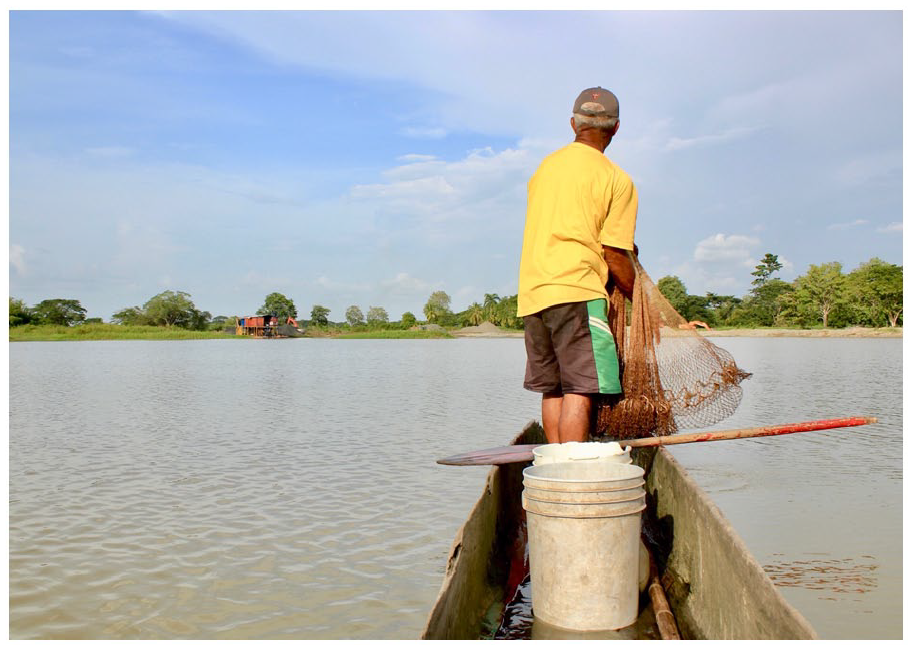
Afro-Colombian fisherman fishing from his dugout canoe on a lake adjacent to the Cauca river, which also harbours a gold mine, visible in the background. Fish stocks have plummeted due to mining (Photo by Samuel Steinhorst).
In the worst cases, the culture and knowledge as well as the income which was tied to the commons is lost for good (Sachs, 2010; UNDESA, 2019). This entails an epistemic loss and can also lead to a significantly diminished quality of life. Gómez-Restrepo et al. (2016) note a substantial increase in suicide rates for Indigenous communities affected by extractivism in Colombia.
Gudynas (2014) distinguishes four generations of extractivism in Latin America. The first generation corresponds to the colonial epoch, marked by the goldrush and associated violence. In this generation, the mastery of nature is invested with the spirit of political imperialism. The second generation is marked by the industrialization of extractive activities and the spirit of capitalism. The third generation refers to the intensive use of heavy machinery, the removal of millions of tonnes of material, and the occupation of hundreds of thousands of hectares. The fourth refers to the deployment of immense amounts of energy, chemicals, or water to access increasingly remote and rare deposits. “Extrahection”—violent extraction—is inherent to the third and fourth generations of extractivism in the Americas (Gudynas, 2014, p. 20). The armed conflicts waged in Colombia thus revolve mostly around territorial control and access to resource rents. The extraction of resources in conflict zones also constitutes a cause of and prolongs conflicts; and political movements may become profit-driven criminal enterprises in such conflicts (Korf,2011; Lujala, 2010; Malamud, 2018). This is most certainly the case with several armed groups in the lower Cauca region.
When nature is framed as a resource, when extractivism and the corresponding violent enclosure of ecological commons become typical practices, the traditional ecological alternative that lives on in the communities we visited risks being destroyed. This rooting out of the traditional ecological alternative means that one body of knowledge, typically one preceding colonial conquest, is suppressed, extinguished and replaced by a knowledge system in which nature is labelled as a resource that can be lawfully appropriated against the will of local residents for the sake of economic development through extraction (Mignolo, 2011; Sachs, 2010; Weber, 2018). Ultimately, these processes can at best be sustained several decades, compared with the millennia of Indigenous subsistence in the lower Cauca region. In this time, however, large parts of the knowledge created in prior centuries by Indigenous and also campesino habitants of the region is threatened to be erased, since their livelihoods become impossible with so much environmental deterioration and the absence of a monopoly of violence. We fear that the only cosmology that can retain a presence in the region hereafter is that of the extractors and their violent enforcers.
In the Anthropocene epoch, billions of lives, among them, 370 million Indigenous people, that depend on “community held lands” (Tauli-Corpuz, Alcorn, & Molnar, 2018, p. 7) will possibly be disrupted due to the persistence of the mastery of nature project. The remaining traditional ecological alternatives, and consequently, viable possibilities of overcoming the environmental crisis, may disappear. In addition to the utilitarian magnitude, the process entails an unimaginable amount of human suffering. In the words of Paul Farmer (2009), “it is one thing to make sense of extreme suffering . . . and quite another to explain it” (p. 20). There are movements resisting the suffering inflicted upon them in creative ways in the lower Cauca. We therefore seek not only to explain how suffering and knowledge loss is produced, but also to offer perspectives of where policies should focus to avoid it.
Extractivism in the lower Cauca
One giant company in the lower Cauca region, Mineros S.A., controls mining titles amounting to closely 15% of the entire area of the region. Mineros S.A. is a state-supported extrahective corporation. The company is owned by a few national and international shareholders, among them the richest Colombian. High-tech barges excavate the riverbeds and concentrate gold-sand, which is picked up by helicopter, smelted into bars and exported. The extraction benefits principally the shareholders of the company, while local riverine communities’ pay a large price: In addition to the company’s perceived debt in royalties, COP$85 billion, which stem from its ownership of a colonial-era mining title that requires a royalty payment of only 0.4%, as opposed to 4% normally, various of our respondents emphasized the environmental debt of the company: If you navigate from Zaragoza to Nechí on the river Nechí, you will find mountains of tailings, mountains of sand, from the sites that Mineros works. Drying up rivers, wetlands. And they received a national environmental prize. (Respondent 6)
A respondent who investigates the alleged crimes of Mineros S.A. emphasizes the discrepancy between external costs and the company’s profits: Why is Nechí flooded so frequently? Because the wetlands served as protective barriers for floods. The wetlands provided fish, they provided communication between the small villages on the riverbanks. They [Mineros] destroyed means of communication, their well-being and environmental diversity, the fishing grounds, and all of this ended up in the pockets of Mineros S.A. through the rentability of gold mining. (Respondent 11)
Extractive enterprises do not place value on natural actors and processes outside of the mineral market, such as wetlands (Shiva, 2010). The material re-configuration of these environments, which our interviewees experience, jeopardizes the traditional ecological alternative by upending subsistence activities such as fishing (Figure 2).
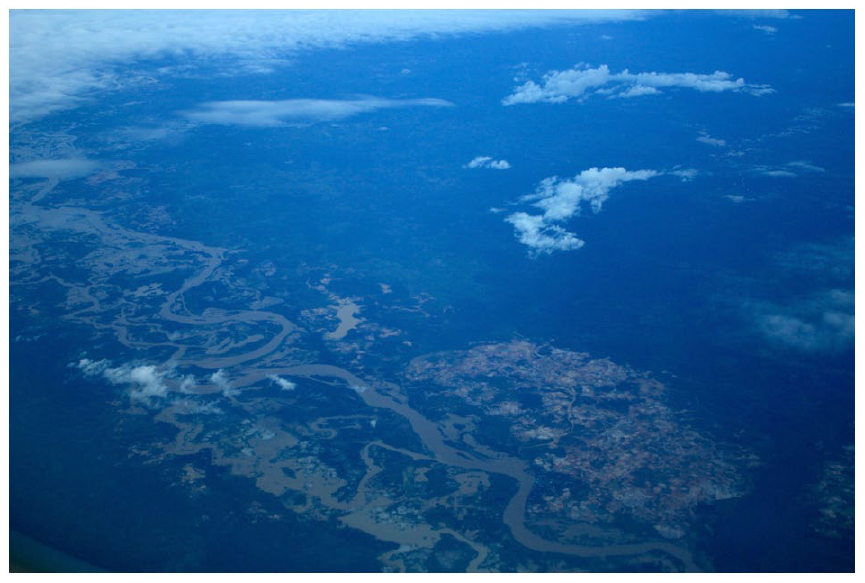
Aerial view of the Néchi River and the destruction by illegal and legal gold mining (Photo by Samuel Steinhorst).
Since the vast majority of mining titles are allocated to large international companies that employ few workers, small miners feel that they have no choice but to extract illegally on public land or in other mining titles. The majority of illegally mined gold is extracted through small-scale mechanized mining. Calculations reveal that to extract 1 g of gold, such an operation needs four workers and one excavator to remove six tons of soil, 1,000 L of water a second to wash them and 10 g of mercury (“Golpe a Minería Ilegal en Antioquia” [Strike Against Illegal Mining in Antioquia], 2019). Antioquia department has the highest level of per capita mercury pollution on the planet (Cordy et al., 2011). Despite the high initial costs and risks, Illegal mining operations can become profitable in a matter of weeks, as opposed to the 3 years it takes a coca plant to mature. A municipal secretary for productivity explained, In addition to the degradation of the environment and damage through mercury, what they call a clasificadora [mechanical mineral-sorting machine] is not very efficient. It only extracts about fifty percent of all the mineral, wasting roughly half. How is mining in this region sustained? Because of the international [mineral] prices. (Respondent 9)
Gold mining initiates a vicious cycle in that it destroys alternative economic activities. A schoolteacher in a campesino community recalled the effects of mining on his village: The river was deeper [in the past]. Do you have any idea how many tons of earth the miners dump into the river each day? Consequently, the water does not have anywhere to go in the wet season and floods the town, more each year. There is no more fish to fish, the mines destroyed that. (Respondent 26)
Mining is not the only cause of environmental crisis in the lower Cauca region. In the 1990s, the Hidroituango hydropower project was planned, destined to provide 2400 MW of fossil-free power to Colombia’s grid while exporting overproduction (Corporación Jurídica Libertad, 2019). Shortly before completion in 2018, the project nearly failed, and thousands of residents had to be evacuated. In February 2019, the Cauca River dried out completely due to complications, which led to a mass die-off of fish. The accumulation of nutrients in the reservoir leads to invasive plants that deplete oxygen and produce environmental toxins (Amat, 2019). The dam also impedes fish migration to spawning grounds upriver. At the same time, no more alluvial gold deposits will be transported further downstream than the dam, essentially putting an end to subsistence mining downriver (Amat, 2019).
The mastery of nature inserts itself in the lower Cauca region also through land-grabbing. Colombia is the Latin American country with the most unequal concentration of land (OXFAM, 2017). Land titles are often created in dubious ways. A respondent who works in land restitution explained, Basically, they’re the manifestations of a judge who revised a testimony, never went to the property and said that this guy is the owner. (Respondent 17)
Criminal networks often buy up land to invest profits, launder money, or expand coca cultivation areas (Villegas & Rebolledo, 2018). Cocaine production has allegedly more than doubled in Colombia during the past decade, despite eradication campaigns. However, extensive cattle ranching far surpassed any other use of land during the time of data collection: 415,719 hectares were destined for cattle ranching in the lower Cauca region, while 15,627 hectares were used for coca cultivation (Fundación Paz y Reconciliación, 2018; United Nations Development Program, 2012). Ranches also displace ecological commons. A social leader from a subsistence community stressed, The cattle ranches that surround us are for the owners only, people from the village do not have access to work there. they manage the farms centralized, with computers. (Respondent 1)
Landowners are interested in only one or two use-values of land which are priced on markets, not the entirety of ecosystem services. Natural habitat that is irrelevant or detrimental to this exploitation, for example, wetlands and forests, is eradicated in the process of producing meat, contributing to the making of the environmental crisis (Pardo Martínez & Alfonso, 2017).
The products that are extracted from the lower Cauca region, gold, energy, cocaine, and meat, are principally commercialized for what Shiva (2010) terms luxury consumption. The value added by their production and extraction accrues to the elites which trade and consume them, not those who sacrificed their health, security, and natural environment to extract and produce these goods. While the mega-projects in the region are sustained by developmental discourses of modern technology, efficiency and sustainability, illegal mining, and drug-trading networks sustain themselves through the high prices of these luxury goods. Since the majority of surface areas, mineral deposits, land, or rivers are controlled by corporations, illegal extractive operations, or landgrabbers, this leaves precariously few intact ecosystems for Indigenous and campesino communities in the lower Cauca, as our interviewees experience.
Waging war against ecological alternatives in the lower Cauca
Colombia harbours one of the longest ongoing civil wars on the planet. Without alliances between armed groups and extractive operations, both the extraction and the armed struggle would be impossible. The region is a prime example of a non-sovereign territory where multiple factions fight for control (Collier, 2009; Korf, 2011). For large corporations, the government or criminal networks, mastering nature implies the mobilization of armed groups. The previous government preferably supported large-scale industrial extraction, which it deemed cleaner and more efficient. According to our respondents, 86% of all titles are allocated to large companies, leaving few areas for traditional miners, who frequently mine illegally without a title. Although traditional miners could legally work for large corporations, they face rampant exploitation. A representative of a small miner’s association narrated the situation as follows: Is like a negotiation between a tiger and a donkey that’s tied to a tree, because they [the corporations] have the law in their favour. They have the titles, the economic, bureaucratic, and administrative power, everything. And we are the illegals, the ones who contaminate, the ones who break and damage, we are scapegoats in any case. (Respondent 6)
In the Colombian armed conflict, grievances of traditional miners are thus exploited by armed groups in practices of illegal mining, of which they obtain sizable rents. As one respondent who investigates the mining sector explains, Paramilitaries fund themselves from their own mines as well as others that they extort. They [Mineros] have their own army in their territory, the mining battalion N°5, which arose from a policy from 2012 that created these battalions to protect [extractive] companies. (Respondent 11)
We can confirm the presence of armed Colombian soldiers on the barges, which are outfitted with gun turrets (Figure 3).
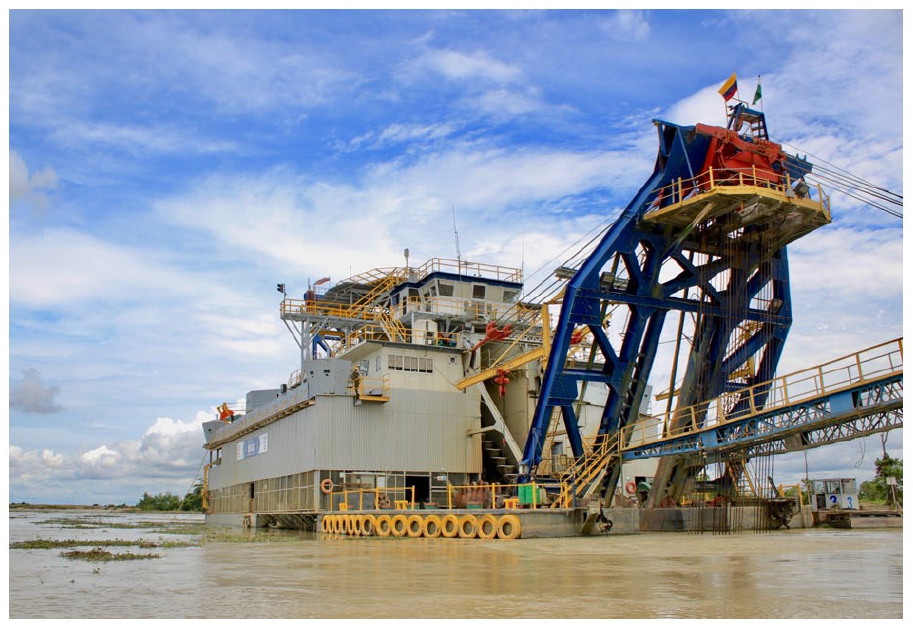
One of over 10 mining barges owned by the private company Mineros S.A. and protected by Colombian soldiers (Photo by Samuel Steinhorst).
Some respondents also claimed that Mineros employs informal agents for dirty work. State-owned extractive projects like Hidroituango are no less violent: Sixty-two massacres occurred between 1982 and 2016 in municipalities affected by the project, including a massacre committed against a Nutabe (Indigenous group from the Cauca canyon) community in 1998 project (Human Rights Everywhere, 2018).
The persecution of social leaders and their targeted assassination is a key strategy for achieving mastery over the lower Cauca region. An Indigenous representative explains the depth of this state of terror: If you speak up, you put yourself at risk. . . . The leaders that can generate social fabric are assassinated. The majority of leaders who are killed are killed at the hands of narco-paramilitary groups. (Respondent 5)
The strategy of paramilitaries is to associate resistance to extraction or defence of ecological commons with leftist guerrilla groups, legitimizing the assassination of social leaders that criticize or resist (Cohen, 2017; Corporación Jurídica Libertad, 2019). In May 2018, two members of a protest movement against Hidroituango were murdered in 1 week (Federación Internacional Por Los Derechos Humanos, 2018). Assassinations are a way to intimidate local populations and break resistance to the enclosure of ecological commons, as the representative of small miners and peasants observes. He tells us how this works: They [hit men] charge COP 50,000 per shot fired. . . . An assassination can cost between COP 300–400,000 if they put eight shots into him. For example, my comrade [Local social leader and member of mining and peasant organisation] was shot seven times, that’s 350,000 pesos [approximately 100 USD]. (Respondent 6)
The mastery of nature, marked, today, by violent extraction, implies an instrumental, economic approach not only to extraction, but also to breaking resistance of the traditional ecological alternative to it. And the cheapest way for extractive enterprises to accomplish this is by murdering social leaders, narrating this as acts of war against enemy combatants.
Materializing the mastery of nature is inherently violent and conflictive. The appropriation of so-called resources by large corporations is contested and resisted by traditional communities (Esteva, 2014); and armed groups are employed to break this resistance. The fear installed in local populations by past memories and the continuous presence of armed groups is enough to control them, as a respondent from the land restitution office tells us: Now, five men are enough to control a vereda [small village]. With five motorcycles, a cellphone and a couple of handguns. They don’t need machine guns, nor uniforms, they just have to keep talking about what they’ve been talking about for thirty years now. (Respondent 17)
The mere presence of armed groups effectively prevents resistance to extraction. This strategy, as our interviewees perceive, does not require the imminent use of physical violence against the broader community.
The forced displacement of Indigenous and campesino communities is another tactic to enclose ecological commons. Colombia currently hosts one of the largest numbers of internally displaced people worldwide. Displacement is also an inherent feature of mega-projects (Gellert & Lynch, 2003). Hidroituango’s zone of affection is an extreme example. From 1990 to 2016, 106,027 people in the so-called projects influence zone were forcibly displaced and 3,557 people were murdered (Calle et al., 2018). During the premature and accidental filling of the reservoir, around 500 people were displaced from their homes in the Cauca canyon upriver of the dam. The last Nutabe Indigenous community in Orobajo was displaced by the reservoir (David Higuita, 2018). A Sinú representative tells us, To displace an Indigenous person is not the same thing as to displace a non-Indigenous person. Let’s say in the case of an Emberá, an Emberá who doesn’t speak Spanish, comes to Medellin as a displaced person, in what kind of situation will he get, if he doesn’t know how to communicate, doesn’t have money, . . . his culture, everything is different, it’s much harder. it is not the same with a peasant obviously, who has a minimum of knowledge [of urban Colombian life], who has relatives perhaps. (Respondent 5)
The forced displacement of an Indigenous person induces a cultural shock, but also places the person in a setting of acute poverty, as the nourishing ties with her environment are severed. An Indigenous or campesino who is accustomed to an independent life as a subsistence farmer or fisher will have difficulties acquiring to life as an employee in a capitalist consumer society. Obviously, TEK is of little use in an industrial hub such as Medellín or Bogotá, where many displaced people resettle from rural areas.
Meanwhile, Indigenous and campesino communities have a hard time making their case for ecological commons. A respondent working in a municipal administration confided to us that his municipality possesses 2,000 hectares from a restitution fund from the Colombian peace process, which the administration intends to convert into plantations. Two Indigenous town hall representatives of the same municipality mentioned to us that they had asked for land for displaced communities, unsuccessfully: We’re crazy for land here, land that used to belong to the mafias, now it’s in the hands of the town hall. The mayor won’t give us two or three hundred hectares, land that the municipality has, so that we could go after our [Indigenous] customs there. (Respondent 14)
Colombian state policy aligns with the mastery of nature project, whereby the development of monoculture crops is considered as the most efficient vehicles in transforming natural capital into economic growth. Policy-wise, the implementation of sustainable development outweighs the considerations for traditional ecological alternatives, as an environmental engineer explained to us: Since mining is categorized as an activity of public interest, a [legal] mining project is simply implemented. You do not agree? Expropriation, you go, bye. What does this generate? Displacement, abandonment of land, violent cultural changes in these communities. (Respondent 7)
In such circumstances of displacement, knowledge created by Indigenous and campesino communities over millennia is reduced to irrelevance in months.
In sum, extraction is frequently tied to violent power structures such as armed state agencies or illegal armed groups (Collier, 2009). The unequal distribution of mining titles clearly fuels violent conflict, since illegal armed groups guarantee security and access to resources for plunderers. Breaking the traditional ecological alternative operates in many ways. In the past, massacres were dominant, while the current tactic seems to be the selective assassination of social leaders. The forced displacement of people paves the way for the conversion of ecological commons into natural resources and their extraction for the sake of sustainable development or luxury consumption (Esteva, 2014; Gudynas, 2014; Shiva, 2010). Displacement particularly affects Indigenous cultures and is a principal cause behind the rooting out of Indigenous practices.
How the mastery of nature is perceived by Indigenous and campesino leaders in the lower Cauca
In the lower Cauca region, Indigenous and campesino communities maintain, through “vernacular law,” a wide range of practices to protect ecological systems, such as watersheds or forests upon which they in turn depend for sustenance (Weston & Bollier, 2013, p. xx). Representatives of traditional communities tend to see the mastery of nature for the sake of sustainable development as a repository of empty promises. Referring also to the hydropower plant, a Sinú representative from an Indigenous organization told us that Development is like a grand idea, in the future, ahead of us, that they conjure up to make us pass through all the hardships. (Respondent 5)
Progress is narrated by this respondent as a process of enduring hardships without being assured a reward. The prime example that many Indigenous respondents brought forth was the Hidroituango project then under construction and in crisis: If I live on a parcel of land there, what benefit do I get from it? (Respondent 5)
While the electricity produced in the facility is mainly transported to the metropolitan areas, many communities in the area lack a reliable grid connection. For our respondents, technology-intense projects typically manifest an appeasement politics that forces local communities to accept the enclosure of ecological commons. They emphasize that those who pay the real price of this development never get to collect any benefit. The rewards of mastery of nature projects accrue to those who organize them and to those who own and manage the deployed technology.
For Indigenous people in the lower Cauca and Colombia in general, the ecological commons that satisfy their basic vital needs is referred to as a territory, the natural environment where many human and non-human lives are rooted. There is a non-definable tie connecting these living beings to their local natural environment. An Indigenous town hall representative who was displaced twice from her land describes the crucial importance of such an understanding of nature: We don’t have territory and without territory an Indigenous person is not alive. Our lives are tied to our territory, there you have the most important, thing, mother nature to provide you, with her you have enough. (Respondent 25)
Nature as maternal nourisher comes with a certain spiritual and social understanding, an intimate relationship with the one who feeds. In many Indigenous ontologies, nature resembles a person. An Indigenous leader describes this relationship in the Sinú culture: The fact of preparing the hills [for sowing crops] does not only imply the preparation itself, but to enter into a dialogue with the mountain, to shout at the mountain. We have this thing that we term “the call to the mountain,” when we go to collect the harvest, and depending on that call, you either harvest productively or not. Who is going to certify that scientifically? No, that’s an intrinsic relation between our culture and territory. (Respondent 5)
In organizing the ecological alternative, Indigenous people in the lower Cauca region enact traditional rules (passed on from generations to generations) or “vernacular law” (Weston & Bollier, 2013, p. 125). They do so to regulate economic activities in their territories and organize collective action in food production and maintenance. As a municipal Sinú chief explained, This part, we will use it for cattle grazing, this part for agriculture, and this part we’ll conserve for fauna. . . . If you need wood for a house, you can cut it there, but you have to plant a new tree. (Respondent 21)
Our Indigenous interviewees emphasize that vernacular law has proven to be more effective in protecting nature than government regulations, claiming that tree cover had increased on their land and decreased in the neighbouring forest reserve, which is under custody of the central government. Government regulations serve the political, economic, social, and cultural interests of the mastery of nature project. Examples are the mining code, but also the creation of forest reserves that exclude Indigenous communities from settling there, while turning a blind eye to the rampant exploitation occurring in these reserves. Natural parks and forest reserves in and around the lower Cauca region are frequently used to produce and transport cocaine, illegally mine gold, or extract timber.
In Indigenous and campesino communities in the lower Cauca, our interviewees claim, economic activities are carried out in such a way as not to disrupt the local ecological balance. This requires local knowledge of the physical environment, of the flora and fauna, and foresight.
Indigenous communities are effective custodians of their territories because of their sense of connectedness to the latter and their unsurpassable local knowledge (Tauli-Corpuz et al., 2018; Wilder et al., 2016). Historically, the economic, social, and cultural existence of the Sinú depends on water systems. An Indigenous representative explained to us, In winter [the wet season] there is fish. When the waters rise, the fish enter the rivers from the lakes and swim upriver to spawn. When the rivers subside [in the dry season], they leave sediments and gold, so the people pan for gold. The biggest company we have in the lower Cauca region is the Cauca river. (Respondent 5)
The river is a fundamental ecological commons for the communities, similar to the role of a large corporation in a small town. Instead of mastering it, they adapt to its seasonal variations.
In the lower Cauca region, the economic value of gold came with Spanish imperialism. For the Sinú people, as a Sinú chief explained to us, gold had no economic value: Gold did not have value for us. The Sinú did not live from gold, they lived from plants, from their harvests Today a Sinú trades gold for other things he needs, because the Spaniards and others placed value on it. (Respondent 21)
The environmental crisis is, among other things, made by placing value on gold and other resources, which the Sinú traded with other settlers. Trading is accompanied by an influx of synthetic materials—materials that are often introduced casually to traditional knowledge systems without a holistic approach to dealing with their social and environmental fallout. An Indigenous representative gave us an example, We are accustomed to packing our food in a large leaf of the hoja de bijao [Calathea lutea] plant. You ate the food and left the leaf, and nature reabsorbed it. Nothing happened. Now, they pack food in a plastic bag and those who are accustomed to throwing away a leaf, throw away a plastic bag. (Respondent 5)
In other words, the mastery of nature also manifests itself through the substitution of natural materials through synthetic ones—materials that are non-biodegradable or outright harmful, such as mercury (Shiva, 2010). Indigenous communities still resist this process, as is evident in Figure 4.
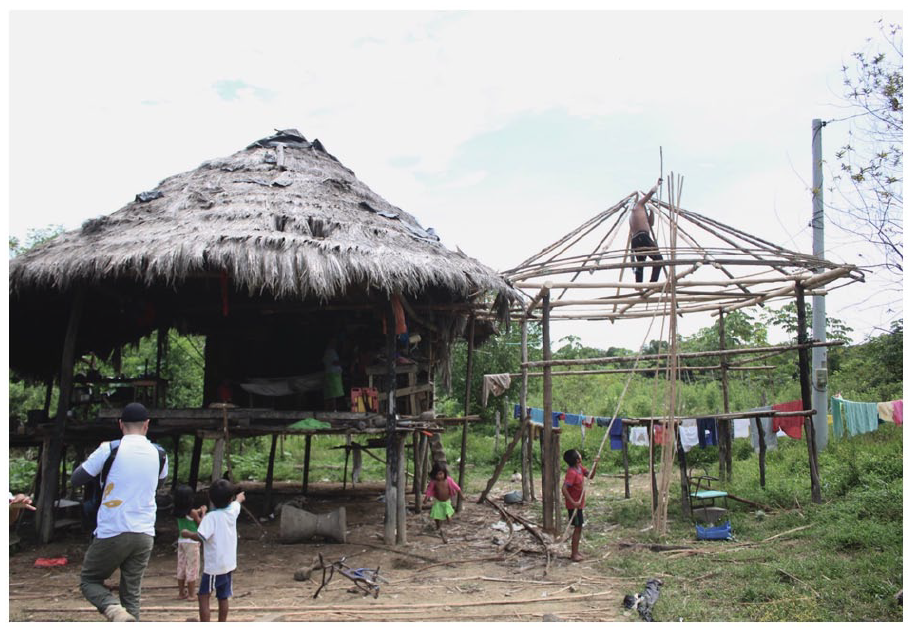
An Emberá (Indigenous group in central and northern Colombia and Panama) man in the lower Cauca region reconstructs his house using locally occurring materials and recycling ones from his old house (Photo by Samuel Steinhorst).
The primacy of intact and stable ecosystems, biophysical processes and community relations is key not only to the success of traditional ecological knowledge systems, but also to their precariousness. Orally transmitted and empirical knowledges are more susceptible to disappear (UNDESA, 2019), as it happened with the Sinú who lost their language and much of the knowledge encoded in it. The ongoing loss and substitution of TEK with synthetic materials and modern knowledge, if any at all, corresponds to an increasing dependence and a general increase of the consumption of energy, materials, and biophysical processes occurring outside of traditional territories (Gellert & Lynch, 2003).
Concluding remarks
We argued that the environmental crisis is the product of the mastery of nature project, which in turn serves the purpose of development. Particularly in the Americas, this is experienced by Indigenous and campesino communities as a politics of conquest. Resistance is dangerous for these communities and their leaders, who must fear persecution, displacement, or assassination (Calle et al., 2018; Defensoría del Pueblo, 2018; Fundación Paz y Reconciliación, 2018). Overcoming the environmental crisis, accordingly, implies transcending the mastery of nature project. And this implies the ability to break the long-standing political trajectory of the Americas—an imperialist and capitalist trajectory of environmentally exploitative practices like mining, grandiose technological projects, cocaine production and cattle ranching, feeding an ongoing cycle of plundering, oppression, injustice, inequality, environmental degradation, enclosing of ecological commons, and organized violence.
We emphasize that the Indigenous and campesino culture, knowledges, and power of the lower Cauca region are key to stopping the environmental crisis and the conflict there, and we argue that this requires politically abandoning the mastery of nature project. In traditional ecological alternatives, social relations point at the longevity of relations between nature and communities. The mastery of nature attacks and severs these relations. It thereby destroys subsistence societies’ immune system (Latouche, 2004). TEK is at the heart of such a system; it enables an Indigenous or campesino community to survive relatively independent of outside actors and organizations like corporations or government agencies in a difficult environment, such as a tropical rainforest. More so, these knowledges enable deeply sustainable lifestyles which can in theory continue for many thousand years while adapting to environmental and social changes. Every time a Sinú wraps her home-grown food in leaves instead of buying pre-packed food, she practices a silent and undocumented resistance to the mastery of nature project. Ecological commons and traditional knowledge thus serve to weaken a society’s “addiction” to development (Knut, 2018; Latouche, 2004, para. 11). The possibility of realizing a deeply sustainable world economy, we conclude, implies the adoption of an Indigenous or campesino understanding of nature as a home, that is, a world of natural actors and processes in which humans are only a part, playing a responsible and ecologically integrated role while recognizing the constraints nature places on them (Esteva, 2014; Kalonaityte, 2018; Knut, 2018).
We have, however, also revealed how a strongly established system of governance makes it hard to realize ecological alternatives in the lower Cauca. Indigenous and campesino communities resist extractivism in creative and peaceful ways, through the creation of an Indigenous territorial guard, petitions, collaboration with national and international agencies, the investigation and publication of injustices and breaches of the law, and protest marches (Figure 5).
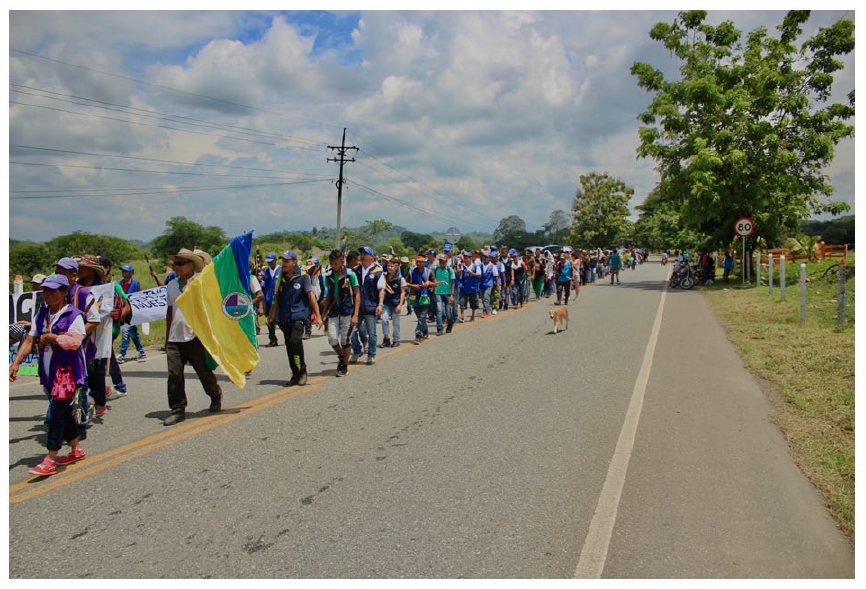
First organized Indigenous protest march in the lower Cauca region, from Cáceres to Caucasia, Antioquia department (Photo by Samuel Steinhorst).
Those who enforce the mastery of nature respond to this resistance with automatic weapons, poison, concrete, and bulldozers. Often, they also have the law on their side. We conclude, therefore, that for the people of the lower Cauca region the traditional ecological alternative is threatened to be crushed, to the point that the environmental crisis persists: Extractive power structures have forced the lower Cauca region into a trajectory of “business as usual” (Wright et al., 2018, p. 459) and technological solutions in response to the challenges of the Anthropocene. In this trajectory, ecological commons, and corresponding Indigenous knowledges, will struggle to survive, much less thrive. In this sense, we want to show in practice what Lander (2009) means when he writes that “the same survival of these [Indigenous and campesino] communities is being threatened by the encroachment of a process of global assault on public goods” (p. 198). It is a “final assault” on nature he argues (Lander, 2009, p. 198), since the assaulting civilation will soon cease to be if it continues destroying the very factors of its existence.
Indigenous and campesino communities in the lower Cauca region are actively confronting this assault. They teach us that possibilities of environmental change revolve principally around ecological adaption, while the mastery of nature project emphasizes technological solutions that tend to favour adaption of the environment to anthropogenic uses (Weber, 2018). Indigenous and campesino economies, however, rely on centuries of knowledge of the ecological processes they depend on and tend to adapt to these processes. Examples are the seasonal economies of fishing and traditional gold mining. The practices that sustain these communities have been gradually developed alongside and in response to the challenges of the ecosystem they are based in. They induce little risk, compared with the large-scale disruptions induced by mechanized mining or hydropower exploitation, which typically place the physical burden of risk and displacement on local and regional communities and the financial risk with taxpayers, while syphoning off most of the profits privately (Gellert & Lynch, 2003).
The Indigenous and campesino communities in the lower Cauca region wish to safeguard and further develop their aforementioned knowledges and practices. This is key also to their question of identity, and the (re)construction of a campesino, Sinú, Emberá, or Afro-Colombian cultural space which resists conquest by colonial or corporate structures. In Spring 2018, the Sinú and Emberá communities of the lower Cauca organized their first regional protest march, locally termed minga. The march was however disrupted by the failing of the Hidroituango Hydropower facility. The number one issue that community leaders mentioned, regarding their well-being, is the question of land ownership, followed by security from armed actors.
With territory, traditional economic practices can be continued, guaranteeing sustenance and independence from outside actors. We therefore call for policies that increase and accelerate the restitution of un-degraded land to Indigenous and campesino communities, particularly those that have been displaced and currently residing in urban areas. Empowering these communities with unrestricted access to their own territories creates opportunities for traditional ecological alternatives to flourish. With the election of Colombia’s first leftist president since the start of the civil war, and the first ever Afro-Colombian vice president in 2022, the possibilities for deep civilizational transformation become perhaps more viable. A major campaign pledge was to drastically reduce Colombia’s resource exports.
Footnotes
Acknowledgements
First and foremost, we thank our Indigenous and non-Indigenous respondents, who often invested considerable time and effort to host our researchers and facilitate visits to far-flung and difficult to access communities and sites of resource extraction in the Lower Cauca Region. We also extend our gratitude to other local and regional entities and local leaders who helped facilitate this research through administrative, political, and logistical support; without them it would have been impossible to conduct the fieldwork in an effective and safe manner.
Authors’ note
Declaration of conflicting interests
The authors declared no potential conflicts of interest with respect to the research, authorship, and publication of this article.
Funding
The authors received no financial support for the research, authorship, and publication of this article.

Glossary
campesino peasant
clasificadora mechanical mineral-sorting machine
Emberá Indigenous group in central and northern Colombia and Panama
Hidroituango a state-owned extractive project
hoja de bijao Calathea lutea; a large leafed plant native to Colombia
minga form of Indigenous protest in Colombia
Nutabe Indigenous group from the Cauca canyon
Senú an alternate spelling for Sinú, an Indigenous group from north-central Colombia
Sinú Indigenous group from north-central Colombia
vereda small village; the lowest level of territorial organization in Colombia, usually encompassing only a handful of streets
Zenú an alternate spelling for Sinú, an Indigenous group from north-central Colombia