



Abstract
In this article, we reflect on our methodology, working with a uniquely Indigenous approach to collaborative cross-cultural research and sustainability planning for murrukupuni (Country) and winga (salt water) on the Tiwi Islands, Northern Territory, Australia: the Turtuni Framework, which takes its name from the turtuni (a carved wooden pole) used in Tiwi (the Indigenous Peoples of the Tiwi Islands) ceremonies and governance. We focus on the emergence of the Turtuni Framework from existing Tiwi governance models of relationality as a means of exploring a vision for Indigenous-led transdisciplinary work in research and practice, in particular for biodiversity and sustainability planning. We place contemporary academic discourse on concepts of composing, decomposing, and recomposing in conversation with practices of working with Tiwi knowledge and politico-epistemics.
Engagement and beyond: composing and recomposing research
Indigenous engagement has been recognised as critical to successful land and sea management both in Australia (Hill et al., 2012; J. Hunt et al., 2018; Jackson et al., 2012) and internationally (Ban et al., 2018; Berkes, 2008; Ruwhiu et al., 2022). This is reflected by the emphasis on Indigenous peoples as “custodians of biodiversity and as partners in its conservation, restoration, and sustainable use” in the 2022 agreement under the Convention of Biological Diversity (Conference of the Parties to the Convention on Biological Diversity, 2022, p. 5). There have been growing efforts by environmental researchers, managers, and policymakers to engage with traditional ecological knowledge (TEK) and Indigenous ecological knowledge alongside dominant science in order to address pressing environmental issues. This places Indigenous people in the complex position of, on one hand, “advocating for and demanding that [TEK] form an integral part of environmental governance,” while, on the other hand, needing to “protect their knowledge from misuse, misappropriation or exploitation” (D. McGregor, 2014, p. 343).
Various engagement practices surrounding TEK for environmental science, management, and policy development have emerged in response to this tension. However, there remains a risk that methods of Indigenous engagement may continue to reproduce extractive and assimilationist colonial agendas, or decontextualise and co-opt Indigenous knowledge for scientific outputs (Simpson, 1999; Tynan, 2024). As Max Liboiron (2021, p. 53) notes, in attempts to incorporate Indigenous knowledge into mainstream science, many in the academy “do not appear to understand that TEK et al. [as written in original work] are about ways of knowing [emphasis added], not what is known.” Other Indigenous academics have similarly emphasised the need for research to respect relational knowledge practices, rather than simply focused on knowledge alone (Nxumalo & Tuck, 2023; Simpson, 2004). There have thus been calls for researchers in the environmental and social-ecological sciences to go beyond community engagement (D. McGregor, 2014; Sumida Huaman & Mataira, 2019) and transdisciplinarity (Moewaka Barnes et al., 2021), in order to centre an Indigenous research agenda (Smith, 2012) and knowledge practices at all stages in research. In particular, Indigenous scholars and their non-Indigenous collaborators have highlighted the importance of recognising ways of knowing through relationality (Bawaka Country, Suchet-Pearson et al., 2013; Bawaka Country, Wright et al., 2016; Tynan, 2021; Wilson, 2008) and peoplehood (Holm et al., 2003; Sumida Huaman & Mataira, 2019). This involves attention to the ongoing renewal processes of language, sacred history, religion, and land and the relationships, practices, and commitments that accompany it.
Notions of composition and decomposition have been used by scholars to explain and describe various emergent processes of knowing and being, where heterogeneous materialities, actors, and practices intermingle as part of an ongoing process of becoming. Attention to composition can involve an awareness of “some assemblage of affects, effects, conditions, sensibilities and practices” where “disparate and incommensurate elements (human and non-human, given and composed) cohere and take on force as some kind of real, a world” (Stewart, 2014, p. 119). Decomposition has been theorised as a process of recomposition or a breaking down and reassembling of elements, producing ambiguous and unbounded arrangements that are nonetheless generative (Abrahamsson & Bertoni, 2014; Hamilton & Neimanis, 2018; Haraway, 2016; Puig de la Bellacasa, 2017). Marilyn Strathern (1992) draws on the term to denote a particular form of analytical work among the Hagen (an Indigenous Peoples of New Guinea) where “‘Things’ are forms in which relations appear” (p. 249). As Strathern (1992) expanded, “Forms appear out of other forms, that is, they are contained by them: the container is decomposed, everted, to reveal what is inside” (p. 249). Helen Verran (2001) adopted Strathern’s term but reconfigured its meaning, such that decomposition became a method for thinking with emergent worlds and their knowledge practices through a form of generative critique.
In this article, we present one such generative critique and reflect on our work in an Indigenous-led transdisciplinary research project on the Tiwi Islands. We focus on the Turtuni Framework, a process of recomposing a framework for engagement and collaborative ecological research. Our emphasis here is on recomposing, to highlight that the Turtuni Framework arose from pre-existing Tiwi (the Indigenous Peoples of the Tiwi Islands) models of governance emergent within Tiwi social life as practices of knowing and understandings of what is known. We reflect on how composition, decomposition, and recomposition bring together different ideas and materialities, and how this process might embody a methodology for working with difference. In doing so, we reflect on how our methodology emerged from long-established governance practices already in use by Tiwi People. We describe our process of generating a working methodology for community engagement in a transdisciplinary research project on biodiversity and sustainability conducted on the Tiwi lands on Bathurst and Melville Islands, Northern Territory, Australia, and in doing so consider how working with Indigenous ways of knowing and prioritising Indigenous peoplehood can transform research relations. This article focuses on three specific compositions of the Turtuni Framework: The Turtuni Story painting, the Four Milimika Pillars of Strength and Warntarana Ngirramini (ethical principles), and the Murrakupuni Memorandum of Understanding. Through its circulation in the community, the decomposed and recomposed concepts of the Turtuni Framework made visible Tiwi modes of governance wherein “forms appear out of other forms” (Strathern, 1992, p. 249). In doing so, it reconfigured our project.
Throughout this article, we also reflect on the ways our collaborative practices involve various relational compositions and recompositions. As we collaborate as a team, our lead author, Author 1, and other Tiwi contributors work according to Tiwi practices of kin and social obligations, while our non-Tiwi researchers learn how to support this work and reconceive the project accordingly. As a result, in this article, there will be different voices, with the lead author, Author 1, sometimes speaking from her individual Tiwi position and sometimes speaking together with non-Tiwi collaborators. We make these voices evident in order to acknowledge that in our collaborative practice we have different accountabilities and contributions.
Context: planning for biodiversity on the Tiwi Islands
This research emerges in the context of long-standing traditions of Indigenous land and sea management in Australia, which was recently recognised by the Australian Government as a highly effective component of formal environmental management and local economic strategies (Austin et al., 2018).
Located in the Arafura Sea, between Indonesia, Papua New Guinea and Australia, the Tiwi Islands are comprised of two human-inhabited islands and several others inhabited by other-than-human kin. With a rich cultural history (Kerinaiua & Rademaker, 2023), Tiwi People’s management of the Tiwi Islands has remained unbroken throughout time. Land ownership was formally recognised by the Australian Government under the Aboriginal Land Rights Act 1976. Contemporary Tiwi governance structures involve legal formalisations of traditional kinship-based land tenure (Goodale, 1971; Hart et al., 1988; Venbrux, 1999). The current governing body, The Tiwi Land Council, is comprised of eight land-owning groups who share a common language (Tiwi). Tiwi relationality and land management centre on connections to murrakupuni (Country), other Tiwi People, and kinship ties, wherein timani (traditional homeland or Country) and clan identification are inherited from one’s father, while responsibilities towards particular sites and skin identification is inherited from one’s mother. These connections are commonly expressed through song, dance, artwork, behavioural protocols, and caring obligations. Such relationality is animated by yiminga—the pulse, life force, and spirit of the more-than-human world including places, people, animals, and plants.
This project was initiated at the request of Tiwi People in order to assist with Tiwi-led decision-making for land and sea management. It involved ecological research into small mammals and plant ecosystems and social science research into community values and biodiversity aspirations. The social science component of the project was initially envisioned with a focus on collecting data to inform decision-making in a collaborative, transdisciplinary manner. However, disruptions to the research caused by the COVID-19 pandemic, and the subsequent restrictions on travel, saw a radical re-envisaging of the project, whereby Author 1, a Tiwi scholar and community-based researcher from the Mantiyupwi (a clan of the Tiwi People), led a team in the process of developing a collaborative engagement framework mindful of the different epistemologies and politics involved in conversations between Tiwi and non-Tiwi knowledge (Janke, 2009; Kwaymullina, 2016). Author 1 recognised that Indigenous-governed collaborations would lead to the increased integration of Indigenous ecological knowledge and science, a position supported by Hill et al.’s (2012) typology of Indigenous engagement in environmental management.
Shaping the Turtuni Framework
Before we describe the three main compositions of the Turtuni Framework, we explain in the following sections how our lead author directed us in the development of our research methodology. The foundation for our methodology was Author 1’s position within the Tiwi community and the ways she was already working with complex Tiwi ways of relating. It was vital to work within these Tiwi protocols and governance practices alongside the various policy assemblages of government and non-government organisations and services. In the first instance, this meant engaging with the concept and practices of milimika, as described in the next section.
A milimika (a ceremonial clearing) for collaborative research
Described by Tiwi Elders as the cleared ground in which ceremony takes place, the Tiwi concept of milimika is central to the relationship between people and Country. Milimika is where Tiwi knowledge practices are enacted for the purposes of celebrating and sustaining social-material relations such as land ownership, Tiwi institutions, kinship structures and groupings. These practices are performed in the milimika through, and within dance, song and ceremonial roles and responsibilities. In the milimika, one’s position in kinship and ceremony allows one to know what dance to perform, what ceremonial activities to conduct, and the order people will conduct activities in. One is also aware of how to relate to or interact with other people, for example, avoiding certain people out of respect.
In the 1990s, senior Tiwi leaders associated with the school—whose names were Terizita Kilipayuwu Puruntameri, Leah Kerinauia, Elizabeth Yimray Kerinauia, Carmelina Pauntulura, and Ancilla Kurrupuwu—adapted the relational practices of milimika in order to develop a framework for cultural safety within the Tiwi education system. Here, a milimika structure was implemented in school to make visible the relationships between people and institutions, so that staff and students were aware of their roles and responsibilities. Within the milimika system, school leaders were also granted responsibilities to oversee one of four key components of Tiwi education: discipline, culture, language, and curriculum.
Author 1 was inspired by the school milimika system, which she described as a process of de/recomposing Tiwi governance structures for new contexts, and further recomposed it for the Turtuni Framework. Author 1 explained Tiwi policy by likening them to Tiwi songs. Songs are constantly being composed in the Tiwi language as responses to contemporary happenings, but these compositions build on and refer to older songs and stories through webs of relationality. In this sense, older Tiwi songs or stories take a new form but are recompositions of what already existed for Tiwi. Likewise, Author 1’s recomposition of this model of governance draws from past compositions of policy and builds on them. Here, the milimika provides a protocol and relational framework for ngapaningimarri ngirramini ngini murrakupuni (coming together to learn knowledge about Country). This can be applied to instances where disparate knowledge practices meet. Author 1 emphasised that if the milimika is first established as an ethical space of engagement (Ermine, 2007), Tiwi knowledge practices and dominant scientific practices can come together in correct relation. Importantly, this relationality is one where specificity in differences is required (Donald, 2009; Liboiron, 2021). In a milimika, people have different roles, responsibilities, and obligations depending on specific kin relations; likewise, a milimika for collaborative research makes visible various kinds of relations and differences that influence how knowledge is shared. Here, the milimika practises Shawn Wilson’s (2008) dictum that Indigenous research methods are ceremony; like ceremony, Indigenous research relies upon relational accountability. Importantly, in Author 1’s recomposition of the milimika for our work together, the distinction between traditions, for example, Tiwi and scientific knowledge traditions, remains—there is a meeting of these traditions within the milimika, but not a merging. This marks a significant variation from the standard Venn diagram of Indigenous research, as the area of overlap between Indigenous and Academic knowledge practices (Figure 1(a)) (Christie, 2006). The space of the milimika is not a collapse of ontological and epistemological differences but is instead the creation of a new space of collaborative practice, a clearing ground based in Tiwi policy where different knowledge practices respectfully meet in correct relationality. We now describe the three main compositions of the Turtuni Framework.
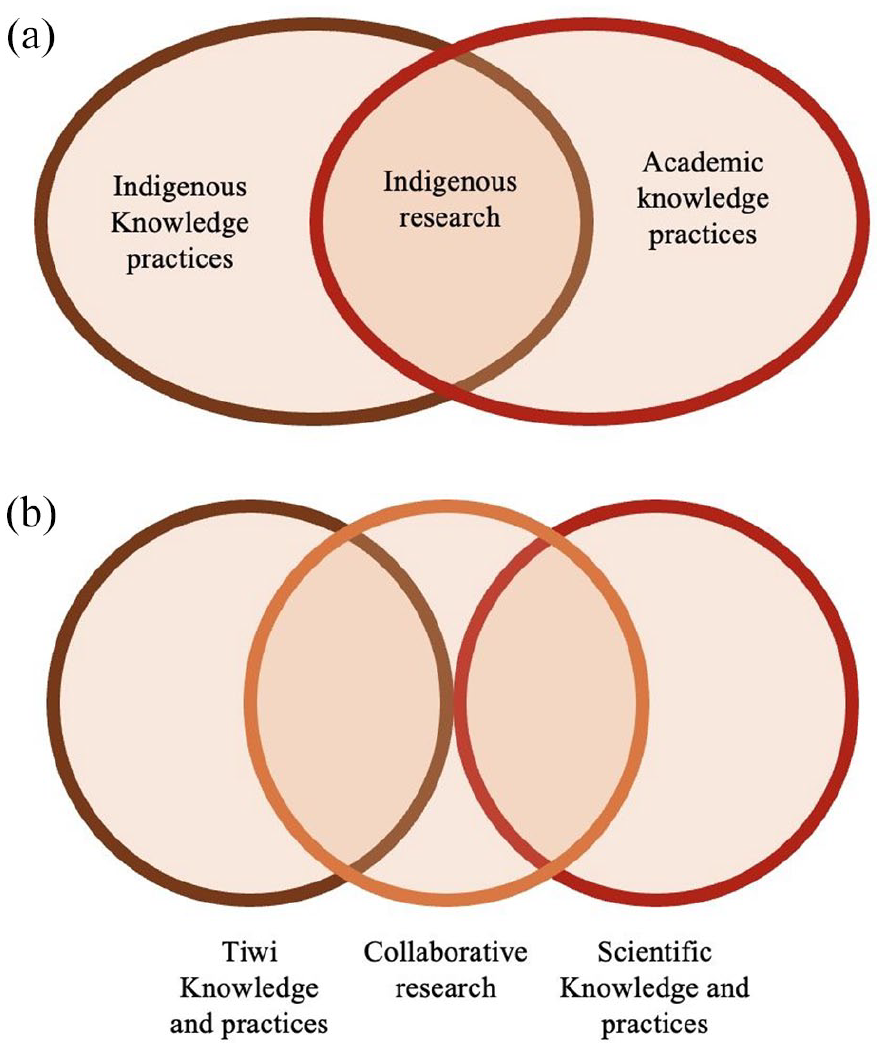
Indigenous research (a)* and collaborative research (b).
The Turtuni Story painting
Author 1 describes the painting, The Turtuni Story (Figure 2), as an engagement tool that emerges from and makes visible Tiwi approaches to governance in order to create a milimika for collaborative research. Through conversations with Tiwi Elders, Author 1 and other team members developed the painting concept over several months in 2020, following which, it was painted by Tiwi artist Fiona Kerinaiua. The image of the painting centres on a turtuni (a carved wooden pole) pole that becomes known as a pukumani (Tiwi mortuary rituals pole) when used in Tiwi mortuary ceremony. Other writers (Goodale, 1971; Ngarukuruwala Women’s Group & Campbell, 2023; Venbrux, 1995) have discussed these mortuary rituals in detail. However, what struck Author 1 was the turtuni’s capacity to represent Tiwi life and governance as processes of continual composition and recomposition. A turtuni begins with a kartukuni (ironwood tree; Erythrophleum chlorostachys) that grows from murrakupuni and is cut down and shaped according to ceremonial processes and rules of relationality. Once the artisans have completed their work, the turtuni is ceremonially erected within the milimika. It may then be taken down and moved. As the artwork weathers, the turtuni may be continuously repainted, replaced, or left to decompose. Author 1 showed how, while the turtuni shifts and changes, it is in a sense regenerative—it is composed from murrakupuni and decomposes into murrakupuni. In The Turtuni Story painting, the turtuni has three parts representing the past, present and future, where different generations work together to care for murrakupuni. Each generation will have their own approaches, but all are grounded in Tiwi relationality. The footprints at the bottom of the painting depict Tiwi land-owning groups and other stakeholders walking together on a pathway towards this vision.
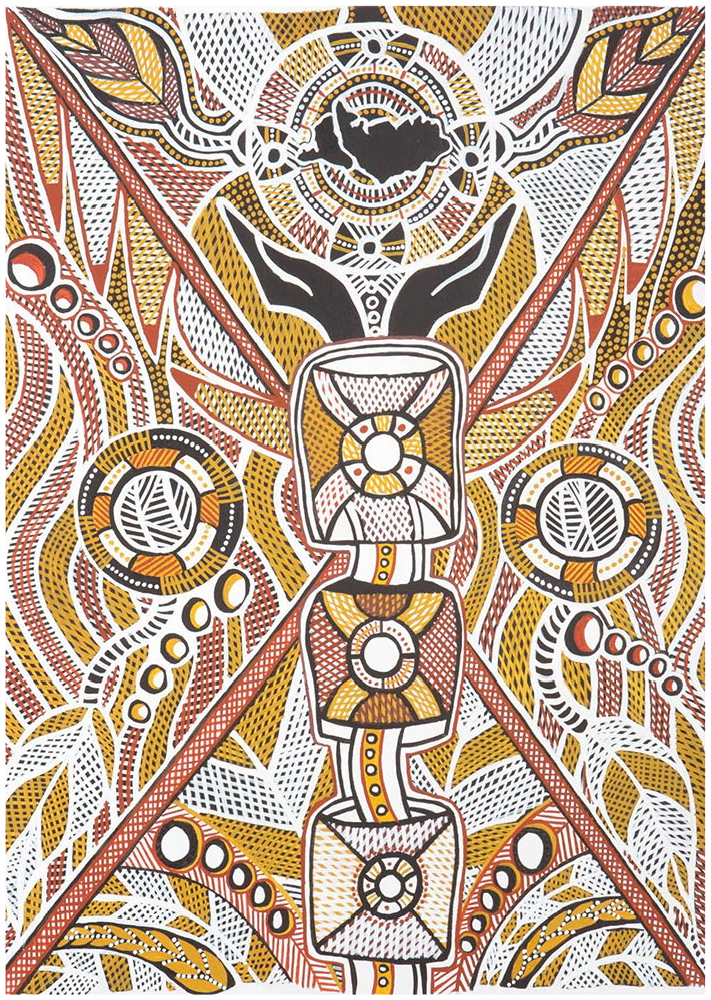
Turtuni Story (concept and design by Mavis Kerinaiua; painting by Fiona Kerinaiua; photo by Emily Nicholson).
The aim of creating The Turtuni Story was to bring together the image of turtuni and other important Tiwi visual concepts to encourage diverse members of the Tiwi community, including those who have traditionally been marginalised in decision-making, to reflect on values, aspirations, and concerns for Tiwi social, emotional, and environmental life. In doing so, we hoped to also start conversations about how a milimika could be created between Tiwi knowledge holders and non-Tiwi researchers about caring for murrakupuni. Below, Author 1 recounts the process of developing The Turtuni Story as an engagement tool and framework: I started The Turtuni Story as a way of looking at the social and environmental aspects of Tiwi . . . I am interested in looking at how do we still maintain our culture at the same time as we are doing research working with Western way and methodologies. We have our Tiwi way and Tiwi methodologies too . . . . How would they like this to go? It is open for their input, their comments: How do we shape this turtuni? Because when we create a turtuni it takes time to make it and shape it. That concept resonates with my [Tiwi People]. Using the turtuni as an engagement tool gets people to think and talk about what is important to them and murrakupuni and winga [salt water].
The Turtuni Story acted as an engagement tool in this research and an entry point to conversations with Traditional Owners from across various clan groups. In informal meetings with individuals, we showed a reproduction of The Turtuni Story painting and briefly summarised the story. Community members would then be invited to comment on their interpretations of the painting, how they think it might be used, and what it made them think of.
As Author 1 reflected: People relate to those symbols; it is a form of healing when we see it visually. Everyone relates to it differently, but the main commonality is that we are walking together and working together. How do we walk together around Tiwi biodiversity and sustainability? Also how do we create that good relationship with Western science and for Western science to create that good relationship with Tiwi?
These semi-structured conversations were often guided by geographic maps and sometimes included cultural mapping activities as a means of visually representing Tiwi community members’ values, concerns, and aspirations for murrakupuni and winga.
One particularly memorable occasion was the first time we used The Turtuni Story as an engagement tool at a meeting with two senior Elders in the Tiwi community. Upon being presented with the painting, the senior Tiwi man looked closely at the design before sharing the story of Purrukapali (the Tiwi ancestor-being). After the death of Purrukapali’s infant son, Purrukupali introduced pukumani as a mode of relating, healing, transforming, and regenerating. “Our ancestors told us that story,” the senior Elder concluded, nodding towards the painting with a large smile. This first story prompted the other Senior Elder to tell a story about the life and death of one of her ancestors, which in turn stimulated a long conversation about concerns for murrakupuni and winga and how to keep traditional knowledge strong as a means of caring for Country. Thus, as an engagement tool, the painting and associated narrative invited stories of what it means to live and die as a Tiwi person according to lore passed down from Tiwi ancestors, which was then linked to contemporary aspirations for caring for Country. This story-based discussion took place with minimal prompting from non-Tiwi researchers, who were positioned as listeners and learners. Storytelling, as a mode of knowing and relating already existing within Tiwi practice, allowed space for voices frequently silenced in decision-making to lead the conversation regarding the social-ecological concerns the researchers had been invited to provide support around (Christensen, 2012; S. Hunt, 2013; Nthogo Lekoko, 2007; Tynan, 2021).
For a year (2022–2023), we used The Turtuni Story as an entry to conversations with 39 individuals and representatives from 10 Tiwi organisations. We also presented the painting at a number of clan group and organisational meetings. Interpretations of the painting stimulated discussions about practices of ceremony, bushfood collection, art, song, engagement with Christianity, historically and spiritually significant sites, protocols for interacting with Country, and spirits. Elders often used the opportunity to educate younger Tiwi People and the non-Tiwi researchers about important Tiwi concepts while also sharing about their own lived experiences. Affective responses frequently included joy and pride in the Tiwi identity. These conversations and the painting, more generally, also led to discussions about a range of issues affecting Tiwi People, murrakupuni, and winga. These included language loss, habitat risks, climate change, large-scale developments, cultural education, employment opportunities, intellectual property rights, small local business opportunities, early childhood supports, health, and social and emotional wellbeing. In this way, we were able to listen to Tiwi People’s hopes and concerns for murrakupuni and winga as they effected and were affected by all areas of Tiwi life.
The Four Milimika Pillars of Strength and Warntarana Ngirramini
Through the course of conversations using The Turtuni Story, community members encouraged Author 1 to develop the story into a more formal means of opening meetings concerning Tiwi community life and business. The use of such statements is common in Australia as a means of acknowledging traditional land ownership and paying respect to Elders (Bodkin-Andrews et al., 2016). Author 1 was inspired to develop a welcome statement that would, along with The Turtuni Story, create a milimika where Tiwi protocols and diverse opinions would be respected. She also wished to include protocols and ethical principles as a foundation for working on collaborative projects. With the school milimika structure as inspiration, we worked with senior cultural advisors and translators to develop The Four Milimika Pillars of Strength, summarised as:
Ngarrimajakupuwani-a-jirri (discipline; we know of our behaviour).
Ngirramini ngini ngapangirra (language; this is the language that we speak).
Ngirramini ngini yoyi amintiya yiminga (culture; our dance and our spiritual identity).
Pikarringini ngini wuta ngawa-ampi amintiya ngamanunguwi putuwurupura naki ngirramini (policy; the legacy our grandfathers and grandmothers have left).
The Four Milimika Pillars of Strength allowed us to consider the correct protocols for creating a cross-cultural and transdisciplinary milimika, and the values that might support land and sea management (Austin et al., 2018) and anti-colonial science (Civic Laboratory for Environmental Action Research, 2021). For instance, according to these values, an ecologist doing field research should always be accompanied by a Traditional Owner of the timani they intend to visit, who would instruct them on the correct protocol of greeting murrakupuni and asking permission to work there. This involves the pillars of discipline through restraining from going where one should not, culture through recognising the right Traditional Owners and acknowledging murrakupuni, and language through calling out to country in Tiwi, which together acts as a Tiwi policy for working with murrakupuni.
In addition to The Four Milimika Pillars of Strength, we also developed a list of ethical principles drawn from Author 1’s reflections on Tiwi philosophies and her vast experience in community governance. Together, Author 1, senior Elder Callista Kentilla, and a non-Tiwi researcher sat by the beach with The Turtuni Story painting and The Four Milimika Pillars of Strength spread out before them and discussed what Tiwi ethical principles might mean in relation to The Turtuni Story (Figure 3). Through this process, Author 1 was able to outline fundamental warntarana ngirramini:
Piripungintayi (respect).
Ngapapunya yintayi kapi alawuruwi (leadership).
Ngini wanta pupuni (honesty).
Puraji-atirri karluwu ngawa-lamiya (fairness).
Ngawa-luwa-a-tirri pupuni amintiya jiyirti ngirramini kangi ngawa yiminga (integrity).
Pitiputuwa ngutaluwapa (compassion).
Reflecting on the list, Senior Elder Callista Kentilla smiled and said, “We all come together in the circle and talk about milimika, those footsteps. We are all carrying that turtuni on the path, heading towards the milimika. [Author 1] got it all right . . . Right story, that one.” In Tiwi, jarramwaka (right path) is a means of expressing that one is behaving relationally in the correct manner. Here, the senior Elder means that The Turtuni Story, the Four Milimika Pillars of Strength, and the warntarana ngirramini encourage people to carry out the work conducted according to the right Tiwi protocols and principles along a correct path of behaviour to a milimika where people will engage in important storytelling. In this sense, it is the right story for collaborative work. Collaborative work is the performance of Tiwi kinship and governance in ways that maintain difference and dissensus as an important element in, rather than a limit to, working together.
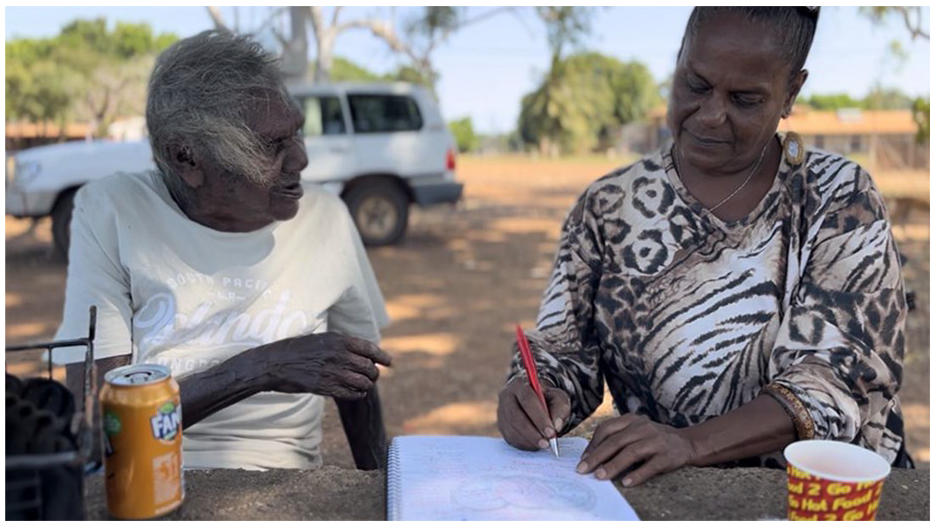
Senior Elder Callista Kantilla (Author 9) working with Mavis Kerinaiua (Author 1) to develop warntarana ngirramini (ethical principles) (photo by Alana Brekelmans).
The Murrakupuni Memorandum of Understanding
We now turn to consider the research team members’ practices of working with the three elements of the Turtuni Framework and the way it has influenced our research project. To do this, we reflect on a particular instance where we were influenced by what we had learned as part of The Turtuni Story engagement process. After a period of 3 days working together with The Turtuni Story painting in Wurrumiyanga, Authors 1, 2, 3, and 4 met at a university in the mainland capital city of Darwin, Northern Territory. We planned to develop a Memorandum of Understanding (MoU) that could be used by Tiwi People and stakeholders prior to discussion about planning for murrakupuni and winga. Starting with sample MoUs, Author 1 led the process of drafting our own MoU on a whiteboard (Figure 4). We discussed how the MoU, as a reflection of the milimika relational process, would need to remind all involved of their roles and responsibilities. However, as we attempted to develop the wording, we felt as though something was missing. No amount of rewording seemed to solve the problem, and we struggled to get beyond the basic definition of an MoU. Then, Author 1 cried out, “We have forgotten about murrakupuni as the main character! Everything needs to come out of murrakupuni!” In this moment, the team realised that while murrakupuni had been at the centre of the conversations with Tiwi, when it came to our meeting away from the Tiwi Islands, we had fallen into institutionalised ways of working that saw an MoU as an agreement between human parties. In this sense, we had lost The Turtuni Story as an engagement tool that encompassed complex Tiwi relations and allowed varied, including more-than-human, voices to be heard. As Author 3 reflected at the time, “Universities make us think like that,” a statement that calls to mind various critiques of Western institutions (Patel, 2016; Sumida Huaman & Mataira, 2019; Tuck & Yang, 2014; Wynter, 2003). Here, Author 1’s reminder that The Turtuni Story is about murrakupuni produced a generative disconcertment (Verran, 2002) that allowed for the decomposition of modes of working when they veered too far into methods of colonial institutions, that is, what an MoU might look like in a university. Author 1’s statement that “murrakupuni is the main actor” troubled colonial approaches to policy and modes of agreement, allowing us to remember what community members had told us. With this in mind, we focused on developing the Murrakupuni Memorandum of Understanding, where the agency of murrakupuni within Tiwi policy was brought to the surface as fundamental to all forms of agreement. Here, the understanding must be with murrakupuni as a mode of ongoing engagement with Country according to Tiwi policy and relationality, not about murrakupuni as if it were an inanimate landscape.
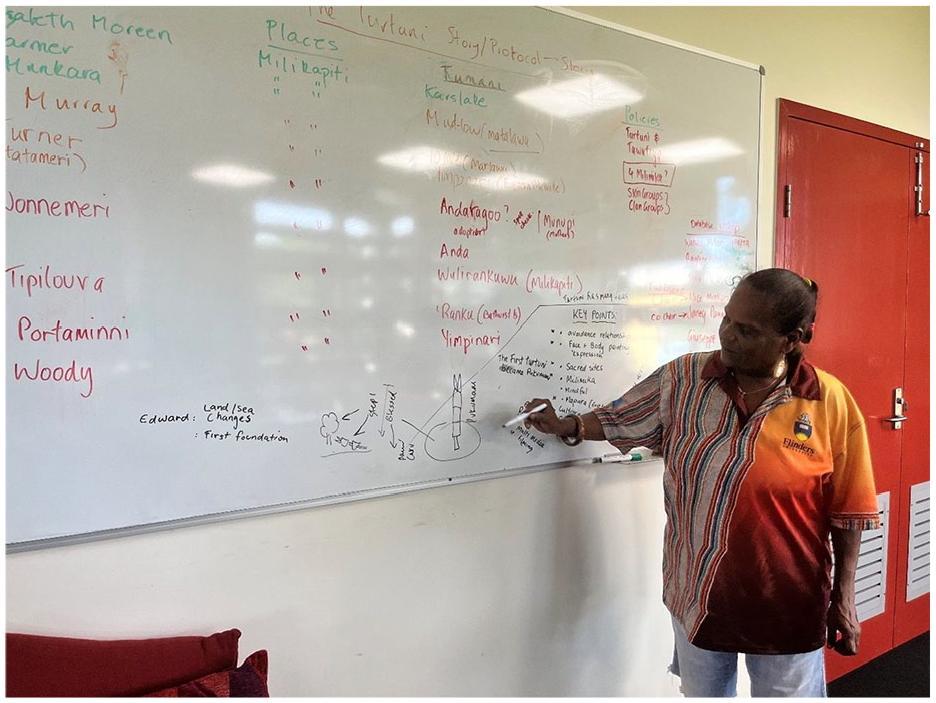
Author 1 drafting the Memorandum of Understanding (photo by Alana Brekelmans).
Discussion: composing and decomposing policy, engagement, and research
Composition, decomposition, and recomposition are fundamental processes in Tiwi governance. This is exemplified on a material level through the turtuni itself in its journey of emerging from and returning to murrakupuni, and in Tiwi songs that are recomposed to recount new happenings. Likewise, Author 1 argues that successful Tiwi policy for working in collaboration may require moving or changing, but it always emerges from murrakupuni, is shaped through the work of relational practices of reciprocity, and returns to nourish murrakupuni (H. E. McGregor & Marker, 2018). In the Tiwi polity, such a process of composition, decomposition, and recomposition is thus a means of acknowledging older forms while also making something new. Like song, successful policy is composed from what is already there: Tiwi policies based on the embodied and relational principles of murrakupuni.
From the outset of our project together, Author 1 contended that successful cross-cultural collaboration and engagement in research should be based in policies constituted in and through existing Tiwi governance, which would then manage tensions that might arise through knowledge work between Tiwi and non-Tiwi. As Author 1 reflected, “So many organisations fall into the trap of not working with what is already in the ground, where the tree becomes the turtuni.” Author 1 was thus mindful to participate in a process of decomposing and recomposing existing Tiwi policies. In this sense, it is more accurate to say the Turtuni Framework was not developed by us but emerged through Author 1’s intellectual work of reflecting on, bringing together, and making visible an assemblage of diverse Tiwi approaches to governance. It draws from Tiwi protocols in ceremony and everyday community life, as well as the ways these Tiwi approaches to governance have been mobilised in particular organisations such as the school. In making visible these Tiwi policies and protocols, the Turtuni Framework not only continues a tradition of recomposition that centres Tiwi governance but also prompts consideration of relational ethics. Indeed, the importance of The Turtuni Story as something that evokes ancestral teachings and foundational Tiwi values became apparent in a conversation with another Senior Elder who held a position in local government: “This is like our Tiwi constitution, our tuwitiya [Tiwi unwritten rules of governance],” he said, providing his own translation. By this, he meant that The Turtuni Story outlines the Tiwi constitutional practices, or a uniquely Tiwi way of living handed down from one’s ancestors that remains unwritten—though documents have been produced about it—and which is enacted as Tiwi sovereign practices. He emphasised the importance for such a tuwitiya to be at the forefront of planning and decision-making, especially when other stakeholders are involved. The Turtuni Story acted to evoke these Tiwi policies, allowing Tiwi People to assert Tiwi policy as always already present in collaborative relations and to communicate the importance of these policies to the non-Tiwi members of our research team. In this sense, the engagement is two-way: as non-Tiwi researchers sought to engage community members in the project, Tiwi community members sought to engage non-Tiwi researchers in Tiwi philosophy and models of governance. It thereby shifts the traditional power relations of research in remote communities by presenting Tiwi knowledge prior to any mention of mainstream Science and to the politics of knowledge and data production that might be assumed to accompany it in collaborative research.
To use the metaphor of singing, the composition of the Turtuni Framework involved consideration of how to create a milimika that allows many different people to know when and how to sing in a manner that produces harmony. In composing songs for a ceremony and working collaboratively, the tone of one’s voice and who speaks when is important for maintaining harmony. However, in collaborative work, voices can become discordant. Author 1 envisioned the Turtuni Framework as a set of engagement tools that encourage people to think about how multiple voices, including those who are traditionally marginalised in decision-making processes, could sing together and be heard as a continuation of past compositions but also with a view to recompose. With this in mind, we took care to circulate The Turtuni Story painting beyond formal meetings to start conversations with diverse people in the community. In this sense, the Turtuni Framework, while a recomposition of Tiwi ideas, was regarded as a novel Indigenous-led approach to research. As a senior Elder commented: We never had this in our lives! We never! Thanks for coming out, and caring. Letting us know. We have never had researchers come and work closely before, only linguists. Most researchers don’t talk to the people like this, there is never a process.
The familiarity of the concepts in The Turtuni Story allows all Tiwi an entry into conversations about values, concerns, and aspirations for murrakupuni in a manner that more formal meetings may not. Considering this, Author 1 explained: I think what the painting brings out is an opportunity for voice, for the people to have their say. They can comment or add more to the story. It gives them a self-reassurance to speak for what they want for their timani.
This way of starting Tiwi cultural concepts as a guide for conversations offers an antidote to damage-centred research (Tuck, 2009) and allows community members to lead the research process from the beginning. In doing so, it enabled researchers to identify a range of key values, concerns, and aspirations for Tiwi murrakupuni and consider how research may usefully respond.
Throughout the course of our research, it became apparent that if our project was to be truly collaborative, it needed to be everted using Indigenous methodologies, such that engagement was not merely a method for research but a primary goal of research. The Turtuni Framework facilitated this process. By placing the Turtuni Story and relationality at the forefront of the work we did together, we were better able to understand that the project was not about planning for murrakupuni but planning with murrakupuni. In creating an MoU that centres murrakupuni, we understood a milimika for collaborative research would always be emergent from Tiwi-led engagement with murrakupuni, which existed prior to and continues to exist beyond the life of the project. This is the governance process of composing, decomposing, and recomposing. It is also the work of relationality within a milimika. In this sense, the Turtuni Framework went beyond normative academic practices of Indigenous engagement in research, Indigenising our research through the sets of relations that are made visible in a milimika.
Conclusions
We return now to Max Liboiron’s (2021) statement, as invoked in the introduction of this article, with one important amendment for the purposes of our conclusion: “TEK et al. [as written in original work] are about ways of knowing, not [just] what is known” (p. 53). In this article, we have drawn on the approach to research performed through the Turtuni Framework in order to consider how different ways of knowing constitute and are constituted by different knowns. Frequently, in efforts to embrace Indigenous knowledge, academics from the modern university tradition have forgotten their own governance configurations and, as a result, have failed to take seriously the difference in knowing and the relational kin-based world from which governance often emerges in Indigenous communities. In Tiwi relational approaches, politics and epistemics are practised together. What is known is how one works with difference and arranges relations of kin, skin, clan, and so on, as Country. In research as in ceremony, knowledge emerges from known ways of relational responsibility and accountability (Wilson, 2008). At the beginning of our project, we assumed we could collect data to inform decision-making in a manner where epistemics and politics happened separately. However, through Author 1’s leadership, our project was everted—decomposed and recomposed—as we gradually learned ways of doing politico-epistemics, which has these things as coming together and also being able to be worked separately under Tiwi guidance and authority.
Our process of being guided into a better understanding of Tiwi governance, where “forms appear out of other forms” (Strathern, 1992, p. 245), led us to consider what it might mean to shift away from seeing TEK as data to be collected and assimilated into dominant science and towards an acknowledgement of Indigenous ways of knowing and doing research, which might start with reflection on what knowledge means for governance at a local level. One of the key lessons from this project has been the importance of researchers who work with Indigenous communities being open to processes of composition, decomposition, and recomposition—both in the ideas brought together in a project and in the goals of the project itself. Within the colonial context of the contemporary Australian state, Tiwi People are working to support the means by which their politico-epistemics as a governance practice can be remembered in engagements with other configurations of governance. It is thus crucial to be mindful that engagement between Indigenous communities and institutions, such as a university or research centre, is necessarily a two-way meeting in a zone of difference, where ways of knowing and what is known should not be taken for granted. The milimika concept teaches us the importance of creating harmony through correct protocol, while the turtuni reminds us of the constantly regenerative nature of the Indigenous governance structures always already engaged in politico-epistemics. This is instructive for cross-cultural and transdisciplinary engagement with Indigenous communities. As Author 9, senior Tiwi Elder Callista Kantilla, reminds us, in order to walk a good path together, we must all come together in correct relation to carry systems of governance that emerge from and return to Country.
Footnotes
Acknowledgements
We acknowledge all the partners and participants in this research, including the Tiwi Land Council, Tiwi Resources, and Tiwi Rangers. Our deepest thanks and respect to all Tiwi people.
Authors’ note
Jacinta Alimankinni (Jilarruwi) is a Tiwi cultural consultant, translator, researcher, educator, and senior knowledge authority. She started her career working in an Indigenous Health clinic and then spent three decades working at a Catholic Primary School as an assistant teacher and later in administration. Through Jacinta’s work at the school she engaged with the milimika governance system. She spent three years working as the Mantupwi director, and is currently part of the sub-committee for Pumulayu Family Child Centre.
Declaration of conflicting interests
The authors declared no potential conflicts of interest with respect to the research, authorship, and publication of this article.
Funding
The authors disclosed receipt of the following financial support for the research, authorship, and publication of this article: This research was supported by the Australian Research Council (ARC) Linkage Project (LP170100305) with the Tiwi Land Council, Deakin University, and ARC Discovery Indigenous project (IN230100065).

Glossary
Hagen an Indigenous Peoples of New Guinea
kartukuni ironwood tree; Erythrophleum chlorostachys
Mantiyupwi a clan of the Tiwi People
milimika a ceremonial clearing
murrakupuni Country
ngapaningimarri ngirramini coming together to learn knowledge about Country
ngini murrakupuni leadership
Ngapapunya yintayi kapi alawuruwi
ngarrimajakupuwani-a-jirri discipline; we know of our behaviour
Ngawa-luwa-a-tirri pupuni integrity
amintiya jiyirti ngirramini kangi ngawa yiminga Ngini wanta pupuni honesty
ngirramini ngini language: this is the language that
ngapangirra we speak
ngirramini ngini yoyi culture; our dance and our spiritual
amintiya yiminga identity
pikarringini nginin wuta policy; the legacy our grandfathers
ngawa-ampi amintiya ngamanunguwi putuwurupura naki ngirramini and grandmothers have left
piripungintayi respect
pitiputuwa ngutaluwapa compassion
pukumani a Tiwi mortuary rituals pole
puraji-atirri karluwu fairness
ngawa-lamiya
Purrukapali the Tiwi ancestor-being
timani traditional homeland or Country
Tiwi the Indigenous Peoples of the Tiwi Islands
turtuni a carved wooden pole
tuwitiya Tiwi unwritten rules of governance
warntarana ngirramani ethical principles
winga salt water
yiminga the pulse, life-force, spirit of the more-than-human world including places, people, animals, and plants