



Abstract
It is agreed that Indigenous scholars should be central in researching Indigenous issues. However, the literature on Indigenous research methodologies remains vague on who should be involved. This study aims to lower the entry barrier to Indigenous methodologies for anyone wholeheartedly committed to contribute to the decolonizing processes of Indigenous communities and beyond. We do so by exploring the main challenges experienced by the first author during her doctoral journey and highlighting how these challenges were dealt with. Four themes identified were as follows: (1) the colonial gaze, (2) battling with the concept of authenticity, (3) recognizing Indigeneity in the ordinary, and (4) reconciliation with the past to pave the way toward a better future. Three lessons learned are discussed. A vision for a more inclusive Indigenous inquiry is offered, suggesting that reconnection, reclaiming and sovereignty are key to establishing an ethical space between Indigenous ways of knowing and the existing dominant knowledge systems.
Although growing up in an Indigenous community I never learnt my grandmother’s language. Everything about her culture was like a relic, communicated to me as backward. Social welfare entered the community framed as help, we were muted and learned helplessness. Becoming a graduate student, though, I came to understand the disorientation and pain suffered by people in the community, and I decided I wanted to contribute to the dignity and resurgence of those people, which, I came to understand, was in fact my people—which not only my grandmother, but also I belong to. But for a long time, I kept asking myself: Am I Indigenous enough to study Indigenous matters? Am I Indigenous enough to use Indigenous research methodologies? In this article I will share my own vulnerabilities and doubts, and show you how I overcame them, hoping to inspire you to follow your own path. —Untitled poem by Wasiq Silan, first author, written in collaboration with Mai Camilla Munkejord, second author
Introduction
It has long been established that western positivist methodologies may harm Indigenous communities (K. L. Braun et al., 2014; Denzin et al., 2008). As a response, it is argued that Indigenous voices and practices should be included in methodologies and epistemologies (Hart et al., 2017; Kovach, 2015; Smith, 2012). However, while the popularity of Indigenous research methodologies is rising, scholars diverge in their perceptions of what Indigenous research methodologies really are, how they should be practiced, and by whom (Gone, 2019). Two main approaches co-exist. At one end of the spectrum, it is argued that Indigenous research methodologies can be done solely by Indigenous scholars, as it is assumed that they are themselves the knowers of Indigenous cosmology, epistemology and world views (Olsen, 2017a; Wilson, 2008). Moreover, it is argued that there is an ongoing intellectual and institutional assimilation of Indigenous peoples and Indigenous ways of knowing, and that non-Indigenous people cannot be trusted. Therefore, according to this line of argument, the participation of non-Indigenous people in conducting Indigenous research is not welcome.
At the other end of the spectrum, it is stressed that utilizing both the strengths of Indigenous and western foundations is necessary, such as the application of Two-Eyed Seeing (Bartlett et al., 2012). Indeed, Indigenous epistemologies and methodologies are deeply rooted in the local lands and people, transferring from one generation to another. Yet, the cultural interface between Indigeneity and non-Indigeneity, as well as whiteness and non-whiteness, has become blurred. Indigenous researchers are increasingly trained in westernized universities and Indigenous methodologies as such are often designed within western academic institutions (Porsanger, 2004). This indicates rather than pursuing a timeless and culturally pure Indigeneity, a conceptualization of decolonization that is situated in the interface between Indigenous and non-Indigenous relations should be the goal. This is echoed in the case of Tayal (an Indigenous People in Taiwan) land stewardship (Acabado & Kuan, 2021).
Thus, while we agree that Indigenous scholars should be central in designing, leading, doing and conveying research on Indigenous issues (Denzin et al., 2008; Kovach, 2009; Smith, 2012; Wilson, 2008), it is also important to foster collaboration with non-Indigenous scholars, practitioners and activists (Brannelly & Boulton, 2017). Everyone fully committed to the decolonizing goal, in other words, should be welcome to be involved in promoting Indigenous agenda and collaborate on the shared concerns (Smith, 2012), including Indigenous methodologies. Currently, however, early career researchers may experience much of the existing literature on Indigenous research methodologies as perplexing and complex, for instance, regarding how to navigate between issues such as authenticity, legitimacy and power (Neeganagwedgin, 2015; Snow, 2018). Consequently, the barrier may be high, especially among early career researchers of non-Indigenous or mixed ethnic backgrounds who may wonder if they are Indigenous enough to be entitled to use Indigenous research methodologies at all.
This study aims to lower the entry barrier to Indigenous methodologies for anyone wholeheartedly committed to contributing to the decolonizing processes. We will do this by highlighting the main challenges experienced by the first author during her doctoral journey (Gao, 2021). We ask the following: Which phases could be identified in the research process of Wasiq Silan when returning to her childhood community to explore perceptions and practices of aging and elderly care, and which lessons can be learned?
This article utilizes the story of the first author, who belongs to the Tayal Indigenous community in Taiwan to analyze the complex negotiations of Indigenous Tayal heritage and ongoing colonial ideologies that played out during her doctoral process. Examples from her research journey are used to illustrate how other early career researchers may navigate the intricacies of engaging with Indigenous methodologies.
The Tayal
The Tayal are one of the Austronesian peoples who have been inhabiting Taiwan for thousands of years. By mid 2022, the census registration made by the settler Taiwanese government indicated that the number of pan-Tayal—namely the Tayal, Seediq and Truku—was approximately 138,000, however, Indigenous peoples—including the Tayal—have contested the settler-sanctioned category of Indigeneity and refused the state-imposed logics of Indigenous status (Wang, 2011). Traditionally, from the Tayal point of view, life itself came from the river that flows through the Tayal territory. In his study on the cultural landscape of the Tayal people, Kuan (2013) suggests that the river not only represents a means of shared resources, but also binds the Tayal people together and that the river itself represents a shared language, blood and memories.
The Tayal people retained their autonomy in the mountains, in spite of Chinese settler colonization in the plains, until the end of the 19th century. In 1895, Taiwan was ceded from the Qing to Japan as a result of the treaty of Shimonoseki, and Japan quickly imposed militaristic colonization, featuring “armed bunkers, relay stations, and guard posts along a scorched-earth trail known as the aiyūsen (military guard line) to enclose the Atayal [Tayal] settlements of Northern Taiwan” (Barclay, 2017, p. 39), followed by economic and spiritual colonization. The Kuomintang Government continued the Japanese colonial system after 1945, repressed Tayal advocates for self-awareness, self-governance and self-defense, and executed Indigenous intellectuals such as Tayal political activist Losin Watan (Kuan, 2016). These waves of colonialism in Taiwan have severely affected the Indigenous peoples. In light of the democratization process and the establishment of the Indigenous movement from the 1980s onwards, there is an emerging trend for Indigenous peoples to regain power and to refuse settler colonial logic in Taiwan (Acabado & Kuan, 2021; Yapu, 2005). Similar trends of self-determination are taking place in other parts of the world (Simpson, 2014). The ongoing decolonization process includes, for example, developing Indigenous-based school curricula (Shih & Tsai, 2021), interrupting settler land ownership claims (Acabado & Kuan, 2021), repositioning social work in the context of historical trauma (Teyra & Hsieh, 2022) as well as re-inventing research methodologies to disrupt positivist research approaches seen “through imperial eyes” (Smith, 2012, p. 44).
Decolonizing research: theoretical reflections
For the past decades, various disciplines have become disillusioned with the universal standard of inquiry that builds narrowly on positivism, deductive reasoning and objectivity informed by natural sciences (Flyvbjerg, 2001; Harding, 2004). A positivist scientific approach is problematic because it claims to hold “a monopoly concerning what is true and what is false,” and what is propagated as “superstition or ignorance” (Helander-Renvall, 2016, p. 63). This hierarchical tradition of placing western knowledge over Indigenous knowledge formed the basis of justifying assimilation policies, and even cultural genocide (Francis, 1998; Skutnabb-Kangas et al., 2016). Under these circumstances, it is imperative to be critical of the epistemological framework that informs us what reality or truth is, and how we gain knowledge about it.
Indigenous research methodologies are one of the critical voices challenging positivist science (K. L. Braun et al., 2014). The key role of the Indigenous research paradigm is to strengthen the knowledge production of Indigenous peoples and build conceptual and ethical frameworks, and that contribute to decolonizing Indigenous communities. The Indigenous research paradigm has drawn inspiration from other interpretive traditions that share similar concerns, such as feminist standpoint theory (Haraway, 2004; Harding, 2004), postcolonial studies (Said, 1978) and anti-oppressive practice (Baines, 2017; Strega & Brown, 2015). These perspectives honor multiple truths and challenge the dominant power relations by engaging with the margin, the other, the situational or the embodied “self-in-relation” (Graveline, 1998, p. 57). Moreover, they raise the awareness of power, hegemony, colonialization, racism and oppression that the dominant knowledge practice often denies (Alular-Meyer, 2008).
Methodologies: approaches and reflections
Design and empirical material
To answer our research question, a qualitative, interpretative research design was chosen. The analysis was based on the first author’s personal fieldnotes and reflection diaries as well as interview transcripts from her fieldwork in the Tayal territory from 2015 to 2018. Although the analysis, as well as the writing and revisions of this article, were done in collaboration with the second author, this article will describe the phases identified and the lessons learned during the doctoral fieldwork of Wasiq Silan; we decided that from here on, this article will be written in the first-person voice of the first author.
A reflexive, thematic approach was used to analyze the field notes and diary entries (V. Braun & Clarke, 2006). First, I discussed the emotion in a transparent way with my co-author, talking about how I felt like a fresh doctoral student, and how I gradually developed an increasing assertiveness about myself and my PhD project. After several rounds of analysis and discussions, four main themes or phases during my doctoral fieldwork, were identified: (1) the colonial gaze, encountering ongoing coloniality through shame and mistrust, (2) battling with the concept of authenticity, (3) recognizing Indigeneity in the ordinary, and (4) reconciliation with the past to pave the way toward a better future. In practice, these phases were not linear from points A to B, but rather recursive (V. Braun & Clarke, 2006). The phases are illustrated in Figure 1.
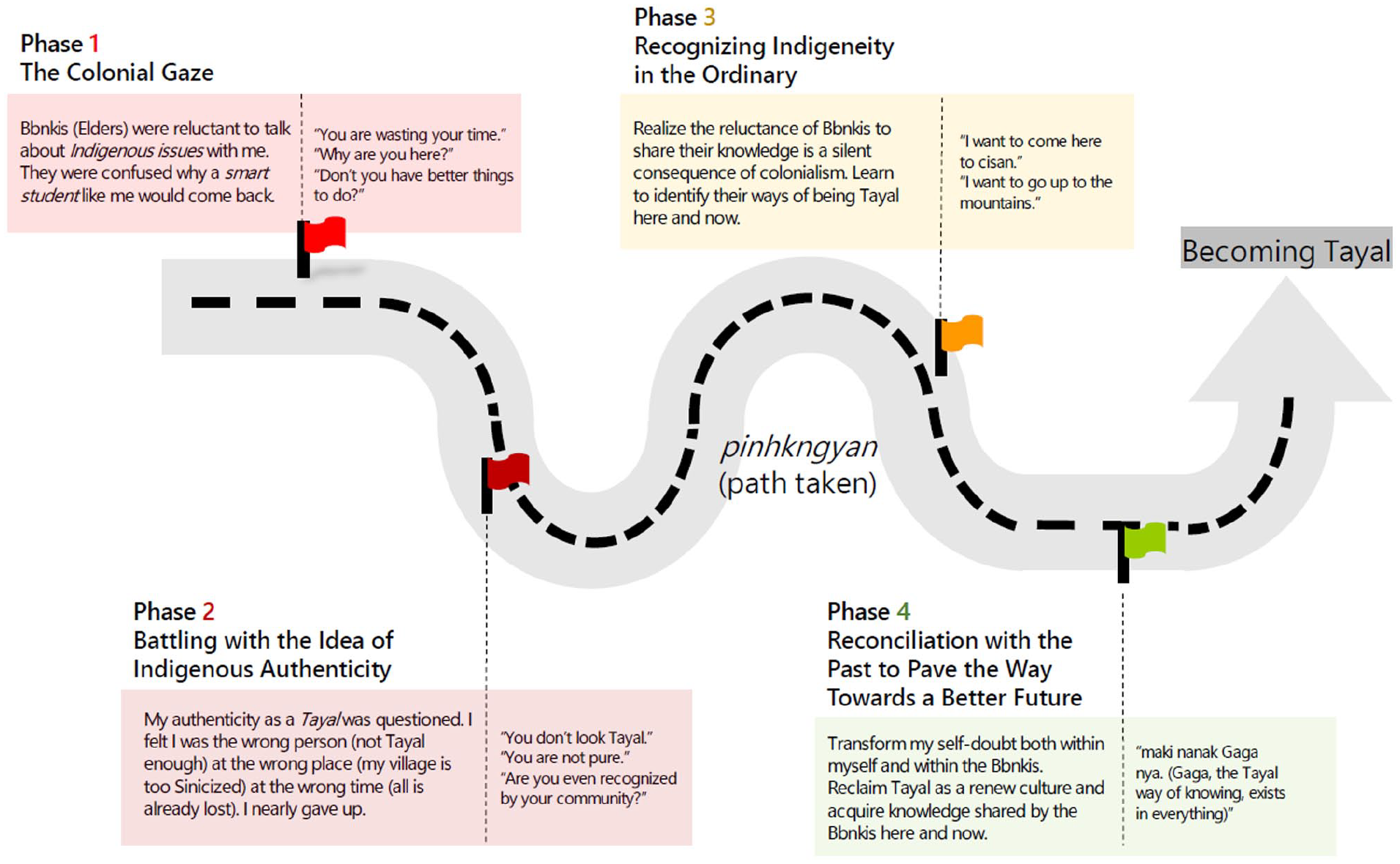
Steps of decolonizing the researcher, visualized as pinhkngyan (Designed by Wasiq Silan).
I can add that during the first round of analysis, I tried to focus on my fluid and nonlinear relationships with the Bbnkis, which means Elders in Tayal language. In this regard, Wilson’s (2008) notion of relational accountability was helpful. Relational accountability means being aware of one’s responsibility and ethical obligations in conducting research in the Indigenous community.
Positioning the author team
To position myself, I can say that my own lineage stems from the mountains of Pinsbkan. I grew up in my paternal grandmother’s birthplace south of Taiwan’s capital, Taipei, and I am now, after periods of doubt and insecurity, a proud descendant of Tayal from the Taranan river valley. My father was raised in a mixed family of a Chinese father and a Tayal mother, and my mother was raised in a mixed family of a Chinese father and a Hakka mother. Colonization of Taiwan by the Japanese (1895–1945) and the Kuomintang’s one-party rule (1945–1980s) aimed to eradicate the cultural identities and languages of local peoples in Taiwan. Therefore, my active engagement with critical social work validated what I intuitively knew regarding the way in which these forcefully removed identities had become an ongoing struggle for people like me. Thus, this article is not only a research article but it also speaks to my own personal process of developing an onto-epistemological positioning of becoming a Tayal researcher, “my own awakening” so to speak (Aluli-Meyer, 2013, pp. 251–252). The second author of this article is of majority ethnic background living and working in one of the Nordic countries. She has a wholehearted interest in critical social research and aims to contribute to social justice for vulnerable groups, including Indigenous peoples, frail older people or persons who for various reasons are excluded from the labor market. We have collaborated closely for more than 3 years in designing research projects, gaining knowledge, analyzing and thinking along with the empirical material from the field, and communicating our findings to a wider audience.
Doing fieldwork in Indigenous communities: outline the four phases of my research process
In the following, I will present the four phases identified when analyzing the empirical material, such as fieldnotes, reflections and transcriptions from my doctoral studies. These phases can be conceptualized by the Tayal concept of pinhkngyan, or the path taken (Figure 1).
Phase 1: the colonial gaze—encountering ongoing coloniality through shame and mistrust
In my Master’s thesis, I got interested in Indigenous health and well-being by exploring the notion of life expectancy gap and disadvantaged health. Soon after finishing my Masters, I decided to pursue my research interest by diving deeper into the topic of social justice in long-term care for the Indigenous peoples, with an empirical focus on my grandmother’s people, the Tayal. Before entering the field, I had read about the effect of harsh assimilative policies and the destructive aftermath on Indigenous well-being and health, outlined for example by the literature on historical trauma (Walters et al., 2011), and I had read about the ethical problems that Indigenous peoples around the world encounter (Smith, 2012). I also prepared myself for fieldwork by learning some Tayal language to show respect and honor the cultural protocols in the community (Datta, 2018).
The first thing I did upon arrival in the Tayal community was to establish a reference group of Bbnkis (Elders), who were invited to act as co-researchers or partners to guide my research goals and priorities. As the reference group was quite positive about my research topic, I thought that the Bbnkis would be happy that a researcher with Tayal heritage would be interested in making their voices heard. I was therefore a bit perplexed to discover that the Bbnkis were reluctant to talk about Indigenous issues with me. For instance, when I asked them to teach me some more Tayal concepts, they sometimes just stared at me, and when I asked questions about Tayal traditional knowledge, they did not answer, or even looked amused as if they thought I was joking. Faced with this situation, I anxiously concluded that probably, I had not quite understood how to successfully collect data in an Indigenous context.
A few weeks later, however, I realized there was an elephant in the room, something bigger than me not having understood how to be a good researcher. In fact, the Bbnkis in the local day club for older people that I continued to visit, gradually shared that they were confused by someone like me—a smart student at university with a prosperous future spending so much time in their midst; why are you even here? they repeatedly asked me. Or don’t you have better things to do? I soon understood that these questions were genuine concerns on their part. They also took the time to kindly explain to me that there is nothing valuable here in the village, so don’t waste your time here.
Phase 2: battling with the idea of Indigenous authenticity
Phase 2 began when I had struggled for quite a while to obtain meaningful data material about aging and culturally safe elderly care from the Bbnkis’ perspective. In addition to telling me that I was wasting my time, I felt that they questioned my authenticity; I had a long university education and I had settled abroad. Thus, according to several of the Bbnkis in the Day Club, I did not live a true Tayal life, and therefore, I was not a real Tayal. In addition, I did not look Tayal! This was expressed, when one of the Bbnkis, over a cup of maqaw (Litsea cubeba; a deciduous shrub, also known as mountain pepper) tea, looked into my face, and concluded that I did not have any traces of the proud Tayal ancestors as I was far too pale (W. Nomin, Tayal entrepreneur in his early 60s). When I explained that even though I grew up in Tayal community, only my father was Tayal, and that even my father was of mixed heritage as my grandfather was Chinese, the Bbnkis declared. “Well, that explains it. You are not pure. You’re only one-fourth Tayal!” Moreover, during my fieldwork, it happened that some of the Bbnkis and others in the community sometimes asked me whether I spoke fluent Tayal, or if I was at least able to recognize some of the plants, animals, and trees in the Tayal forests. Having to answer no to both questions increased my doubt about my right to claim to be Tayal at all.
I hesitantly decided to share some concerns about this issue with a Paiwan researcher. I expected him to be supportive, but instead he commented, “You’ve not been accepted yet by your community, have you?” (V. Gadu, Paiwan researcher in his early 50s). His question caught me off guard. I felt both hurt and confused. Later, he explained that the question he posed had been on his own mind for more than 20 years, as he himself was still not fully accepted by the Elders of his people. For him, being accepted was still an ongoing battle.
At the same time, as my authenticity was questioned, I felt lost and stuck in disjuncture between what I expected the Bbnkis to share with me, and what they actually shared. I, therefore, continued to feel that the methods and theories that I had learned during my university education somehow did not seem to work. In addition, I received comments from different persons that made me doubt not only myself and my methods but also my research idea. Did the older people in the village even have traditional Tayal knowledge to share with me about my research theme? I turned to a senior non-Indigenous scholar who had extensive experience working in Taiwan’s Indigenous communities for help. I was baffled to hear him suggest that I conduct research in other Indigenous communities with less influence and contact with the outside world. He commented that “there is no value in researching the care practices in your village, the old people there are too Sinicized” (A. Wang, Han Chinese project leader in his 50s). This idea was also echoed within the community, by Besu Iban, a community leader, who commented, This village was assimilated way back when tourism came. They [Bbnkis] have lost their traditional culture. They only care about money. [He looked at me and sighed] Even in my generation, we know very little, not to mention in your generation. (B. Iban, community leader, Tayal man in his late 50s)
Tayal culture was talked about as something that was already lost and gone. Speaking frankly, for me, phase 2 was when I almost gave up the whole idea of my PhD.
Phase 3: recognizing Indigeneity in the ordinary
Phase 3 began with a gradual sense of relief when I finally started to connect the dots through actively engaging in conversations with my grandmother and other Bbnkis to heal some of the layered disconnections in my own mind. I also engaged in a more honest, open-minded and reflective journaling. I understood that the reluctance of the Bbnkis to share their knowledge with me could be interpreted as a silent consequence of ongoing colonialism and the traumas it was still causing. This awareness gradually arose in me as the result of several compassionate encounters with other Indigenous scholars who were willing to listen and share their own vulnerabilities and doubts, and how they had overcome them. They also shared their own family’s lived experiences of colonialism. An Elder who was Kanaka Maoli (the Indigenous people of Hawaii, USA) whom I met in a conference when in the intersection between phases 2 and 3, for instance, took the time to truly listen to my worries. She responded with empathy and shared that her own parents had been ashamed of being Indigenous, whereas her own grandchildren were very proud of their Indigenous heritage (A. Fuga, Kanaka Maoli mother, grandmother and activist in her 70s). I also spoke with Sámi (an Indigenous People living in Finland, Norway, Sweden and North-West Russia) researchers in different parts of Sápmi (the land of the Sámi People living in Norway, Sweden, Finland and North-West Russia), who nodded as they shared similar experiences. Hildá, a pseudonym, told me that her mother was frustrated when she learned that her grandchildren were learning to speak Sámi, calling it “a waste of time.” Another Sámi researcher, Ellen Marie Jensen, told me that a few months before her grandmother passed away, the grandmother had shared that she had decided not to pass the Sámi language and identity on to her children: to protect the next generation from the traumas she herself had experienced as a Sámi child in a local school under heavy Norwegianization policy where her mother tongue, Sámi, was banned. The grandmother shared that she still remembered the fear and shock when being taught by teachers from the majority society in a foreign language she took years to learn. Through these shared narratives, I understood that transformation, and reclaiming Indigenous identities is indeed possible even after generations of colonialism. That contributed to sparks of trust and hope.
In phase 3, I also gradually understood that as a researcher, I needed to cultivate patience and humility. Vicki-Ann Speechley-Golden, an educator and grandmother from the Australian Yuin Aboriginal People, South Coast, New South Wales, cautioned me that sensing and adapting to the rhythm of the Bbnkis was crucial. The small snatches of talk that they brought up could perhaps be interpreted as pre-talks to test whether I could be considered ready to listen to their stories with an open heart. I thus realized that although the Bbnkis had not spoken at length about Tayal traditional knowledge as I had expected earlier, I started my fieldwork, I understood that the ways they experienced and conceptualized the world nevertheless was based on their Tayal ways of being and knowing, including the traditional Tayal law called Gaga, which we have described in more detail elsewhere (Gao, 2021; Silan & Munkejord, 2022).
Thus, in phase 3, I started to learn more just from observing the ways the Bbnkis interacted with each other. For instance, on the individual level, I noticed that according to the Bbnkis, being Tayal meant to be qnyat (hardworking), lokah tzywaw (industrious) and ini psayu’ (not speaking ill of others). On the relational level, I noticed the significance of the Tayal notion cisan, meaning storytelling, which is also a form of socializing and relationship building, whereas the Tayal notion rgyax (mountain), often conveyed in musa’ saku’ rgyax (going to the mountain) meant the deep connection the Tayal have with the land. On an ethical level, I learned the concept of malahang, which meant care, caring and governing by keeping the balance between the material and the spiritual world. Malahang, I came to understand, could be maintained by planting vegetables, caring for children and attending the local church.
In sum, I went through a personal restorative process of contributing to healing the wounds of colonial traumas imposed on the Tayal people by being increasingly open about both my personal challenges, and by continuously listening to and storytelling with mentors, advisors, peers, young people and, of course, the Bbnkis themselves. Phase 3, in other words, was about recognizing myself and the Indigeneity of the Tayal people despite generations of colonialism; it was about reconnecting with the past and reclaiming the present. It was also about building trust.
Phase 4: reconciliation with the past to pave the way toward a better future
Phase 4 began when I was able to transform my own self-doubt into recognition of the Indigeneity both within myself and within the Bbnkis. With increased confidence, I understood that when at the beginning of my fieldwork, the Bbnkis had constantly asked me why I was there, they had intended to protect me from the harm they themselves had endured in terms of racism, dispossession, stigmatization, marginalization and learned helplessness. Simultaneously, I came to terms with myself: I initiated a process of forgiving myself for being overwhelmed by a tide of guilt, doubt and shame during the first phases of my fieldwork. I also came to terms with being an authentic Tayal in my own way, despite the ongoing comments from others based on my too pale skin color, partial cultural inheritance according to the logic of purity, as well as on my accent when speaking Tayal, a language I had not learned as a child. In this phase, I realized that being an authentic Tayal did not necessitate going back to the original way of life hundreds of years ago before the first colonizers arrived in Tayal territory. Rather, it was about reclaiming and even renewing the knowledge, culture and language shared by the Bbnkis in the here and now.
I looked back on the paths taken, pinhkngyan, where the Bbnkis had walked alongside with me in reflecting and thinking. I realized that maki nanak Gaga nya, Gaga, the Tayal way of knowing, exists in everything. In my case, everything I had encountered during my fieldwork so far, and all the paths taken, had contained the Tayal law Gaga, whether I was aware of it or not. Through interacting with the Bbnkis, I become aware that exploring care in the Tayal community was not about discovering a single truth, rather, it was about situated knowledge and Gaga-centered relationships. Gaga, in fact, refers to the morality, cosmology and balanced relationship between the Tayal and the environment. It entails the ethical responsibility between different beings. The Bbnkis taught me that care in the Tayal community is to re-orient us to Gaga. It means we can establish relationships with humans, animals, land, rivers, fish, grain and all entities in an ethical way that could sustain everything and make all things flourish in the web of life. In this phase, I started to fully understandsome of the Tayal key tenets of care in the Tayal community in more detail and in relation to each other, such as hmali’ (Tayal language) and the significance of rgrgyax (going to the mountains; Silan & Munkejord, 2022).
In Phase 4, a sense of pride and confidence started to glow in me because I had walked through the valleys of despair and doubt. Moreover, I began the process of reconfiguring power relations and methodological questions in my research. I also started to ponder on questions such as who owns research-based knowledge, whose interests does research knowledge serve, who will benefit from it and how to make Indigenous Methodologies more inclusive (Porsanger, 2004; Smith, 2012).
Discussion
This article highlights how I navigated the issues of Indigeneity, authenticity and legitimacy. My path demonstrates the challenges I experienced when entering a field where colonization was still ongoing. In the following, I will discuss the following three main lessons we can learn from this study; they are reflections related to (1) recognizing myself and being recognized as an Indigenous insider, (2) doing Indigenous research by using existing Indigenous perspectives and methodologies and (3) developing Indigenous methodologies by aligning with the ways of knowing and being in the specific community where the research is done.
How to recognize oneself as an insider in an Indigenous context
The first lesson that I learned is that one cannot take Indigeneity or even insider-ness for granted. Even though I grew up with Tayal relatives in my grandmother’s ancestral village, and had Tayal status printed on my ID, it took a long time of fieldwork until I recognized myself, and was recognized by others, as an insider. In line with Hawaiian epistemologist Aluli-Meyer (2013), I gradually understood that being Tayal, or staying true to Tayal ancestry, is not a what question, but a how question. One is not simply born as an Indigenous person, let alone an “Indigenous knower” (Gone, 2019, p. 49).
At the beginning of my fieldwork, I was not accepted by the Bbnkis, who kept a distance, perhaps to save me from ruining my academic career. This distance or silence was no doubt grounded on multiple layers of trauma that had imposed on them a sense of being impure and inauthentic (Harris et al., 2013), or even urbanized or Sinisized. Faced with such trauma, we need to open up our conceptions of what Indigenous authenticity is. Olsen (2017b) points out that Indigeneity and non-Indigeneity “are not binaries. There are spaces in between—in the cultural interface” (p. 211). In line with this, Blix describes how becoming and being accepted as an insider in the Sámi community was a long and slow process of becoming for herself and her children—which required breaking silences across generations (Blix et al., 2021).
In sum, the first lesson I want to share with you is that Indigenous insider should not be taken at face value. The space in-between cultures (Kaomea, 2004) and even among Indigenous researchers could be intricate (Silan & Mataira, 2019). The genuine meaning of recognizing ourselves lies in an act of allowing ourselves to become decolonizing, community-based researchers, privileging Indigenous research methodologies and community priorities.
How to use existing Indigenous perspectives and methodologies
The second lesson we can learn relates to daring to engage with and use Indigenous research methodologies in meaningful ways. In my case, the four phases elaborated in this article illustrate the transformative steps I took during my fieldwork. These four phases, moreover, shed light on the significance of reverence in Indigenous methodologies, as proposed by Pidgeon (2019). Reverence refers to the importance of the researcher connecting to the spirituality within the Indigenous community or worldview, and in so doing, establishing a genuine relationship to the field. Reverence, I argue, may contribute to combating cognicentrism, which refers to the deep-seated hostility within western knowledge paradigms against ideas, concepts and knowledge outside of one’s own realm of experience (Glass-Coffin & Kiiskeentum, 2012). Reverence not only refers to recognizing the quality of sacred Indigenous knowledge (Pidgeon, 2019), but also includes recognizing the significance of more mundane moments of everyday life (Barnes et al., 2017).
In addition, it is important to reiterate that decolonizing Indigenous methodologies should be developed in an inclusive manner between Indigenous and non-Indigenous researchers and potentially also activists (Brannelly & Boulton, 2017). On one hand, non-Indigenous scholars and students should decenter, and consciously place themselves outside the privileged position (Olsen, 2017b, p. 212), so that the research can be done in different and various ways that would benefit Indigenous peoples, who are ultimately heterogeneous (Skille, 2021). On the other hand, Indigenous scholars need to cultivate skills to identify whether settler researchers honor the vision of Indigenous peoples and ground themselves in the principles outlined by Indigenous peoples (Hart et al., 2017). Together, this inclusive relationship in developing decolonizing Indigenous methodologies has the potential to carve out more space for a collective story based on Indigenous knowing despite the rules of the academy (Lavallée, 2009). This relationship also ultimately challenges the Euro-American ethnocentricity of positivistic paradigms (K. L. Braun et al., 2014).
The phases elaborated in this article, moreover, illustrate that the core of Indigenous research methodologies is about using Indigenous research. It is about growing to be more aware of the paths taken and the reverence cultivated along with each step, and ultimately becoming more aligned to the aims of the decolonization of Indigenous communities. The four phases demonstrate a pathway for how to engage more confidently with the process of decolonization. They also demonstrate, as Shawn Wilson (2008) who is an Opaskwayak Cree from northern Manitoba, Canada, has noted, “If research doesn’t change you as a person, then you haven’t done it right” (p. 135).
How to contribute to the development of Indigenous research methodologies?
The third lesson we can learn from pinhkngyan relates to the importance of openness during the research process. As described in this article, it took me years to finally understand what the Bbnkis’ stories were truly about, probably because I expected them to tell me something else. I expected the Bbnkis, to be knowledge-holders (Datta, 2018), or community leaders who would fight against oppression with a unified and strong voice. I expected that they would teach me how the Tayal build balanced relationship between plants and humans and shower me with Tayal mythologies and stories, so I would not have to learn about the Tayal from museums, but directly learn from them. This did not happen in the way I expected, though. The words of Shawn Wilson (2008) could almost have been mine: The Elders never used to directly confront someone about a problem, or offer direct advice. Instead, the Elder would tell a story from their own life. . . . It was up to the listener to piece together a lesson from the story and to apply the pieces where they fit to help in the current problem. (pp. 27–28)
If I had been more open and had listened to Bbnkis’ indirect stories as piecing together a puzzle, I would probably have understood what the Bbnkis told me much earlier.
But, what does being more open mean? While doing this study, I came to understand that I needed to let go of my assumptions and preconceptions, and rather observe and learn from the Bbnkis’ actual doing, speaking and thinking, as well as from their values, beliefs and spiritual experiences rooted in their own space and time, expressed in their own way. Thus, to be more open means to embody self-in-relations (Graveline, 1998), to embrace wholism (Absolon, 2010) and to cultivate a level of corporeal experience (Bishop, 1999). For me, this meant gradually becoming physically, intellectually, emotionally, morally, ethically and spiritually ready to engage in the co-production of knowledge. Instead of talking about my research, my idea, my PhD, the Indigenous research should always begin with seeing if the study is wanted or needed by the community. My focus on my study in the beginning of my PhD journey can probably explain parts of the challenges I experienced, until I was able to reconnect, and thus obtain a more honest, open minded and reflexive presence in the community. In that way, my study gradually became a collective undertaking in phase 3.
Moreover, while developing Indigenous research methodologies may seem specific and local, the implications are general and global. Developing Indigenous research methodologies is to defend Indigenous self-determination and sovereignty. It is a way to actively refuse western positivist theories and methods as they uproot Indigenous cultures, knowledges and worldviews by labeling Indigenous systems as primitive. In other words, developing Indigenous research methodologies has its distinctive genealogy. Thus, in line with The United Nations Declaration on the Rights of Indigenous Peoples (UNDRIP), I argue that “any research involving Indigenous peoples should support Indigenous peoples’ pursuit of self-determination” (McGregor, 2018, pp. 300–301). Developing Indigenous methodologies in Critical Social Work and beyond is an active act of decolonization, both in terms of (1) deconstructing coloniality and the colonial ideology of superiority that used to dominate research about Indigenous peoples and (2) reconciling relationships between Indigenous and non-Indigenous worldviews and ways of knowing.
Conclusion
This article has focused on the four phases I experienced during my doctoral journey and the lessons learned. The four phases include passing from the colonial gaze where I encountered ongoing coloniality through shame and mistrust; the phase where I battled with the concept of authenticity, through the phase where I started to recognize Tayal Indigeneity in the ordinary, before finally, being able to reconcile with the past at both a personal level and at the community level. In the discussion, I reflect on how to recognize oneself as an insider in an Indigenous context, how to use existing Indigenous perspectives and methodologies and how to contribute to the development of Indigenous methodologies. Simultaneously, the article highlights my process of gradually recognizing myself and being recognized as a real Tayal despite my pale looks, as well as recognizing myself and being recognized as an Indigenous scholar.
Ultimately, Indigenous research methodologies are about establishing an ethical space (Ermine, 2007) between Indigenous and academic ways of knowing with the aim of making a roadmap for a better, shared future. My hope, in this regard, is to engage students and researchers to enter this ethical space, and in that way, to contribute to the decolonizing processes of Indigenous and majority communities worldwide. If not you, who? And if not now, when? This story is about listening, recognizing, reclaiming, becoming, and doing. So, go back to the community that calls upon you. Celebrate the process of doubt when feeling stuck or in-between. Find strength in becoming an insider. If not you, who? And if not now, when? —Untitled poem by Wasiq Silan, first author, written in collaboration with Mai Camilla Munkejord, second author
Footnotes
Acknowledgements
The authors express their gratitude and humility to rhiyal, hllahuy, llyung, hlaqiy, bbehuy, tqinuw, syax wagi ki syax byacing: the land, forests, rivers, snow, wind, and mushrooms, sunshine and moonlight. They are deeply grateful to those—elders and youth, women and men, Indigenous and non-Indigenous scholars and practitioners—who have committed themselves to pinhkngyan, paths to recognize, doing and developing Indigenous methodologies.
Authors’ note
Declaration of conflicting interests
The authors declared no potential conflicts of interest with respect to the research, authorship and publication of this article.
Funding
The authors disclosed receipt of the following financial support for the research, authorship and publication of this article: Norwegian Research Council (287301); Norway Centre for Research Data (577949).

Glossary
Bbnkis Elders
cisan storytelling; visiting, socializing, building relationship
Gaga the Tayal Law; moral order; sacred law and cosmology, which entails balanced relationship between people and the environment; the center of life
hmali’ tongue; Tayal language
ini psayu’ not speaking ill of others
lokah tzywaw industrious
maki nanak Gaga nya Gaga exists in everything
maqaw Litsea cubeba; a deciduous shrub, also known as mountain pepper
malahang care and caring between people, humans, animals and with land
musa’ saku’ rgyax going to the mountain
pinhkngyan path taken
qnyat hardworking
rgyax mountain
rgrgyax mountains
Chinese language
Kuomintang Chinese Nationalist Party
Japanese language
aiyūsen military guard line
Sámi language
Sápmi the land of the Sámi People living in Norway, Sweden, Finland and North-West Russia
Indigenous Peoples
Kanaka Maoli the Indigenous people of Hawaii, USA
Opaskwayak Cree an Indigenous People living in Canada
Paiwan an Indigenous People in Taiwan
Sámi an Indigenous People living in Finland, Norway, Sweden and North-West Russia
Seediq an Indigenous People in Taiwan
Tayal; Atayal an Indigenous People in Taiwan who speak the Tayal language
Truku an Indigenous People in Taiwan who speak the Truku language
Yuin a group of Australian Aboriginal peoples from the South Coast of New South Wales