



Abstract
This article explores existing research related to mixed-blood Indigenous individuals in an effort to reveal a more complete picture of social inequality that exists within and between the binary categorization of Indigenous and non-Indigenous within Canada. Tracing a line through past and present discriminatory assimilationist policies, this article reveals the pervasive challenges associated with living as a mixed-blood Indigenous person in this country. Marked by a perpetual struggle to gain recognition from both Indigenous and settler populations, individuals living within this marginal identity face a structure of inequality that is little explored in contemporary research literature.
Introduction
In much of the Indigenous scholarship in Canada that presently exists, sociological perspectives related to Indigenous Peoples in this country tend to be centred on binary conversations related to differences and inequalities apparent between Indigenous and non-Indigenous populations. While certainly important, these broad stroke conversations tend to diminish each of these people groups into a homogeneous categorization that betrays the true diversity inherent therein (Satzewich & Wotherspoon, 2000; Voyageur & Calliou, 2001). The impossibility of fitting the sheer diversity and complexity of over 600 Indigenous groups into simplistic European-imposed categories has resulted in a variety of complications and exclusions that are felt and fought differently within each Indigenous society (Voyageur & Calliou, 2001). Perhaps most importantly, these conversations fail to recognize the lived realities and struggles of those people who fall somewhere in-between the seeming duality of Indigenous and non-Indigenous.
After over a century of exploitative and assimilatory politics, Canada has established a foundation of deep structural inequalities alongside a distrustful and strained relationship between the Canadian government and Indigenous Nations. Critical to the inflammatory friction that currently characterizes the federal government’s relationship with Indigenous Peoples is the identification marker known as Indian status. Simultaneously a sanctioned label for structural racism and a recognition of rights, maintaining Indian status has come to mean many things. Remarkably, Indian status has become so enmeshed with rights and recognition within the Indigenous political landscape that one of the most prominent struggles in relation to the issue of status has been a call for its expansion, rather than its removal.
Over the past few decades, there have been several significant modifications related to government recognition and Indian status. Of particular note was the addition of Métis (one of Canada’s three recognized Indigenous groups, encompassing a distinct culture reflecting their blend of Indigenous and European ancestry) as a recognized Indigenous people group under Section 35(2) of the Constitution Act 1982 (Bell, 1991). Furthermore, Bill C-31 was introduced to amend the Indian Act 1985; the amendment removed the mechanism that formerly stripped an Indigenous woman of her status upon her marriage to a non-Indigenous man (Indian Act 1985; Native Women’s Association of Canada, 2018). Both of these developments, alongside other gains, marked significant milestones in the re-conceptualization of Indian status and Indigeneity, as they opened up new legal avenues for government recognition of these identities. While these may be perceived in many ways as advancements, they should not be understood as broad sweeping wins on the side of Indigenous Nations. Rather, these changes represent amendments to government-led assimilatory polices that continue to govern Indigenous rights and recognition in Canada (Dennis, 2015; Lawrence, 2004).
As the boundaries of Indigeneity continue to be contested, defended, redrawn, and reconstituted, there is little research and recognition of the structural inequalities that are fomented through these processes. Specifically, research fails to consider the experience of those who have had to forge identities on the margins of government-regulated identity markers. This article will look at those scholars who are engaged in research and discussion related to the lived experiences of mixed-blood non-status Indians and Métis individuals in order to reveal a more complete picture of social inequality that exists within and between the taken-for-granted categories of Indigenous and non-Indigenous.
Breeding out Indigeneity: the Indian Act, 1876–1985
While the Indian Act 1985 represents the principal document governing status among First Nations Peoples in Canada, this Act evolved from several earlier policies, which sought to formally negotiate relations between Indigenous and non-Indigenous Peoples. The Royal Proclamation of 1763 first charted the manner in which colonial powers should engage with Indigenous populations and outlined the process by which the government could respectfully acquire their lands (Government of Canada, 2013). Policy documents evolving from this proclamation began laying pathways for greater assimilation of Indigenous Peoples into the settler culture that was quickly spreading across the land. In the Act for the better protection of the Lands and Property of the Indians in Lower Canada 1850, the government of the colony of Canada officially gave itself the role of delineating what or who was considered an Indian (An Act for the Better Protection of the Lands and Property of the Indians in Lower Canada 1850; Lawrence, 2004). To be an Indian, according to this Act, one had to have Indian blood; had to belong to a Body or Tribe of Indians; or had to be married to, adopted by, or descended from such an individual (An Act for the Better Protection of the Lands and Property of the Indians in Lower Canada 1850). Shortly thereafter followed the Act to Encourage the Gradual Civilization of the Indian Tribes in This Province, and to Amend the Laws Respecting Indians 1857, also known as the Gradual Civilization Act 1857 and the Act for the Gradual Enfranchisement of Indians, the Better Management of Indian Affairs, and to Extend the Provisions of the Act 31st Victoria, Chapter 42, also known as the Gradual Enfranchisement Act 1869. These Acts were developed as a means for Indigenous Peoples to voluntarily give up their status in return for a small parcel of land and the right to vote. Within the Gradual Enfranchisement Act 1869, the government also outlined patriarchal stipulations, by which the family of a non-status individual would also automatically lose their status (An Act for the Gradual Enfranchisement of Indians, the Better Management of Indian affairs, and to Extend the Provisions of the Act 31st Victoria, Chapter 42 1869; An Act to Encourage the Gradual Civilization of the Indian Tribes in This Province, and to Amend the Laws Respecting Indians 1857). It is no surprise that Indigenous Peoples were unwilling to give up their culture, rights, and Indian status. Thus, the government’s efforts to assimilate the Indigenous populations continued to coalesce into firmer manifestations, ultimately culminating in the infamous Indian Act 1876.
The Indian Act 1876 essentially built upon the earlier assimilation policies to establish a crude framework, which was artificially laid onto Indigenous Peoples across Canada, extinguishing existing Indigenous self-governing structures, and coercively forcing these populations into a European-led understanding of what it meant to be Indigenous (Lawrence, 2004; Native Women’s Association of Canada, 2018). When the Indian Act 1876 came into effect, it defined Indians as “First. Any male person of Indian blood; Secondly. Any child of such person; Thirdly. Any woman who is or was lawfully married to such person” (Indian Act 1886, p. 1). Women were treated much like property would be within this Act, and provisions outlined the fact that status women marrying non-status men would lose their status, and non-status women who married status men would gain status (Indian Act 1886; Native Women’s Association of Canada, 2018). Intermarriage between Indigenous Peoples and settlers was not an uncommon occurrence across the land, particularly during the fur trade era when relations between these groups were stronger; the motivations for such unions varied from violent economic pursuits to a desire to expand kinship ties (Graybill, 2016; Van Kirk, 2002). Upon marrying a non-status man, however, these women were forced away from their cultural ties as they were required to relinquish their status (Naumann, 2008).
At its core, the Act represented a forceful attack on behalf of the Canadian government to eliminate Indigenous Peoples and to acquire their land. Other provisions within the Act included the loss of status as a result of earning a degree or becoming a doctor, lawyer, or clergyman. The act of losing one’s status was treated throughout the document as a positive development and was termed enfranchisement; the government unashamedly devalued Indigenous cultures and took for granted the societal goal of assimilation (Indian Act 1886; Native Women’s Association of Canada, 2018).
The Indian Act 1876 was not just a legally constricting document, it was also a socially destructive artefact, particularly when considering gender politics. When Europeans arrived in North America, the role of women in many Indigenous societies was honoured and respected. In these societies, they had a strong identity not rooted in patriarchal subjugation and possession by men (Baskin, 2019). However, this position of women was corrupted, alongside that of men, through the imposition of European ideals of gendered roles in society, as became embodied in the Indian Act 1876 (Naumann, 2008).
Following the initial institution of the Indian Act 1876, the federal government proceeded to enact new regulations which sought to restrict the rights and freedoms of Indigenous Peoples even further, while trying to forcefully assimilate their populations into the European mainstream. These regulations included restrictions on the behaviours and movements of Indigenous Peoples, increased paths of enfranchisement, greater government control over Indigenous land, and, most disturbingly, the mandatory attendance of Indigenous youth in residential schools (Native Women’s Association of Canada, 2018).
Gradually, the brutal discrimination and assimilatory practices perpetrated through the Indian Act 1876 began to be recognized. In 1960, Indigenous Peoples were granted the right to vote in federal elections and in 1961, compulsory enfranchisement was removed from the Act. In 1969, the government proposed the idea to eliminate the Act altogether in a White Paper. Recognizing this as a threat to Indigenous rights, including land rights, the Indigenous populations in Canada reacted with a strong backlash. Ultimately, the White Paper was discarded (Native Women’s Association of Canada, 2018; Tsukada, 2016).
The Canadian government experienced mounting pressure in opposition to the sexist tenants within the Indian Act 1876. While this battle was left largely to an invisible backdrop for nearly the first century of the Act’s existence, in 1970, the Royal Commission on the Status of Women released a recommendation regarding the repeal of sexist provisions within the Act. In 1978, the government formally acknowledged in a report the sexist nature of women losing their status through marriage. It would not be until 1985, however, that Bill C-31 would come into effect, finally removing the marrying out rule within the Indian Act 1985 (Indian Act 1985; Native Women’s Association of Canada, 2018).
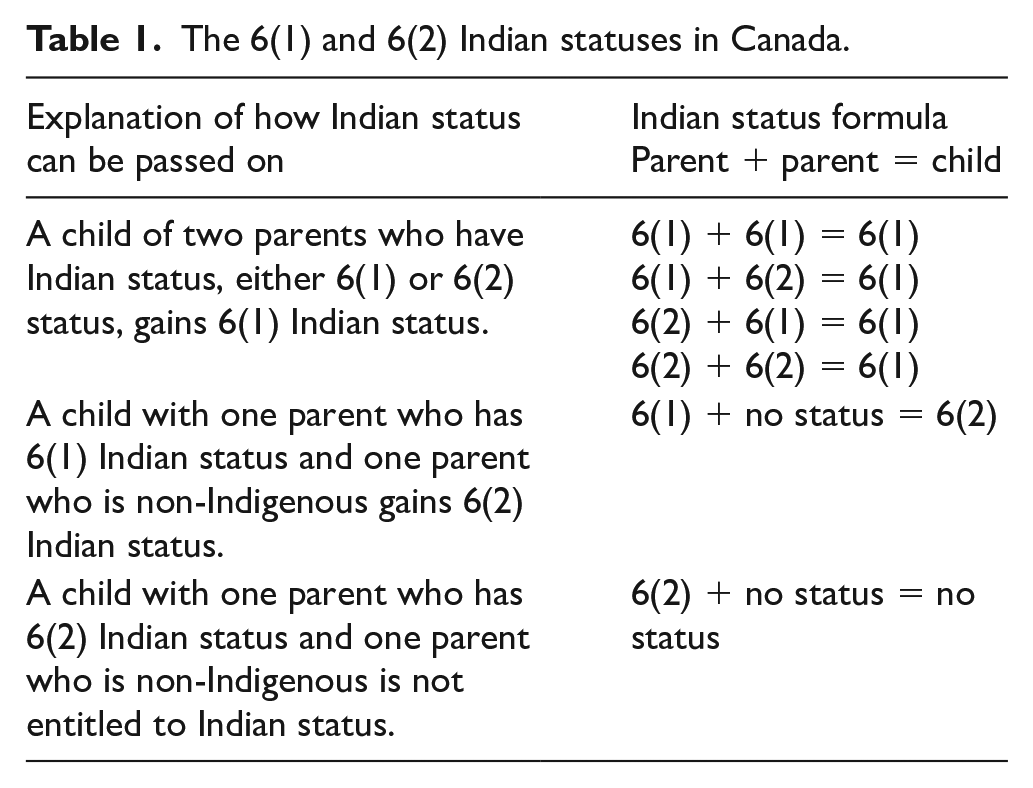
While Bill C-31 was rightfully seen as a win for many Indigenous Peoples, it also served as somewhat of a Trojan horse, as it established a new assimilatory measure achieved through the introduction of a tiered status system, which remains in effect today. This system ultimately enables the government to maintain a structure in which Indigeneity can still be bred out. More specifically, sections 6(1) and 6(2) Indian statuses legislate how Indigenous individuals inherit their Indian status. Section 6(1) includes a variety of provisions associated with the entitlement to status according to lineage and historic connections through the registration system. Section 6(2) is applied to children with one non-Indigenous parent and one parent with 6(1) status. As captured in Table 1, a child of a 6(2) status Indian and a non-Indigenous person is not entitled to status at all (Indian Act 1985; Native Women’s Association of Canada, 2018).
The 6(1) and 6(2) Indian statuses in Canada.
There have been efforts since the introduction of Bill C-31 to further remove gender inequities that continued to plague the Indian Act 1985. Of note, in 2011, Bill C-3 was introduced and later, in 2017 and 2019, additional changes were made to the Act through Bill S-3. Each of these amendments sought to further expand the ability for First Nations women to regain their status and the status of their children, recognizing the cascading impacts of decades of gender-based discrimination within the Indian Act 1876. While these amendments made notable improvements, they did not remove the tiered status system (An Act to Amend the Indian Act in Response to the Superior Court of Quebec Decision in Descheneaux c. Canada (Procureur général) 2017; Assembly of First Nations, 2020; Government of Canada, 2019; Indigenous Services Canada, 2020).
It is clear within the present status system that blood quantum continues to play a significant role in Canada’s understanding and recognition of Indigenous Peoples. Their hierarchical ranking of 6(1) and 6(2) Indians entrenches what is largely known as a second-generation cut-off rule, which to many represents a system of racial discrimination based on an enforced (mis)understanding of blood-line purity (Naumann, 2008; Palmater, 2011).
For those facing loss of status, they find themselves in a cultural no-man’s-land, sliding into the cracks between settler and Indigenous identities. Some of these individuals have turned to the identity of Métis, naturally adding additional confusion in Canada’s perpetual battle to cleanly delineate Indigenous identities (Naumann, 2008).
The continued efforts on behalf of the government to breed out Indigeneity speak to a desire to limit responsibilities associated with Indigenous rights. The political discrimination associated with these efforts is perhaps best illustrated in a comparison between Indigenous identity politics and those of African Americans in the USA. Historically, having a large Black population was beneficial to settler populations—as they represented a slave base for exploitation—whereas having an Indigenous population was seen as detrimental, as they represented a population with unique rights, including rights to land, which the settler populations wished to claim. Given these contradictory incentives, European settlers employed an expansive identity policy for African Americans, by which only a drop of African blood meant that the person would be identified as Black. Meanwhile, for Indigenous populations, a subtractive system was employed, in which Indigeneity was slowly diluted through engagement within European society and, most notably, through intermarriage (Tuck & Yang, 2012; Wolfe, 2006). These conflicting identity models continue to play a major role in how identity is constructed within these populations in Canada and the USA.
Fighting to be seen: non-status Indians
Although it remains an ambiguous and nebulous category, non-status Indian currently refers to those who identify as First Nations Peoples, but who are not officially registered through the Indian Act 1985; they are typically mixed-blood individuals who are ineligible for status as they have fallen outside the stringent regulations captured within the Indian Act 1985 (Indian Act 1985; Siggner & Peters, 2014). In other instances, however, these individuals may represent unrecognized Peoples, who, through historic injustices and erasure tactics, have never had access to status (Lawrence, 2012).
There is very little research conducted on non-status Indians within Canada, and this lack is particularly stark for empirical research. Siggner and Peters (2014) represent one of the few works in this field; using 1996, 2001, and 2006 long-form Canadian census data, they derived the non-status Indian population in order to determine their demographics and socioeconomic realities as compared to other populations in the country. In this study, they find that non-status Indians are more likely than any other Indigenous group to live in urban centres. When looking at age profile, mobility, education, employment, income, parenting, and housing, non-status Indians are found to be almost identical to all other urban Indigenous Peoples. Comparing non-status urban Indians to non-Indigenous Peoples, however, reveals a different story. In almost all socioeconomic categories, non-status Indians fare worse than their non-Indigenous counterparts (Siggner & Peters, 2014). Meanwhile, urban Indigenous Peoples across Canada tend to be overrepresented in the poorest neighbourhoods within Canadian cities (Culhane, 2003).
Dennis (2015) conducted research regarding the pervasiveness of racism within situations of frequent contact and intermingling between Indigenous and non-Indigenous Peoples in Canada. Within his research, he noted that, despite frequent positive interactions with their Indigenous neighbours, non-Indigenous people continue to perpetuate laissez-faire racism, blaming Indigenous Peoples for their disadvantaged position and denying any relevance of historic wrongs or need for retributive programmes. Within this research, he finds that racism of this nature is not limited to status Indians but also extends to non-status Indians and Métis. This research again highlights the similar disadvantages realized by those with and without status (Dennis, 2015).
While non-status Indians face the same disadvantaged position as their city-dwelling status neighbours, Siggner and Peters (2014) note a critical difference they face: non-status Indians are not entitled to those government supports and services that are extended to status Indians. For instance, they do not have the right to live on reserve or engage politically in band activities. They are also excluded from any government assistance provided to off-reserve Indigenous Peoples (Siggner & Peters, 2014).
According to Voyageur and Calliou (2001), in the past, the category of non-status Indian was primarily used to describe those individuals who had lost their Indian status through the assimilationist policies implicit and explicit within the Indian Act 1876. It was also used to describe Métis people and those of mixed descent in earlier years. They propose that since Bill C-31 came into effect in 1985, most of those who had lost their status regained it, and those now categorized as non-status Indian make up a smaller group (Voyageur & Calliou, 2001).
This is a common perception regarding non-status Indians that, while true to an extent, ignores a more holistic recognition of the damage wrought by the Act’s sexist measures. For instance, research has shown that, when Bill C-31 came into effect, there were many women who were already so removed from their communities that, while technically eligible for status, they felt both unwelcomed and detached from their community-based Indigenous identity. These women, at times, chose not to pursue the often long and painful bureaucratic process of regaining status (Culhane, 2003; Lawrence, 2004). Moreover, the assumption that Bill C-31 significantly reduced the category of non-status in one fell swoop is a line of thinking situated in a point in history, which neglects the continued relevance of the assimilatory regulations of the Canadian government in moving generations of Indigenous children into this ambiguous and nebulous space of non-status (Palmater, 2011). While there have been some continued gains on this front, with more non-status people regaining their status after Bill C-3 and S-3, there is still the perpetual issue of the tiered 6(1) and 6(2) statuses.
Assessing the second-generation cut-off rule, Palmater (2011) argues that this stipulation is leading to a growing number of non-status children and that ultimately Indian bands across the country should expect to eventually become extinct (Palmater, 2011). She argues that, although the Canadian government was the one to implement the crude Indigenous identifier of status, after over a century of using Crown categorizations, First Nation Bands themselves have begun to embody these delineations, leading to the same discrimination of racialized blood quantum being applied at the community level (Palmater, 2011).
Palmater strongly opposes the Canadian government’s legal determination framework for First Nations Peoples. As she poignantly states, The use of one-quarter blood quantum or degree of descent from a status Indian as a means of excluding Indigenous Peoples from registration as Indians is either racial discrimination or an analogous ground of blood quantum/descent because it perpetuates racist stereotypes about Indigenous People based on a physical characteristic over which the affected individual has no control. Further, the government has no business in determining what is an appropriate biological connection to equate with an Indigenous identity through status. (Palmater, 2011, p. 118)
Palmater points to the provisions regarding status as having kept thousands of families of non-status Indians from enjoying the fullness of their cultural heritage, including inhibiting access to Elders and cultural practices. She claims that these injustices, while originating from a colonial power, have resulted in discrimination and marginalization within Indigenous communities, essentially creating fissures along imaginary—yet legally relevant—heritage lines. She states that the invisibility of non-status Indians has resulted in funding gaps and lower socioeconomic performance among these populations and that the label of non-status Indian can be so harmful that it should be considered a deprivation of freedom (Palmater, 2011).
Palmater claims that having proof of Indian status has now become a marker to others of true Indigeneity; it now dictates how you will be seen and treated by others within the Indigenous community. She states that the imposed categorization of status and non-status Indians as determined by the Canadian government has been demeaning to Indigenous Peoples (Palmater, 2011).
Palmater (2011) suggests that rather than understanding and recognizing Indigenous Peoples through an imposed lens of “status, blood quantum, residency, marriage partner, or tradition,” Canada should concentrate on Indigenous Peoples’ holistic connections to Nations (p. 189). She believes that the status versus non-status divide leads to cracks within communities and detracts from the full potential of members to meaningfully contribute. Moreover, the understanding of status continues to stem from a view of pure Indigenous Peoples and culture from an historic time (Palmater, 2011).
Within this line of thinking, Palmater condemns Canada’s perpetual drive to see Indigenous Peoples through a romanticized understanding of a traditional culture existing before the arrival of Europeans. She asserts that “to limit Indigenous people to pre-contact cultural practices not only locks them in a cultural time box, but sentences them to cultural death when change occurs over time” (Palmater, 2011, p. 64). She proposes that Indigenous Peoples must be able to maintain their communal and cultural identities in a way that is flexible and takes into consideration the diversity represented within the lived experience of being Indigenous. This will be what ensures the long-term survival of these cultures for future generations (Palmater, 2011).
In her research on mixed-blood urban Indigenous Peoples, Lawrence (2004) draws very similar conclusions to Palmater (2011). She points out that mixed-blood Indigenous Peoples constantly have to negotiate external denials and affirmations associated with their Indigeneity, usually according to how closely they conform to externally imposed standards of what is understood to be Indigenous. She notes that when Indigenous People are seen as behaving in a manner outside of an historic understanding of Indigenous authenticity, they can be dismissed as being fake. This curtails the ability of Indigenous Peoples to enjoy an uncontested identity in a modern environment (Lawrence, 2004).
Lawrence argues that most mixed-blood Indigenous individuals struggle in their ability to identify as Indigenous, and she notes there is a highly gendered aspect to Indigenous exclusion, pointing to an over-representation of people with Indigenous lineage on their mother’s side identifying outside of strict Indian status. Understanding that women had a legacy of losing status as a result of intermarriage, this finding is not surprising (Lawrence, 2004).
Lawrence points to the fact that as mixed-blood Indigenous Peoples living in urban centres choose to look seriously at their Indigenous heritage, they are confronting the cultural genocide that in many cases resulted in them becoming distanced from their Indigenous heritage to begin with. Indeed, she points out that many urban Indigenous youth were forced to grow up in a highly racist environment, where flying under the radar and trying to be seen as White meant survival. These survival tactics were necessary not only in formal interactions but often were required in everyday living among family and friends. In fact, it is often the White family members of these mixed-blood individuals who engage in psychologically manipulative acts of racism in order to quash any claims to Indigeneity within their family. This politically applied racial binary, when played out at the household level, results in mixed-blood individuals feeling forced to fight for Indigeneity or abandon it in submission to the dominant White culture. Many, however, find themselves somewhere in-between, feeling like they do not have a legitimate claim to either identity in full. They find themselves having to “force their lives into the categories available and to use brutal clarity, silence, denial, and humor to deal with the ways in which they do not fit these categories” (Lawrence, 2004, p. 151). Lawrence notes that the painful price associated with this hidden identity is a generational loss of cultural knowledge and belonging and resulting feelings of ambiguity and unbelonging in the Indigenous world (Lawrence, 2004).
Although mixed-blood urban Indigenous individuals sometimes tout the irrelevance of official Indian status, they also contradictorily view it as a seal of Indianness, and one of their key aspirations is the expansion of the Indian category to actually include them (Lawrence, 2004). This struggle highlights the inequality that currently exists within Indigenous groups stemming from the colonial legacy of crude racial categorization. Emphasizing this point, Lawrence (2004) states, Canada has been able to use Indian status to define who can be considered Indian in ways that have alienated whole communities from any access to a land base and permanently fragmented Native identity through an extremely patriarchal and racist system that has torn large holes in the fabric of Native societies. (p. 229)
Lawrence points to a need for connection between Indigenous Peoples in urban and reserve settings, so as to ensure the cultural health and survival of Indigenous groups. Mixed-blood urban Indigenous Peoples long for a connection to their ancestors and to community which racial legislation over centuries has eliminated. As more Indigenous Peoples begin to live in cities throughout Canada, looping in non-status individuals is critical for the survival of Indigenous cultures and populations (Lawrence, 2004).
While the struggle for recognition among non-status mixed-blood Indigenous Peoples progresses, there also exists a legitimate desire within Indigenous communities to protect their cultural boundaries from settler trespassers. Tuck and Yang introduce a concept of settler moves to innocence, in which non-Indigenous individuals seek manners in which to latch onto Indigenous culture in such a way that they can shed any responsibility for self-reflection and escape the discomfort of settler-guilt. One of these moves to innocence is a phenomenon in which White settlers claim to have a long-lost Indigenous relative, which grants them legitimacy in Indigenous spaces. This tactic, alongside widespread acts of cultural appropriation, is enough to threaten the boundaries of Indigeneity (Tuck & Yang, 2012).
The attempted intrusion of White people into Indigenous spaces can leave Indigenous Peoples feeling defensive of their cultural boundaries and understandably leads to the cementing of defence walls. This is problematic, however, as other mixed-blood Indigenous People are found outside of those walls. Naumann (2008) points to personal narratives of non-status Indians feeling unworthy of officially identifying themselves as belonging to an Indigenous Nation and points out that this tends to be most pronounced in cases of mixed-blood individuals who inherit distinctly European physical traits, such as light hair or eye colour (Naumann, 2008). Likewise, Lawrence reveals the seeming importance of appearances in identity construction among mixed-blood urban Indigenous Peoples. She finds that mixed-blood individuals with paler skin tend to feel inauthentic in their own identity given their inherited genes, resulting in a constant struggle among pale-skinned mixed-blood Indigenous Peoples against racial understandings of who they are and what they should look like (Lawrence, 2004).
Naumann points out that non-status Indigenous Peoples are often excluded from reserve and band-life on account of their mixed ancestry and lack of status. Consequently, she notes, some of these individuals turn to the recognized category of Métis as a way of accessing a legitimate space for their mixed identity (Naumann, 2008).
The Métis identity
Exploring the Métis identity in the same context as non-status Indians in Canada is a relevant layer in the discussion, as the historical struggles and present-day debates regarding the racial and cultural parameters associated with Métis-ness mirror in myriad ways those struggles faced by First Nations Peoples grappling with the government recognized framework of status.
The Métis identity sits atop a complex nest of historical events and cultural convergences; this has led to a complicated, and often conflicted, understanding of these Indigenous Peoples. The beginnings of this identity are found in the intermarriage of European and Indigenous Peoples, which resulted in a large group of individuals with mixed ancestry that did not neatly fit within Indigenous or settler identities (Voyageur & Calliou, 2001). It is broadly recognized that the culture that emerged from this new community was unique and thus represented a People on its own, and this community further coalesced in the form of collective action for political and social independence and direct confrontations in the pursuit of Métis nationalism (MacDougall, 2012). Ultimately, the Canadian government was forced to acknowledge their existence towards the end of the 19th century, and established a shallow process of rights recognition, known as the scrip system, whereby Métis could receive from the government either money or a formal title to their land (MacDougall, 2012).
In fact, it was not until 1982 that the Canadian government formally recognized Métis as a legitimate Indigenous group. At this time, Métis were included in the Constitution Act 1982 Section under 35(2) (Bell, 1991). This did not represent a concrete commitment, however, on behalf of the government, as the term Métis was left undefined, and it did not clarify whether the Métis had existing Indigenous rights (Bell, 1991).
Several years later, the rights of Métis were further defined through R. v Powley (2003). This case represented a dispute over hunting rights; however, it was historic in that it was the first major Indigenous case that specifically concerned Métis rights. Since this time, two other major cases have also come forward concerning Métis: Manitoba Métis Federation Inc. v Canada (Attorney General) (2013) and Daniels v Canada (Indian Affairs and Northern Development) (2016). In Manitoba Métis Federation Inc. v Canada (Attorney General) (2013), the Supreme Court declared that the Canadian government had failed in its constitutional obligation captured in the Manitoba Act 1870, which committed to providing land to the children of the Red River Métis. Thereafter, the government committed, through a Memorandum of Understanding, to seeking a solution with the Manitoba Métis Federation on this issue (Government of Canada, 2016). In Daniels v Canada (Indian Affairs and Northern Development) (2016), the Supreme Court ruled that it was the federal government’s responsibility, rather than provincial governments, to enact on behalf of issues related to both Métis and non-status Indians, opening up potential new avenues for future discussions related to the rights of these Indigenous Peoples (Daniels v Canada [Indian Affairs and Northern Development], 2016).
Although the Métis are understood to have adopted a unique culture of their own, there are still those who do not ascribe to this culture but that are of mixed ancestry and thus self-identify as Métis (Voyageur & Calliou, 2001). Siggner and Peters (2014) point out that even though Métis people originating from areas now known as British Columbia, Saskatchewan, Manitoba, and Ontario appear to have a relatively clear distinction of what constitutes a Métis, Indigenous Peoples of mixed descent coming from other parts of Canada seem to use this identifier more freely. This identity is tied up in an understanding of Métis in terms of their dilution of Indigenous blood (Siggner & Peters, 2014).
There is also division within the Métis based on descendance from either the Red River area, which is situated in modern-day Manitoba or that claim ancestry from other parts of North America. Andersen (2014), for instance, firmly asserts that the Métis people are a distinct culture originating from the Red River region. He proposes that this group should be understood in terms of peoplehood, rather than nationhood, and that their origin can be drawn through an events-based history in which their identity was cemented through key historic moments. In particular, he points to five such moments: the Battle of the Seven Oaks in 1816, the disruption of the Hudson Bay Company’s monopoly in 1849, the Battle of Grand Couteau in 1851, the Red River uprisings in 1869–1870 and 1885, and the dispossession of the Métis that rippled out from the Manitoba Act 1870. Andersen cautions against superficial understandings of Métis simply in terms of mixedness or hybridity between Indigenous and European ancestry and refutes the idea that Métis from communities with no ties to the Red River Métis should be associated with this identity. Rather he stands firmly in the position that the Red River Métis are the only legitimate Métis, in that they are the ones that actually adopted this identity historically. His key argument rests on the premise that they can claim this identity because their ancestors did so (Andersen, 2014).
Interestingly, throughout his argument, Andersen utilizes similar language regarding the struggle of the Métis to that experienced by present-day mixed-blood non-status Indians. Most notably, regarding the struggle they face due to their mixedness and their longing for recognition. As he states, “Métis are classified as hybrid—with all the denigrating connotations of the term—in ways that deny that which we seek most, an acknowledgment of our political legitimacy and authenticity as an Indigenous people” (Andersen, 2014, p. 38).
Chartrand (2003) follows much the same line of reasoning as Andersen when it comes to defining the parameters of Métis. He affirms that the Métis identity should be associated with those people who have historic ties to the Red River Métis only. He posits that “Aboriginal rights are based in history. Their present purpose is to protect the interests of Aboriginal peoples that were at stake upon the assertion of Crown sovereignty” (Chartrand, 2003, p. 89). Thus, much like Andersen, Chartrand points to ancestral claims to Indigeneity as the legitimizing factor in the adoption of a given Indigenous identity. He claims that those Métis who are approaching their claim in terms of their mixedness between Indigenous and European ancestry should be viewed instead as disenfranchised First Nations and be treated in terms of their relation to First Nations, rather than Métis peoples (Chartrand, 2003).
Lawrence (2004), approaching the argument as a mixed-blood Mi’kmaw (a member of the Mi’kmaq First Nations people, eastern Canada) woman, stands in contrast to Chartrand and Andersen, as she rejects the idea of the Métis being narrowly understood through a lens of distinct cultural difference stemming from Red River heritage. Instead, she argues that the identity would be more usefully understood in terms of historic dispossession and exclusion resulting from racist categorizations embodied in the Indian Act 1876 (Lawrence, 2004).
Likewise, Gunn (2015) refutes the idea of understanding Métis in terms of Indians altogether and argues that Canada needs to recognize Métis for their internal characteristics as a people, not on their identity as it relates to that of First Nations. She points to a changing definition of Indian according to the Canadian government, which inherently leads to a shifting Métis identity, given their relational nature (Gunn, 2015).
Similar to Gunn’s assertions, Andersen declares that Métis should not be understood through a lens of Indianness, as this ultimately obscures a legitimate understanding of this people. He points to discrimination that the Métis have felt as they were understood as falling in-between Indigenous and European identities; with an underlying assumption on the purity of those opposing identities, Métis were understood to be something lesser (Andersen, 2014).
Much like the struggles faced by mixed-blood non-status Indians, the racially ambiguous appearance of many Métis can often lead them to be confused with their non-Indigenous counterparts. At times, this results in Métis having to explain and justify their cultural existence. Often, however, Métis will opt for passing as a White person in order to remain invisible and thus avoid the uncomfortable societal friction associated with not conforming to the dominant culture (Richardson, 2004).
Meanwhile, akin to Tuck and Yang’s (2012) assertion that a settler move to innocence involves claiming Indigeneity through a long-lost relative, Leroux (2019) points to a similar phenomenon among French descendants claiming an Indigenous ancestor as a basis for adopting the Métis identity (Leroux, 2019). Leroux has been forceful in his discredit of people claiming Indigenous identities associated with mixed-blood heritage, particularly those in academic and otherwise public facing positions, dubbing numerous individuals and groups pretendians (Leroux, 2019).
Analysis of existing literature
There are currently over 1.6 million Indigenous peoples in Canada, representing 5% of the population; this includes just over 820,000 First Nations people, representing 2% of the Canadian population. Non-status Indians make up a full 23.8% of the total First Nations population within Canada (Statistics Canada, 2017) or 14% of the total Indigenous population in the country (Government of Canada, 2020). This represents a substantial group of individuals who have been excluded from formal recognition of their Indigeneity due to continued assimilatory policies on behalf of the government. This group is predominantly urban and, while they share the same socioeconomic struggles as their urban Indigenous neighbours, they are excluded from those rights and services that might provide them with needed support and community connection.
Among the challenges that non-status individuals face is their ability to maintain a sense of identity in an ambiguous and largely unrecognized space. Facing racial discrimination from both Indigenous and non-Indigenous groups, these people are left in an in-between position, where they must constantly struggle to understand and receive recognition for their identity.
Ongoing debates within Métis Nations reveals a similar picture, with external battles being fought against the Canadian government in search of greater rights and recognition, while internal fissures reveal exclusionary viewpoints associated with who can and cannot adopt the Métis identity. This debate flows into the harbour of non-status Indians, as the identity of Métis, as understood in terms of mixed European-Indigenous heritage, has been seen as an appropriate avenue to achieve legitimacy within some mixed-blood Indigenous communities (Naumann, 2008).
Andersen (2014) and Chartrand (2003) starkly highlight this heated debate ongoing on Métis identity. A rigid hold on the historical legitimacy of the Métis identity stemming from a connection to Red River, while understandably a relevant line of reasoning for the boundaries of the Métis people, may be perceived as exclusionary to mixed-blood non-status Indians who have no other hope of attaining recognition for their Indigeneity except through recognition of their mixedness (Andersen, 2014; Chartrand, 2003). Like much debate regarding Indigeneity, it finds its justification in a historical narrative that negates the changing reality of Indigeneity in Canadian societies. In his assertion that Indigenous recognition and rights are based on the historic moment when the Crown asserted sovereignty, Andersen seemingly takes a past-tense view of colonialism which disregards to a large extent the continued and evolving nature of the colonization of North America (Andersen, 2014).
More generally speaking, the perpetual understanding of Indigeneity in historic pre-contact terms continues to erode contemporary Indigenous identities. This is particularly salient when considering the growing urban Indigenous population, where non-status Indians are most widely represented. Without a flexible, adaptable, and evolving understanding of what it means to be an Indigenous person in contemporary Canada, Indigenous groups across this country risk confronting persistent cultural conflict from all sides.
This archaic understanding of what is understood to encompass an Indigenous person is also revealed in the crude grasp of what these individuals should look like. For many mixed-blooded Indigenous Peoples, there exists the disjuncture between how they may look and how their cultural heart beats. Race is a slippery and baseless concept built on perceived differences between people; yet, it has become a powerful societal tool and ultimately underpins much of the government policy framework surrounding Indigeneity in Canada. Thus, for mixed-blood individuals negotiating their often-White appearance in the face of their claim to Indigeneity, they are frequently left feeling disingenuous and uncomfortable in their own skin.
Furthermore, as mixed-blood Métis and non-status Indians seek to navigate their peripheral identities, they are faced with a veritable minefield of Indigenous personalities and scholars diligently policing the boundaries of Indigeneity. While this may seem a noble pursuit for those situated comfortably at the centre of their Indigenous or settler identity, for those straddling this dichotomous understanding of Canada’s population, the erection of these forceful cultural borders may feel more akin to a witch hunt, with deep implications. Mixed-blood individuals who embrace their Indigenous identities must be ready to defend who they are in the face of heavy scrutiny. Those falling short of their critics’ expectations must face loss of reputation, opportunity, or even career (Leo, 2022).
Beyond reputational risks, research has found lateral violence (aggression directed internally between members of an oppressed group) to be common within Indigenous communities (Whyman, Adams, et al., 2021). Research looking into the causes of Indigenous lateral violence in Australia has found that identity issues, internalized racism, and issues associated with obtaining status were some of the key causes spurring this violence (Whyman, Murrup-Steward, et al., 2021).
A thematic thread woven throughout all of the literature on non-status and Métis identities is the crude racialized categorization of Indigeneity imposed by the Canadian government, which cements Indigenous authenticity in a romanticized historic view of what it means to be Indigenous. This same categorization has become accepted among Indigenous groups and appears to now be inextricably tangled in those rights and entitlements owed to Indigenous Nations in Canada. The enjoyment and protection of these rights plays out in a system of seeming internal colonialism which has embedded itself within the Indigenous landscape. The result has been a system of cracks and conflicts among Indigenous Peoples, manifested in a structure of internal inequality that is little explored in current research literature.
Conclusion
The findings presented herein expose the fact that many of the assimilatory policies in Canada have succeeded and continue to succeed to this day with the continued relevance and enforcement of the Indian Act 1985. Those who find themselves in the margins of recognized Indigenous or non-Indigenous identities face a whole spectrum of unequal power dynamics, not addressed in the prevailing sociological binary of settler-Indigenous relations that currently dominates research literature in Canada.
This binary engenders an understanding of Indigeneity that is rooted in an historic view of Indigenous Peoples overlaid with a crude political configuration of what it means to be Indigenous. This overly simplistic categorization leaves mixed-blood individuals fumbling to understand their place. It also leaves little to no room for modern expressions of Indigeneity, as these manifestations are dismissed as being inauthentic.
This article has sought to expose a more complex understanding of social inequality as it exists not only between settlers and Indigenous Peoples, but within and between these Peoples. Mixed-blood non-status Indians and Métis face unique challenges and experiences related to their often-unrecognized identities. Occupying a seemingly liminal space within a framework of generational assimilation, mixed-blood non-status and Métis individuals must fight for recognition in an arena with far fewer supports and connections. Indeed, as Lawrence points out, differences arising from those legal restrictions that have been placed on Indianness “are the most divisive issues that Native People face in Canada today” (Lawrence, 2004, p. 230).
Future research in social inequality related to Indigenous issues in Canada should consider those inequalities that exist within this more complex frame, in order to present a true picture of what it means to be Indigenous in this country.
Footnotes
Author’s note
Declaration of conflicting interests
The author declared no potential conflicts of interest with respect to the research, authorship, and publication of this article.
Funding
The author received no financial support for the research, authorship, and publication of this article.

Glossary
Métis one of Canada’s three recognized Indigenous groups, encompassing a distinct culture reflecting their blend of Indigenous and European ancestry
Mi’kmaq a First Nations people, eastern Canada
Mi’kmaw a member of the Mi’kmaq First Nations people, eastern Canada