




Abstract
This mixed-methods study aimed to explore the experiences and goals of Māori parents and whānau (families) caring for young autistic children. Data were collected via a rōpū kōrero (focus group) and an online questionnaire, with a total of 33 parents and whānau participating in at least one phase of the study. Reflexive thematic analysis was used to analyse rōpū kōrero data with findings used to inform the design of an online questionnaire. Questionnaire responses were summarised using descriptive statistics. Results indicate that experience and perceived helpfulness of supports varied across participants. Communication and values-based goals were a high priority for most participants, and most rated cultural goals as important. Findings highlight the value of considering parent and whānau voices, especially those from Indigenous communities.
Introduction
While autism was once considered to be a white, middle-class condition, globally prevalence rates appear to be relatively stable across different racial and ethnic groups (Elsabbagh et al., 2012; Fombonne, 2003). However, there may be disparities in access to and experience of autism support services for autistic individuals from ethnic minority groups (Dallman et al., 2021; Smith et al., 2020). Current understandings of autism and approaches to supporting autistic individuals are largely based on western perspectives and research conducted with western populations (O’Dell et al., 2016; Simpson, 2021; West et al., 2016). Yet, it is likely that culture plays an important role in how autism is understood, experienced, and approached (Bernier et al., 2010; Simpson, 2021). For example, culture may impact a family’s decisions around seeking support (Freeth et al., 2014) and their specific goals and priorities (Tincani et al., 2009).
There is a paucity of autism literature focussed on the perspectives and experiences of autistic Indigenous peoples (Lindblom, 2017), including Māori, the Indigenous people of Aotearoa, New Zealand (Tupou et al., 2021). It is estimated that 3.1% of Māori children under the age of 15 are autistic, which is slightly higher than the New Zealand population prevalence rate (Ministry of Health, 2022). There is little published literature focussed on Māori and autism. Indeed, a recent scoping review (Tupou et al., 2021) identified only 13 publications on this topic. The review highlighted a need for services that offer effective and culturally responsive supports for whānau Māori (Māori families) and a need for further Māori-centred autism research, including research that privileges Māori perspectives and experiences. It also found overall differences between Māori and western understandings of autism, illustrated by the recently coined kupu Māori (Māori word) for autism, takiwātanga, meaning in his or her own time and space (Te Pou o te Whakaaro Nui, 2019). Takiwātanga was coined by Keri Opai in 2017, as part of a glossary of Māori terms for use in the mental health, addiction, and disability sectors. It was intended to address a gap in the Māori vocabulary and provide a non-judgemental term for autism (Altogether Autism, 2017).
Parents and families of autistic children often play an active role in advocating for their child (Ryan & Cole, 2009) and are becoming increasingly involved in the planning and delivery of early supports (Matson & Konst, 2014). Parents may also have important insights into their child’s daily routines (DePape & Lindsay, 2014), support needs, and what is working for their child (Moodie-Dyer et al., 2014). In te ao Māori (the Māori world), whānau (family; families) is recognised as an integral part of an individual’s hauora (health and well-being) (Durie, 2001; Pere, 1991). Information focussed on the experiences and support needs of whānau Māori caring for autistic children is limited (Tupou et al., 2021). Only one study (Bevan-Brown, 2004) has focussed specifically on Māori parents’ experiences. Bevan-Brown interviewed the parents and whānau of 19 autistic children and young adults to investigate their perspectives on autism and experiences with health, education, and care services.
Bevan-Brown’s (2004) findings suggest that whānau generally had a good understanding of autism, often informed by the western medical definition. Experiences with support services varied across participants with some reporting barriers to accessing support, including negative attitudes from professionals and the public. Support received from wider whānau also varied and participants indicated a desire for their whānau to better understand autism. Some participants also suggested that certain culturally valued activities and skills, for example, learning te reo Māori (the Māori language), were challenging for their children. The need for support services that are effective and culturally safe was also emphasised, as some participants reported having to choose between effectiveness and cultural safety when accessing services for their child.
Similar to Bevan-Brown’s (2004) research, this study aimed to explore the experiences and perspectives of whānau Māori caring for autistic children. We also extended upon Bevan-Brown’s work in several ways. For example, the scope of the study was narrowed to focus specifically on whānau caring for autistic children aged 0 to 6 years, a crucial period for identification, diagnosis, and support (Eggleston et al., 2019; Hume et al., 2005). Also, both qualitative and quantitative methods were employed and the day-to-day experiences of whānau caring for an autistic child, including participants’ goals for their children and their experience with different supports were specifically explored. This information is likely to be important for informing the design and provision of autism support services for whānau Māori.
Research questions
How do whānau describe the experience of caring for their autistic child?
What goals do whānau have for their autistic child?
How do whānau describe their support needs and the experience of accessing support for their autistic child?
Methods
This study was conducted by Māori and Pākehā (New Zealander of European descent) female researchers, two of whom have autistic whānau members and are involved in delivering community-based supports for autistic children and their whānau. As a collective, the research team has knowledge and experience in autism research, Māori-centred research and tikanga Māori (Māori customs and practices) and te reo Māori. A Māori-centred approach was taken where Māori were involved in all stages of the research, Māori knowledge and values were privileged and both Māori and non-Māori methods and tools were used (Cunningham, 2000).
Ethical considerations
Ethical approval for this study was granted by Te Herenga Waka Victoria University of Wellington Human Ethics Committee. There were separate consent processes for the rōpū kōrero and questionnaire phases. For the rōpū kōrero, participants provided written informed consent and were aware of their right to withdraw from the study at any time. For the questionnaire, participation was anonymous, and participants were assumed to have provided consent by responding.
Design
A two-phase exploratory sequential mixed methods design was used (Fetters et al., 2013). In the qualitative phase, an in-depth rōpū kōrero discussion was conducted to explore the experiences and goals of whānau caring for a young autistic child. In the quantitative phase, findings from the rōpū kōrero were used to inform the design of an online questionnaire to further explore and quantify themes with a wider range of whānau from across Aotearoa New Zealand. Both qualitative and quantitative methods were used to gain a more comprehensive understanding of whānau experiences for complementarity (Greene et al., 1989) or completeness (Bryman, 2006). Methods integration occurred through building, as the results of the qualitative rōpū kōrero informed the design of the quantitative questionnaire (Fetters et al., 2013). Integration also occurred at the interpretation and reporting level through the presentation and discussion of qualitative and quantitative results. This is referred to as “integrating through narrative” (Fetters et al., 2013, p. 2142).
Rōpū kōrero
Participants were recruited via an advertisement that was distributed through several local autism and educational organisations and local iwi. To be eligible to participate, whānau needed to (a) be involved in the day-to-day care of a child aged 0–6 years with a diagnosis of autism or displaying characteristics of autism, and (b) identify as Māori or be caring for a Māori child. Six participants were recruited, and their characteristics are summarised in Table 1.
Demographic characteristics of participants from qualitative and quantitative research phases.
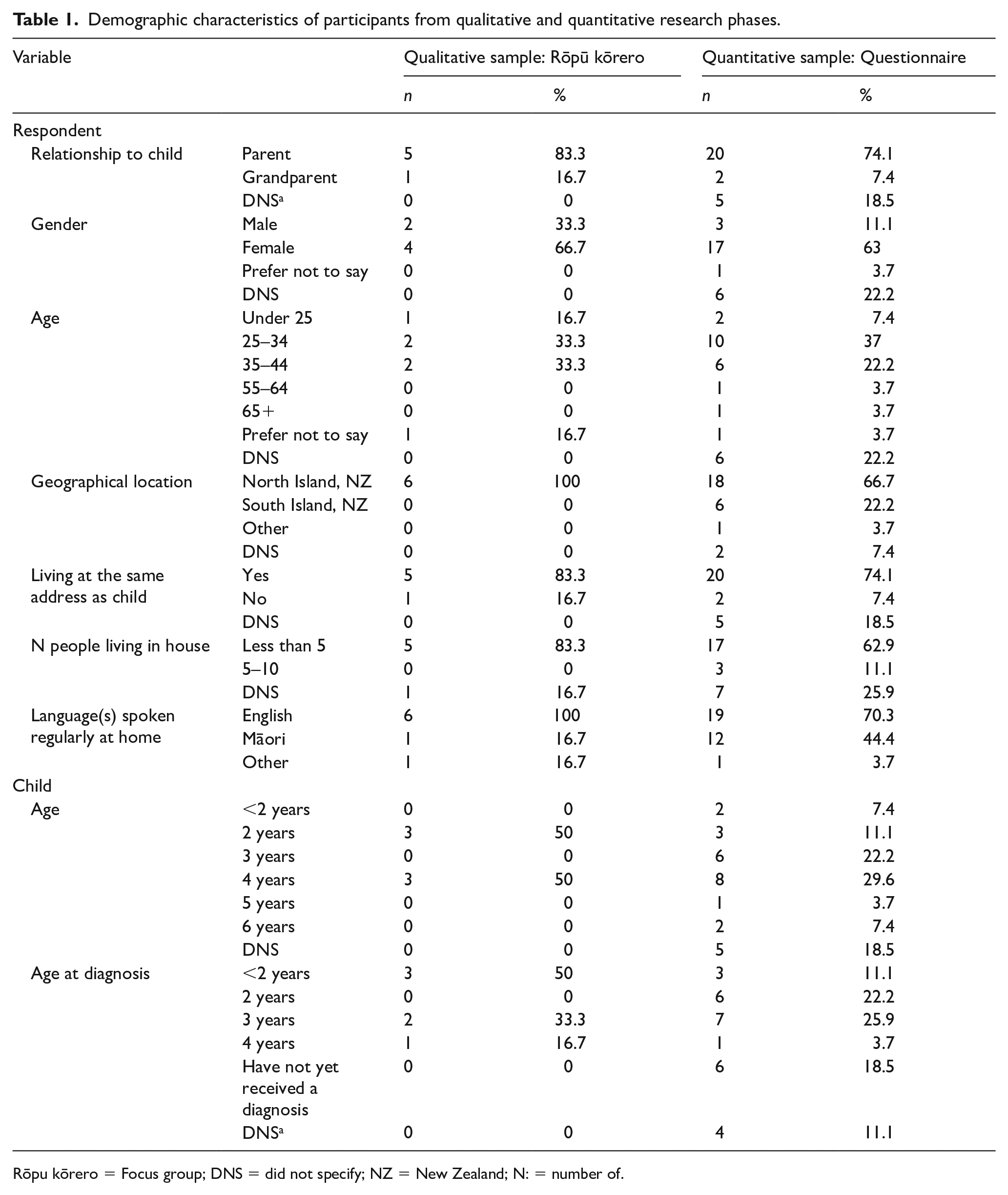
Rōpu kōrero = Focus group; DNS = did not specify; NZ = New Zealand; N: = number of.
The 2-hr rōpū kōrero took place in a quiet space at the Autism New Zealand Resource Centre, Wellington. The first author facilitated the group discussion and a research assistant observed and took notes. Proceedings began with mihi (introductions; acknowledgments; greetings) and karakia timatanga (opening prayer or chant), followed by the main group discussion, then kai (food) and karakia whakamutunga (closing prayer or chant). Participants discussed their experiences in caring for their children, including accessing supports, and their goals for their children. These topics were decided upon by the authors, based on previous research on parental experiences and the authors’ experience working with whānau supporting autistic tamariki (children). A summary of topics discussed can be found in Supplementary Material 1. One week prior to the rōpū kōrero, participants were sent an outline of the proposed topics and given the opportunity to suggest adjustments. No adjustments were suggested.
The rōpū kōrero was audio recorded and transcribed verbatim. A research assistant also took written observation notes. Prior to analysis, member checking was used to confirm that participants’ contributions during the rōpū kōrero had been accurately captured. Participants were also asked to select their own pseudonyms. Data were analysed using reflexive thematic analysis (Braun & Clarke, 2019; Clarke et al., 2019) with the aid of the NVivo software program. Semantic codes (Clarke et al., 2019) were used because the aim was to provide a descriptive account of participants’ experiences and perceptions. Next, tentative themes and subthemes were constructed by organising codes into clusters of meaning. The research questions were used as a framework for analysis, but the researcher remained open to emergent themes that did not fit within this framework. Tentative themes were then refined and defined before being compared with the entire dataset to check that they accurately reflected the data. Memoing was used throughout to record the process used to analyse data.
Questionnaire
The questionnaire was designed specifically for this study and content was informed by findings from the rōpū kōrero. Specifically, questionnaire questions were designed to reflect the themes and subthemes that whānau had indicated were important during the rōpū kōrero. These included (a) child and family activities and routines, (b) parent and whānau goals, (c) caregiving experiences, and (d) helpfulness of supports. The items for each question were also based on rōpū kōrero data. For example, for the question on child goals, items were goals that rōpū kōrero participants had described as important for their child. The questionnaire was hosted on Qualtrics and was available for 3 months. It was estimated to take approximately 15 min to complete, and all questions were optional. The questionnaire was piloted with one whānau from the target population and a senior Māori researcher with expertise in mana (dignity)-enhancing questionnaire design. A copy of the questionnaire is included in Supplementary Material 2. Characteristics of the 27 parents and whānau members who participated are summarised in Table 1.
The questionnaire opened with an introduction to the researcher, the purpose of the study, the consent process, and the estimated completion time for the questionnaire. There were also questions related to participant and child demographics. The remainder of the questionnaire covered (a) child and family activities and routines, (b) goals, (c) the experience of caring for an autistic child, and (d) helpfulness of supports. For each topic, participants were presented with one main question and asked to respond using a 5-point Likert-type scale. There was also free-text space for participants to add further information or comments.
Descriptive statistics were used to summarise responses. The Shapiro–Wilk test of normality was used to check for normal distribution. Results indicated that datasets were not normally distributed so medians were calculated instead of means.
Results
Rōpū kōrero responses
Nine themes were constructed from the rōpū kōrero data; these are outlined in Supplementary Material 3 and described below in relation to the corresponding research questions.
Research Question 1. How do whānau describe the experience of caring for their autistic child?
There were two themes related to this research question: (a) daily activities and (b) social interactions.
Daily activities: Whānau shared stories of many activities that their children enjoyed, including attending early childhood education (ECE), going to the park, playing with toys, going to the shops, swimming, and playing outside. Whānau attempted to do these things regularly with their children. One participant commented: “He’s generally a happy kid, probably because we’re doing all the things that he loves to do every day” (Elizabeth, mother). Participants’ children also enjoyed regular screen time, for example, watching television or using an iPad.
Participants also described challenges that they faced navigating many everyday routines or activities with their child. Mealtimes and sleeping were challenging for all participants. Other activities or routines such as getting ready in the morning, bathing, toileting, and shopping were challenging for most participants. Whānau also talked about the challenges involved in taking their children out to public places. Some participants also described success in supporting their child to participate in daily routines that had initially been challenging: His biggest thing at the moment is shopping for toys, so my thing is, “Well Mum can’t go to work in the morning because you’re too tired, cos you don’t want to get out of bed and go to daycare. I can’t get money.” So he knows now, he’s starting to pick up no money, no toys so that’s one of my things of teaching him at the moment. (Julz, mother)
Communication challenges could also lead to difficulties with daily routines and activities because participants sometimes struggled to understand what their children wanted. One participant shared, He might have a meltdown because he’s got what he wants in his head, but actually for it to come out, it’s like it’s a totally different word coming out. I’m like “I have no idea what you’re wanting.” (Elizabeth, mother)
Whānau also described how caring for their child sometimes impacted their ability to work outside the home. For example, one mother had recently left paid employment to be at home full-time to support her son. Another mother shared that she was often late to work because it was difficult to get her son ready in the mornings.
Social interactions: Whānau reported that interactions with others were often challenging for their children. For example, one participant shared how her son was often unaware of other children around him and would sometimes “just bulldoze past” them (Elizabeth, mother). This made it challenging for him to play alongside his sister, cousins, and peers. Whānau also described challenges with interactions between other adults and their children: It’s really hard to kind of get anyone to understand her way of speaking and her language because her language isn’t verbal. . .it’s very physical. (George, father)
Going out socially with other adults was also challenging for parents and whānau. One mother commented: “If I want to go out for dinner with some friends or what not, I have to like think ‘OK should I go or should I not?’ It’s a real struggle” (Julz, mother).
Research Question 2. What goals do whānau have for their autistic child?
There were three themes related to this research question: (a) communication goals, (b) cultural goals, and (c) social goals and values.
Communication goals: All whānau indicated that communication goals were important to them, with five participants indicating that supporting communication was the most important goal for their child. Whānau also noted a strong link between communication and behaviour. They shared that many of their child’s behaviours that harmed themselves or others came from being misunderstood by the people around them. One participant said: “when he’s frustrated, he’s like, he can’t talk and he can’t tell anyone what it is and that’s when he will hit me or slap me, you know” (Julz, mother). All whānau felt that if they could help their child to communicate in a way that could be understood by others, it would help to address many of their child’s behavioural goals. This in turn would help to make daily routines and activities smoother and more enjoyable for the children and their whānau. Although whānau wanted their children to learn to speak, their main priority was for their child to be understood by the people around them, including by using non-verbal communication. One participant commented: “Even for us just pointing would be good like. . . if he could just point or lead me towards whatever it was he wanted, that’s still the start of him trying to, you know, communicate” (Elizabeth, mother).
Cultural goals: All whānau wanted their children to learn and understand te reo Māori and tikanga Māori and to know “their culture and their heritage.” Some whānau shared how they had tried to get their children involved in kapa haka (Māori cultural performance) and kōhanga reo (Māori language preschool), and one father shared how his daughter had a special interest in waiata Māori (Māori songs). Although whānau wanted their children to learn te reo Māori, supporting them to learn English was a higher priority. One participant shared: “I want her to know her Māori side, but at the same time I think I want her to speak English first, then worry about if she wants to learn Māori and all that later down the track” (Suzie, mother). Some whānau also worried that learning two languages would be confusing for their child and might lead to them speaking “some blended language that no one could understand”.
Social goals and values: All whānau described social interaction goals as important for their children. They suggested specific goals such as making friends, playing nicely with others and being open to new surroundings. One father described his main social interaction goal for his daughter: She likes to boss other kids around, so all of her mates are like a year younger ‘cos they let her boss them around. So yeah, something a bit more interactive as opposed to telling them what to do all the time would be nice. (Nathan, father)
Participants also shared value-related goals that they held for their children such as “knowing right from wrong” and “being a kind person.”
Research Question 3. How do whānau describe their support needs and the experience of accessing support for their autistic child?
There were four themes associated with this research question: (a) frustration with government-funded supports, (b) early childhood education, (c) whānau support, and (d) understanding and attitudes.
Frustration with government-funded supports: Participants primarily relied on government-funded professional support, although one whānau had also accessed support privately. There was an overall sense of frustration from whānau regarding the professional support they had received for their child. Participants seemed especially frustrated by long wait times and a lack of consistency. Some whānau felt that they were constantly being handed from one professional to another because their child had been “put in the too hard basket.” This was an emotional topic for participants as they shared the hope that they felt when first meeting a professional who might be able to support them and their child and then the frustration they felt when that person moved on or was unable to help.
Most whānau also felt that the professionals they saw were not willing to listen to them. One participant commented, “they don’t look at the bigger picture and they don’t really listen or care what you have to say even though you’re with your child 24/7” (Suzie, mother). Whānau also felt that professionals did not see enough of their children to really understand them and their needs. For example, when describing her interactions with her son’s speech and language therapist (SLT), one participant noted that “the two times that I’ve met up with her my son hasn’t even been around” (Julz, mother). Communication goals were important for all whānau so getting support from an SLT was described as a high priority. Most participants wanted SLTs to provide some direct support to their child, rather than taking a “hands off approach” and providing them with tasks to do with their child. For example, one participant commented, I thought speech therapy was more for them to come and have one-on-one with the child. . . she’s giving me papers and she’s like, “if you do this and do this” . . . and I’m thinking like, “what are you doing? Aren’t you supposed to come and help me, show me how it’s done and then help implement it?” (Julz, mother)
Two whānau also had positive stories to share. One mother had attended several parent education programmes run by her local hospital and commented: “the stuff that they’ve explained during the seminars actually do relate to me” (Elizabeth, mother). Another participant explained that a new programme which enabled her to use respite care funding to pay her aunty to care for her son was “really good” (Julz, mother). One father also shared stories of his whānau’s positive experiences with a government-funded SLT. Although some of the strategies that the SLT suggested “didn’t really work that well,” (Nathan, father) the whānau appreciated the consistency of seeing the same professional every fortnight and the involvement of their child’s kindergarten teachers. The whānau also felt supported because the SLT listened to their needs and priorities and “was really trying to help” (Nathan, father). Overall, whānau felt that it was largely “the luck of the draw” as to whether they received adequate government-funded support. Navigating support services seemed to be part of the process for all whānau who noted how challenging this was, especially when the “systems don’t talk to each other” (Anne, grandmother).
Early childhood education: Participants’ children all attended or had recently attended some form of ECE. Children attended a range of different ECE settings including kōhanga reo, home-based ECE, kindergarten, playcentre, and Montessori preschool. Experiences with ECE varied across participants. For example, one participant described the successful experience his daughter had with her kindergarten: Her kindy’s [kindergarten’s] awesome actually. She goes full time and it’s pretty much unstructured, so they don’t have mealtimes or anything. . .it’s sort of indoor-outdoor flow, they’ve got a big grass bit out the back. She loves running and jumping, riding bikes and rough play. . .so it suits her really well. (Nathan, father)
In contrast, other whānau shared stories of how various ECE providers had not been a good fit for them. For example, one whānau had recently stopped attending playcentre because of the heavy workload that it involved. Another whānau had moved their child from kindergarten into home-based child care because kindergarten staff were not giving their daughter the attention she needed. Another mother described how she had recently moved her son out of the kōhanga reo where she worked: He had been attending kōhanga. . .since he was 7 months old, only just last year I decided to pull him out due to the fact that, like I love my culture and all that and I want him to learn where he’s from, you know, his heritage and all that, but I felt there wasn’t much support in the kōhanga . . . that they could provide for him, so I had to make the choice of pulling him out. (Julz, mother)
Whānau support: Most participants felt well-supported by their partners and shared how valuable this support was. One participant was a single parent, she discussed the challenges of caring for her son on her own and described it as a “real struggle sometimes” (Julz, mother). Participants also varied in the extent to which they felt supported by their wider whānau. Some participants described individual whānau members as “awesome supports,” while others were described as “no help at all”. One father described how his sister-in-law’s encouragement helped him to have the resolve to stick with toilet training his daughter. One mother commented, “My mum’s good you know, she studies to learn a lot about autism” (Suzie, mother).
Participants highlighted a link between their wider whānau’s understanding and acceptance of their child and autism and the extent to which their whānau offered support. That is, whānau members who had a greater understanding of their children and autism were more likely to be supportive. One mother shared that her whānau did not understand her son so could not really offer support: It’s very hard, especially when you want their [your family’s] support and everything . . . I can’t even say like “Oh, can you watch him for a couple of hours?” . . . Cos they say, “Oh but he might cry for you,” and I’m like “That’s an excuse, you’ve gotta obviously bond with him and get to know what he wants.” (Julz, mother)
Understanding and attitudes: Other people’s attitudes towards autism could be challenging for participants. For example, some participants felt misunderstood by health professionals and judged when taking their child out in public. One father noted that parents of autistic children “don’t often get told that they’re doing a good job” (George, father). Participants also felt that some of their whānau members did not understand autism. For example, one father explained that he found it hard to have his daughter around his whānau because they were “oblivious” to the meltdowns that she was having and viewed autism as “a thing you just grow out of” (George, father).
Participants also noted that some of their whānau did not understand their child and their child’s unique way of behaving. One mother commented, My father is a bit in denial. Now and then my son might do little things, he loves imaginary play so when he’s playing, he’ll just start making sounds and Dad’s like, “What are you doing? Are you being stupid? Don’t!” Like he’s not being stupid, he’s using his imagination. (Julz, mother)
Some whānau felt that within the Māori community there was a general lack of understanding and acceptance of autism. One father commented, “I think that’s something we need to fix in our culture is that autism is not something you can just push under the carpet” (Nathan, father). A mother, who identified as both Māori and Samoan, noted: “For Pacific and some Māori, like some of them can become in denial in regards to autism, because there’s not a lot of information out there” (Julz, mother).
Questionnaire responses
Questionnaire responses were collected from 27 participants over the 3-month data collection period. Participant responses to the four main questionnaire questions are summarised in Supplementary Materials 4–7 and described below.
Participation in routines or activities: Supplementary Material 4 displays the list of activities and routines and the percentage of participants (n = 22) who reported that their child participated in each routine or activity: (a) more than once per week, (b) less than once per week, and (c) never. Most participants indicated that their children participated in a range of the listed routines or activities at least once per week (median = 7 activities, range = 1–8 activities). Playing outside was the most reported frequent activity with 95.5% of participants reporting that their child plays outside more than once per week. Almost one-fifth (18.2%) of participants reported that their child never plays with other children.
Participants were also asked to list any other activities or routines that their child does regularly that were not included in the original list. Five participants suggested additional routines or activities including watching movies, doing jigsaw puzzles, playing cards, movie time, indoor playgrounds, and going for long drives. One participant also wrote, “Although he has kids around him, he doesn’t interact” (Anonymous, mother).
Parenting experience: The list of statements regarding parenting experience is displayed in Supplementary Material 5. The only statements that all participants (n = 21) agreed with were “I enjoy spending time with my child” and “my child and I have a good relationship”. The least commonly agreed upon statement was “My child follows my instructions”. Less than half (47.6%) of the participants agreed with this statement and 28.6% of participants disagreed with it. No participants disagreed with the following four statements: “I enjoy spending time with my child,” “my child and I have a good relationship,” “I understand my child,” and “I know what makes my child happy.”
Goals: Participant ratings of the importance of each child goal are presented in Supplementary Material 6. All participants (n = 21) considered “being kind” to be a very or extremely important goal for their child, while less than half (47.6%) of the participants considered “getting dressed independently” and “having a bath/shower independently” to be very or extremely important goals. “Communicating with gestures” was the goal most commonly rated as unimportant, with 9.5% of participants indicating that this goal was “not at all important” for their child. “Knowing te reo and tikanga Māori” was rated as “not at all important” by 4.8% of participants.
Additional goals were shared by two participants. These included physical independence and musical skills. One participant also wrote, “It is extremely important to me that we can communicate, and I hope he speaks verbally again, however if sign or gestures are his preferred way I will 100% support that” (Anonymous, mother).
Helpfulness of supports: The list of supports and the extent to which participants found these supports to be helpful are presented in Supplementary Material 7. Overall, participants (n = 21) indicated that they had received a range of supports (median = 5, range = 1–10). “Kaiako/teachers” was most commonly rated as highly helpful, with 76.2% of participants rating this support as extremely or very helpful. Participants were least likely to rate their general practitioner as highly helpful with only 28.6% rating this support as extremely or very helpful. Almost a quarter (23.8%) of participants rated support from friends as “not at all helpful.” All participants who received support from “kaiako/teachers,” “parent education/support programmes,” and “speech and language therapy” found these supports to be at least sometimes helpful. All of the listed supports were rated as unavailable by at least one participant. Two supports, occupational therapy and psychologist support, were unavailable to almost half (47.6%) of all participants.
Participants were also asked to list any supports that had been helpful to them but were not on the list. One participant indicated that play-based therapies had been helpful. Another participant commented that there were very long waiting lists to access supports and their whānau had not received any follow-up or support.
Discussion
We set out to explore the experiences and goals of whānau Māori caring for young autistic children. Rōpū kōrero and questionnaire data converged to highlight the positive relationships that whānau had with their children and the variation in participants’ access to helpful support. While some whānau felt well supported in their journey with their child, many felt let down by government-funded services and their friends and wider whānau. Whānau also varied in the specific goals that they prioritised for their children; however, communication-related goals and “being a kind person” were most likely to be viewed as highly important by participants.
There are several similarities between findings from the present study and those from Bevan-Brown (2004). Participants from both studies described situations where they had to choose between prioritising their child’s cultural needs or their autism support needs. This highlights a need for holistic support services that can cater for both cultural and autism-specific support needs. Lindblom’s (2017) exploration of music interventions through a First Nations lens also highlighted a need for culturally responsive autism supports for Indigenous children and their families. Indeed, most whānau from the present study wanted their children to know te reo Māori and tikanga Māori, with almost all questionnaire respondents rating this goal as important. Rōpu kōrero participants explained that, although they wanted their children to learn te reo Māori, they felt a need to prioritise learning English. Although Bevan-Brown’s research did not directly explore specific parent goals, several of her participants reported concern that learning both English and Māori might confuse their child. This concern was also shared by participants from the present study. Interestingly, research suggests that learning multiple languages is not confusing or detrimental for autistic children (Drysdale et al., 2015). Furthermore, language is an important part of one’s cultural identity (Davis et al., 2022) and the formation of a strong cultural identity appears to be a protective factor for autistic Māori (Simpson, 2021). It may be valuable for professionals to share this information with whānau so that they are able to make informed decisions.
Like Bevan-Brown (2004), we also found the extent that participants felt supported varied across participants. Questionnaire respondents had all received at least one helpful support in the previous 3 to 6 months. They were most likely to rate support from “kaiako/teachers” as highly helpful, while support from friends was most likely to be rated as not at all helpful. Rōpū kōrero participants had all received government-funded SLT support but varied in the extent to which they were satisfied with this support. Overall, participants disliked the hands-off approach to support and would have preferred more direct support for their child. This appears to align with findings from a recent questionnaire examining New Zealand parents’ preferences regarding early support services (Wallace-Watkin et al., 2020), which found that all participating parents preferred direct delivery of SLT services. Although there are several potential benefits associated with involving parents in the delivery of supports for their child, some parents may find the expectation to be actively involved stressful or may not have the necessary resources or support (Roberts & Dissanayake, 2013). Furthermore, in New Zealand, there is legal provision for “Māori self-determination. . .in the design, delivery, and monitoring of health and disability services” (Ministry of Health, 2020, “Our approach to achieving these goals” section, para. 2). It therefore seems important for service providers to consider the preferences of whānau Māori in terms of the nature of service delivery, rather than taking a one-size-fits-all approach.
The present study contributes important insight regarding the goals that Māori parents and whānau prioritise for their children. “Being a kind person” was a very important goal for all whānau. This goal could be viewed as linked to the value of manaakitanga (the process of showing hospitality, kindness, generosity, and respect to others) which is central to Māori culture (Rameka, 2011). This highlights the importance of incorporating cultural values and priorities when designing and delivering supports for autistic Māori. Most participants also rated “communicating needs and wants” as highly important. Communication-related goals are commonly prioritised by parents of autistic children (Pituch et al., 2011; Rodger et al., 2004); this makes logical sense given that differences or difficulties in communication are one of the defining characteristics of autism (American Psychiatric Association, 2013). Rōpū kōrero participants also made clear links between communication goals, family life, and the well-being of their child and family, highlighting the interconnectedness of whānau and individual well-being (Durie, 2001; Pere, 1991).
Limitations and suggestions for future research
Although these findings provide important insights into the experiences and goals of whānau Māori, several limitations should be noted. First, the study is limited to the perspectives of a relatively small sample, and other whānau may have different experiences and perspectives. The study is also focussed specifically on parent and whānau experiences with caring for and accessing supports for their autistic child. It may be valuable for future research to explore other aspects of parent and whānau experience, such as their experience of the autism diagnostic process.
There are also limitations associated with the methodology used. For example, focus group participants may be reluctant to share sensitive information in a group environment and group bias may affect participants’ discussion (Tuckett & Stewart, 2004). Nevertheless, rōpū kōrero participants shared a range of different views and experiences that at times contrasted with what other participants had shared. There are also potential limitations associated with asking parents to self-report information both in the rōpū korero and the questionnaire. Future research could include other sources of data such as observations of whānau–child and whānau–support service interactions.
A further limitation is that rōpū kōrero topics were determined by the research team, rather than autistic and Māori communities. It is possible that topics of salience to these groups may have been missed as a result. However, rōpū kōrero participants were given a chance to make alterations and suggest additional topics prior to and during the rōpū kōrero session. It may be valuable for future studies to use a Kaupapa Māori approach to include Māori community members as active research partners in all stages of the research.
Conclusion
Several important implications can be drawn from the present findings. Most questionnaire respondents rated knowing te reo Māori and tikanga Māori as important for their child. This is an important consideration for the design and delivery of supports for autistic Māori. Rōpū kōrero whānau were supportive of their tamariki learning te reo Māori and tikanga Māori but felt that they needed to prioritise other areas of their child’s development. This highlights a need for autism services that are culturally responsive and able to meet both cultural and autism-specific support needs. Developing resources in te reo Māori and educating whānau on the potential benefits of learning te reo Māori and bilingualism for autistic children may also be beneficial. Current findings also highlight the importance of professionals working in partnership with whānau and ensuring that supports align with whānau preferences and priorities. This may require services to allow more time for professionals to build real relationships with whānau and children to enable a true partnership model. It may also be necessary for support services to be more open to providing support directly to children, if this is what whānau prefer.
Supplemental Material
sj-docx-1-aln-10.1177_11771801231167652 – Supplemental material for Experiences of whānau Māori caring for a young child on the autism spectrum
Supplemental material, sj-docx-1-aln-10.1177_11771801231167652 for Experiences of whānau Māori caring for a young child on the autism spectrum by Jessica Tupou, Chevelle Rangimaria Ataera and Hannah Waddington in AlterNative: An International Journal of Indigenous Peoples
Footnotes
Acknowledgements
The authors thank the whānau who participated in this study for their valuable contributions to this research.
Authors’ note
Declaration of conflicting interests
The authors declared no potential conflicts of interest with respect to the research, authorship, and publication of this article.
Funding
The authors received no financial support for the research, authorship, and publication of this article.

Supplemental Material
Supplemental material for this article is available online.
Glossary
hauora health and well-being
kai food
kaiako teacher
kapa haka Māori cultural performance
karakia timatanga opening prayer or chant
karakia whakamutunga closing prayer or chant
kōhanga reo Māori language preschool
kupu Māori Māori word
mana dignity
manaakitanga the process of showing hospitality, kindness, generosity, and respect to others
mihi introductions; acknowledgments; greet-ings
Pākehā New Zealander of European descent
rōpū kōrero focus group
takiwātanga autism
tamariki children
te ao Māori the Māori world
te reo Māori the Māori language
tikanga Māori Māori customs and practices
waiata Māori Māori songs
whānau Māori Māori families
whānau family; families
References
Supplementary Material
Please find the following supplemental material available below.
For Open Access articles published under a Creative Commons License, all supplemental material carries the same license as the article it is associated with.
For non-Open Access articles published, all supplemental material carries a non-exclusive license, and permission requests for re-use of supplemental material or any part of supplemental material shall be sent directly to the copyright owner as specified in the copyright notice associated with the article.
