




Abstract
Technology and digital platforms have become essential for people and communities to interact because of COVID-19. Despite its benefits, digital exclusion disproportionately affects Pacific communities living in New Zealand. This article provides insights into how Niue mamatua (older adults) used their gifted mobile phones and mobile data as part of a COVID-19 digital inclusion initiative. It begins with an overview of the digital inclusion needs of older adults, followed by a description of the digital vā (relational space) and negotiating a new way of maintaining connection in an online world. The tutala (a Niue method of conversation anchored on respect) with 12 mamatua highlighted the benefits, support factors, and challenges of how they were able to use their mobile phone. Importantly, mobile phones provided the necessary access and connectivity to interact in a digitally connected world, namely the digital vā, when in-person connections were disrupted because of COVID-19.
Introduction
The COVID-19 pandemic has highlighted the importance of digital connectivity in New Zealand and around the world. Since the pandemic started and lockdown measures were implemented, technology become an important conduit for New Zealanders to connect online while protecting themselves against COVID-19. The pandemic has influenced the way people interact with learning, work, health, faith-based services, shopping, and maintaining social connections with family and friends (Choi et al., 2021; Elers et al., 2020; Enari & Faleolo, 2020).
While technology can enrich the lives of individuals, having access to useful and practical digital tools and the skills to use them can be complicated for a range of communities who are then vulnerable to becoming digitally excluded. Digital inclusion refers to “an end-state where everyone has equitable opportunities to participate in society using digital technologies” (Department of Internal Affairs, 2019, p. 7), and in the following, digital exclusion is a state where such opportunities for participation are not equitably available. New Zealand research has shown Māori and Pacific peoples, elderly, the unemployed, people with disabilities, and people living in social housing are digitally disadvantaged (Grimes & White, 2019). It is also estimated that one in five New Zealanders cannot access the Internet (Grimes & White, 2019). Even before the pandemic, a report undertaken by the Citizens Advice Bureau found that Māori and Pacific communities accessing Citizens Advice Bureau services were more likely to experience digital exclusion, especially when trying to access online Government services (Citizens Advice Bureau, 2020). Digital exclusion is an increasingly important issue in the context of a pandemic and post-pandemic world.
Digital exclusion has been linked to social isolation, loneliness, and poor mental well-being (Chopik, 2016). In two separate studies of low-income New Zealanders and their experiences of life during lockdown, many found it had a negative effect on their mental well-being, with participants describing feeling anxious and isolated from their friends, whanau, and missing day-to-day in-person social interactions (Choi et al., 2021; Elers et al., 2020). Although technology was used to stream church services online and digitally check-in, connecting people to social support and bridging the social divide, those without Internet access could not access the same benefits. These sentiments were highlighted in an international study where older adults who were experiencing social isolation used digital interactions, such as video chats, emails, texts, and social media interactions, as a source of joy and comfort amid the stressors of COVID-19 in-person restrictions (Whitehead & Torossian, 2021).
New Zealand’s ageing population provides unique opportunities and challenges for Pacific communities who make up 8.1% (381,642) of the total population. It is predicted that by 2034, the number of Pacific older people will double, reaching 46,700 from 21,300 in 2018 (Office for Seniors, 2021). Pacific older people are increasingly valued as they age and contribute to our communities and families, notably as bearers of traditional cultural knowledge and practices (Tamasese et al., 2014). Yet, Pacific older people have poorer health than older people from other ethnic groups (Lotoala et al., 2014; Ryan et al., 2011, 2019; Southwick et al., 2012; Tautolo et al., 2017). They are also likely to experience higher rates of hardship and poorer economic standards (Lotoala et al., 2014). A study by Chopik (2016) showed digital inclusion can have a positive effect on ageing. However, the marginalisation of Pacific older adults with poorer health, socioeconomic status, and digital exclusion highlights the need to focus on activities that promote meaningful connection and social inclusion.
To ensure older New Zealanders lead valued, connected, and fulfilling lives, the Better Later Life, He Orana Kaumātua 2019 to 2034 strategy highlights several key areas for action, with one “enhancing opportunities for participation and social connection” as an important driver towards digital inclusion (Office for Seniors, 2021, p. 34). Digital inclusion is considered essential where older people can safely use technology to remain socially connected and actively participate in their communities. The Ola Manuia: Pacific Health and Wellbeing Action Plan 2020–2025 also recognises the importance of digital inclusion and equity for Pacific people, highlighting the need for Pacific families and communities to use technology and digital health platforms to improve health and well-being (Ministry of Health, 2020).
Technology has potential to enrich the lives of Pacific people who have access. However, the concept of digital exclusion is a reality for many, and significant support is imperative for digital inclusion and digital equity to be achieved (Digital Government New Zealand, 2021). In particular, little is known of how technology is adopted and how this can be positively adapted into Pacific people’s lives (Lopesi, 2018). Before the pandemic, Pacific people in the diaspora have always been able to cross transnational spaces and gather in-person as a collective (Enari & Faleolo, 2020). With COVID-19 halting this social mobility, digital tools and the Internet are now an essential medium to maintaining collective cultural norms and interactions. Importantly, the Internet has now become a conduit for individuals and communities to teu le vā—a Samoan concept that relates to maintaining relationships and relational spaces that was once premised heavily on interactions in physical time and space (Anae, 2016; Lopesi, 2018; Tiatia-Seath, 2018). Within a Niue context, Vilitama (2015) describes this as vahāloto, which “refers to the relationships between individuals or objects” (p. 251). Like Samoan worldviews, maintaining meaningful relationships between people is a key aspect of positive behaviour among Niue communities. Pacific people have used this cultural knowledge to adapt to the environment and technological change demanded by COVID-19, within a new digital vā (relational space) a phrase which refers to the digital relational space and maintenance of relationships digitally (Enari & Faleolo, 2020; Enari & Matapo, 2020; Koya Vaka’uta, 2017).
As Samoan scholar Lopesi (2018) writes, “the internet is integral to the contemporary Moana experience. It has become a way to remain connected, share information among family and friends, construct public identities and have a say” (p. 93). Furthermore, “to understand Moana peoples in the twenty-first century, we have to do a better job of understanding the significance and power of the online environment and understanding ourselves moving alongside technological developments” (p. 103).
Collectivism is a key value that resonates across different Pacific ethnic-specific groups (Health Research Council of New Zealand, 2014). Lopesi (2018) acknowledges the challenge of maintaining collective connections and relationships digitally, as there is a heavy reliance on individualism, with individuals using computers and mobile phones which is premised on a single user interface model. Koya Vaka’uta (2017) adds, “the digital vā, now exists in a new space/place/time continuum that pulls towards individualism and away from collectivism” (p. 11). For Pacific communities to maintain connections with their collective, many need to overcome digital exclusion challenges and find value in using digital platforms. Considering the health and social benefits of digital inclusion for Pacific older adults, having a deeper understanding of their relationship with technology ensures new digital approaches are responsive, insightful, and enabling for Pacific communities, without compromising key cultural values or cultural identity.
While having an overview of the digital equity concerns that affect Pacific communities is key, exploring the digital needs and expectations of Pacific ethnic-specific groups embraces and acknowledges the opportunity to engage with and better understand Pacific communities who are not homogeneous. Enari and Faleolo’s (2020) study with Tongan and Samoan communities living in Brisbane, Australia affirmed the use of technology to connect with families and friends in the diaspora during COVID-19. In following, this article focuses specifically on the experiences of Niue mamatua (older adults) living in New Zealand. The aim of this article is to understand how the provision of mobile phones contributed to digital inclusion, digital skills, and well-being for Niue mamatua during COVID-19.
Methods
Study design
This qualitative study used a Niue method of conversation, tutala, to privilege the voices of Niue mamatua and to acknowledge the time, sharing, and meaningful exchange during conversations between Niue mamatua and the researcher (Vilitama, 2015). Tutala is a culturally aligned method anchored on Niue values fakalilifu (respect), fakaalofa (love), fakafetuiaga (relationships), and loto fakalataha (unity) (Vilitama, 2015). Importantly, it is considered more culturally respectful than talanoa. Despite talanoa being widely used with Pacific communities and referred to as a conversation, a talk, an exchange of ideas or thinking, whether formal or informal (Vaioleti, 2006), it is a problematic and non-inclusive method for Niue communities. To talanoa with a Niue individual or community is to engage in informal conversations or gossip (Vilitama, 2015). Tutala was therefore used to guide the research and ensure the approach was meaningful and purposeful for Niue mamatua. The study was approved by the Auckland Health Research Ethics Committee (Reference AH22860).
Mamatua and data collection
Purposive sampling was used to identify Niue mamatua who received a mobile phone as part of a COVID-19 church initiative in 2020 and 2021. Mamatua were contacted by the first author, who introduced the project followed by a request to tutala if they were interested in proceeding. Mamatua were encouraged to contact the researcher directly by text message, email, or phone call if they had any questions or if they would like to participate in the tutala. Fourteen mamatua were contacted, of which 12 consented to participate and 2 declined. Times for the tutala were then scheduled at a time convenient for mamatua who agreed to participate.
Prior to the scheduled tutala, participant information sheets and consent forms were translated into Vagahau Niue (Niue Language) and emailed or sent to mamatua via messenger or multimedia messenger service. Two mamatua had their participant information sheets and consent forms emailed to their children who they were residing with. Informed consent was obtained from all mamatua prior to the tutala starting.
Each tutala was facilitated by the first author and conducted bilingually. A question schedule was used to guide the tutala. All tutala were conducted over the phone due to COVID-19 lockdown restrictions and recorded using a digital audio recorder. All mamatua received a fakaalofa (gift) in acknowledgement of their time and contribution.
Data analysis
Audio recordings of the tutala were transcribed verbatim. All transcripts were checked against audio files for accuracy and reviewed by a cultural advisor to ensure the spelling of Vagahau Niue was correct. Transcripts were returned to mamatua to review and provide comment before data analysis was undertaken. A field journal was kept by the first author to record impressions and analytical thoughts. Completed transcripts and field notes were organised and coded using NVivo 12 software (QSR International). The first author performed the data analysis, reading each transcript to identify themes and an initial list of codes based on the questions included in the tutala guide. Each transcript was read several times to identify key themes and coded using NVivo12. Following the development of initial codes, the research team met to discuss the coded tutala, reviewing the coding process and expanding on the initial codes.
Results
Demographic characteristics
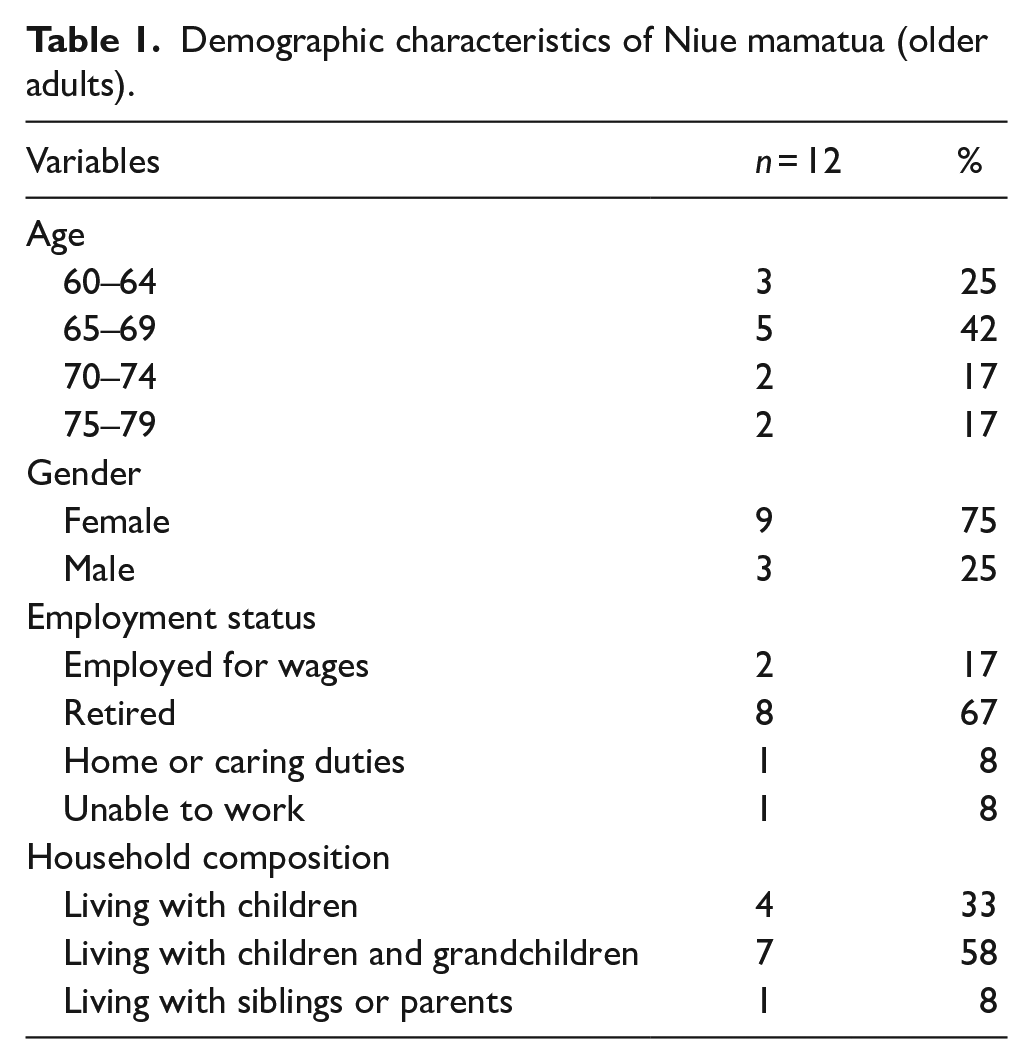
Twelve tutala with Niue mamatua lasting between 30 and 60 min were undertaken in September and October 2021. There were nine mamatua fifine (older women) and three mamatua taane (older men) who participated. All mamatua were located in South Auckland and lived in intergenerational households. The majority of mamatua were aged between 60 and 69 years (n = 8; 67%). Each mamatua was encouraged to have a family member present during the tutala, with three choosing to have their child present. A demographic overview of Niue mamatua is shown in Table 1.
Demographic characteristics of Niue mamatua (older adults).
The analysis generated three main themes: (1) Benefits, (2) Factors that support success, and (3) Challenges; each with several subthemes. To understand how mobile phones helped contribute towards digital inclusion and well-being for Niue mamatua, quotes will be used to illustrate key findings. To maintain the integrity of quotations, excerpts that used Vagahau Niue are included, followed by an English translation. This allows the integrity of the discussions to be upheld, while also providing a translation for non-Vagahau Niue speakers. All mamatua are provided with pseudonyms for anonymity.
Benefits
This key theme describes the benefits mamatua found once they were confident using their mobile phone. Six subthemes were identified: (1) quick access to people and information; (2) connection with family and friends; (3) connection to church; (4) connection to Niue and the world; (5) connection with health services; and (6) no mobile phone means no connection. Mamatua acknowledged mobile phones provided access to information quickly, as well as important connections with family and friends and online church services. Importantly, if they had no mobile phone, this made mamatua feel lost and disconnected.
Quick access to people and information
The biggest benefit mamatua shared about having a mobile phone was how fast communication was with people, including how easy it was to access online information: To lahi e mitaki e tau matutakiaga he foni ne moua, tuga pehe ka ha ka fano ke he fale koloa tagi e foni. Iloa ka ha e tau mena tutupu mo e tau tala kua moua ke lata ai mo e tau gahua he community. (Eva, mamatua fifine, 65–69 years) I thoroughly enjoyed the communications used for the phone I received. It’s like when I go to the shop the phone rings. It’s good to know the latest news and things that are currently happening in our community. (Translated by Lynn Lolokini Ikimotu Pavihi [LLIP])
The convenience of having a mobile phone also meant people were able to call for assistance in an emergency or to let family members know of their whereabouts: I can take it with me when I go out and if anything happens to me, I ring home for help. (Ana, mamatua fifine, 70–74 years) The phone is always with you or always with me in the pocket. (Sefa, mamatua taane, 60–64 years)
Connection with family and friends
Despite the restrictions COVID-19 brought to in-person gatherings with families, extended family, and friends, most mamatua expressed they were highly motivated to use their mobile phones to maintain connection and tutala with people important to them. Mamatua would frequently send messages and photos through text, make phone calls, and use Facebook, Viber, Messenger, or Zoom. Having a mobile phone made mamatua feel connected to each other wherever they were in the world: Ko e lahi e aoga mo e mitaki e tau telefoni utafano. Mena fakamau ke vilo fano ke he tau magafaoa lata ia mo e tau malolo tino ha ko e tau gagao COVID-19 nai, mo e kumi fano ke he tau tagata he community, ke lata ia mo e ha lautolu a tau nonofoaga. (Eva, mamatua fifine, 65–69 years) It’s very good and useful to have a mobile phone. It’s good to use it as a tool to ring and contact others in your family to check in on their health and wellbeing because of COVID-19. It’s also a good tool to use to look for people in the community and where they live. (Translated by LLIP) Tutala mo e tau lafu haaku, tau lafu mamao i Australia mo e tau lafu i hinai, tutala foki au mo e aunty haaku i Niue he mobile foki. (Mei, mamatua fifine, 60–64 years) I was able to communicate with my siblings, siblings that live far away in Australia and my siblings here, I also get to talk to my aunty in Niue using the mobile. (Translated by LLIP)
Some mamatua shared how using their mobile phone helped them overcome loneliness especially when family members were overseas. Using their mobile phone to connect with family made them feel happy: Sometimes if I do nothing, I feel lonely then I call my sisters just to say hello. Sometimes I think they get sick of me, ringing them [laughs], even my sister in-law, up here . . . sometimes I ring her about twice a day. (Salome, mamatua fifine, 75–79 years) I don’t miss [name] because I always text her in the morning, she texted me throughout the day just to say hi! How are you? And I’m really happy with that, fiafia lahi au [I’m really happy] . . . I didn’t miss her, it’s like she is over here. (Pele, mamatua fifine, 60–64 years) When we have zoom, I feel like talking to them all the time on the zoom. I’m happy that I can see their faces when I talk to them. (Ana, mamatua fifine, 70–74 years)
Although some mamatua were confident using technology and apps like Zoom, there were limitations with what other family members were able to do as they did not share the same digital skills: I use zoom now, to zoom to my boys, my grandboys [name] and [name] and [name] and the family, yeah, I’m used to zoom . . . but my sister, I can′t zoom my sisters because they still have those old fashion ones [laughs]. They said “sis you are lucky you got that phone.” I can call them, I only can hear their voice, but I can’t see their face. (Salome, mamatua fifine, 75–79 years)
Connection to church
Being able to connect to online devotions and church services was described as important for the well-being of mamatua. They explained having access to sermons and connecting online comforted them emotionally with one mamatua describing warmth and love when connecting with her church family online: It’s good because I spend my morning with Reverend [name] or Reverend [name] and then after that I spend it with the Niue Ekalesia [church]. It’s a good connection for all the mamatua and the young people and to keep the link going until the level is back to normal. You feel warmth, you feel connected, you feel loved, and you feel you have all your friends back together. (Sela, mamatua fifine, 75–79 years)
One mamatua explained watching the online devotions helped her mentally by focusing on the devotional message rather than thinking about COVID-19 in her community: That’s why I’m happy to have the mobile phone because that’s more important for me to listen to them [church minsters] talk and the devotion in the morning because that’s all I’m watching sometimes, 4 or 5 times a day before I go to sleep, I watch it. It’s something for me to keep my mind from thinking too much about the sickness [COVID-19]. (Ana, mamatua fifine, 70–74 years)
The convenience of having a mobile phone also meant that one mamatua was able to watch faith-based devotions in his own time when he returned from work, providing flexible and accessible spiritual connectedness: When I finish work, I come on YouTube to update whatever the devotions. (Sefa, mamatua taane, 60–64 years)
Connection to Niue and the world
Being able to connect to content related to Niue was important for several mamatua. Of note was connecting to Niue songs, as well as activities and news that informed mamatua of what was happening in Niue: I use YouTube to watch and listen to songs . . . homo e tau lologo tuga e tau lologo Samoa, pihia ni ha tautolu a tau lologo Niue, fakaaoga e au e YouTube ke fakanogonogo e tau lologo ia. (Pele, mamatua fifine, 60–64 years) I use YouTube to watch and listen to songs . . . I love the songs like Samoan songs as well as Niue songs. I use YouTube to listen to those types of songs. (Translated by LLIP) I like to watch that YouTube, it can get Niue songs, Niue news too. When you put it up, you can see Niue. (Salome, mamatua fifine, 75–79 years)
Mamatua also shared how their mobile phone enabled them to connect to information around the world and in different countries, extending their knowledge of those cultures within those countries as well as current affairs: When I got my mobile phone that’s when I found out . . . it’s like opening my eyes to what’s happening in the world. (Ana, mamatua fifine, 70–74 years) It can reach wherever you want to go to in the world. I go South Africa, I go to America, I go to the Philippines. (Sela, mamatua fifine, 75–79 years) The things that happen around the world I didn’t know exist . . . I know what’s happening in Peru, America, and the police in America . . . I learn a lot of lessons from the YouTube. (Vaka, mamatua taane, 65–69 years)
Connection with health services
Several mamatua described how they were able to connect and engage with health services by mobile phone call or text. Mamatua enjoyed the convenience of using their mobile phone, as well as the speed at which information was conveyed as it related to picking up their repeat medication or when medication changes needed to occur: They [pharmacist] send me messages, [name] your repeat medication is almost finished, and I text them back “yes” so they prepare it, like a day, and I have to pick it up from them. (Sefa, mamatua taane, 60–64 years) Hea mai mogoia e toketa he telefoni haaku poke txt mai ke he telefoni haaku, pehe e segavai haaku ka inu, poke miss out e aho e, inu he aho e . . . fiafia ai au ke fakaaoga he telefoni, ha koe tau fekau pihia, mafiti pihia ke hau e toketa ke txt mai poke vilo mai. (Mei, mamatua fifine, 60–64 years) The doctor will then ring me on the phone or text me on my phone and say this is how much medication you are to have, or you can miss out on this day and take it on that day . . . I’m happy when they use my phone, for messages like that, it’s fast for my doctor to text or call me. (Translated by LLIP)
The convenience of having electronic lab forms meant for one mamatua, once her doctor texted her, she could go straight to a lab for her blood test and show her identification: If I have to go to the lab, they send in the message on my phone to tell me they sent the blood test form to the lab, and all I do is I just go and show my ID. (Salome, mamatua fifine, 75–79 years)
No mobile phone means no connection
Maintaining connection with people and information was important for mamatua. If mamatua were unable to contact family and friends, they described feeling lost or disconnected: If I didn’t have a mobile phone I would be lost. I can’t communicate with people. (Vaka, mamatua taane, 65–69 years) I wouldn’t know what’s going on in the world. I wouldn’t know where my families are or if they are okay. There’s a lot of things that come into it. (Sela, mamatua fifine, 75–79 years)
Factors that support success
This key theme provides an overview of success factors that enabled mamatua to be able to use their mobile phone. Two subthemes were identified: (1) intergenerational support within the home and (2) digital skills. Key to their success was the support network within the home, time, patience, and learning new digital skills.
Intergenerational support within the home
All mamatua had a support network of family members within their household who were able to teach them how to use their mobile phone. While the intergenerational support mechanisms were available within the homes of mamatua, acquiring and retaining new digital skills was not easy as time and patience was needed: Fiafia lahi au ha kua maeke he tokoua e tau mokopuna haaku ke fakaako mai au e fakaaogaaga. Taha he tau mokopuna haaku ne tohi hifo e ia e tau mena he foni utafano he pepa tote ke maeke ia au ke muitua ki ai, ti fiafia au he tau aho oti, omai tumau a laua ke huhū mai ki au “nena manako lagomtai nakai a koe ke lata mae fakaaogaaga he foni utafano haau?” Ti pehē atu au “Ē, manako lagomatai au.” (Ana, mamatua fifine, 70–74 years) I was happy because my two grandchildren (name) and (name) taught me how to use it. One of them wrote everything from the mobile phone in a notebook for me to follow and I am happy too because every time and every day they always come and ask me “nena do you need help with your mobile phone” and I say “yes, I do need help.” (Translated by LLIP)
Several mamatua felt their age meant information was processed more slowly as many needed to have instructions repeated several times. Writing instructions and information in a notebook helped several mamatua remember key steps: Lagomatai e [daughter] au mo [daughter] mo [granddaughter] e tau puhala ke fakaaoga e foni [laughs] talamai e mena e, uka lahi kia au ke toka ke he ulu haaku, ha koe kitia ne koe ka ha kua motua tai e ulu, ti uka lahi au ke manatu e tau fakaholoaga ne talamai he fanau, so tuku e au, tohi e au he laupepa ke onoono ki ai oh yeah pehe e nae, oh yeah pehe e nae, haia ti pihia, ti ko e tau lagomataiaga haia, hau ni he tau fanau haaku ni. (Pele, mamatua fifine, 60–64 years) Two of my daughters and a granddaughter helped me explain ways of using the mobile phone [laughs] telling me this, and it’s challenging for me to store it in my head, because as you can see, my brain is getting old. Therefore, it’s hard for me to remember what my children have taught me, so I ended up writing it on a piece of paper so I can keep referring back to it and remember oh yeah this is this, oh yeah and this is how to do this. So those are the ways of support that I have been getting, from my children. (Translated by LLIP) Pe he au tama ko [name], fakaako fakaeneene ha kua my coconut fua niu haaku kua dry tei, kua pakupaku . . . hau a [name] falu afiafi, “kua fefe ma mum?” Hae ni ka ha ne aoga mo [name] . . . first time laia in my life he toto e mena ia ke hokahoka. (Eseta, mamatua fifine, 65–69 years) I told my child [name] teach me slowly because I have a coconut brain that’s dry. Some evenings my child [name] asks me “how’s it going mum?” Currently we are still learning with [name] it’s my very first time in my life to hold such a device and punching in numbers and letters. (Translated by LLIP)
Digital skills
As mamatua acknowledged, learning new digital skills developed gradually over time.
Texting and making phone calls were the most common digital skill mamatua were able to perform. YouTube was also the most common app mamatua used to access online content such as church sermons, cultural music videos, and content related to Niue: I can . . . turn the phone on, put it on the message, send the message to wherever I want to send the message to. If I can’t send the message, I go on the viber, send it on the viber, or use the messenger to send on messenger . . . but mostly one easy way, I just call, I just give a ring on the phone. (Sefa, mamatua taane, 60–64 years)
Interestingly, one mamatua used Google to assist his literacy, checking for spelling before sending messages to individuals: A challenge for me is spelling . . . sometimes I struggle to spell so I use google and google what’s the spelling of this word and I put it into a phrase. (Vaka, mamatua taane, 65–69 years)
As mamatua embraced and enjoyed the benefits of using their mobile phone, a few described how they used their phone with caution out of fear of doing something wrong and pressing the wrong buttons. One mamatua jokingly shared if she ever pressed the wrong buttons, she would just restart her phone: Falu mogo mena ka uka, umm tuga e kumi e au e telefoni he tagata, ti ko e falu mogo, mukamuka tai . . . fano fai ke he contacts ke press e mena ia ke hake mai e telefoni he tagata ia, kae falu mogo, ae ai iloa ko e heigoa e tau mena kua fano fota! magaaho ia haaku, tuga kua . . . tamate tai e au e foni [laughs]. (Mei, mamatua fifine, 60–64 years) There are some challenging things, umm like looking for someone else’s contact number, but now it’s a lot easier . . . I have to go to the contacts to press that button and then the contacts will pop up on the phone. Sometimes I don’t know what buttons I touched! That’s when I turn my phone off [laughs]. (Translated by LLIP)
Challenges
This key theme explores the challenges mamatua acknowledged when using and learning how to use their mobile phone. Two subthemes were identified: (1) mobile data costs and (2) visual and physical difficulties.
Mobile data costs
One of the challenges mamatua faced when using their mobile phone was the need to ensure they had credit or data. Some mamatua only used their mobile phone at home where they could access Wi-Fi although one commented that she previously had WiFi at home, but this had been disconnected. Cost was often noted as a barrier to technology use, with food and mortgage payments prioritised over data: Falu magaaho mukamuka ke top up kaeke kua moua ka ha e tau benefit . . . top up mogoia laga taha $40, poke $60, falu magaaho top up $20 . . . falu mogo ka ha ka ai fai tupe toka ni ka ha mo kai e falaoa. (Eva, mamatua fifine, 65–69 years) Some days it’s easy to top up when I get my benefit . . . I top up once $40 or $60, sometimes I top up $20 . . . other days of course I don’t have money, so I leave it to buy my bread. (Translated by LLIP) If you don’t have much money sometimes you are struggling, and you can’t pay this and can’t pay that . . . should I pay this or that . . . sometimes we struggle and can’t afford [mobile data] because it’s too expensive. (Vaka, mamatua taane, 65–69 years)
When mamatua had no credit on their mobile phone, they felt there was no use taking their phone with them so would leave it at home: Ko e kakano ne ai fa uta e au e telefoni haaku, ha ko e mena ai fai credit ne toka ai. (Ioane, mamatua taane, 65–69 years) The reason that I don’t take my phone with me where I go, is because there is no credit in it. (Translated by LLIP)
A difficulty for one mamatua who used pre-paid was having to wait for her daughter to load credit before she could use her mobile phone as she was unable to do this herself: I wait until my daughter put credit inside and then I can use it. (Ana, mamatua fifine, 70–74 years)
Even when mamatua were able to top up, this limited what they were able to do online as there was high data costs associated with certain activities such as watching YouTube: I don’t really use YouTube because it’s easy for my credit to go fast aye. (Salome, mamatua fifine, 75–79 years)
Visual and physical difficulties
Vision impairments made it difficult for some mamatua to view letters and symbols on their mobile phone when sending text messages. Using their fingers to press different app buttons also became too challenging, which left mamatua like Mele not wanting to use her phone as much as she had hoped to: Falu mogo, ka press e au, kehe tai e mena ka hake mai ai, he lahi e matalima haaku, mo e ai maama foki he mataikiiki . . . ai la fai mena ia kua mau ke pehe kua iloa e au ke taute e telefoni. Ko e iloa ni ka ha ke palaki, ai la iloa ia e tau mena ke hea ke he taha matakainaga. (Mele, mamatua fifine, 70–74 years) Sometimes when I press something on the phone, something different pops up, it’s because I have big fingers and it’s not very clear because the text is so small . . . nothing is remembered fully on how to use the phone. I just know how to plug it in and not yet confident on how to ring my relatives. (Translated by LLIP)
Discussion
The findings of this study provide an important understanding of how Niue mamatua have adopted technology. COVID-19 has positioned mamatua to learn new digital skills. Of note was the encouraging intergenerational support within homes, with children or grandchildren facilitating digital skills so mamatua could learn how to use their mobile phone.
Family members were important conduits for mamatua who had a positive attitude towards adopting their mobile phone. Key to their transition was time, family members providing instructions in small steps, using repetition, writing down notes, and conversing in Vagahau Niue. This is in line with literature suggesting children and grandchildren are an important social support network for older family members as they learn how to navigate new technology (Portz et al., 2019; Van Dijk, 2020). Although there are formal intergenerational programmes that teach older adults’ digital skills, most are based in community settings rather than with families (Weng, 2019). Findings from this study highlight the importance of the home environment and intergenerational support from family members as they navigate learning new digital skills. This also strengthens intergenerational connections which is significant for maintaining relationships and connection.
Digital activities that were most meaningful for mamatua centred around connection and being motivated to use their mobile phone to tutala with family and friends. Other important activities included connecting to online church services, connecting to cultural content about Niue and the world, as well connecting with health services. For mamatua to be able to interact with health services for repeat prescriptions via digital platforms is encouraging. Given Pacific communities consistently experience barriers accessing primary health care, improving access to digital health platforms will play a key role in improving health equity and access to healthcare, a key indicator highlighted in the Ministry of Health Ola Manuia: Pacific Health and Well Being Action Plan 2020–2025 (Ministry of Health, 2020; Ryan et al., 2019).
Despite the geographical distance and absence of in-person interactions during COVID-19, mobile phones afforded mamatua the opportunity to participate in society and maintain important social connections and relationships within the digital vā. Maintaining connections online has become an important part of socialisation for mamatua, in turn increasing their confidence and motivation to learn to use yet more new technology. Being able to connect online has made it possible for mamatua to overcome feelings of loneliness and disconnection from their loved ones. These findings support several studies noting digital inclusion can reduce social isolation and improve loneliness and mental well-being (Choi et al., 2021; Chopik, 2016; Whitehead & Torossian, 2021). More importantly, from a Niue context, the restoration and balance of a mamatua’s vahāloto within a digital vā meant meaningful relationships and connections could be upheld.
Much of what Niue mamatua shared in this study resonates with the Fonofale model of health and well-being, which incorporates key values and elements that many Pacific people believe are important for maintaining good health and well-being (Pulotu-Endemann, 2001). The use of mobile phones was shaped by the context of COVID-19, increasing the perceived usefulness of technology to maintain social connections. A new digital vā was traversed considering the environment did not allow for in-person interactions to take place, changing family, cultural, health, and spiritual practices and interactions.
Family and the intergenerational connections and support within homes became an important foundation for digital inclusion and for learning digital skills. While the physical distancing requirements kept mamatua safe from COVID-19, the spiritual and social needs were fulfilled through online church services or devotions. Importantly, mamatua were able to overcome loneliness and improve mental well-being by maintaining online connections with family and friends despite geographical and physical boundaries. Maintaining connections to health professionals and cultural content about Niue was also made possible through online interactions. This in turn restored their vahāloto within the digital vā that was severed during COVID-19. As Lopesi (2018) notes, understanding Pacific people in the twenty-first century and the significance of online environments is vital especially as Pacific people are constantly moving and changing in time.
There were several challenges mamatua noted in this study. First, visual and physical limitations prevented individuals from using their mobile phone. Despite being motivated to contact family members, visual limitations left one mamatua abandoning her phone after visualising characters became too difficult. Second, not having mobile data affected the types of online activities mamatua were able to engage with. For instance, while YouTube was an important portal to view church services and content related to Niue, it used a lot of data which limited how much time mamatua were able to spend on such platforms. Moreover, food and mortgage payments were prioritised over data plans. Even when mamatua had WiFi in their home, they were unable to use their mobile phone beyond their home. The majority of mamatua in this study were retired and enjoyed being able to connect using their phone. Considering Pacific older adults have the highest rates of hardship in New Zealand, providing affordable data or Internet options for this age group is an important equity issue worth noting (Lotoala et al., 2014; Tautolo et al., 2017).
Mobile phones were an important entry point to the digital world for mamatua. Although they were gifted to the mamatua in this study, mobile phones are now more affordable and ubiquitous compared to computers, providing increasing opportunity for those traditionally excluded to access the Internet (Correa et al., 2020). Despite the benefits, mobile phones are not a complete solution to improving digital inclusion. As highlighted in this study, visual and physical limitations, data, and Internet costs are still a major barrier to digital inclusion. Although mobile phones are limited with what they can offer, they can certainly improve the digital gap and social connectivity which are important well-being indicators for older adults (Office for Seniors, 2021).
The findings from this study are encouraging and highlight how mobile phones and the digital vā are enabling and maintaining connections for Niue mamatua in a society that is ever evolving digitally. This is an important step forward to understanding how digital platforms can complement Pacific worldviews and well-being while retaining the global connectedness of Pacific peoples in the diaspora to their families, communities, and homeland (Lopesi, 2018).
Limitations
There are several limitations to this study. Only Niue mamatua who were part of a community that received a mobile phone as part of a church initiative in 2020 and 2021 were included. The small sample size also means the generalisability of the findings is limited to Niue mamatua living in Auckland. Despite our small sample size, this study contributes important insights about how mobile phones can help mamatua to maintain connection, as well as insights into the challenges they face using technology, and the factors that supported their successful engagement with it.
Conclusion
This study provides valuable perspectives of how Niue mamatua have benefitted from using their mobile phone during COVID-19. Of note, their mobile phone use has enabled Niue mamatua who are a collective, separated due to COVID-19 become a collective again, and now operating within a digital vā. Our findings provide an important roadmap for successfully facilitating digital inclusion in ways that are beneficial for Niue mamatua. It also provides insight into strategies that might be adopted and the benefits that might be experienced by Pacific mamatua more generally. Although Niue mamatua experienced several challenges, the benefits they experienced reflect the importance of supporting mamatua to overcome these challenges to enable connection and restoration of their vahāloto within an ever-evolving digital vā.
Footnotes
Acknowledgements
The authors thank the Niue mamatua who participated in this study and Lynn Lolokini Pavihi Ikimotu for translating the Vagahau Niue quotes.
Authors’ note
Declaration of conflicting interests
The authors declared no potential conflicts of interest with respect to the research, authorship, and publication of this article.
Funding
The authors disclosed receipt of the following financial support for the research, authorship, and publication of this article: This study was funded in part by InternetNZ (research grant) and the Health Research Council of New Zealand (Pacific PhD scholarship).

Glossary
fakaalofa love; to gift with love
fakafetuiaga friendship; intimacy
fakalilifu respect
loto fakalataha unity
mamatua older adults
mamatua fifine older woman
mamatua taane older male
talanoa talk or discussion
teu le vā nurturing the relationship
tutala a Niue method of conversation anchored on respect
vā relational space
Vagahau Niue Niue Language
vahāloto the space between, midst; interval of time