




Abstract
In this article, we present the background and process of the building of a traditional South Saami derhvie-gåetie (turf hut) on Nord University’s campus in Levanger, Norway. The turf hut project is linked to the university’s teacher education programs in which traditional Saami knowledge is part of the curriculum. In what way can the gåetie be a cradle for ways of knowing, creating, and learning, based on South Saami traditional knowledge? The article is a discussion of the scope and experiences of the turf hut project as land-based experiential learning in an Indigenous knowledge context and how the cooperation with South Saami tradition bearers is paramount for its outcome. As we see it, the project is a step toward the indigenization of the university’s teacher education programs.
Introduction
One night, in December 2018, some of the international students at Nord University were the first to sleepover in the new Saami derhvie-gåetie (turf hut) on campus. The night was cold with a sprinkle of snow, but the fireplace lit with birch wood kept them warm during the night. One of the students, a girl from the Czech Republic, claimed this to be the experience of her life. Lying there by the fire looking up through the smoke hole in the top of the gåetie was pure magic, she said in her youthful manner of speaking.
She might have experienced some of the quietude and well-being that old Saami recall when thinking back on their childhood in the gåetie. Jonar Thomasson, an old Saami, from Raarvihke [Røyrvik] recalls, in an interview, the quiet moments in the home when in the evening he and his siblings lay close together on one side of the hut with the adults on the other side: I listened to the grown-ups telling about relatives and family, events and anecdotes. It was all nice and safe (as cited in Arntsen, 2014).
Although not emphasized by Thomasson in the interview cited above, there is certainly a spiritual dimension to the traditional Indigenous dwelling places which survive in many communities as myths, tales, and collective memory. The university students and indeed new generations have long been able to experience some of the texts of South Saami oral literature as they have been collected, published, and disseminated by folklorists. However, these texts have mostly been experienced as words on paper, and without context. This is all the more critical as the South Saami culture for many non-Saami students is seen as alien and irrelevant, even for those living within the borders of traditional Saami land. Although knowledge about the Saami has been part of the Norwegian national curriculum since 1974, it is still generally given low priority in schools (Midtbøen et al., 2017).
How may these narratives become tangible? How may the narrative tradition of the South Saami become relevant and immanent to students and staff of the university? This article is a discussion of an effort to re-contextualize the narratives, through the building of a South Saami derhvie-gåetie on Nord University’s campus in Levanger, and how narratives and storytelling were rediscovered as a tool of creativity, conservation of knowledge, and community building. At the same time, this met with what is recognized as a great challenge for educators: to find ways of incorporating alternative forms of education that suits Indigenous Knowledge methodologies, perspectives, and values (O’Connor, 2009; Webber et al., 2021). In this article, we discuss an effort to introduce and apply a traditional Saami building and educational practice in the teacher training program at Nord University. We will present the background and process of the gåetie building and its significance for our teacher education programs in which traditional Saami knowledge is part. In what way can the gåetie be a cradle for ways of knowing, creating, and learning, based on South Saami traditional knowledge?
Background
The main point for our project is to visualize that the gåetie is just as evident and natural in the historical landscape of central Scandinavia as the early medieval longhouse or the 19th-century smallholder’s cabin. And this is especially true in the specific landscape of Nord University. Since 1989, the Faculty of Teacher Education and Arts at Nord University has had the national responsibility for South Saami language and culture in higher education. Until 2015, this applied to Nord-Trøndelag University College which, in 2016, was merged with the University of Nordland and Nesna University College under the name Nord University. Nord University is situated at different campuses in Northern and Middle Norway. This part of Norway includes the traditional land of Lule, Pite, and Ume Saami communities in the North and South Saami communities in South. Also, in Middle Norway, there are municipalities, like Røyrvik and Namsskogan, with a solely Saami presence until the first farmers settled around 1800 (Kolberg, 2019).
The South Saami derhvie-gåetie is a concrete result of the dynamic process among man, time, and space: A flexible and practical dwelling for the reindeer herding family with roots in the hunter-gatherer community, developed in line with the needs of the reindeer nomadism with materials available in the landscape. The design of the gåetie varies around Saepmie (the land of the Saami), but still with basic common constructional principles (Sjølie, 1995, 2016). Unlike the låavtege (the traditional Saami tent), the turf-hut was used for more permanent dwellings, one for winter and others for the summer period dependent on the migratory patterns of the reindeer herd. The tent was portable for temporary use, for example, for travels between winter and summer pastures. The turf-huts could last quite long, up to 50 years, if needed. If they no longer were used, they would gradually go back to nature and after some decades visible only for the trained eye. A former gåetie site will eventually leave a vague circular mound from the decayed walls and certain vegetation, for example, concentration of fire weed, where the aernie (fire-place) used to be. Professor in Saami arts and crafts Gunvor Guttorm (2011) describes how the reindeer herding families chose suitable sites for their dwelling place where access to proper resources was indeed a precondition for survival, not least materials for the building of the gåetie. This use of resources is what Guttorm terms birget (manage, survive): “This is not only a question of traditional knowledge, but also of the management of knowledge by an [I]ndigenous people” (p. 60).
The concept of birget is included in the Science curriculum of the Saami part of the National Curriculum where it is stated that birget in nature should be shown through active participation and compared in different Saami areas (Utdanningsdirektoratet [Udir], n.d.b, para. 1). Local and Indigenous knowledge is closely connected to the land. The experienced eye, as it were, will detect available resources, and how to utilize them in a sustainable way. The South Saami historian Sverre Fjellheim emphasizes how strongly the South Saami identity is tied to the land, to the landscape. He underlines how these bonds are formed through growing up with myths, narratives, and conceptions rooted in traditions, and the myths’ origin in the landscape; the landscape as a basis for the collective memory (Fjellheim, 1995). The Saami cultural landscape therefore differs from the cultural landscape as conceived by the majority community. Fjellheim defines the Saami cultural landscape as: created in a dynamic process between man—the rational and the irrational, the time—eras, seasons, circadian rhythm, and space—the territory of landscape and the sum of natural conditions (Fjellheim, 1995).
In the light of this conception of the cultural landscape, the Saami turf hut has proved a fruitful vantage point for a land-based education approach (Webber et al., 2021; Wildcat et al., 2014), not least concerning different relationships to the land: The majority view of private ownership rooted in the agricultural society is opposite to the Indigenous Saami conception of the land as a provider of life and livelihood for the collective (Norges offentlige utredninger, 2001). Although Norwegian schools have a tradition of outdoor education, the question of ownership of the land has basically been a topic concerning the public right to roam the countryside (Norwegian Environment Agency, 2020). In this perspective, Saami reindeer herding interests have often been obscured or contested. It is stated in the National Curriculum of 2020 that “[the] Indigenous- people perspective is part of the pupils' education in democracy” (Udir, n.d.a, para. 3). It means that we need to address the settler colonialism in Saepmie as well as the later years’ pressure on Saami land, for example, through huge wind power developments (Nilssen, 2019). Looking through our lecture hall windows we see forested hills and low mountains in the distance. The majority perspective commonly implies that the hills represent “the wilds” or “wilderness,” the “uninhabited” space used for cross country skiing or treks in our leisure time (Sem, 2019, p. 161–162). For the reindeer herding families, it is a cultural landscape; the hills in question are in fact all within the Gaskelaanten sïjte reindeer herding district.
The campus is situated in what the majority population commonly conceive as the cultural landscape, for example, an agricultural landscape, as opposed to the natural landscape, or wilderness. That this wilderness is in fact a Saami cultural landscape frequently turns out as an eye-opening talking point when we gather the students around the aernie in the gåetie. Similarly, attitudes toward university architecture seem to stand in contrast or opposition to the ideas of birget and the turf hut: colossal buildings meant to stand out of and dominate the surrounding landscape in foreign materials, built by hired contractors and based on educational ideas of theoretical declamations in a clearly structured hierarchy of power.
On this background, we wanted to investigate whether the building and use of a South Saami turf hut could bring about changes in educational practices, perspectives on the landscape, architecture and building traditions and in general on the status and appreciation of the South Saami Indigenous heritage of the territory of Mid-Norway. This way, the building of the turf hut on campus is a storytelling intervention, an injection of a South Saami narrative imposed on the academic campus.
The building process
In coordination with South Saami tradition bearers, plans were made in 2016 for the construction of a South Saami gåetie centrally located on campus. The project was funded by The Saami Parliament of Norway, Nord-Trondelag County Administration, and Nord University. The gåetie was officially opened by the Member of the Saami Parliamentary Council Mikkel Eskil Mikkelsen on 7 February 2019 (Figure 1).
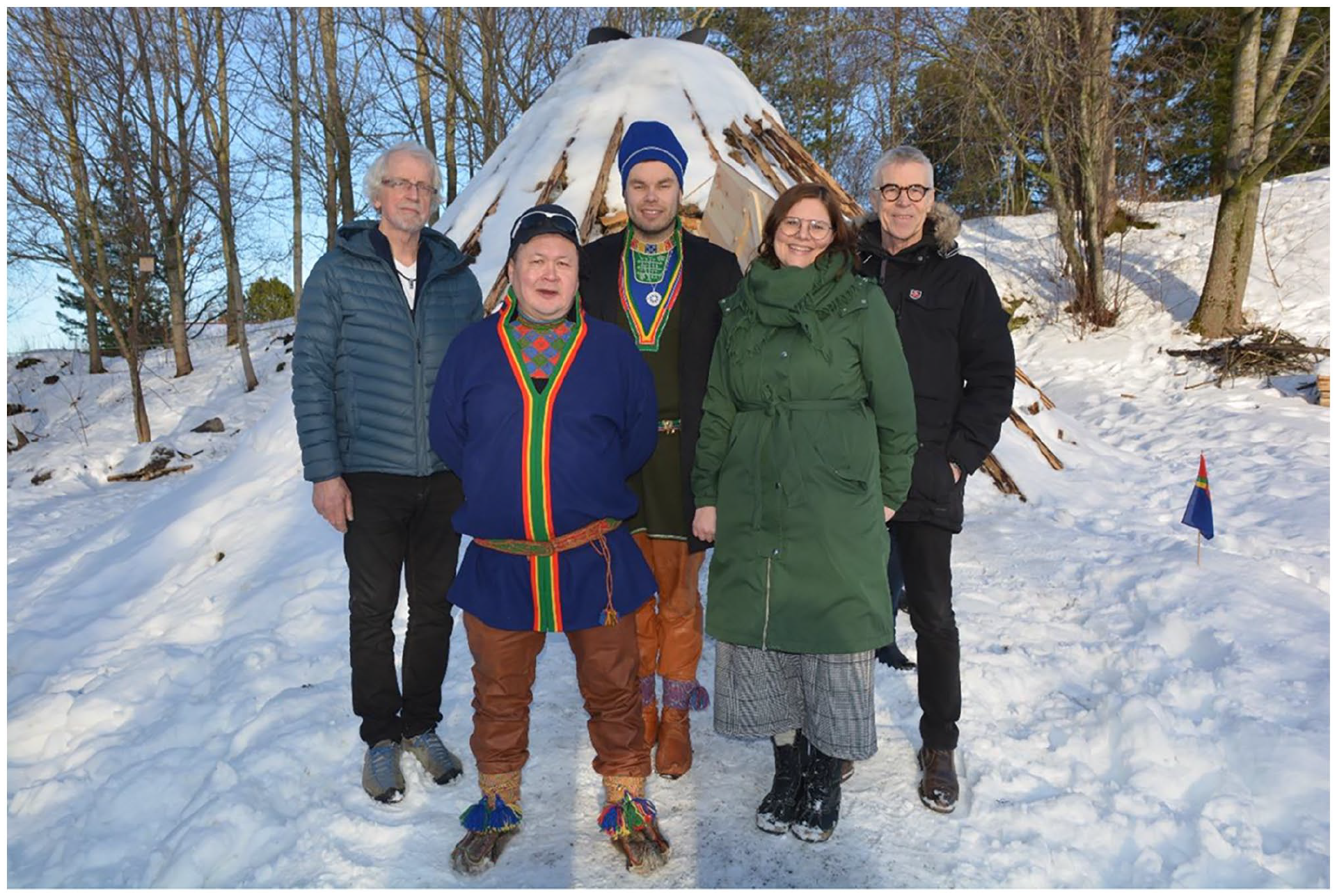
Official opening of the campus gåetie, 2019. From the left: Arts and crafts lecturer Aslak Tennes, gåetie-builder John Kristian Jåma, Saami Parliament councilor Mikkel E. Mikkelsen, South Saami coordinator Åshild Karevold and project manager Asbjørn Kolberg (Photograph: Bjørnar Leknes).
A crucial condition for the carrying-out of the project was the involvement of local South Saami gåetie builders, to contribute to true indigenization of teacher education and school curricula in Norway (Cederström et al., 2016; Olsen, 2019; Sollid & Olsen, 2019). The project was based on the understanding of the concept aerpiemaahtoe (Saami traditional knowledge and skills), as shown in the Árbediehtu Pilot Project (Porsanger & Guttorm, 2011) and on the UNESCO (2017) definition as “the understandings, skills and philosophies developed by societies with long histories of interaction with their natural surroundings” (para. 1). Project manager has been Asbjørn Kolberg, Nord University. John Kristian Jåma of the South Saami community Åarjel Fovsen sïjte, has been the tradition bearer, the aerpieguedtije, responsible for the construction of the gåetie. In addition, the Dean and staff members have assisted in the building process. Students of our International Semester Nordic and International Perspectives on Teaching and Learning (NIP) also participated, for example, in the laying of the turf on the gåetie. The NIP study includes knowledge of South Saami language and culture (Nord University, n.d.), and since 2013, we have collaborated with John Kristian Jåma in the dissemination of South Saami traditional knowledge. Since 2013, the NIP students have participated in Åarjel Fovsen sïjte’s autumnal reindeer gathering.
The gåetie type was chosen in agreement with John Kristian Jåma: a traditional circular derhvie-gåetie with a base measure of 25–30 m2. Jåma learned the craft from his father Ingvald Jåma, a prominent aerpieguedtije who passed away in 2016. Together they have built several gåetieh (Forollhogna, 2015). John Kristian was also the building manager for the 2017 reconstruction of Saami political pioneer Daniel Mortenson's winter dwelling in Hedmark county.
In 2016, The Directorate of Public Construction and Property Management had granted authorization for the construction of a gåetie on campus. In the fall of 2017, John Kristian Jåma found a suitable plot; south-facing, slightly sloping, centrally located, but still fairly sheltered. The construction process began 6 October 2017 when the plot was cleared. During the following winter, John Kristian Jåma collected suitably twisted birches for the gåetie’s framework, like otnerassh (bow rods) and other key parts of the supporting construction. Spruce logs 4–5 m long for the walls, deakehkh (wall poles), were delivered by a local forest owner, debarked by the project group, and left to dry through the summer. After the completion of the framework and walls, two layers of birch bark were added; inside out, breathable, and watertight. The spring collection of birch bark is indeed a traditional art but to save time we bought it from a local supplier.
The door and roof hatch were made by Aslak Tennes. He wanted to mark the door with the blue and red circle, a traditional Saami symbol of the sun and the moon that has been used on the drums of the nåejtie (spiritual guide and mediator) (Kaikkonen, 2020). The symbol is also associated with the South Saami poet Anders Fjellner (1795–1876) and his epic poem The Son of the Sun’s Courting in the Land of the Giants (Berg-Nordlie & Gaski, n.d.; Fjellner, n.d.). Tennes turned to the researcher and expert of duedtie (South Saami traditional arts and craft) Maja Dunfjeld to get her opinion on this. She advised to also include the other two colors of the Saami flag, yellow and green, which was duly followed up. The materials of the gåetie were traditionally collected from resources available in the local environment. The gåetie is a product of Saami culture which is closely connected to the land. This proved to be an important point of discussion and learning throughout the building process concerning choices of materials, from the gierkieh (stones), as a basis for the deakehkh (pillars to the logs for the walls). For the framework and wall poles birch was preferred, but other species of wood were also used, like pine and spruce. As John Kristian Jåma put it, the gåetie builders utilize what the land can provide, hence the way of building may differ accordingly. This was typical of the building process. Each step of the construction was explained and legitimized through a host of narratives either of former building projects, accounts of traditional use, or etiological legends (Figure 2).
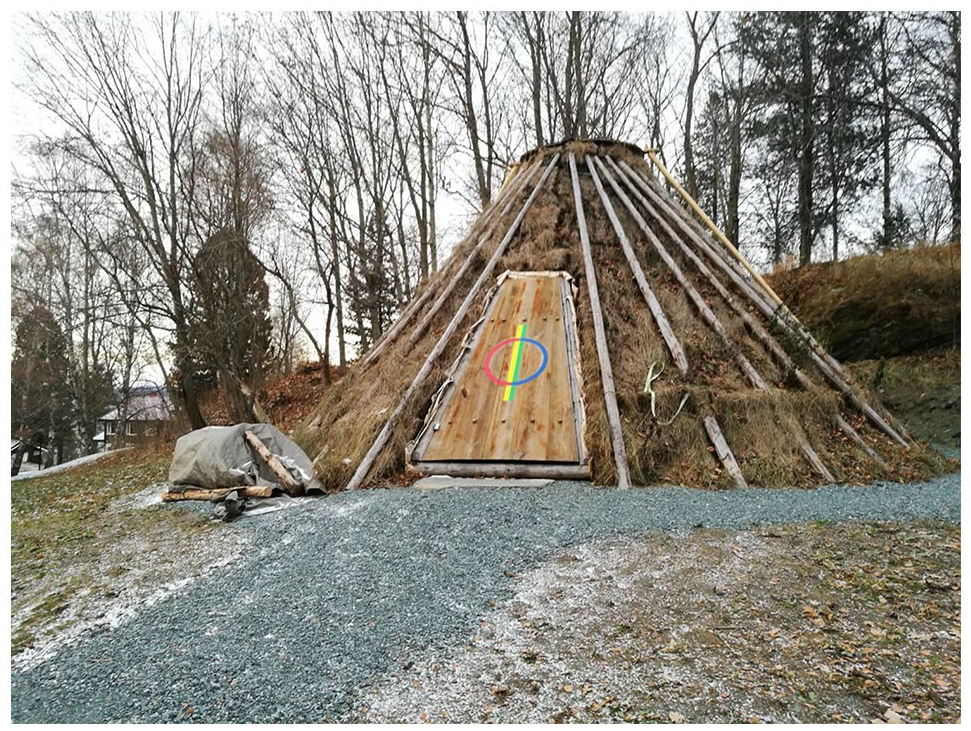
The door in place and the roof hatch (Photograph: Asbjørn Kolberg).
Gåetieh as bearer of narratives
The traditional human dwelling, like the gåetie, was a microcosmos mirroring the metaphysical conception of the world outside (Eliade, 1951/1998; Westerdal, 2006). In the center is the aernie, the fireplace, from where the smoke goes up through the smoke hole. This is the center of the microcosmos of the gåetie, reflecting the center of the greater world. Right opposite the door, at the back of the gåetie, is the sacred båassjoe where food is prepared and where the Saami drum was kept. On each side of the horizontal axis through the gåetie, from the door via the aernie to the båassjoe, is the place for the people where everybody had her or his fixed place.
According to the Indigenous Saami religion, certain spiritual beings were connected to the gåetie, namely the female goddesses Sarakka, Oksakka, and Juksakka, daughters of the ancestral mother Maderakka (Kaikkonen, 2020). They were all connected to the female sphere, in particular to the birth process. Sarakka was the goddess of creation, she brought the unborn child to the womb and assisted in the birth process. Sarakka’s place was in the aernie. Juksakka could change the gender of the unborn child. Her place in the gåetie was by the sacred båassjoe. Oksakka had her place under the door. She guarded the gåetie and protected the children (Karsten, 1955; Løøv, 2012; samer.se, n. d.; Sjølie, 2016).
The context of the gåetie obviously makes the teaching of the Indigenous Saami religion alive and present in a unique way. We can see up through the smoke hole, the opening toward heaven and the Polaris, we can gaze into the fire of the aernie, the dwelling place of Sarakka, comment on the fact that the Saami word for door is incorporated in the name of Oksakka—and reflect on how religion was connected to life in very concrete ways in the Saami community. Through the gåetieh, the mythology and its narratives thus are reified, made tangible, and may serve as a concrete vantage point for students.
Life in the gåetie—living memories
Through the physical structures and social space of the gåetie the spiritual dimension may become more than void or vague claims or naive suppositions. Not in the sense that they necessarily have to be believed or portrayed as facts, but they will be given a context, and the spiritual and sensory experience of the material dimension may support and inform one another to infuse and spawn reflection. The memories of people who spent their childhood in a turf hut are of utmost importance when we introduce the gåetie for students and schoolchildren. Such tales may open the eyes of the student to the fact that these stories are keyholes into lifeworlds—as indeed all stories are.
How was it really like living in a gåetie, do you think? When school children are asked this question, they find it hard to fathom how it was possible for a family, let alone an extended family, to live within such limited space, everybody in the same room without any of the facilities we take for granted. In fact, it is an eye opener and an important memento. The way most people live in the industrialized world, in flats or multiroom houses, is a commodity of the past 150 years only. The most common reaction among visitors to the gåetie is one of disbelief and awe under which we can easily spot the following sentiment: It must have been terrible, poor people! Indeed, this was not an uncommon attitude among the majority elite throughout the 19th and early 20th centuries judging from contemporary travelogues. Yngvar Nielsen (1843–1916), a Norwegian historian, politician, and geographer, in relating an 1863 journey to Finnmark county in 1863, described the gåetie as a disgusting hole (as cited in Nielsen, 1909). However, he was surprised at finding one gåetieh he visited to be clean and pleasant—but stated that it was an exception. Earlier, he writes, when entering a gåetie his eyes met with filth and foulness in their disagreeable state (as cited in Nielsen, 1909).
The view upon the Saami as the other, representing an inferior, premodern, and dying culture also includes the assumption of their living conditions as very poor and unhygienic (Nielsen, 1909). This seems to be a conventional opinion among the majority population by the latter part of the 19th century and later (Andresen et al., 2021). From the perspective of the majority, modernistic culture, the turf hut was commonly construed as dirty, smoky, and in-sane dwellings. The way they are portrayed in, for example, the literature supports this way of seeing them, and this literature is rarely added or contradicted by other sources. This is also reflected in a recent work of regional history, written in 2005: “The Saami were hunting, gathering, fishing, husbanding reindeer and trading and had very simple homes” (Bull & Dybdal, 2005, p. 156). Instead of describing the tools and dwellings of a nomadic culture as crude, the material equipment whose function and technology have been pressed and tested to the extreme could probably just as well be labeled as highly developed design (Sem, 2019).
It is interesting then to be able to confront such attitudes, which are still quite common, with sources to the contrary. An opportunity to experience these dwellings may correct this mythical air. By giving students a chance to see that the Saami turf huts indeed are not dwellings of chaos, but one of order and hygiene—not necessarily exactly like the ones from the dwellings of the majority population, but of another kind. South Saami reindeer herder Inga Toven (1917–2018) was born in a gåetie and did not move into a house until the late 1940s. She tells how she experienced living in a house for the first time as a simply terrible experience: houses were so dense. She felt an enormous discomfort in the morning when she woke up. She felt like having slept so heavily that I almost could not breathe. And there was so much dust. She almost felt like wanting to go back to the airy castles she was used to before (Fjellheim, 1991). Far from being the chaotic, dirty cave one tends to find in the literature, the gåetie is a very ordered universe: Jonar Thomasson tells about life in the gåetie, how every member of the household, including animals, had their own space according to their position or role in the household. The most prominent places were on either side of the båassjoe, right opposite the entrance door. On the left side of the båassjoe is the place of the housewife, on the other the father or the grandparents. Then the children on either side, other relatives, servants, if any, and so on. (Thomasson, 1998). The dogs also had their allotted place by the door. One South Saami elder told us on a visit to campus in 2019 how their old dog made sure that the younger dog kept to its place and did not wander about in the gåetie. The accounts of experiences of life in a turf hut may thus be a necessary remedy for a common prejudice.
It is paramount that our training is in accordance with the South Saami community and their bearers of tradition. It means that the gåetie should be used according to the traditional rules of conduct that have been passed on through the generations. Key persons, in that respect, are the elders with memories of living in a gåetie. The South Saami elder mentioned above, Jonar Thomasson and John Kristian Jåma are but few of the prominent bearers of tradition in our county.
Conclusion: Saami topics in education—from invisibility via inclusion to Indigenization
All students at Nord University’s Faculty of Teacher Education learn about Saami languages, history, and culture. The gåetie will naturally be included in the acquisition of South Saami cultural knowledge, not only for our students, but also for visiting school classes, kindergarten groups, in-service training for teachers, etc. The gåetie will also be used as a meeting room on special occasions.
For many, it is an eye opener that gåetieh of this type was in use in the hills not far from Levanger town as late as the 1970s. Approximately 50 km from Levanger campus, a gåetie was used as a year-round residence until 1976. A little further down the hillside, another family lived until the 1960s. This area, which is part of Gaskelaanten sïjte reindeer herding district, was probably the last gåetie-based reindeer herding unit in the whole of Saepmie (Jünge, 2017). In the same area lay several of the gåethieh of the South Saami political pioneer Daniel Mortenson. Despite this fact, very few members of the majority community of the area know that Mortenson was born in the neighborhood. Indeed, Saami presence has been obscured in our regional history throughout the 20th century. The context of the gåetie, like those that were used in the hills surrounding the campus as late as 50 years ago, and where traces still can be seen, makes history so much closer than merely telling and reading about it in the classroom.
The campus gåetie has proven an ideal starting point for the teaching of our local Saami tradition, for the Saami students as well as the non-Saami students. Congregating around the fireplace within the traditional gåetie structure makes the memories, stories, and myths tangible in a totally different way than in a modern classroom. Often the Saami students spontaneously contribute with their own stories and experiences, be it tales from older relatives or experiences connected to preparing the gåetie for a new season. One of our Saami students, for instance, told the rest how they gathered juniper branches and put them alongside the inner wall to prevent mice to enter the gåetie (Figure 3).
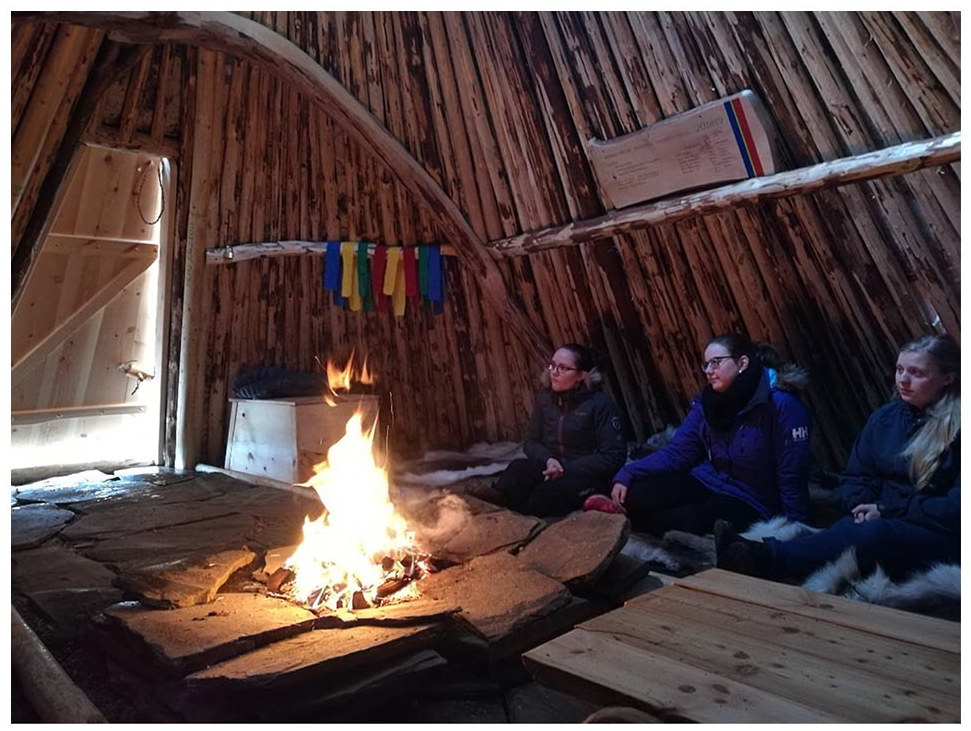
Teaching session in the new gåetie, 2019 (Photograph: Asbjørn Kolberg).
Until 1974, there was in fact no mention of the Saami, Norway’s Indigenous population, in the national curriculum. Olsen et al. (2017) show how the curricula since then have changed due to change of state policies from a strategy of increased inclusion of Saami topics in 1987, 1997, and 2006, replaced by a strategy of indigenization in the process toward the new national curriculum implemented in 2020, applicable for all primary and secondary education in Norway. In the 2020 curriculum, there is an expressed Saami perspective, at least in the Core Curriculum (Udir, n.d.a).
The gåetie project can be seen as an effort to include the Saami perspective in education in the same way that the perspective of the majority community is included but commonly taken for granted. In this way the gåetie project is in line with the new National Curriculum of Norway where it is stated that “Sami cultural heritage is part of Norway’s cultural heritage. Our shared cultural heritage has developed throughout history and must be carried forward by present and future generations” (Udir, n.d.c, para. 1). For further reading, see also, Olsen (2019) and Sem and Kolberg (in press). Saami students shall feel the same belonging as the majority non-Saami students. It is of utmost importance that our teaching is founded in the Saami culture as well as the majority culture and that this foundation is evident for all parties involved, Saami as well as non-Saami staff members, administrative staff, students, and members of the Saami community. The gåetie project involved representatives from all these categories. According to feedback from the non-Saami staff and students involved, they had little or no knowledge of the actual building process, materials, and design and the Indigenous traditional knowledge of the building process before the project was started. After the completion, they all expressed a feeling of involvement, deeper respect for, and enhanced knowledge of the local Saami history, primarily through the hands-on narratives conveyed by the builder, John Kristian Jåma.
The gåetie offers multiple layers of narratives of the South Saami heritage in Norway. A manifest document of Saami building craft, an arena for storytelling where narratives are given a tangible quality, and a container as well as a context of narratives. The gåetie project is thus indeed in line with Nord University’s mission as stated in the university’s Strategy 2030: “Nord [University] is located in Sámeednam/Saepmie and is responsible for research and education in [L]ule and Southern Sami languages and culture. [Nord] will strengthen the Sami education programmes, and increase the scope of interdisciplinary Sami research” (Nord universitet, 2021, para. 1). Time will show whether the university succeeds in following up the ambitions expressed in the strategy document. The gåetie project, as such, is but a small, although significant, step toward implementing a Saami perspective in our teacher education programs, as we have shown in this article. Not least for our Saami students this step has proven successful. For them, the gåetie is a place to gather for meetings and social events in a truly Saami setting. Through its building and use the gåetie is now added to the story of a spawning indigenization of the Norwegian academy.
Footnotes
Acknowledgements
We thank John Kristian Jåma for his great work during the building process and in sharing his traditional knowledge with the authors and all the other people involved in the building of the gåetie: Dean, staff members, and students at Nord University’s Faculty of Teacher Education and Arts, Levanger.
Declaration of conflicting interests
The author(s) declared no potential conflicts of interest with respect to the research, authorship, and publication of this article.
Funding
The author(s) disclosed receipt of the following financial support for the research, authorship, and publication of this article: The article is written as part of the research project Management and Dissemination of South Saami Traditional Knowledge (2019–2021), Raarvihken tjïelte/Røyrvik municipality and Nord University. Funded by the Regional Research Fund Trøndelag (RFF).

Glossary
aernie fireplace
aerpieguedtije tradition bearer
aerpiemaahtoe traditional knowledge; literally: inherited knowledge
båassjoe the area where food is prepared in the turf hut or tent
deakehke pole, log for walls of the turf hut, plural (nominative): deakehkh
derhvie-gåetie turf hut
duedtie South Saami traditional arts and craft
gåetie house, cabin, hut, plural (nominative): gåetieh
gierkie stone, plural (nominative): gierkieh
låavtege Saami tent
nåejtie spiritual guide and mediator.
okse door
otnerasse bow rod for the turf hut supporting construction, plural (nominative): otnerassh
sïjte reindeer herding district